
Seeing a dog growl, snap, lunge, or bite is alarming for owners and families. Aggression in dogs is a safety issue first and an animal behavior challenge second. This article explains what aggressive behavior is, common warning signs, typical causes, immediate safety steps, longer-term management strategies, and when to get professional help. The goal is practical, careful guidance that treats aggression as communication and a solvable problem, not a moral failing in a dog or owner.
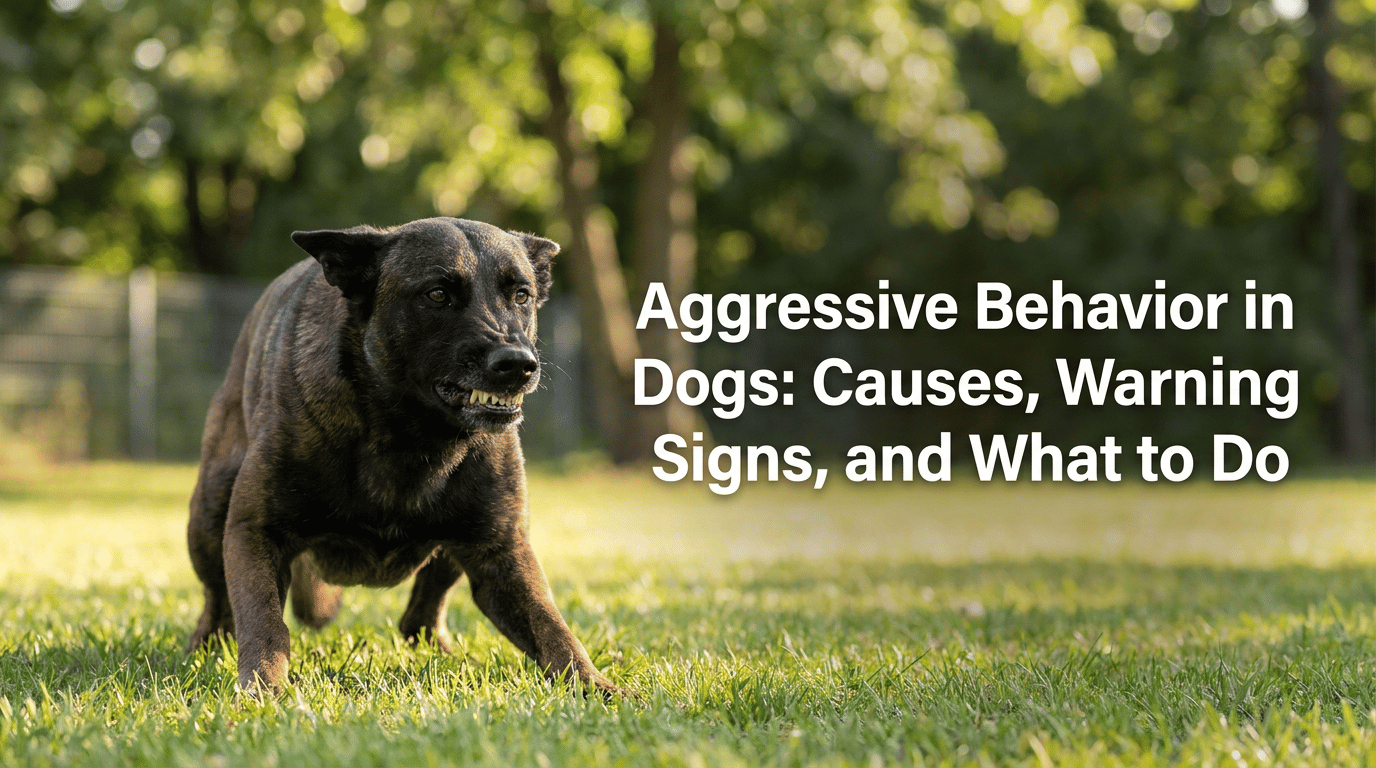
What is aggressive behavior in dogs?
Aggression is communication, not a bad personality
Dogs use body language and actions to communicate needs, intentions, and discomfort. Aggression is one way a dog signals that something in the environment feels risky, confusing, painful, or worth defending. Treating aggressive acts as meaningful communication helps owners respond safely and constructively rather than resorting to punishment or shame.
For general mammal fact sheets and approachable species information, see the Smithsonian National Zoo’s mammal resources for context on mammal behavior and care from the Smithsonian National Zoo.
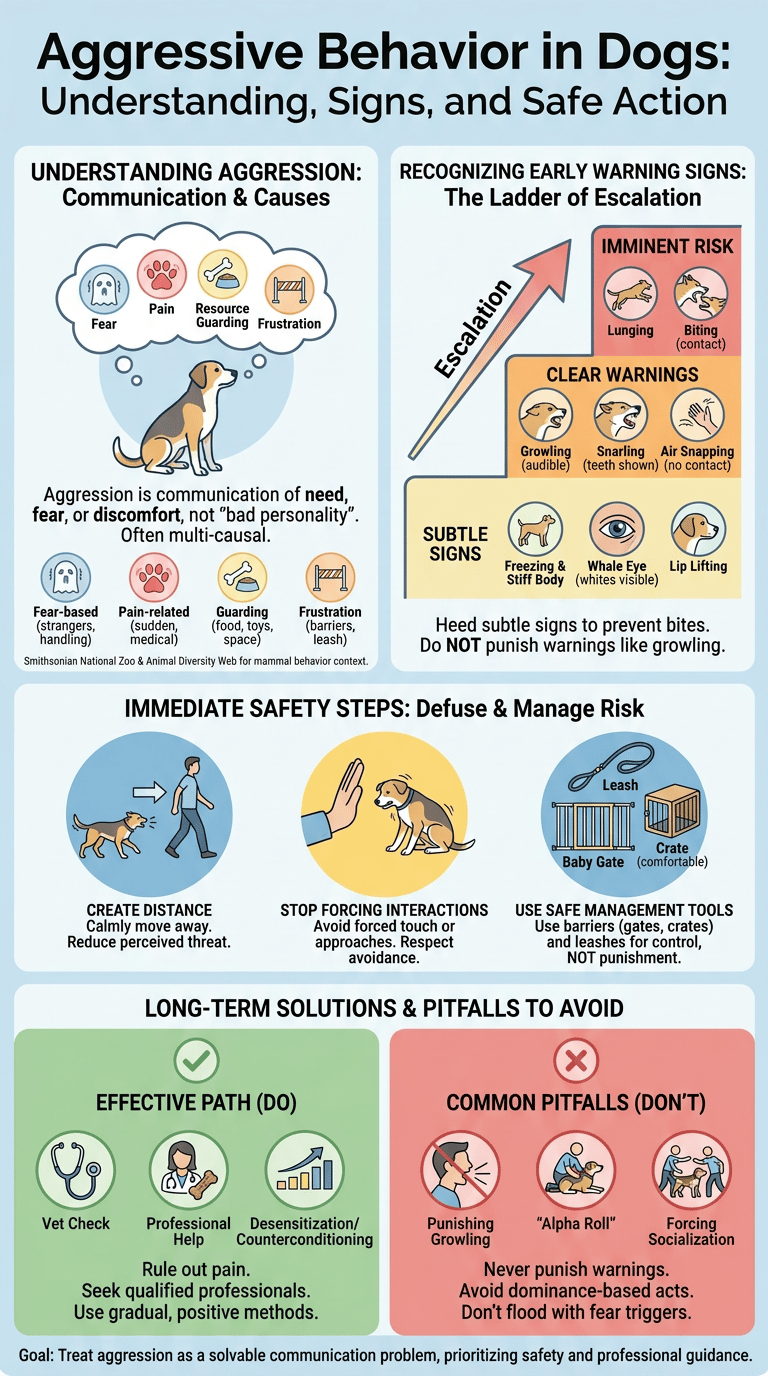
Aggression can come from fear, pain, guarding, frustration, or conflict
Rather than a single category, dog aggression often has multiple overlapping causes. A fearful dog might growl to avoid an uncomfortable interaction; a dog in pain might snap when touched in a sore area; a dog guarding food, toys, or space might bite in order to keep a valued resource. Understanding the likely cause narrows both immediate safety steps and long-term approaches.
General mammal behavior resources can help owners think about context when observing their dog, such as educational overviews available at the Animal Diversity Web on mammal behavior.
Why aggressive behavior should never be ignored
Warning signals such as growls, lip lifts, and stiff body posture are attempts to avoid escalation. Ignoring or punishing these signals can remove a dog’s way to warn before escalation and increase the chance of a more dangerous bite later. Early recognition and careful steps to manage risk are essential.
Common signs of aggressive behavior
Recognizing the range of signs that can indicate aggressive intent helps owners intervene before a bite. Not every sign always leads to a bite, but consistent or escalating signs should prompt safety measures and professional evaluation.
Growling
Growling is an audible warning that a dog is uncomfortable and often precedes more intense actions.
Snarling
Snarling, where a dog shows teeth and emits a low sound, is a stronger display of intent than a soft growl and may indicate that the dog is closer to acting.
Lunging
Lunging is a sudden forward movement toward a target and can be accompanied by barking or snapping. It may be motivated by fear, redirected energy, or an attempt to move an intruder away from a resource or territory.
Snapping
Snapping is a quick bite that may or may not make contact. It is a deliberate act to warn or to stop a person or animal from continuing an unwanted approach or handling.
Biting
Bites range in severity. Any bite to a person or another animal is a serious concern and should prompt immediate safety steps and follow-up with a qualified professional.
Freezing
A dog that freezes becomes still and may avoid eye contact. Freezing can be a prelude to a sudden defensive response if the dog perceives no way to escape.
Hard staring
Intense, unblinking eye contact or a fixed stare can be a sign of focus toward a perceived threat. Hard staring paired with other tension signs increases concern.
Blocking access to objects or people
When a dog positions itself between a person and another pet, a doorway, or a valued item, that posture can indicate guarding and willingness to challenge intrusions.
Why dogs become aggressive
Below are common categories of aggression with descriptive examples. For each, the context matters: frequency, intensity, and triggers guide how to respond.
Fear-based aggression
Fear-based aggression occurs when a dog perceives a situation as threatening and uses aggression to avoid or stop the perceived threat.
Fear of strangers
Some dogs become anxious around unfamiliar people and may growl, bark, or retreat; others may escalate to lunging or snapping if approached. Gradual, controlled exposure supervised by a behavior professional is the recommended route for change.
Fear of children
Children’s unpredictable movements and high energy can be stressful for some dogs. When a dog shows avoidance, growling, or snapping around children, management and professional behavior support are important to prevent harm to both child and dog.
Fear of handling
If routine touch, grooming, or veterinary handling triggers fear reactions, a dog may bite when approached. This type of response can stem from painful handling or inadequate positive experiences with touch.
Territorial aggression
Territorial aggression is triggered by perceived threats to a dog’s space. The dog’s intent is to protect a territory from what it regards as an intruder.
Barking at visitors
Persistent barking when someone approaches the home can be an early territorial response. Barking alone is not necessarily aggression, but if it is paired with growling, lunging, or blocking, the behavior is more concerning.
Guarding the home
Some dogs patrol and challenge entry to doorways or yards and may escalate their behavior based on arousal and perceived threat.
Fence aggression
Fence-directed aggression, sometimes called barrier frustration, happens when a dog repeatedly patrols and reacts to passersby outside a fence.
Resource guarding
Resource guarding occurs when a dog defends items it values, such as food, toys, resting places, or even people.
Food guarding
Guarding food bowls or human plates can present a clear risk if people or pets try to take food away. Management strategies can reduce opportunities for guarding while a behavior plan is put in place.
Toy guarding
Toys that a dog highly values can trigger guarding. Supervision and consistent management are important when dogs have access to high-value items.
Bed or space guarding
A dog may guard a favorite bed, couch, or corner of the home from other animals or people. Clear household rules and management tools can prevent confrontations.
Owner guarding
In some cases, dogs guard a specific person from perceived threats. This behavior can be dangerous if it escalates toward family members, visitors, or emergency personnel.
Pain-related aggression
Pain can make any dog more reactive. A dog that previously tolerated touch may suddenly bite when touched in a painful area.
Sudden aggression when touched
If a dog snaps when a particular area is handled, consider the possibility of a sore spot, injury, dental pain, or internal discomfort. Pain-related reactions often happen suddenly and can appear out of character.
Senior dogs and pain
Older dogs may develop conditions that make routine handling or movement uncomfortable. Changes in tolerance for touch or mobility should prompt a health evaluation.
Why vet checks matter
Because medical problems can underlie sudden changes in behavior, a veterinary check is a reasonable first step when aggression appears or escalates without an obvious trigger. A health exam rules out painful conditions that may be contributing to defensive reactions. For background on general mammal care and health context, owners can consult educational programs such as the San Diego Zoo Wildlife Explorers for general mammal information.
Dog-to-dog aggression
Interactions between dogs differ widely. Some dogs can live together peacefully, while others have ongoing conflicts that require careful management.
Leash reactivity
Some dogs react aggressively to other dogs while on leash. Being restrained can increase arousal and make it harder for the dog to disengage, producing barking, lunging, or snapping toward passing dogs.
Household dog conflict
Dogs that live together may develop tension over resources, social hierarchy, or compatibility. Household conflict can be subtle and escalate quickly without appropriate interventions.
Poor social experiences
Negative early experiences with other dogs, or a lack of safe, structured socialization, can leave a dog uncertain and defensive around conspecifics.
Frustration-based aggression
Frustration develops when a dog wants something but cannot get it. The subsequent aggressive behavior is often about the dog’s blocked goal rather than direct fear of a trigger.
Barrier frustration
Dogs that see a passerby through a window or fence but cannot reach them may become highly aroused and react aggressively toward the barrier.
Leash frustration
When a dog on leash cannot approach a target, built-up arousal can be redirected into lunging, snapping, or barking.
Over-arousal
High arousal from excitement or stress can reduce a dog’s ability to make calm choices, increasing the risk of aggressive outbursts in situations where the dog feels unable to cope.
Aggressive behavior by situation
Aggression often varies by context. The following situational descriptions show typical patterns and suggest immediate safety priorities.
Aggression toward strangers
Dogs that react to strangers may do so out of fear, territorial instincts, or lack of positive experiences with new people. Management focuses on preventing direct contact, providing predictable routines, and establishing safe approaches for gradual, professional-led desensitization.
Aggression toward family members
Conflict with household members is particularly concerning because exposure is frequent. Careful management, consistent household rules, and professional assessment are important to maintain safety and preserve relationships.
Aggression toward children
Interactions between dogs and children require active supervision at all times. If a dog shows guarding, fear, or irritability around children, separate the dog and child, manage interactions, and seek behavior support to prevent injuries.
Aggression toward other dogs
Some dogs tolerate other dogs in many settings but react in specific contexts, such as on leash or during high-energy play. Identifying the triggers and avoiding unstructured close contact until a behavior plan is in place reduces risk.
Aggression at the vet or groomer
Veterinary and grooming visits can be stressful and painful. When a dog shows fear or defensive behavior in these settings, arrange low-stress handling, ask veterinary staff about pain checks, and consider training and desensitization strategies that increase tolerance for routine care.
Aggression around food
Food guarding can appear as tense posture, stiffening around bowls, or snapping when approached while eating. Manage by removing access to triggers, supervising meals, and consulting a qualified behavior professional to safely reshape the reaction.
Warning signs before a bite
Recognizing subtle cues helps people give the dog the space it needs. Warning signs are often predictable if you know where to look.
Body stiffness
A sudden change to a rigid or stiff posture shows heightened arousal and attention to a perceived problem. Stiffness often precedes more active defensive behaviors.
Whale eye
“Whale eye” refers to visible whites of the eyes when a dog turns its head but keeps its eye on the trigger. This can indicate discomfort or concern.
Lip lifting
Lip lifting that exposes teeth without a full snarl can be a low-level warning. It signals that the dog feels threatened and prefers distance.
Growling
Growling is an explicit auditory warning and provides an opportunity to change the situation before escalation.
Air snapping
Air snapping, where a dog snaps close to a person or another animal without contact, is deliberate communication intended to stop an approach and should be treated as a clear indicator that the dog needs distance.
Avoidance before aggression
Many dogs attempt to avoid a situation before they show aggressive behavior. Avoidance can include turning away, retreating, or seeking a hiding place. Reaching in to force interaction with an avoiding dog increases the chance of defensive biting.
What to do if your dog shows aggression
Immediate steps focus on safety, reducing escalation, and gathering information for later planning. These are first steps, not a replacement for professional assessment and behavior modification.
Create distance first
If a dog is showing warning signs or has acted aggressively, move people and other animals away calmly and deliberately. Distance reduces the dog’s perceived need to defend and lowers arousal. Avoid sudden movements that may be interpreted as threatening.
Stop forcing interactions
Do not force a dog to accept physical contact, approach strangers, or remain near a perceived trigger. Forced interactions can remove the dog’s ability to send warning signals and increase the likelihood of escalation.
Use management tools safely
Management tools reduce opportunities for problematic encounters while a behavior plan is created. Use them carefully, complying with manufacturer instructions and local laws, and as part of a comprehensive plan rather than as a long-term substitute for behavior work.
Leash
A sturdy leash keeps the dog under control when in public. Shortening the leash for safety and increasing distance from triggers are part of immediate risk reduction. Never wrap a leash around a body part, and avoid using the leash to punish the dog.
Baby gates
Baby gates help separate dogs from family members or visitors in the home. They provide a non-confrontational barrier that reduces unsupervised contact and allows the dog to remain in a safe space.
Crate
A properly introduced crate can be a safe retreat for a dog when supervised and used positively. Crate use should never be a punishment.
Muzzle training
When used humanely and trained gradually, a well-fitting muzzle can prevent bites during critical handling or transport. Muzzle use should be part of a larger safety plan and accompanied by training so the dog accepts the muzzle without fear. Seek guidance from a qualified professional for proper selection and conditioning.
Record triggers
Careful documentation of aggressive incidents helps professionals design an effective plan. Record what happened before, during, and after the reaction, and note any patterns.
Who was present
List people and animals present during the incident, including their relationships to the dog and any notable behaviors.
What happened before the reaction
Document the series of events leading up to the aggression, including sounds, movements, or changes in the environment.
Distance from trigger
Note how close the dog was to the trigger when the reaction began. This helps calibrate management and training steps.
Body language signs
Record the dog’s posture, vocalizations, and facial expressions. Even small details can help a professional interpret the dog’s emotional state.
What not to do
Some common responses to aggression can worsen the problem or increase risk. Below are actions to avoid and why they are problematic.
Do not punish growling
Punishing a dog for growling may stop the vocal warning but not the underlying fear or discomfort. Removing the warning signal can leave people unaware that the dog is stressed and make future incidents more likely to be severe.
Do not alpha roll your dog
Techniques intended to assert dominance, such as forcibly rolling a dog onto its back, can create fear and mistrust and may provoke defensive aggression. Modern behavior science favors force-free methods that build trust and teach alternative responses.
Do not force socialization
Exposing a fearful or reactive dog to a stressful social situation without careful, gradual conditioning and professional oversight can reinforce fear and increase aggression. Controlled, stepwise exposure under expert guidance is the safer approach.
Do not ignore repeated warning signs
Repeated growling, snapping, or blocking are signals that the dog needs a different environment, training, or medical evaluation. Ignoring these signals risks a more serious incident later.
How aggressive dog behavior is treated
Treatment is individualized. A combination of medical evaluation, management, training, and behavior modification often produces the best outcomes.
Veterinary check
A medical examination helps rule out or identify pain, sensory decline, or neurological conditions that can influence behavior. Because sudden changes often have medical components, a vet check is a prudent early step.
Management plan
Management reduces opportunities for problem interactions while training and behavior modification take effect. A plan addresses daily routines, separation of triggers, safe spaces, and appropriate use of barriers and equipment.
Desensitization
Desensitization involves exposing the dog to the trigger at a very low intensity so the dog can remain relaxed. Over time, the exposure intensity is gradually increased while preventing stress responses. This process should be paced by the dog’s comfort and guided by a qualified behavior professional.
Counterconditioning
Counterconditioning pairs the presence of a previously aversive trigger with something the dog likes, such as a favored treat or game. The goal is to change the dog’s emotional response to the trigger from negative to neutral or positive. Professional instruction ensures the process is safe and effective.
Professional behavior help
Qualified behavior professionals, such as certified applied animal behaviorists or experienced veterinary behaviorists, can develop individualized plans that integrate medical findings, behavior modification techniques, and owner education. Seek professionals with appropriate credentials and a humane, evidence-based approach.
For general context on mammal behavior and care that informs understanding of canine needs, consult reputable educational resources such as the Animal Diversity Web on mammal behavior and the San Diego Zoo Wildlife Explorers mammal pages from the San Diego Zoo. For broader context on species conservation and global status of wild relatives, see the IUCN Red List.
Aggressive behavior in dogs FAQ
Can aggressive dog behavior be fixed?
Many dogs show measurable improvement with the right combination of medical care, management, and behavior modification. Improvement depends on the cause, the dog’s history, the owner’s ability to follow safe management practices, and access to appropriate professional help. A gradual, consistent approach that focuses on safety and the dog’s emotional state is most effective.
Why is my dog suddenly aggressive?
Sudden aggression often signals an acute change such as pain, sensory decline, medication effects, or a new stressful event. A veterinary exam is a sensible first step when a dog’s behavior changes abruptly.
Should I punish my dog for growling?
No. Punishing growling can remove an important warning signal and increase the risk of more severe aggression later. Instead, create distance, identify and reduce triggers, and consult a qualified behavior professional who can help address the underlying cause.
Is dog aggression always dominance?
No. Contemporary animal behavior science recognizes many motivations for aggression, including fear, pain, resource guarding, frustration, and learned responses. Labeling aggression as “dominance” oversimplifies the problem and can lead to counterproductive or harmful interventions.
When should I get professional help?
Seek professional help if aggression is frequent, escalating, causes injury, involves children or vulnerable people, or appears suddenly without an obvious explanation. Consult your veterinarian to rule out medical causes and a qualified behavior professional for safety and long-term planning. If immediate danger is present, prioritize creating distance and protecting people and animals until help arrives.
Safety reminder: For bites that break the skin, seek medical care promptly according to local health guidance. For dangerous situations involving immediate risk to people or animals, contact local authorities or emergency services as appropriate.
If your dog is showing aggression, prioritize safety, contact your veterinarian for a medical check, and seek a qualified, humane behavior professional to develop a tailored plan. Early, careful action reduces risk and improves the chance of a positive outcome for your dog and household.

Ethan Walker is the founder and research editor of Animal Fact Central. He creates and reviews educational animal facts content using trusted wildlife, pet care, and science-based sources. His work focuses on making animal behavior, adaptations, habitats, and species facts clear, accurate, and engaging for everyday readers.
Read More Details About Ethan Walker: https://animalfactcentral.com/ethan-walker/