
Dogs communicate with movement, sound, and attention-seeking actions. When those signals become frequent, intense, or risky, owners often describe them as behavior problems. This article groups common issues, explains likely causes, and offers practical first-step solutions while pointing to categories that may need professional help. The goal is a single hub you can use to recognize patterns and decide whether training, enrichment, medical evaluation, or expert behavior modification is the best next step.
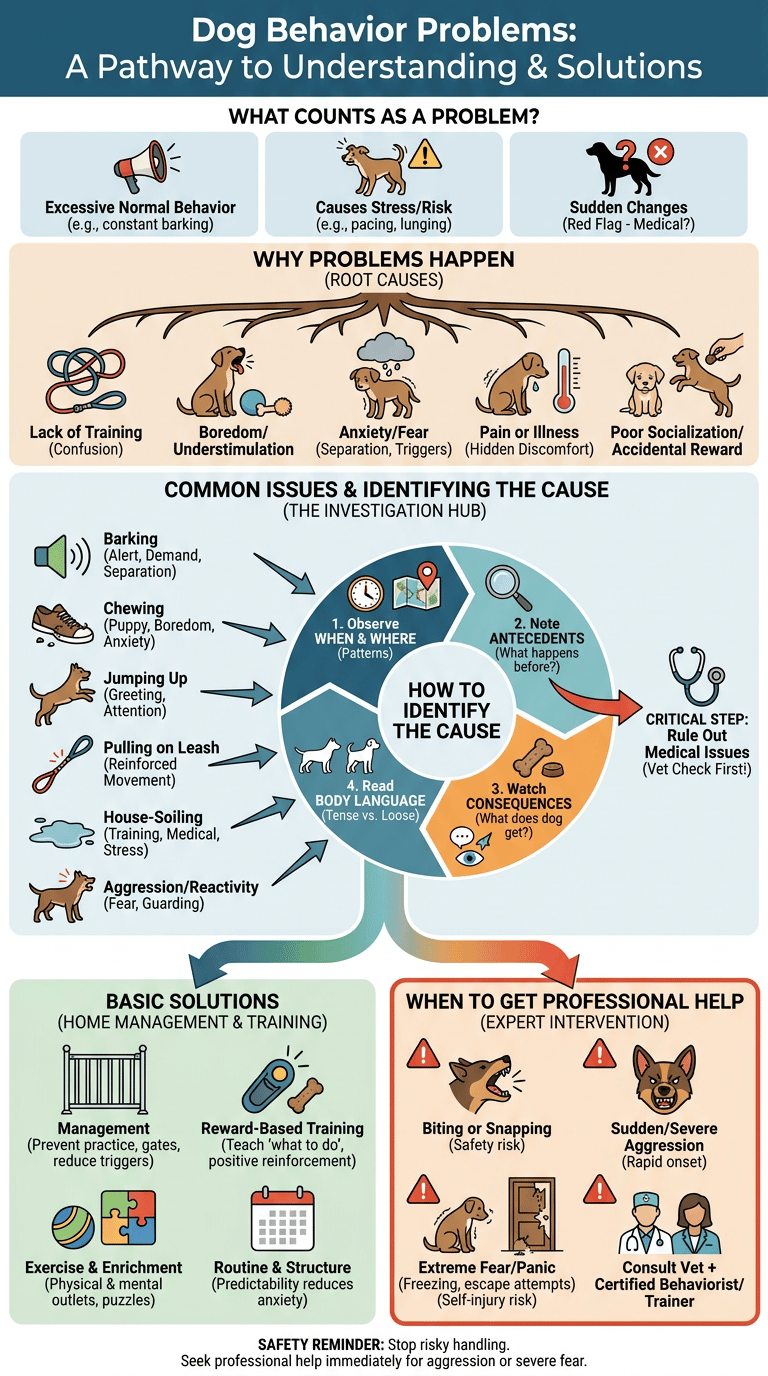
What Counts as a Dog Behavior Problem?
Normal behavior that becomes excessive
Many behaviors that are ordinary for dogs can become problems when they occur too often or at the wrong time. Examples include barking at new sounds, chewing during teething, or jumping up during greetings. The behavior itself is natural but becomes disruptive when it interferes with family life, damages property, or creates safety concerns.
Behavior that causes stress at home
Behaviors that increase household tension, such as constant pacing, repeated vocalizing, or persistent demand-seeking, often indicate that a dog is uncomfortable, understimulated, or anxious. Even if the behavior is not dangerous, ongoing stress is a welfare concern for the dog and a quality-of-life concern for people in the home.
Behavior that creates safety risks
Actions that can put the dog or people at risk are serious. Examples include aggressive lunging, uncontrolled chasing of cars or bicycles, repeated attempts to escape a fenced yard, or scavenging dangerous items. When behavior can lead to injury, prompt assessment and management are required.
Sudden behavior changes
A rapid onset of new or markedly different behaviors is a red flag. Sudden changes can have medical causes, including pain or neurological issues, and should prompt a veterinary check as part of the evaluation process.
Why Dog Behavior Problems Happen
Lack of training
Training teaches dogs what to do instead of what not to do. Without consistent, clear guidance, dogs may form habits that work for them but are unacceptable to owners. A structured approach that rewards desired responses and sets predictable rules can prevent many common problems.
Boredom
Dogs are social and cognitive animals that need physical activity and mental challenges. When those needs are unmet, some dogs create their own stimulation through chewing, digging, or vocalizing. Environmental enrichment and play help reduce problem behaviors that stem from underuse of a dog’s abilities.
Anxiety
Anxiety can produce repetitive behaviors, clinginess, hypervigilance, or destructive acts when owners are absent. Separation-related problems are one common expression of anxiety, although not all anxious dogs show the same signs. Addressing anxiety typically combines management, gradual desensitization, and often professional guidance.
Fear
Fear-driven behaviors include avoidance, freezing, or defensive aggression. Fear responses are protective for the dog but can escalate if the dog repeatedly encounters the fearful stimulus without a way to cope. Identifying triggers and using gradual, reward-based approaches helps many dogs gain confidence.
Pain or illness
Physical discomfort can change a dog’s behavior. A dog that is normally gentle may snap when touched if a joint or tooth is painful, or may stop house-training if a urinary issue is present. Because medical issues can underlie behavioral changes, ruling out illness is a fundamental first step in problem solving.
Poor socialization
Early experiences shape how dogs respond to people, animals, and environments. Dogs that did not have gradual, positive exposure to common sights and sounds during the early months may show fear, reactivity, or avoidance in adulthood. Thoughtful socialization and desensitization can reduce many of these responses over time.
Accidental reinforcement
Owners sometimes unknowingly reward problem behavior. For instance, giving attention to a dog that barks for petting teaches the dog that barking brings rewards. Recognizing what the dog gains from the behavior is key to changing it; altering what happens after the behavior is as important as teaching alternatives.
Common Dog Behavior Problems
Excessive barking
Barking is a normal canine signal, but it becomes a problem when frequent, prolonged, or directed at inappropriate times. Different reasons produce different barking patterns and require different responses.
- Alert barking – Dogs may bark to warn of new sounds, people, or animals. Management can include identifying triggers, reducing stimulus exposure when possible, and training alternative cues for quiet.
- Demand barking – This occurs when barking reliably produces attention, food, or access. Teaching a replacement behavior and only rewarding quiet moments reduces the reinforcement for barking.
- Separation-related barking – Barking that occurs while the owner is absent often co-occurs with pacing, destruction, or frantic exit-directed activity. Addressing separation-related problems usually involves careful management and graduated desensitization, and may require professional behavior support.
Destructive chewing
Chewing helps dogs explore, exercise jaws, and relieve teething discomfort in young dogs. It becomes problematic when household items are targeted or when chewing continues despite available appropriate outlets.
- Puppy chewing – Puppies mouth and chew as part of development. Supervision, safe chew toys, and redirecting to appropriate items teach acceptable chewing choices.
- Boredom chewing – When under-stimulated, dogs may chew to occupy themselves. Increasing exercise and providing puzzle feeders or long-lasting chews can reduce boredom-driven damage.
- Anxiety chewing – Some dogs chew when anxious. If chewing is paired with signs of stress, the underlying anxiety should be addressed alongside management to prevent ingestion hazards.
Jumping on people
Jumping is often an excited greeting behavior that becomes unwelcome because it causes clutter, mess, or safety concerns for children and older adults.
- Greeting behavior – Dogs jump to reach faces and solicit interaction. Teaching a sit or a calm greeting cue gives a polite alternative.
- Attention-seeking – If jumping reliably results in petting or pushing away, it is reinforced. Consistently ignoring the dog until all four paws are on the floor removes the reward.
- How owners accidentally reward it – Pushing the dog away, talking to it, or laughing can all be seen as attention. Replacing attention with consistent, planned responses helps extinguish the habit.
Pulling on leash
Walking politely on-leash is a learned skill; when a dog pulls, it often gets where it wants faster, which reinforces the behavior.
- Why pulling works – Movement toward an interesting stimulus is rewarding. If the dog reaches the stimulus by pulling, the behavior is reinforced.
- Why equipment alone does not fix it – Collars, harnesses, or head halters can reduce pressure or provide better control, but without training the dog still learns to move toward desired goals. Combining training that rewards walking on a loose leash with appropriate equipment is more effective than relying on gear alone.
Digging
Digging serves several natural purposes for dogs. When it becomes frequent or destructive, understanding the motive helps choose a solution.
- Cooling off – Dogs may dig to reach cooler soil. Providing shaded rest areas and cool surfaces reduces the need to dig for temperature regulation.
- Escape – Attempting to get out of a yard often includes digging near gates or fences. Secure containment, reducing boredom, and addressing triggers outside the fence help prevent escape digging.
- Boredom – Idle dogs may dig to entertain themselves. More exercise and interactive toys can redirect energy.
- Breed tendencies – Some breeds have a higher instinct to dig due to historical jobs. Providing acceptable digging outlets can channel the drive constructively.
House-soiling
Urinating or defecating indoors may indicate training gaps, medical issues, or stress. Careful assessment distinguishes the cause.
- Training gaps – Puppies and newly adopted dogs need consistent routines and positive reinforcement for elimination outside.
- Medical causes – Urinary or gastrointestinal conditions can cause accidents. A veterinary exam is part of responsible problem solving when accidents begin or increase.
- Stress-related accidents – Changes in household routine, new pets, or environmental stressors can lead to regressive accidents in otherwise house-trained dogs.
Separation-related behavior
Some dogs show a pattern of distress when left alone. Signs vary in severity and often combine vocalization, movement, and destruction.
- Pacing – Repetitive walking along a path in the home can be an indicator of distress during absence.
- Barking – Persistent calling when alone is a common symptom of separation-related problems.
- Destruction near exits – Chewing or scratching at doors and windows is often an attempt to reunite with an absent person.
- Panic signs – Extreme escape attempts, profuse salivation, or severe trembling suggest a higher level of distress and typically need professional intervention.
Resource guarding
Guarding arises when a dog tries to keep access to items it values. Understanding the trigger and patterns makes management safer.
- Food – A dog that stiffens or growls when someone approaches while eating is showing a resource-guarding behavior that requires careful, gradual behavior modification.
- Toys – Guarding prized objects can occur during play or rest and may take the form of pushing others away or showing teeth.
- Sleeping spaces – Dogs sometimes guard favored beds or enclosed spaces; structure, supervised access, and training can reduce conflicts.
Aggression and reactivity
Aggressive behavior includes a range from warning signals to biting. Reactivity, which may appear as lunging or barking, is often an exaggerated response to a stimulus. Both require careful assessment.
- Human-directed aggression – Aggression toward people has many causes, including fear, pain, or resource guarding, and should be evaluated by qualified professionals.
- Dog-directed aggression – Conflicts between dogs often relate to social tension, resource issues, or poor introductions.
- Leash reactivity – Dogs that act differently on-leash are often frustrated or feel threatened by the restraint; counterconditioning and management are common strategies.
Excessive licking
Frequent licking can be a grooming habit, a displacement activity related to stress, or a sign of itch or pain. Persistent localized licking of a limb or skin area often suggests a medical issue such as allergy, infection, or pain and benefits from veterinary evaluation.
Mounting or humping
Mounting occurs for sexual reasons, social play, or arousal. In many cases it is an attention-seeking or overstimulation behavior. Teaching an interrupt cue and rewarding alternative behaviors helps reduce unwanted mounting.
Chasing cars, bikes, or animals
Chasing is driven by predatory or herding instincts and can be dangerous. Management focuses on secure containment, preventing exposure where risks exist, and training alternative impulse-control skills before walking in high-risk areas.
How to Identify the Cause
Look at when it happens
Timing provides clues. If a behavior mostly occurs at certain times of day or in specific locations, those patterns narrow down likely triggers. For instance, noises from outside may provoke evening barking while new people arriving may trigger excitement behaviors at doorways.
Look at what happens before it
Antecedents matter. Observe the immediate events leading up to the behavior. A dog that chews after being left alone may be responding to solitude; one that lunges when another dog approaches likely reacts to social cues.
Look at what the dog gets after it
Consequences shape behavior. If a behavior ends an unpleasant stimulus or gains attention or access to desired items, it will be reinforced. Changing consequences is often as important as teaching alternatives.
Look for body language signs
Supportive signals such as loose movement and soft eyes indicate comfort. Tense posture, pinned ears, whale eye, or lip lift can signal discomfort or escalation. Learning to read canine body language helps owners intervene earlier and more safely.
For general information about mammal behavior and communication, see the Animal Diversity Web overview on mammal behavior for context on how many mammals, including dogs as domesticated members of the mammal group, use body signals and vocalizations. Animal Diversity Web mammal behavior overview
Rule out medical issues
Because pain and illness commonly change behavior, a veterinary exam is part of responsible troubleshooting for many problems. Examples include new aggression, house-soiling, sudden lethargy, or changes in appetite. If behavior changes coincide with physical symptoms, seek veterinary evaluation promptly.
Basic Solutions for Dog Behavior Problems
Management
Management means changing the dog’s environment so the unwanted behavior cannot occur or its consequences are different. Examples include:
- Using baby gates, crates, or secure fencing to prevent unsupervised access to areas where problems occur.
- Rotating and supervising high-value items so a dog does not develop guarding habits around them.
- Reducing triggers when possible, such as closing blinds to block visual stimuli that provoke barking.
Management is not a permanent cure in itself but provides safety and a stable setting for training to work.
Reward-based training
Positive reinforcement training focuses on teaching what to do and rewarding the dog for desirable choices. This approach builds skills and strengthens the bond between dog and owner without using fear or physical correction. Teaching incompatible behaviors, such as sitting calmly at the door instead of jumping, gives dogs a clear alternative and a way to earn rewards.
Exercise and enrichment
Regular physical exercise and mental stimulation reduce many behavior problems by meeting a dog’s basic needs. Examples of enrichment strategies include:
Readers comparing dog behavior problems may also find dog to dog behavior useful for a closer look at a related part of canine behavior.
Readers comparing https://animalfactcentral.com/dog-behavior-problems-causes-solutions/ may also find licking useful for a closer look at a related part of canine behavior.
Readers comparing dog behavior problems may also find female dog behavior after spaying useful for a closer look at a related part of canine behavior.
Readers comparing dog behavior problems may also find dog in heat behavior useful for a closer look at a related part of canine behavior.
- Puzzle feeders and treat-dispensing toys that encourage problem solving.
- Scent games and nose-work activities that use a dog’s natural strengths.
- Interactive play, training sessions, and walks that provide structured activity and social contact.
Changing the quality and timing of enrichment is often a high-impact, low-risk step for owners to try first.
Routine and structure
Consistent daily schedules for feeding, walking, play, and rest help dogs predict what will happen and reduce anxiety-driven behaviors. Clear, consistent household rules and expectations prevent confusion and make training more effective.
Behavior modification for serious cases
When problems are entrenched, severe, or involve safety risks, behavior modification programs developed by qualified professionals are often necessary. These plans use systematic training methods, sometimes combined with management and, when appropriate and under veterinary guidance, medical or pharmaceutical support. For complex problems such as severe separation-related distress or aggression, a coordinated team approach with a veterinarian and a certified behavior professional is the safest route.
When to Get Professional Help
Biting or snapping
Any behavior that causes injury or a credible threat of injury warrants professional evaluation. A qualified behaviorist or certified trainer with experience in aggression, together with veterinary assessment, should be involved to manage immediate risk and develop a long-term plan.
Sudden aggression
Rapidly appearing aggressive behavior can signal medical problems or abrupt environmental changes. Because the cause may be health-related, seek veterinary assessment and, as recommended, behavior consultation.
Severe fear
Dogs that panic, freeze, or experience extreme distress in common situations need careful, gradual interventions. Professionals trained in fear reduction techniques can create humane plans that promote coping and confidence.
Destructive separation behavior
When leaving the home results in repeated destruction that compromises safety, specialist help is appropriate. Professionals can guide owners through structured desensitization and provide management strategies to protect the dog and property.
Behavior that is getting worse
If a problem escalates despite owner intervention, professional input helps reassess the cause and change the approach. Early consultation prevents deterioration of safety and welfare.
Dog Behavior Problems FAQ
What is the most common dog behavior problem?
Owners commonly report issues such as unwanted vocalizing, pulling on-leash, and chewing. Which problem is most common varies by household and dog life stage. Observing when and why a behavior happens is a better guide to solving it than assuming a single cause.
Can dog behavior problems be fixed?
Many behavior problems can be improved significantly with consistent management, reward-based training, and changes in the dog’s environment. For severe or long-standing issues, professional behavior modification combined with veterinary oversight provides the best chance for meaningful change.
Why is my dog suddenly behaving badly?
“Sudden” changes often have underlying causes such as pain, illness, new stressors, or changes in routine. Because health can cause abrupt behavioral shifts, a veterinary assessment is a prudent early step before assuming the issue is purely training-related.
Are behavior problems caused by bad training?
Poor or inconsistent training contributes to many problems, but training is only one piece. Genetics, early experiences, health, environment, and daily routine all interact to shape behavior. A comprehensive approach that addresses multiple elements is usually most effective.
When should I contact a dog behaviorist?
Consider professional help when a problem threatens safety, causes severe or persistent stress, or does not respond to consistent, reward-based efforts by the owner. Dogs showing aggression, intense separation distress, or rapidly worsening behavior benefit from expert assessment and a tailored plan.
For accessible, general background on mammal behavior and species information that provides broader context for canine communication and needs, see the Smithsonian National Zoo mammal pages and the San Diego Zoo Wildlife Explorers mammal facts.
Smithsonian National Zoo mammal pages | San Diego Zoo Wildlife Explorers mammal facts
Safety reminder: If a behavior involves biting, severe fear, sudden changes, or potential harm, stop attempting risky handling and consult a veterinarian, a qualified trainer, or local animal professionals for immediate guidance.
Addressing dog behavior problems is often a multi-step process: observe and record patterns, rule out medical causes, manage the environment to reduce risk, teach alternative behaviors with reward-based methods, and seek professional help when problems are severe or persistent. Thoughtful, humane interventions support both dog welfare and harmonious life with people.

Ethan Walker is the founder and research editor of Animal Fact Central. He creates and reviews educational animal facts content using trusted wildlife, pet care, and science-based sources. His work focuses on making animal behavior, adaptations, habitats, and species facts clear, accurate, and engaging for everyday readers.
Read More Details About Ethan Walker: https://animalfactcentral.com/ethan-walker/