
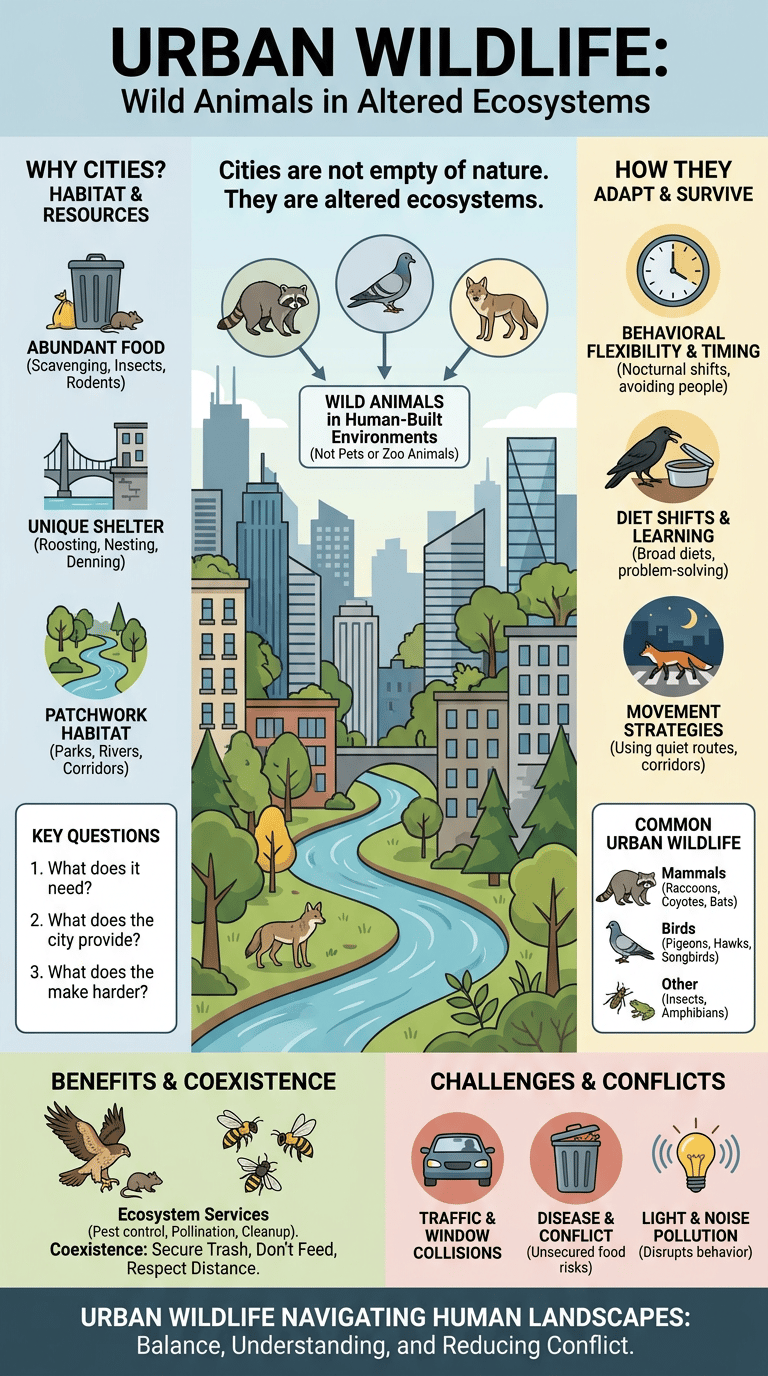
Urban wildlife is made up of wild animals that live in, move through, or regularly use cities and suburbs. Some of these animals are easy to notice, such as pigeons on sidewalks, squirrels in parks, raccoons near trash bins, or hawks perched on tall buildings. Others stay mostly hidden, including bats, foxes, coyotes, opossums, frogs, insects, and small mammals that use the edges of human spaces.

The main idea is simple: cities are not empty of nature. They are altered ecosystems. Pavement, buildings, lights, noise, traffic, lawns, gardens, rivers, storm drains, bridges, and parks all create new conditions that some animals can use and others cannot. The National Park Service describes Gateway Arch National Park as a place to study urban ecology, noting that animals such as opossums, raccoons, and coyotes can be found in many city settings.
Quick Overview: What Urban Wildlife Means
Urban wildlife means wild animals that use human-built environments as part of their daily life. The term can include animals that live entirely within cities, animals that nest or den in city structures, and animals that move through urban areas while using parks, rivers, rail corridors, cemeteries, campuses, stormwater ponds, or backyard habitat.
Urban wildlife is not the same as pets, livestock, or zoo animals. A city raccoon is still a wild raccoon. A peregrine falcon nesting on a skyscraper is still a wild bird of prey. A coyote walking through a neighborhood at dawn is not a stray dog, even if it has learned to avoid people and use quiet streets as travel routes.
One useful way to think about urban wildlife is to ask three questions. What does the animal need? What does the city accidentally provide? What does the city make harder? Species that answer the first two questions well, and tolerate the third, are more likely to appear in urban areas.
Why Cities Have Become Wildlife Habitats
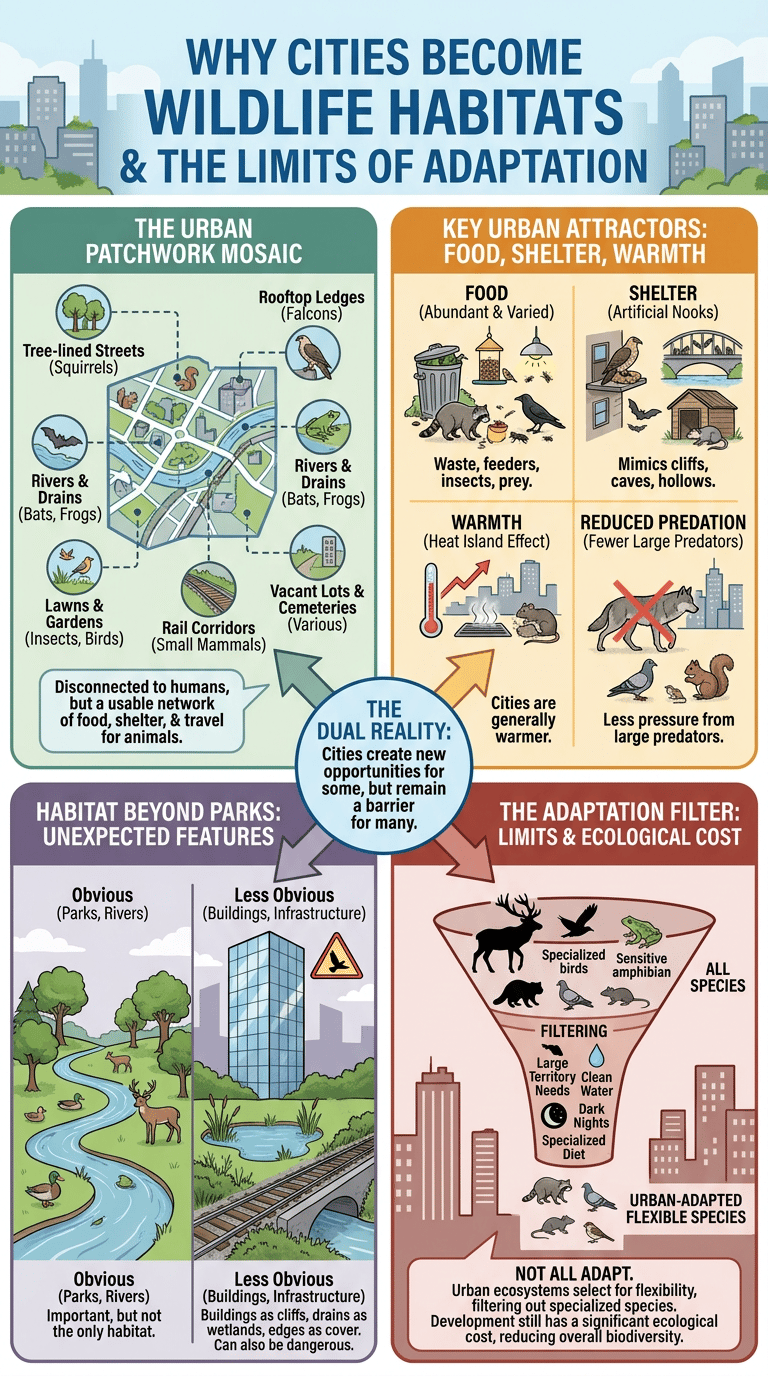
Cities replace natural habitat, but they also create a patchwork of new habitat types. A single city can contain tree-lined streets, rooftop ledges, rivers, storm drains, lawns, vacant lots, community gardens, rail corridors, wetlands, highway edges, school campuses, and old buildings. To a person, these may look disconnected. To an animal, they may form a usable network of food, shelter, cover, and travel routes.
Food, shelter, warmth, and reduced predator pressure
Food is one of the biggest reasons animals use cities. Urban food can include seeds, fruit, nuts, insects, small mammals, human food waste, pet food, birdseed, compost, roadkill, and prey animals that also live around people. Raccoons and crows are famous for taking advantage of varied food opportunities, but they are not the only ones. Squirrels use tree seeds and backyard feeders. Bats hunt insects around lights and waterways. Hawks and owls may hunt rodents and pigeons.
Shelter also matters. Buildings can mimic cliffs, caves, tree hollows, rock piles, or sheltered crevices. Peregrine falcons may use tall buildings as nesting ledges. Bats may roost in bridges or buildings. Opossums and raccoons may use crawl spaces, sheds, brush piles, or hollow trees in parks. Small birds may nest in shrubs, vents, signs, or building edges if the site offers enough protection.
Parks, rivers, buildings, roads, and waste as habitat features
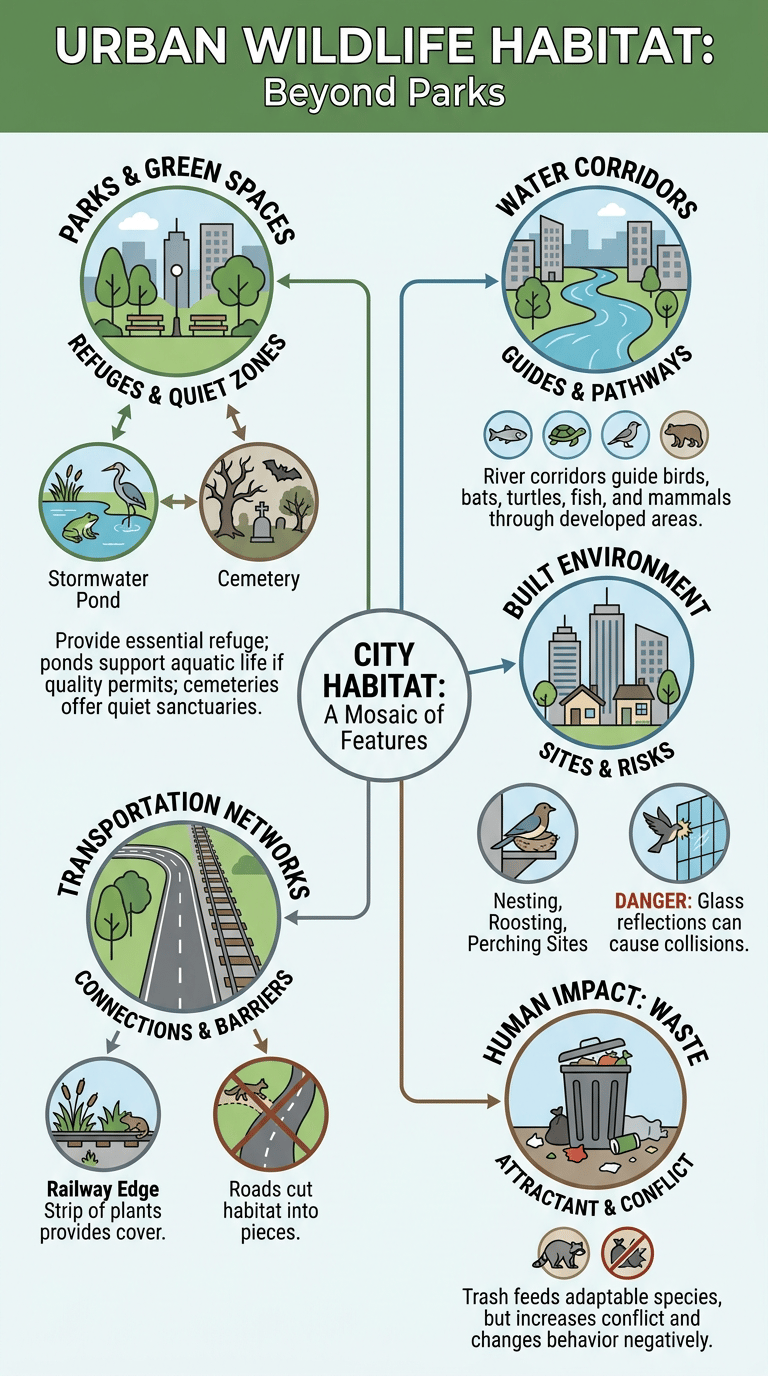
Urban wildlife does not use only parks. Parks are important, but city habitat also includes less obvious features. A river corridor can guide birds, bats, turtles, fish, and mammals through a developed area. A stormwater pond can support frogs, insects, and wading birds if water quality and vegetation are suitable. A cemetery with old trees may function as a quiet refuge. A railway edge may grow into a strip of plants that small animals use for cover.
Buildings can serve as nesting, roosting, or perching sites. They can also be dangerous, especially when glass reflects sky or vegetation. Roads can connect human neighborhoods while cutting animal habitat into pieces. Trash can feed adaptable species, but it can also increase conflict and change animal behavior in ways that are bad for both wildlife and people.
Why not every animal can adapt to cities
It is tempting to imagine that wildlife simply learns to live with people, but many species do not adapt well to urbanization. Animals that need large territories, clean water, quiet breeding sites, dark nights, specialized food, or connected habitat may decline when development spreads. Some animals may appear in cities only briefly because they are passing through, displaced, or trapped by fragmented habitat.
The Smithsonian has described urban ecosystems as less complex than many natural ecosystems because only a portion of species have enough flexibility to succeed in heavily artificial environments. That point matters because urban wildlife is not proof that development has no ecological cost. It shows that some species can use human-altered spaces, while many others are filtered out by the same conditions.
Main Framework: How Animals Adapt to Urban Life
Urban adaptation is not one single skill. Animals may adjust behavior, diet, movement, timing, nesting choices, communication, or activity patterns. Some changes happen within an individual animal’s lifetime through learning. Some may reflect differences between populations over generations. In many cases, researchers are careful not to call every urban difference evolution, because behavior, habitat selection, and learning can also explain what people observe.
Behavioral flexibility and learning
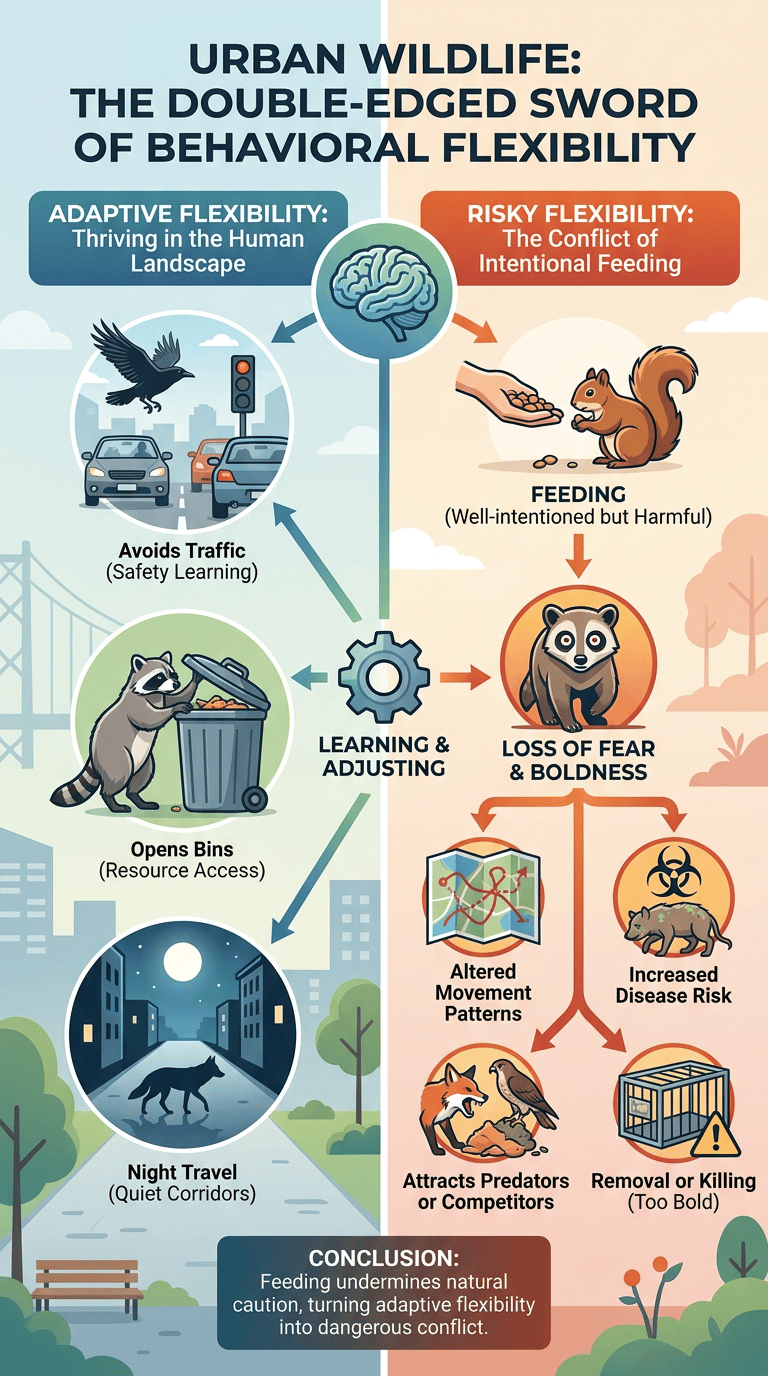
Behavioral flexibility is the ability to adjust actions when conditions change. In cities, this can include learning when people are less active, which routes are safer, where food appears, which structures provide shelter, and which human behaviors are risky. A crow that avoids traffic, a raccoon that opens a loose bin lid, or a coyote that travels at night through quiet corridors is showing behavior that fits a human-altered landscape.
At the same time, flexibility can create conflict. An animal that learns people are a food source may lose fear in ways that put it in danger. That is why feeding urban wildlife is usually harmful, even when it feels kind. It can change movement patterns, increase disease risk, attract predators or competitors, and create situations where animals are removed or killed because they became too bold around people.
Diet shifts and scavenging opportunities
Diet is one of the clearest differences between urban winners and urban losers. Animals with broad diets can use natural foods and human-associated foods. Raccoons, opossums, rats, gulls, crows, pigeons, foxes, and coyotes may all use city food sources in different ways. Some hunt. Some scavenge. Some browse plants. Some do all three depending on the season and location.
This does not mean human food is healthy for wildlife. Bread, junk food, pet food, and garbage can be poor nutrition, and they can bring animals into contact with traffic, pets, toxins, and people. A coyote eating rodents in a park is part of an urban food web. A coyote repeatedly feeding on unsecured pet food in a yard is a conflict risk created by human behavior.
Timing changes in response to people, light, and noise
Many urban animals adjust when they are active. Some become more nocturnal, meaning they shift more activity into the night. Others use dawn and dusk, when people and traffic may be lower in certain areas. This can reduce direct contact with people, but it can also expose animals to artificial light, nighttime traffic, and different predators.
Light and noise are powerful urban forces. Artificial light can affect navigation, sleep, feeding, and breeding cues in some animals. Human-made noise can interfere with communication, predator detection, and mating signals. The National Park Service overview of noise effects on wildlife explains that noisy environments can affect animal stress, communication, and behavior across different groups.
Movement changes around roads, buildings, and fragmented habitat
Movement is one of the hardest parts of city life. Animals need to move to find food, mates, shelter, nesting sites, water, and seasonal habitat. Cities break movement routes into small patches separated by roads, buildings, fences, lawns, parking lots, and bright or noisy areas.
Some animals cross roads often and pay a high cost through vehicle collisions. Others avoid roads, which can isolate them in small habitat patches. Some use culverts, drainage systems, rail corridors, tree lines, or riverbanks as travel routes. For tree-dwelling animals, gaps in canopy cover can be as real a barrier as a highway is for a turtle or salamander.
Common Animals That Live in Cities
Mammals such as raccoons, coyotes, foxes, squirrels, bats, and rodents
Raccoons are classic urban generalists because they eat many foods, climb well, use many shelter types, and are active at night. Opossums also do well in many neighborhoods, especially where cover and food are available. Squirrels use trees, parks, yards, and power-line corridors. Rodents such as rats and mice thrive where food waste, shelter, and building access are easy.
Bats are often overlooked because they are active at night. Some species roost in buildings, bridges, trees, or bat houses and feed on flying insects. They are valuable insect predators, but they should not be handled. If a bat is found inside a living space or contact may have occurred, people should follow local public health guidance because rabies risk, while uncommon, is serious.
Birds such as pigeons, crows, gulls, hawks, and songbirds
Birds are among the most visible forms of urban wildlife. Pigeons use ledges and buildings that resemble cliff nesting habitat. Crows and gulls use flexible diets and strong learning ability. House sparrows and European starlings are common around buildings, though both are nonnative in North America and can affect native cavity-nesting birds. Songbirds use street trees, shrubs, parks, gardens, and waterways when habitat quality is high enough.
Birds of prey are also part of urban ecosystems. Peregrine falcons can nest on tall buildings and hunt birds in open urban airspace. Red-tailed hawks, Cooper’s hawks, owls, and other raptors may hunt rodents, pigeons, squirrels, or smaller birds depending on the city and habitat. Their presence reminds us that urban wildlife is not only scavengers and pests. It includes predators, prey, competitors, and nesting species interacting in real food webs.
Reptiles, amphibians, insects, and other small urban wildlife
Amphibians are often more sensitive because they need moisture and suitable breeding sites. Frogs and salamanders may use urban wetlands, ponds, drainage areas, or forest remnants, but road crossings, pollution, habitat drying, and fragmented wetlands can make city life difficult. Their presence can be a useful sign that water and habitat conditions still support more than the most tolerant species.
Insects and spiders form the foundation of many urban food webs. Bees, butterflies, beetles, ants, flies, moths, grasshoppers, and spiders pollinate plants, break down organic matter, feed birds and bats, and regulate other insects. A city with almost no insects may seem tidy, but it is usually a poor habitat for many birds, reptiles, amphibians, and small mammals.
Benefits and Problems of Urban Wildlife
Urban wildlife can be beneficial, challenging, or both at the same time. A hawk that controls rodents may also alarm people when it hunts near a yard. A raccoon may help clean up carrion but become a problem if garbage is unsecured. A pollinator garden may support bees and butterflies while also attracting wasps, spiders, and other insects some residents fear. The goal is not to label every species good or bad. The goal is to understand roles, risks, and boundaries.
Ecosystem services such as seed dispersal, pest control, and cleanup
Wild animals perform ecological work even in cities. Birds and mammals can disperse seeds. Bats, birds, spiders, and predatory insects eat insects. Hawks, owls, foxes, snakes, and coyotes can prey on rodents or other small animals. Scavengers help remove carrion and organic waste, although this benefit can become a problem if human food waste supports too many animals in the wrong places.
The US Geological Survey notes that fish and wildlife play crucial roles in ecosystems and human communities. In cities, those roles may be less obvious than in forests, wetlands, or oceans, but they still matter. Urban biodiversity can support pollination, soil processes, food webs, education, recreation, and a stronger sense of connection to nature.
These benefits depend on habitat quality. A city that supports only a few scavengers is not the same as a city with healthy plant layers, insects, birds, amphibians, bats, and native species. More animals is not always better if the increase comes from garbage, invasive plants, or unsafe feeding.
Conflict points such as trash, traffic, disease concern, and building collisions
Disease concerns should be handled carefully. Wild animals can carry parasites or pathogens, but risk depends on species, location, contact, and behavior. The Urban Wildlife Institute at Lincoln Park Zoo studies human and animal interactions in cities, including disease issues connected with urban sprawl. That kind of research helps communities respond with evidence instead of fear.
Traffic and buildings create some of the most visible harm. Roadkill affects mammals, reptiles, amphibians, birds, and scavengers. Window strikes can kill birds when glass reflects habitat or appears open. These are not simply accidents in the everyday sense. They are predictable results of city design, which means better design can reduce them.
Why coexistence is different from feeding or taming wild animals
Coexistence means reducing conflict while allowing wild animals to remain wild. It does not mean inviting raccoons onto porches, feeding coyotes, touching fledgling birds, taking selfies with deer, or keeping a wild turtle because it looks harmless. Those actions can injure animals, spread disease, create unsafe behavior, or violate wildlife laws.
Common Myths or Misunderstandings About Urban Wildlife
Myth that city animals are not truly wild
A wild animal does not stop being wild because it lives near people. Urban animals still find their own food, choose shelter, avoid danger, reproduce, compete, and interact with other species. They may use human structures, but they are not domesticated. Domestication involves long-term human selection across generations. A raccoon that uses a chimney or a coyote that crosses a street is adapting behaviorally to habitat, not becoming a pet.
Myth that all urban wildlife is dangerous or invasive
Invasive status also needs precision. Some common city species, such as European starlings and house sparrows in North America, are nonnative and can affect native species. Many other city animals are native species using changed habitat. Calling every unwanted animal invasive is inaccurate and can lead to poor management choices.
Myth that animals adapt easily to any human change
The presence of wildlife in cities can create a false sense that animals are fine no matter what people build. That is not true. Some species adapt to certain urban features, but many decline when habitat is lost, waterways are polluted, night skies are bright, roads block movement, or breeding sites are disturbed.
Even successful urban animals may face hidden costs. A species may be common but have lower nesting success near heavy disturbance. Another may survive in city parks but avoid the loudest roads. Another may use buildings for nesting yet suffer from window collisions. Urban adaptation is not the same as urban comfort.
How This Topic Connects to Related Animal Questions
Light pollution and night behavior
Artificial light at night can change how animals move, feed, communicate, rest, and navigate. It is especially important for nocturnal animals, migrating birds, insects, amphibians, and coastal species such as sea turtles. In a city, light can create both attraction and avoidance. Some insects gather under lights. Some bats may hunt near lighted areas, while others avoid them. Some birds become disoriented by bright buildings during migration.
Noise pollution and communication
Noise can mask animal signals. Birds may shift song timing or frequency. Frogs may struggle to hear mating calls near traffic. Mammals may avoid loud roads even when vegetation looks suitable. Marine animals can also be affected by human-made noise, especially in waterways and coastal cities where boats, construction, and industry add sound to aquatic habitats.
Roads, crossings, roadkill, and movement barriers
Roads are among the strongest barriers in urban ecology. They can kill animals directly through collisions, but they can also divide habitat even when animals do not cross. A turtle, salamander, fox, deer, or coyote may need to move between feeding, nesting, breeding, and shelter areas. If roads cut those routes, survival becomes harder.
Wildlife crossings, fencing, culverts, canopy bridges, and green corridors are different ways to reduce the barrier effect. They work best when they match animal behavior and connect real habitat on both sides. A crossing in the wrong place, without cover or guiding structures, may do little for the animals that need it most.
Window strikes, buildings, and bird navigation
Glass is a uniquely human hazard. Birds may see reflected trees or sky and try to fly through. At night, bright buildings can contribute to disorientation for migrating birds. Window strikes are not limited to skyscrapers. Homes, schools, bus shelters, glass railings, and low-rise buildings can all create risk.
Green spaces as urban refuges and corridors
Green spaces are the parts of cities that most clearly support wildlife, but not all green spaces are equal. A lawn with few plants may offer little food or shelter. A park with native trees, shrubs, grasses, leaf litter, water, and connected edges can support insects, birds, bats, amphibians, reptiles, and small mammals.
Green spaces also act as stepping stones. Animals may use them to move through urban areas, avoid roads, find shade, nest, or feed. The Smithsonian’s bird-friendly action guidance highlights native plants because they provide food and shelter for birds and the insects many birds depend on. That is why city planning, yard choices, park management, and road design all shape what urban wildlife can survive.
FAQ
What animals are most common in cities?
Common city animals vary by region, but many US cities support pigeons, crows, gulls, sparrows, starlings, squirrels, raccoons, opossums, rats, mice, bats, foxes, coyotes, hawks, owls, insects, spiders, and sometimes reptiles or amphibians. The exact mix depends on climate, habitat, water, food waste, building types, and surrounding natural areas.
Why do some wild animals do better in cities than others?
Animals usually do better in cities when they have flexible diets, tolerate disturbance, learn quickly, use different shelter types, reproduce successfully near people, and move through patchy habitat. Generalists often have an advantage because they can use several food sources and adjust behavior when one option disappears.
Specialists are more likely to struggle. A species that depends on a specific wetland, quiet nesting area, dark migration route, clean stream, or large territory may not be able to use a city even if some green spaces remain. Urban success is about fit, not superiority.
Is urban wildlife good or bad for ecosystems?
Urban wildlife can be both helpful and challenging. Animals can pollinate plants, disperse seeds, eat insects, control rodents, clean up carrion, and connect people with nature. They can also collide with cars, hit windows, spread waste, damage property, or come into conflict with people and pets when attractants are present.
A healthier way to think about the issue is to ask whether the urban ecosystem supports balanced wildlife communities and safe boundaries. A city with diverse plants, connected habitat, clean water, fewer collision hazards, and responsible waste management is usually better for wildlife than a city that only supports scavengers around trash.
Should people feed wild animals in cities?
In most situations, people should not feed wild animals in cities. Feeding can make animals bolder around people, draw them toward roads and homes, spread disease, increase conflict, and create dependence on poor-quality food. It can also attract predators or competitors and cause problems for neighbors.
Helping wildlife is usually better done through habitat, not handouts. Planting appropriate native plants, reducing pesticide use, securing trash, keeping pets supervised, treating windows, and protecting water sources can support wildlife without training animals to approach people.
Final Thoughts
Urban wildlife shows that cities are living ecosystems, not separate from nature. Raccoons, pigeons, coyotes, bats, hawks, frogs, insects, and many other animals respond to the food, shelter, risks, and movement routes that people create. Some species adapt well to these conditions. Others disappear when cities become too bright, loud, fragmented, polluted, or simplified.
The most useful takeaway is balance. City animals are not pets, pests, or proof that wildlife can handle anything. They are wild species navigating human-built landscapes. When people secure food waste, protect green spaces, reduce collision hazards, respect distance, and understand how animals use cities, urban wildlife has a better chance to remain both wild and safe around people.

Ethan Walker is the founder and research editor of Animal Fact Central. He creates and reviews educational animal facts content using trusted wildlife, pet care, and science-based sources. His work focuses on making animal behavior, adaptations, habitats, and species facts clear, accurate, and engaging for everyday readers.
Read More Details About Ethan Walker: https://animalfactcentral.com/ethan-walker/