
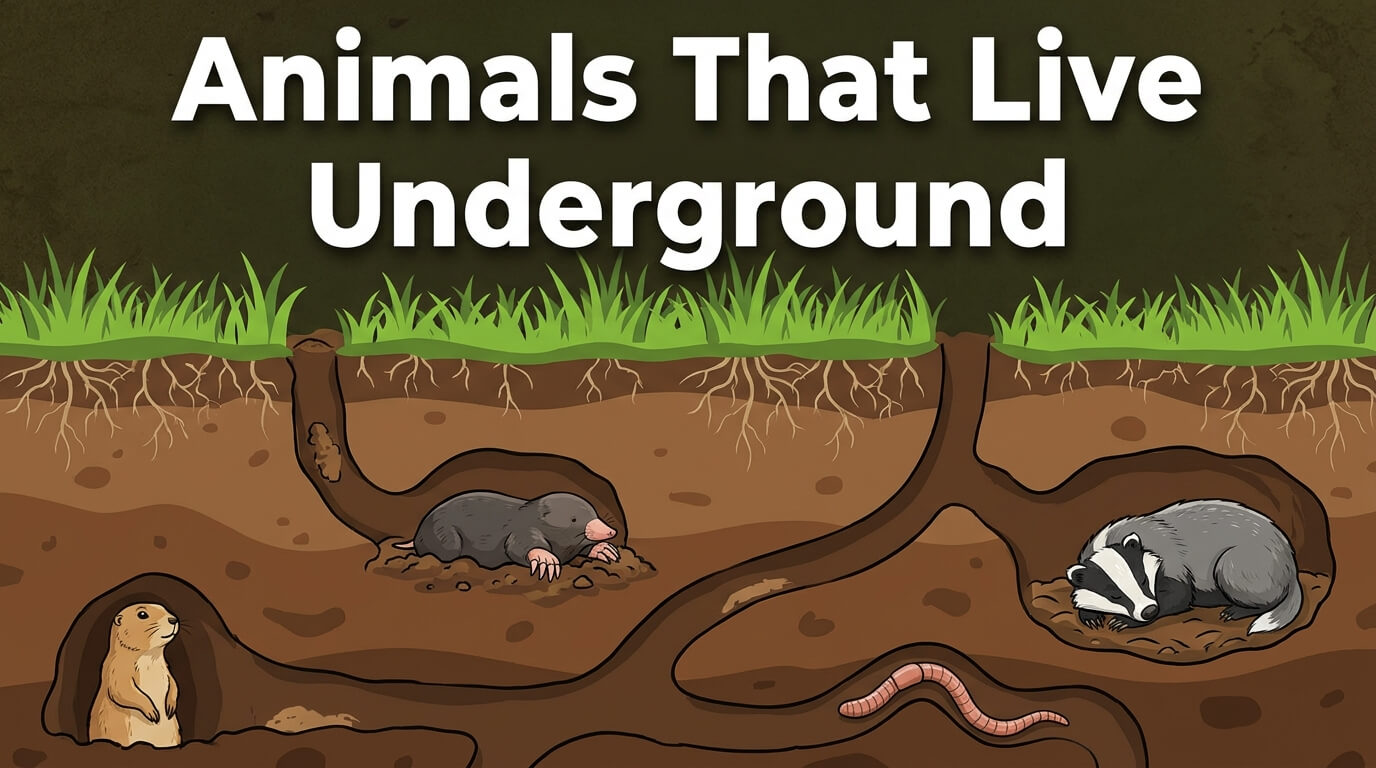
Animals that live underground use soil the way other animals use trees, water, rocks, or open grassland. A burrow can be a nursery, shelter, pantry, sleeping chamber, temperature refuge, ambush site, escape tunnel, or whole colony. Some underground animals spend nearly their entire lives below the surface. Others only dig when they need to nest, hide, overwinter, avoid heat, or raise young.
This guide focuses on burrows, tunnels, soil spaces, and digging adaptations. It is not a cave animals article, and it is not a pest-control manual. Instead, it explains how underground homes work, why animals dig, what body traits help them move through soil, and why burrowing animals can matter far beyond the hole you see at the surface.
Quick Answer
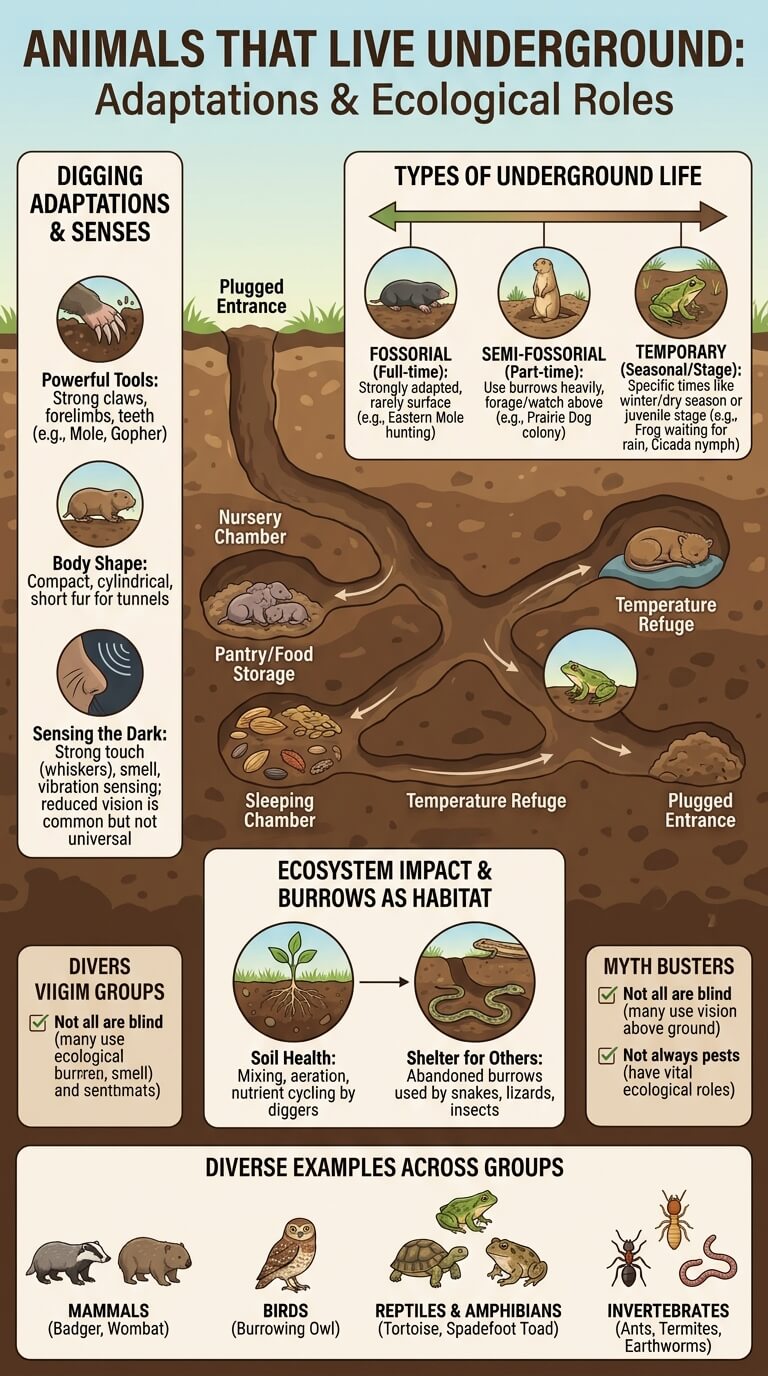
Animals that live underground include moles, pocket gophers, mole-rats, prairie dogs, ground squirrels, badgers, wombats, armadillos, rabbits, foxes, some snakes, lizards, frogs, salamanders, ants, termites, beetles, worms, cicada nymphs, crayfish in wet soils, and birds such as burrowing owls. Some are fossorial, meaning they are strongly adapted for digging and underground life. Others are semi-fossorial, meaning they use burrows often but still forage, bask, hunt, or travel above ground.
Underground living helps animals solve several problems at once. Soil can buffer heat, cold, wind, and dryness. Tunnels can hide animals from predators. Chambers can protect eggs or young. Burrows can store food. Social tunnels can connect family groups or colonies. In some habitats, the safest place to survive a harsh day or season is below the surface.
What It Means for an Animal to Live Underground

Living underground does not have one simple definition. A worm moving through soil, a mole digging hunting tunnels, a prairie dog colony with chambers and entrances, and a turtle buried for winter all count in different ways. The shared idea is that underground space plays a meaningful role in the animal’s daily life, seasonal survival, feeding, reproduction, or safety.
Burrows, dens, tunnels, nests, and soil spaces
A burrow is usually a hole or tunnel made or used by an animal. It may be simple, like a short tunnel leading to a nest chamber, or complex, with branches, chambers, plugged entrances, food storage areas, and escape routes. A den is often a shelter space used for resting, breeding, or raising young. A tunnel is the passageway itself. A nest can be built inside a burrow, under roots, in loose soil, or in a chamber.
Some burrows are dug by the animals that live in them. Others are borrowed, enlarged, or reused. That is why abandoned burrows can become important habitat for snakes, lizards, insects, amphibians, small mammals, and birds. In many ecosystems, one digger can create shelter for many non-diggers.
Fossorial, semi-fossorial, and temporary underground behavior
Fossorial animals are strongly adapted for digging or living below ground. Moles are a familiar example. The Animal Diversity Web profile of the eastern mole describes an animal with a cylindrical body, reduced eyes, large forefeet, and a diet built around soil invertebrates such as earthworms and insect larvae. Those traits fit an underground hunting lifestyle.
Semi-fossorial animals use burrows heavily but do not live underground all the time. Prairie dogs, ground squirrels, badgers, rabbits, armadillos, wombats, and many reptiles can fit this category depending on the species. They may feed above ground, defend territory, mate, bask, or watch for predators, then retreat below when danger, weather, or resting time arrives.
Temporary underground behavior is different again. Some frogs burrow during dry periods. Some turtles bury themselves for winter. Some insects spend the juvenile part of life underground and emerge as adults. These animals may not be classic underground specialists, but underground shelter can still be critical at one stage of life.
Underground homes versus caves
Underground homes and caves are not the same habitat. A burrow is usually made in soil, sand, clay, mud, leaf litter, or loose ground by an animal or by erosion around roots and rocks. A cave is a larger natural underground space, often formed in rock, with its own light, moisture, airflow, and food constraints.
Cave animals may be adapted to deep darkness without digging burrows at all. Burrowing animals are shaped by the physical work of moving through soil. Their challenges include compact ground, tunnel collapse, oxygen and carbon dioxide balance, moisture control, roots, rocks, predators at entrances, and the energy cost of excavation.
Main Underground Animal Adaptation Framework
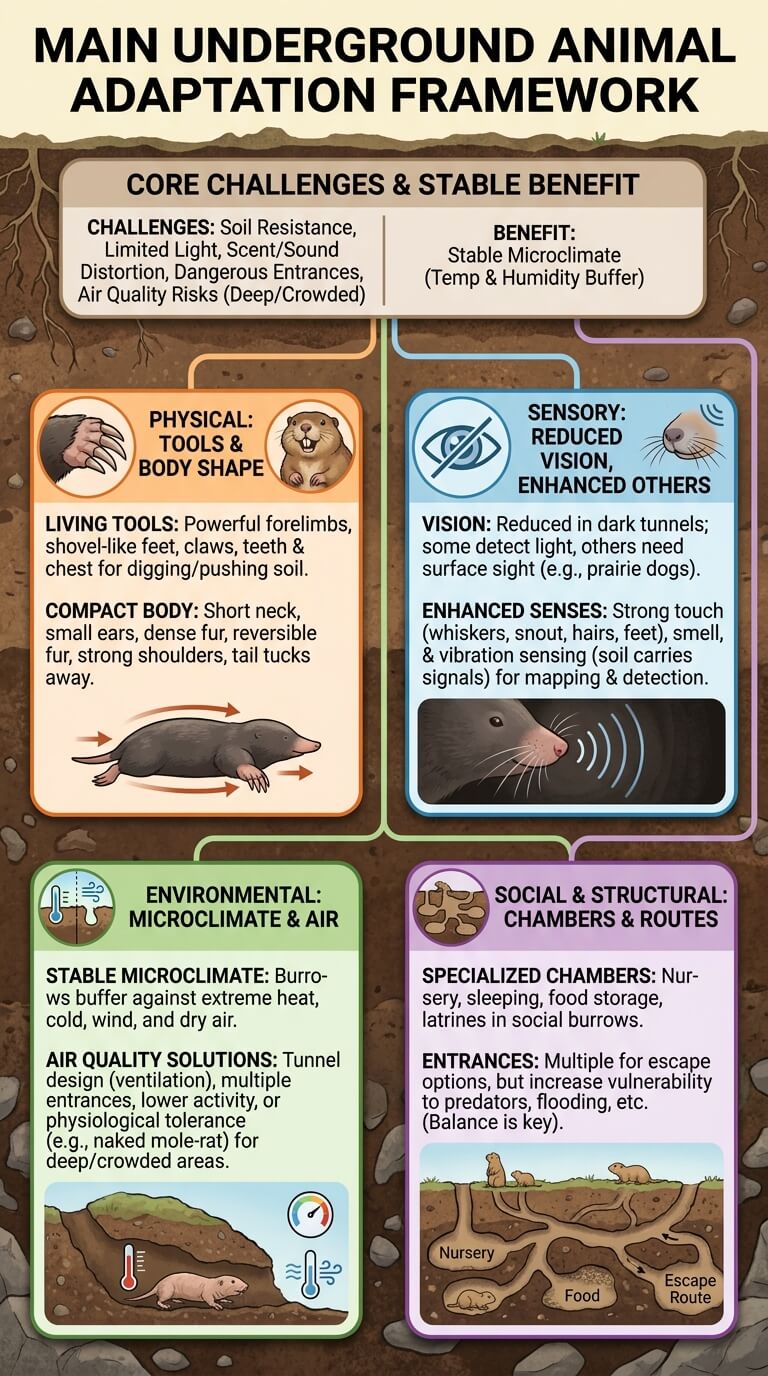
Underground animals face a set of problems that aboveground animals do not face in the same way. Soil resists movement. Light is limited or absent. Sound and scent move differently. Entrances can be dangerous. Temperature and humidity can be more stable than the surface, but air quality can become a challenge in deep or crowded tunnels.
Digging claws, powerful forelimbs, teeth, and body shape
Many digging animals are built like living tools. Moles use powerful forelimbs and broad front feet that work like shovels. Pocket gophers use claws, forelimbs, chest, and teeth to loosen and push soil. The Animal Diversity Web account of pocket gophers explains that their burrow systems can include shallow foraging tunnels and deeper tunnels used for nesting, food storage, and latrines.
Body shape matters underground. A long-legged runner is not ideal in a narrow tunnel. Many fossorial mammals have compact bodies, short necks, small external ears, dense fur, strong shoulders, and tails that do not get in the way. Some have fur that can move smoothly forward or backward through tight spaces.
Reduced eyesight, strong touch, smell, and vibration sensing
Dark tunnels reduce the value of sharp long-distance vision. That does not mean all underground animals are blind. Some have reduced eyes, some can still detect light, and some spend enough time above ground that good vision remains important. Prairie dogs and burrowing owls, for example, depend strongly on aboveground sight to watch for predators and communicate.
Touch, smell, and vibration can become more useful below ground. Whiskers, sensitive snouts, body hairs, feet, antennae, and chemical signals help animals map tight spaces, find food, detect tunnel walls, recognize colony members, and notice movement nearby. Soil can carry vibrations from digging, footsteps, rain, or predators at the entrance.
Breathing, temperature control, and low-light movement
Burrows often provide a steadier microclimate than the surface. A microclimate is a small local climate within a larger habitat. Soil can soften extreme heat, cold, wind, and dry air. This is one reason burrows are valuable in grasslands, deserts, forests, wetlands, and even human-altered yards.
Air quality can still matter. Deep, crowded, or poorly ventilated tunnels may have less fresh air than the surface. Animals that live in such systems may rely on tunnel design, multiple entrances, lower activity levels, or physiological tolerance. The Smithsonian’s naked mole-rat profile describes a species native to dry grasslands of East Africa that lives in underground colonies and is highly specialized for subterranean life.
Social tunnels, chambers, and escape routes
Some underground animals are solitary. Others live in family groups or colonies. Social burrows can include nursery chambers, sleeping chambers, food areas, latrines, and multiple entrances. More entrances can mean more escape options, but they may also create more places where predators, parasites, flooding, or temperature changes can enter.
Prairie dogs are a classic example of social underground life paired with aboveground behavior. The Animal Diversity Web profile of the black-tailed prairie dog describes this species as living in open short-grass plains and using burrow systems in colonies. Their underground space is part of a larger grassland lifestyle, not a substitute for the grassland itself.
Animals That Live Underground by Group

Underground living appears in many animal groups because soil solves common problems in many habitats. The examples below are not all full-time subterranean animals. They show a spectrum: animals that hunt in soil, animals that sleep in burrows, animals that breed underground, animals that use old burrows, and animals that build entire hidden societies.
Mammals such as moles, gophers, prairie dogs, badgers, and wombats
Mammals are some of the most familiar underground animals because their burrows leave visible mounds, ridges, entrances, or dens. Moles are insect-eating tunnel hunters. Pocket gophers are plant-eating rodents that build extensive burrow systems. Prairie dogs are social rodents that combine aboveground grazing and lookout behavior with underground refuge.
Badgers, foxes, rabbits, groundhogs, armadillos, meerkats, wombats, and some ground squirrels also use burrows, but their lifestyles differ. A badger may dig powerfully to reach prey or make a den. A rabbit may use a warren for shelter and young. A wombat can create large burrow systems with strong claws and a sturdy body. An armadillo may dig for food and shelter, depending on species and habitat.
Reptiles and amphibians that burrow for moisture and safety
Many reptiles and amphibians use underground space because it helps control temperature and moisture. Snakes may shelter in burrows made by mammals, hide under loose soil, or use underground spaces during cold weather. Lizards may dig or use existing holes to avoid heat, predators, or dry conditions. Tortoises and some turtles may use burrows or bury themselves seasonally.
Amphibians are especially tied to moisture because their skin can lose water easily. Some frogs and salamanders spend dry periods underground, then return to the surface when rain creates better conditions for feeding or breeding. Burrowing can be the difference between surviving a dry spell and drying out on the surface.
Insects and invertebrates such as ants, termites, beetles, worms, and cicadas
Invertebrates may be the most numerous underground animals, even if people notice them less than mammals. Ants and termites can build elaborate nests with chambers, tunnels, nurseries, food areas, and ventilation features. Beetle larvae, fly larvae, grubs, earthworms, millipedes, centipedes, spiders, mites, springtails, and many tiny soil animals live in or move through soil and leaf litter.
Earthworms do not build dens like mammals, but their movement through soil can change soil structure. Cicada nymphs spend years underground feeding on plant fluids from roots before emerging as adults, with timing depending on the species. Some bees and wasps nest in the ground, using tunnels or small chambers for eggs and larvae.
Birds and other animals that nest or shelter in burrows
Some birds nest in burrows even though they are not built like underground mammals. Burrowing owls are the best-known example in North America. The U.S. Fish and Wildlife Service profile of the burrowing owl explains that these small owls nest in underground burrows and are often associated with prairie dog towns and other burrowing animals.
Other birds, including some kingfishers, puffins, bee-eaters, bank swallows, and storm-petrels, may nest in burrows or earthen banks depending on the species. They usually fly and feed above ground or over water, but the underground nest protects eggs and chicks from weather and some predators.
Why Underground Animals Matter to Ecosystems
Soil mixing, aeration, water movement, and nutrient cycling
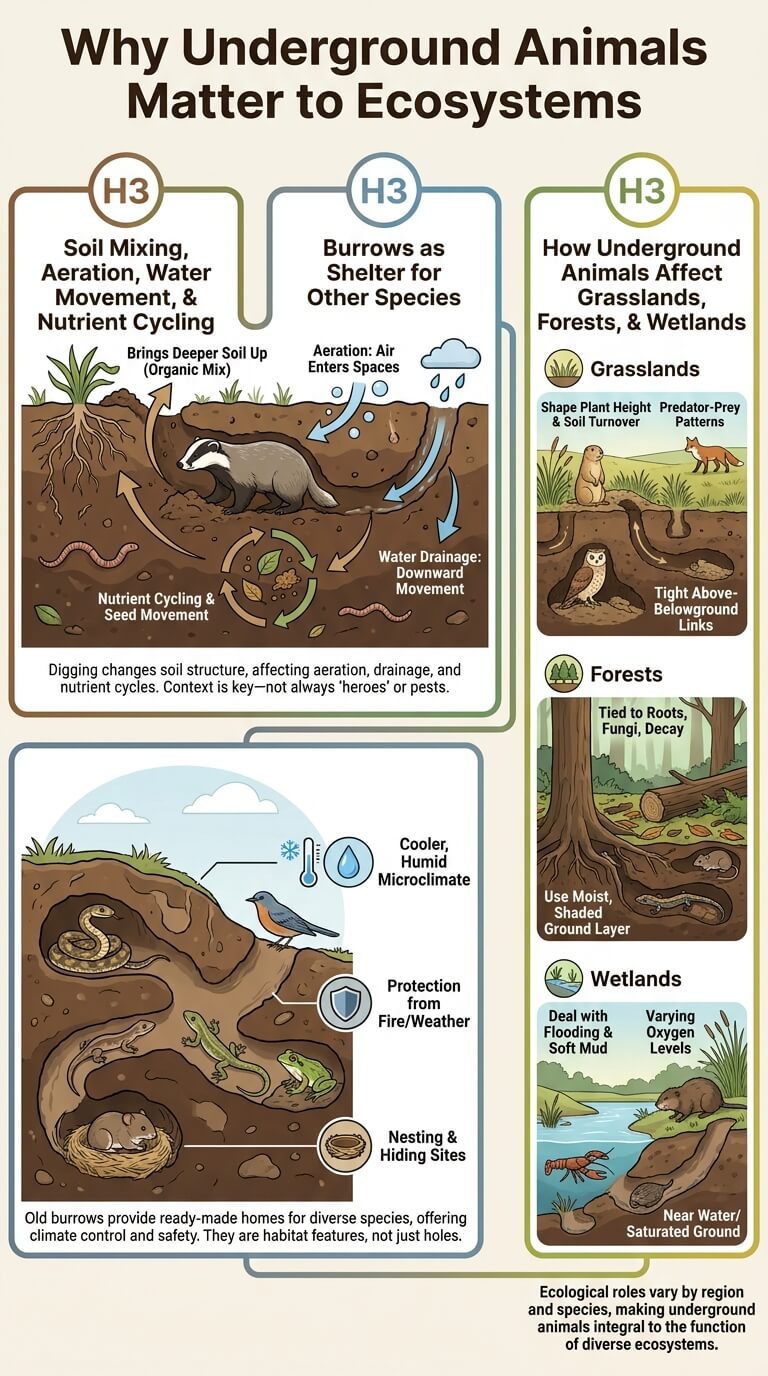
Digging changes soil structure. When animals bring deeper soil to the surface, mix organic matter, or create tunnels, they can affect aeration, drainage, seed movement, and nutrient cycling. Aeration means air can enter spaces in the soil. In some places, burrows also help rainwater move downward instead of only running across the surface.
This is why broad claims can mislead. Burrowing animals are not automatically soil heroes in every setting, and they are not automatically destructive pests either. Their ecological role depends on context.
Burrows as shelter for other species
Old burrows can become ready-made shelters. Snakes, lizards, insects, frogs, small mammals, and birds may use tunnels made by another animal. Burrows can provide cooler temperatures, higher humidity, hiding places, nesting sites, and protection from fire or weather.
Prairie dog towns are often discussed as examples of burrow systems that affect many other animals, including species that use the openings, vegetation changes, or predator-prey patterns around colonies. The exact relationships vary by region and species, so it is better to think of burrows as habitat features rather than simple holes.
How underground animals affect grasslands, forests, and wetlands
In grasslands, burrowing animals can shape plant height, soil turnover, predator behavior, and shelter availability. Prairie dogs, ground squirrels, badgers, burrowing owls, snakes, and insects can all be part of open-ground systems where underground and aboveground life are tightly connected.
In forests, burrows may appear under roots, logs, banks, and leaf litter. Small mammals, amphibians, insects, and soil invertebrates use the moist, shaded ground layer. A forest burrow is often tied to roots, fungi, decaying wood, and leaf litter rather than the open visibility of a grassland colony.
Wetlands and wet soils add another twist. Some crayfish, turtles, frogs, snakes, muskrats, and small mammals use burrows near water or in saturated ground. These burrows have to deal with flooding, soft mud, oxygen levels, and changing water lines, which makes them different from dry grassland tunnels.
Common Mistakes or Myths About Underground Animals
Underground animals are easy to misunderstand because people usually see only the surface signs: mounds, holes, ridges, missing plants, or an animal briefly appearing near an entrance. That limited view leads to myths about blindness, pest status, and how long animals stay in burrows.
Myth that all underground animals are blind
Some underground animals have reduced eyes, and some deep subterranean animals rely little on vision. But many underground animals can see. Prairie dogs, ground squirrels, badgers, rabbits, burrowing owls, many snakes, and many lizards use vision above ground. Even animals with small eyes may still detect light or movement.
The better rule is that underground life often reduces the value of long-distance vision and increases the value of touch, smell, vibration, memory, and chemical communication. Blindness is one possible outcome in some lineages, not a universal feature of every animal that digs.
Myth that every burrowing animal is a pest
Burrowing animals can create real conflicts. Tunnels may damage gardens, lawns, roadsides, irrigation banks, levees, pastures, or crop fields. Some species eat roots or seedlings. Others leave mounds that interfere with mowing or livestock movement. Those problems should be handled through local, legal, humane, and species-specific guidance.
At the same time, calling every burrowing animal a pest erases its ecological role. Many are prey for hawks, owls, snakes, foxes, coyotes, badgers, and other predators. Many move soil or create shelter for other species. The same animal can be ecologically valuable in a native grassland and problematic in a small garden bed.
Safety matters too. People should not dig up, handle, feed, or relocate wild animals on their own. The CDC’s overview of rabies notes that rabies can spread through bites and scratches from infected animals, so unusual, injured, or approachable wild mammals should be avoided and handled by the proper local authority.
Myth that dens and burrows are always permanent homes
Some burrows are long-lasting structures, but many underground shelters are temporary, seasonal, or used only for one life stage. A fox den may be important during pup-rearing but not used the same way year-round. A turtle may bury itself during cold weather. A frog may wait underground for rain. A bird may use a burrow only for nesting.
Even social burrow systems change. Entrances can collapse, flood, be abandoned, be enlarged, or be taken over by other animals. A visible hole does not always tell you who made it, who uses it now, or whether it is active.
Edge Cases and Exceptions
Animals that only burrow during breeding or winter
Many animals go underground for breeding or seasonal protection. Ground-nesting bees may use soil chambers for young. Some turtles and snakes use underground retreats to survive cold periods. Some mammals use dens mostly while raising young. Some amphibians burrow during dry conditions and emerge when rain returns.
These animals are still worth including because underground shelter is essential during vulnerable times. Eggs, babies, winter dormancy, dry-season survival, and predator avoidance can all depend on a safe hidden space, even when the adult spends much of the year above ground.
Cave animals that live underground but do not dig burrows
Cave animals are underground in a literal sense, but they belong to a different habitat category. A cave cricket, cave salamander, bat roosting in a cave, or blind cave fish may not be a burrowing animal. Their world is shaped more by rock cavities, darkness, moisture, airflow, and limited food than by soil excavation.
This distinction helps avoid mixing two different topics. A mole and a cavefish both live out of sight, but one is shaped by digging through soil and the other by living in natural underground water or rock spaces. They face different pressures and need different explanations.
Aquatic or wetland burrowers without becoming a freshwater topic
Some animals dig in wet soils, mud banks, stream edges, marshes, or floodplains. Crayfish, muskrats, some turtles, frogs, snakes, and small mammals may use burrows near water. Their burrows can provide shelter, nesting areas, or protection from drying and predators.
Wet burrowing should not be confused with a full freshwater animal guide. The underground feature is the burrow, bank, mud chamber, or soil retreat. The larger habitat may be a wetland, river edge, pond, or marsh, but the animal is still solving a shelter problem with underground space.
Other Habitats Underground Animals Often Use
Underground animals connect naturally to grasslands, forests, wetlands, caves, and the broader question of why animals live where they do. A burrow is not isolated from the habitat around it. It is part of the animal’s food, predators, climate, soil, plant cover, and life cycle.
Grassland animals that build colonies and burrow systems
Grasslands are especially important for many burrowing mammals because open vegetation allows aboveground lookout behavior while soil offers underground refuge. Prairie dogs, ground squirrels, badgers, burrowing owls, snakes, and insects can form a visible network of aboveground and belowground relationships.
Forest animals that den or use root spaces
Forest underground spaces are often tied to roots, logs, banks, and leaf litter. Foxes, rabbits, chipmunks, amphibians, insects, spiders, worms, and small mammals may use underground or semi-underground shelter, but the surrounding forest still supplies food, cover, nesting material, and moisture.
Cave animals as a different kind of dark habitat
Cave animals are useful for comparison because they show that darkness alone does not define an underground lifestyle. A cave may be dark, cool, humid, and food-limited, but a cave animal does not necessarily dig. A burrowing animal must deal with soil movement, tunnel maintenance, entrance risk, and the physical cost of excavation.
FAQ
What animals live underground?
Animals that live underground include moles, pocket gophers, prairie dogs, ground squirrels, mole-rats, badgers, rabbits, wombats, armadillos, some snakes, lizards, turtles, frogs, salamanders, ants, termites, beetles, cicada nymphs, earthworms, crayfish in wet soils, and burrowing owls. Some live underground most of the time, while others use burrows mainly for shelter, breeding, winter, dry seasons, or protection from predators.
The best answer depends on how strictly you define underground living. Full-time fossorial animals are built for soil life. Semi-fossorial animals split time between burrows and the surface. Temporary burrow users may only go underground at certain stages or seasons.
Why do animals dig burrows?
Animals dig burrows to hide from predators, raise young, store food, find prey, avoid heat or cold, keep moisture, escape fire or weather, or create a stable resting place. In many habitats, soil is safer and more stable than the exposed surface.
Different animals dig for different reasons. A mole tunnels to hunt soil invertebrates. A pocket gopher tunnels to feed and store plant material. A prairie dog uses a burrow system as part of social colony life. A frog may burrow mainly to survive dryness.
Are burrowing animals good for soil?
Many burrowing animals can help mix soil, open air spaces, move nutrients, and create paths for water. Earthworms, ants, termites, moles, gophers, prairie dogs, and other diggers can all affect soil structure in different ways. Their old burrows may also shelter other species.
That does not mean every burrowing animal is welcome in every place. Burrows can damage lawns, gardens, banks, roadsides, and crops depending on the species and setting. The most accurate answer is that burrowing animals are ecologically important, but their effect on people can be helpful, neutral, or costly depending on context.
What is the difference between a burrow and a cave?
A burrow is usually a tunnel, hole, or chamber in soil, sand, mud, or loose ground that is made or used by an animal. A cave is a larger natural underground space, usually in rock, formed by geological processes rather than animal digging.
Burrowing animals are shaped by digging, tunnel maintenance, soil pressure, entrance safety, and underground chambers. Cave animals are shaped more by darkness, rock spaces, airflow, moisture, and limited food. Both may live underground, but the habitats work differently.
Final Thoughts
Animals that live underground show how much wildlife activity happens out of sight. A burrow may look like a simple hole, but it can be a nursery, hunting route, shelter, food store, colony network, or ecosystem feature used by many species over time. Underground life is not one lifestyle. It includes full-time diggers, part-time den users, burrow-nesting birds, moisture-seeking amphibians, soil invertebrates, and animals that only disappear below the surface during a risky season.
The main takeaway is that underground animals should be understood by how they use the hidden habitat. Ask whether the animal digs its own tunnels, borrows another species’ burrow, lives below ground full-time, uses soil only temporarily, or depends on underground shelter for young. That question turns a simple list of hidden animals into a clearer picture of survival, adaptation, and the habitats beneath our feet.

Ethan Walker is the founder and research editor of Animal Fact Central. He creates and reviews educational animal facts content using trusted wildlife, pet care, and science-based sources. His work focuses on making animal behavior, adaptations, habitats, and species facts clear, accurate, and engaging for everyday readers.
Read More Details About Ethan Walker: https://animalfactcentral.com/ethan-walker/