

Rainforest animals live in one of the most crowded and layered wildlife habitats on Earth. A tropical rainforest is warm, wet, dense, and full of vertical space, which means animals are not all competing on the same flat forest floor. Some move through the canopy. Some hide in the understory. Some live among roots, rotting leaves, fungi, and fallen fruit. Others use rivers, tree holes, vines, flowers, and epiphytes, which are plants that grow on other plants.
The easiest way to understand rainforest animals is to think in layers and niches. A niche is the role an animal plays in its habitat, including where it lives, what it eats, when it is active, and how it avoids being eaten. Rainforests can support many species because food, shelter, moisture, and hiding places are arranged in many small zones rather than one simple habitat.
Quick Answer
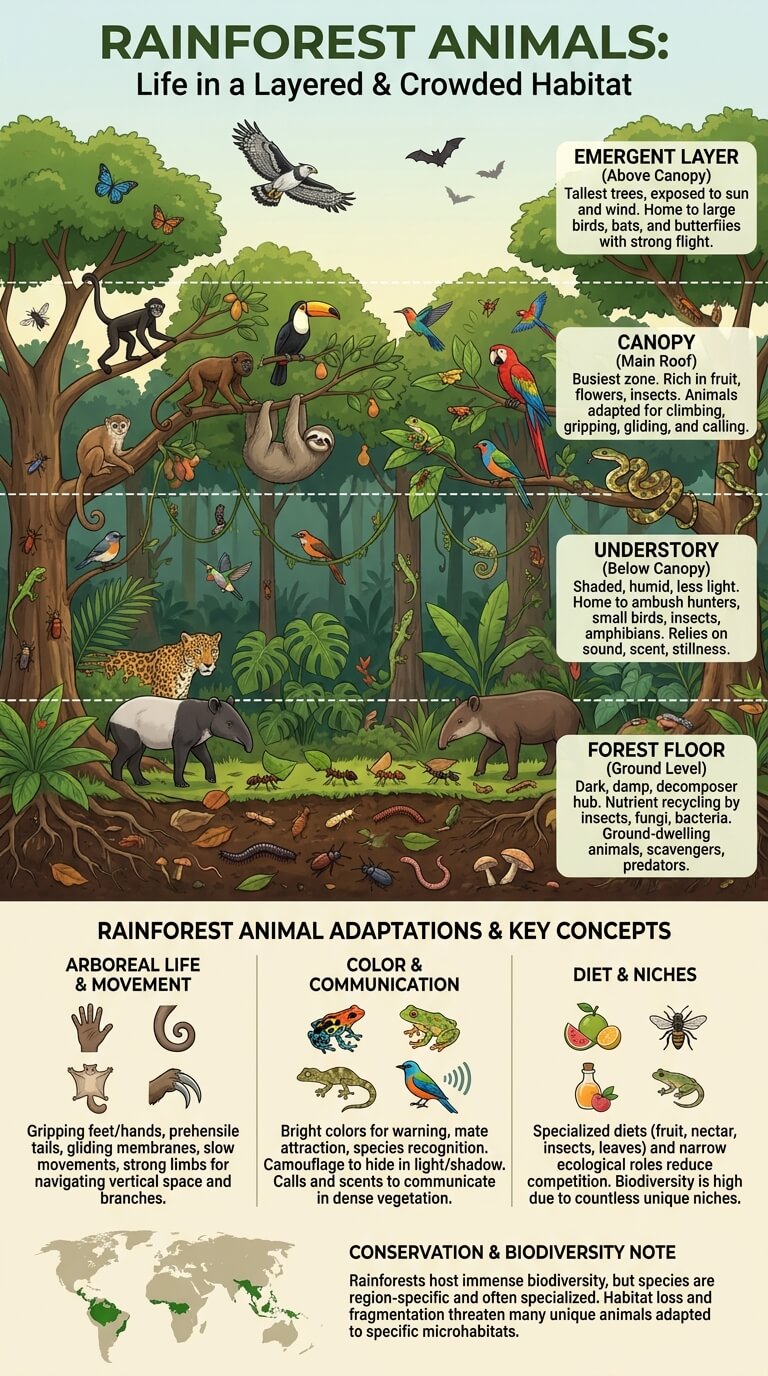
Rainforest animals include monkeys, sloths, jaguars, tapirs, toucans, macaws, hornbills, tree frogs, poison frogs, snakes, lizards, bats, butterflies, beetles, ants, termites, spiders, snails, and many decomposers. The exact species depend on the region. The Amazon, Congo Basin, Southeast Asian rainforests, Central American rainforests, and tropical island forests do not all have the same wildlife.
What rainforest animals share is not one body type. They share a habitat shaped by warm temperatures, high rainfall, thick vegetation, and intense competition for food, light, space, and mates. A rainforest animal may be adapted for climbing, gliding, gripping smooth leaves, calling through dense vegetation, eating fruit, hunting at night, mimicking leaves, warning predators with color, or living in wet leaf litter.
What Makes Rainforests Different From Other Forests

All forests have trees, but tropical rainforests are not just greener versions of temperate woodlands. They are usually warm year-round, receive heavy rainfall, and support dense plant growth. That creates a habitat where moisture, shade, plant diversity, and vertical structure shape animal life. The National Geographic Education rainforest overview describes rainforests as layered systems, commonly including emergent, canopy, understory, and forest floor zones.
Warmth, rainfall, humidity, and dense plant growth
Tropical rainforests are usually warm and humid enough for plants to grow through much of the year. Instead of a long freezing winter, many rainforest regions have wet and less-wet seasons, fruiting cycles, flowering periods, floods, or local dry spells. Animals respond to these patterns by timing breeding, movement, foraging, and calling behavior around food and moisture.
High humidity is especially important for amphibians and invertebrates. Frogs, salamander-like amphibians in some tropical regions, snails, worms, and many insects lose water easily, so damp leaves, soil, tree holes, and shaded surfaces can be critical microhabitats. A microhabitat is a small habitat within a larger one, such as the water held in a bromeliad or the underside of a rotting log.
Rainforest layers from forest floor to emergent canopy
The forest floor is dark, damp, and rich in fallen leaves, fruit, seeds, fungi, animal droppings, and decomposing material. Many insects, millipedes, worms, fungi-feeding animals, ground birds, amphibians, rodents, and larger mammals use this layer. Predators may patrol trails, riverbanks, and openings, while small animals hide in leaf litter and root tangles.
The understory lies below the main canopy and is full of shade-tolerant plants, saplings, vines, broad leaves, and hidden perches. This layer can be ideal for ambush predators, small birds, insects, tree frogs, and reptiles. Because light is limited, animals here often use sound, scent, stillness, or quick movement rather than open chasing.
The canopy is one of the busiest rainforest zones. It holds leaves, flowers, fruit, insects, nests, epiphytes, and travel routes. Many monkeys, sloths, toucans, macaws, bats, frogs, snakes, lizards, and insects spend much of their lives above the ground. Above the canopy, the emergent layer includes the tallest trees and exposed crowns where large birds, bats, butterflies, and some climbing animals may move through open air and stronger wind.
High biodiversity and tight ecological niches
Rainforests are famous for biodiversity, but biodiversity does not mean every animal is everywhere. Many rainforest animals are tied to specific regions, elevations, forest types, or food sources. A frog from a lowland Amazonian forest may not belong in a montane cloud forest. A primate adapted to Atlantic coastal forest may not live in Southeast Asian rainforest. Rainforest animals should be understood by region, not as one global species list.
Tight ecological niches reduce direct competition. One bird may specialize in fruit near the canopy. Another may hunt insects on tree trunks. A bat may feed on nectar at night. A frog may breed in small water pockets. Ants may harvest leaves for fungal gardens. These narrow roles help explain how many animals can share a rainforest without all doing the same job.
Main Rainforest Animal Adaptation Framework

Rainforest animal adaptations usually solve five major problems: how to move through dense vegetation, how to find food in a crowded habitat, how to communicate when visibility is limited, how to avoid predators, and how to reproduce in a wet but competitive environment. These adaptations are not all extreme. A gripping foot, a quiet hunting style, a sticky toe pad, a warning color, or a seasonal fruit-tracking habit can be enough to shape an animal’s life.
Arboreal movement, gripping feet, tails, and gliding
Many rainforest animals are arboreal, meaning they spend much of their time in trees. Arboreal animals need balance, grip, and safe travel routes. Monkeys may use grasping hands, feet, and in some species prehensile tails, which can wrap around branches. Sloths use long limbs and curved claws to hang from branches. Tree frogs use toe pads and flexible bodies to cling to wet leaves and smooth surfaces.
Not every tree-dwelling animal moves quickly. The Smithsonian’s two-toed sloth profile explains that two-toed sloths have a low metabolic rate and spend much of their lives hanging in trees, feeding on plant material and getting water from food and moisture on leaves. Their slow lifestyle is not laziness. It is part of an energy-saving strategy suited to a leafy canopy diet.
Bright colors, warning signals, camouflage, and mimicry
Rainforest animals are often colorful, but color does not have only one meaning. Bright colors may warn predators, attract mates, identify species, help communication, or simply appear because of feather or scale structure. Dull colors, leaf shapes, bark-like patterns, and disruptive markings can help animals hide in a habitat full of shadows and broken light.
Some poison frogs are classic examples of warning coloration. The Smithsonian’s poison frog profile notes that amphibians with toxic skin secretions often have bright warning colors or patterns. That does not mean every bright rainforest animal is dangerous, and it does not mean every poison frog species has the same level of toxicity.
Specialized diets based on fruit, leaves, insects, nectar, and prey
Rainforest diets are diverse because rainforest food is diverse. Fruit, leaves, flowers, nectar, seeds, insects, spiders, eggs, small vertebrates, fungi, carrion, and aquatic prey all support different animals. Many species are flexible, but others specialize. A fruit eater may follow ripening trees. A nectar bat may visit night-blooming flowers. A frog may feed on small invertebrates in wet understory plants.
Fruit is especially important because many rainforest trees depend on animals to move seeds. Birds, monkeys, bats, rodents, and large mammals may eat fruit and carry seeds away from the parent tree. Some seeds pass through an animal’s digestive tract. Others are dropped or cached. Either way, animals can shape where the next generation of plants grows.
Sound, scent, and visual signals in dense vegetation
Rainforests can be loud. Birds call from canopy perches, insects produce rhythmic sounds, frogs call after rain, primates use contact calls, and mammals may communicate through scent marks. In dense vegetation, sound can carry information when animals cannot easily see one another. Calls may help with territory, mate attraction, group contact, alarm, or species recognition.
Scent is also important. Many mammals mark routes, territories, or breeding readiness with scent. Insects use chemical trails. Some ants lay paths to food. Some mammals recognize familiar individuals or reproductive cues through smell. In a humid forest with complex surfaces, scent can be more useful than long-distance vision.
Rainforest Animal Examples by Layer

Forest floor animals and decomposers
The rainforest floor may look quiet, but it is full of activity. Ants, termites, beetles, cockroaches, millipedes, worms, fungi, bacteria, and scavengers break down leaves, wood, fruit, and animal remains. Warmth and moisture can speed decomposition, which means nutrients often cycle quickly through living plants, fungi, microbes, and soil organisms.
Leafcutter ants are among the most memorable rainforest floor animals because they cut pieces of leaves and carry them along trails. The leaves are not simply eaten like salad. In many leafcutter systems, plant material is used to grow fungus that feeds the colony. This is a strong example of how small animals can shape a rainforest food web through behavior, not size.
Understory hunters, insects, amphibians, and reptiles
The understory is shaded, humid, and visually cluttered. It is a good place for ambush hunters and small animals that depend on cover. Snakes may wait near branches, leaf litter, or water. Lizards search for insects on trunks and leaves. Tree frogs call from vegetation after rain. Spiders build webs where insects fly through narrow spaces.
Amphibians are especially tied to moisture. Many frogs use small pools, tree holes, flooded leaves, streams, or puddles for breeding, although the details vary by species. Their eggs and skin can be sensitive to drying, which is why a slight change in humidity or canopy cover may affect them more than it would affect a large mammal.
Canopy mammals, birds, insects, and tree frogs
The canopy is a food-rich layer with fruit, flowers, leaves, insects, and nesting sites. Many rainforest mammals spend much of their time there because the canopy lets them feed and travel while staying above many ground predators. Monkeys, sloths, tree porcupines, civets, squirrels, marsupials, and bats all show different ways of using branches, vines, and tree crowns.
The Smithsonian’s golden lion tamarin profile describes golden lion tamarins as small social primates from Brazil’s Atlantic coastal rainforest region. They use trees, feed on fruit and small animals, and depend on forest habitat that has been heavily reduced. This makes them a useful example of how canopy life and conservation concerns can overlap without turning every rainforest animal into the same story.
Emergent-layer birds and wide-ranging animals
The emergent layer includes the tallest trees that rise above the canopy. It is brighter, windier, and more exposed than the shaded layers below. Animals that use this zone often need flight, climbing ability, or strong perching skills. Large birds may perch or nest high in the canopy or emergent trees, depending on species and region.
Toucans show how a canopy bird can be both specialized and flexible. The Animal Diversity Web profile of the toco toucan describes it as mainly a canopy frugivore that also feeds opportunistically on other foods such as insects and eggs. Toucans are not found in every rainforest, but their fruit-heavy diet helps illustrate why birds can matter for seed movement.
Rainforest Food Webs and Species Relationships

Rainforest food webs are not simple chains. They are networks of plants, fungi, microbes, herbivores, predators, scavengers, pollinators, seed dispersers, and decomposers. Many rainforest animals matter because of the relationships they create. A small insect can pollinate a plant. A bat can move pollen at night. A monkey can drop seeds far from a parent tree. A predator can change how prey use trails, water, or canopy paths.
Fruit eaters, seed dispersers, pollinators, and predators
Fruit eaters are central to many rainforest systems. When birds, bats, primates, rodents, and larger mammals eat fruit, they may help seeds reach new places. Not every seed survives, and not every animal is an ideal disperser, but fruit-eating animals can influence forest regeneration. Some plants appear closely tied to particular dispersers, while others use many animals.
Pollinators include bees, butterflies, moths, beetles, flies, birds, and bats. Different flowers attract different visitors through color, scent, timing, shape, or nectar. Night-blooming flowers may rely on bats or moths. Bright daytime flowers may attract birds or insects. This is another reason rainforest animals cannot be understood only by body size. Some of the most important interactions are small and easy to miss.
Ants, termites, fungi, and nutrient recycling
Rainforest soils are often misunderstood. People sometimes imagine deep, endlessly rich soil, but in many tropical forests a large share of nutrients is held in living plants, leaf litter, fungi, microbes, and rapidly cycling organic material. Decomposers and detritivores help keep that cycle moving by breaking down plant and animal material.
Termites, ants, beetles, millipedes, earthworms, fungi, and bacteria are part of the engine room of the rainforest. They break materials into smaller pieces, mix organic matter, influence soil structure, and make nutrients available again. A rainforest without decomposers would not function as the lush habitat people picture.
Why specialization can make rainforest animals vulnerable
Specialization can be powerful in a stable habitat. A frog that breeds in tiny water pockets, a bird that follows fruiting trees, or an insect that feeds on a certain plant can thrive when those conditions are present. But if the habitat changes, the same specialization may become a weakness.
Habitat loss and fragmentation can break canopy routes, dry out understory areas, reduce nesting trees, isolate populations, and remove food plants. The WWF explanation of deforestation and forest degradation notes that tropical rainforests are a major concern because they are home to much of the world’s biodiversity. For animal articles, that should be read carefully: risk varies by species, region, and threat, not every rainforest animal has the same conservation status.
Common Mistakes or Myths About Rainforest Animals
Myth that rainforests are just jungles full of big predators
Large predators are important, but they are only a small part of rainforest wildlife. Jaguars, leopards, harpy eagles, large snakes, crocodilians in river systems, and other predators draw attention because they are powerful and dramatic. Yet most rainforest animal life is much smaller.
Insects, spiders, frogs, lizards, small birds, bats, rodents, snails, worms, and soil animals do much of the daily ecological work. They pollinate, recycle nutrients, disperse seeds, provide food for predators, and shape plant communities. A rainforest without small animals would not be a functioning rainforest.
Myth that bright colors always mean danger
Bright colors can be warning signals, but they do not always mean an animal is toxic, venomous, or unsafe to approach. Color may also be used for mate choice, species recognition, camouflage in colorful surroundings, or light effects from feathers and scales. Some harmless species mimic warning colors, while some dangerous animals are not brightly colored at all.
The safest rule is not to handle wild rainforest animals. Frogs, insects, snakes, lizards, and mammals can be stressed or injured by contact, and some may carry toxins, bites, parasites, or disease risks. A photograph from a safe distance is more ethical and more accurate than a staged image of someone holding wildlife.
Myth that all rainforest animals live in trees
The canopy is famous, but many rainforest animals live on the forest floor, underground, in streams, inside dead wood, under leaves, or along swampy edges. Tapirs, peccaries, ground birds, ants, termites, frogs, beetles, worms, and many reptiles may spend much of their time away from the upper canopy.
Edge Cases and Exceptions
Rainforests blur into other habitats. A tropical rainforest may include rivers, oxbow lakes, swamps, caves, tree holes, mountain slopes, forest edges, and underground spaces. Those edge cases are useful because they show how rainforest animals connect to nearby habitat topics without turning this guide into a freshwater, cave, or general forest article.
Rainforest rivers and swamps without becoming a freshwater article
Many rainforest regions include rivers, flooded forests, seasonal wetlands, and swampy areas. These habitats support fish, turtles, caimans, crocodiles, otters, wading birds, insects, frogs, and mammals that depend on water. Some animals move between land and water, while others specialize in aquatic or semi-aquatic life.
Nocturnal rainforest animals and hidden diversity
Many rainforest animals are active at night. Darkness can reduce heat stress, lower competition, or help animals avoid daytime predators. Bats, moths, frogs, geckos, snakes, owls, rodents, insects, and some mammals use night conditions for feeding, calling, mating, or traveling.
Nocturnal life is one reason rainforests can seem quiet during a daytime walk but become loud after sunset. Frogs may call after rain. Insects may create layered sound. Bats may move through gaps. Predators may follow scent trails or listen for movement. A rainforest is not asleep when people cannot see it.
Species that use burrows, tree holes, or caves in rainforest regions
Some rainforest animals use shelters that seem more like underground or cave habitats. Tarantulas may use burrows. Some mammals use dens. Frogs may breed in tree holes. Bats may roost in caves, hollow trees, or buildings depending on species. These shelters protect animals from weather, predators, and drying.
How Rainforest Animals Fit Into Other Habitats
Rainforest animals connect to several nearby habitat questions. They are forest animals, but not all forest animals are rainforest animals. They may use wetlands, but not all wetland animals live in rainforests. Some use tree holes, burrows, or caves, but those shelters are only part of a larger habitat story.
Forest animals as the broader forest ecosystem topic
Rainforest animals fit within the larger idea of forest wildlife. Like temperate forest animals, they use trees, shade, dead wood, leaf litter, canopy structure, and seasonal food. The difference is that tropical rainforests usually have warmer conditions, high rainfall, dense vegetation, and many highly specialized species.
This makes rainforest wildlife a focused subtopic, not a replacement for general forest animals. A deer in a North American woodland and a tamarin in Brazil both use forest structure, but their climates, food webs, predators, and survival challenges are very different.
Wetland animals in rainforest swamp habitats
Rainforest wetlands create a bridge between land and water. Flooded forests, peat swamps, mangrove edges in tropical regions, and river margins can support animals that are partly aquatic and partly forest-dependent. Frogs, reptiles, fish, wading birds, insects, and mammals may all benefit from wet rainforest zones.
Animal habitats as the larger biome framework
Rainforest animals also fit into the broader question of why animals live where they do. Their bodies and behaviors make sense only when matched to food, shelter, climate, predators, mates, breeding sites, and movement routes. A rainforest is not just scenery. It is the set of conditions that makes each adaptation useful.
FAQ
What animals live in rainforests?
Rainforests are home to many mammals, birds, reptiles, amphibians, insects, spiders, worms, mollusks, fish in river systems, and decomposers. Examples include monkeys, sloths, bats, jaguars, tapirs, toucans, parrots, tree frogs, poison frogs, snakes, lizards, ants, termites, butterflies, beetles, and many species that are small or hard to see.
The exact answer depends on the rainforest region. Amazon rainforest animals are not the same as Congo Basin animals or Southeast Asian rainforest animals. A good rainforest animal list should mention groups and examples without pretending that every tropical forest has the same species.
Why are rainforest animals so colorful?
Some rainforest animals are colorful because color can help with warning signals, mate attraction, species recognition, camouflage, or communication in dense vegetation. Poison frogs, tropical birds, butterflies, beetles, and some reptiles show how color can serve different purposes.
Bright color should not be treated as a simple danger label. Some bright animals are toxic or unpalatable, some are not, and some dangerous animals are dull-colored. The meaning of color depends on the species, its predators, its habitat, and its behavior.
What rainforest animals live in the canopy?
Canopy animals include many monkeys, sloths, tree frogs, snakes, lizards, birds, bats, insects, and other small animals. Some live there most of the time, while others move between the canopy, understory, and forest floor. The canopy offers fruit, leaves, flowers, insects, nest sites, and travel routes.
Canopy life often requires climbing, gripping, balancing, gliding, flying, or careful movement across branches and vines. It also requires good ways to find patchy food and avoid predators in a three-dimensional habitat.
Why are many rainforest animals threatened?
Many rainforest animals face pressure from habitat loss, forest fragmentation, hunting, wildlife trade, pollution, climate-related changes, invasive species, or disease, depending on the species and region. It is not accurate to say every rainforest animal is endangered, because conservation status varies widely.
The cautious answer is that rainforest specialists can be vulnerable when the exact habitat features they depend on disappear. A canopy species may need connected trees. An amphibian may need humid leaf litter and clean breeding sites. A fruit-eating bird may need mature forest with seasonal food. Threats should always be checked species by species.
Final Thoughts
Rainforest animals are shaped by warmth, moisture, dense vegetation, vertical layers, and intense ecological relationships. The most useful way to understand them is not to memorize a random list of colorful species. It is to ask where each animal lives in the forest, what it eats, how it moves, how it communicates, how it avoids predators, and what habitat features it needs to reproduce.

Ethan Walker is the founder and research editor of Animal Fact Central. He creates and reviews educational animal facts content using trusted wildlife, pet care, and science-based sources. His work focuses on making animal behavior, adaptations, habitats, and species facts clear, accurate, and engaging for everyday readers.
Read More Details About Ethan Walker: https://animalfactcentral.com/ethan-walker/