
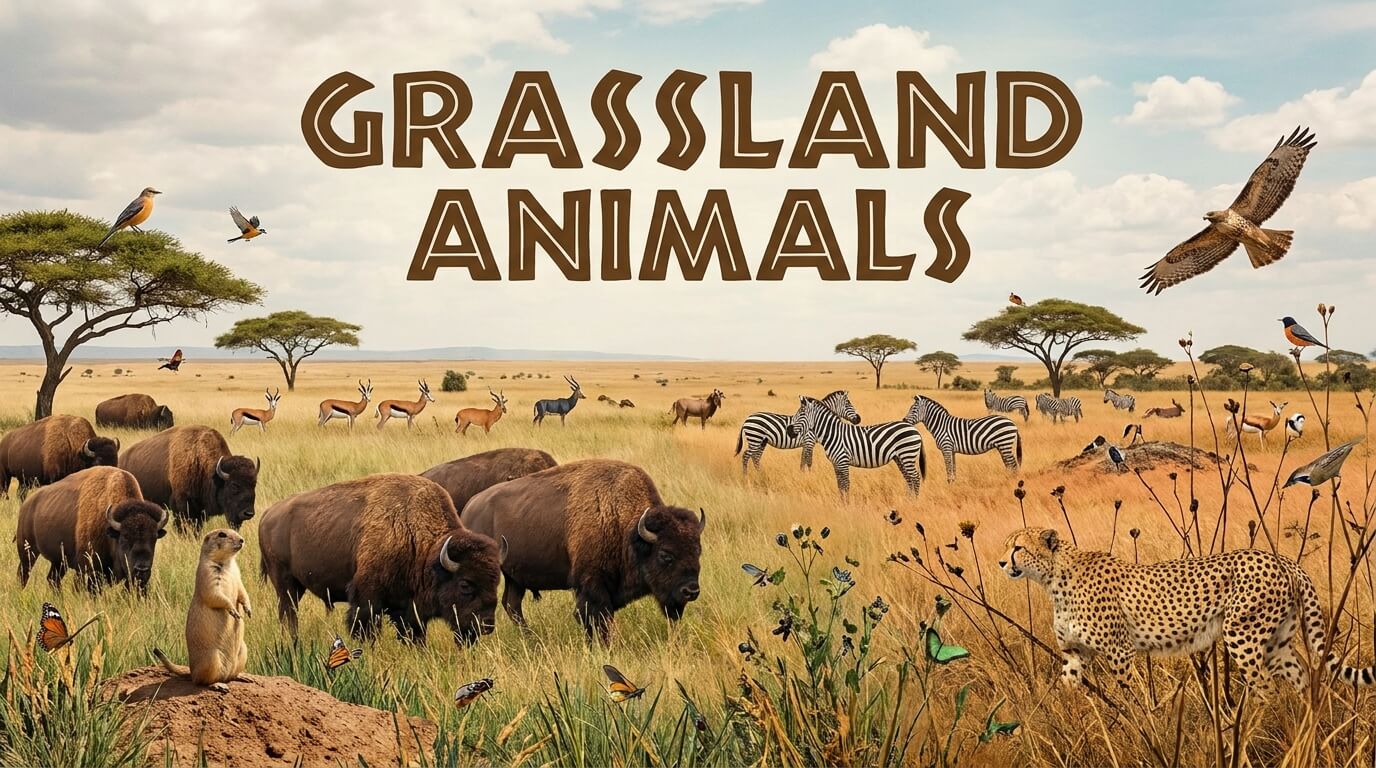
Grassland animals live in open habitats where grass, wind, sunlight, distance, and seasonal change shape many survival decisions. A grassland may look simple because it lacks the vertical layers of a forest, but it can be packed with life. Grazers crop plants, predators scan long sightlines, birds nest low to the ground, insects feed the food web, and burrowing animals build hidden shelters beneath the soil.
The main challenge of grassland life is exposure. Without many trees, animals often have fewer places to hide above ground. That pressure favors speed, endurance, camouflage, group living, early warning behavior, underground shelter, seasonal movement, and flexible feeding. Some grassland animals run, but others survive by staying low, living in colonies, blending into dry stems, hunting from the sky, or moving below ground.
Quick Answer

Grassland animals are animals that live, feed, nest, hunt, migrate, shelter, or raise young in habitats dominated by grasses and other low-growing plants. Examples include bison, antelope, zebras, prairie dogs, ground squirrels, coyotes, foxes, lions, cheetahs, hyenas, hawks, owls, meadowlarks, prairie chickens, grasshoppers, beetles, ants, termites, snakes, lizards, tortoises, and many pollinators.
Grassland wildlife survives through a mix of open-country adaptations. Large grazers use strong teeth, specialized digestion, herd behavior, and seasonal movement. Predators use speed, teamwork, ambush, or wide-area searching. Small mammals often use burrows. Birds may rely on ground nests, camouflage, display grounds, or hovering flight. Insects and soil animals keep energy moving through the ecosystem.
Grasslands are not all the same. A North American prairie, an African savanna, a Eurasian steppe, and a high mountain meadow can all be grassy habitats, but they differ in rainfall, temperature, plant species, tree cover, fire patterns, grazing pressure, and animal communities.
What Makes Grasslands Different From Other Habitats

Grasslands are shaped by openness. In many grasslands, trees are rare, scattered, or limited by fire, drought, grazing, cold, soil, or seasonal rainfall. The habitat is not defined only by grass, but by a balance of grasses, flowering plants, soil life, herbivores, predators, weather, and disturbance. Cornell Lab’s grassland ecosystem guide describes grassland landscapes as areas dominated by grasses and other herbaceous plants, often with low tree and shrub cover.
That open structure creates both risks and opportunities. Animals can see danger from far away, but predators can also see prey. Wind may carry scent and sound, but it can also make signals harder to read. Sunlight supports dense plant growth, but drought can quickly reduce food and cover. Many grassland animals are therefore adapted to change, not just to grass.
Open space, grasses, few trees, and long sightlines
The most obvious feature of grassland habitat is the long view. In forests, an animal can disappear behind trunks and shrubs. In open prairie or savanna, movement may be visible across a much greater distance. Grazers often lift their heads while feeding, and predators may approach low, use terrain, wait near cover, or rely on bursts of speed.
Long sightlines help explain why group living is common among many grassland animals. A herd of bison, a herd of zebras, a prairie dog town, or a flock of ground-nesting birds can gain information from many eyes and ears. Group living does not make animals safe, but it can make detection faster and reduce the chance that one individual is surprised.
Open space also affects body shape and movement. Many large grassland herbivores have long legs suited to travel across broad areas. Some predators have long limbs, deep chests, or efficient gaits that help them cover ground. Small animals face a different problem: crossing open space can be dangerous, so many stay near burrows, grass clumps, rocks, shrubs, or other cover.
Prairie, steppe, savanna, and meadow differences
A prairie is a temperate grassland, especially familiar in central North America. Prairies may include tallgrass, mixed-grass, or shortgrass communities depending on rainfall, soil, grazing, and fire history. The animals of a tallgrass prairie may not be the same as those of a drier shortgrass prairie because plant height changes cover, nesting conditions, and forage.
A steppe is usually a dry temperate grassland with relatively low rainfall and few trees. Steppes occur in parts of Eurasia, North America, South America, and elsewhere. Animals in these systems often deal with wide temperature swings, open travel routes, and seasonal food changes.
A savanna is a grassy habitat with scattered trees or shrubs. African savannas are famous because they support large grazers and predators, but savannas also occur in other regions. The scattered trees matter. They create shade, perches, nesting sites, browse, and ambush points, which makes savanna wildlife different from wildlife in treeless grasslands.
A meadow is a smaller open habitat, often within or near forests, mountains, wetlands, or river valleys. Meadow animals may overlap with forest animals, wetland animals, or mountain animals. That overlap is one reason grassland habitats can act like bridges between other ecosystems.
Fire, grazing, drought, and seasonal change
Grasslands are often maintained by disturbance. Fire, grazing, drought, and seasonal growth can prevent many grasslands from turning into shrubland or woodland. Fire can remove old plant material, recycle nutrients, and create new growth. Grazing animals can influence plant height, seed dispersal, soil disturbance, and the patchy structure that many smaller animals use.
The National Park Service explains in its page on fire and grazing in the prairie that grazing animals and fire both play major roles in prairie ecosystems. This does not mean every fire is good or every grazing pattern is healthy. Timing, intensity, frequency, species involved, and local conditions matter.
Main Grassland Survival Framework

Speed, endurance, and early warning behavior
Speed is one of the best-known grassland adaptations, but it is often misunderstood. Fast animals are not running at top speed all day. Speed is costly, and many animals use it only during escape, pursuit, display, or short bursts of danger. Endurance can be just as important because food, water, and shelter may be spread across wide areas.
Early warning behavior is often the first line of defense. Grazers scan while feeding. Birds flush when danger approaches. Prairie dogs give alarm calls. Antelope and deer may stiffen, stare, snort, or bound away. These signals help an animal gather information and may alert nearby individuals. They can also tell a predator that it has been noticed, which may reduce the chance of a successful surprise attack.
Herds, colonies, and social defense
Many grassland animals live in groups because groups can help with detection, defense, movement, breeding, and access to information. Herds of grazers may spread out while feeding but bunch together when threatened. Some adults may position themselves around young animals. In other species, group living helps individuals find food patches, remember routes, or reduce the chance that any one animal is singled out.
Prairie dogs show a different kind of social grassland life. They live in colonies, use burrow systems, and communicate danger with alarm calls. Smithsonian’s black-tailed prairie dog profile describes these animals as habitat modifiers that dig burrows close together in colonies called towns.
Social life has costs, too. Groups can attract predators, spread parasites, and create competition for food. A herd or colony is not a perfect shield. It is a trade-off that works under certain conditions. Grassland animals balance the benefits of many eyes with the costs of many mouths.
Camouflage in open vegetation
Camouflage in grasslands often looks different from camouflage in forests. Instead of matching bark or leaf litter, animals may match dry grass, soil, stems, seed heads, or shadowed clumps. Many grassland birds have streaked brown, tan, buff, or gray patterns that break up their outline near the ground. Young mammals may use stillness and cover rather than running before they are strong enough to escape.
Open-country camouflage depends heavily on behavior. A bird crouched in grass is harder to spot than the same bird standing tall on bare ground. A snake hidden along a soil crack is less visible than one crossing a trail. A grasshopper that matches stems may be well hidden until it jumps.
Burrows, nests, and shelter where trees are rare
When trees are rare, shelter often moves underground or down into the vegetation. Burrows help animals avoid heat, cold, wind, fire, predators, and dehydration. They can also provide protected places to raise young. Prairie dogs, ground squirrels, badgers, foxes, burrowing owls, tortoises, insects, spiders, and many reptiles may use underground spaces in grassland regions.
Not every grassland animal digs its own burrow. Some use burrows made by other species. A burrow can become part of the habitat long after the original digger leaves. This is one reason burrowing animals can affect the wider grassland community.
Ground nests are another common solution. Many grassland birds nest directly on or near the ground, often hidden among vegetation. This makes them vulnerable to trampling, mowing, flooding, predators, and disturbance. It also means grass height, plant composition, and timing of land management can strongly affect nesting success.
Important Grassland Animal Groups

Grazers and browsers that shape the landscape
Grazers feed mainly on grasses and other low plants. Browsers feed more on leaves, shoots, twigs, and shrubs. Many animals do some of both depending on season and availability. In grasslands, large herbivores can shape plant height, nutrient cycling, trails, seed movement, and predator-prey behavior.
American bison are one of the clearest North American examples. Animal Diversity Web notes that American bison historically occurred in grasslands and open savannas, while also using other habitats where grazing was suitable. That flexibility matters because bison are not simply symbols of prairie. They are large herbivores whose feeding, movement, wallowing, and social behavior can influence grassland structure.
In African savannas, zebras, wildebeest, antelope, buffalo, elephants, giraffes, and other herbivores use different feeding heights and plant parts. Some crop grasses low. Some browse shrubs and trees. Some move seasonally after rainfall and fresh growth. These differences reduce direct competition and create varied plant patterns.
Predators that hunt across open ground
Grassland predators do not all hunt the same way. Cheetahs are famous for high-speed chases in open habitat, but many predators rely on stalking, ambush, group hunting, endurance, scavenging, or nighttime activity. Lions may use cover, teamwork, and short powerful rushes. Coyotes search widely and eat a flexible diet. Hawks and eagles use height and vision. Snakes may wait near burrows, trails, or cover.
Scavengers are important, too. Vultures, coyotes, hyenas, beetles, flies, and other animals recycle carcasses and move nutrients back into the ecosystem. Grassland food webs are not just about dramatic chases. They also depend on cleanup, decomposition, and small animals that process what larger animals leave behind.
Birds that nest, display, or hunt in grasslands
Grassland birds are some of the most habitat-specific animals in open landscapes. Meadowlarks, bobolinks, prairie chickens, sparrows, curlews, harriers, burrowing owls, and many other birds may depend on grass height, open space, insects, ground cover, and low disturbance during nesting season. Cornell Lab’s resources on grassland birds describe a group of species tied closely to open grassy habitats and the challenges those habitats face.
Some grassland birds hide nests in vegetation. Others use open display grounds, where males gather and perform calls or dances. Raptors hunt over grasslands by soaring, hovering, or quartering low over the ground. Burrowing owls often use burrows made by mammals, showing how one animal group can create shelter opportunities for another.
Birds also reveal the health of grasslands. If a field has grass but lacks insects, nesting cover, or safe timing from mowing or heavy disturbance, it may not function well for grassland birds. Habitat quality matters more than the simple presence of open land.
Small mammals, reptiles, insects, and soil engineers
Small animals make grasslands busy beneath the surface. Ground squirrels, prairie dogs, mice, voles, pocket gophers, and other mammals dig, graze, store food, and become prey for hawks, snakes, foxes, coyotes, badgers, and owls. Their tunnels can change soil structure and create shelter used by other species.
Reptiles use grasslands in many ways. Snakes may hunt rodents or insects. Lizards may bask in open sun and retreat into burrows or dense vegetation. Tortoises in some grassland and savanna regions dig or use burrows that help them avoid heat, cold, and predators.
Insects are central to grassland life. Grasshoppers convert plant matter into food for birds, reptiles, mammals, and spiders. Bees, butterflies, moths, flies, and beetles pollinate wildflowers. Ants, termites, dung beetles, and other invertebrates affect soil, seeds, dung, and dead material. A grassland without insects would lose much of its food web.
How Grassland Food Webs Work

A grassland food web begins with sunlight captured by grasses, sedges, forbs, shrubs, and scattered trees where they occur. Herbivores eat the plants. Predators eat herbivores. Scavengers and decomposers break down dead matter. Soil organisms recycle nutrients that help plants grow again. The visible drama of herds and predators is only one part of the system.
Grass energy, grazers, predators, scavengers, and decomposers
Grasses are adapted to tolerate grazing better than many woody plants because their growth points are often low to the ground. This does not mean grasses cannot be overgrazed. It means many grassland plants evolved in systems where grazing, fire, and regrowth were part of the pattern.
Grazers turn plant material into animal biomass. Predators then depend on the availability, movement, age, and condition of prey. Scavengers feed on remains that predators leave or animals that die from weather, disease, injury, or old age. Decomposers finish the recycling process by breaking organic matter into simpler forms.
How burrowing animals support other species
Burrowing animals can change grasslands by moving soil, clipping vegetation, creating tunnels, and making shelter. Prairie dog towns are a well-known example, but the broader idea applies to many diggers. Burrows can provide escape routes, nesting sites, temperature buffering, and protected retreats for species that did not dig them.
These effects can create patches. A burrow system may have shorter vegetation, different soil texture, more bare ground, or different plant growth compared with nearby grassland. Some animals avoid these patches. Others depend on them. The result is a more varied habitat than a smooth field of identical grass.
Why insects are central to grassland wildlife
Insects are often the link between plants and larger animals. Grasshoppers, caterpillars, beetles, ants, termites, flies, bees, and moths consume plants, pollinate flowers, feed birds, feed bats, feed reptiles, break down dung, and help recycle nutrients. Many young birds depend heavily on insects because growing chicks need protein-rich food.
Insects also respond quickly to weather and vegetation changes. A wet season can bring more plant growth and more insects. A drought, pesticide exposure, or loss of flowering plants can reduce insect availability. Those changes may affect birds, reptiles, amphibians, and mammals that rely on insects directly or indirectly.
Common Mistakes or Myths About Grassland Animals
Grasslands are easy to underestimate because their complexity is spread out and partly hidden. A forest looks layered because trees make the layers visible. A grassland often hides its structure in soil, roots, seasonal growth, insects, burrows, seed banks, and movement patterns. That hidden complexity leads to several common myths.
Myth that grasslands are empty or simple habitats
A quiet grassland is not empty. Many animals are small, camouflaged, underground, nocturnal, seasonal, or spread across large areas. Birds may be nesting in grass. Insects may be feeding on flowers or roots. Mammals may be below ground during the heat of the day. Predators may pass through at dawn, dusk, or night.
Myth that all grassland animals survive by speed alone
Speed matters for some grassland animals, but it is not the whole story. A prairie dog survives through burrows, vigilance, communication, and social structure. A meadowlark survives through camouflage, ground nesting, and timing. A grasshopper survives through jumping, color, life cycle timing, and feeding flexibility. A snake may survive by ambush and concealment rather than by running.
Even fast animals rely on more than speed. A gazelle needs early detection, group spacing, good footing, and enough food to stay in condition. A cheetah needs cover, timing, and a successful short chase, not endless running. Grassland survival is usually a combination of traits.
Myth that fires are always bad for grasslands
Fire can be dangerous, especially when it threatens people, homes, livestock, wildlife at the wrong time, or habitats not adapted to frequent burning. In many grassland systems, though, fire has historically helped maintain open habitat, recycle nutrients, and reduce woody encroachment. The key is context.
A poorly timed, too frequent, too intense, or human-caused fire under extreme conditions can harm wildlife and habitat. A carefully planned prescribed burn in a fire-adapted grassland can have different effects. Animals respond in varied ways. Some flee, some shelter underground, some return after new growth appears, and some benefit from the habitat structure created later.
Edge Cases and Exceptions
Animals that shift between grasslands and forests
Some animals use both open grasslands and nearby forests. Deer may feed in openings and retreat to wooded cover. Coyotes may hunt fields, forest edges, and suburban landscapes. Turkeys may use open areas for feeding and display while roosting in trees. Foxes may den near edges and hunt in fields.
These species show why habitat edges can be productive. The edge between forest and grassland may provide food from one habitat and shelter from another. However, edge habitat is not automatically better for every species. Some grassland birds need large open areas and may avoid wooded edges where predators perch or nest.
Wet meadows and grassland species near wetlands
Wet meadows sit between grassland and wetland habitat. They may support sedges, grasses, rushes, amphibians, water-loving insects, shorebirds, rails, snakes, small mammals, and grazing animals. Water changes the survival problem. Instead of only dealing with exposure and drought, animals may also deal with flooding, soft soil, seasonal pools, and dense wet vegetation.
This overlap matters for birds and amphibians in particular. Some species nest or feed in moist grasslands, while others use nearby wetlands for breeding or foraging. A meadow can therefore be part of a larger habitat mosaic rather than a single isolated patch.
High-elevation grasslands and mountain wildlife overlap
Alpine meadows and high-elevation grasslands connect the grassland topic to mountain animals. These habitats may have short growing seasons, cold nights, intense sunlight, strong winds, and limited shelter. Animals that use them often need seasonal timing, burrows, migration, thick coats, or the ability to switch between open meadows and rocky or forested cover.
Examples can include marmots, pikas, mountain ungulates, ground-nesting birds, pollinating insects, and grazing mammals depending on the region. The shared feature is openness, but elevation adds a different set of pressures from lowland prairies or savannas.
How This Connects to Nearby Animal Topics
Underground animals as grassland ecosystem engineers
Many underground animals are especially important in grasslands because open habitats offer limited above-ground shelter. Burrows can protect animals from heat, cold, predators, fire, and drought. They can also create shelter for other species and change the way water and air move through soil.
This is why prairie dogs, ground squirrels, pocket gophers, badgers, ants, termites, and other diggers are more than background wildlife. They can shape the physical habitat that other animals use.
Mountain animals that use alpine meadows
Mountain animals often depend on open meadows for grazing, flowering plants, insects, and seasonal feeding. These meadows may look like small grasslands placed inside a mountain landscape. The same basic pressures appear: openness, exposure, limited shelter, and strong seasonal timing.
Animal habitats as the broader biome framework
Grassland animals are one part of the broader animal habitat framework. Every habitat must provide food, water, shelter, breeding space, and safe movement. Grasslands provide those needs through grasses, roots, soil, burrows, herds, insects, open sightlines, seasonal growth, and predator-prey movement across space.
FAQ
What animals live in grasslands?
Grassland animals include large grazers such as bison, antelope, zebras, wildebeest, and kangaroos in different regions, along with predators such as coyotes, foxes, lions, cheetahs, hyenas, hawks, and owls. Many small mammals, reptiles, insects, spiders, ground-nesting birds, scavengers, and soil animals also live in grasslands.
The exact species depend on the type of grassland. A North American prairie supports different animals from an African savanna or a Eurasian steppe. Climate, rainfall, fire, grazing, soil, and human land use all affect which animals can live there.
Why do many grassland animals live in groups?
Group living can help grassland animals detect danger earlier, share information, protect young, move across open landscapes, and reduce the chance that one individual is caught by surprise. In open habitats, many eyes and ears can be useful because predators and prey may see each other from far away.
Groups also have costs. Animals in groups compete for food, attract attention, and may spread disease or parasites more easily. That is why not every grassland animal lives in a herd or colony. Group living is one strategy, not a rule.
How do grassland animals hide without many trees?
Grassland animals hide by using grass height, soil color, low body posture, burrows, ground nests, rocks, shrubs, seasonal vegetation, and camouflage. Some animals freeze instead of fleeing. Others stay active at dawn, dusk, or night when they are harder to spot.
Burrows are especially important because they create shelter below the open surface. Ground squirrels, prairie dogs, reptiles, insects, spiders, and some birds use underground spaces directly or indirectly. Hiding in grasslands is often about using small cover well rather than finding large trees.
Are prairies and savannas the same habitat?
Prairies and savannas are both grass-dominated habitats, but they are not the same. Prairies are usually temperate grasslands with few trees. Savannas are grasslands with scattered trees or shrubs, often shaped by seasonal rainfall, grazing, and fire.
The difference matters for animals. Scattered trees in savannas can provide shade, browse, nesting sites, perches, and ambush cover. Treeless or nearly treeless prairies often place more emphasis on burrows, grass cover, long-distance movement, and open-ground nesting.
Final Thoughts
Grassland animals survive in habitats where openness is both a gift and a danger. Open space can help animals see, move, graze, display, and migrate. It can also expose them to predators, weather, fire, drought, and disturbance. The animals that thrive there use many strategies: speed, endurance, group living, camouflage, burrows, ground nests, flexible diets, seasonal movement, and careful timing.

Ethan Walker is the founder and research editor of Animal Fact Central. He creates and reviews educational animal facts content using trusted wildlife, pet care, and science-based sources. His work focuses on making animal behavior, adaptations, habitats, and species facts clear, accurate, and engaging for everyday readers.
Read More Details About Ethan Walker: https://animalfactcentral.com/ethan-walker/