
Animal movement is the way animals travel, reposition their bodies, and interact with the world around them. It includes walking, running, swimming, flying, jumping, gliding, climbing, crawling, burrowing, and many smaller motions that help animals feed, escape danger, find mates, reach shelter, and explore their surroundings.
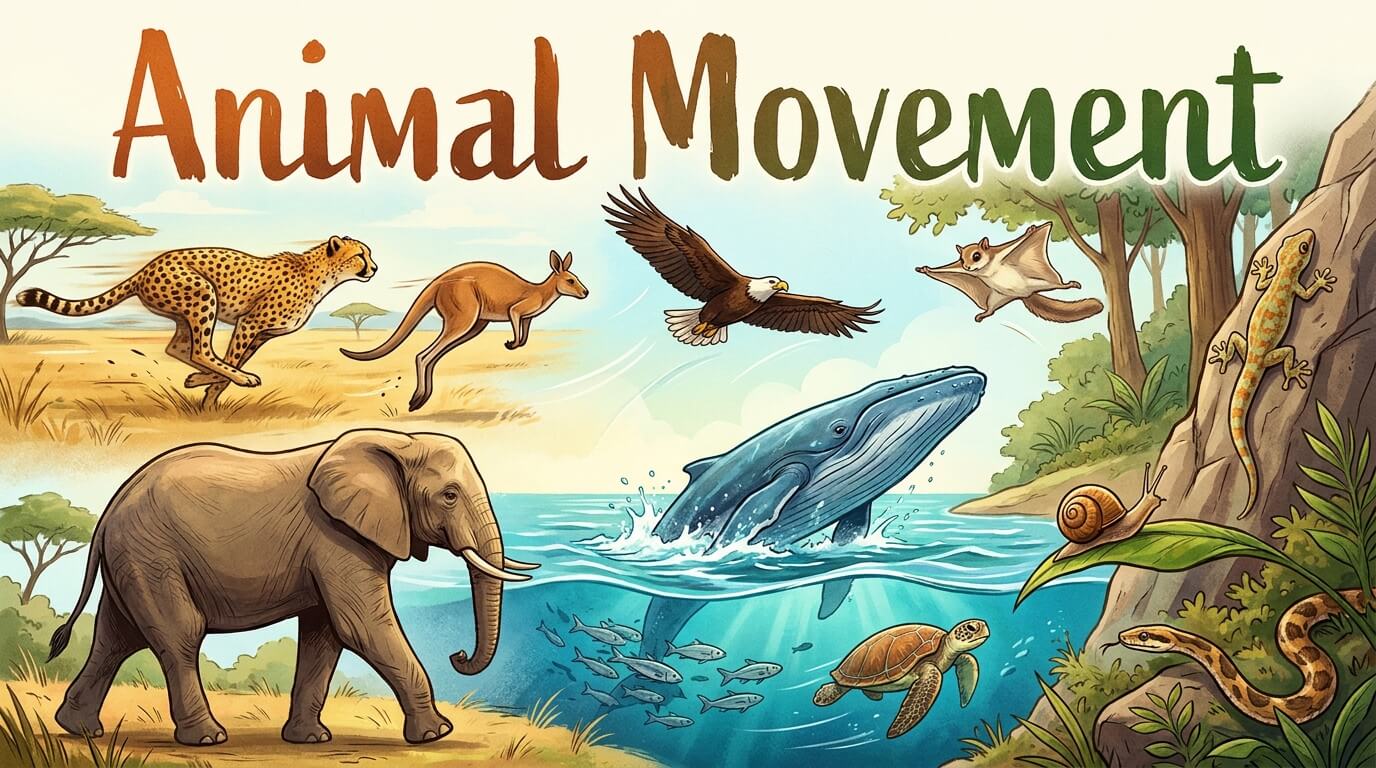
The simple idea is this: animals do not move in one best way. They move in the way their body, habitat, size, energy supply, and survival pressures allow. A trout, cheetah, gecko, eagle, frog, and crab all solve the same basic problem, getting from one place to another, with very different tools. For a broad biological definition, Britannica’s overview of locomotion describes locomotion as movement from place to place by living organisms.
Understanding animal movement makes many animal facts easier to understand. It explains why a seal looks clumsy on land but graceful in water, why a cheetah can sprint so explosively for a short distance, why birds need specialized feathers, why some animals jump instead of run, and why a slow-looking gait can still be efficient. Movement is not just motion. It is anatomy, physics, behavior, and survival working together.
Quick Overview
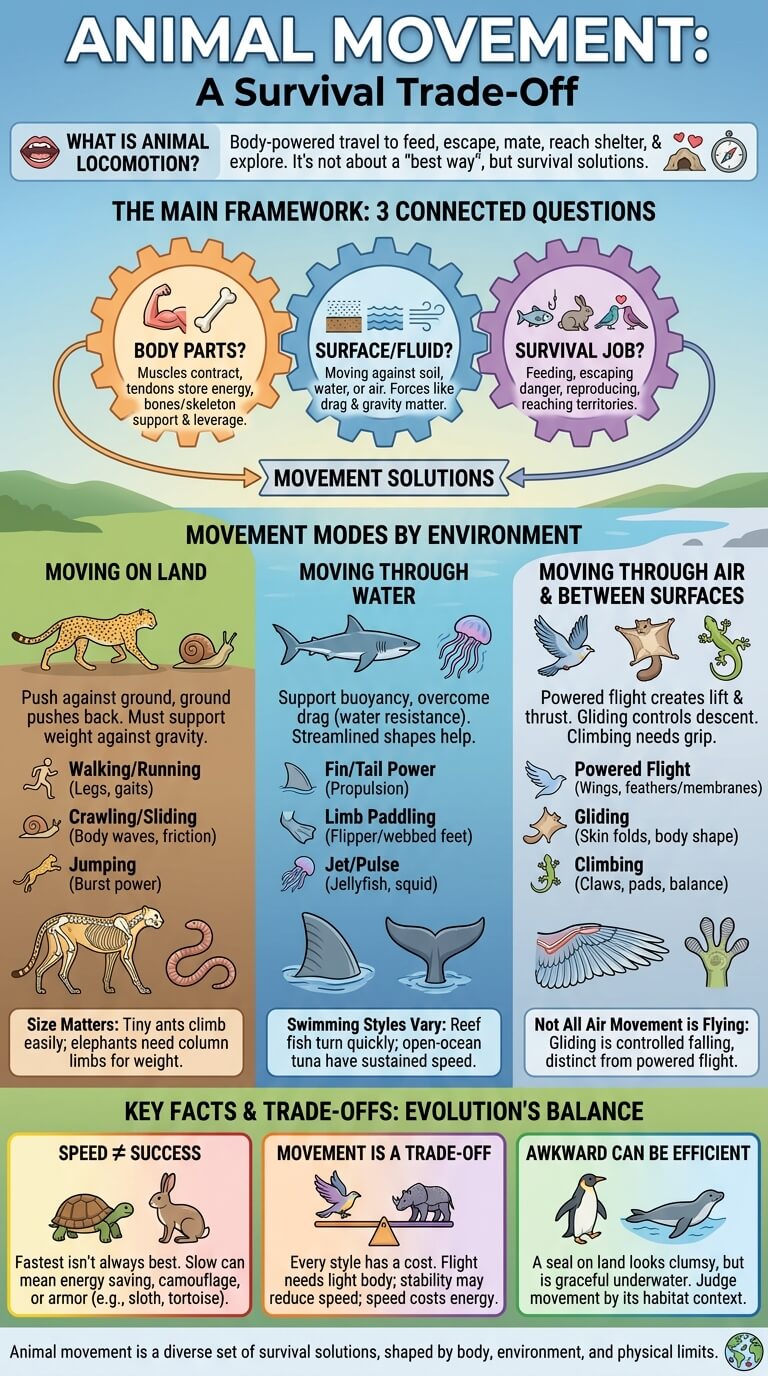
Animal movement, also called animal locomotion, is body-powered travel. It usually depends on muscles pulling on body parts such as legs, wings, fins, tails, arms, feet, or the whole body. Some animals also use water currents, wind, gravity, mucus, body waves, or spring-like tissues to make movement easier.
The main types of animal movement include land movement, water movement, air movement, and movement across surfaces such as trees, rocks, soil, ice, or cave walls. Most animals use more than one kind. A duck walks, swims, dives, and flies. A frog swims as a tadpole, hops as an adult, climbs if it is a tree frog, and may glide in a few specialized species. A crab can walk sideways, swim in some groups, and burrow into sand.
Movement is shaped by trade-offs. Speed can cost energy. Stability can reduce speed. Strong climbing claws can make flat-out running harder. Wings can allow flight, but they require light body design and high energy output. A body that works beautifully in water may struggle on land. That is why animal movement is best understood as a set of solutions, not a ladder from simple to advanced.
What Animal Movement and Locomotion Includes

Animal movement includes the visible motions people notice, such as a horse galloping or a hawk flapping its wings, but it also includes the hidden mechanics behind those motions. Muscles contract. Tendons store and release energy. Bones act as levers. Joints control range of motion. Fins and wings push against fluids. Feet grip, slide, dig, or spring away from the ground.
Biologists often use the term locomotion when the movement carries the whole animal from one place to another. A lizard running across a rock is using locomotion. A fish swimming upstream is using locomotion. A bird taking off from a branch is using locomotion. Smaller body movements, such as blinking, chewing, or turning the head, matter too, but they are not usually the main focus when people ask how animals move.
Moving on land
Land movement is built around contact with the ground. Animals push against soil, rock, bark, grass, ice, or sand, and the ground pushes back. That push creates motion. Legs are common, but they are not the only solution. Snakes use body waves and friction. Snails glide on a muscular foot. Caterpillars crawl with soft body contractions. Earthworms anchor parts of the body with tiny bristles and pull themselves forward.
Land animals must deal with gravity more directly than most swimmers. Their limbs, skeletons, or body walls have to support weight while also producing movement. That is one reason body size matters so much. A tiny ant can climb rough surfaces with ease, while an elephant needs thick column-like limbs for support and cannot leap in the way smaller mammals can.
Moving through water
Water changes the rules. It supports body weight, but it also pushes back strongly. Swimming animals must overcome drag, which is resistance from the water. Streamlined bodies, flattened tails, flexible spines, webbed feet, flippers, and fins all help animals control how water moves around them.
Some animals swim by waving the body from side to side. Others paddle with limbs, pulse like jellyfish, jet backward like squid, or move with powerful flukes. NOAA’s harbor seal anatomy page notes that harbor seals have streamlined bodies and use their hind flippers from side to side for propulsion, while the fore flippers help with steering in water through NOAA’s harbor seal anatomy transcript.
Moving through air and between surfaces
Air movement includes powered flight, soaring, gliding, parachuting, and controlled falling. Powered flight requires an animal to create lift and thrust using wings or wing-like structures. Birds, bats, and many insects are true powered flyers. Gliding animals do not flap to power themselves through the air in the same way. Instead, they launch from a height and control their descent with skin membranes, widened ribs, webbed feet, fins, or flattened body shapes.
Moving between surfaces can be just as specialized. Climbing animals need grip and control. Jumping animals need stored power and fast release. Gliding animals often begin their movement by climbing or jumping. A forest animal that moves from branch to branch may combine claws, flexible joints, balance, leaps, and glides in a single route.
The Main Framework for How Animals Move

At the center of animal movement are three connected questions. What body parts produce the movement? What surface or fluid is the animal moving against? What survival job does the movement solve? The answer changes across species, but the framework stays useful.
A fish tail and a bird wing look different, but both push against a fluid. Water and air are fluids in physics, meaning they flow around objects. A kangaroo tendon and a horse tendon look different from the outside, but both can help store elastic energy. A gecko toe and a squirrel claw solve different versions of the same challenge: staying attached while moving across a surface.
Body shape and skeleton
Body shape sets the limits of movement. A long, flexible body can bend in waves. A short, compact body may turn quickly. A streamlined body reduces resistance in water or air. A heavy body may be stable and powerful, but it can be harder to accelerate.
Skeletons help animals use muscles efficiently. Vertebrates have internal skeletons made of bone or cartilage. Arthropods such as insects, crabs, and spiders have external skeletons. Soft-bodied animals such as worms and octopuses use fluid pressure, muscle sheets, and flexible tissues instead of rigid bones. Each design offers different strengths and limits.
Muscles, tendons, and joints
Muscles create force by contracting. They usually pull rather than push, which is why animals need paired muscles, elastic tissues, or body structures that bring parts back into position. Tendons connect muscles to skeletons and can act like springs. Joints guide where movement can happen and how far it can go.
Walking and running animals often save energy by storing and returning elastic energy in tendons and other spring-like tissues. A classic Journal of Experimental Biology review of energy-saving mechanisms explains that mammals can reduce the energy cost of walking and running through gait choice, joint position, and elastic recoil in tendons and related structures.
Energy, speed, stability, and control
Every movement has a cost. Muscles use chemical energy from food and oxygen. Fast movement often requires high power. Controlled movement may require extra contact points, slower speed, or larger steering surfaces. Stable movement can be safer, but it may not be the quickest way to escape.
Animals balance these costs differently. A stalking cat needs slow, quiet control before a sprint. A grazing antelope needs rapid escape and long-distance awareness. A climbing sloth can afford slow movement because its strategy is based more on camouflage, grip, and energy conservation than speed. A hummingbird spends enormous energy hovering, but hovering lets it feed from flowers that many other animals cannot use in the same way.
Key Facts Readers Should Know About Animal Movement
The most useful animal movement facts are not just record claims. They explain why a movement style works. A fast animal is not automatically the most successful. A slow animal is not automatically poorly adapted. A strange-looking movement may be the perfect answer to a difficult habitat.
Movement is always a survival trade-off
Movement helps animals survive, but it also exposes them. Traveling can reveal an animal to predators. Running can overheat a body. Flying can demand a lightweight build that affects other traits. Swimming fast can require a streamlined shape that may reduce flexibility in tight spaces. Climbing can be safe in trees but risky on open ground.
These trade-offs explain why animals do not all evolve toward one ideal form. A cheetah’s body is specialized for acceleration and speed, but that specialization comes with limits. The Smithsonian describes the cheetah as the fastest land mammal and explains that its flexible spine, traction-providing claws, long stride, and light body help it sprint, but those sprints are short and physically demanding in Smithsonian’s cheetah profile.
The same body part can serve different movement jobs
A tail can balance, steer, swim, display, grip, or communicate. A bird’s wing can power flight, help with display, shade chicks, or move through water in penguins. A mammal forelimb can become a bat wing, a whale flipper, a mole digging tool, a monkey arm, or a horse leg. Similar body parts can be reshaped over evolutionary time for different movement problems.
This is one reason animal anatomy is so interesting. The function of a body part depends on the whole body and the environment. A flipper is not simply a flattened hand. It is part of a swimming system that includes body shape, muscles, breathing behavior, sensory systems, and the way the animal finds food.
Small animals and large animals face different physics
Size changes movement. Small animals often deal more with surface forces and can use rough textures, tiny hooks, adhesive pads, or light bodies to climb and jump in ways that seem extreme compared with their size. Large animals face greater weight-support demands and often need stronger bones, thicker limbs, and more careful movement patterns.
This does not mean small animals are always agile or large animals are always slow. It means movement must be understood relative to scale. A flea’s jump is remarkable because of its size. An elephant’s steady walk is remarkable because each step has to support a massive body safely. A whale’s swimming power is remarkable because water supports its weight, allowing a body size that would not work on land.
Walking, Running, Swimming, Flying, Jumping, Gliding, and Climbing Compared

The easiest way to understand animal movement is to compare the main modes side by side. Each one uses a different relationship between body, environment, and force.
| Movement mode | Main challenge | Common body tools | Typical survival use |
|---|---|---|---|
| Walking and running | Supporting weight while pushing against the ground | Legs, feet, joints, tendons, claws, hooves, pads | Foraging, escaping, patrolling, migration, chasing prey |
| Swimming | Overcoming drag and controlling buoyancy | Fins, flippers, tails, webbed feet, body waves | Feeding, avoiding predators, traveling, diving |
| Flying | Generating lift and thrust against gravity | Wings, flight muscles, feathers or membranes, light body design | Travel, hunting, escape, migration, finding mates |
| Jumping | Producing power quickly and landing safely | Long hind legs, elastic tendons, powerful muscles, balance structures | Escape, attack, crossing gaps, display |
| Gliding | Controlling descent without powered flight | Skin membranes, widened ribs, webbing, flattened fins or bodies | Moving between trees, avoiding predators, saving travel time |
| Climbing | Maintaining grip on vertical or uneven surfaces | Claws, adhesive pads, gripping hands, prehensile tails, flexible joints | Reaching food, nesting, hiding, escaping, moving through forests |
Walking and running on land
Walking usually involves periods when at least one foot or body part supports the animal. Running often includes faster, springier motion, and in many animals there is a moment when all feet leave the ground. Not all animals fit neat human definitions, especially animals with more than four legs, no legs, or unusual body plans.
Gaits are repeated patterns of limb movement. A horse can walk, trot, canter, and gallop. Many lizards use different gaits depending on speed and surface. Insects coordinate six legs in patterns that keep the body stable while moving quickly. Gaits matter because movement is not only about how fast an animal goes. It is also about how safely, quietly, efficiently, or powerfully it moves.
Swimming with fins, tails, limbs, and body waves
Swimming animals push water backward, downward, or sideways to move themselves forward or control direction. Fish often use body waves and fins. Whales and dolphins move their tail flukes up and down. Crocodilians use powerful tails and can also walk or crawl. Ducks paddle with webbed feet. Sea turtles use forelimbs like underwater wings.
Swimming can be slow and precise or fast and direct. A reef fish may need quick turns among coral. A tuna needs sustained speed in open water. A jellyfish pulses through the water but may also drift with currents. Movement style depends on whether the animal needs endurance, stealth, hovering control, escape bursts, or long-distance travel.
Flying, gliding, and controlled falling
Powered flight is one of the most demanding movement styles because the animal must fight gravity while moving through air. Birds use wings and feathers, bats use skin membranes stretched over elongated fingers, and insects use wings with very different anatomy. The Cornell Lab explains that bird flight feathers help form airfoils, with primaries contributing to forward thrust and secondaries contributing much of the lift through Cornell Lab’s feather guide.
Gliding is different. A flying squirrel, colugo, Draco lizard, or gliding frog starts from a height and uses body surfaces to steer and slow the fall. It may travel impressively far, but it is not producing continuous powered flight like a bird or bat. Controlled falling is still valuable because it can reduce injury, help escape predators, or let an animal move through a forest without returning to the ground.
Jumping and climbing as burst movement strategies
Jumping is a power problem. The animal must build force quickly and release it through the body. Frogs, grasshoppers, kangaroos, fleas, and jumping spiders solve this in different ways. Some rely on long legs and muscles. Others use elastic structures that store energy before releasing it rapidly.
Climbing is a grip and balance problem. Squirrels use claws. Geckos use microscopic toe structures that interact with surfaces. Primates use grasping hands and feet. Mountain goats use hoof structure and careful foot placement. Climbing often looks slow compared with running, but on cliffs, trunks, branches, and walls, control is often more valuable than speed.
How Movement Helps Animals Feed, Escape, Mate, and Travel

Movement is rarely random. Even playful movement can build skills that matter later. In adult animals, movement often supports four major survival jobs: finding food, avoiding danger, reproducing, and reaching the right place at the right time.
Hunting and foraging
Predators use movement to get close to prey, chase prey, ambush prey, or search efficiently. A heron steps slowly through shallow water. A wolf pack travels long distances and coordinates pursuit. A mantis waits still, then strikes quickly. A dolphin maneuvers through water with speed and sensory control.
Plant-eaters and omnivores also rely on movement. Grazers travel between feeding areas. Bees fly between flowers. Monkeys climb and leap through trees to reach fruit. Sea stars move slowly over surfaces, but their movement lets them reach prey that cannot simply run away. Foraging movement often reflects the food itself. Scattered food encourages travel. Hidden food encourages searching. Dangerous food areas encourage caution.
Escaping predators
Escape movement is not always about maximum speed. Some animals freeze first because stillness prevents detection. Others sprint, leap, dive, climb, burrow, zigzag, drop from branches, or retreat into shells. The best escape depends on the predator’s senses and hunting style.
A rabbit’s sudden turns can matter more than straight-line speed. A fish may dart into cover rather than swim far away. A lizard may sprint to a crevice. A bird may burst upward from grass. A slow animal may rely on armor, toxins, camouflage, spines, or a hidden lifestyle instead of fast travel.
Reaching mates, territories, and shelter
Many animals must move to find mates or defend space. Courtship displays can include dances, flights, leaps, swimming patterns, wing vibrations, or ritualized walks. Male birds may fly between display sites. Frogs may move to breeding ponds. Some mammals patrol territories by walking, trotting, or climbing along routes they know well.
Movement also helps animals reach shelter. A tree hole, burrow, tide pool, cave, nest, reef crevice, or patch of dense grass may be the difference between safety and exposure. Animals often know their home ranges through repeated movement. Their routes can reflect memory, scent marks, landscape features, season, and the location of food and water.
Common Myths or Misunderstandings About Animal Movement

Animal movement is easy to oversimplify because record-breaking facts are memorable. The problem is that record facts can hide the more useful story. Movement is not only about the fastest, strongest, highest, or farthest animal.
Fastest does not always mean most successful
The fastest animal in a category is not automatically the best survivor. Speed helps in certain situations, especially open habitats and short chases. It does not solve every problem. A fast animal can still miss prey, overheat, injure itself, or lose food to stronger competitors.
Many successful animals are slow, careful, or energy-saving. Tortoises, sloths, sea stars, snails, and many ambush predators show that survival can depend on patience, protection, camouflage, toxins, or choosing the right moment. Speed is one tool, not the goal of evolution.
Flight and gliding are not the same thing
A common mistake is calling every animal that moves through the air a flyer. True powered flight means the animal can generate thrust and lift with repeated wing movement. Gliding means the animal uses gravity and body surfaces to travel through air after launching from a higher point.
This distinction matters because it changes the body design. Birds, bats, and flying insects need structures that can power movement in air. Gliding mammals, frogs, lizards, snakes, and fish need control surfaces that slow and steer descent. Both are impressive, but they are not the same mechanical solution.
Awkward-looking movement can be highly efficient
Some animals look awkward only because humans judge movement from a human walking perspective. A seal on land, a penguin walking, a crab moving sideways, or a caterpillar crawling may seem clumsy. In the right habitat, the movement may make excellent sense.
Penguins are not built for graceful land running, but their bodies are superb for underwater pursuit. Crabs move sideways because of how their legs attach and bend. Caterpillars use soft-bodied crawling that works on leaves and stems. A movement style should be judged in the habitat where it evolved, not only on flat ground.
Why Movement Patterns Overlap Across Habitats
Many animals use more than one movement mode because real habitats are mixed. Shorelines combine water, mud, rocks, and air. Forests combine trunks, branches, gaps, leaf surfaces, and ground. Wetlands combine floating vegetation, water, soil, and open sky. Movement often changes when an animal crosses from one material to another.
Why swimming animals are not all built the same way
Aquatic animals face the shared challenge of moving through water, but their bodies vary because they use water differently. A fast open-ocean fish, bottom-walking frogfish, diving bird, sea turtle, otter, jellyfish, and seal do not need the same movement system. Some need speed. Some need maneuverability. Some need stealth. Some need to hover. Some need to move between land and water.
This is why the phrase swimming animal includes many designs. Swimming can be tail-powered, fin-guided, limb-paddled, jet-propelled, or pulse-driven. A general rule such as “streamlined bodies swim best” is useful but incomplete. Many aquatic animals trade perfect streamlining for armor, camouflage, turning ability, bottom contact, or feeding structures.
Why gliding and flightlessness reveal different paths
Gliding and flightlessness both involve air movement, but they point in different directions. Gliding can evolve as a way to control movement through the air without the full demands of powered flight. Flightlessness, in birds and some insects, usually means a lineage with flying ancestors has reduced or lost powered flight because other survival pressures became more important.
These changes show that movement evolves around context. In some forests, controlled gliding can help animals move between trees. On some islands, large ground birds historically faced fewer mammal predators before humans introduced new threats. In water, penguin wings became flippers for underwater movement rather than aerial flight.
Why animal gaits explain walking and running better than speed alone
A gait is a repeated pattern of limb movement. It explains how an animal organizes its steps, not just how fast it travels. A horse walking and a horse galloping use different coordination patterns. A dog trotting and a dog sprinting feel different because the limbs contact the ground in different rhythms. An insect can move quickly while keeping several legs on the ground for stability.
Gaits are useful because animals often change patterns as speed, terrain, fatigue, or purpose changes. A slow walk may be stable and quiet. A trot may save energy over distance. A gallop may help with a short burst. Looking at gait helps explain why two animals moving at the same speed may be using their bodies in very different ways.
FAQ
What is animal locomotion in simple terms?
Animal locomotion is the way an animal moves its whole body from one place to another. Walking, running, swimming, flying, jumping, gliding, crawling, climbing, and burrowing are all forms of locomotion. The term is useful because it focuses on travel, not just small body movements like blinking or chewing.
What are the main types of animal movement?
The main types are land movement, water movement, air movement, and surface-based movement such as climbing, crawling, burrowing, and moving through trees. Many animals use more than one type. Ducks can walk, swim, dive, and fly. Crabs can walk and burrow. Frogs may swim, hop, and climb depending on the species.
Why do different animals move in different ways?
Different animals move in different ways because they have different bodies, habitats, predators, food sources, and energy limits. A body that is excellent for sprinting across open grassland would not be ideal for squeezing through coral, climbing bark, hovering at flowers, or digging underground. Movement is shaped by survival needs, not by a single standard of progress.
Is animal movement always an adaptation?
Many movement traits are adaptations, meaning they help animals survive or reproduce in a particular context. But it is safer not to assume every detail has one perfect purpose. Some movement patterns are shaped by ancestry, body size, development, trade-offs, and physical limits as well as direct survival benefits.
Final Thoughts
Animal movement is one of the clearest ways to see how body design and habitat work together. Legs, wings, fins, tails, claws, muscles, tendons, feathers, flippers, and flexible bodies all become meaningful when you ask what problem the animal is solving. Some animals need speed. Others need grip, endurance, stealth, buoyancy, lift, balance, or energy savings.
The best takeaway is that no movement style is universally best. Animal movement is a collection of solutions shaped by water, air, land, gravity, body size, predators, food, and reproduction. Once you notice those trade-offs, even a slow crawl, sideways walk, awkward waddle, or brief glide can reveal a smarter survival story than a simple speed record ever could.

Ethan Walker is the founder and research editor of Animal Fact Central. He creates and reviews educational animal facts content using trusted wildlife, pet care, and science-based sources. His work focuses on making animal behavior, adaptations, habitats, and species facts clear, accurate, and engaging for everyday readers.
Read More Details About Ethan Walker: https://animalfactcentral.com/ethan-walker/