
Cave animals are wildlife that use caves for shelter, feeding, breeding, hibernation, or complete life in darkness. Some, such as many bats, leave the cave to feed and return to roost. Others, such as certain cavefish, salamanders, spiders, insects, and crustaceans, may spend their entire lives in dark underground spaces. The most specialized cave animals are shaped by conditions that feel strange to humans: little or no sunlight, limited food, stable temperatures, high humidity, narrow passages, and fragile water systems.
The key is that caves are not just empty holes in rock. They can be living habitats with entrance zones, twilight zones, deep dark zones, pools, streams, guano piles, roots, microbes, and animals that depend on tiny energy inputs. A cave animal does not have to be blind, pale, or rare to matter. What matters is how the animal uses the cave and how closely its survival is tied to that hidden environment.
Quick Answer

Cave animals include bats, cave crickets, salamanders, blind cavefish, spiders, beetles, millipedes, isopods, amphipods, crayfish, snails, microbes, and animals that shelter near cave entrances. Biologists often group them by cave dependence. A trogloxene is a cave guest that uses caves part-time but usually feeds outside. A troglophile can live in caves but may also live in similar moist, dark places outside caves. A troglobite, sometimes called a troglobiont, is a true cave specialist that normally completes its life cycle underground.
The National Park Service cave animal overview uses those categories to explain why bats, bears, and some other animals are not the same kind of cave dwellers as eyeless insects or fully aquatic cave species. This distinction prevents a common mistake: treating every animal found in a cave as if it were equally adapted to permanent darkness.
What Makes Caves Unique Animal Habitats
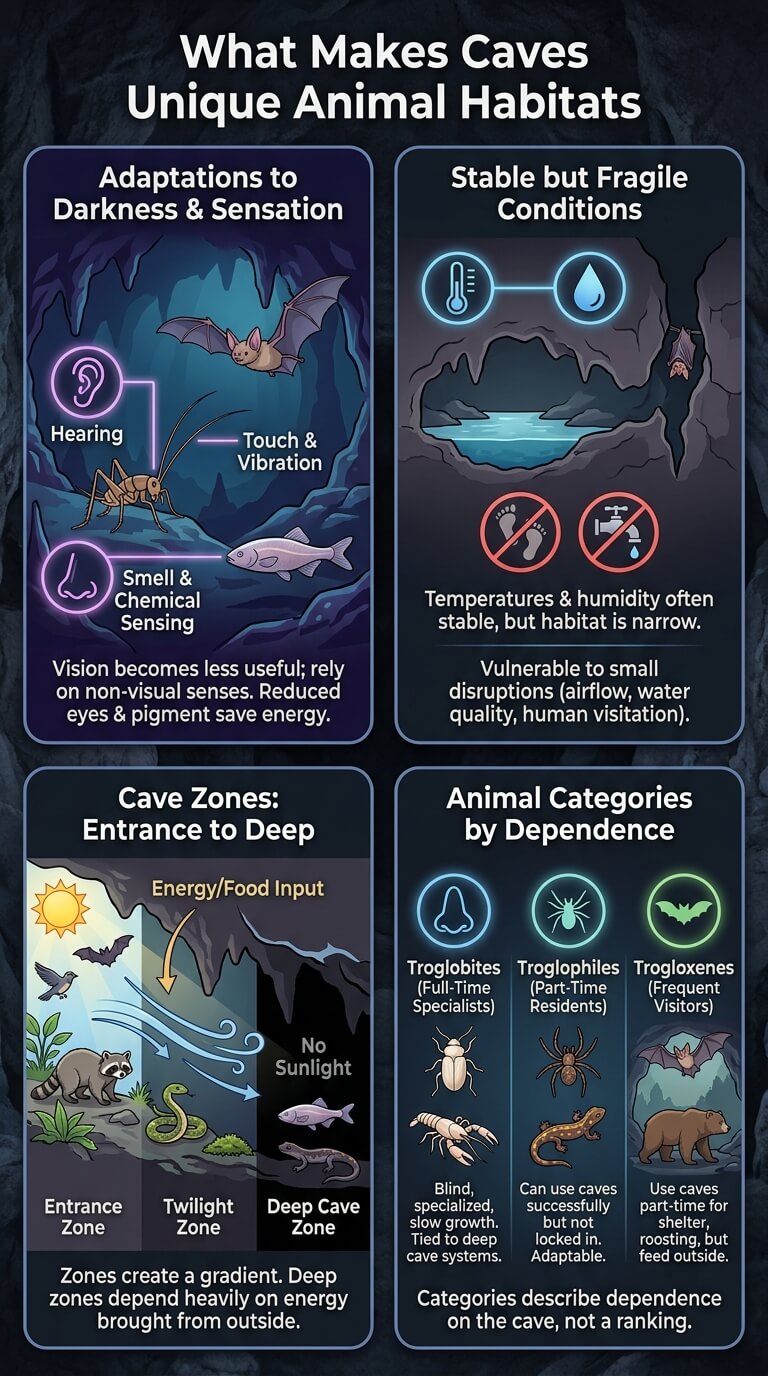
Caves are extreme because they remove or reduce several things animals often use every day. Sunlight is absent in deep cave passages. Plants cannot form normal green food webs there. Temperatures may be more stable than outside, but air movement, water level, and humidity can vary by cave zone. Food often arrives from outside through bats, crickets, floods, roots, wind, surface animals, and organic material washed underground.
Darkness, stable temperatures, humidity, and limited food
Darkness changes almost everything. Vision becomes less useful, color signals stop mattering in deep zones, and animals that rely on sight outside may need touch, smell, hearing, vibration, or chemical sensing instead. For true cave specialists, the energy cost of maintaining large eyes or strong pigment can be less useful than sensory structures that work in darkness.
Cave temperatures are often more stable than surface temperatures, especially far from the entrance. That stability can help animals avoid freezing heat or cold swings, but it can also make them vulnerable to small disruptions. A cave pool, a roost chamber, or a damp crack may have conditions that a specialist has used for many generations. Changes in airflow, water quality, human visitation, or pollution can matter because the habitat is narrow and resources are limited.
Cave zones from entrance to deep cave
Most caves are not equally dark from the entrance to the deepest passage. The entrance zone receives sunlight and often supports plants, mosses, algae, insects, spiders, birds, mammals, reptiles, and amphibians that also use the surrounding forest, mountain, desert, or wetland edge. A twilight zone receives dim light, cooler air, and more shelter than the surface. The deep cave zone has no normal sunlight and depends heavily on energy brought in from outside.
These zones create a gradient rather than a sharp border. A raccoon or snake may use a cave entrance as shelter. A cave cricket may spend the day inside and forage outside at night. A bat may roost deep enough for protection and stable conditions but feed outside. A cavefish in a deep pool may have no surface life at all. Asking where an animal is found inside the cave often tells you more than simply asking whether it is a cave animal.
Troglobites, troglophiles, and animals that only visit caves
Troglobites are the animals most people imagine when they hear about blind cave animals. They may have reduced eyes, little pigment, long appendages, slow growth, or specialized sensory systems. Many are small invertebrates, though cavefish and aquatic salamanders are famous vertebrate examples. Because many troglobites are tied to one cave system or one underground water network, they can be especially sensitive to disturbance.
Troglophiles are less extreme. They can use caves successfully but are not always locked into cave life. Some spiders, crickets, salamanders, and invertebrates may fit this category depending on species and region. Trogloxenes are cave visitors. Bats are the best-known example, but bears, rodents, birds, snakes, and other animals may use caves part-time. These categories are helpful, but they are not a ranking from simple to advanced. They describe dependence on the cave.
Main Cave Animal Adaptation Framework

Cave animal adaptations are best understood as trade-offs. In a dark, food-limited habitat, survival may favor animals that waste less energy, move carefully, sense their surroundings without light, and use scarce food efficiently. Not every cave species shows every trait. Some are blind, some are not. Some are pale, some keep color. Some are slow-moving specialists, while others are active visitors that depend on the surface.
Loss or reduction of eyesight and pigment
Many true cave animals have reduced eyes or no functional eyes, but this should not be turned into a rule for all cave animals. Bats have eyes. Some cave entrance animals see well. Some aquatic cave species have reduced vision because sight offers little advantage in permanent darkness. Reduced pigment is also common in some deep cave specialists because color is less useful where there is no light for animals to see it.
Blindness in cave animals is not a simple story of an animal deciding not to use its eyes. Over generations, traits that save energy or help survival in darkness can become more common. Eye reduction may also be linked with changes in skull development, sensory systems, and feeding behavior. The safe way to describe it is cautious: many cave specialists show reduced eyes or pigment, but cave life does not automatically make every animal blind or white.
Enhanced touch, smell, vibration, and chemical sensing
When vision is less useful, other senses can become more important. Cavefish may detect water movement and pressure changes. Cave salamanders and invertebrates may rely on smell, taste, vibration, and touch. Long antennae, leg hairs, sensitive skin, and body structures that detect movement can help animals find food, mates, shelter, and safe routes in darkness.
These sensory abilities are not magic. They work because caves are full of physical and chemical clues. Water carries dissolved chemicals. Rock surfaces hold moisture and scent trails. Vibrations travel through ground, water, and air. A tiny arthropod may find carrion or guano by chemical cues. A predator may detect prey movement through touch or water pressure. In the dark, information still exists. It just arrives through different channels.
Slow metabolism and energy conservation
Food is often scarce in deep cave habitats, so energy conservation can be a major advantage. Some cave specialists grow slowly, reproduce slowly, move less often, or survive long gaps between meals. This does not mean cave animals do nothing. It means many have life histories shaped by a habitat where wasting energy can be costly.
The USGS ecology summary for Mammoth Cave explains that a cave ecosystem does not receive sunlight in the way surface ecosystems do, so energy must arrive through other routes. That single fact explains why cave food webs tend to be low-energy compared with sunny forests, grasslands, or wetlands. It also explains why a dropped snack, polluted water, or disturbed guano pile can change more than people expect.
Long limbs, feelers, and movement in darkness
Many small cave invertebrates have long legs, antennae, or feelers. These features extend the animal’s reach before its body hits a wall, predator, prey, or opening. Long appendages can help an animal move across uneven rock, wet surfaces, loose sediment, and narrow cracks. In darkness, touching the world becomes part of navigation.
Movement in caves is often careful rather than fast. Smooth rock, wet walls, vertical drops, loose breakdown, flowing water, and tight spaces create physical challenges. Aquatic cave animals must also deal with currents, low food, and isolated pools. Some animals avoid open surfaces and stay in cracks. Others use ceilings, walls, streambeds, or guano patches. There is no single cave body plan. There are many ways to survive where light is not available.
Important Cave Animal Examples

Cave wildlife is more diverse than most visitors realize. The large animals at the entrance are only part of the story. Much of cave life is small, pale, hidden, aquatic, or active at times people do not see. Understanding examples by role is more useful than memorizing a list.
Bats as major cave visitors and nutrient movers
Bats are famous cave animals, but many are better described as cave visitors or cave roosters rather than full-time cave specialists. They may use caves for hibernation, maternity colonies, day roosts, or protection, then leave to feed on insects, nectar, fruit, or other foods depending on species. In many caves, bats also move nutrients underground through guano and dead individuals, supporting insects, microbes, fungi, and scavengers.
The National Park Service page on Mammoth Cave notes that river passages and back-flooding can bring nutrients into low cave areas, while cave-dwelling bats benefit from insects and water in those passages. This shows that cave food webs are not cut off from the outside world. Surface rivers, insects, bats, and cave chambers can be connected in one moving system.
Blind cave fish, salamanders, and aquatic cave species
Aquatic cave animals are some of the most specialized cave animals. Blind cavefish live in underground waters where sight may be reduced or absent. Some have pale bodies, reduced eyes, and strong non-visual senses. Cave salamanders range from entrance and twilight species to highly specialized aquatic forms. The olm, Proteus anguinus, is a famous cave salamander from underground waters in parts of the Dinaric karst region of Europe.
The Animal Diversity Web profile of Proteus anguinus describes olms as native to countries along the Adriatic Sea region, including Slovenia, northern Italy, Croatia, and Bosnia and Herzegovina. That kind of range detail matters because not every cave animal is widespread. Many cave species are tied to particular karst systems, aquifers, islands, lava tubes, or drainage networks.
Cave insects, spiders, millipedes, crustaceans, and microbes
Small invertebrates are the hidden engine of many cave ecosystems. Cave crickets can move food energy from the surface into caves. Beetles, springtails, mites, millipedes, spiders, pseudoscorpions, amphipods, isopods, copepods, crayfish, snails, and worms may feed on guano, fungi, detritus, microbes, carrion, or one another. Some live in air-filled passages, while others live in streams, pools, or saturated cracks.
Microbes matter too. Bacteria and fungi break down organic material, grow on wet surfaces, and form part of the base of some cave food webs. In a low-energy habitat, tiny organisms are not background detail. They are part of the recycling system that makes guano, washed-in leaves, dead insects, and carcasses usable for other life. A cave may look still to a visitor, but its small life can be constantly processing scarce resources.
Animals that shelter in caves but feed outside
Many animals use caves without being specialized cave animals. Bears may den in cave-like shelters in some regions. Snakes, rodents, foxes, raccoons, birds, frogs, and salamanders may use entrances, cracks, overhangs, or twilight zones. Swifts and oilbirds in some parts of the world are known for nesting or roosting in dark spaces, though they are not the same as deep cave specialists.
The Smithsonian’s cave salamander profile describes a North American species found from eastern Oklahoma to northern Virginia and south to central Alabama, showing how some animals associated with caves also use rocky, moist, forested habitats around cave openings. This is a useful bridge to forest and mountain habitats, but the cave article should stay focused on animals whose lives intersect with cave conditions.
How Cave Food Webs Work

Cave food webs often begin outside the cave. Surface plants capture sunlight. Insects eat plants or other insects. Bats, crickets, floodwater, roots, or animals carry organic material underground. Microbes, scavengers, fungi, and small invertebrates break that material down. Predators then feed on the animals using those resources. The deep cave is dark, but it is not disconnected from the sunlit world above it.
Guano, washed-in material, roots, microbes, and scavengers
Guano can be one of the most visible food inputs in caves used by bats or birds. A pile of droppings may support fungi, bacteria, fly larvae, beetles, mites, springtails, millipedes, and predators that hunt those smaller animals. Washed-in leaves, wood, seeds, soil, and dead organisms can support other communities, especially after floods. Roots may enter cracks and provide food or structure in some systems.
Scavengers are especially important because they turn rare food events into usable energy. A dead insect, bat, fish, or amphibian can feed multiple organisms. Carrion does not last long in active biological patches. In low-food habitats, a small piece of organic material can briefly become a hotspot, attracting microbes, detritus feeders, and predators.
Why cave ecosystems often depend on outside energy
Most familiar ecosystems begin with photosynthesis. Grasslands, forests, wetlands, and rainforests all rely heavily on plants or algae using sunlight. Deep caves usually lack that foundation. Some unusual underground systems can involve chemical energy from microbes, but the common cave food web that visitors learn about depends largely on material transported from the surface.
This outside-energy dependence is why bats, crickets, surface water, and cave entrances are so important. A cave cricket that feeds outside and rests inside may become food for spiders or salamanders. A flood that carries leaves into a cave stream can feed aquatic invertebrates. A bat colony can support a guano-based community. The cave does not make much food on its own, so animal movement is part of the food supply.
Why small changes can affect cave specialists
Cave specialists may have small ranges, slow reproduction, and tight dependence on water quality, humidity, temperature, or food inputs. That makes them vulnerable to changes that look minor on the surface. Pollution can travel through karst aquifers. Visitors can crush small animals, leave lint or food, disturb roosts, change airflow by opening gates, or carry soil and microbes between caves.
Bat conservation adds another layer. The U.S. Fish and Wildlife Service discussion of white-nose syndrome explains ongoing efforts to fight a fungal disease affecting North American bats. A cave animal article should not become a disease manual, but it should make one point clear: cave visits, gear, and roost disturbance are not harmless when sensitive bat populations or closed caves are involved.
Common Mistakes or Myths About Cave Animals
Cave animals attract myths because they live out of sight. Some myths exaggerate them as monsters. Others treat caves as empty rock chambers with a few bats. Both views miss the real biology, which is more interesting and more delicate.
Myth that all cave animals are blind
Many true cave specialists have reduced eyes, but not all cave animals are blind. Bats can see. Animals near entrances may rely heavily on vision. Cave visitors such as bears, rodents, snakes, and birds do not lose eyesight because they use a cave as shelter. Even among deeper cave species, traits vary by species, lineage, and habitat.
A better statement is this: permanent darkness can favor non-visual senses and reduced eyes in some cave-adapted animals. That wording leaves room for exceptions and avoids turning one famous trait into a universal rule.
Myth that bats are the only important cave animals
Bats can be extremely important in caves, especially where guano supports other life, but they are not the only important cave animals. Cave crickets, beetles, springtails, isopods, amphipods, spiders, millipedes, salamanders, fish, crayfish, snails, and microbes can all matter. In some caves, the most specialized species are tiny and easy to overlook.
This myth also hides the difference between cave visitors and cave specialists. A bat may use a cave seasonally and still feed outside. A tiny blind crustacean in an underground pool may have no surface life at all. Both belong in a cave animals article, but their relationship with the cave is very different.
Myth that caves are lifeless because they are dark
Darkness does not mean lifelessness. It means the food web must work differently. Caves can contain active communities built around guano, washed-in debris, roots, microbes, cave streams, flood pulses, and animals that move between surface and underground habitats. The life may be sparse, hidden, slow-growing, or microscopic, but it is still life.
Visitors may miss cave animals because they are small, nocturnal, aquatic, camouflaged, or protected from public access. Many cave organisms live in cracks, under stones, in sediment, in guano, or in water. A quiet cave wall does not prove the cave is empty. It may simply mean the animal community is not built for human eyes.
Edge Cases and Exceptions
Caves overlap with other habitat topics. Some form in limestone mountains. Some occur in lava flows. Some are connected to groundwater, springs, sea cliffs, forests, or deserts. The cave animal angle should focus on the conditions created by the cave itself rather than every animal that happens to live underground.
Lava tubes, sea caves, and karst caves without becoming an ocean topic
Karst caves form where soluble rock such as limestone or dolomite dissolves over time, often creating sinkholes, springs, underground drainage, and caves. Lava tubes form from flowing lava that leaves a hollow tube behind. Sea caves form along coasts through wave action and erosion. Each cave type can create different animal opportunities.
A sea cave may shelter birds, seals, invertebrates, or bats in some regions, but that does not make it an ocean animals article. A lava tube may support specialized arthropods or roots from surface plants. A karst cave may hold groundwater animals and bats. The shared theme is not rock type alone. It is the way darkness, shelter, moisture, and outside energy shape animal life.
Cave entrances as forest or mountain edge habitats
Cave entrances often behave like edge habitats. They may be cooler, more humid, and more protected than nearby open ground. Mosses, ferns, insects, spiders, salamanders, snakes, rodents, and birds may use the entrance even when they are not deep cave specialists. In mountainous or forested areas, the entrance can connect surface wildlife with underground shelter.
This is where cave animals naturally connect to forest animals and mountain animals. A salamander near a damp cave mouth may depend on the surrounding forest for shade and moisture. A mountain bat roost may depend on cliffs and caves but feed over meadows or water. The cave is part of a habitat network, not a sealed box.
Burrows versus caves and why they are different
Burrows and caves can both be dark underground shelters, but they are not the same habitat. Burrows are dug or modified by animals such as prairie dogs, rabbits, tortoises, badgers, foxes, ants, termites, or crayfish. Caves are natural or partly natural openings in rock, lava, coastal cliffs, or underground systems. Burrows are usually tied closely to soil engineering by the animal. Caves are shaped mostly by geology and water, then used by animals.
This difference matters for topical clarity. Animals that dig burrows have body traits and behaviors linked to excavation, soil, tunnels, and colony structure. Cave animals are shaped more by darkness, rock spaces, cave water, low food, and hidden ecosystems. Some animals use both cave-like shelters and burrows, but the main survival problem is different.
How Cave Animals Connect With Other Hidden Habitats
Cave animals sit at an interesting intersection of geology, habitat, evolution, and animal behavior. They connect naturally to underground animals, mountain animals, wetland animals, forest animals, and the larger question of why animals live where they do. The connection should stay contextual, not become a full treatment of those topics.
Underground animals that dig burrows instead of using caves
Underground animals such as moles, prairie dogs, naked mole-rats, burrowing owls, ants, termites, and many reptiles create or use tunnels in soil. Their world may be dark, but it is not identical to a cave. Soil collapses, roots, digging costs, colony defense, tunnel ventilation, and predator avoidance shape burrowing life. Cave animals, especially troglobites, often use pre-existing rock spaces or groundwater systems rather than digging their own homes.
Mountain animals that use rocky caves as shelter
Mountain animals may use caves, rock shelters, crevices, cliffs, and talus fields for protection from weather or predators. Bats may roost in mountain caves. Bears or other mammals may use cave-like shelters where available. Reptiles and amphibians may use rocky cracks near cave entrances when temperature and moisture are suitable.
Animal habitats as the broader survival framework
Caves are one example of how habitat shapes animal bodies and behavior. Forests create vertical layers. Grasslands create open visibility. Wetlands create waterlogged edges. Mountains create elevation and steep terrain. Caves create darkness, shelter, and limited food. Each habitat filters animals by what they can sense, eat, avoid, tolerate, and reproduce within.
That broader framework helps readers understand why cave animals are not just weird exceptions. They are clear examples of a larger pattern: animals survive by matching their traits and behavior to the conditions around them.
FAQ
What animals live in caves?
Animals that live in or use caves include bats, cave crickets, salamanders, blind cavefish, spiders, beetles, millipedes, isopods, amphipods, crayfish, snails, microbes, and part-time visitors such as snakes, rodents, birds, bears, and raccoons in some regions. Some are true cave specialists, while others use caves only for shelter, nesting, roosting, hibernation, or temporary protection.
Why are some cave animals blind?
Some cave animals are blind or have reduced eyes because permanent darkness makes vision less useful. Over many generations, traits linked to energy conservation and non-visual sensing may be favored in cave habitats. Blindness is not universal, though. Bats, entrance animals, and many cave visitors can still see, and some cave-associated species are not highly specialized for darkness.
Do bats live in caves all year?
Some bats use caves during particular seasons or life stages, such as hibernation, maternity roosting, or daytime shelter. Others roost in trees, buildings, bridges, mines, rock crevices, or other places depending on species and region. Bats are important cave animals where they occur, but they should not be treated as full-time residents of every cave.
Why are cave ecosystems so fragile?
Cave ecosystems can be fragile because many depend on small amounts of food, stable humidity and temperature, clean water, and species with limited ranges. Disturbing bats, collecting animals, leaving food, changing water quality, or carrying pathogens on gear can have effects that are larger than they look. The safest approach is to respect closures, stay on marked routes, avoid touching wildlife, and follow local cave rules.
Final Thoughts
Cave animals show how life can adapt to places that seem almost empty at first glance. A cave may have no sunlight and very little food, yet still support bats, crickets, salamanders, fish, spiders, crustaceans, microbes, and other hidden life. The most important thing to remember is that cave animals are not all the same. Some only visit caves. Some can live inside or outside. Some are true cave specialists shaped by darkness, low energy, and isolation.
For readers, the takeaway is simple: caves are habitats, not just scenery. Their animals depend on conditions that can be easy to disturb and hard to repair. Looking carefully, keeping distance, respecting closures, and avoiding contamination are part of appreciating cave wildlife without harming it.

Ethan Walker is the founder and research editor of Animal Fact Central. He creates and reviews educational animal facts content using trusted wildlife, pet care, and science-based sources. His work focuses on making animal behavior, adaptations, habitats, and species facts clear, accurate, and engaging for everyday readers.
Read More Details About Ethan Walker: https://animalfactcentral.com/ethan-walker/