

Animal habitats are the places where animals find the conditions they need to survive, feed, hide, move, breed, and raise young. A habitat can be as large as a mountain forest or as small as the damp underside of a fallen log. What matters is not only where an animal is found, but whether that place provides the right mix of food, water, shelter, space, temperature, nesting sites, and safety.
For readers trying to understand where animals live and why, the most useful starting point is simple: animals are shaped by the places they depend on. A frog, hawk, mole, bat, salamander, bison, otter, and tree squirrel may all live in North America, but each one uses a very different set of habitat features. Those features influence body shape, senses, daily behavior, seasonal movement, and even how an animal avoids predators.
This overview explains animal habitats as a big framework rather than a deep dive into one biome. It introduces major habitat types, clears up common terms, and shows how habitat connects to feeding, movement, shelter, reproduction, and conservation. The goal is to help you read any animal fact with better context: not just what the animal does, but why that behavior makes sense where it lives.
Quick Overview
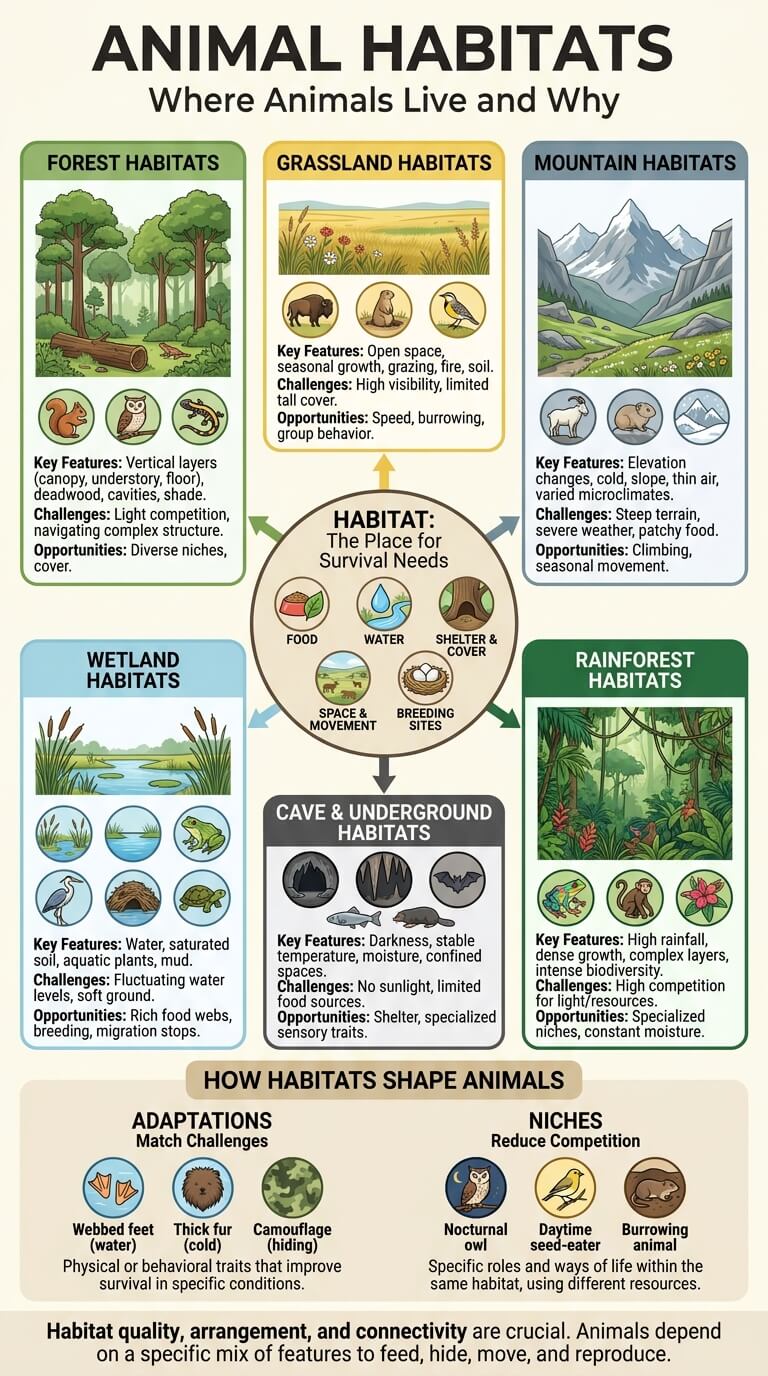
An animal habitat is the natural place or set of places an animal uses to meet its survival needs. The basic needs are often described as food, water, shelter or cover, breeding space, and enough room to carry out normal behavior. The exact version of those needs changes by species. A woodpecker may need dead or dying trees for nesting cavities. A salamander may need moist leaf litter and clean water nearby. A pronghorn may need open country where it can spot predators from far away.
Habitat is not the same thing as scenery. Two places can look similar to a person but work very differently for wildlife. A green lawn is not the same as a native meadow, and a young tree plantation is not the same as an old forest with logs, cavities, shrubs, streams, fungi, insects, and different tree ages. Animals respond to the details.
One of the most important animal habitat facts is that habitat quality matters as much as habitat type. A wetland, forest, grassland, cave, rainforest, or burrow system can support wildlife only if the required features are present in the right arrangement. That is why habitat change can affect common animals as well as rare ones.
What Counts as an Animal Habitat

An animal habitat can be a broad landscape, a narrow zone within that landscape, or a small feature used for only part of an animal’s life. A pond may be breeding habitat for frogs, feeding habitat for herons, drinking habitat for deer, and hunting habitat for dragonflies. The same patch of land can serve different animals in different ways.
For many species, habitat is not a single spot. It is a pattern of connected places. A bird may nest in a shrub, forage in nearby grass, drink from a stream, and shelter in dense vegetation during storms. A turtle may use water for feeding, sunny logs for basking, and sandy banks for nesting. When those pieces are separated or removed, the habitat may stop working even if part of it remains.
Habitat vs ecosystem vs biome
A habitat is the place an organism uses to live. An ecosystem is broader: it includes living organisms, nonliving features such as water and soil, and the interactions among them. A biome is broader still, grouping large regions with similar climate, vegetation, and animal life. Britannica’s biome overview describes a biome as a large biotic unit shaped by similar life forms and environmental conditions.
Here is a practical way to separate the terms. A salamander’s habitat might be a cool, moist forest floor near a stream. The ecosystem includes the salamander, insects, fungi, trees, soil, leaf litter, water, predators, and nutrient cycles. The biome might be a temperate forest. These terms overlap, but they are not interchangeable.
Microhabitats and home ranges
A microhabitat is a smaller place within a larger habitat that has its own useful conditions. The underside of a rock, a tree hollow, a rotting log, a tide pool, a burrow entrance, a mossy patch, or the shaded side of a stream bank can be a microhabitat. Small animals, eggs, larvae, and moisture-sensitive species often depend heavily on these tiny differences.
A home range is the area an animal normally uses during routine activities. It is not always defended like a territory. Some animals have small home ranges because their needs are concentrated in one place. Others travel widely because food, mates, water, or seasonal shelter are spread out. Species occurrence records, such as those shared through GBIF’s biodiversity data network, help researchers and conservation planners understand where organisms have been documented, though records still need careful interpretation.
Why habitat quality matters
Habitat quality describes whether a place provides enough of what a species needs, in a usable arrangement, with tolerable levels of disturbance. The U.S. Fish and Wildlife Service considers features such as space for normal behavior, cover, food, water, air, light, breeding sites, and protection from disturbance when evaluating critical habitat for listed species.
Quality can decline even when a habitat still looks natural. A stream may still contain water but be too warm or polluted for sensitive fish. A forest may still have trees but lack cavities, deadwood, understory cover, or clean water. A grassland may still be open but have invasive plants that change nesting cover or insect abundance.
Main Habitat and Biome Framework

There are many ways to group animal habitats. Some systems focus on vegetation, some on climate, and others on landform or water. For a beginner-friendly animal facts site, the most useful framework is to ask what challenge the habitat creates and what opportunities it provides. Forests offer vertical layers and cover. Grasslands offer open space and seasonal plant growth. Mountains add elevation, cold, slope, and thin air. Wetlands mix water, vegetation, and soft ground. Caves and underground spaces create darkness, stable temperatures, and limited food. Rainforests add intense biodiversity and layered competition.
The International Union for Conservation of Nature uses a detailed habitat classification scheme for Red List assessments, including broad categories such as forest, savanna, shrubland, grassland, wetlands, rocky areas, caves, desert, marine, and artificial habitats. The IUCN habitat classification scheme is a reminder that habitat labels are tools, not perfect boxes.
Forest habitats
Forest habitats are built around trees, but a wildlife-rich forest is more than trunks and leaves. Tree height, canopy cover, deadwood, understory plants, fungi, streams, leaf litter, and gaps of sunlight all create different living spaces. A squirrel may use branches and cavities. A salamander may use moist ground cover. An owl may hunt along forest edges or inside open stands.
Forests are especially important because they create vertical habitat. Animals can live in the canopy, on trunks, inside bark, in shrubs, on the forest floor, under logs, or in soil. This layering allows many species to share the same broad habitat while using different niches.
Grassland habitats
Grassland habitats are shaped by open space, grasses, wildflowers, grazing, fire, seasonal rainfall, and soil. Many grassland animals rely on visibility, speed, burrows, camouflage, or group behavior. Bison graze in open landscapes, prairie dogs build burrow systems, meadowlarks nest close to the ground, and many insects depend on native flowers and grasses.
Open habitat does not mean empty habitat. A healthy grassland can be dense with life at ground level. Seeds, roots, insects, small mammals, nesting birds, reptiles, fungi, and soil organisms all contribute to the food web. Much of the structure is low, hidden, or seasonal, so it is easy to underestimate.
Mountain habitats
Mountain habitats change quickly with elevation. Temperature, oxygen, wind, snow, vegetation, and water availability can shift over short distances. A lower slope, alpine meadow, rocky cliff, high forest, and snowfield may all support different animal communities.
Mountain animals often deal with cold, steep terrain, short growing seasons, and patchy food. Some have strong climbing ability, thick coats, seasonal movement patterns, or behaviors that conserve energy. Others use cliffs or rocky areas as protection from predators.
Wetland habitats
Wetland habitats include marshes, swamps, bogs, floodplains, wet meadows, and coastal wetlands. They are defined by water, saturated soil, and plants adapted to wet conditions. For animals, wetlands can provide food, cover, breeding areas, nesting sites, and migration stopovers.
Wetlands often connect land and water food webs. Frogs, fish, insects, turtles, wading birds, waterfowl, beavers, muskrats, snakes, and many invertebrates may use different parts of the same wetland. Shallow edges, reeds, mud, open water, submerged plants, and nearby uplands can all matter.
Cave and underground habitats
Caves and underground habitats are shaped by darkness, stable temperatures, moisture, narrow spaces, and limited plant growth. Since sunlight does not support green plants deep inside caves, food often enters through outside sources, such as bat guano, washed-in organic material, roots, or animals that move between the surface and cave.
Cave animals may have reduced eyesight, pale coloration, long antennae, slow metabolisms, or strong touch and chemical senses. Not every animal found in a cave is a cave specialist. Some use caves for shelter, hibernation, roosting, or temporary escape, while others spend most or all of their lives underground.
Rainforest habitats
Rainforest habitats are known for high rainfall, dense plant growth, and layered structure. Tropical rainforests are especially famous for biodiversity, but rainforests can differ by region, elevation, soil, rainfall pattern, and disturbance history.
The vertical layers of a rainforest create many niches. Some animals specialize in the canopy, others use tree trunks, vines, leaf litter, streams, flowers, fruiting trees, or small pools held by plants. A frog may live in a water-filled plant cup, while a monkey may travel through branches far above the ground.
Key Facts Readers Should Know About Animal Habitats

The most useful habitat facts are not just labels. They explain how a place solves or fails to solve an animal’s survival problems. Animals need resources, but they also need those resources in the right season, at the right scale, and close enough together to be usable.
Food, water, shelter, breeding space, and safe movement
Food is more than calories. It includes the right prey size, plant part, nutrient quality, seasonal availability, and access without too much risk. A hummingbird needs nectar, small insects, perches, and nesting sites. A fox needs prey, cover, denning places, and routes through its home range.
Water needs vary widely. Some animals drink often. Others get much of their water from food or live in moist environments where drying out is the main danger. Aquatic animals need water quality, oxygen, temperature, depth, and flow that fit their bodies and behavior.
Shelter includes more than hiding from predators. It can mean shade, burrows, nests, roosts, cavities, vegetation, snow cover, rocks, mud, or water depth. Safe movement matters because animals must reach food, mates, shelter, and seasonal habitat without crossing barriers that create excessive risk.
Adaptations match habitat challenges
An adaptation is a physical or behavioral trait that helps an organism survive or reproduce in a particular environment. The Smithsonian National Museum of Natural History uses examples such as owl wings, eye size, and camouflage to show how animal adaptations can be linked to habitat.
Adaptations are not magic upgrades. They involve trade-offs. Webbed feet may help in water but not on cliffs. Long legs may help an animal run through open country but make hiding in dense cover harder. A thick coat may help in cold climates but increase heat stress in warm ones.
This is why animals do not simply choose any habitat they like. Their bodies, senses, life cycles, and behavior fit some conditions better than others. When habitats change quickly, traits that worked well in the past may not match the new conditions as well.
The same biome can support very different niches
A niche is the role and way of life of a species, including what it eats, where it shelters, when it is active, how it avoids predators, and how it reproduces. In the same forest, one animal may be a nocturnal insect hunter, another a daytime seed eater, another a burrowing predator, and another a tree-cavity nester.
Niches reduce direct competition by allowing species to use different resources or use them in different ways. This does not mean conflict disappears. Predation, competition, disease, weather, and seasonal shortages still shape survival. But niche differences help explain how multiple species can share the same broad habitat.
How Animals Use Habitats to Feed, Move, Hide, and Reproduce
Habitats matter because animals use them actively. They search, listen, smell, dig, climb, swim, glide, migrate, nest, court, defend, hide, and raise young within a real physical environment. The habitat sets the rules for what works.
Feeding strategies by habitat
Feeding strategies often reflect how food is distributed. In forests, food may be layered vertically, with leaves, fruit, insects, seeds, fungi, and prey found at different heights. In grasslands, food may be spread across open ground and change strongly with seasons. In wetlands, food may be concentrated along edges where water, mud, plants, and small animals meet.
Predators also hunt differently by habitat. An owl may use silent flight and low-light vision in wooded areas. A heron may stand still in shallow water. A fox may listen for small mammals under snow or grass. A spider may build a web where flying insects pass. The hunting method matches the structure of the habitat.
Movement routes and seasonal changes
Animals move through habitats for food, mates, shelter, and climate. Some move only a short distance each day. Others migrate across large regions. Many use seasonal routes that connect breeding areas, feeding grounds, winter shelter, or stopover sites.
Movement becomes difficult when habitat is fragmented. Roads, fences, development, drained wetlands, cleared forests, and altered rivers can separate resources that animals need together. Some species cross gaps readily. Others avoid open spaces, dry ground, fast water, bright light, or human activity.
Nesting, denning, burrowing, and shelter choices
Reproduction often has stricter habitat needs than daily feeding. A bird may be able to eat in many places but nest only where the right cover, structure, temperature, and predator protection are available. A turtle may forage in water but need a suitable dry nesting site. A bat may feed over open water but roost in trees, caves, bridges, or buildings depending on the species.
Because nests, dens, burrows, and roosts are sensitive, people should avoid disturbing them. A wild animal shelter may look abandoned when it is not. Approaching, touching, moving, or trying to rescue wildlife without training can stress animals, separate young from adults, or create safety risks.
Common Myths or Misunderstandings About Habitats

Habitat myths usually come from thinking too broadly. Humans see a forest, field, pond, or cave. Animals experience temperature, moisture, cover, food size, predator pathways, nesting material, chemical cues, light, sound, and timing. The animal’s version of the place is more detailed than ours.
Myth that animals can easily move anywhere similar
It is tempting to think that if one forest is removed, forest animals can just move to another forest. Some mobile generalists may adjust, but many animals face limits. The nearby habitat may already be occupied, too far away, too fragmented, too dry, too young, too disturbed, or missing a key feature.
Moving can also be risky. Animals may cross roads, leave cover, enter unfamiliar territories, lose access to food, or face predators. Young animals, small amphibians, flightless insects, nesting birds, and animals tied to water or soil conditions may have especially limited options.
Myth that all forests, wetlands, or grasslands work the same way
Broad habitat labels hide important differences. A wetland can be tidal or inland, fresh or salty, permanent or seasonal, open or heavily vegetated. A forest can be old or young, dry or wet, continuous or fragmented, dense or open. A grassland can be native prairie, pasture, savanna, or a recently cleared field.
Those differences change which animals can live there. A species adapted to temporary pools may not thrive in a deep permanent pond. A bird that nests in tall native grass may not use a closely mowed field. A cave-roosting bat may need specific temperature and humidity, not just any dark opening.
Myth that habitat loss only affects rare animals
Rare species often get attention because their populations are already vulnerable, but habitat loss and degradation can affect common animals too. Common species can decline when nesting sites disappear, food webs change, migration routes break, water quality drops, or safe shelter becomes scarce.
Forest change is one clear example. WWF notes that forests provide habitat for a large share of mammal and bird species, and that unsustainable agriculture, grazing, logging, and infrastructure can drive deforestation and degradation in many regions, as summarized in WWF’s work on forest threats.
How This Topic Connects to Related Animal Questions
Animal habitats connect naturally to many specific animal questions. Once you understand the general framework, it becomes easier to explore why forest animals use layers, why grassland animals rely on openness, why mountain animals cope with cold and slope, why wetlands support breeding and migration, why caves favor unusual sensory traits, why rainforests contain so many specialized niches, and why underground animals dig.
Forest animals and layered ecosystems
Forest animal questions often focus on layers. Which animals live in the canopy? Which use the understory? Which depend on fallen logs, leaf litter, or tree cavities? A forest is easier to understand when you picture it as a vertical and horizontal patchwork rather than a simple wall of trees.
Grassland and mountain survival challenges
Grassland questions often revolve around openness. How do animals hide with few trees? Why do some live in herds? Why do many nest on the ground or use burrows? Speed, vigilance, camouflage, digging, group behavior, and seasonal movement are common themes.
Wetland, cave, rainforest, and underground adaptations
Wetland questions often involve water level, mud, aquatic food webs, nesting cover, and migration stopovers. Cave questions often involve darkness, limited food, roosting, and unusual sensory traits. Rainforest questions often involve biodiversity, canopy layers, fruit, insects, camouflage, and highly specific niches.
FAQ
What are the main types of animal habitats?
Main animal habitats can be grouped in several ways, but common broad types include forests, grasslands, mountains, wetlands, caves, underground habitats, rainforests, deserts, freshwater habitats, oceans, coastal areas, and human-influenced habitats such as farms, parks, suburbs, and cities. These broad labels are useful for learning, but they are only the first layer.
The more accurate answer depends on the animal. A frog may need a seasonal wetland and nearby moist land. A hawk may need open hunting areas and tall nesting sites. A beetle may depend on one host plant or decaying wood. Habitat is always species-specific.
Why do animals live in different habitats?
Animals live in different habitats because their bodies, senses, behavior, diets, reproduction, and predator defenses fit different environmental conditions. A fish is built for water, a mole is built for digging, a mountain goat is built for steep rocky terrain, and a tree frog is built for climbing and moisture.
Habitats also differ in food, water, shelter, temperature, light, space, and seasonal patterns. Over many generations, species become better suited to certain conditions. That does not mean every individual is perfectly adapted, but it does mean habitat and survival are deeply connected.
Can one animal use more than one habitat?
Yes. Many animals use more than one habitat during a day, season, or lifetime. Deer may feed in openings and shelter in woods. Some amphibians breed in water and spend much of adult life on land. Migratory birds may use breeding habitat, wintering habitat, and stopover habitat in different places.
Using multiple habitats can be an advantage, but it also creates vulnerability. If one required habitat disappears, the animal may struggle even if another part of its range remains. This is why migration routes, breeding sites, nesting areas, and feeding grounds all matter.
What happens when an animal habitat changes?
When a habitat changes, animals may adjust, move, decline, or disappear from that area. The result depends on the species, the speed of change, the type of change, and whether nearby suitable habitat is available. Some generalist animals adapt well to moderate change. Specialists often have fewer options.
Habitat change can affect food supply, water quality, shelter, breeding success, predator exposure, disease risk, and movement routes. It can also change the timing of resources, such as when flowers bloom, insects emerge, ponds dry, or fruit becomes available. Even small changes can matter when an animal depends on a narrow set of conditions.
Final Thoughts
Animal habitats explain where animals live, but they also explain why animals look, move, feed, hide, and reproduce the way they do. A habitat is not just a backdrop. It is the working environment that provides food, water, shelter, breeding space, safe movement, and the conditions that make a species’ way of life possible.
The best way to understand animal habitats is to move from broad labels to real features. Forest, grassland, mountain, wetland, cave, rainforest, and underground habitats all create different survival problems and opportunities. Once you see those patterns, animal facts become more meaningful because each fact connects back to place, behavior, and survival.

Ethan Walker is the founder and research editor of Animal Fact Central. He creates and reviews educational animal facts content using trusted wildlife, pet care, and science-based sources. His work focuses on making animal behavior, adaptations, habitats, and species facts clear, accurate, and engaging for everyday readers.
Read More Details About Ethan Walker: https://animalfactcentral.com/ethan-walker/