

Wetland animals live in places where land and water meet, mix, rise, fall, freeze, dry, and flood. Frogs, salamanders, ducks, herons, alligators, turtles, muskrats, beavers, dragonflies, snails, crayfish, and countless small invertebrates can all be part of wetland wildlife, depending on the region and wetland type. The main thing they share is not one body shape or one way of life. They share a habitat shaped by saturated soil, shallow water, dense plants, and changing edges.
Quick Answer
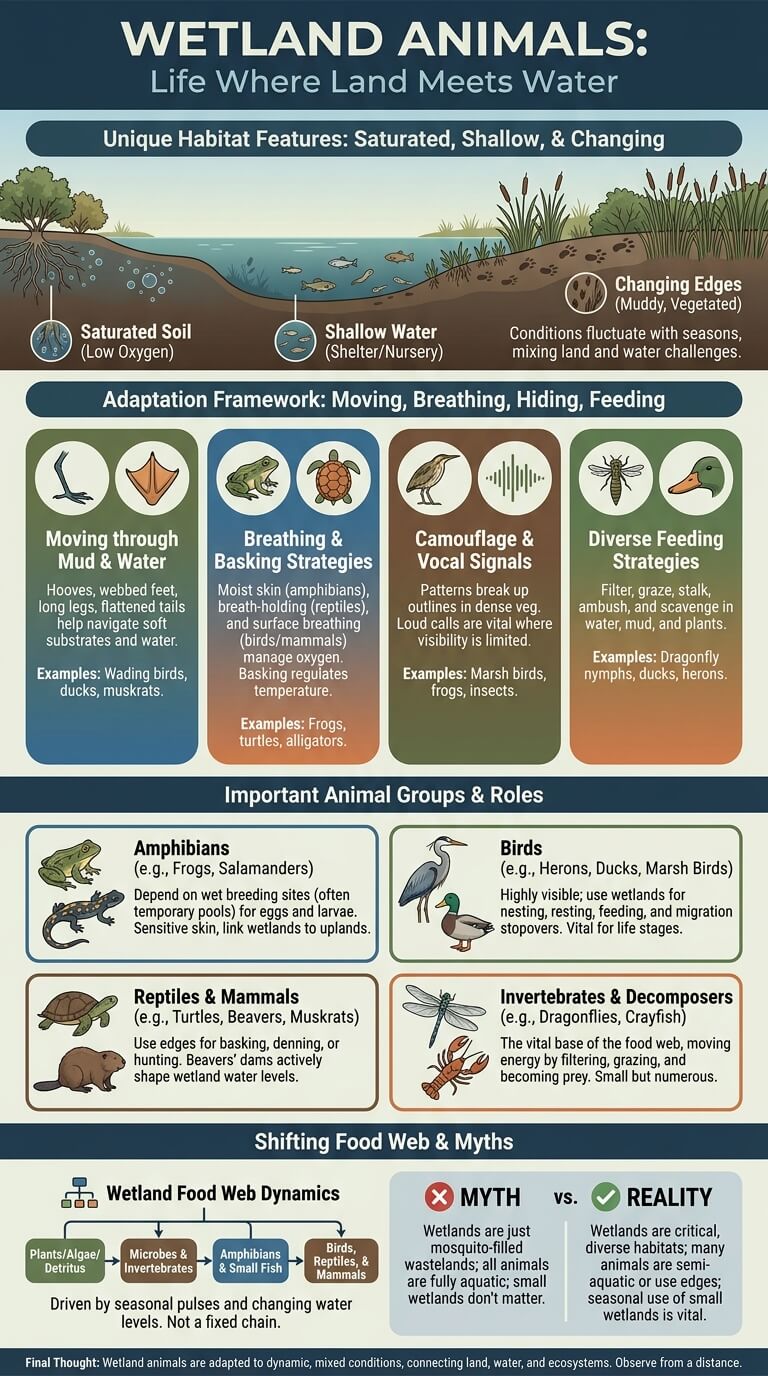
Wetland animals are animals that use marshes, swamps, bogs, fens, floodplains, wet meadows, vernal pools, mangroves, or other saturated habitats for food, shelter, breeding, migration, or protection. Some live there year-round, while others use wetlands only during a season or a life stage. Amphibians may breed in temporary pools, birds may stop in wetlands during migration, reptiles may bask along muddy edges, insects may begin life underwater, and mammals may build dens or lodges near stable shallow water.
In tropical regions, flooded forests, mangrove edges, and rainforest swamps can support rainforest animals that move between trees, water, mud, and dense vegetation.
A good way to understand wetland animals is to look at the habitat first. The EPA’s wetland classification overview explains that marshes, swamps, bogs, and fens differ in water source, vegetation, soil, and chemistry. Those differences shape which animals can thrive there. A cattail marsh, a cypress swamp, and a northern bog may all count as wetlands, but they do not create the same shelter, nesting sites, food web, or movement challenges.
What Makes Wetlands Unique Animal Habitats

Wetlands are transition habitats. They connect land and water, which means wetland animals often deal with mixed conditions instead of one stable environment. A shoreline may be underwater in spring and muddy by late summer. A shallow pond may hold fish in one place but dry out in another. A forested swamp may look like a forest from above, but its soil, roots, insects, amphibians, and animal trails are shaped by water.
Waterlogged soils, shallow water, and changing edges
The most important wetland feature is water near the surface for enough of the year to change the soil and plant community. Wetland soils are often low in oxygen because water fills the spaces that would otherwise hold air. Plants adapted to saturated soil create cover, perches, egg-laying sites, and food. For animals, this creates a habitat full of vertical stems, muddy edges, floating leaves, submerged roots, open pools, and hidden channels.
Marshes, swamps, bogs, fens, and floodplains
Marshes are usually dominated by soft-stemmed plants such as grasses, reeds, rushes, sedges, and cattails. They often support wading birds, waterfowl, frogs, insects, muskrats, turtles, and fish where water is permanent enough. Swamps are wetlands with trees or shrubs, so they can overlap with forest animal communities. Forested swamps can provide cavities, fallen logs, submerged roots, and shaded pools for animals that need both woody cover and wet ground.
Wetlands as nurseries, feeding areas, and migration stops
Wetlands are valuable because they can concentrate food and cover. The U.S. Fish and Wildlife Service wetland overview describes wetlands as habitat for many wildlife species, including migratory birds and threatened or endangered species that rely on wetlands or associated aquatic habitats. For birds, wetlands can offer nesting cover, resting places, and refueling habitat during long seasonal movements.
Main Wetland Animal Adaptation Framework

Wetland adaptations are not just about swimming. Many wetland animals are only partly aquatic. Others do not swim much at all but depend on damp soil, emergent vegetation, seasonal pools, or water-linked food. The best framework is to ask what the animal must do in a wetland: move, breathe, hide, communicate, reproduce, and feed while water levels and cover change.
Moving through mud, water, reeds, and floating vegetation
Mud is a physical challenge. Hooves, paws, claws, webbed feet, long toes, flattened tails, and low bodies all change how an animal moves in or around it. Wading birds use long legs to step through shallow water while keeping much of the body dry. Ducks and geese use webbed feet for paddling. Muskrats and beavers swim efficiently with bodies suited to water, but they also climb onto banks, lodges, or vegetation mats.
Breathing, basking, diving, and using shallow water
Water changes how animals breathe and regulate body temperature. Amphibians have moist skin and complex life cycles, but they still need oxygen and safe conditions for eggs and larvae. Turtles and alligators can hold their breath underwater for periods, then surface to breathe air. Many wetland reptiles bask because external heat helps them function. Birds and mammals breathe air, but their feeding may depend on water depth and access to submerged prey.
Shallow water can be safer than deep water for some species because it limits access for large aquatic predators, but it can also expose animals to raccoons, herons, snakes, and drying. Temporary wetlands are a special case. The National Park Service wetland description notes that vernal pools can be important for certain amphibians and invertebrates because they may lack fish, which would otherwise eat eggs or larvae. That does not make every temporary pool safe, but it shows why drying is not always bad for wetland life.
Camouflage, calls, and seasonal breeding
Wetlands can be visually confusing places. Reflections, shadows, reeds, mud, duckweed, leaf litter, and floating vegetation break up body outlines. Many frogs, turtles, snakes, young birds, insects, and mammals benefit from colors and patterns that match muddy greens, browns, grays, and plant stems. Camouflage is not invisibility. It simply makes detection harder, especially when an animal stays still in a complex background.
Sound is also important. Frogs and toads may call during breeding periods when water and temperature are suitable. Marsh birds can be easier to hear than see because dense reeds hide them. Red-winged blackbirds, rails, bitterns, and other wetland birds often rely on vocal signals in places where visibility is limited. Breeding often lines up with seasonal water, food pulses, and plant growth, so wetland animals may appear suddenly abundant after rain or spring thaw.
Feeding in water, mud, plants, and edge zones
Wetland feeding strategies are diverse. Some animals filter, scrape, graze, probe, stalk, dive, dabble, ambush, or scavenge. Ducks may feed by dabbling at the surface or tipping into shallow water. Herons and egrets stalk prey in the shallows. Frogs may sit near water and snap up insects. Dragonfly nymphs are underwater predators before they become flying adults. Snails, worms, and many small invertebrates process algae, plants, or decomposing matter.
Important Wetland Animal Groups

No single list can cover every wetland animal, because wetlands occur across climates and continents. A US reader may picture alligators in the Southeast, muskrats in cattail marshes, wood ducks in forested swamps, salamanders in vernal pools, or shorebirds on mudflats. The groups below are useful because each shows a different way to use wetland habitat.
Amphibians that depend on wet breeding sites
Frogs, toads, salamanders, and newts are strongly associated with water or damp environments during at least part of life. Many species lay eggs in water, and their larvae develop there before transforming into adults. Some species use permanent ponds, while others use temporary pools that reduce fish predation. Moisture matters because amphibian skin can lose water easily, and many species are sensitive to changes in temperature, pollution, disease, and habitat structure.
Amphibians also connect wetlands to surrounding forest or grassland. An adult salamander may spend much of the year under logs or leaf litter, then move to a seasonal pool for breeding. A frog may call from a marsh in spring but forage in nearby damp vegetation later. This is why a wetland cannot always be protected as just the water area. The surrounding upland can be part of the animal’s real habitat.
Wading birds, waterfowl, and marsh birds
Birds are among the most visible wetland animals. Herons, egrets, ibises, cranes, rails, bitterns, ducks, geese, swans, grebes, and marsh songbirds use wetlands in different ways. Long-legged wading birds search shallow water. Waterfowl feed, rest, molt, nest, or migrate through wetland networks. Marsh birds may nest in dense vegetation where stems hide nests but still allow access to insects and aquatic prey.
The Fish and Wildlife Service report on wetlands and waterfowl states that more than one third of North American bird species rely on wetlands for food, shelter, breeding, nesting, or rearing young. That does not mean every bird is a wetland specialist. It means wetlands provide critical life-stage habitat for a large share of birds, especially during migration and breeding.
Reptiles and mammals that use wetland edges
Wetland reptiles include turtles, snakes, alligators, crocodilians in suitable regions, and many lizards that use wet edges. Turtles may bask on logs, feed in water, and nest on land. Snakes may hunt frogs, fish, rodents, or other prey along banks. Alligators in the southeastern United States use marshes, swamps, ponds, and slow waters, where they are important predators and ecosystem shapers. The safety rule is simple: watch from a distance and never feed or approach wild reptiles.
Mammals are just as varied. Muskrats cut and eat wetland plants and build houses or burrows in marshes. River otters hunt aquatic prey across waterways and wetlands. Moose use some northern wetlands for aquatic plants and escape from heat or insects. Beavers are especially important because their dams can slow water and create ponded wetland conditions. The Animal Diversity Web profile of the American beaver describes dam and lodge building as central parts of beaver shelter and habitat use.
Insects, crustaceans, mollusks, and decomposers
The small animals of wetlands often do the most hidden work. Dragonflies, damselflies, midges, mayflies, beetles, mosquitoes, caddisflies, water striders, snails, clams, crayfish, worms, fairy shrimp, and many microscopic animals help move energy through the system. Some eat algae or decaying plants. Some filter particles. Some hunt other invertebrates. Many become food for fish, frogs, birds, bats, and small mammals.
How Wetland Food Webs Work

A wetland food web is not a neat chain. It is a shifting network built from plants, algae, detritus, microbes, invertebrates, amphibians, fish, reptiles, birds, and mammals. Water level affects who can reach whom. Plant density affects cover. Seasonal breeding can create bursts of eggs, larvae, insects, and young animals. Predators respond to these pulses, and scavengers clean up what remains.
Plants, algae, insects, amphibians, fish, birds, and predators
Wetland plants capture sunlight and build stems, leaves, roots, seeds, and rhizomes. Algae and microscopic organisms grow in water and on surfaces. Herbivores and detritus feeders use this material directly or after it begins to break down. Insects and other invertebrates become food for frogs, fish, birds, and bats. Fish and amphibians become prey for herons, snakes, otters, raccoons, and larger fish. The same wetland can support grazers, browsers, filter feeders, ambush predators, and scavengers.
Why mosquitoes are only one part of the wetland story
Mosquitoes are real wetland insects, but they are not the whole story. Some mosquito species breed in standing water, yet wetlands also support mosquito predators such as dragonfly nymphs, fish, bats, birds, aquatic beetles, and other invertebrates. Healthy wetlands with diverse predators and moving or changing water do not function the same way as neglected containers, clogged gutters, or artificial pools around homes.
How flooding and drying cycles shift animal activity
Flooding can open new feeding and breeding areas, but too much water can wash away nests or reduce basking sites. Drying can concentrate prey, but it can also strand aquatic animals or end breeding attempts. Many wetland animals are adapted to these cycles rather than to one fixed water level. Frogs may call after rains. Birds may move to newly flooded fields. Turtles may bask more when water drops and logs are exposed. Invertebrate communities may change quickly as pools connect or separate.
These cycles are one reason small wetlands matter. A seasonal pool, wet meadow, or floodplain depression may not hold water all year, but it can be important during a narrow breeding window. Removing it because it looks dry in late summer can erase habitat that animals use in spring. The animal value of a wetland depends on timing as well as appearance.
Common Mistakes or Myths About Wetland Animals
Wetlands are often misunderstood because they can look muddy, buggy, tangled, or hard to walk through. For animals, those same features can be useful. The myths below are common, but each misses how wetland habitats actually function.
Myth that wetlands are just mosquito-filled wastelands
Wetlands can produce mosquitoes, but calling them wastelands ignores their role as wildlife habitat, water storage areas, filters, nurseries, and feeding grounds. A marsh full of insects may also support frogs, fish, dragonflies, swallows, bats, and birds that rely on insect abundance. A swamp with dark water may shelter turtles, amphibians, snakes, fish, and mammals that would not thrive in a dry field.
Myth that all wetland animals are aquatic
Many wetland animals are semi-aquatic, amphibious, or edge-dependent rather than fully aquatic. A duck is not a fish. A heron does not live underwater. A salamander may need a wet breeding pool but spend much of its adult life in damp forest cover. A turtle may feed in water but lay eggs on land. A snake may patrol marsh edges without being a strong open-water swimmer.
This matters for habitat protection and for image accuracy. Wetland animal scenes should show animals using reeds, logs, mud, shallow water, shrubs, tree roots, floating plants, and upland edges, not just swimming in open water. The most important habitat features may be the messy transitions.
Myth that draining small wetlands has little impact
Small wetlands can matter because animal use is seasonal and local. A vernal pool may be dry part of the year, but it can still be a breeding site for amphibians when filled. A wet meadow may be used by birds during migration or by frogs during rainy periods. A roadside or farm-edge wetland may connect larger habitat patches. Size alone does not determine value.
Edge Cases and Exceptions
Wetlands overlap with other habitat categories, which can create confusion. A single place may be both forest and wetland, both grassland and wetland, or both coastal habitat and wetland. The key is to describe the animal’s actual relationship to saturated soil, shallow water, vegetation, and seasonal flooding.
Forested swamps and forest animal overlap
Forested swamps blur the line between forest animals and wetland animals. Woodpeckers, owls, songbirds, squirrels, deer, bears, snakes, frogs, salamanders, and insects may all use wooded wetlands depending on region. Dead trees, cavities, buttressed roots, fallen logs, and shallow pools create habitat layers that look forest-like above and wetland-like below.
For a wetland article, the focus should stay on how water changes the forest. Saturated soils affect tree species, roots, fallen wood, amphibian breeding, insect communities, and animal travel routes. The article should not become a general forest animals guide, but forested wetlands are a natural bridge between the two topics.
Wet grasslands and prairie pothole habitats
Wet grasslands and prairie potholes connect wetlands to grassland wildlife. In parts of North America, shallow seasonal wetlands in open landscapes can be important for ducks, shorebirds, frogs, insects, and other animals. Grassland birds may use nearby cover, while waterfowl use open water and vegetation. Water levels can change sharply with snowmelt, rainfall, drought, and land use.
This overlap explains why grassland and wetland conservation can be linked. Animals do not care whether humans label one area grassland and another marsh if their life cycle uses both. A duck may need nesting cover in uplands and brood-rearing habitat in wetlands. A frog may call from water and forage through damp grass.
Coastal wetlands without becoming an ocean animal topic
Coastal marshes, mangroves, salt marshes, and tidal flats are wetlands, but they can easily pull a reader into ocean animal territory. A wetland animal article can mention coastal wetlands as habitats for crabs, fish nurseries, wading birds, shorebirds, reptiles, and invertebrates without turning into a marine animal guide. The distinction is the habitat focus: shallow tidal edges, salt-tolerant plants, mudflats, brackish water, and nursery cover.
How This Connects to Nearby Animal Topics
Wetland animals are part of the broader animal habitats framework because they show how strongly water shapes survival. They also connect naturally to forest animals, grassland animals, rainforest animals, and underground animals, but the connection should stay contextual rather than taking over the article.
Forest animals that use wooded wetlands
Many forest animals use wet places for drinking, feeding, cooling, breeding, or hunting. A forested wetland may concentrate insects, amphibians, and soft vegetation. It may also provide cavities, fallen logs, and shaded pools. For readers, this shows that habitat categories are tools for understanding nature, not hard walls that animals obey.
Grassland animals around wet meadows
Wet meadows can function as wetland islands inside open landscapes. Birds, amphibians, insects, small mammals, and predators may use them differently across the year. During wet periods, they can provide breeding water and insect flushes. During dry periods, they may still hold greener vegetation or damp cover longer than surrounding uplands.
Animal habitats as the broader framework for wetland roles
The broader question behind wetland animals is why animals live where they do. Wetlands answer that question through water, soil, vegetation, food webs, and timing. An animal chooses or uses a wetland because the habitat provides something needed at a specific moment: eggs can develop, prey is abundant, cover is dense, migration fuel is available, or predators are easier to avoid.
FAQ
What animals live in wetlands?
Wetlands can support amphibians, reptiles, birds, mammals, fish, insects, crustaceans, mollusks, worms, and many microscopic animals. Common examples include frogs, salamanders, turtles, snakes, ducks, herons, rails, red-winged blackbirds, muskrats, beavers, otters, dragonflies, snails, crayfish, and aquatic insect larvae. The exact animals depend on wetland type, region, water depth, vegetation, season, and whether the water is fresh, brackish, or salty.
Some animals live in wetlands most of the year. Others use wetlands only for breeding, migration, feeding, or shelter. That is why a wetland can be important even if it does not always look full of wildlife.
Why are wetlands important for birds and amphibians?
Birds use wetlands for nesting, feeding, resting, migration stopovers, molting, and raising young. Dense vegetation can hide nests, shallow water can make food accessible, and mudflats or flooded fields can expose invertebrates. Amphibians often need wet places for eggs and larvae, especially species whose young develop in water. Some amphibians depend on temporary pools because those pools may have fewer fish predators.
Wetlands also support the insects and small animals that many birds and amphibians eat. Losing a wetland can remove not just water, but a seasonal food source, breeding site, and shelter area.
Are all wetland animals good swimmers?
No. Some wetland animals are strong swimmers, such as beavers, muskrats, otters, ducks, and many turtles. Others are waders, climbers, burrowers, perchers, or edge hunters. A heron is built for standing and striking in shallow water. A red-winged blackbird may nest in marsh vegetation. A salamander may depend on wet breeding sites but spend much of its time hidden in damp cover.
Thinking of wetlands only as swimming habitat misses the importance of reeds, mud, logs, shrubs, tree roots, moss, and upland edges. Many wetland animals use water without living like fish.
How do wetland animals handle changing water levels?
Wetland animals respond to changing water levels through movement, timing, flexible feeding, seasonal breeding, and use of nearby habitat. Frogs may breed after rains. Birds may shift to newly flooded feeding areas. Turtles may move between ponds, banks, and basking sites. Insects may develop quickly in temporary pools. Some animals benefit from floods, while others may lose nests or have to relocate.
Changing water levels are not automatically good or bad. The impact depends on timing, speed, depth, pollution, vegetation, and whether animals can reach nearby refuges. Natural cycles can support diversity, but sudden drainage, contamination, or poorly timed disturbance can be harmful.
Wetland viewing should be hands-off, especially around frogs, salamanders, turtles, and snakes. The CDC guidance on reptiles and amphibians notes that reptiles and amphibians can carry Salmonella even when they appear healthy, which is one more reason to observe wild animals without touching, collecting, or moving them.
Final Thoughts
Wetland animals show why habitats are more than scenery. A marsh, swamp, bog, fen, wet meadow, or floodplain can shape how animals breathe, move, hide, call, feed, breed, and migrate. Some wetland animals are obvious, like ducks, herons, frogs, turtles, and beavers. Others are tiny, hidden, seasonal, or active only at night. Together, they form food webs built around saturated soil, shallow water, plants, mud, and changing edges.
The best takeaway is that wetlands are not wasted land. They are dynamic animal habitats that connect water and land, support life stages that dry habitats cannot, and create natural bridges to forests, grasslands, rivers, and coasts. Understanding wetland animals starts with respecting that complexity and watching from a safe distance without disturbing the wildlife that depends on it.

Ethan Walker is the founder and research editor of Animal Fact Central. He creates and reviews educational animal facts content using trusted wildlife, pet care, and science-based sources. His work focuses on making animal behavior, adaptations, habitats, and species facts clear, accurate, and engaging for everyday readers.
Read More Details About Ethan Walker: https://animalfactcentral.com/ethan-walker/