
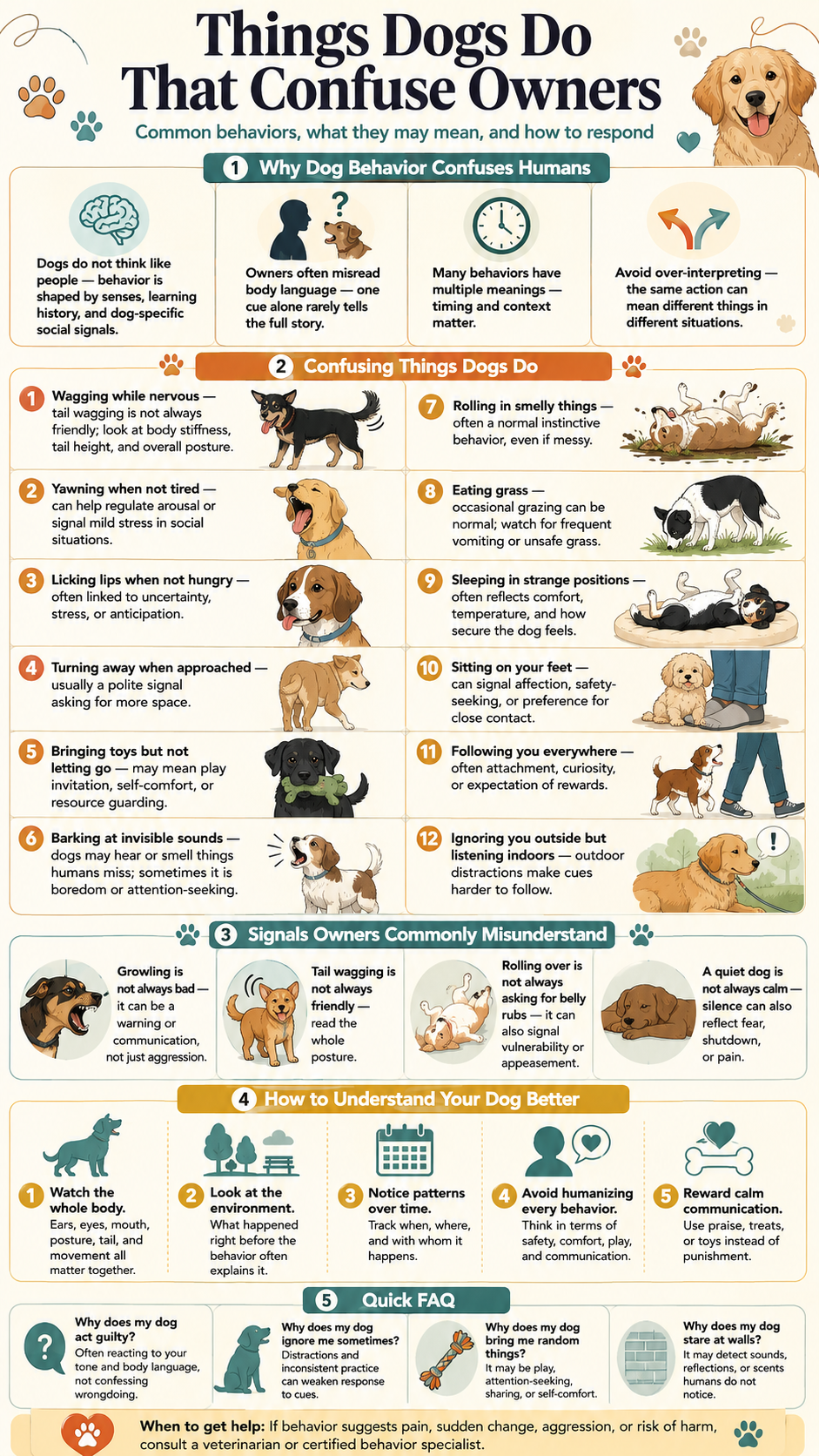
Dogs are everyday companions, but many of the things they do can leave owners puzzled. A wagging tail that seems friendly, a sudden yawn during a party, or a toy that is proudly carried but never shared can all prompt the same question: why did my dog just do that? This article focuses on the small, confusing, and often misread actions that dog owners see most commonly. The goal is to explain likely motivations in clear, cautious language and to offer practical ways to observe and respond without over-interpreting every move.

Why Dog Behavior Confuses Humans
Dogs do not think like people
People naturally look for human-style reasons behind animal actions because we use human social rules to interpret behavior. Dogs process the world using their senses, learning history, and species-specific social signals. That means behaviors that look like intentional communication to us may instead be reflexive responses, scent-driven investigations, or learned reactions to routine. Keep in mind that a behavior that seems to mean one thing to a person might mean something different to a dog.
Owners often misread body language
Human faces, posture, and tone of voice carry clear signals between people. Dog body language uses different cues and combinations. A wagging tail, a turned head, or a play bow can mean different things depending on ear position, body stiffness, and context. Rather than relying on a single cue, it helps to read the whole animal. For general resources that show how animal signaling differs across species and why context matters, see materials from major natural history organizations such as the Cornell Lab of Ornithology for examples of how researchers interpret signals in other animals and the importance of context when reading behavior from field studies and species guides.
Some behaviors have multiple meanings
Many dog actions serve more than one function. A yawn can be calming, a sign of mild stress, or simply a real yawn from tiredness. A dog that brings a toy may be asking to play, trying to initiate social bonding, or offering a comforting object to manage anxiety. Because a single action can carry several possible meanings, paying attention to timing, preceding events, and other signals is essential. Broader animal behavior resources emphasize that multiple interpretations are common across species, which is why observers should avoid rushing to a single explanation; resources that explain context-driven interpretation in wild animals can be helpful background reading about how behavior varies by situation.
Confusing Things Dogs Do
Wagging while nervous
A wagging tail is often read as a universal sign of friendliness, but tails are not a simple on-off indicator. Dogs sometimes wag when they are excited, but they can also wag when they are uncertain, stressed, or preparing to respond to something in their environment. The speed, position, and direction of the wag matter. For example, a low, slow wag with a stiff body may reflect caution, while a relaxed, wide wag with loose body movements is more likely to signal ease. When you notice a wag paired with tense muscles or avoidance behaviors, consider giving space and observing further rather than assuming friendliness.
Yawning when not tired
Dogs yawn for the same basic physical reason people do: the mechanics of yawning help with arousal regulation. Yawns can also appear in social situations as a way to manage tension. A dog that yawns when guests arrive or during a vet visit may be coping with slight stress or trying to calm itself. Because yawns can signal different states, look for other signs like lip licking, shaking off, or changes in posture to help decide whether a break, reassurance, or simply a calm pause is appropriate.
Licking lips when not hungry
Lip-licking in dogs is commonly seen as a sign of hunger, but it is often a subtle signal related to stress, uncertainty, or anticipation. A dog might lick its lips when meeting a stranger, during noisy situations, or while trying to settle. This behavior can function as a calming signal in social contexts or as an automatic response to a change in the environment. If lip-licking happens alongside other stress cues, consider removing the dog from the trigger or creating a predictable routine to reduce anxiety.
Turning away when approached
Turning the head or body away from a person or another dog can look like disinterest, but in many cases it is a polite avoidance signal. Dogs sometimes turn away to reduce the intensity of an interaction or to say that they do not want closer contact in that moment. This behavior can also prevent escalation in a tense situation. Respecting a turned-away dog by giving distance is a safe and empathetic response, and it can prevent misunderstandings that arise when owners insist on closer contact.
Bringing toys but not letting go
When a dog brings a toy and then holds onto it, several motivations are possible. The dog may be inviting play but wants the human to chase or negotiate, or the dog may be practicing resource guarding by keeping the object close. Sometimes the dog is comforting itself by holding a familiar item. To better understand the motive, note whether the dog drops the toy if you respond playfully, whether the dog stiffens when you reach, or whether offering an alternative toy or treat changes the behavior. If the dog shows signs of guarding or aggression around objects, seek guidance from a qualified professional rather than relying on trial-and-error strategies.
Barking at invisible sounds
Dogs have keen hearing and smell, and they may alert to stimuli that humans do not detect. Barking at an unseen noise could be a response to distant animals, mechanical sounds, or subtle changes in the environment. It can also be a sign of boredom or seeking attention if repeated without an identifiable trigger. To reduce persistent alert barking, consider environmental enrichment, increased supervision, or controlled training sessions that teach alternative responses. If barking appears compulsive or is associated with stress, consult a behavior specialist or veterinarian.
Rolling in smelly things
Rolling in strong odors can be baffling, but it is common across many dogs. The behavior may be rooted in ancestral tendencies to mask scent, to communicate information to the group, or simply because the smell is interesting. Although it is messy, it is usually harmless. If rolling in odors becomes frequent or involves potentially hazardous substances, supervise outdoor time more closely and use redirection to discourage the habit.
Eating grass
Many dogs nibble grass occasionally. Some owners worry this means the dog is ill, but occasional grazing can be a normal behavior. Possible reasons include curiosity, boredom, or a desire to add fiber to the diet; it may also be a way to explore plant textures. If grass-eating is frequent or followed by vomiting, or if the grass could be treated with pesticides, consult your veterinarian to rule out medical issues and to ensure safety.
Sleeping in strange positions
Dogs sleep in a variety of positions that can look unusual to people. The position a dog chooses often reflects comfort, temperature regulation, and the need to stay alert. For instance, a dog that sleeps curled up may be conserving heat or protecting itself, while one that stretches out may be cooling down and feeling secure. A change in sleep posture that coincides with other changes in behavior, mobility, or appetite is worth noting and discussing with a veterinarian if it persists.
Sitting on your feet
Sitting on a person’s feet can be read as possessiveness or as affection and safety-seeking. Many dogs use close contact to feel secure and to maintain proximity to a trusted person. For some dogs it is a calming strategy, and for others it is a way to claim a preferred position. If the behavior is mild and welcome, it can be tolerated. If it becomes clingy or interferes with daily activities, create clear boundaries with consistent routines and positive reinforcement for relaxed independence.
Following you everywhere
Clingy following behavior often reflects attachment, curiosity, or the expectation of rewards such as petting, feeding, or walks. Dogs are wired to socialize and to monitor the activities of group members, so following is a natural way to stay connected. Excessive following that shows signs of separation anxiety should be addressed with gradual desensitization exercises and professional support when needed. For everyday cases, offering a comfortable resting place and safe independence-building activities can reduce constant shadowing.
Ignoring you outside but listening indoors
Some dogs respond reliably at home but are less attentive outdoors. The outdoor world is filled with distractions, scents, and novel stimuli that compete for the dog’s attention. Indoors, the environment is predictable and cues are easier to generalize. Practice with short, rewarding training sessions in progressively more distracting settings to build outdoor reliability. If avoidance seems sudden or is linked to fear of outdoor stimuli, work at the dog’s pace or seek guidance from a behavior professional.
Behaviors Owners Commonly Misunderstand
Growling is not always bad
Growling can be a warning, a way to communicate discomfort, or a playful noise in certain contexts. It is a form of communication that tells others to back off, change their approach, or adjust behavior. While growling can precede aggression in some situations, it can also prevent escalation by giving a clear cue. Treat growling as information: ask what triggered it, whether the dog is in pain, and how to change the situation to reduce stress. If growling is frequent or is paired with stiff body language, freezing, or biting, consult a professional.
Tail wagging is not always friendly
As mentioned earlier, tail wagging can signal a range of internal states. The speed, height, and direction of the wag combine with other signals to convey meaning. A dog may wag when uncertain, when focused on a task, or when preparing for action. Read the whole posture rather than assuming a wag equals friendliness. If you are unsure, err on the side of caution and allow the dog to choose the distance of interaction.
Rolling over is not always asking for belly rubs
Many owners interpret a roll onto the back as an invitation for a belly rub. While some dogs do expose their bellies for petting, others roll over to show submission, to signal vulnerability, or to defuse a tense interaction. If the dog appears relaxed and offers the belly with a soft body, it is often an invite. If the dog shows avoidance signals, closed mouth, or quick movements, it may be attempting to avoid contact or express discomfort. Proceed slowly and watch for cues that the interaction is enjoyable for the dog.
A quiet dog is not always calm
Silence does not always equal calm. A quiet dog may be shut down, fearful, or in pain, as well as relaxed. Behavioral quieting can be a stress response in some dogs, whereas others are naturally less vocal. If a normally vocal dog becomes unusually quiet along with other changes in appetite, mobility, or interest in activities, it is appropriate to check with a veterinarian.
How to Understand Your Dog Better
Watch the whole body
To interpret a dog’s message, watch the entire posture instead of relying on a single cue. Look at ear position, eye shape, mouth tension, body stiffness, and tail carriage together. Small, consistent changes across several parts of the body give the best clues about what your dog is feeling. Practicing this type of observation in calm settings helps you recognize subtle shifts in more charged moments.
Look at the environment
Context often explains behavior. Consider what happened right before an action, what is present in the environment, and whether there are triggers that make the behavior more likely. For example, a certain noise outside, presence of other animals, or a particular room in the house may predict when a behavior will occur. Journaling brief notes about incidents and their surroundings can reveal patterns over time.
Notice patterns
Observing when, where, and with whom a behavior appears helps distinguish occasional quirks from consistent signals. Patterns reveal triggers and offer starting points for change. If a behavior appears regularly under the same circumstances, you can plan targeted management or training to modify the context or the dog’s response. Professional trainers and behaviorists rely on pattern recognition to build effective plans, so documenting incidents is a helpful first step.
Avoid humanizing every behavior
Giving dogs human motives they do not have can lead to confusion and misplaced expectations. While it is natural to interpret a dog’s actions through a human lens, try to balance empathy with species-specific understanding. Think in terms of needs and responses — safety, social connection, scent information, play, and comfort — rather than complex human emotions unless there is clear evidence of those states.
Reward calm communication
Positive reinforcement for clear, calm communication helps dogs learn what behaviors are effective and welcome. Reinforce brief periods of relaxed attention, gentle approaches, and voluntary moves away from triggers with treats, praise, or a toy, depending on what motivates your dog. When a dog uses a polite signal — such as turning away or sitting quietly — rewarding that choice teaches an alternative to escalation. Avoid punishment-based tactics that can make communication less reliable and increase stress.
Things Dogs Do That Confuse Owners FAQ
Why does my dog act guilty?
The classic “guilty look” often reflects a dog’s reaction to the owner’s tone, body language, and immediate cues rather than a dog’s internal confession of wrongdoing. Dogs are excellent at reading human reactions and may respond to a scolding tone or tense posture by showing appeasement behaviors such as looking away or lowering the head. To reduce this dynamic, catch and reward desired behavior rather than punish after the fact, and make expectations consistent so the dog learns clear rules.
Why does my dog ignore me sometimes?
Ignored cues outdoors or in stimulating settings often stem from competing priorities: new smells, sights, or social targets can override the value of a recalled cue. Additionally, if a cue is not reinforced reliably across different environments, the dog may not generalize the behavior. Build reliable responses by practicing in short, fun sessions with high-value rewards and gradually increasing distractions. If the dog’s ignoring happens suddenly and across contexts, consider whether pain, fear, or sensory change might be interfering and consult a veterinarian if concerned.
Why does my dog bring me random things?
Bringing objects can be an offer to share, a request to play, a way to seek attention, or a method of self-comfort. Observe whether the dog drops the item when you interact, whether the dog solicits a game, or whether the item is carried to a favorite spot. Respond in ways that teach preferred exchanges: trade a less valuable object for a treat to encourage releasing items, or accept the item and play briefly if the goal appears to be social connection.
Why does my dog stare at walls?
A dog that stares at walls may be sensing unfamiliar noises, reflections, or scent trails that are imperceptible to humans. Dogs may also fixate when bored or when seeking something to do. If wall-staring is new, persistent, or accompanied by disorientation or other unusual signs, a veterinary check is warranted to rule out sensory changes or neurological conditions. In mild cases, enriching the environment with safe toys, scent games, and interactive play can redirect attention.
For general background on how researchers and naturalists observe animal behavior in the field, and why context and species differences matter, readers can consult resources from conservation and species-focused organizations that discuss observational methods and the diversity of animal signals, such as informative pages from the Cornell Lab of Ornithology about field observation and public education materials available from All About Birds that illustrate how signals can vary by situation. Broader conservation organizations also discuss why careful interpretation is important across species in global species accounts on the IUCN Red List and in habitat and behavior summaries from BirdLife International.
If a behavior suggests pain, sudden change, or risk of harm to the dog or people, consult a qualified veterinarian or certified behavior specialist. Avoid punishment-based approaches and prioritize safety and observation. Clear, patient, and context-aware observation will help most owners decode confusing dog actions and deepen the human-dog relationship over time.

Ethan Walker is the founder and research editor of Animal Fact Central. He creates and reviews educational animal facts content using trusted wildlife, pet care, and science-based sources. His work focuses on making animal behavior, adaptations, habitats, and species facts clear, accurate, and engaging for everyday readers.
Read More Details About Ethan Walker: https://animalfactcentral.com/ethan-walker/