
Sharks live in the space between myth and reality: teeth, fins, and a reputation that attracts viral headlines. This article takes a different approach. Each entry starts with a surprising statement and then explains why it is true using careful, non-sensational language. Where claims touch on conservation or species identity, links to official resources are provided so you can follow up. Observe wild sharks from a distance and do not attempt to approach, feed, touch, capture, or otherwise harass them; consult qualified professionals or local authorities for safety or rescue situations.
Some Sharks Can Live Much Longer Than People Expect
Greenland shark longevity
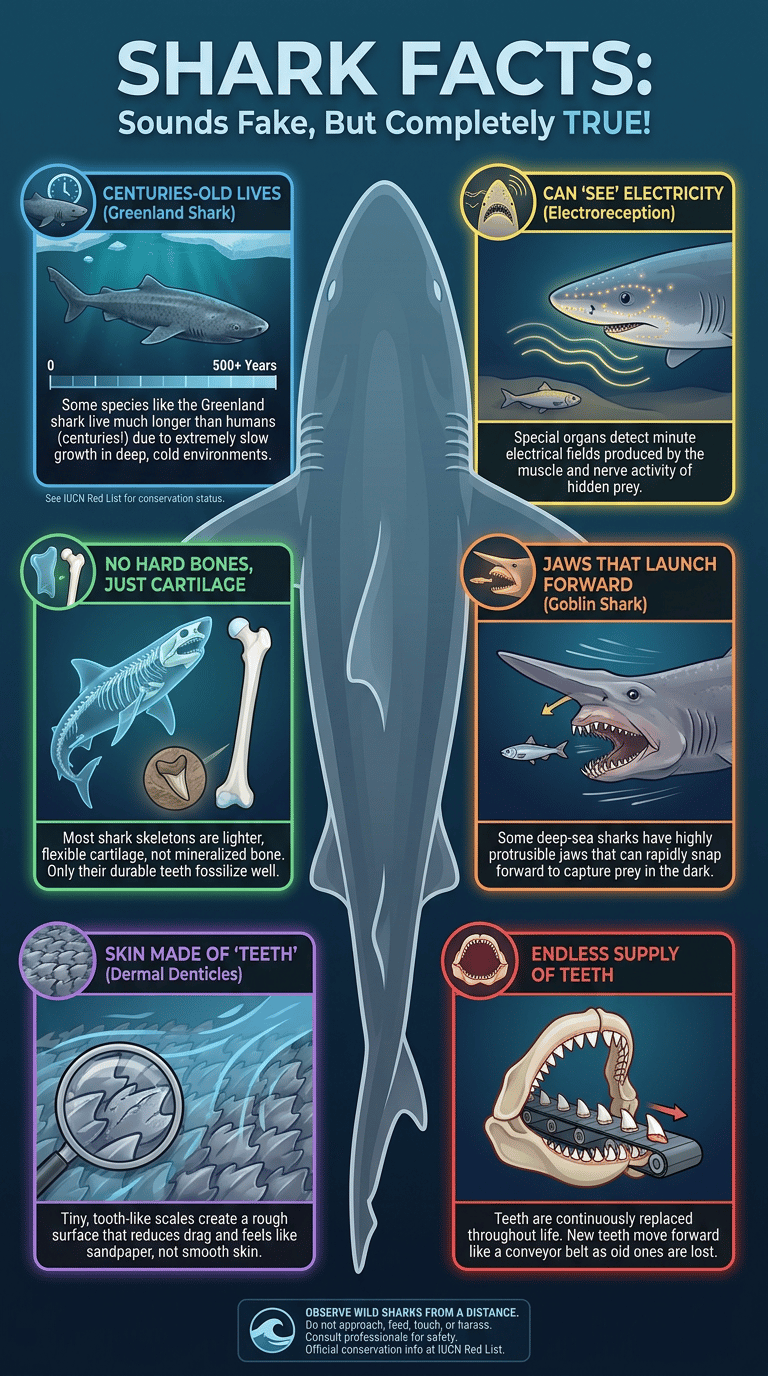
It sounds impossible: individual sharks living far longer than most other vertebrates. Scientific research has identified Greenland sharks as among the longest-lived vertebrates, with exceptionally slow growth and very late sexual maturity. For authoritative species accounts and conservation assessments, consult the IUCN Red List.
See the IUCN Red List for up-to-date conservation information.
Why this sounds impossible
Long lives measured in many decades do not fit our everyday experience. Humans tend to meet animals with lifespans similar to ours or much shorter lives, so a vertebrate living well beyond a human lifetime feels unlikely. The idea challenges simple assumptions about growth and maturity.
What it reveals about slow growth
Greenland sharks and some other cold-water species spend their lives in deep, cold environments where metabolic processes proceed more slowly than in warmer waters. Slow growth and late maturity are linked: when an animal grows slowly, it often delays reproduction. That life-history strategy affects population dynamics and recovery from human impacts; consult conservation assessments for species-level context on management and threats.
Some Sharks Have No Hard Bones
Cartilage skeleton
Although many people expect a skeleton to be bone, most sharks have skeletons composed primarily of cartilage rather than mineralized bone. Cartilage is lighter and more flexible than bony tissue and forms the structural framework for shark bodies. Because cartilage fossilizes differently than bone, shark fossils are often represented by teeth and other mineralized elements.
Why this makes them flexible
Cartilage provides flexibility and reduces overall density. For many shark species, this arrangement helps them maneuver efficiently through water and maintain buoyancy. A primarily cartilaginous skeleton is one of several anatomical features that set sharks apart from bony fishes and influences swimming and feeding mechanics.
Why they still fossilize through teeth
Even though shark skeletons are mostly cartilage and less likely to fossilize, sharks continually replace their teeth throughout life. Teeth are mineralized and durable, so they survive in the fossil record far better than cartilage. Paleontologists commonly find fossilized shark teeth, which provide much of our knowledge about ancient shark diversity and evolution.
Shark Skin Is Made of Tiny Tooth-Like Scales
Dermal denticles
Shark skin feels rough if you rub it the wrong way. That rough texture comes from dermal denticles, tiny scales with a tooth-like structure. Each denticle has enamel- and dentine-like components, creating a surface unlike the smooth skin of many bony fishes or the fur and feathers of terrestrial animals.
Why it feels rough
When you run your hand from head to tail the wrong way, the denticles resist motion. That is why museum specimens or preserved shark-skin samples feel abrasive. The roughness is a natural adaptation rather than a sign of poor hygiene or damage.
How it helps swimming
Dermal denticles do more than make skin feel coarse. Their shape and orientation reduce friction and control small-scale water flow along the body, helping sharks move efficiently. In some species, denticle patterns reduce drag and suppress flow separation. Engineers have studied denticles as inspiration for swimwear and hull coatings.
Some Sharks Can Detect Electricity
Electroreception
Sharks can sense the faint electric fields produced by living animals. This sense, called electroreception, uses specialized sensory organs concentrated in the head region. These organs detect tiny voltage gradients produced by muscle and nerve activity and turn electrical signals into information about the presence and location of other animals, even when they are hidden or motionless.
Why every living animal gives off signals
Muscle contractions and nerve impulses involve ion movement, and those ion currents produce minute electrical fields that extend into surrounding water. Because water conducts electricity, these fields are detectable at short range. Electroreception is therefore a reliable cue in aquatic habitats where visibility is reduced.
How sharks use this to find hidden prey
Sharks use electroreception to detect prey buried in sediment or concealed in crevices. The sense complements smell, vision, and mechanoreception, allowing sharks to localize and capture animals that would otherwise be invisible.
A Whale Shark Is a Fish, Not a Whale
Why the name confuses people
The name whale shark can mislead people into thinking the animal is a mammal. In fact, the whale shark is a cartilaginous fish in the shark lineage. The “whale” part of the common name refers to its large size and filter-feeding habit, which are superficially similar to some baleen whales.
Why whale sharks are true sharks
Whale sharks share key shark features such as gill slits and a cartilaginous skeleton, and their evolutionary placement is within the shark lineage. Calling them a type of fish is accurate. For conservation context and species accounts, consult official assessments.
For conservation status and species accounts, see the IUCN Red List.
How they feed without hunting large animals
Despite their size, whale sharks are filter feeders. They take in water and strain out plankton, small fishes, and other tiny organisms. This feeding mode differs from the bite-and-tear hunting associated with many other sharks, and as large planktivores, whale sharks play ecological roles in marine systems.
Some Sharks Can Walk Along the Seafloor
Walking shark species
It sounds like a cartoon, but a handful of shark species use their fins to move along the bottom in a walking-like fashion. Small sharks in certain families brace and push with their paired fins to move in short steps. These species are sometimes described as walking sharks or referenced by common names such as epaulette or bamboo sharks.
Readers comparing shark facts that sound fake but are true may also find interesting facts about sharks useful for a deeper look at a closely related shark topic.
How they use their fins
Rather than true terrestrial locomotion, walking sharks use strong pectoral and pelvic fins to push and pivot across the seafloor. The motion often looks slow and deliberate and is useful in complex habitats where swimming would be less effective or where access to tight crevices matters for feeding or escape.
Why this helps in shallow reef habitats
Walking-like movement helps in shallow reef or rubble habitats where maneuverability and the ability to hold position matter more than fast swimming. These species can navigate tight spaces to hunt small invertebrates or shelter in microhabitats. If you encounter small sharks while snorkeling or diving, observe from a respectful distance and avoid disturbing them.
Goblin Sharks Can Launch Their Jaws Forward
Why their jaw movement looks fake
Goblin sharks have an extreme jaw mechanism. When they strike, the jaws can extend forward rapidly to snatch prey, creating an appearance that seems like the jaw is shooting out of the face. The motion is striking and can look like a cinematic trick rather than a real biological behavior.
How it helps in the deep sea
Goblin sharks inhabit deep water where prey encounters are rare and quick. A highly protrusible jaw allows them to capture small, quick-moving animals at very short range by rapidly extending the bite zone. This adaptation suits a low-energy, ambush-based feeding strategy in dark and sparsely populated habitats.
Why they are rarely seen
Goblin sharks live mostly in deep water, well below the zones of routine human activity. Their habitat and relatively low abundance mean encounters are infrequent, and most information about them comes from rare captures or deep-sea observations. People should not expect to encounter these sharks in shallow coastal settings.
Sharks Can Lose Teeth While Eating and Be Fine
Continuous tooth replacement
It sounds alarming to lose teeth while eating, but for many sharks this is normal. Shark teeth are replaced throughout life in a conveyor-belt fashion. New teeth develop behind existing ones and move forward as older teeth are shed. This system allows sharks to maintain functional dental arrays without the long recovery period many mammals experience when losing teeth.
Rows of backup teeth
Sharks typically have multiple rows of teeth. When a front tooth is lost, a backup tooth moves into place quickly. This redundancy ensures that the animal can continue feeding effectively even after losing teeth during prey captures or from wear.
Why this is a perfect predator adaptation
For predators that bite and tear prey, a continuous tooth supply is adaptive. Having spare teeth ready reduces the risk of long-term impairment from tooth loss and helps maintain feeding performance through an individual’s life.
Not All Sharks Need to Swim Constantly
Ram ventilation vs buccal pumping
It is commonly stated that some sharks must swim constantly to breathe. While that is true for species that rely on ram ventilation, other sharks can actively pump water across their gills. Ram ventilators force water through the mouth and over the gills by forward motion, but species that do buccal pumping can breathe while stationary by moving muscles in the mouth and pharynx to draw water in.
Sharks that rest on the bottom
Some sharks rest on the seafloor and breathe without forward swimming because they use buccal pumping. This behavior is common among benthic sharks that inhabit reefs and continental shelves. Whether a shark must swim constantly depends on species-specific respiratory mechanics.
Why this myth is only partly true
The statement “all sharks must swim constantly” is an oversimplification. It is true for some species but not for others. Sharks are a diverse group with a wide range of respiratory strategies and behaviors.
Some Sharks Are Smaller Than a Cat
Tiny shark species
When people think of sharks, they often picture large apex predators, but many shark species are quite small. Some species’ adult body lengths are shorter than an average house cat. These diminutive sharks occupy ecological niches that do not require large size to forage or reproduce successfully.
Why not all sharks are giants
Shark diversity includes a range of body sizes that reflect different life-history strategies and habitats. Being small can be advantageous in certain environments, such as tight reef crevices or deep-sea habitats where prey types and energy budgets favor smaller body plans.
Small sharks in deep-sea ecosystems
Some small shark species live in deep or dimly lit habitats where tiny prey and specialized feeding modes allow them to thrive without the size advantages seen in surface-dwelling or pelagic predators. Minimize disturbance if you observe small sharks in the wild.
FAQs About Shark Facts That Sound Fake
What shark fact sounds the most fake?
People often find the idea that individual sharks can live for centuries the most unbelievable. Slow-growing, cold-water species have life histories that allow unusually long lifespans compared with many other vertebrates. For official species information and conservation context, check authoritative species assessments such as the IUCN Red List: IUCN Red List.
Are walking sharks real?
Yes. A small number of shark species show walking-like use of their fins to move across the seafloor. The motion is specialized and occurs in particular habitats. Observe from a respectful distance to avoid stressing animals.
Can sharks really sense electricity?
Yes. Sharks have electroreceptive organs that detect the tiny electric fields produced by muscle activity and neural signals in other animals. This sense is especially useful for finding hidden prey or locating animals in low-visibility conditions and complements other senses such as smell and vision.
Do sharks really have no bones?
Many sharks have skeletons made predominantly of cartilage rather than mineralized bone, which is a central difference from bony fishes and terrestrial vertebrates. Cartilage-based skeletons influence swimming mechanics, buoyancy, and fossilization patterns; fossil evidence is often dominated by shark teeth.
Are goblin sharks real?
Yes. Goblin sharks are a real deep-sea species with a protrusible jaw that can extend forward rapidly to capture prey. They are rarely encountered because they inhabit deep water, and most knowledge about them comes from occasional captures and deep-sea observations.
For information about international protections and trade controls that can affect shark species, consult the Convention on International Trade in Endangered Species of Wild Fauna and Flora.
For additional public-facing natural history resources, consult institutional wildlife and zoo pages maintained by recognized organizations.

Ethan Walker is the founder and research editor of Animal Fact Central. He creates and reviews educational animal facts content using trusted wildlife, pet care, and science-based sources. His work focuses on making animal behavior, adaptations, habitats, and species facts clear, accurate, and engaging for everyday readers.
Read More Details About Ethan Walker: https://animalfactcentral.com/ethan-walker/