
What Do Sharks Eat?
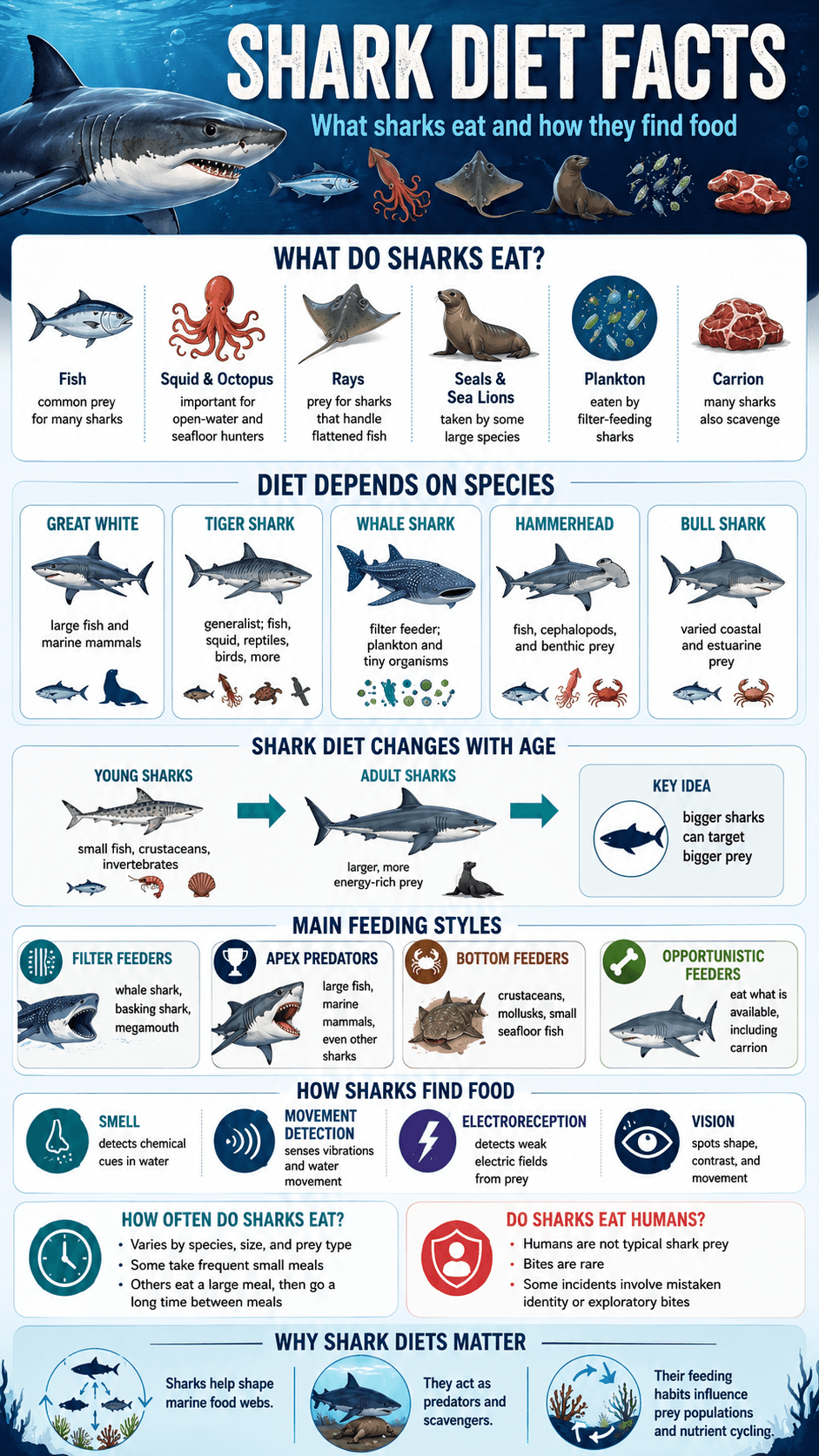
Sharks occupy a wide range of feeding niches in the oceans. Across the group there are species that specialize on tiny plankton, species that seize mid-sized fish and squid, and species that take large marine mammals. The following subsections describe common prey types and why they matter for different sharks.
Fish
Many sharks feed on fish, from small schooling species to larger solitary fish. Fish provide calories and nutrients that sustain active predators, and a shark’s tooth shape and hunting method are often matched to the size and behavior of the target fish.
Squid and octopus
Cephalopods such as squid and octopus are common prey for a variety of sharks. These soft-bodied animals are important for species that hunt in open water or along the seafloor where cephalopods are available.
Rays
Some sharks prey on rays and other flattened fishes. Rays are often taken by sharks that can handle large, laterally compressed prey or that can extract rays from the seabed.
Seals and sea lions
Certain large shark species take marine mammals such as seals and sea lions when those prey are available. For general information on marine mammal biology and diet, see the Smithsonian National Zoo mammal fact sheets.
Readers comparing shark diet facts may also find tiger shark facts useful for a deeper look at a closely related shark topic.
Readers comparing shark diet facts may also find megalodon shark facts useful for a deeper look at a closely related shark topic.
Readers comparing shark diet facts may also find mako shark facts useful for a deeper look at a closely related shark topic.
Smithsonian National Zoo mammal fact sheets
Plankton
A few shark species feed by filtering tiny organisms from the water column. These sharks consume planktonic organisms including microscopic plants and animals, and sometimes small schooling organisms, by taking in large volumes of seawater and sieving out food particles.
Carrion
Many sharks will scavenge on carrion when it is available. Feeding on dead or dying animals is an opportunistic strategy that supplements active hunting and helps sharks obtain energy with reduced effort in some situations.
Shark Diet Depends on Species
Shark diets vary dramatically by species. Body size, tooth structure, habitat, sensory abilities, and life history all shape what an individual species eats. Below are general descriptions for several well-known shark groups; the IUCN Red List provides species-level conservation and natural history details.
Great white shark diet
Great white sharks are often associated with feeding on large fish and marine mammals in coastal and offshore regions. They are equipped to take relatively large prey items compared with smaller coastal species. See the IUCN Red List for species-level information.
Tiger shark diet
Tiger sharks are frequently described as generalist feeders that take a wide array of prey, including fishes, cephalopods, marine reptiles, birds, and various items encountered in coastal waters. This generalist behavior means they will exploit many food sources available in their habitat.
Whale shark diet
Whale sharks are specialized filter feeders that consume plankton and small organisms in the water column. They feed by taking in large amounts of water and filtering out edible particles; consult the IUCN Red List for conservation context on whale sharks.
Hammerhead shark diet
Hammerhead sharks include species that hunt schooling fish, cephalopods, and benthic prey. The unusual head shape of hammerheads is linked to sensory advantages when searching for prey over the seafloor or in open water.
Bull shark diet
Bull sharks are known for inhabiting coastal and estuarine environments where they encounter a range of prey types, including fishes and other coastal animals. Their flexible diet reflects their tolerance for varied habitats and prey availability.
Shark Diet Changes With Age
Shark diets often change as individuals grow. Juveniles and adults can occupy different feeding niches, which reduces competition between age classes and allows sharks to use different habitats and prey types as they mature.
What young sharks eat
Young sharks commonly feed on smaller prey such as small fish, crustaceans, and other invertebrates that are abundant in nursery habitats. These prey items are easier to handle given the juveniles’ smaller size and jaw strength.
What adult sharks eat
Adult sharks typically expand their diets to include larger, more energy-rich prey. Some adults become specialists on particular prey types, while others continue as generalists, taking whatever suitable food is available in their territory.
Why larger sharks target larger prey
Larger prey items provide more energy per capture, which can be efficient for big predators. A shift toward larger prey with age is an ecological strategy seen in many predatory animals because larger predators can handle and subdue larger or tougher prey.
Filter-Feeding Sharks
A small number of shark species feed by filtering small organisms from the water. These sharks use enlarged mouths and specialized internal structures to separate food from seawater.
Whale sharks
Whale sharks feed on plankton and other small organisms by filtering water. Their feeding mode is adapted to exploiting dense patches of plankton and aggregations of small organisms near the surface or in the water column.
Basking sharks
Basking sharks are another filter-feeding species that move with mouths open to strain plankton and small organisms from seawater. These sharks are often seen in cooler temperate waters where plankton concentrations can be high.
Megamouth sharks
Megamouth sharks are deepwater filter feeders that use a large, gaping mouth to take in plankton and small prey items. Because they are less well known than other filter-feeding sharks, they are an example of how diverse feeding strategies are among sharks.
How filter feeding works
Filter-feeding sharks swim with mouths open, draw in water, and use internal filters such as gill rakers to trap food particles. This feeding mode is efficient in areas and at times when prey items are dense enough to make the effort worthwhile.
Apex Predator Shark Diets
Some shark species function as apex predators in their ecosystems, targeting large, energy-rich prey. Their feeding choices influence food webs and can shape the behavior and population dynamics of prey species.
Marine mammals
Apex sharks that take marine mammals select prey that provide high energy returns. For background on marine mammal biology and diet, see the Animal Diversity Web mammal accounts and Smithsonian National Zoo resources.
Animal Diversity Web mammal accounts
Large fish
Large predatory sharks also hunt sizeable fish species. These prey are important sources of protein and fat, enabling apex sharks to sustain their energetic needs across broad ranges.
Other sharks
Some large sharks include other sharks in their diets. Predation among sharks is an ecological interaction that affects shark community structure and can be part of competitive dynamics in ecosystems.
Why apex predators need energy-rich food
Apex predators require substantial energy to maintain activity, growth, and reproduction. Consuming larger or energy-rich prey reduces the frequency of hunts needed and can support larger body size and reproductive output.
Bottom-Feeding Sharks
Sharks that feed near the seabed have adaptations to exploit prey living on or under sediments. Their diets and dentition reflect the demands of crushing, scraping, or picking prey from the substrate.
Crustaceans
Crustaceans such as crabs and shrimps are common prey for bottom-feeding sharks. These animals often require crushing teeth or strong jaws to access the soft tissues inside hard shells.
Mollusks
Mollusks, including clams and other shelled animals, are taken by some benthic-feeding sharks that can break or manipulate hard-shelled prey. These diets are typical in areas with abundant benthic invertebrates.
Small fish
Small demersal fish that live near the seafloor are also important prey for bottom-feeding sharks. Such prey are often caught by ambush or by rooting through sediments where small fishes hide.
How teeth adapt to bottom feeding
Teeth of bottom-feeding sharks tend to be flatter and more molar-like for crushing, or arranged to grip and remove prey from the substrate. Tooth form is a strong indicator of feeding style in sharks.
Opportunistic Shark Feeding
Many sharks are opportunistic, taking whatever prey is abundant or easiest to capture. Opportunism is a successful strategy in variable environments and helps sharks persist when preferred prey are scarce.
Why some sharks eat almost anything
Generalist feeding reduces dependence on any single prey source and allows sharks to exploit changing food supplies. Coastal and estuarine species often show opportunistic behavior because prey availability fluctuates with tides and seasons.
Scavenging behavior
Scavenging on dead or injured animals is an important component of many sharks’ diets. This behavior helps recycle nutrients and provides an energy-efficient way to feed when live prey capture would be costly.
Unusual items found in shark stomachs
Shark stomachs sometimes contain unexpected items because opportunistic feeders will sample a wide range of items in their environment. Reports of unusual stomach contents illustrate the varied diets of some species, but such findings should be interpreted cautiously because they may represent rare events.
How Sharks Find Food
Sharks use a suite of senses and behaviors to locate prey. The combination of senses varies by species and habitat, but most sharks rely on smell, movement detection, electroreception, and vision to different degrees.
Smell
Olfaction is a key sense for many sharks. Chemical cues in seawater can travel with currents and help sharks detect prey at a distance or locate injured animals. Smell works especially well where currents carry scent cues from feeding or injured animals.
Movement detection
Specialized sensory systems allow sharks to detect water movement caused by swimming prey. These systems are particularly useful in low-light or turbid conditions where visual cues are limited.
Electroreception
Sharks possess electroreceptors that detect weak electric fields produced by muscle contractions in prey. This sense allows sharks to pinpoint hidden or buried prey and is especially helpful when other senses are less effective.
Vision and contrast
Vision helps sharks detect shapes, contrast, and movement, particularly in clear water or at dawn and dusk. Visual cues often trigger an attack once a shark is close enough to identify a potential meal.
How Often Do Sharks Eat?
Feeding frequency varies widely by species, size, and prey type. Some sharks take frequent small meals while others consume large prey and then go long periods between meals. Metabolic needs, prey availability, and digestive physiology all influence feeding intervals.
Feeding frequency by species
Smaller, more active species that chase schooling prey may feed more regularly, while larger species that take infrequent large meals may eat less often. The specific pattern depends on the ecology of each species.
Large meals and slow digestion
When a shark consumes a large prey item, digestion can proceed over an extended period, reducing the need for immediate further feeding. This strategy conserves energy in environments where large prey are not always available.
Why sharks do not eat constantly
Continuous feeding would be energetically costly and unnecessary when large prey yield sufficient reserves. Sharks balance the energy spent hunting with the energy gained from meals, which results in feeding patterns adapted to their lifestyle.
Do Sharks Eat Humans?
Human beings are not typical prey for sharks. Most shark species feed on marine animals and are poorly adapted to consider humans as regular food. When interactions occur they are uncommon and often involve confusion or investigative bites rather than purposeful predation.
Humans are not normal shark food
Sharks evolved to feed on marine prey, and humans do not match the usual prey profile in most ocean habitats. The rarity of serious shark bite events reflects this mismatch.
Mistaken identity
Some shark bite incidents are thought to involve mistaken identity, where a shark confuses a swimmer or surfer for a prey item such as a seal. Visual and movement cues in the water can contribute to misidentification.
Exploratory bites
Sharks often sample unfamiliar objects with a bite to gather sensory information. Such exploratory bites can cause injury but are not equivalent to predation behavior aimed at consuming a human.
Why shark bite events are rare
Shark bites on humans are rare compared with other risks at the coast, and many shark species do not interact with people because of differences in habitat preference and behavior. When safety is a concern, contact local authorities or qualified professionals for guidance rather than attempting to handle or approach wild sharks.
Sharks in the Food Chain
Sharks play varied roles in marine food webs, acting as apex predators, mesopredators, and scavengers. Their feeding choices influence prey populations, nutrient cycling, and ecosystem structure.
Sharks as apex predators
Where sharks occupy the top of the food web, their predation helps regulate prey populations and can cascade through the ecosystem, affecting biodiversity and habitat condition.
Sharks as scavengers
By consuming carrion, sharks contribute to nutrient recycling and help remove dead biomass from marine environments, which is an important ecosystem service.
What eats sharks?
Sharks are preyed upon by larger sharks and by other marine predators at certain life stages. Young sharks are also vulnerable to a range of predators until they grow large enough to reduce their risk.
Why shark diets matter to ecosystems
Changes in shark diets or population sizes can alter predator-prey relationships and have broad ecological consequences. Understanding what sharks eat helps researchers and managers assess ecosystem health and the potential effects of human activities on marine food webs. For information about international protections and trade regulation that affect many marine species, see CITES.
CITES information on wildlife trade
FAQs About Shark Diets
What is a shark’s favorite food?
There is no single favorite food across all sharks. Preferences depend on species, age, habitat, and seasonal availability. Some species consistently target fish, others specialize on plankton, and many are flexible opportunists.
Do sharks eat dolphins?
Some large sharks may take dolphins under certain conditions, but dolphins are agile and social animals that employ avoidance behaviors and group defense. Whether sharks attempt to take dolphins depends on local ecology and opportunity.
Do sharks eat other sharks?
Yes, predation among sharks occurs. Larger shark species sometimes take smaller sharks as part of their diet, and this interaction is a natural component of shark community dynamics.
Do all sharks eat meat?
Most sharks are carnivorous, feeding on animals. A subset of species are filter feeders that consume plankton and other small organisms rather than larger animal prey. Feeding strategies vary across the group.
How do whale sharks eat plankton?
Whale sharks feed by filtering water to capture plankton and small organisms. They swim with open mouths or engage in surface feeding to take in dense patches of food, then expel water while retaining edible particles with internal filtering structures. For species-level information and conservation context on whale sharks, consult the IUCN Red List.
For additional context about marine mammal biology, diet, and how these animals fit into ocean food webs, the San Diego Zoo provides accessible species information and educational material that can help readers learn more about prey species discussed in this article.
San Diego Zoo Wildlife Explorers mammal information
Understanding shark diets helps reveal how ocean ecosystems function and why protecting diverse habitats matters. If you observe sharks in the wild, do not approach, feed, or attempt to handle them. Contact local wildlife authorities or marine professionals if you encounter a situation that may pose a safety or conservation concern.

Ethan Walker is the founder and research editor of Animal Fact Central. He creates and reviews educational animal facts content using trusted wildlife, pet care, and science-based sources. His work focuses on making animal behavior, adaptations, habitats, and species facts clear, accurate, and engaging for everyday readers.
Read More Details About Ethan Walker: https://animalfactcentral.com/ethan-walker/