
Sharks Are Older Than Dinosaurs
How long sharks have been on Earth
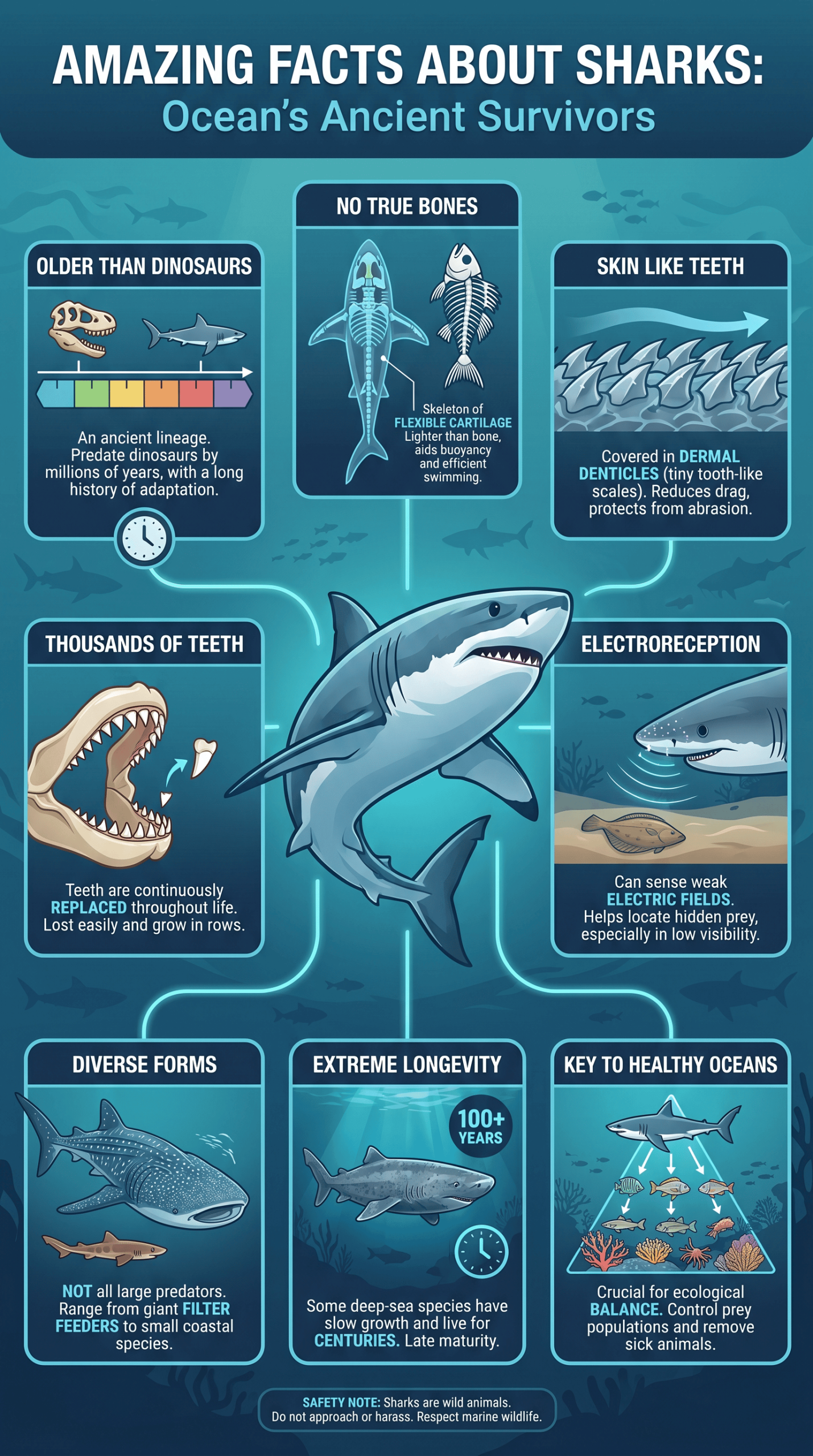
Sharks belong to a lineage of cartilaginous fishes that predates the age of dinosaurs in geological time. Rather than giving exact dates here, think of sharks as part of a very ancient group of jawed fishes that existed long before many modern land animals evolved. This long history helps explain why sharks appear in many different shapes and lifestyles across the oceans.
Why their body design has survived so long
Shark anatomy shows a combination of features that have proved effective in a wide range of marine environments. Streamlined body shapes, efficient swimming mechanics, and sensory systems adapted to life in water have allowed many shark lineages to persist while other groups changed dramatically.
What makes sharks evolutionary survivors
Evolutionary persistence is rarely down to a single trait. For sharks, a mix of flexible feeding strategies, diverse reproductive modes, and physiological traits suited to aquatic life have contributed to their long-term survival. Different shark groups have found ways to specialize or remain generalists, which helps explain their continued presence in marine ecosystems.
Sharks Do Not Have True Bones
What cartilage is
Shark skeletons are primarily made of cartilage, a lighter and more flexible tissue than the mineralized bone found in many other fishes and most land vertebrates. Cartilage provides a strong, flexible framework for muscles to attach to and affects growth, healing, and buoyancy.
Why cartilage helps sharks move efficiently
Because cartilage is lighter than bone, a cartilaginous skeleton contributes to a lower overall body weight for a given volume. This lower weight, combined with fin and body shapes adapted for efficient propulsion, helps many sharks conserve energy while swimming.
How this makes sharks different from bony fish
Bony fishes build skeletons from mineralized bone and often have swim bladders or other mechanisms for buoyancy. Sharks rely on large, oily livers, body shape, and cartilaginous skeletons for buoyancy and maneuverability, which influences how they feed and move compared with bony fishes.
Shark Skin Is Covered in Tiny Tooth-Like Scales
What dermal denticles are
Many sharks have skin covered with tiny, tooth-like scales called dermal denticles. These structures are similar in composition to teeth and form a protective outer layer. Dermal denticles vary in shape and size depending on the species and the part of the body they cover.
Why shark skin reduces drag
The microstructure of dermal denticles can influence how water flows close to the skin. Researchers interpret this as a feature that can help reduce drag in some situations, and it also helps protect sharks from abrasion and parasites.
How shark skin inspired human technology
Because dermal denticles affect fluid flow, scientists and engineers have studied shark skin as an inspiration for low-drag surfaces and antifouling materials. Applications explored include swimsuit materials and coatings for ships.
Sharks Can Replace Thousands of Teeth
Why shark teeth fall out easily
Shark teeth are often arranged in rows and are not fixed into deep sockets like mammal teeth. Teeth can dislodge during feeding, encounters with hard objects, or as part of normal wear. Losing teeth is a normal part of a shark’s life history.
How replacement teeth move forward
Many sharks grow replacement teeth continuously in rows behind the functional mouth teeth. As older teeth are lost, new ones develop and shift forward into position to take their place.
Why tooth shape depends on diet
Shark teeth show a wide range of forms, from narrow, pointed teeth for gripping slippery prey to broad, flattened teeth for crushing shells. Tooth shape is closely tied to feeding strategy.
Some Sharks Can Sense Electricity
What ampullae of Lorenzini are
Certain sensory structures in sharks allow detection of weak electric fields in water. These ampullary sensory organs are tuned to sense electrical signals produced by the muscle activity and bioelectric fields of other animals.
How sharks detect hidden prey
Because living animals generate small electric currents, this sensory ability helps some sharks detect prey that is concealed beneath sand or otherwise out of sight. Electroreception is one tool among several that sharks use to locate food, especially in low-visibility conditions.
Why this sense works so well in water
Saltwater conducts electricity much better than air, so electric fields travel farther and are easier to pick up with specialized sensors. This physical property helps explain why electroreception is particularly useful for aquatic predators.
Sharks Have Very Different Personalities
Why some sharks are bold
Individual differences in behavior are observed by researchers and divers. Some sharks show boldness by approaching new objects or investigating humans and boats more readily. Bold behavior may relate to hunger, curiosity, learning, or life history stage.
Why some sharks are more cautious
Other individuals or species are more wary and keep distance from novel stimuli. Cautious behavior can reduce risk of injury and reflect a different balance between exploration and safety in an animal’s behavior repertoire.
What scientists observe in shark behavior
Behavioral studies document variation within and among species, including differences in activity patterns, social interactions, and responses to environmental change. Scientists use observations, tagging, and experiments to better understand how individual variation affects survival and ecology.
Not All Sharks Are Large Predators
Tiny shark species
Sharks come in a wide range of sizes. Some species are relatively small as adults and occupy niches in coastal and reef habitats. These smaller sharks can be important members of local food webs and often have life histories adapted to their size and habitats.
Gentle filter feeders
Several shark species feed by filtering small organisms from the water rather than hunting large prey. These filter feeders use specialized mouthparts and gill structures to capture plankton, small fish, and other tiny organisms.
Deep-sea sharks with unusual adaptations
Sharks living in deep or low-light environments can show adaptations such as modifications to sensory systems, slow growth, or body shapes suited to sparse prey and high pressure.
Some Sharks Can Glow in the Dark
What bioluminescence means
Bioluminescence is the production of light by living organisms. In the ocean, it is used by many animals for communication, camouflage, and prey attraction. When bioluminescence is discussed for sharks, it refers to light-producing tissues or light reflected by specialized skin cells in some deep-dwelling species.
Why deep-sea sharks may glow
Bioluminescence in deep-sea sharks may help with hiding their silhouette from predators or prey below, attracting mates or prey, or signaling to conspecifics. Light patterns and intensity are tuned to the dim environment of deep water.
How glowing helps with camouflage
One camouflage strategy, often called counterillumination, involves matching the light coming from above so the animal appears less visible from below. Some midwater or deepwater sharks appear to use light-producing or light-manipulating features as a form of concealment.
Sharks Have Incredible Navigation Abilities
Long-distance migration
Certain shark species travel long distances between feeding and breeding areas. Migration can involve predictable seasonal movements that link distant parts of the ocean and are important for completing life cycles.
Using magnetic fields
Research suggests some sharks use cues from the Earth’s magnetic field as one component of their navigation toolkit. Sensitivity to magnetic information, combined with other sensory cues, can help sharks orient during extended travels across open ocean.
Returning to important feeding or breeding areas
Many migratory sharks show fidelity to particular sites for feeding, mating, or giving birth. Returning to known productive or safe areas helps individuals complete critical life stages and maintain ecological roles.
Some Sharks Can Live an Extremely Long Time
Slow growth and long lifespans in cold-water species
Certain deepwater or cold-water shark species are noted for slow growth and long lifespans. In conservation and life-history contexts, this slow pace of life has implications for how populations recover from pressures. For global conservation assessments and species summaries, see the IUCN Red List of Threatened Species.
Why cold water may slow growth
Colder environments generally slow metabolic rates in many fishes compared with warm water, which can lead to slower growth and a longer time to reach maturity. Slower life histories mean individuals allocate energy differently across growth, reproduction, and survival.
What long life means for conservation
Species with slow growth, late maturity, and long lifespans can be more vulnerable to overexploitation and habitat change because populations replace lost adults slowly. Conservation planning for such species often needs to account for these life-history characteristics and protect important habitats. International agreements such as CITES provide context for regulation of certain species in trade.
CITES resources on international wildlife trade
Sharks Play a Key Role in Healthy Oceans
Controlling prey populations
As predators, many sharks influence the abundance and behavior of prey species. By shaping prey populations, sharks can affect the structure of food webs and the distribution of organisms across habitats.
Removing weak or sick animals
Predation that targets injured, sick, or otherwise vulnerable animals can help maintain the health of prey populations at a community level. This ecological role contributes to the overall resilience of marine systems.
Keeping marine ecosystems balanced
Sharks are part of complex ecological networks. Their presence or absence can cascade through ecosystems, altering species interactions, habitat use, and community composition.
Interesting Shark Facts for Kids and Adults
Simple shark facts kids can remember
- Sharks are fish that breathe with gills.
- Many sharks replace lost teeth throughout life.
- Sharks come in many sizes and live in many ocean habitats.
Surprising facts adults often do not know
- Shark skin has a texture like tiny teeth, which helps with protection and swimming efficiency.
- Some sharks detect electric fields, giving them an extra way to find hidden prey.
- Not every shark is a large hunter; filter-feeding sharks feed on plankton and small animals.
Why sharks deserve more respect
Sharks are important parts of marine ecosystems and have unique adaptations that make them interesting objects of study. Learning about their biology and roles in the ocean helps people appreciate why conserving sharks supports healthy seas. For accessible animal information and general natural history resources, see the Smithsonian National Zoo and the San Diego Zoo Wildlife Explorers pages.
Smithsonian National Zoo animal pages and San Diego Zoo Wildlife Explorers offer examples of accessible species information for readers who want to explore more animal facts.
FAQs About Interesting Shark Facts
What is the most interesting fact about sharks?
The most interesting fact depends on your perspective: some people are amazed by their ancient evolutionary history, others by specialized senses like electroreception, and others by unusual life histories in deepwater species. Pick the aspect that sparks your curiosity and consult reputable sources to learn more.
Are sharks intelligent?
Shark cognition is a topic of active research. Sharks show learning, problem-solving, and flexible behavior in a range of contexts, but intelligence varies among species. Scientists study behavior, brain anatomy, and learning experiments to understand cognitive abilities in sharks.
Can sharks smell blood from miles away?
Sharks have a strong sense of smell compared with many animals and can detect small amounts of chemicals in water. Claims about detecting blood from extraordinarily long distances are oversimplifications. Chemical detection depends on concentration, water movement, and the shark’s proximity and motivation.
Do sharks have personalities?
Individual differences in behavior—sometimes described as personality traits—have been observed in sharks. These differences can affect how they explore, how bold they are, and how they interact with their environment. Ongoing research explores how consistent these differences are and what ecological consequences they have.
What makes sharks different from other fish?
Sharks are cartilaginous fishes, with skeletons mainly made of cartilage, different skin structures, and a variety of reproductive and sensory adaptations that set them apart from bony fishes. Their diverse life histories and ecological roles make them a distinct and important group in marine ecosystems.
Safety note: Sharks are wild animals. This article is for general education. Do not approach, feed, touch, capture, or harass wild sharks. If you encounter a situation involving wildlife that may be hazardous or requires intervention, contact local wildlife authorities, marine rescue organizations, or trained professionals.

Ethan Walker is the founder and research editor of Animal Fact Central. He creates and reviews educational animal facts content using trusted wildlife, pet care, and science-based sources. His work focuses on making animal behavior, adaptations, habitats, and species facts clear, accurate, and engaging for everyday readers.
Read More Details About Ethan Walker: https://animalfactcentral.com/ethan-walker/