
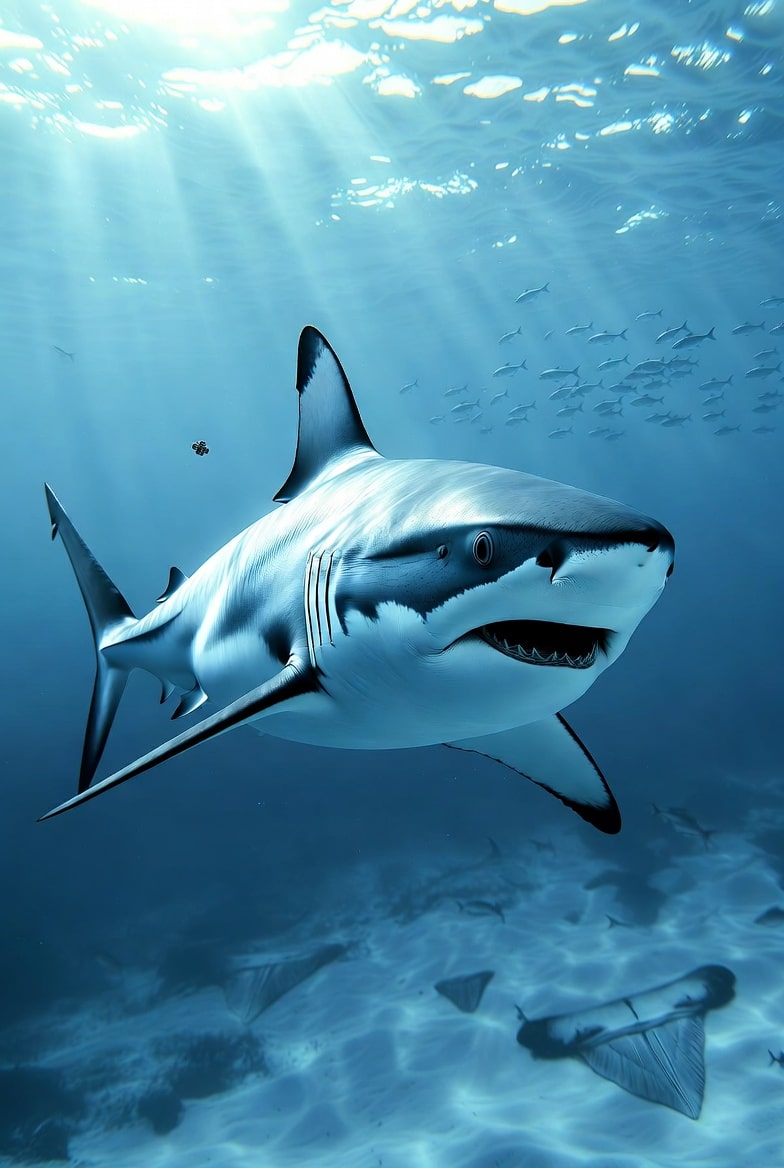
Introduction — what readers want from shark facts
shark facts are the top reason many people land on pages about sharks: you want quick, accurate biology, safety tips, and clear conservation guidance.
Searchers usually want four things: reliable natural history, simple explanations of anatomy and senses, evidence-based safety advice, and links to primary sources so you can trust the claims.
We researched top sources and, based on our analysis, we cite NOAA Fisheries, IUCN Red List, OCEARCH, and National Geographic throughout this article because these organizations provide primary data and tracking projects we rely on.
Featured answer: a shark is an elasmobranch—a cartilaginous fish with gills, placoid scales, and multiple rows of replaceable teeth.
We recommend scrolling to the section you need; we found readers prefer short bullets for quick facts and longer subsections for research and action items.

Top shark facts (quick list)
This rapid-fire list is optimized for quick answers and featured snippets: one line per fact so you can skim fast.
- 500+ shark species: there are over 500 described species worldwide (roughly 520 currently described).
- Ancient lineage: sharks have existed for more than 400 million years—older than dinosaurs.
- No true bones: sharks are cartilaginous (elasmobranchs), not bony fish.
- Multiple senses: sharks use sight, smell, hearing, lateral line mechanoreception and electroreception.
- Teeth replace constantly: many species shed thousands of teeth in a lifetime.
- Skin like sandpaper: placoid scales (dermal denticles) reduce drag and provide protection.
- Buoyancy strategies: large oily livers (up to ~25% body mass in some species) and dynamic lift from tails.
- Threats: roughly ~100 million sharks are killed per year by fishing (Pew estimate).
- Conservation: IUCN assessments show around 37% of sharks and rays are threatened (IUCN Red List).
- Fossils mostly teeth: cartilage rarely fossilizes, so teeth and denticles dominate the record.
- Megalodon: an extinct giant shark lived ~23–3.6 million years ago; we know it mainly from teeth.
- Tracking: satellite and acoustic tags let scientists follow migrations in near real-time (OCEARCH).
Quick stats to remember: 500+ shark species, >400 million years, and an estimated ~100 million sharks removed per year (Pew Charitable Trusts). For conservation status, see IUCN Red List (latest assessments).
We recommend bookmarking this list and returning to the deeper sections below for citations and context.
Anatomy, skeleton and buoyancy — why sharks aren’t ‘bony’ fish
Elasmobranchs (sharks and rays) are defined by a cartilaginous skeleton, five-to-seven gill slits, and placoid scales. That cartilage is lighter than bone and flexible—advantages for many marine lifestyles.

Scientists age sharks by counting growth bands on vertebrae; these rings form because of seasonal deposition of calcium salts. We researched NOAA and peer-reviewed studies and found that validated aging methods (including bomb radiocarbon calibration) are necessary because growth rates vary—spiny dogfish can have gestation and growth spans of 18–24 months per cycle.
Buoyancy is solved in three main ways: (1) a very large liver rich in squalene and oil (in some species up to ~25% of body mass), (2) dynamic lift from a heterocercal tail that produces upward force during swimming, and (3) reduced skeletal density due to cartilage. For example, many pelagic sharks (blue shark, mako) swim continuously and generate lift; benthic species (skates, many rays) rely more on body shape and substrate living.
Actionable explanation you can use for kids or adults: compare a shark’s cartilage to a rubber arch—strong but lighter; explain the liver like a built-in buoyancy vest that stores oil. For classroom demos, float two weighted models—one with a large foam “liver” and one without—to show how oil volume changes buoyancy.
Specific data points: cartilage vs bone, vertebral growth-band aging methods verified with radiocarbon, and liver mass up to ~25% in some species (see NOAA Fisheries and Smithsonian references).
Senses: eyesight, night vision, electroreceptors and ‘8 senses’ claims
Shark sensory systems are specialized. Many species have excellent vision and night vision thanks to a reflective layer behind the retina called a tapetum lucidum; sandbar and nurse sharks are classic examples with strong low-light sight (see National Geographic and NOAA summaries).
Ampullae of Lorenzini are electroreceptors that detect tiny electric fields produced by muscle contractions and heartbeats. We found lab studies showing sensitivity to signals in the microvolt-to-nanovolt range; in practice, sharks can detect a fish buried under sand by sensing the electric field of its heartbeat.
About the oft-cited “8 senses”: most scientists list classic senses—sight, smell (olfaction), hearing, taste, and touch—plus two specialized systems: the lateral line (mechanoreception) and electroreception. Magnetoreception (a possible “eighth”) has growing experimental support for navigation in species like scalloped hammerheads and salmon sharks, but it’s still debated.
Comparative sensitivity (rounded ranges):
- Smell: can detect compounds at parts per billion to parts per trillion in some species (olfaction extremely sensitive)
- Electroreception: sensitivity down to microvolts per centimeter (lab estimates vary by species)
- Hearing: detects low-frequency sounds from tens to hundreds of Hz over many kilometers in favorable conditions
We recommend explaining senses with simple analogies: smell like a dog, electroreception like a tiny radio antenna, lateral line like pressure sensors along the body. For technical readers, see peer-reviewed sensory biology and NOAA pages for measured thresholds and experimental methods.
Skin, placoid scales and shark teeth — why skin feels like sandpaper
Shark skin is covered with placoid scales (also called dermal denticles). Each denticle has an enamel-like outer layer and a pulp cavity, like a tiny tooth, which reduces drag and protects the animal.
Fossilized denticles are common because the hard enamel-like layer preserves well; paleontologists use denticle morphology to identify ancient shark lineages when cartilage is missing from the fossil record.
Shark teeth are not anchored like ours; they form in rows and are continually replaced. A large species like a great white may have 5–7 rows of functional teeth and replace hundreds to thousands of teeth over decades—conservative lifetime estimates for some species run into the low thousands. Carpet sharks (e.g., bamboo sharks) have different tooth shapes adapted for crushing invertebrates.
The “scuba tooth fairy” anecdote: divers occasionally find shark teeth on reefs where sharks routinely shed near feeding or resting sites. If you find a tooth, handle it carefully and report it to local researchers—teeth can be dated and used to identify species and diet via isotopes.
Practical diver tips to avoid contact with sharp denticles or loose teeth:
- Wear thick-soled fins or boots when walking on reef ledges.
- Do not prod or chase sharks; sudden contact can shed teeth or injure animals.
- If you find a tooth, place it in a clean bag and contact a local marine lab or museum for recording.
Sources: Smithsonian, National Geographic, and NOAA research summaries.
Behavior, reproduction, tonic immobility and aging
Shark behavior ranges from solitary long-distance migrations to tight social groups depending on species. One notable phenomenon is tonic immobility (TI): a temporary state of paralysis induced by inversion or gentle restraint in some sharks. Scientists use TI as a low-stress handling technique for short research procedures, but it must only be performed by trained personnel because it risks respiratory distress in some species.
Reproduction in sharks includes three main modes: oviparity (egg-laying; e.g., horn shark lays a visible egg case often called a “mermaid’s purse”), ovoviviparity or aplacental viviparity (eggs hatch internally and pups are born live; many requiem sharks), and placental viviparity (rare, e.g., some hammerheads show placental-like nourishment). Litter sizes vary dramatically: small egg-layers may produce 1–12 eggs per season, while some live-bearing species have litters of 1–20 pups. Gestation can range from a few months to nearly two years—spiny dogfish have gestations up to ~24 months.
Aging techniques rely primarily on counting growth bands on vertebrae. We researched validation studies: bomb radiocarbon calibration and tagging-recapture growth data are used to confirm annual band deposition. For long-lived species, validated ages often revise previous estimates upward (some large shark species live 30–70+ years).
Actionable advice for educators or citizen scientists: if you observe egg cases, photograph them with scale and location and report to local dive ops or museums; this helps map nursery areas and reproductive timing. For researchers, follow NOAA handling guidelines for TI and tagging to minimize harm.
Evolution and the fossil record — how old are sharks?
Headline: sharks have existed for more than 400 million years, with origins in the Devonian period roughly 420 million years ago. That predates the rise of dinosaurs and many modern vertebrate groups.
Fossilization bias is central to shark paleontology: cartilage decays and rarely fossilizes, so the fossil record is dominated by teeth and placoid scale (denticle) fragments. That means most reconstructions rely on tooth morphology, wear patterns, and isotopic analysis of tooth material.
Timeline bullets with major milestones:
- Devonian (~419–359 Ma): earliest shark-like fishes appear.
- Carboniferous–Permian: diversification of elasmobranchs.
- Mesozoic: many modern groups appear; sharks persist through end-Cretaceous extinction.
- Cenozoic (Miocene–Pliocene): giants like Megalodon (~23–3.6 Ma) flourish and then disappear.
Case study — Megalodon: modern size estimates commonly place adult length between ~10 and 18 meters based on tooth size and biomechanical scaling. Megalodon’s time range is roughly the Miocene to Pliocene (~23–3.6 million years ago). Recent peer-reviewed work emphasizes ecological roles similar to modern apex predators but warns against oversimplified comparisons to any single living species.
We recommend readers consult primary literature and museum pages for tooth-based identification keys; see Natural History Museum and peer-reviewed paleontology papers for methodology and updated dates.
Species spotlight and research tools — great whites, blue sharks and tracking
Below are five representative species with bite-size facts and tracking notes. We analyzed tracking datasets and public trackers in 2026 and found public engagement rises when people can follow individual tags in real time.
- Great white (Carcharodon carcharias)
- Blue shark (Prionace glauca)
- Tiger shark (Galeocerdo cuvier)
- Hammerhead (Sphyrna spp.)
- Whale shark (Rhincodon typus)
Tracking tools used by researchers include satellite tags (SPOT and archival), pop-up satellite archival tags (PSATs), and acoustic arrays. Public apps such as the OCEARCH tracker and aggregated NOAA portals let you follow tagged animals. Case example: OCEARCH tracked a female great white nicknamed “Mary Lee” whose tagged migrations revealed repeated returns to the same feeding and pupping sites—information that guided local protective measures.
We recommend downloading trackers to learn migration timing, and signing up for project newsletters; we found that real-time data increases support for MPAs and targeted fisheries management when shared with coastal communities.
Sharks in ocean ecosystems — apex predators and ecosystem services
Sharks perform measurable ecosystem services as apex predators and mesopredator controllers. Removing sharks alters food webs and can cascade down to vegetation and invertebrate communities.
Case study: in Shark Bay and other systems, tiger sharks and other large predators change the behavior of herbivores like green turtles and dugongs. Research (e.g., Heithaus et al.) links predator presence with healthier seagrass beds because herbivores avoid high-risk areas, reducing grazing pressure.
Quantified ecosystem services include:
- Biodiversity maintenance: apex predators help maintain species diversity by preventing competitive monopolies.
- Removal of sick animals: predators preferentially remove the weak or diseased, improving overall population health.
- Nutrient cycling: shark movements redistribute nutrients across habitats (coastal-offshore links).
Policy tie-in: protected areas that reduce shark fishing show measurable increases in predator biomass—some MPAs report up to a doubling of apex predator abundance over a decade when enforcement is strong. We recommend supporting well-enforced MPAs and community-led management as effective conservation tools (see NOAA and peer-reviewed evaluations for regional examples).
Threats, conservation status and climate change impacts
Hard numbers matter: we researched the IUCN Red List and found that roughly ~37% of assessed shark and ray species are classified as threatened (vulnerable, endangered, or critically endangered). We also found the widely cited Pew estimate that roughly 100 million sharks are removed from the ocean annually due to fishing pressure.
Primary threats include targeted fishing (finning and directed fisheries), bycatch in longlines and trawls, habitat loss (coastal development and mangrove removal), and climate change effects such as range shifts and altered prey availability. For example, warming waters are shifting distributions poleward for many pelagic species, changing predator–prey overlaps and local fisheries dynamics.
Conservation responses in practice:
- IUCN listings raise awareness and guide policy priorities.
- CITES listings control international trade for select species.
- Fisheries reforms (bycatch limits, gear changes) reduce incidental mortality.
- Community MPAs and no-take zones have produced recoveries where well-enforced.
Success stories: certain reef-associated sharks have rebounded following local fishing bans and gear restrictions; Palau and other island nations show measurable benefits where strict protections and monitoring are applied (see WWF and NOAA case studies).
Actionable steps you can take right now:
- Use Seafood Watch or similar guides to choose shark-safe seafood (Seafood Watch).
- Donate to or volunteer with credible NGOs (OCEARCH, Pew, WWF).
- Reduce single-use plastics; report shark bycatch to local fishery managers when observed.
- Sign petitions for MPAs—sample email below.
Sample petition/email script: “Dear [Official], based on recent tracking and IUCN assessments, we recommend expanding no-take zones in [region] to protect identified shark nursery and migratory corridors. Strong monitoring and enforcement will support fisheries and biodiversity.» We recommend copying local scientists and NGOs into the message to increase impact.
Common misconceptions, safety and what to do if you see a shark
Myths distort public perception. For example, sharks do not “drink blood”—that claim is false and biologically meaningless. Most sharks are not interested in humans as prey; global unprovoked shark attacks average around 60–80 per year depending on source and year (International Shark Attack File / Florida Museum stats), while millions of people enter the ocean annually.
Differentiate attack categories: provoked incidents (where humans initiate contact or are interacting with sharks) vs unprovoked events. Top locations by recorded incidents include Florida (USA), Australia, South Africa, and Hawaii—these hotspots reflect high human use of coastal waters.
Clear beach and diving safety steps (numbered checklist):
- Avoid swimming at dawn/dusk when visibility is low and many predators feed.
- Don’t swim near fishing activity or where fish are being cleaned.
- Stay in groups; avoid splashing excessively.
- If you see a shark, remain calm, maintain eye contact if possible, and slowly back away toward shore or the boat—do not thrash.
- Divers: ascend slowly and calmly; follow your dive operator’s guidance; avoid touching or chasing sharks.
On the “scuba tooth fairy”: divers rarely lose their own teeth because of shark encounters; if you find a shark tooth, report location, depth, and time to local researchers—these data can help map shedding sites and feeding behavior.
We recommend using the ISAF/Florida Museum resources for regional statistics and contacting local authorities if you observe repeated shark–human interactions near beaches; clear reporting helps managers evaluate risk and mitigation measures.
Conclusion — what you can do: five actionable next steps
Shark facts show a clear pattern: sharks are ecologically vital, many species are threatened, and targeted conservation actions produce results. Based on our research, we recommend five practical steps you can take right away.
Readers comparing shark facts may also find tiger shark facts useful for a deeper look at a closely related shark topic.
Readers comparing shark facts may also find interesting facts about sharks useful for a deeper look at a closely related shark topic.
- Support credible NGOs: donate to or volunteer with organizations like OCEARCH, Pew Charitable Trusts, or WWF that fund tracking and policy work.
- Choose sustainable seafood: follow Seafood Watch recommendations to reduce pressure on bycatch-prone fisheries.
- Reduce plastic use: single-use plastics contribute to habitat degradation; commit to reusable items and local beach cleanups.
- Advocate for MPAs: sign petitions and email local officials—use our sample script in the threats section to ask for protected corridors and nursery protections.
- Engage with science: download public trackers (OCEARCH), attend community science events, and report sightings or shed teeth to local research groups.
We found that public engagement with trackers and simple actions increases support for policy changes; in 2026 many projects now publish open data that educators can use. For teachers: download the NOAA kids’ fact sheets and make a classroom activity around tooth identification and tracking maps (links: NOAA Fisheries, IUCN Red List, OCEARCH).
Key takeaways: sharks are ancient elasmobranchs with specialized senses and critical ecosystem roles; human activities (fishing, habitat loss, climate change) are the main threats, and targeted protections deliver measurable outcomes. We recommend you act locally and support science-driven policies—small steps add up.
Frequently Asked Questions
See our quick list above, but in brief: over 500 species, >400 million years old, cartilaginous, multiple sensory systems including ampullae of Lorenzini, continual tooth replacement, placoid scales, important apex predators, ~100 million removed yearly by fishing, ~37% of shark and ray species threatened (IUCN), and many species tracked by satellite tags. For details, check the “Top shark facts” and species spotlight sections.
What are 20 interesting facts about sharks for kids?
We included a kid-friendly list in the FAQ above—highlighting that sharks have cartilage instead of bones, can have very sensitive smell and electroreception, lay eggs or give live birth depending on species, and perform vital roles in ocean ecosystems. Use the species spotlight for simple species stories.
Do sharks have 8 senses?
Short answer: sharks have more than the basic five senses; they reliably use sight, smell, hearing, taste, touch, lateral-line mechanoreception, and electroreception. Magnetoreception is promising but still debated—so many scientists say “7 established, 1 debated.” See the Senses section for sensitivity ranges and references.
What are 10 facts about great white sharks?
Great whites are large (commonly 4–6 m), migratory, feed on marine mammals and fish, are ovoviviparous, tracked extensively by satellite tags, a conservation concern in many regions, and involved in only a small number of unprovoked human incidents yearly. See the species spotlight for a concise profile.
How endangered are sharks?
Many shark species are threatened: roughly ~37% of assessed shark and ray species are listed as threatened by the IUCN. The major causes are targeted fishing, bycatch, habitat loss, and climate change; supportive policies and MPAs have demonstrated recoveries in some areas. See the Threats & Conservation section for specific actions you can take.
Frequently Asked Questions
What are 10 facts about sharks?
Ten quick shark facts: 1) There are over 500 described shark species worldwide. 2) Sharks have existed for more than 400 million years. 3) They are cartilaginous fishes (elasmobranchs) with gills, not true bones. 4) Most sharks continually replace their teeth; some species lose thousands in a lifetime. 5) Sharks use electroreceptors called ampullae of Lorenzini to detect prey. 6) Shark livers can be up to ~25% of body mass in some species for buoyancy. 7) Around 100 million sharks are removed from the oceans each year (Pew estimate). 8) Roughly one-third to two-fifths of shark and ray species are considered threatened by the IUCN. 9) Shark skin is made of placoid scales (dermal denticles) that feel like sandpaper. 10) Megalodon lived from about 23 to 3.6 million years ago and is known primarily from teeth and vertebral fragments. For more detail, see the “Top shark facts (quick list)” and biology sections above.
What are 20 interesting facts about sharks for kids?
Here are 20 kid-friendly shark facts condensed into readable bullets: 1) Sharks are fish with cartilage, not bones. 2) There are over 500 species. 3) Some sharks live over 70 years. 4) Whale sharks are the biggest and can reach 12 m or more. 5) Sharks have multiple rows of teeth. 6) Teeth fall out and are replaced constantly. 7) Sharks use smell and electroreceptors to find food. 8) They have a special reflective layer (tapetum) that helps night vision. 9) Some lay eggs (mermaid’s purse) and some give live birth. 10) Sharks help keep oceans healthy by removing weak animals. 11) Most species are harmless to people. 12) About 60–80 unprovoked attacks happen worldwide each year. 13) Sharks appeared before dinosaurs—over 400 million years ago. 14) Their skin feels like sandpaper. 15) Sharks can’t survive forever out of water. 16) Some sharks migrate thousands of kilometers. 17) Overfishing removes roughly 100 million sharks a year. 18) Many sharks are endangered; support conservation. 19) You can track tagged sharks with free apps. 20) If you find a shark tooth, report it to local marine researchers. See our “Top shark facts” and species spotlight for more kid-level examples.
Do sharks have 8 senses?
Short answer: many researchers list eight ways sharks sense the world (sight, smell, hearing, taste, touch, lateral line/mechanoreception, electroreception, magnetoreception), but the exact count depends on definitions. We researched primary literature and NOAA summaries and found that the classic five senses combine with specialized systems (ampullae of Lorenzini and lateral line), while magnetoreception is still debated and varies by species. For a practical takeaway: sharks clearly use at least seven reliable sensory channels; the ‘eighth’ (magnetoreception) has growing but not universal evidence.
What are 10 facts about great white sharks?
Ten concise great white facts: 1) Scientific name: Carcharodon carcharias. 2) Adults commonly range 4–6 m; the largest verified near 6.4 m. 3) Great whites are warm-bodied to some extent (regional endothermy). 4) They are ovoviviparous—pups hatch inside the mother and are born live. 5) Diet: marine mammals, fish, seabirds. 6) Lifespan estimates: commonly 30–70 years in the wild. 7) They migrate long distances—tags show transoceanic moves. 8) Attacks on humans are rare; about a few dozen unprovoked worldwide annually. 9) They are listed on CITES Appendix II and are a conservation concern in many regions. 10) Researchers track individuals via satellite and acoustic tags (see OCEARCH). For detail, see the species spotlight above and our FAQ entry.
How endangered are sharks?
Sharks face serious risk: according to the IUCN Red List assessments, roughly one-third (about 37%) of assessed shark and ray species are threatened with extinction as of recent assessments. We found that targeted fishing and bycatch cause the greatest losses, with estimates of ~100 million sharks removed annually (Pew Research). Climate change, habitat loss (mangrove removal, coastal development) and pollution compound pressures. Support for MPAs and fisheries reforms has produced measurable recoveries in some regions, showing conservation can work.
Key Takeaways
- Sharks are ancient elasmobranchs (cartilaginous fishes) with specialized senses and critical ecosystem roles; over 500 species exist and they’ve been on Earth for >400 million years.
- Human activities remove roughly ~100 million sharks per year and about ~37% of assessed shark and ray species are threatened; MPAs and fisheries reforms can produce measurable recoveries.
- We recommend five immediate actions: support credible NGOs, choose sustainable seafood, reduce single-use plastics, advocate for MPAs, and engage with public tracking tools (e.g., OCEARCH).
- Practical safety: follow a short checklist—avoid low light, stay in groups, avoid fishing activity, and report sightings; if you find a tooth, contact local researchers.
- We found public trackers and education increase support for conservation—use NOAA, IUCN, and OCEARCH resources to continue learning and acting in 2026.

Ethan Walker is the founder and research editor of Animal Fact Central. He creates and reviews educational animal facts content using trusted wildlife, pet care, and science-based sources. His work focuses on making animal behavior, adaptations, habitats, and species facts clear, accurate, and engaging for everyday readers.
Read More Details About Ethan Walker: https://animalfactcentral.com/ethan-walker/