
Where do sharks live?
Oceans around the world
Sharks are marine animals found in many ocean regions, occupying environments from coastal shallows to offshore waters. Different species are adapted to particular ocean conditions. For species accounts, range descriptions, and conservation status, see the IUCN Red List for authoritative profiles and habitat notes on the IUCN Red List.
Coastal waters
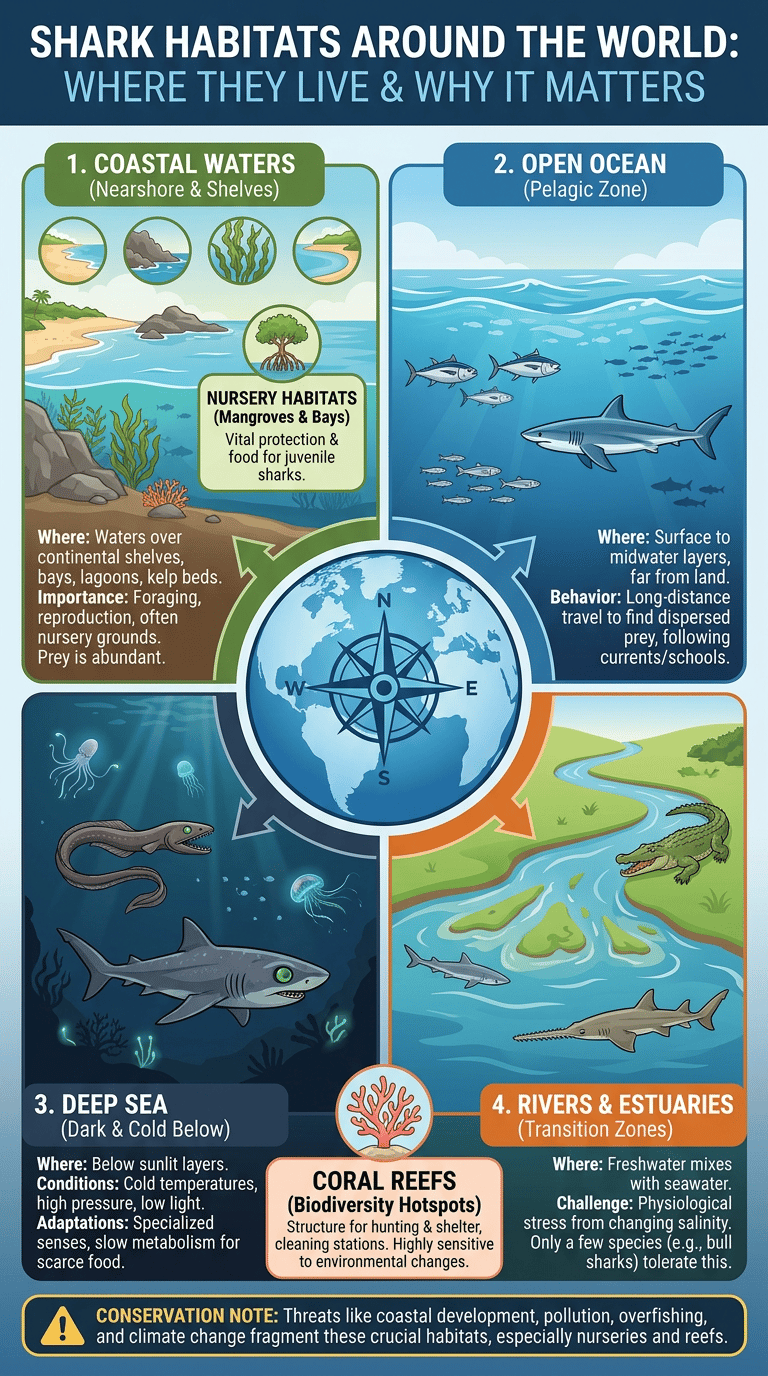
Many shark species live near coasts, in waters over continental shelves where food can be relatively abundant. Coastal habitats include sandy shorelines, rocky areas, kelp beds, lagoons, and shallow bays. These nearshore zones are often important for foraging and reproduction.
Open ocean
Some sharks inhabit the open ocean, often called pelagic sharks. These species spend significant time far from land, swimming through surface and midwater layers where prey can be dispersed. Pelagic habitats require different behaviors and body shapes compared with coastal species.
Deep sea
Other shark species are adapted to deep sea environments below the sunlit layers. Deep-sea sharks often show specialized anatomy and life histories suited to low light, low temperature, and high pressure conditions.
Rivers and estuaries
A few shark species enter rivers and estuaries where freshwater mixes with seawater. These environments pose physiological challenges because of changing salinity, but some sharks can tolerate or use these transition zones. For context on international agreements relevant to traded or protected species, see CITES information on regulated species on the CITES site.
Why habitat depends on species
Warm-water sharks
Species adapted to warm waters are often found in tropical and subtropical seas. They may use coral reefs, shallow coastal waters, or pelagic tropical seas depending on their ecology.
Cold-water sharks
Other species are adapted to colder waters at higher latitudes or in deeper layers. Cold-water sharks may show different feeding habits and metabolic rates compared with warm-water species.
Deep-sea sharks
Deep-sea sharks live in environments with low light and limited food. They may rely on specialized sensory systems, slow hunting strategies, or scavenging. Adaptations vary widely across species.
Freshwater-tolerant sharks
A small number of shark species can tolerate low-salinity waters and may move into rivers, estuaries, or freshwater reaches for feeding or other activities. These adaptations involve physiological mechanisms to maintain internal salt balance. For species-level range and conservation information, consult species accounts on the IUCN Red List on the IUCN Red List.
Coastal shark habitats
Bays
Bays provide sheltered water and often concentrate prey, which can make them attractive to foraging sharks. Shallow bays with muddy or sandy bottoms may serve as areas for juvenile sharks to feed and grow while avoiding some larger open-ocean predators.
Reefs
Coral and rocky reefs are biodiverse areas that support many prey species and complex interactions. Sharks associated with reef systems use structure for hunting, shelter, and social interactions. Reef habitats are sensitive to environmental changes, which can affect sharks that rely on them.
Mangroves
Mangrove forests line many tropical and subtropical coasts and create a maze of roots and sheltered water. These areas can serve as important feeding zones and protection for young sharks because they offer shallow, complex habitats where predators may be less effective.
Estuaries
Estuaries, where rivers meet the sea, combine fresh and salt water and support high productivity. They can be important transition zones for species that move between marine and freshwater environments and often play a role in life stages of fish and sharks.
Nursery importance
Coastal areas often function as nurseries for juvenile sharks because shallow waters with abundant small prey provide food and relative protection. Protecting nursery habitats is a key conservation concern discussed in many species assessments and conservation plans; for global species accounts consult the IUCN Red List on the IUCN Red List.
Open ocean shark habitats
Pelagic sharks
Pelagic sharks occupy surface and midwater zones of the open ocean rather than habitats tied to the sea floor. These sharks typically cover large distances in search of food, and their body forms often reflect adaptations for sustained swimming and efficient energy use in open water.
Long-distance movements
Some pelagic sharks undertake long-distance movements that connect feeding areas, breeding grounds, and migratory routes. Long-distance travel allows these sharks to exploit widely distributed prey and respond to seasonal changes in ocean productivity.
Distributed food sources
In open-ocean environments, prey is often dispersed, which shapes shark behavior and distribution. Pelagic sharks may follow schools of fish, migratory prey, or ocean features such as currents and upwellings that concentrate food.
Deep-sea shark habitats
Low light
Deep-sea habitats are characterized by very low light or permanent darkness below the sunlit layers. Sharks in these zones may rely on enhanced sensory systems to detect prey and navigate in dim conditions.
Cold temperatures
Deep waters are cold, which influences shark physiology, growth, and reproduction. Deep-sea species exhibit life history strategies adapted to lower temperatures and often limited food availability.
High pressure
The high pressure of deep waters shapes the anatomy and cellular physiology of deep-sea organisms. Sharks that live at depth show anatomical and buoyancy features suited to those conditions.
Unique adaptations
Deep-sea sharks may display adaptations such as reduced eyes, specialized sensory organs, or unique feeding structures that suit a low-food environment. These traits help them find and capture scarce prey while conserving energy.
Reef shark habitats
Coral reefs
Coral reefs support diverse food webs and provide structure that reef-associated sharks use for hunting and movement. Healthy reefs can sustain a variety of shark species that depend on reef fish and invertebrates as prey.
Cleaning stations
On many reefs, cleaner organisms remove parasites from larger animals at predictable spots known as cleaning stations. Sharks sometimes visit these stations and engage in cleaning interactions, which can be important for health and behavior.
Hunting near reef edges
Sharks often hunt near reef edges where reef-associated prey and open-water prey meet. These transitional zones can concentrate foraging opportunities, allowing sharks to exploit a mix of species that move along reef margins.
Reef health and shark populations
Changes to reef health, including coral loss and reductions in reef fish populations, can affect sharks that rely on reefs for food and shelter. Conservation assessments highlight reef degradation as a factor influencing many shark species; see IUCN species accounts for conservation context on the IUCN Red List.
Freshwater and river shark habitats
Sharks in rivers
Some shark species are known to enter river systems and travel distances from the sea. These occurrences reflect specific physiological abilities to tolerate lower salinity and behavioral choices related to feeding or life history needs. For species-level range information, consult the IUCN Red List on the IUCN Red List.
Estuaries as transition zones
Estuaries act as ecological transition zones where saltwater and freshwater mix. They can be used by sharks as foraging areas, travel corridors, or nursery habitats because they often support high productivity and diverse prey communities.
Why few sharks use fresh water
Most sharks are marine and maintain internal salt balance suited to seawater. Moving into freshwater requires specific physiological adaptations to regulate salts and fluids, so only a small number of species regularly utilize fresh or low-salinity environments.
Shark nursery habitats
Protection for juveniles
Young sharks face higher predation risk and need ample food to grow. Shallow, structured, or sheltered habitats can reduce predation risk and provide abundant small prey, improving survival prospects. Recognizing and protecting nursery habitats is an important part of conservation planning; for broader species assessments see the IUCN Red List on the IUCN Red List.
Mangroves and shallow bays
Mangroves and shallow bays often serve as nursery areas because their complex habitats provide shelter and food. Protecting these coastal habitats can support juvenile development and contribute to the persistence of local shark populations.
Human threats to nursery areas
Nursery habitats can be threatened by coastal development, pollution, and habitat modification. When nursery areas are degraded or lost, juvenile survival may decline, with potential consequences for adult populations over time. International trade and protection mechanisms can be part of broader strategies to support habitat protection; see CITES for information on trade regulation on the CITES site.
Shark migration and habitat use
Seasonal movements
Many shark species undertake seasonal movements to follow prey, find suitable breeding areas, or respond to changing ocean conditions. These movements may be predictable and repeatable, linking different habitat types.
Feeding grounds
Sharks often use specific feeding grounds where prey availability is consistently high. Feeding grounds can include coastal upwellings, areas with dense schools of fish, reef edges, or parts of the open ocean influenced by currents.
Breeding areas
Breeding areas can be distinct from feeding grounds and may include protected coastal zones or particular offshore locations where mating and birthing occur. Identifying and protecting breeding habitats is an important part of conservation planning.
Tracking with tags
Researchers use tagging and tracking technologies to study shark movements and habitat use. Tracking studies help reveal migration routes, habitat preferences, and seasonal behavior patterns that inform conservation and management. Movement data are often incorporated into species assessments such as those on the IUCN Red List on the IUCN Red List.
Human impacts on shark habitats
Coastal development
Coastal development that replaces natural shorelines with built structures can reduce or fragment habitats used by sharks, including nurseries and foraging areas. Preserving natural coastal features helps sustain ecological functions that support shark life stages.
Pollution
Pollution from land-based sources, shipping, and other activities can degrade water quality and affect the health of marine communities. Pollution impacts can reduce prey abundance and harm habitats such as reefs and mangroves that are important for many shark species.
Overfishing
Overfishing can remove sharks directly or deplete the prey species sharks rely on. Sustained removal of large predators alters food webs and can change habitat use patterns. Conservation assessments often highlight overfishing as a primary threat to many shark species; see species accounts on the IUCN Red List on the IUCN Red List.
Climate change
Changes in ocean temperature, currents, and chemistry can affect where suitable habitat exists for sharks and their prey. Shifts in habitat conditions may lead to changes in distribution and timing of movements for many marine species.
Coral reef decline
Coral reef decline reduces habitat complexity and prey availability for reef-associated sharks. Loss of reef health can therefore affect the abundance and behavior of sharks that depend on reefs as a primary habitat.
FAQs about shark habitats
Do sharks live in every ocean?
Sharks have been recorded in all of the world ocean regions, though different species occupy different parts of the global ocean. For species-level range maps and conservation information, consult the IUCN Red List on the IUCN Red List.
Do sharks live in rivers?
A few shark species can enter rivers and low-salinity systems, but most sharks are marine and remain in saltwater habitats. Estuaries and river mouths can be important transition zones for some species. For context on international trade and protection that can affect species across habitats, see CITES on the CITES site.
What depth do sharks live at?
Sharks are found from shallow coastal waters down to deep-sea environments. Depth use varies greatly by species and life stage, with some sharks remaining near the surface and others adapted to life in deeper, darker layers.
Do sharks live near beaches?
Some sharks frequent areas near beaches, especially where prey is abundant. Beach-goers should follow local safety guidance and beach advisories and avoid approaching or attempting to interact with wildlife. If a concern arises, contact local authorities or trained professionals for assistance.
Where are sharks most common?
Shark abundance tends to be higher where food is plentiful and habitat supports life stages such as feeding and reproduction. Coastal upwellings, productive reef systems, estuaries, and certain pelagic zones can support higher numbers of sharks depending on species and region. For conservation summaries and range information across species, consult the IUCN Red List on the IUCN Red List.
Readers comparing shark habitat facts may also find shark facts useful for a deeper look at a closely related shark topic.
Readers comparing shark habitat facts may also find shark diet facts useful for a deeper look at a closely related shark topic.
Readers comparing shark habitat facts may also find megalodon shark facts useful for a deeper look at a closely related shark topic.
Readers comparing shark habitat facts may also find mako shark facts useful for a deeper look at a closely related shark topic.
Readers comparing shark habitat facts may also find tiger shark facts useful for a deeper look at a closely related shark topic.
Readers comparing shark habitat facts may also find whale shark facts useful for a deeper look at a closely related shark topic.

Ethan Walker is the founder and research editor of Animal Fact Central. He creates and reviews educational animal facts content using trusted wildlife, pet care, and science-based sources. His work focuses on making animal behavior, adaptations, habitats, and species facts clear, accurate, and engaging for everyday readers.
Read More Details About Ethan Walker: https://animalfactcentral.com/ethan-walker/