
Noise pollution affects wildlife by making it harder for animals to communicate, find mates, detect predators, locate prey, move through habitat, and use areas that would otherwise be suitable. For many animals, sound is not background decoration. It is part of how they survive.

A busy road, aircraft route, construction site, boat channel, or loud recreation area can change the acoustic environment that animals rely on. The effect may be obvious, such as a bird singing louder near traffic, or subtle, such as a bat avoiding a hunting area because the noise makes prey harder to hear. The National Park Service overview of wildlife and noise describes several documented responses, including stress, avoidance of noisy areas, reduced ability of female frogs to locate male signals, and hunting problems for some bats.
The main lesson is simple but easy to miss: habitat is not only trees, water, shelter, and food. For sound-dependent animals, a usable habitat also has an acoustic shape. If noise blocks signals or makes danger harder to detect, a place can become less useful even when it still looks natural to people.
Quick Answer: What Does Noise Pollution Do to Animals?
Noise pollution can affect wildlife in four broad ways. It can mask calls, songs, alarms, or movement cues. It can change behavior, such as causing animals to sing differently, move at different times, avoid certain areas, or spend more energy staying alert. It can also interfere with reproduction, feeding, predator avoidance, and habitat use.
Not every species responds the same way. Some animals adjust quickly by calling louder, shifting timing, or using visual cues. Others may leave noisy places, lose feeding opportunities, or have lower breeding success under chronic noise. The outcome depends on the species, the sound frequency, the loudness, how long the noise lasts, when it occurs, and whether the animal has other ways to gather the same information.
Noise pollution is often invisible: a habitat can look healthy while sound changes which animals can use it.
Why Sound Matters in Animal Life
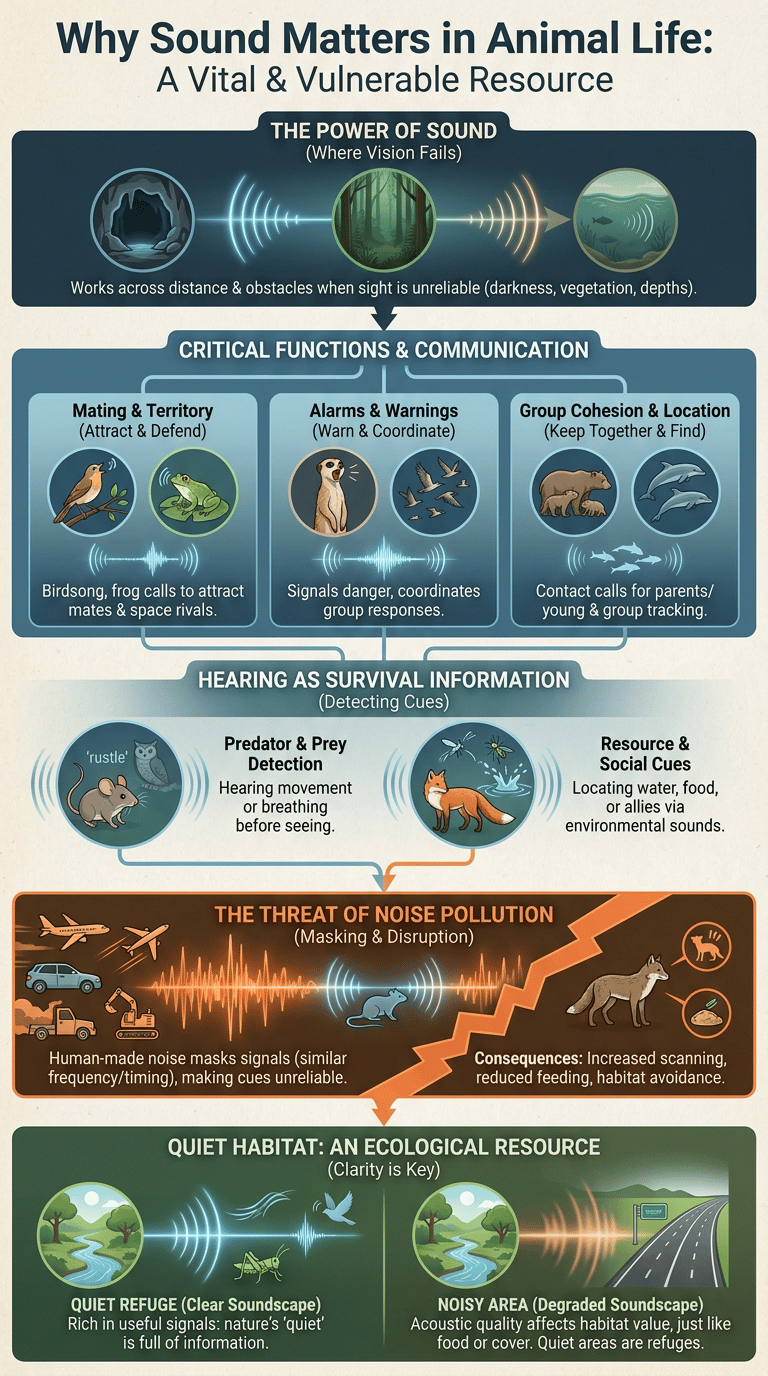
Animals use sound for far more than making noise. Sound can travel through vegetation, darkness, muddy water, caves, and ocean depths where vision is limited. It can warn, attract, coordinate, threaten, locate, and identify. Because sound works across distance and around obstacles, many animals depend on it when sight is unreliable.
Communication, Mating Calls, Alarms, and Territorial Signals
Birdsong is one clear example. Birds use songs and calls for territory, mating, group contact, alarm, begging, and other social functions. The Cornell Lab’s bird communication materials explain that birds communicate with songs, calls, drumming, and other sounds.
Frogs and toads also rely heavily on sound. In many species, males call from ponds, wetlands, or forest edges to attract females and space themselves among rivals. Insects such as crickets and cicadas produce sound for courtship or group signaling. Mammals may use calls to keep groups together, warn about danger, defend territory, or communicate between parents and young.
When human-made noise overlaps with these signals, the problem is not only volume. A call can be masked if the human noise occurs in a similar frequency range, at the same time, or with enough persistence to reduce the distance over which the signal can be detected.
Hearing Predators, Prey, Mates, and Group Members
Sound is also information. A small mammal may hear an owl before it sees one. A predator may listen for rustling prey. A young animal may locate a parent by contact calls. A social animal may keep track of group members by sound while moving through cover.
Noise pollution can make those cues less reliable. If an animal cannot hear faint movement, wingbeats, calls, or alarm signals, it may spend more time scanning, reduce feeding time, or avoid the area altogether. In this way, noise can change the cost of living in a habitat even if it does not physically remove food or shelter.
Quiet Habitat as an Ecological Resource
Quiet is not empty. In wildlife ecology, a quiet habitat can be full of useful signals: running water, insect choruses, bird alarms, mammal footsteps, wind direction, surf, or the calls of neighboring animals. Human-made noise can reduce the clarity of that soundscape.
This is why protected areas, city parks, wetlands, and green corridors can have different value depending on their acoustic conditions. A patch of trees beside a highway may offer food and cover, but road noise can still reduce its usefulness for animals that depend on low-level sound cues. Quiet areas can function as refuges in much the same way that dark areas help animals affected by artificial light at night.
Main Mechanisms of Noise Pollution Effects
Noise pollution affects wildlife through several overlapping mechanisms. The same road can mask bird songs, stress amphibians, reduce bat hunting efficiency, and make mammals avoid nearby cover. These effects are connected, but they are not identical.
Masking Animal Communication
Masking happens when one sound makes another sound harder to detect or interpret. Traffic is a common example because it produces broad, steady sound that can overlap with animal calls. Machinery, generators, aircraft, boats, and construction can create similar problems.
Animals may respond by changing the timing, volume, pitch, or structure of their sounds. Some birds sing at higher minimum frequencies in noisy places. Some frogs change call traits near traffic. Some mammals adjust calling behavior when their social calls no longer travel as far. These changes can help, but they may also carry costs. Calling louder takes energy, a shifted call may be less attractive, and calling at a different time may increase exposure to predators or competitors.
Stress Responses and Energy Costs
Noise can act as a stressor, especially when it is loud, unpredictable, or chronic. In wildlife research, stress is not just a feeling. It can involve hormones, alert behavior, lost feeding time, and changes in reproduction or movement. A study on traffic noise and treefrogs reported evidence that traffic noise increased glucocorticoid concentrations and impaired reproductive behavior in the frogs studied.
That does not mean every noisy environment causes the same hormone response in every species. Stress effects vary by species, sound type, season, exposure, and whether animals can move away. A cautious way to understand the issue is that noise can raise the energetic and behavioral cost of using a habitat, especially during breeding, feeding, migration, or parental care.
Avoidance, Displacement, and Habitat Loss Without Habitat Destruction
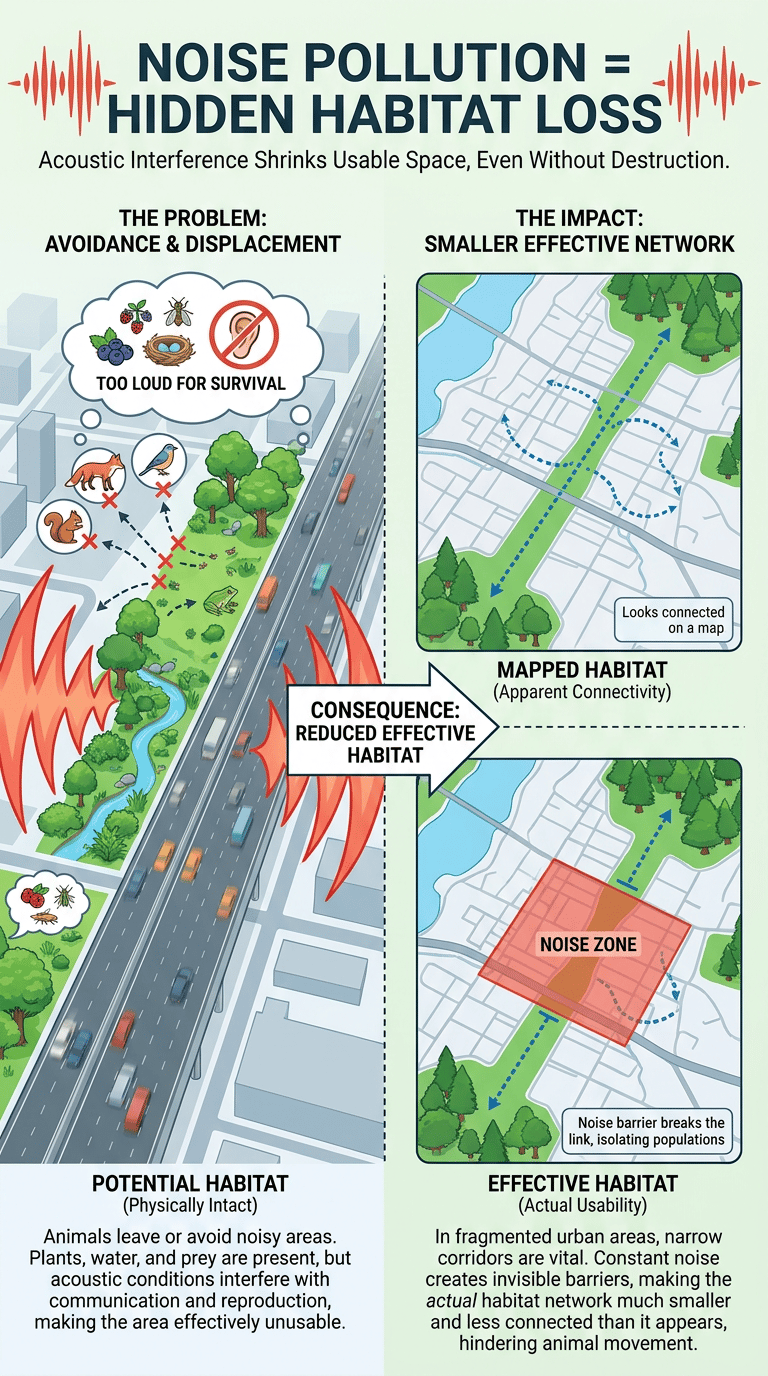
Some animals respond to noise by leaving or avoiding noisy places. This can create a hidden form of habitat loss. The plants, water, nesting sites, or prey may still be present, but animals may use the area less because the acoustic conditions interfere with survival or reproduction.
This matters in urban areas and along roads because habitat is already fragmented. A narrow strip of trees, riverbank, or park edge may be one of the few places animals can move through a city. If constant noise makes that strip less usable, the effective habitat network becomes smaller than it appears on a map.
Reduced Detection of Predators or Prey
Noise can interfere with the way predators and prey listen to each other. Owls, bats, foxes, coyotes, rodents, insects, frogs, and many other animals use sound either to hunt or avoid being hunted. If noise covers footsteps, wingbeats, rustling, mating calls, or prey-generated sounds, the balance between predator and prey can shift.
In laboratory experiments, researchers found that traffic noise reduced hunting efficiency in greater mouse-eared bats, which are acoustic predators that listen for prey sounds. The study of greater mouse-eared bats is a useful example because it shows that noise can affect feeding, not only communication.
Birds and Urban Noise
Birds are visible examples because many sing, call, and defend territories near traffic and city activity.
Changes in Song Pitch, Timing, and Repetition
Urban noise can push some birds to adjust their songs. A bird may sing louder, repeat signals more often, sing at a higher minimum frequency, or shift singing to quieter times of day. These changes can improve the chance that the signal reaches another bird, but they may also alter how the signal functions.
White-crowned sparrows in the San Francisco Bay Area have been especially useful for studying these responses. A Science study on white-crowned sparrows found that when pandemic shutdowns reduced urban noise, male sparrows changed their singing performance in ways that improved signal transmission. The study is often discussed because it showed that at least some songbirds can respond quickly when the acoustic environment changes.
Nesting and Mate Attraction Challenges
Bird songs are not random music. In many species, song helps males defend territories and attract mates. If traffic noise makes a song harder to hear, a bird may have to work harder to hold a territory or communicate with a potential mate. Calls also matter around nests, where adults and young may use sounds for contact or begging.
Noise may also change where birds choose to nest. Some species tolerate noisy areas and continue breeding near roads or buildings. Others may avoid them, which can affect which bird communities remain in loud urban spaces. The result is not simply fewer birds everywhere. It is often a change in which birds are common, which are scarce, and how they behave.
Why Noisy Cities Favor Some Bird Species Over Others
Bird species that are flexible, bold, common, or able to adjust their songs may do better in noisy cities. Species with quieter calls, narrower habitat needs, or less flexible behavior may be filtered out. This is one reason city bird communities can become dominated by a smaller set of adaptable species.
Noise is only one filter. Light, food, buildings, predators, vegetation, pets, and climate also shape urban bird life. Still, noise can be a strong pressure because so many bird behaviors depend on sound. A city does not need to be silent to support birds, but reducing chronic noise in key habitats can make communication easier.
Mammals, Amphibians, and Insects
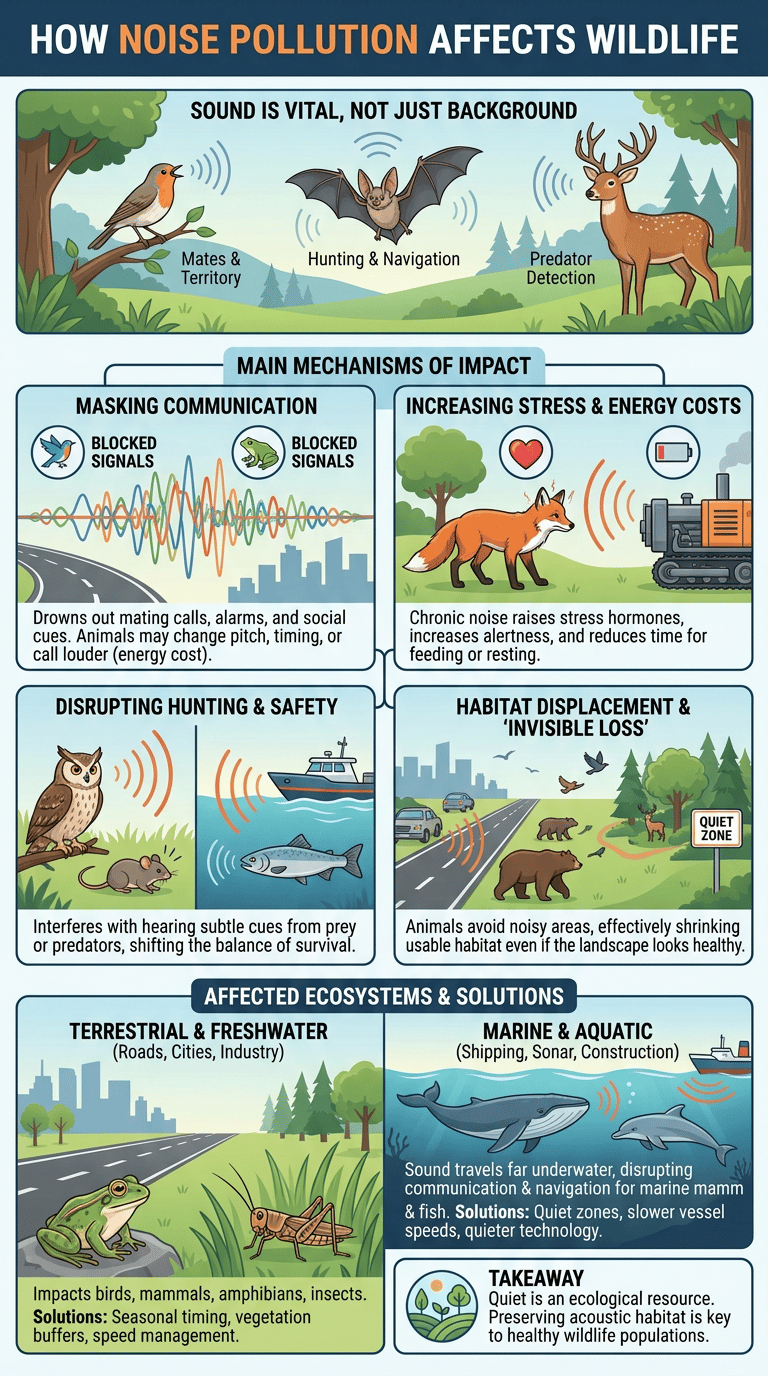
Mammals, amphibians, insects, and quieter-seeming animals also rely on acoustic cues.
Mammals Avoiding Loud Roads or Changing Activity Times
Mammals can respond to noise in several ways. Some avoid noisy areas, especially when noise is paired with traffic, people, or open habitat. Others shift activity toward quieter hours. A cautious coyote, fox, bobcat, deer, or small mammal may not be responding to sound alone, but noise can be one part of a larger disturbance pattern.
For mammals that use hearing to find prey or avoid predators, noise can make daily life more expensive. A predator may have to search longer. A prey animal may spend more time alert and less time feeding. Social mammals may have trouble keeping group contact if calls are masked by roads or machinery.
Frogs and Insects Competing With Human Noise
Frogs are a strong example because many species breed by sound. Male calls can tell females where males are located and can help females assess potential mates. If traffic or machinery overlaps with those calls, females may have more trouble locating males, and males may shift call traits in ways that affect energy use or attractiveness.
Insects face similar issues when they use sound or vibration. Crickets, katydids, cicadas, and other insects may communicate in soundscapes that include roads, mowers, engines, or construction. The details differ by species because insect signals can use different frequencies and structures, but the basic problem is the same: a signal must stand out from the background to be useful.
Social Animals and Group Communication Under Noise Pressure
Social animals depend on communication to coordinate movement, warn group members, maintain contact, and reduce conflict. Noise can make these signals less clear. A group may stay closer together, call more often, avoid certain areas, or change timing.
These responses may look small from the outside, but they can influence energy use and risk. Repeating calls, moving through less ideal habitat, or spending more time vigilant can affect feeding and reproduction. Over time, chronic noise may help decide which species can remain in a place and which ones use it less often.
Marine and Freshwater Noise Impacts
Noise pollution is not only an urban street problem. It also happens underwater, where sound behaves differently and many animals rely heavily on hearing or vibration. Boats, shipping, construction, sonar, seismic activity, and industrial equipment can add human-made noise to aquatic environments.
Boat Traffic, Sonar, and Underwater Sound Basics
Underwater sound can travel efficiently over long distances, especially in dark, deep, or murky water. NOAA Fisheries emphasizes that sound is an especially efficient way to communicate underwater and studies human-made noise impacts through its NOAA Fisheries ocean noise program.
Boat engines, propellers, shipping lanes, pile driving, dredging, and sonar can add noise to habitats used by whales, dolphins, seals, sea lions, fish, and invertebrates. The effects depend on the species and exposure. A brief sound may cause temporary avoidance. Chronic shipping noise may reduce communication space. Very intense sound can be more serious, especially when it overlaps with sensitive behaviors or habitats.
Marine Mammals, Fish, and Invertebrate Sensitivity
Marine mammals are often highlighted because many whales and dolphins use sound to communicate, navigate, find food, and maintain social contact. But fish and invertebrates also respond to sound and vibration. Some fish produce sounds during courtship or territorial behavior. Some invertebrates detect vibrations or particle motion in ways that help them respond to their surroundings.
Noise can change movement, calling, feeding, or stress responses in aquatic animals. The careful point is that marine noise is not one single threat with one single outcome. A whale exposed to ship noise, a fish near construction, and an invertebrate in a noisy harbor may experience different types of risk.
Why Underwater Noise Travels Differently Than Air Noise
People often underestimate underwater noise because we are land animals. Sound travels differently in water, and many aquatic animals live in environments where sight is limited. A sound source that seems distant from the surface can still matter underwater.
This is why marine noise management often focuses on timing, location, vessel speed, quieter technology, and protection of sensitive habitats. Reducing noise at the right time and place can matter more than trying to make the entire ocean quiet. The goal is to reduce harmful interference with feeding, migration, breeding, and communication.
Roads, Traffic, and Fragmented Habitats
Roads create traffic noise as well as collision risk, barriers, edge habitat, light, and human access.
Road Noise as a Barrier Even Before Animals Reach the Pavement
A road can discourage animals from using nearby habitat because of constant sound. For a species that needs to hear predators, prey, mates, or group members, the area around a road may become less suitable. This can reduce movement through landscapes already divided by buildings, fences, lawns, and development.
Some animals may cross roads less often because they avoid the noisy edge. Others may still cross but spend less time feeding or breeding nearby. The details vary widely, which is why road noise should be considered alongside traffic volume, road width, vegetation, lighting, and surrounding habitat quality.
How Traffic Noise Overlaps With Roadkill Risk but Is Not the Same Issue
Traffic noise and roadkill are connected but separate. Roadkill is direct mortality from vehicles. Traffic noise is a sensory disturbance that can change communication, behavior, movement, and habitat use. An animal may be affected by road noise without being hit by a car.
This distinction helps avoid confusing solutions. Wildlife crossings and fencing may reduce collisions and improve movement. Noise reduction, speed management, buffers, and quieter surfaces may improve the acoustic quality of nearby habitat. The best road projects often need to consider both movement safety and sensory disturbance.
Why Crossing Structures May Need Quiet Habitat Connections
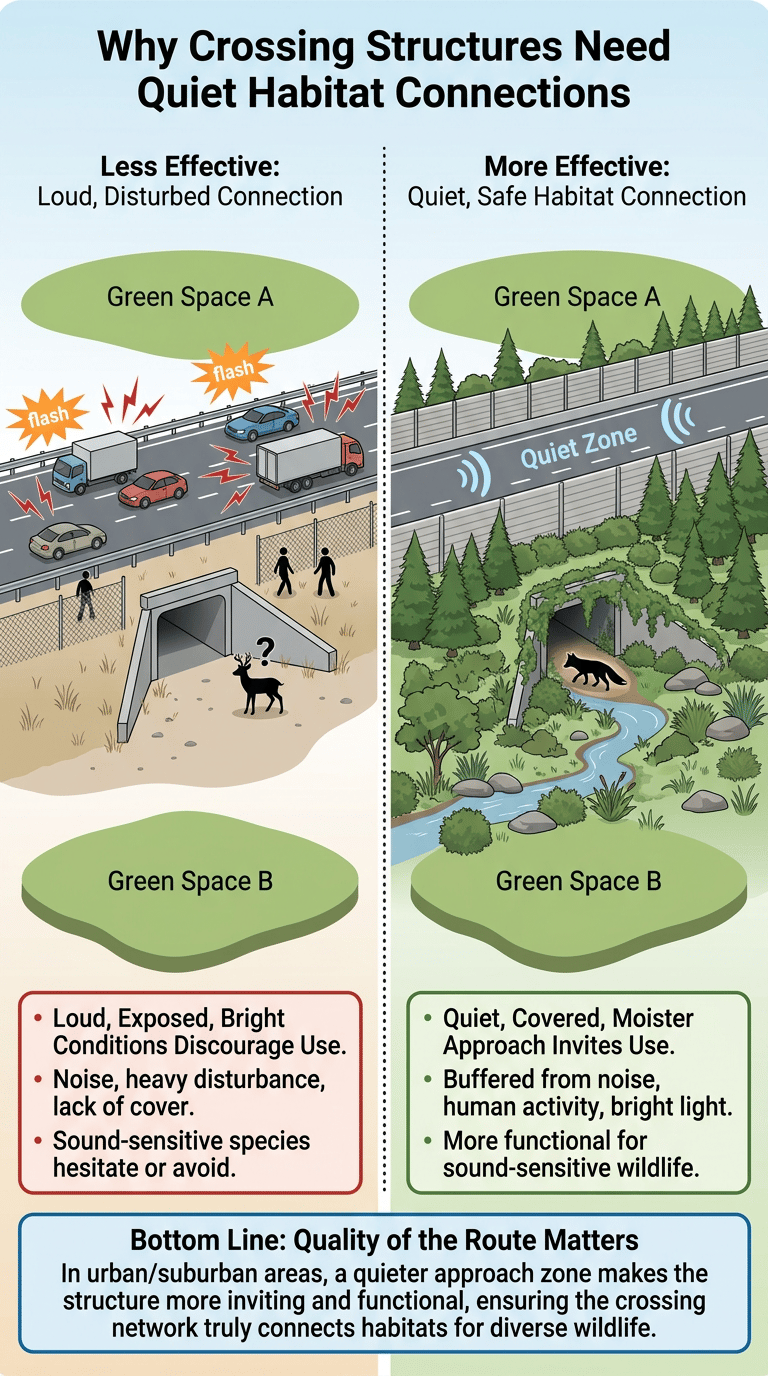
Wildlife crossings work best when animals are guided toward them through habitat that feels safe and usable. If a crossing is surrounded by loud, exposed, bright, or heavily disturbed conditions, some species may hesitate to use it. Noise is one factor among many, along with cover, moisture, fencing, human activity, and the surrounding habitat network.
This is especially relevant in urban and suburban areas. A crossing or culvert may connect two green spaces, but the quality of the route matters. For sound-sensitive animals, a quieter approach zone can make the structure more inviting and more functional.
Common Myths and Mistakes
Wildlife may respond to sound patterns and frequencies that people barely notice.
Myth That Animals Simply Get Used to Loud Environments
Some animals habituate to repeated sounds, especially if the sound is predictable and not associated with danger. But habituation is not guaranteed, and it is not the same as being unaffected. An animal may remain in a noisy area because it has no better habitat, not because the noise has no cost.
Other animals show sensitization, avoidance, or reduced performance under chronic noise. The right question is not whether wildlife can get used to noise in general. The better question is which species, which sound, which behavior, and which season.
Myth That Only Mammals and Birds Are Affected by Noise
Birds and mammals are easy to notice because many produce familiar calls. But amphibians, insects, fish, and invertebrates also use sound, vibration, or pressure cues. Some of these animals are small, nocturnal, aquatic, or hidden, so people may not realize noise affects them.
This matters for food webs. If insects change calling behavior, frogs struggle to hear mates, bats have trouble hunting, or fish avoid noisy breeding areas, the effects can move beyond one species. Noise can reshape interactions among predators, prey, competitors, and mates.
Mistake of Measuring Only Loudness Without Timing, Frequency, and Duration
Loudness matters, but it is not the whole story. A short loud sound may have a different effect from a moderate sound that lasts all night. A low-frequency rumble may mask one set of animal signals, while a high-frequency sound may affect a different set. Noise during breeding season can matter more than the same noise during a less sensitive period.
Good wildlife noise thinking considers timing, frequency, duration, predictability, location, and species sensitivity. A single decibel number rarely tells the full ecological story.
Reducing Noise Impacts on Wildlife
Noise can often be reduced by changing timing, equipment, traffic behavior, route planning, or activity levels.
Quiet Zones, Speed Management, Vegetation Buffers, and Seasonal Timing
Quiet zones can help around sensitive nesting, breeding, roosting, or migration areas. Speed management can reduce traffic noise and collision risk in some settings. Vegetation buffers may not block all sound, but they can improve habitat structure and create psychological distance from disturbance for some animals.
Seasonal timing is especially useful. Avoiding loud work near breeding wetlands, nesting colonies, rookeries, or migration bottlenecks can reduce harm without requiring permanent closure of an area. Timing can be a practical tool because many species are most sensitive during specific windows.
Construction and Recreation Timing Near Sensitive Habitats
Construction, mowing, tree work, fireworks, off-road vehicles, drones, amplified sound, and motorized recreation can disturb wildlife when they occur near sensitive habitat. The safest approach is to follow local rules and avoid adding loud sound near nesting, denning, roosting, or breeding areas.
For everyday readers, this means not using animal calls, loud speakers, drones, or repeated playback to get reactions from wildlife. A startled or responding animal may look exciting, but forcing that response can waste energy, disrupt communication, or increase stress.
City Planning Approaches That Preserve Acoustic Refuges
Cities can help wildlife by designing parks, green corridors, wetlands, and waterfronts with sound in mind. Locating quiet habitat away from heavy traffic, using barriers thoughtfully, managing recreation intensity, and reducing nighttime disturbance can make urban green spaces more useful for animals.
Acoustic refuges do not have to be huge wilderness areas. A quieter patch of riparian vegetation, a less disturbed wetland edge, or a protected park interior can provide meaningful habitat value, especially when connected to other green spaces.
How This Connects to Nearby Animal Topics
Noise overlaps with other urban wildlife issues, but sound is its own ecological layer.
Light Pollution as Another Sensory Disruption
Light pollution and noise pollution both change sensory environments. Light affects night behavior, migration, circadian rhythms, and predator-prey visibility. Noise affects communication, listening, movement, and stress. Some urban animals face both at once near roads, buildings, ports, and bright recreation areas.
Wildlife Crossings and Road Design
Wildlife crossings are often discussed as a way to reduce roadkill and reconnect habitat. Noise adds another design question: will animals approach and use the crossing if the surrounding area is loud and exposed? A crossing may need fencing, vegetation, cover, and quieter approach habitat to serve more species.
Green Spaces as Quieter Refuges and Corridors
Urban green spaces can provide food, shelter, shade, water, and movement corridors. They can also provide acoustic relief when they are large enough, well designed, or buffered from heavy traffic. A city park is more than a patch of green on a map if animals can also communicate and listen there.
FAQ
What Animals Are Most Affected by Noise Pollution?
Animals that depend heavily on sound are often most vulnerable. This includes many birds, frogs, bats, marine mammals, fish, insects, and social mammals. The risk is highest when human-made noise overlaps with important signals such as mating calls, alarm calls, prey sounds, parent-young contact calls, or migration cues.
That said, there is no single most affected group in every habitat. A frog breeding beside a noisy road, a bat hunting near traffic, a whale exposed to ship noise, and a bird singing in a city all face different acoustic challenges.
Can Traffic Noise Change Bird Songs?
Yes, traffic noise can change how some birds sing. Researchers have documented changes such as louder songs, altered timing, and higher minimum frequencies in some species and settings. These changes can help birds transmit signals through noisy environments, but they may also affect energy use or signal quality.
Not every bird species adjusts in the same way. Some birds are flexible, while others may avoid noisy habitats or be less successful there. That difference is one reason urban bird communities often favor adaptable species.
Does Noise Pollution Affect Marine Animals?
Yes. Many marine animals use sound for communication, navigation, feeding, or social contact. Human-made underwater noise from ships, boats, sonar, construction, and industrial activity can interfere with those behaviors depending on the sound and the species exposed.
Marine noise effects should be discussed carefully because exposure varies. A brief sound, chronic shipping noise, and very intense underwater sound are different situations. The strongest claims should be tied to specific species, sound sources, and study conditions.
Can Animals Adapt to City Noise?
Some animals can adapt to city noise by changing their calls, shifting activity times, choosing different nesting or feeding sites, or relying on other cues. Adaptation does not mean the noise has no cost. It may require more energy, reduce communication distance, or favor only the most flexible species.
Other animals may avoid noisy areas or decline where chronic noise interferes with breeding, feeding, or safety. In cities, the winners are often species that are behaviorally flexible, tolerant of disturbance, and able to use several types of habitat.
Final Thoughts
Noise pollution affects wildlife because sound is part of how animals experience habitat. Birds sing to defend territory and attract mates. Frogs call from breeding sites. Bats listen while hunting. Mammals use sound to stay alert or connected. Marine animals depend on underwater sound in places where vision may be limited.
The most useful takeaway is that wildlife protection is not only about saving visible habitat. It is also about preserving conditions animals can actually use. Reducing chronic noise near breeding areas, migration routes, wetlands, parks, coasts, and green corridors can make real habitat more functional. Quieter landscapes give animals a better chance to communicate, feed, move, and survive.

Ethan Walker is the founder and research editor of Animal Fact Central. He creates and reviews educational animal facts content using trusted wildlife, pet care, and science-based sources. His work focuses on making animal behavior, adaptations, habitats, and species facts clear, accurate, and engaging for everyday readers.
Read More Details About Ethan Walker: https://animalfactcentral.com/ethan-walker/