
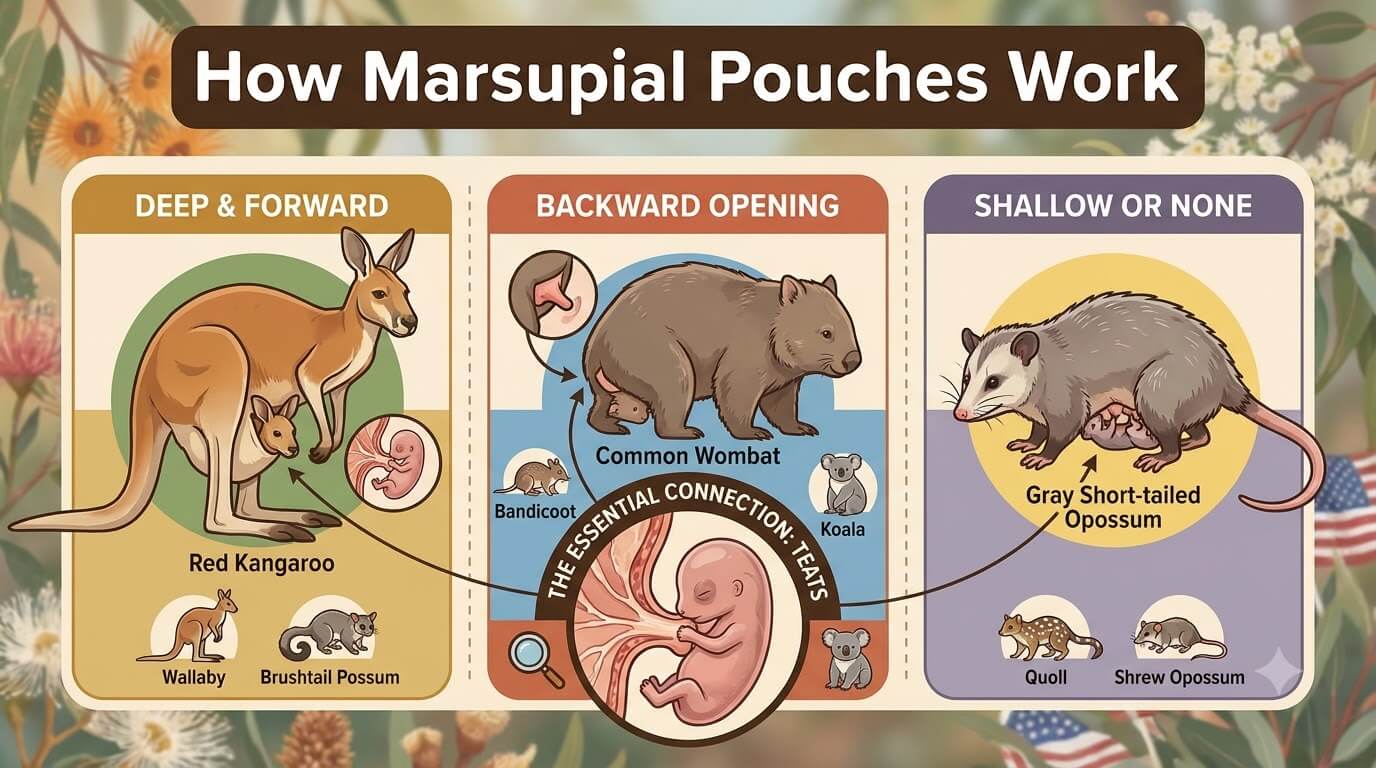
A marsupial pouch is not a miniature womb, and not every marsupial has the deep kangaroo-style pocket people picture. The pouch, or marsupium, is a skin structure around the mammary area that helps protect nursing young after birth. Across living marsupials, it ranges from a deep permanent enclosure to shallow skin folds, seasonally developed tissue, or no fully enclosing pouch at all.
What matters most biologically is access to the mother’s teats. Marsupial young are born at an early developmental stage and depend heavily on milk. A pouch can shield the young, keep them close to the teats, and help the mother stay mobile while nursing, but the exact design varies with lineage and lifestyle. Kangaroos, wombats, bandicoots, opossums, quolls, devils, possums, and other marsupials do not all use the same pouch architecture.
Quick Answer
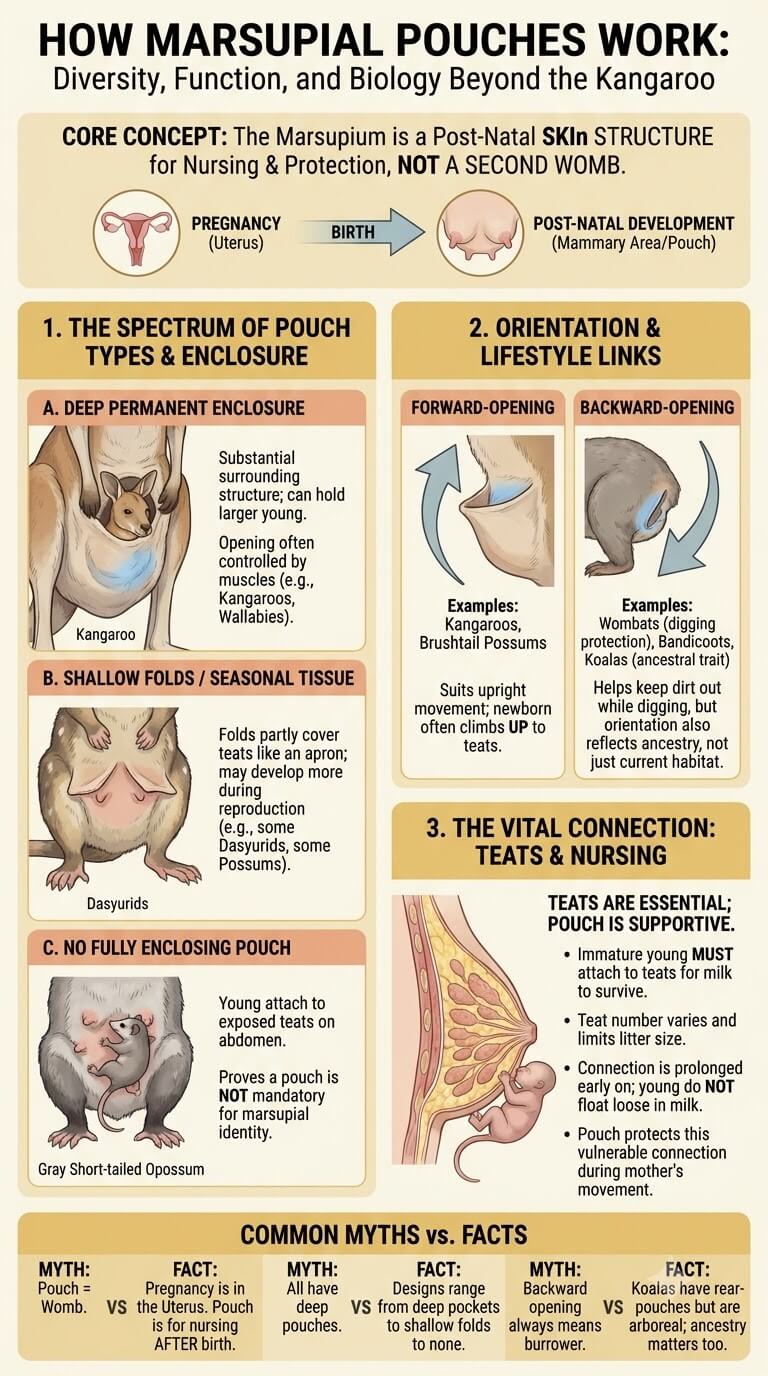
Marsupial pouches are folds or pockets of skin associated with the mammary region. In species with a well-developed pouch, the teats lie inside or within the protected area. In others, the pouch is shallow or incomplete, and some marsupials lack a large enclosing structure entirely. The Australian Museum’s overview of marsupials explicitly notes that not all marsupials have pouches and that in some species the structure is only a fold around the mammary area.
The pouch supports life after birth. Pregnancy and prenatal development occur in the uterus. Once the young is born, it reaches the mammary area, attaches to a teat, and continues developing while nursing. That postnatal function is why the pouch should be understood as a protective and nursing structure, not as an external uterus.
What a Marsupial Pouch Actually Is
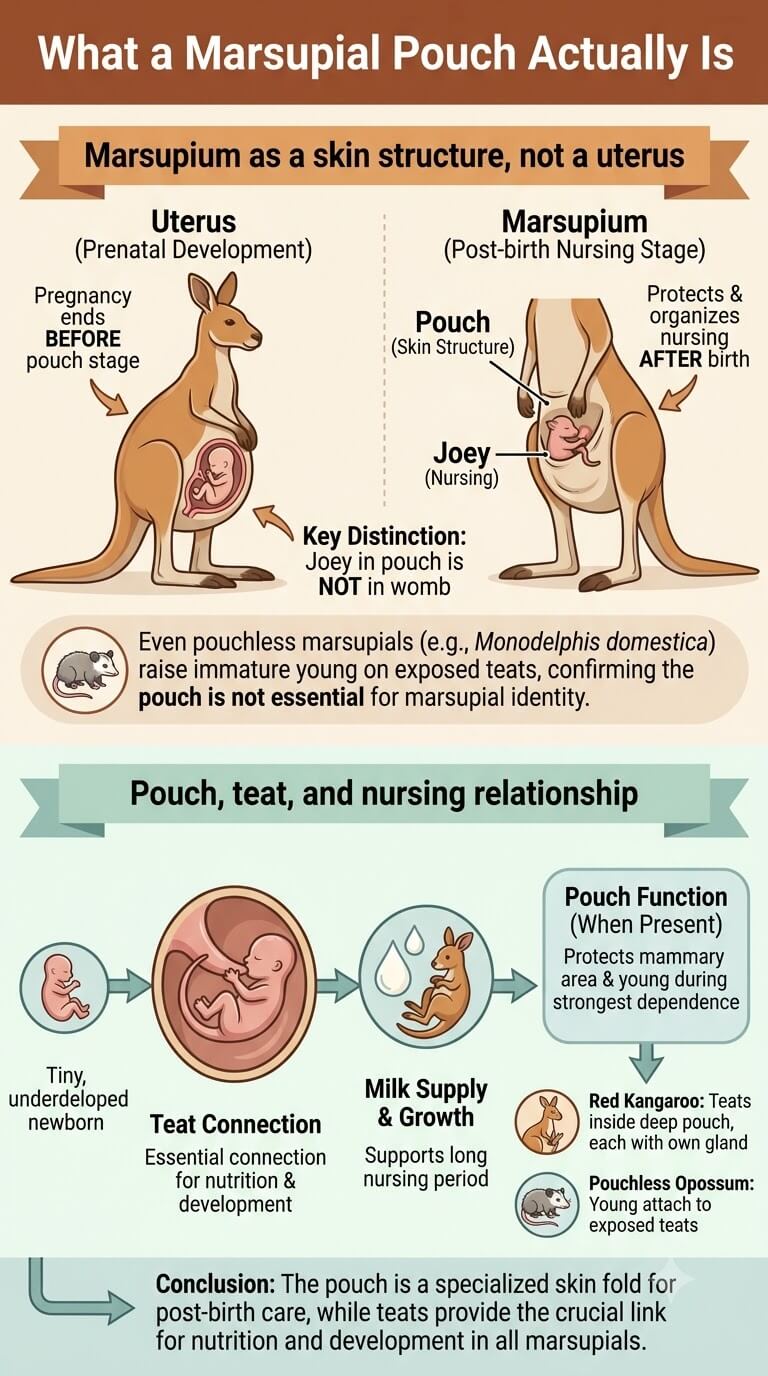
Marsupium as a skin structure, not a uterus
The word marsupium comes from Latin for pouch. Anatomically, the marsupial pouch is formed from skin and associated soft tissues on the mother’s abdomen. It surrounds some or all of the mammary area, depending on the species. In a kangaroo, the pouch is deep and obvious. In other marsupials, the covering may be much shallower.
This distinction matters because pregnancy has already ended by the time a newborn reaches the pouch. The uterus supports prenatal development before birth. The pouch protects and organizes the nursing stage after birth. A joey inside a pouch is therefore not still in the womb, even when it is tiny, hairless, and extremely immature.
A recent study of the pouchless gray short-tailed opossum, Monodelphis domestica, emphasizes the same point from the opposite direction: marsupial identity does not require a pouch at all. The species is a marsupial even though it lacks a fully enclosing pouch and raises its highly immature young attached to exposed teats.
Pouch, teat, and nursing relationship
The teats are the essential connection between the mother and her young after birth. Milk supplies nutrition and supports continued development over a long nursing period. In species with a pouch, the pouch protects the mammary area and young while this dependence is strongest.
A review of marsupial milk and mammary biology notes that teat position and number vary among species and that the number of functional teats can limit how many young can be supported at once. In red kangaroos, for example, the teats are located inside the pouch and each is associated with its own mammary gland.
Very young marsupials do not simply lie loose in a pool of milk. They establish contact with individual teats, and in early development the connection can be prolonged. The teat itself may elongate as the young remains attached. The exact duration and mechanics differ among lineages, so the kangaroo model should not be treated as universal.
Main Pouch Types and Degrees of Enclosure
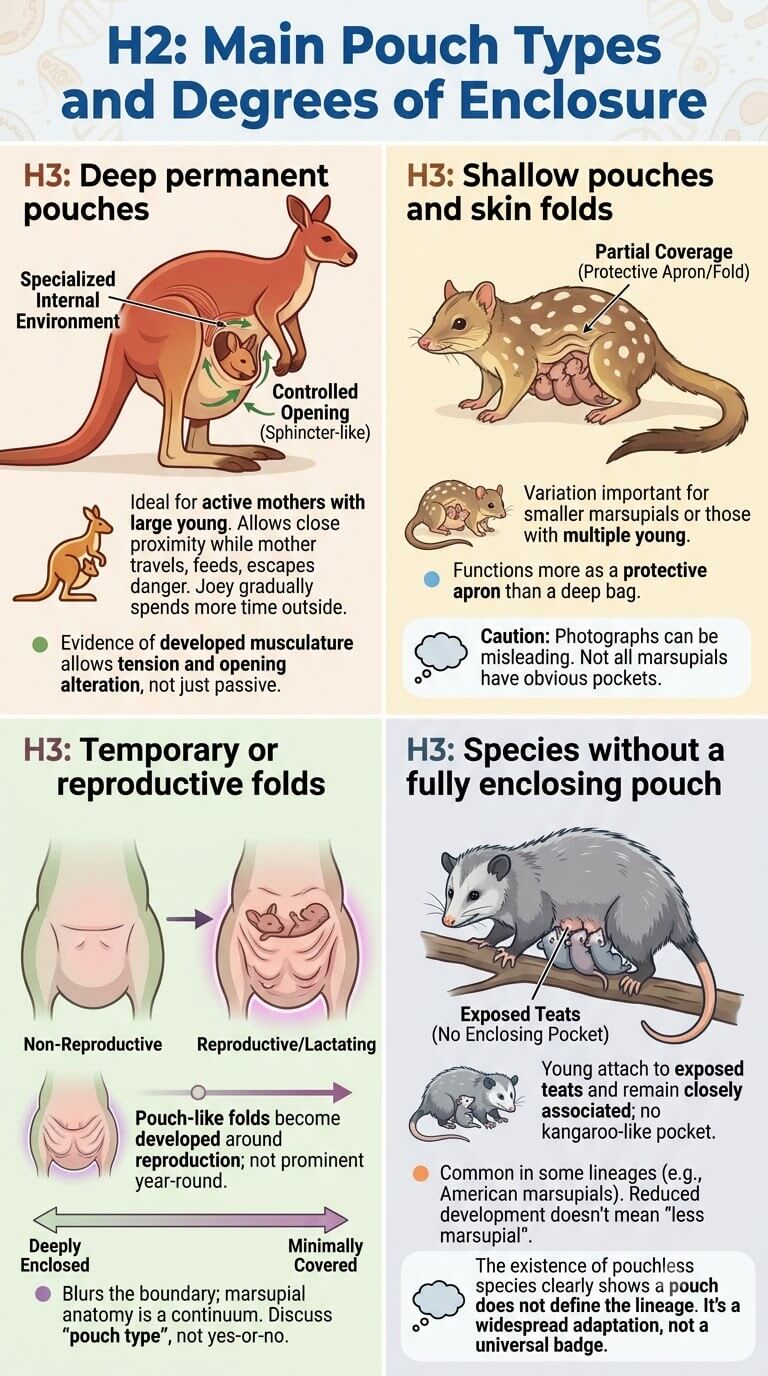
Deep permanent pouches
Large macropods such as kangaroos and wallabies have the classic deep pouch. It creates a substantial enclosure around the mammary area and can hold a developing joey as it grows. The opening can be controlled to some degree by surrounding muscles, and the pouch wall forms a specialized internal environment around the young.
This design works well for an active mother carrying a relatively large pouch young. The joey can remain close to the teats while the mother travels, feeds, and escapes danger. As the young grows, it gradually spends more time outside while continuing to return for nursing.
A histological study of the red kangaroo found developed musculature around the pouch opening, including a sphincter-like arrangement at the orifice. That red kangaroo pouch anatomy provides good evidence that at least some macropods can alter the tension and opening of the pouch rather than relying on a passive skin pocket.
Shallow pouches and skin folds
Not all pouches form a deep cavity. In some marsupials, folds of skin partly cover the teats without enclosing the young as completely as a kangaroo pouch. These shallower arrangements still offer structure around the mammary area and can help protect attached newborns.
This type of variation is especially important in smaller marsupials and in lineages where multiple young may be attached at once. The pouch can function more like a protective apron or fold than a deep bag.
Because “pouch” covers several anatomical forms, photographs of one species can be misleading. A reader who expects every marsupial female to have an obvious pocket may incorrectly conclude that a pouchless or shallow-pouched species is not a marsupial.
Temporary or reproductive folds
In some species, pouch-like folds become more developed around reproduction rather than remaining equally prominent year-round. The mammary region can change with pregnancy and lactation, and skin folds may become more protective as the young arrive and grow.
These temporary or seasonally emphasized structures blur the simple boundary between “has a pouch” and “has no pouch.” Marsupial anatomy exists on a continuum from deeply enclosed to minimally covered mammary areas.
This is one reason evolutionary biologists and anatomists often discuss pouch type rather than treating the pouch as a yes-or-no character. The degree of enclosure, opening direction, number and placement of teats, and relationship to the young can all vary independently.
Species without a fully enclosing pouch
Some marsupials raise their young without a large enclosing pouch. The gray short-tailed opossum is a well-known example used extensively in laboratory research. Its young attach to exposed teats on the abdomen and remain closely associated with the mother even though there is no kangaroo-like pocket around them.
Other American marsupials also show reduced pouch development. This is not evidence that they are “less marsupial.” Their ancestry and reproductive biology still place them firmly within Marsupialia.
The existence of pouchless species is one of the clearest corrections to the idea that a pouch defines the lineage. It is a widespread and important adaptation, not a universal membership badge.
Pouch Openings and Orientation
Forward-opening examples
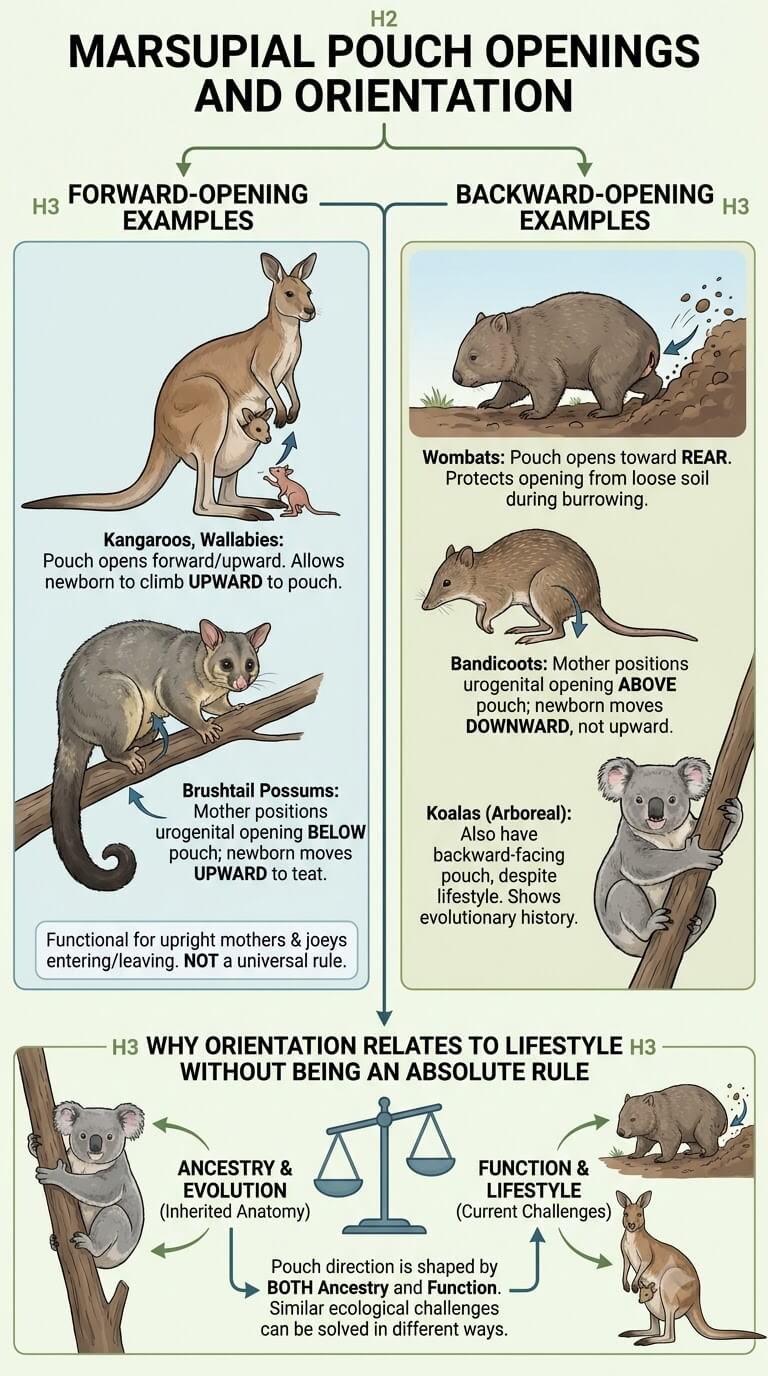
In kangaroos and wallabies, the pouch opening faces generally forward or upward on the abdomen. This arrangement allows the newborn to climb up toward the pouch after birth in species where that route has been observed. It also suits a joey that later begins leaning out or entering and leaving the pouch while the mother remains upright.
Brushtail possums also provide a forward-opening example. A review of birth in marsupials describes red kangaroos, tammar wallabies, and brushtail possums as species in which the mother positions the urogenital opening below the pouch and the newborn moves upward toward the teat.
That pattern is useful, but it should not be turned into a universal marsupial birth sequence. Other pouch orientations require different routes, and species without a definite pouch use still other arrangements.
Backward-opening examples
Wombats are famous for having pouches that open toward the rear. This makes intuitive sense for a powerful burrowing animal because a forward-facing opening could be exposed to loose soil while the mother digs. Animal Diversity Web notes that the wombat pouch is well developed but oriented so that it opens to the rear.
Bandicoots also include backward-facing pouch designs. Observations of birth in northern brown bandicoots show that the mother’s position places the urogenital opening above the pouch, and the newborns move downward rather than performing the upward climb associated with macropods.
Koalas complicate any simplistic ecology rule. Living koalas also have a pouch that opens toward the rear, even though they are arboreal rather than burrowing specialists. Orientation therefore carries evolutionary history as well as current functional significance.
Why orientation can relate to lifestyle without being an absolute rule
It is reasonable to discuss how pouch orientation can help keep debris away from young in digging marsupials, but it is too strong to say that every burrower must have a backward-opening pouch or that pouch direction perfectly predicts habitat.
Evolution works with inherited anatomy. A lineage may retain a pouch orientation even after descendants adopt different lifestyles. Similar ecological challenges can also be solved in different ways. Pouch direction is therefore best understood as one feature shaped by both ancestry and function.
Teats Inside and Outside Pouches
Teat number and placement vary by lineage
Marsupials do not have one standard teat arrangement. Large kangaroos have only a few teats in a deep pouch, while opossums and some smaller marsupials may support larger litters with more teats. Some species place the teats within a covered pouch, while pouchless species leave them exposed on the mammary surface.
In practical terms, teat number matters because an extremely young marsupial needs access to a teat to survive. Some small marsupials can give birth to more young than there are functional teats, which means not every newborn will successfully establish a nursing connection.
That is a species-level reproductive detail rather than a universal rule about marsupials. Teat number, litter size, attachment period, and milk production vary widely and should be checked for the animal being discussed.
Early attachment and protection
Once a newborn reaches the mammary area, attachment to a teat creates a stable feeding connection during a vulnerable period. The pouch can shield the attached young from physical disturbance and help keep it close to the mother’s body as she moves.
In deep-pouched species, the young may remain enclosed for a long period before regularly emerging. In shallow-pouched or pouchless species, maternal posture, skin folds, nesting, and other behaviors can contribute to protection.
The pouch is therefore only one part of a broader maternal system. Teats, milk, body temperature, maternal behavior, shelter, and developmental timing all work together.
Why young do not simply float loose in milk
Popular descriptions sometimes make the pouch sound like a bag that fills with milk. That is incorrect. Milk is delivered through teats. The interior may be moist, and the mammary area changes during lactation, but the young is not swimming in milk.
Early attachment is especially important because newborn marsupials are not yet capable of feeding like older mammals. They rely on the mother’s mammary system to deliver milk while their jaws, muscles, organs, and sensory systems continue maturing.
How Pouches Protect and Support Young
Physical protection during movement
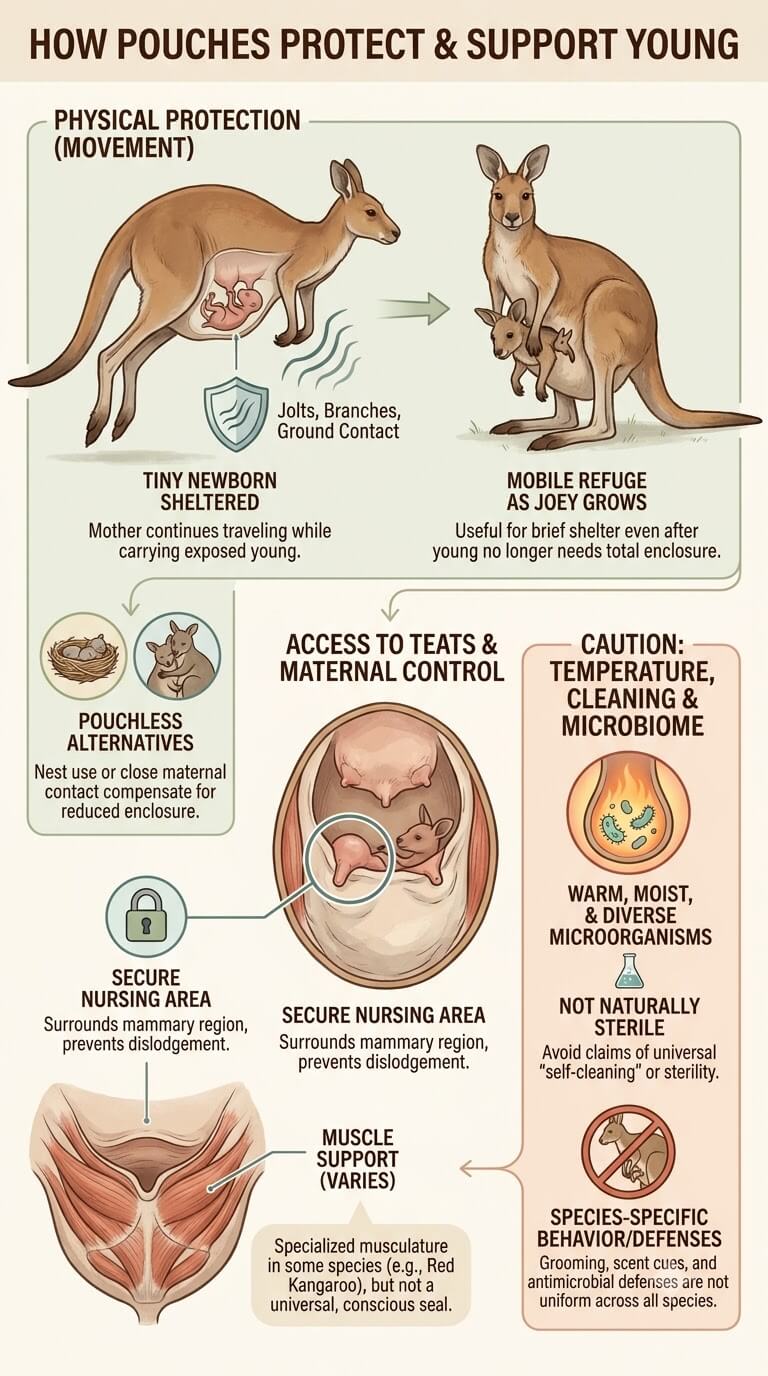
A deep pouch provides obvious mechanical protection. A tiny attached newborn is sheltered from branches, ground contact, and many of the jolts associated with the mother’s movement. For a kangaroo, that means the mother can continue traveling while carrying a young animal that would otherwise be extremely exposed.
As the joey grows, the physical challenge changes. A large pouch young has more developed limbs and senses, and it may begin poking its head outside or leaving the pouch briefly. The pouch remains useful as a mobile refuge even after the young no longer needs total enclosure.
Other marsupials achieve protection differently. A shallow fold can cover tiny attached young, while nest use or close maternal contact can help pouchless species compensate for reduced enclosure.
Access to teats and maternal control
By surrounding the mammary region, a pouch keeps the nursing area close to the mother’s body and makes it harder for attached young to be dislodged. Muscles around the opening can add support in some species. In a red kangaroo, the pouch orifice has specialized musculature rather than functioning as an uncontrolled gap.
Still, it would be inaccurate to claim that every marsupial can consciously seal its pouch in the same way or with the same muscles. Detailed pouch musculature has been studied far better in some species than others.
The safest general statement is that pouch skin, surrounding muscles, teat attachment, and maternal posture can all contribute to keeping young secure, but the mechanism varies.
Temperature, cleaning, and microbiome claims that require caution
The interior of a pouch is warm, moist, and biologically active. Researchers have studied bacteria in pouches and antimicrobial compounds in marsupial milk and tissues, especially because newborn marsupials have immature immune systems. A review of pouch microbiology describes evidence for diverse microorganisms and maternal antimicrobial defenses.
What should be avoided is the popular idea that every pouch is naturally sterile or that every species uses the same self-cleaning system. Pouch microbial communities can change with reproductive state and species, and the evidence does not support one universal hygiene story.
Mothers may lick or groom the pouch region in some species, especially around birth, but cleaning behavior should be described only where it has been observed. Claims about temperature regulation, scent cues, antimicrobial secretions, or microbiome function should also remain species-specific.
Pouch Design Across Different Lifestyles
Kangaroos and wallabies
Kangaroos and wallabies show the deep-pouch design most familiar to the public. Their young are born extremely small, reach the pouch, attach to a teat, and spend a long period developing inside. Later, the growing joey begins to emerge while still returning to the pouch and teat.
This arrangement works with a highly mobile mother. The pouch keeps the young integrated into the mother’s locomotion rather than requiring a fixed nest. It also allows a developing joey to transition gradually from constant enclosure to increasing independence.
Koalas and wombats
Koalas and wombats are close relatives within Diprotodontia, and both have rearward-opening pouches. Their current lifestyles are very different: koalas are tree-dwelling leaf eaters, while wombats are ground-dwelling burrowers.
The comparison is useful because it warns against treating pouch orientation as a simple label for one ecology. The wombat’s rear opening has an obvious functional advantage during digging, but koalas retain a similar basic orientation in an arboreal setting.
In both animals, the pouch protects a very immature young early in development. As the young grows, later transport and maternal contact differ from the classic kangaroo pattern.
Possums, devils, quolls, and bandicoots
Possums show several pouch forms, including well-developed enclosures in familiar species such as brushtails. Dasyurids such as devils and quolls can have more rudimentary pouch regions or skin folds, especially compared with kangaroos.
Bandicoots are notable for rearward-facing pouches and for reproductive biology that differs from the macropod model in several ways. Their newborns can move downward toward the pouch because of the mother’s birth posture and pouch position.
These contrasts demonstrate why “the marsupial pouch” is really a family of anatomical solutions rather than one standardized organ shape.
Opossums and reduced-pouch examples
American opossums are especially valuable for breaking the kangaroo stereotype. Some have a well-defined pouch, while others have a reduced mammary fold or lack a fully enclosing pouch. The gray short-tailed opossum is a clear pouchless example.
This diversity also helps explain why a pouch is not a practical field test for marsupial identity. A female marsupial without an obvious external pocket may still belong to a lineage whose reproductive system depends heavily on early teat attachment and prolonged lactation.
Common Myths and Mistakes
Every marsupial has a kangaroo-style pouch
False. Marsupial pouches range from deep enclosures to shallow folds, and some species lack a fully enclosing pouch. The kangaroo pouch is one prominent version, not the template for the entire lineage.
The pouch is the womb
False. Prenatal development occurs in the uterus. A marsupial enters the pouch only after birth. The pouch supports nursing and protection during postnatal development.
Backward-opening always means burrowing
False. Wombats provide a strong example of a rearward pouch that suits digging, and bandicoots also include rear-opening pouches. Koalas, however, also have a rearward pouch even though they are arboreal. Orientation reflects ancestry as well as current function.
Every pouch has the same hygiene or temperature system
False. Pouch structure, glands, microbiota, grooming, and surrounding musculature vary among species. Red kangaroo studies provide useful details about one deep pouch, but those findings should not automatically be applied to opossums, wombats, devils, bandicoots, or pouchless marsupials.
How Pouches Relate to Reproduction, Movement, and Habitat
Defining marsupial traits go beyond the pouch
A marsupial is defined by ancestry and a suite of reproductive and developmental traits, not by whether a visible pouch is present. Live birth, early postnatal development, teat dependence, prolonged lactation, and characteristic reproductive anatomy are more fundamental than the shape of the skin around the mammary area.
This broader view explains why a pouchless opossum is still a marsupial and why a pouch should not be used as a single diagnostic feature.
Baby development continues after birth
The pouch makes the most sense when viewed as part of a developmental sequence. A very immature newborn reaches a teat, attaches, and continues growing while dependent on milk. Later, attachment becomes less constant, the young gains mobility, and eventual weaning marks the end of milk dependence.
Exact timing differs sharply among species. The important point for pouch anatomy is that the structure supports a postnatal stage whose details belong to the biology of the young, not to pregnancy itself.
Movement and habitat can shape pouch function
A kangaroo benefits from carrying its young while traveling long distances on the ground. A wombat benefits from a pouch orientation that keeps the opening away from much of the loose soil pushed backward during digging. Arboreal species need pouches or folds that remain secure while climbing.
Those examples show plausible links between anatomy and lifestyle without turning the relationship into a rigid law. Evolutionary history constrains what forms are available, and closely related species can retain similar pouch designs even when they live in very different ways.
FAQ
Do all marsupials have a pouch?
No. Some marsupials have deep permanent pouches, others have shallow folds around the mammary area, and some lack a fully enclosing pouch. The gray short-tailed opossum is a well-known pouchless example. Pouch presence alone therefore cannot define Marsupialia.
Why do some pouches open backward?
A rearward opening can be useful in species that dig because it reduces the chance of loose soil entering the pouch from the front. Wombats are a strong example. But the explanation is not universal, because koalas also have rearward-opening pouches despite being arboreal. Pouch orientation reflects both function and evolutionary history.
Are teats always located inside a pouch?
No. In species with a deep pouch, the teats are protected inside the pouch. In species with shallow folds or no full pouch, the teats may be exposed or only partly covered. The essential feature is that newborn young gain access to milk, not that every teat sits inside a kangaroo-style enclosure.
Can marsupial young develop without a full pouch?
Yes. Pouchless and shallow-pouched marsupials still nurse highly immature young. They rely on teat attachment, maternal contact, body position, shelter, and other forms of protection rather than a deep permanent pouch. Their development confirms that the pouch is one maternal adaptation among several, not a biological requirement for every marsupial.
Final Thoughts
Marsupial pouches work by protecting the mammary area and nursing young after birth, but there is no single universal pouch design. Kangaroos and wallabies have deep permanent enclosures, wombats and bandicoots include rearward-opening pouches, some dasyurids rely on shallower folds, and species such as the gray short-tailed opossum lack a fully enclosing pouch. Teats, not the pouch itself, are the essential postnatal connection because young depend on milk while much of their development continues. Pouch orientation, muscles, depth, and coverage can reflect both ancestry and lifestyle, but none should be turned into a rigid rule. The most accurate picture is a spectrum of maternal structures that help different marsupials solve the same basic challenge: keeping extremely dependent young connected to milk while the mother continues living, moving, feeding, and avoiding danger.

Ethan Walker is the founder and research editor of Animal Fact Central. He creates and reviews educational animal facts content using trusted wildlife, pet care, and science-based sources. His work focuses on making animal behavior, adaptations, habitats, and species facts clear, accurate, and engaging for everyday readers.
Read More Details About Ethan Walker: https://animalfactcentral.com/ethan-walker/