
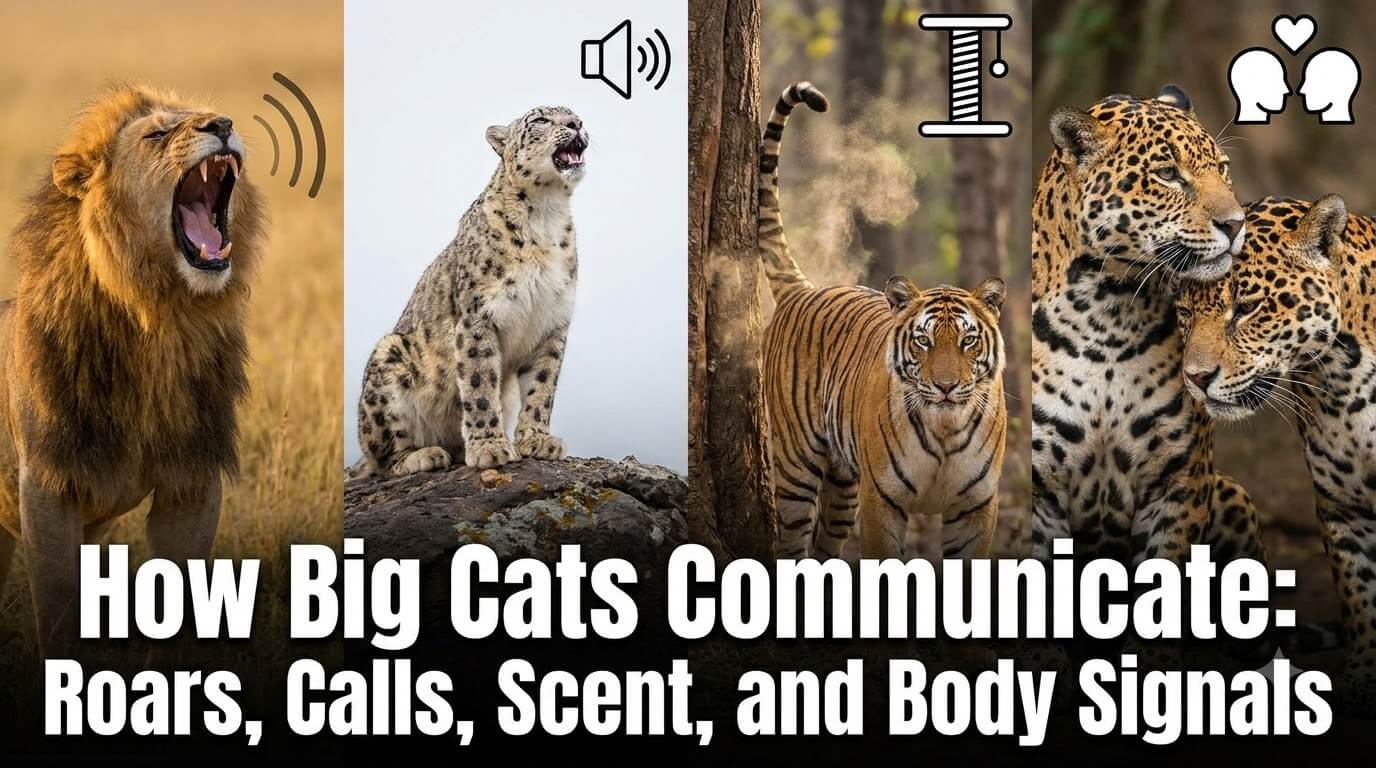
Big cats communicate through much more than roaring. Lions, tigers, leopards, jaguars, snow leopards, clouded leopards, and other large wild cats combine sound, scent, posture, facial expression, touch, and physical marks in the environment. A signal that travels for a long distance can help an animal advertise its presence without a face-to-face encounter, while a quiet chuff, head rub, ear position, or tail movement can matter during close contact.
The mix of signals differs among species because their social lives differ. Lions often live and interact in groups, while tigers, leopards, jaguars, and snow leopards spend much more of their adult lives apart. Even solitary cats still need to avoid rivals, locate mates, maintain contact with young, and judge whether another cat is friendly, threatening, or simply passing through. Communication allows them to exchange information without treating every encounter as a physical confrontation.
Big Cat Communication Uses Several Channels at Once

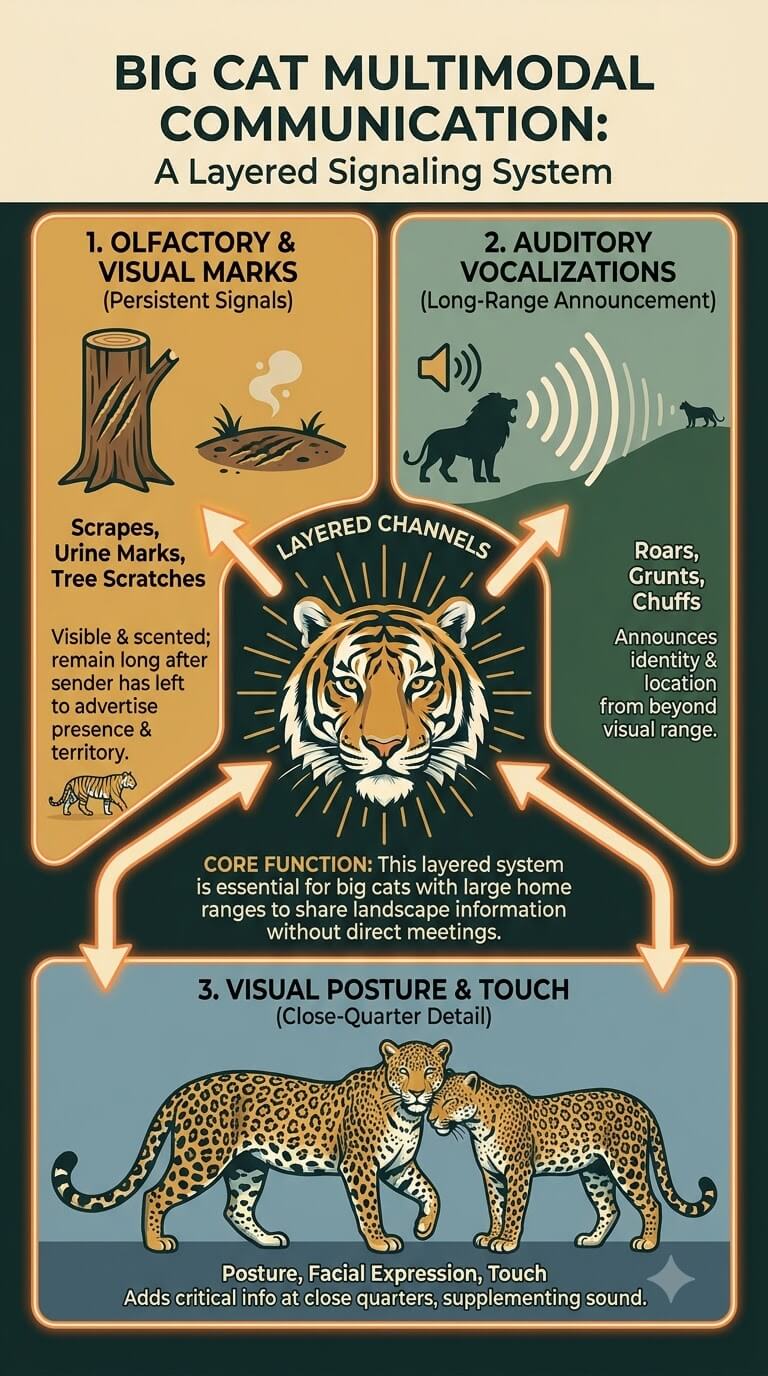
Animal communication works when one individual’s signal changes what another animal can detect or respond to. In big cats, those signals are often multimodal, meaning more than one sensory channel is involved. A scrape on the ground can be visible and scented. A urine mark can be smelled long after the sender has left. A roar may announce a cat from beyond visual range. At close quarters, posture, facial expression, and touch add information that sound alone cannot provide.
This layered system is especially useful for cats that occupy large home ranges. A tiger does not need to meet every neighboring tiger directly to leave information in a shared landscape. The Smithsonian National Zoo tiger profile notes that tigers communicate with vocalizations including roars, grunts, and chuffs, while also using scent marks and scratches on trees. These signals help individuals advertise their presence and use of space.
Why Big Cats Communicate
Spacing and Territory
For many large cats, one of the most important functions of communication is reducing uncertainty about who is nearby. A scent mark, scrape, call, or scratch can tell another cat that an area is actively used. That does not create an invisible wall around a territory. Home ranges can overlap, boundaries can shift, and animals may cross areas used by neighbors. Signals simply give individuals information they can use before deciding whether to approach, avoid, investigate, or mark again.
Classic field work on free-ranging tigers documented urine spraying, scraping, clawing, cheek rubbing, and other marking behaviors. Marks were especially concentrated near territorial boundaries and travel routes, and adjacent animals sometimes appeared to mark in response to one another. The Animal Behaviour study of scent marking in wild tigers shows why chemical marks are best understood as part of spacing behavior rather than as a simple ownership stamp.
Mating and Reproduction
Large cats also use communication to find and assess potential mates. Chemical cues can convey reproductive information, while calls can help individuals locate one another across distance. During courtship, the signal set can become more intense and more close-range, with vocalizations, scent investigation, rubbing, posture, and repeated approaches all contributing to the interaction.
The exact pattern differs by species and by sex. A female’s reproductive state may change how often she marks or calls, while males may increase investigation or marking when receptive females are nearby. It is better to think of these as flexible combinations of cues than as one universal feline mating signal.
Parent and Cub Contact
Mothers and cubs need a different communication toolkit from distant territorial adults. Close-range calls help maintain contact, especially when vegetation, rocks, or darkness limit visibility. Touch, grooming, body position, and scent are also important because cubs spend long periods near their mother before becoming independent.
A mother may use different sounds or movements when gathering cubs, tolerating nursing, moving them, or reacting to danger. Cubs, in turn, use calls and physical contact to seek attention. These interactions are highly context dependent, so a single sound should not be translated into a fixed human sentence.
Roars and Other Long-Range Calls
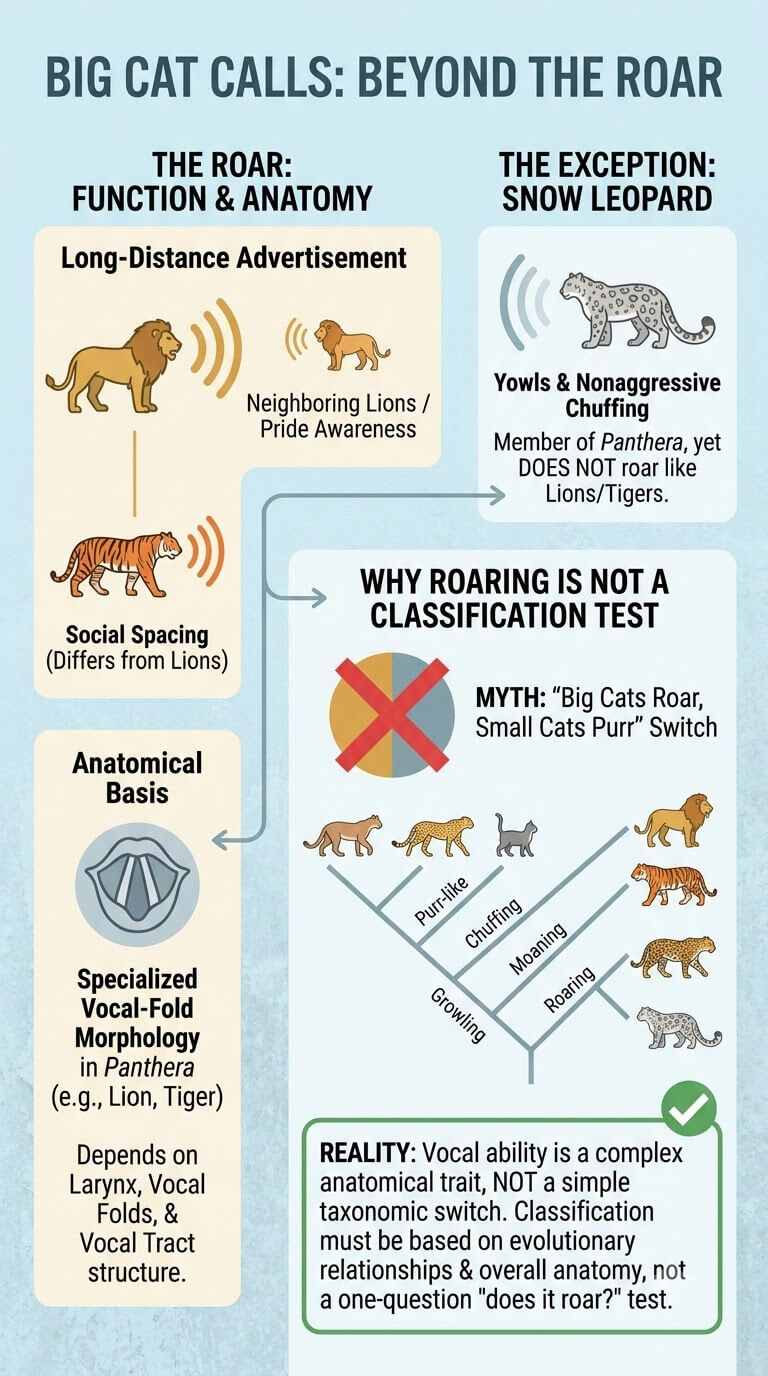
The roar is the best-known big cat sound, but it should not be used as a definition of “big cat.” Some members of Panthera produce powerful roars, yet the anatomy and vocal abilities of large felids are not identical. Snow leopards are a particularly important exception to simplistic roar-based rules.
What Makes a Roar Different
Roaring depends on the structure and behavior of the larynx, vocal folds, and vocal tract. A comparative anatomical study of felids found specialized vocal-fold morphology in roaring members of Panthera, with the snow leopard standing apart from the other species examined. The study of roaring and non-roaring cat larynges is a useful reminder that vocal ability is an anatomical trait, not a simple taxonomic switch that divides every cat into two perfect groups.
Roars can function in long-distance advertisement. For a lion, a roar may help advertise presence to neighboring lions or maintain awareness among pride members. Tigers also roar, but because their usual social spacing differs from lions, the social setting is not identical. A loud call can reduce the need for immediate visual contact while still making the caller difficult to ignore.
Why Roaring Is Not a Classification Test
Readers sometimes encounter the idea that “true big cats roar and small cats purr.” Real felid vocal anatomy is more complicated. Different cats can produce different kinds of purr-like, chuffing, growling, moaning, or roaring sounds, and not every trait maps neatly onto body size or a single branch of the family tree.
Snow leopards illustrate the problem well. They belong to Panthera, yet authoritative descriptions do not treat them as roaring like lions or tigers. Their call repertoire includes yowls and nonaggressive chuffing. Classification should therefore be based on evolutionary relationships and anatomy, not on a one-question “does it roar?” test.
Chuffs, Growls, Moans, and Contact Calls

Many important big cat sounds are quieter than a roar. These calls often matter at shorter distances, when animals can also see or smell each other. The same broad sound label can cover calls that differ in intensity, rhythm, and context, so it is risky to assume every “growl” or “chuff” has one fixed meaning.
Chuffing or Prusten
A chuff, also called prusten in some contexts, is a soft, breathy sound associated especially with tigers and some other large cats. It can occur during nonaggressive encounters and courtship. Smithsonian keepers describe tigers using chuffs during social introductions, often alongside rubbing and other calm behaviors. That makes chuffing very different from a long-range roar, but it still should not be translated mechanically as “hello.”
Snow leopards can also produce chuff-like sounds. In species that spend much of their time alone, such quiet calls can be useful when two animals are close enough that a far-carrying advertisement is unnecessary.
Growls and Defensive Sounds
Growls, snarls, and other harsh sounds often appear in tense encounters, but context remains essential. Ear position, mouth posture, body tension, distance, and whether the animal is retreating or advancing all affect interpretation. A growl is better treated as part of an escalating interaction than as a word with one exact translation.
This matters for human safety too. A person should never intentionally approach a wild cat to “read” its body language more closely. Large wild cats require distance and professional wildlife management, not experimentation with calls or posture.
Species-Specific Calls
Leopards are known for a hoarse, rasping call sometimes compared with sawing. Jaguars produce powerful grunts and other calls. Lions roar alone and in choruses. Tigers use roars, moans, grunts, and chuffs. Snow leopards yowl and chuff. These examples show diversity, but they do not mean every individual uses the same repertoire at the same frequency.
Call use changes with age, sex, season, reproductive condition, social setting, and proximity to other cats. Field studies are also uneven across species, so scientists know more about communication in some large cats than in others.
Scent Marking Carries Information After the Cat Has Gone
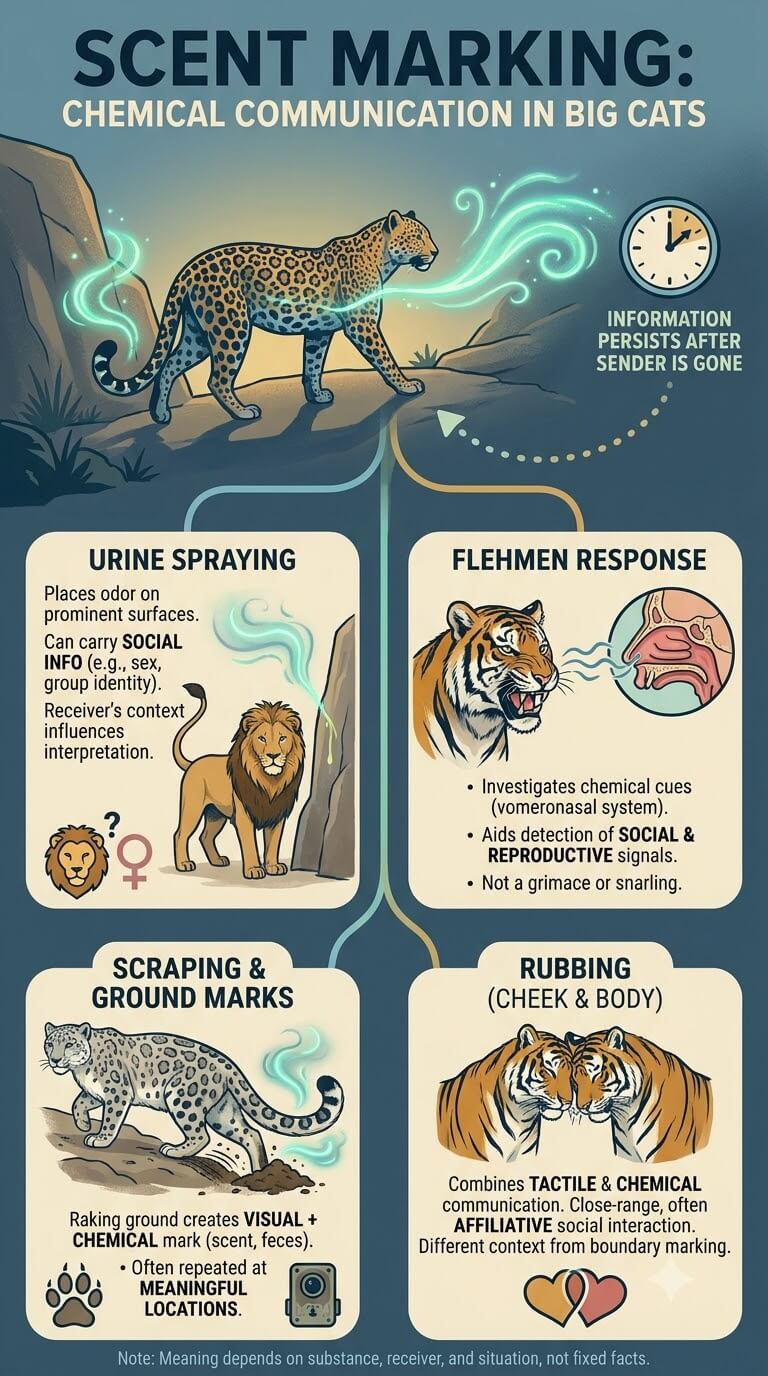
Chemical communication is especially valuable because a scent mark can remain after the sender has moved away. That lets two animals exchange information without meeting at the same moment. Urine, glandular secretions, feces, and material deposited during scraping can all contribute to a scent-marking system.
Urine Spraying
Urine spraying places odor on a vertical or prominent surface. The position of the mark and the location chosen can make it easier for another cat to investigate. In wild lions, experiments have shown that urine odors can carry socially relevant information. A study of urine-odor discrimination in African lions found that lions could distinguish information associated with the sex and social-group identity of other lions from urine samples.
That does not mean a urine mark acts like a written name tag containing a fixed list of facts. Odor is a complex chemical signal, and the receiver’s own age, sex, experience, and current situation influence its response.
Flehmen and Scent Investigation
Big cats do not only leave scent. They also investigate it. During flehmen, a cat lifts the upper lip and changes the position of the mouth while sampling chemical cues. This behavior helps deliver odor molecules toward the vomeronasal system, which is especially involved in detecting certain social and reproductive chemicals. To a person, the expression can look like a grimace, but it is not the same thing as snarling.
Flehmen often appears after a cat investigates urine, glandular secretions, or other scent left by another individual. It can be especially relevant when reproductive information matters, but it should not be described as a magical ability to identify every detail about another animal. Like other chemical signals, its meaning depends on the substance, the receiver, and the situation.
Scraping and Ground Marks
Scraping is common in several large cats. An animal may rake the ground with its hind feet and leave scent, fecal material, urine, or glandular secretions in association with the scrape. The disturbed ground adds a visual component, while odor provides chemical information.
Snow leopards are a good example because researchers often use repeated marking locations to study them. A 2025 study of snow leopard marking behavior examined how communication sites and marking patterns can inform camera-trap survey design. The research underscores that scrapes are not random dirt disturbances. They can be repeated at meaningful landscape locations.
Cheek Rubbing and Body Rubbing
Rubbing can combine tactile and chemical communication. Cats have scent-producing areas on the face and body, and contact with another animal or object can deposit odor while also serving as a close-range social interaction. In tigers, head rubbing has been observed during affiliative encounters. Lions also use rubbing and close body contact within social groups.
Because rubbing usually requires close proximity, it occurs in a very different social setting from boundary marking. A cat spraying a travel route and two familiar lions rubbing heads are both communicating chemically, but the relationship and immediate purpose are not the same.
Claw Marks and Scratches Can Be Visual and Chemical Signals
Scratches on trees or other surfaces can leave a visible record that a cat has been present. Depending on species and context, scratching may also deposit scent from glands associated with the paws or place the animal near other scent marks. For a receiver, the value may come from the combination of mark location, odor, freshness, and repeated use of the site.
It is tempting to interpret every claw mark as a territorial warning, but that is too simple. Scratching can overlap with claw maintenance, stretching, movement routes, and scent deposition. Researchers interpret it in context with other evidence, such as tracks, camera-trap records, urine marks, and repeated visitation.
Body Posture, Ears, Tail, and Face Matter at Close Range
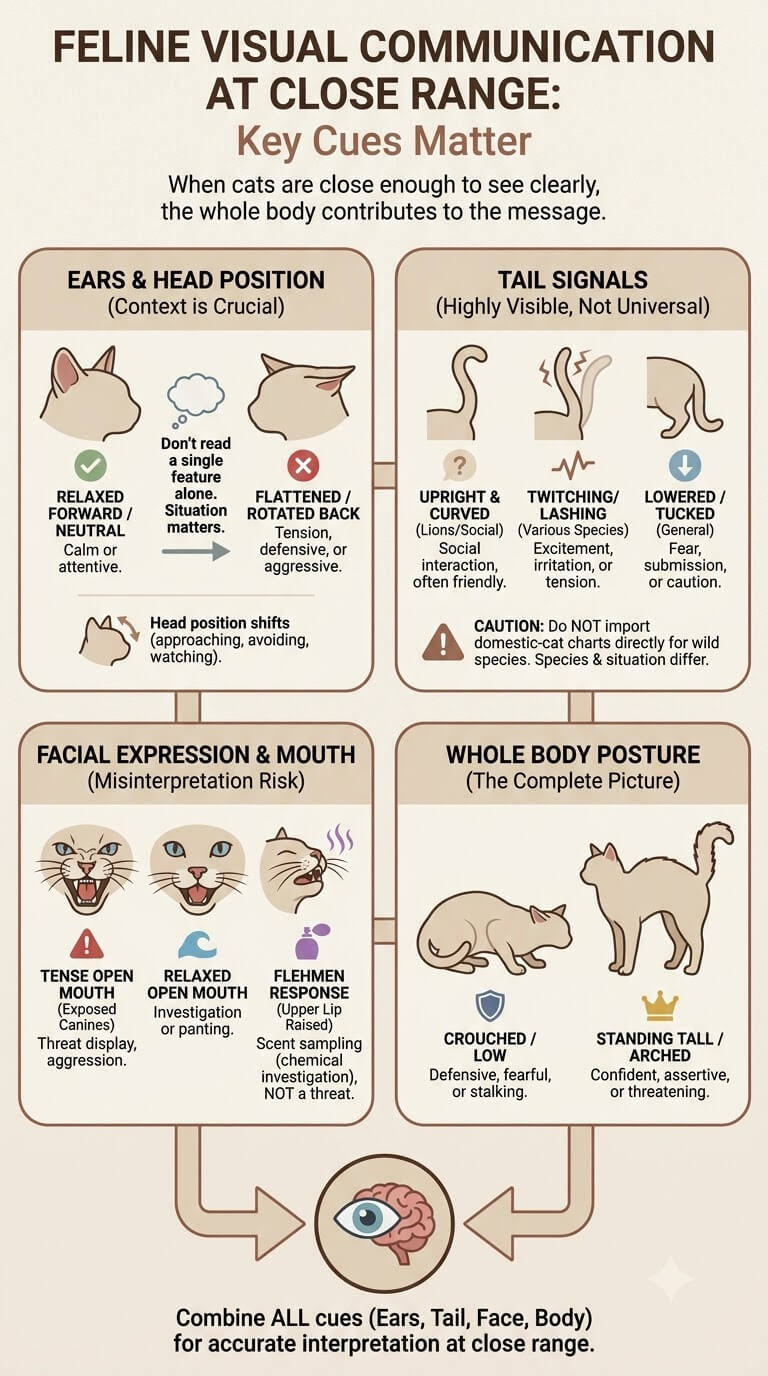
Visual communication becomes more useful when cats are close enough to see one another clearly. The whole body can change during a social encounter. Ear direction, head height, tail movement, facial tension, pupil appearance, mouth opening, and whether the animal crouches or stands tall can all contribute information.
Ears and Head Position
Ears held in a relaxed forward or neutral position create a different picture from ears flattened or rotated during tension. Head position can also shift as a cat approaches, avoids, watches, or threatens another animal. No single feature should be read alone because the same ear movement can occur for sensory reasons as well as social ones.
Tail Signals
The tail is highly visible and can change position or movement during interactions. In lions, which often communicate at close range within a pride, tail movement joins facial and body cues in a socially rich setting. In more solitary cats, tail posture still contributes when animals meet, especially during courtship, parent-young contact, or tense encounters.
Tail signals should not be interpreted by importing domestic-cat internet charts directly into wild species. The species, situation, distance, and rest of the body matter.
Facial Expression and Mouth Posture
A tense open mouth with exposed canines can accompany a very different interaction from a relaxed open-mouth investigation or a flehmen response. Flehmen, in which the upper lip is raised while scent is sampled, is associated with chemical investigation rather than a threat display. Misreading the two can make a photograph look more aggressive than the behavior actually was.
Touch Is Important When Social Distance Shrinks
Tactile communication is most obvious in species or life stages that spend time physically close to one another. Lions may rub, groom, rest in contact, or touch during greeting and group interactions. Mothers lick and reposition cubs. Courtship can involve repeated close contact. These behaviors carry information that would be unnecessary or impossible over long distance.
Even largely solitary cats can use touch during mating, parent-young care, and occasional affiliative encounters. The presence of tactile communication does not make a species “social” in the same way as a lion pride. It simply shows that social systems are more nuanced than a solitary-versus-group-living label.
Communication Differs Across Big Cat Species
Lions
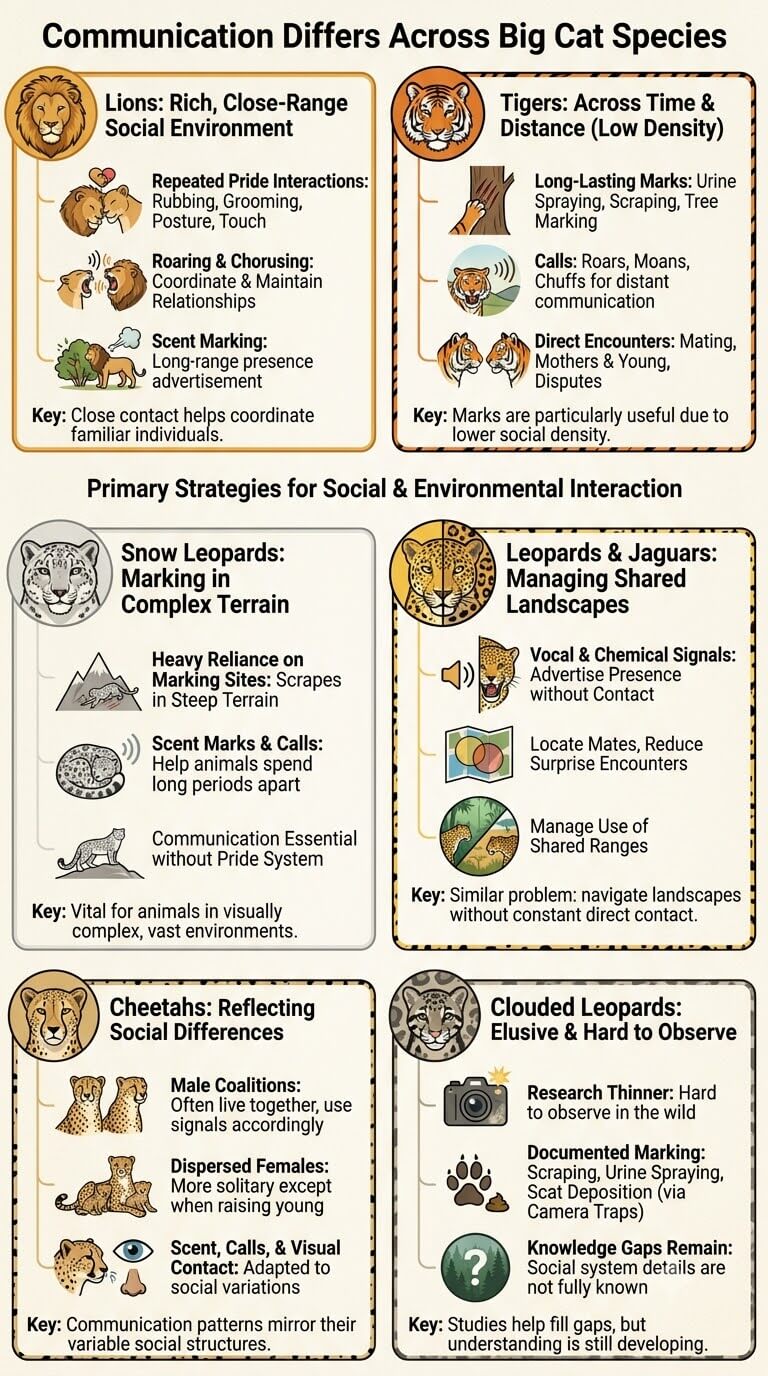
Lions have one of the richest close-range social environments among large cats because pride members interact repeatedly. Roaring, chorusing, scent marking, rubbing, grooming, posture, and touch all have roles. Long-range calls can advertise presence, while close contact helps coordinate familiar individuals and maintain relationships.
Tigers
Tigers usually live at lower social density, so long-lasting marks are particularly useful. Urine spraying, scraping, tree marking, roars, moans, and chuffs allow a tiger to communicate across both time and distance. Direct encounters still occur during mating, between mothers and young, and when neighboring or competing individuals meet.
Leopards and Jaguars
Leopards and jaguars also combine vocal and chemical signals. Both can advertise presence without direct contact, and both use scent and physical marks in their ranges. Their calls sound different to human ears, but the broader communication problem is similar: locate mates, reduce surprise encounters, and manage use of shared landscapes.
Snow Leopards
Snow leopards rely heavily on marking sites in steep, visually complex terrain. Scrapes, scent marks, calls, and body signals help animals that may otherwise spend long periods apart. They do not need a lion-like pride system for communication to be essential.
Cheetahs
Cheetahs add another pattern because males may live in coalitions while females are often more dispersed except when raising young. They use scent marks, calls, and visual contact in ways that reflect those social differences. Studies of captive cheetahs have also documented urine spraying and scraping as scent-marking behaviors, but captive observations should not automatically be treated as a complete description of wild behavior.
Clouded Leopards
Clouded leopards are harder to observe in the wild, so communication research is thinner than it is for lions or tigers. Camera traps have nonetheless documented marking behavior in Sunda clouded leopards, including scraping, urine spraying, and scat deposition. The Scientific Reports study of Sunda clouded leopard scent marking helps fill an important gap without implying that every detail of their social system is already known.
Common Myths About Big Cat Communication
“All Big Cats Roar”
They do not. Roaring ability varies, and snow leopards are an important counterexample to a simple Panthera-equals-roar rule. The term “big cat” itself is common language rather than a formal scientific rank, so vocal ability should not be used as a membership test.
“Purring and Roaring Form a Perfect Taxonomic Divide”
Felid vocal production is more complicated than a two-box rule. Different species produce different combinations of purr-like sounds, chuffs, growls, calls, and roars. Anatomy matters, but no simple popular slogan captures every species correctly.
“A Growl Always Means the Same Thing”
Sound must be interpreted with context. Distance, body posture, the identity of the other animal, whether food or cubs are present, and whether the caller is approaching or retreating can all change what a receiver does next.
“Big Cats Have a Human-Like Language”
Big cats clearly communicate, but communication is not automatically the same as human language. Scientists use specific criteria when discussing syntax, symbolic reference, and language-like structure. It is more accurate to describe feline calls, scents, gestures, and contact behaviors as signals unless research demonstrates something more specific.
How Signals Support Social Life Without Constant Contact
Communication helps explain how a large predator can be mostly solitary yet still live in a social world. A tiger can respond to a scent mark left hours earlier. A snow leopard can revisit a scrape site used by another cat. A leopard can call across cover. A lion can roar beyond visual range and later shift to touch and posture when pride members are together.
The same principle ties communication to territory, reproduction, parenting, and conflict avoidance. Signals reduce uncertainty. They let cats gather information before deciding whether direct contact is useful or risky. In that sense, communication is not an extra behavior layered onto hunting and survival. It is one of the systems that makes spacing, mating, cub care, and coexistence with neighbors possible.
FAQ
Can snow leopards roar?
Snow leopards are not generally considered true roarers in the way lions and tigers are. Comparative laryngeal research has identified anatomical differences, and behavioral descriptions emphasize yowls, chuffs, growls, and other calls instead. This is one reason roaring should not be used to define which animals count as big cats.
Why do big cats spray urine?
Urine spraying is a form of chemical marking. Depending on species and context, it can advertise presence, contribute to territorial spacing, and carry reproductive or identity-related information. Other cats can investigate the odor later, so the signal continues to function after the sender has left.
What does a tiger chuff mean?
A chuff, or prusten, is usually associated with nonaggressive close-range interaction and can occur during greeting or courtship contexts. It should not be translated as one exact word such as “hello,” because the surrounding behavior and relationship between the animals still matter.
Do big cats communicate with their tails?
Yes. Tail position and movement can contribute to close-range visual signaling, especially when combined with ear position, facial expression, and overall posture. Tail cues are not identical across every species or situation, so the whole interaction is more informative than one tail position by itself.
Are scent marks only about defending territory?
No. Scent marking can help with spacing and territorial advertisement, but it can also carry reproductive and identity-related information. The same individual may mark differently depending on season, neighboring cats, reproductive state, and location within its range.
Final Thoughts
Big cat communication is a layered system of sound, scent, sight, touch, and environmental marking. Roars are only one part of that system. Chuffs and contact calls matter at shorter range, scent marks can persist after the sender is gone, scrapes and claw marks add visible information, and posture or touch becomes important during close encounters.
The biggest takeaway is that large cats do not communicate through one universal code. Lions, tigers, leopards, jaguars, snow leopards, cheetahs, and clouded leopards face different social and ecological situations, so they use different combinations of signals. Understanding those differences gives a more accurate picture than treating every roar as aggression, every scent mark as a border sign, or every solitary cat as an animal that rarely communicates.

Ethan Walker is the founder and research editor of Animal Fact Central. He creates and reviews educational animal facts content using trusted wildlife, pet care, and science-based sources. His work focuses on making animal behavior, adaptations, habitats, and species facts clear, accurate, and engaging for everyday readers.
Read More Details About Ethan Walker: https://animalfactcentral.com/ethan-walker/