
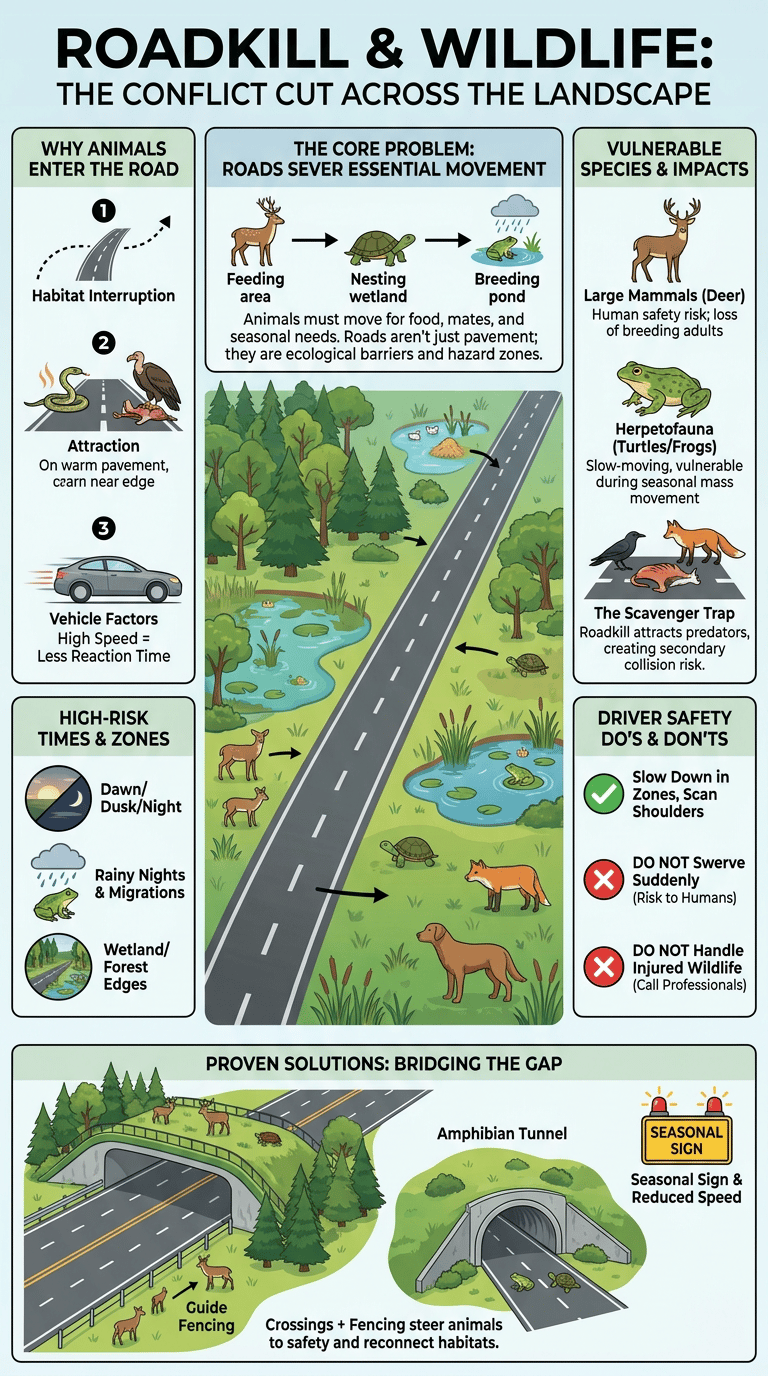
Roadkill and wildlife are connected by a simple problem: roads often cut across the places animals need to move. A deer may cross to reach feeding areas. A turtle may leave a wetland to nest. A frog may move during a rainy breeding night. A hawk may land near a carcass. When those normal movements meet fast vehicles, the result can be deadly for animals and dangerous for people.

Roadkill is not just an unpleasant thing drivers notice on pavement. It is part of a larger road ecology issue involving habitat fragmentation, animal behavior, seasonal movement, traffic speed, visibility, scavengers, and human safety. The goal is not to blame animals for crossing roads. It is to understand why they cross, which species are most vulnerable, and which prevention strategies reduce harm without encouraging unsafe contact with wild animals.
Quick Answer: Why Is Roadkill a Wildlife Problem?
Roadkill becomes a wildlife problem when vehicle mortality removes animals from local populations, blocks movement between habitat patches, increases risk for scavengers, and makes roads function like ecological barriers. A single dead animal may seem like an isolated accident. Across a landscape, repeated collisions can affect breeding adults, slow-moving species, seasonal migrants, and animals that already face habitat loss.
The Federal Highway Administration’s wildlife-vehicle collision study describes wildlife-vehicle collisions as a safety and ecology issue, especially for large animals such as deer that can cause serious crashes. For smaller animals, the public safety risk may be lower, but the wildlife cost can still be high because many deaths are never reported or counted.
Roadkill is most serious where roads overlap with movement corridors, wetlands, forest edges, desert washes, rivers, suburban green spaces, and migration routes. The same road can affect animals in several ways at once: it kills some individuals, discourages others from crossing, attracts scavengers, and divides habitat into smaller pieces.
Why Animals Get Hit by Vehicles
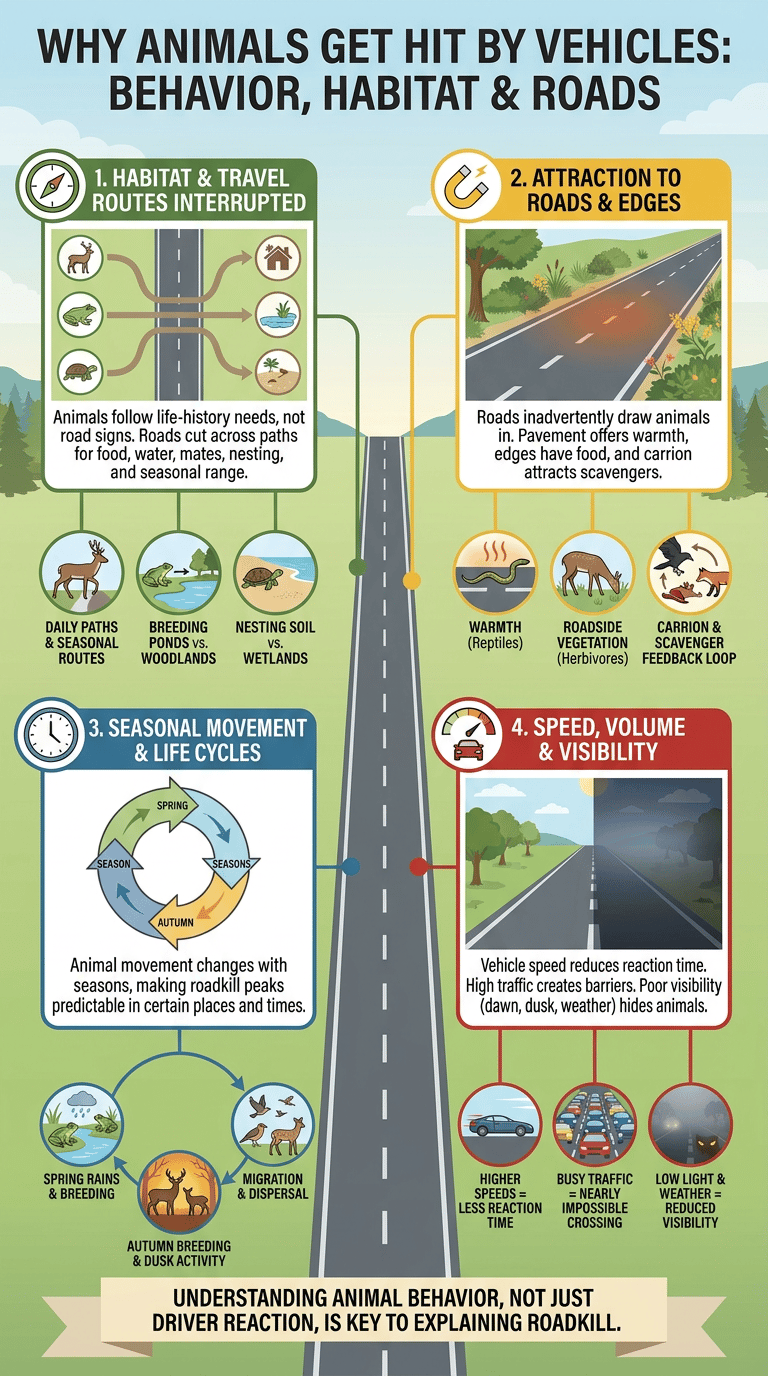
Animals are hit by vehicles for many reasons, and those reasons vary by species. Some animals cross because the road lies between essential resources. Others are drawn to the road itself. A useful roadkill explanation starts with animal behavior, not just driver reaction time.
Roads cutting through habitat and travel routes
Wild animals move because they have to. Food, water, mates, nesting sites, den sites, winter range, summer range, and dispersal habitat are rarely all in one safe patch. When a road cuts across that pattern, the animal may not recognize the pavement as a permanent barrier. It may simply follow a familiar route, scent trail, drainage, fence line, or opening.
For large mammals, road crossings may occur along seasonal movement routes or daily paths between cover and feeding areas. For amphibians, a road may separate woodland habitat from breeding ponds. For turtles, a road may sit between wetlands and nesting soil. The animal is not being careless. It is responding to a life-history need that existed before the road was built.
Attraction to road edges, warmth, carrion, and roadside food
Some animals are attracted to roads or roadsides because they provide food, warmth, or open ground. Snakes and other reptiles may use warm pavement for body heat. Deer and other herbivores may feed on roadside vegetation. Rodents may use grass edges. Raptors, vultures, crows, foxes, coyotes, and raccoons may come to feed on carcasses.
That attraction can create a feedback loop. One animal is hit, then scavengers arrive, and those scavengers face their own collision risk. This is one reason roadkill can affect food webs, not just the first animal struck.
Seasonal movement, migration, breeding, and dispersal
Roadkill often rises during specific seasons because animal movement changes. Deer may be more active during breeding periods. Amphibians may move on rainy nights toward breeding ponds. Turtles may leave water to find nesting sites. Young mammals may disperse from their birth area. Migratory animals may cross roads when moving between seasonal habitats.
These seasonal patterns make roadkill predictable in some places. A rural road near a wetland may have amphibian mortality during spring rains. A road through deer habitat may have higher risk around dusk during breeding season. A desert road may become more dangerous for reptiles after warm rain or during periods of surface activity.
Speed, traffic volume, visibility, and animal behavior
Vehicle speed affects both collision risk and collision severity. Higher speeds give drivers less time to notice animals and give animals less time to react. Traffic volume also matters. On a lightly traveled road, an animal may cross between vehicles. On a busy road, the same crossing attempt can become nearly impossible.
Visibility changes risk. Dawn, dusk, rain, fog, curves, roadside vegetation, and glare can make animals harder to see. Many animals are also active when humans see poorly. Deer, raccoons, opossums, foxes, coyotes, owls, frogs, and salamanders may move in low light or darkness.
Animals Most Affected by Roads
Roadkill affects many kinds of animals, but the pattern depends on region, habitat, road type, traffic, season, and body size. Large mammals dominate crash reports because they are visible and can damage vehicles. Small animals may be killed more often in some places but remain undercounted.
Deer and large mammals
Deer are often the most familiar large-animal roadkill in the United States. They live near roads in forests, farms, suburbs, and parks, and they move most actively during lower-light periods. Elk, moose, bears, pronghorn, wild pigs, and other large mammals can also be involved in collisions depending on the region.
Large mammals matter for two reasons. First, losing breeding adults can affect local wildlife, especially where populations are small or fragmented. Second, collisions with large animals can injure people and cause major vehicle damage. This is why transportation agencies often focus on large mammals when designing crash-reduction measures.
Turtles, snakes, frogs, and salamanders
Reptiles and amphibians can be especially vulnerable because many are slow-moving, seasonal, or tied to both land and water. Turtles may cross roads to reach nesting sites. Snakes may bask on warm pavement. Frogs and salamanders may move in groups during wet nights.
The National Park Service overview of reptile and amphibian threats notes that many studies have reported high road mortality for reptiles and amphibians, and that amphibians can be especially vulnerable during mass movement between habitat patches. This is important because many amphibians depend on successful seasonal movement to breed.
Birds, scavengers, and roadside predators
Birds can be hit while feeding, hunting, crossing low over roads, or scavenging. Owls may hunt rodents along roadsides. Hawks may dive after prey. Vultures, crows, ravens, gulls, and other scavengers may gather at carcasses. Some birds may also collide with vehicles near bridges, wetlands, or open fields where flight paths cross roads.
Scavengers provide a real ecological service by consuming dead animals, but roads make that service dangerous. A carcass on pavement or a shoulder can pull scavengers into the path of vehicles. If one scavenger is struck, more may arrive, extending the risk.
Roadside predators can face similar problems. Foxes, coyotes, bobcats, domestic dogs, and feral cats may hunt along road edges because prey is abundant there. That does not mean roads are good habitat. It means a road edge can offer food while increasing mortality risk.
Small mammals and animals people rarely notice
Many road-killed animals are small mammals, reptiles, amphibians, and invertebrates that drivers may barely notice. Mice, voles, shrews, rabbits, squirrels, chipmunks, bats, lizards, frogs, and insects all interact with roads in different ways.
Small animals matter because they are part of larger food webs. They move seeds, eat insects, aerate soil, feed predators, and connect habitats at a smaller scale than deer or bears. A road that repeatedly kills small animals may change the prey base available to owls, hawks, snakes, foxes, and other predators.
Ecological Effects of Roadkill
The ecological effects of roadkill depend on how many animals are killed, which species are affected, whether the animals are breeding adults, and whether the road also blocks movement. Roadkill is most concerning when it adds pressure to species that already have slow reproduction, small populations, limited habitat, or repeated seasonal crossings.
Direct mortality and local population pressure
Direct mortality is the most obvious effect. An animal is killed before it can reproduce, raise young, disperse, or fill its role in the ecosystem. For common, fast-breeding species, a local population may absorb some losses. For slow-breeding species or small isolated populations, road mortality can be more serious.
The FHWA discussion of road impacts on threatened and endangered wildlife explains that roads can harm wildlife through habitat loss, reduced habitat quality, reduced connectivity, and direct road mortality. That combination matters because roadkill is rarely the only pressure on a population.
Scavenger food webs and secondary collision risk
Roadkill creates food for scavengers. In a natural setting, carcasses are part of the food web. On a road, that food can become a trap. Vultures, crows, ravens, foxes, coyotes, raccoons, opossums, insects, and other scavengers may feed close to traffic and become victims themselves.
This secondary collision risk can also affect predators that are not strict scavengers. A hawk may chase prey near a road. A fox may investigate a carcass. A snake may enter pavement after rodents. Roads concentrate danger where animals are feeding, hunting, or moving.
Genetic isolation and movement barriers
Not every roadkill problem is only about dead animals. Roads can also reduce successful crossings. If animals avoid a road, fail to cross it, or die when they try, populations on opposite sides may become more isolated. Over time, that can reduce gene flow, which is the movement of genes between breeding groups.
That is why road ecology connects roadkill with wildlife crossings, culverts, fencing, and green corridors. The goal is not only to prevent death on pavement. It is also to keep habitat connected enough for animals to live normal lives.
How roads can reshape animal communities
Roads do not affect all species equally. Some generalists may use road edges, trash, open vegetation, and human-altered habitat. Sensitive species may avoid roads or suffer high mortality. Over time, roads can favor animals that tolerate disturbance while filtering out animals that need quiet, connected, or specialized habitat.
When Roadkill Risk Is Highest
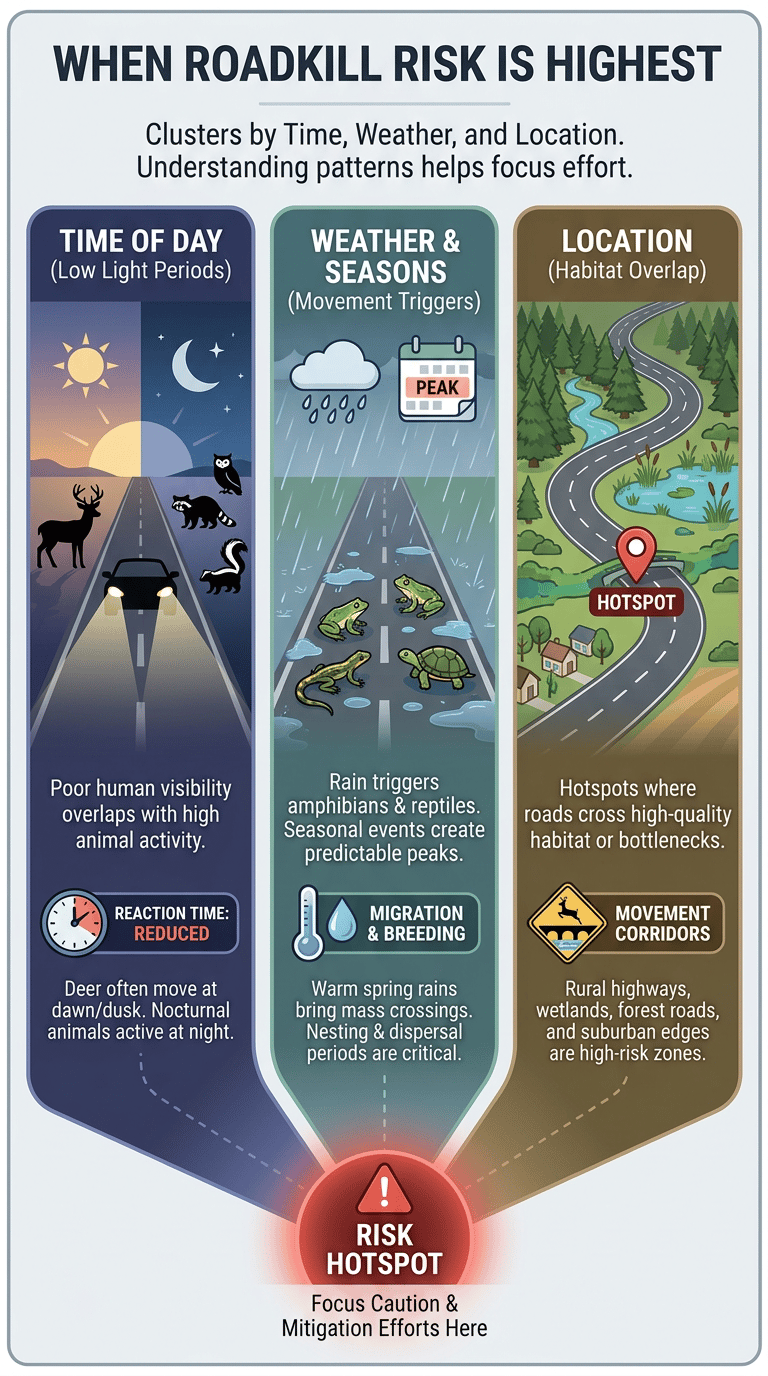
Roadkill risk is not evenly spread across the calendar or the map. It often clusters at certain times, in certain weather, and along certain road segments. Understanding those patterns helps drivers, agencies, and conservation groups focus effort where it matters most.
Dawn, dusk, and nighttime movement
Many wildlife-vehicle collisions happen during low-light periods because animal activity and poor human visibility overlap. Deer often move at dawn and dusk. Raccoons, opossums, foxes, coyotes, skunks, owls, frogs, and salamanders may be active at night. Drivers may have less time to react, especially at higher speeds.
Rain, breeding migrations, and seasonal peaks
Rain can trigger movement in amphibians and some reptiles. Warm spring rains may bring frogs, toads, and salamanders across roads in large numbers. In dry areas, rain can also increase reptile and desert tortoise activity. Seasonal breeding, nesting, and dispersal can create predictable roadkill peaks.
The University of Florida IFAS Extension article on road impacts on Florida’s threatened and endangered species discusses how roads can affect wildlife through vehicle collisions, habitat fragmentation, movement barriers, and attraction to roadside conditions. Although the examples are Florida-focused, the framework applies widely: road risk rises when animal movement and road placement overlap.
Seasonal timing also explains why some prevention efforts are temporary. Amphibian crossing nights, turtle nesting season signs, and migration warnings may be useful for only part of the year, but they can matter during that window.
Rural highways, suburban edges, wetlands, and forest roads
Roadkill hotspots often occur where roads cross high-quality habitat or movement bottlenecks. Rural highways through deer range, roads beside wetlands, forest roads near streams, suburban roads along green corridors, and desert roads through washes can all become high-risk zones.
Prevention and Mitigation Strategies
Roadkill prevention works best when it combines road design, habitat knowledge, driver behavior, seasonal timing, and long-term monitoring. No single tool solves every problem. The right strategy depends on which animals are being killed and why they are reaching the road.
Wildlife crossings and fencing
Wildlife crossings, such as overpasses, underpasses, culverts, and amphibian tunnels, give animals a safer route across roads. Fencing or guide barriers often make these structures more effective by steering animals toward the crossing and away from traffic.
The FHWA Wildlife Crossings Program was created to reduce wildlife-vehicle collisions and improve habitat connectivity. In a roadkill article, the key point is that crossings are one prevention tool, not the whole story. Their success depends on placement, target species, fencing, maintenance, and whether habitat on both sides remains useful.
Crossings should not be treated as decorative bridges. A turtle tunnel, a deer underpass, and a mountain lion overpass require different design choices. The safest projects start by asking which animals are moving, where they are moving, and what keeps them from using a safer route.
Seasonal signs, speed reduction, and road planning
Warning signs can help when they are targeted and believable. A permanent sign in an area where drivers rarely see animals may fade into background noise. A seasonal sign during a known migration or breeding period may be more useful. Flashing signs, temporary closures, and variable speed zones can help in the right context.
Speed reduction is especially important because it gives drivers and animals more time. Lower speeds can also reduce the severity of a collision if one happens. In parks, refuges, and rural wildlife corridors, posted speed limits often protect animals as well as people.
Amphibian and turtle crossing programs run by trained groups
Some communities use organized amphibian or turtle crossing programs during seasonal movement. These programs may involve trained volunteers, reflective gear, local permits, temporary road measures, and coordination with wildlife agencies or conservation groups. The safest programs are structured, not improvised.
People should not step into traffic or pick up animals in dangerous conditions. Helping a turtle on a quiet road may sound simple, but safety, species identification, legal rules, and bite risk matter. Snapping turtles, venomous snakes, and injured animals require extra caution and often should be left to trained people.
Habitat connectivity and green corridor planning
Green corridors, parks, riparian strips, wetlands, and connected open spaces can reduce the pressure on animals to cross dangerous roads at random points. They do not eliminate roadkill, but they can guide movement through safer areas when paired with crossings, culverts, or traffic-calming measures.
What Drivers Should and Should Not Do
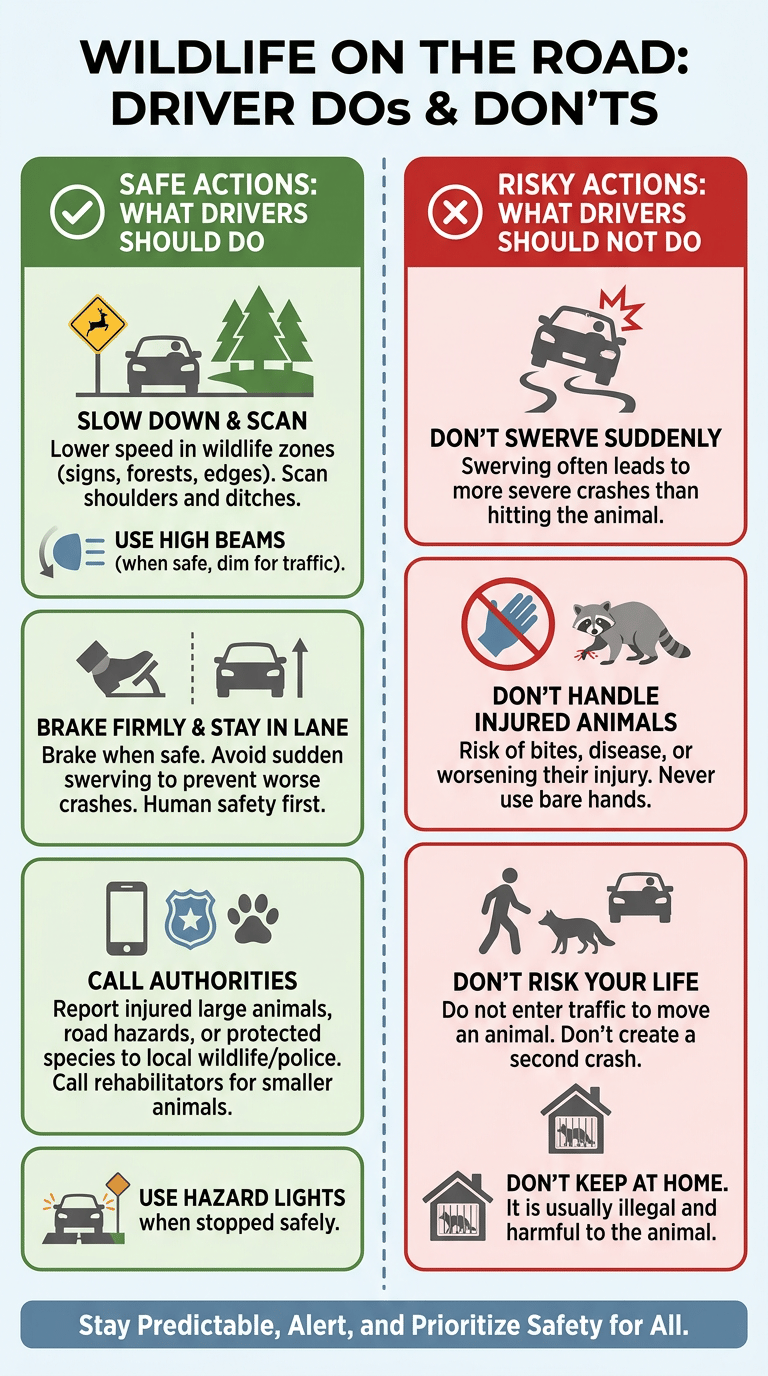
Drivers cannot control every wildlife encounter, but they can reduce risk. The safest approach is predictable driving, lower speed in wildlife zones, awareness at high-risk times, and avoiding unsafe attempts to handle animals or carcasses.
Stay predictable and avoid dangerous swerving
If an animal appears on the road, the safest response depends on the situation, but sudden swerving can create a worse crash. Drivers should brake firmly when it is safe, stay in their lane when possible, use hazard lights when stopped safely, and watch for other vehicles. Human safety comes first.
In wildlife areas, prevention begins before the animal appears. Slow down near animal crossing signs, forest edges, wetlands, fields, and parks. Use high beams when appropriate and legal, but dim them for oncoming traffic. Scan shoulders and ditches, not only the center of the lane.
Never handle injured wild animals without trained help
Injured wild animals may bite, scratch, kick, carry disease, or worsen their injuries if handled incorrectly. Even small animals can hurt people or be harmed by well-meaning rescue attempts. Bare-handed contact is not safe, and keeping an injured animal at home is usually illegal and harmful.
U.S. Fish and Wildlife Service guidance on injured or orphaned wildlife explains that many wild animals should be left alone unless there are clear signs of injury, and that licensed wildlife rehabilitators have the needed training and permits. Around roads, that advice becomes even more important because traffic adds danger.
If an animal is injured near traffic, call local animal control, a state wildlife agency, a licensed wildlife rehabilitator, or law enforcement if the road hazard is urgent. Do not risk your own life or create a second crash.
When to contact local wildlife authorities or licensed rehabilitators
Contact local authorities when a large animal is injured or dead in a traffic lane, when an injured animal is creating a road hazard, when a protected species may be involved, or when you are unsure what the law allows. For smaller injured wildlife, call a licensed rehabilitator before moving the animal.
Common Myths and Mistakes
Roadkill is familiar, so people often assume they understand it. Several common myths make the problem seem simpler than it is.
Myth that roadkill only affects large animals
Large mammals are easy to see and can be dangerous to drivers, so they get most attention. But roads also kill turtles, snakes, frogs, salamanders, birds, small mammals, and insects. In some habitats, smaller animals may be the main conservation concern.
Myth that scavengers clean up the problem without cost
Scavengers do remove carcasses, and that is an important natural role. The problem is location. A carcass on a road shoulder attracts animals into traffic. The cleanup service becomes dangerous for vultures, crows, foxes, coyotes, raccoons, opossums, and insects.
Mistake of moving animals in dangerous traffic conditions
Many people want to help a turtle, snake, bird, or mammal on the road. The impulse is understandable, but stepping into traffic can injure the rescuer, cause drivers to swerve, or stress the animal. A rescue attempt is not helpful if it creates a larger emergency. Unknown, injured, large, or potentially dangerous animals should be left to trained responders.
How This Connects to Nearby Animal Topics
Roadkill overlaps with several nearby urban wildlife topics. It connects to crossings, noise, light, green spaces, and city animal movement, but it remains its own issue: direct mortality and road-related ecological pressure.
Wildlife crossings as a targeted solution
Wildlife crossings are one of the clearest ways to reduce roadkill where animal movement routes are known. They are most useful when paired with fencing, habitat connections, and monitoring. A roadkill article explains the problem; a wildlife crossings article explains one major solution in more detail.
Noise and light as road-related stressors
Roads do not only kill animals through collisions. Traffic noise can mask communication or discourage animals from using habitat near roads. Vehicle headlights, streetlights, and building lights can alter movement, attraction, or avoidance. These sensory effects can change where animals travel before a collision ever happens.
Noise pollution is a separate road-related pressure because traffic sound can change how animals communicate, hunt, avoid predators, or approach habitat near roads.
Green spaces and corridors as safer movement routes
Green spaces can help wildlife when they provide food, cover, nesting sites, and connected movement routes. They can also create risk if animals are drawn toward roads without safe passage. The best urban ecology planning connects habitat while asking how animals will cross streets, highways, rail lines, and developed gaps.
FAQ
What animals are most likely to become roadkill?
The answer depends on the habitat and region. In many parts of the United States, deer are the most visible large-animal roadkill and are often central to crash reports. Near wetlands, turtles, frogs, salamanders, and snakes may be highly vulnerable. In suburbs, raccoons, opossums, squirrels, rabbits, foxes, coyotes, birds, and small mammals may be common. Smaller animals are often undercounted because they are hard to see and disappear quickly.
Why do turtles and frogs cross roads?
Turtles and frogs cross roads because roads often sit between habitats they need. Turtles may leave water to nest, move between wetlands, or search for mates. Frogs and salamanders may move during wet weather to reach breeding ponds. They are not crossing randomly. They are following seasonal or life-cycle movements that can become dangerous when a road cuts through the route.
Do wildlife crossings prevent roadkill?
Wildlife crossings can reduce roadkill when they are placed in the right location, designed for the target species, paired with guide fencing or barriers, and maintained. They are not a universal fix. A crossing built for deer may not help amphibians, and a tunnel without good approach habitat may be ignored. The strongest projects use monitoring to see whether animals use the structure and whether road mortality declines.
What should you do if you see an injured wild animal near a road?
First, keep yourself and other drivers safe. Do not stop in a dangerous lane, walk into traffic, or try to grab an injured animal. If the animal is creating a road hazard or is a large mammal, contact local authorities. For smaller injured wildlife, call a licensed wildlife rehabilitator or state wildlife agency before moving it. Do not keep the animal at home, and do not handle wildlife with bare hands.
Final Thoughts
Roadkill and wildlife are part of a larger story about how human transportation networks reshape animal movement. Animals cross roads because they are seeking food, water, mates, nesting sites, shelter, seasonal habitat, or safe dispersal routes. When roads cut through those patterns, collisions become an ecological problem, not just a driving inconvenience.
The most useful takeaway is that roadkill can be reduced when people treat it as road ecology. Safer speeds, better planning, wildlife crossings, fencing, seasonal protection, connected green spaces, and careful reporting all help. At the same time, readers should avoid unsafe rescues, never handle injured wildlife without trained guidance, and remember that the best solution is often designing roads so animals are less likely to end up on the pavement in the first place.
Ethan Walker is the founder and research editor of Animal Fact Central. He creates and reviews educational animal facts content using trusted wildlife, pet care, and science-based sources. His work focuses on making animal behavior, adaptations, habitats, and species facts clear, accurate, and engaging for everyday readers.
Read More Details About Ethan Walker: https://animalfactcentral.com/ethan-walker/