
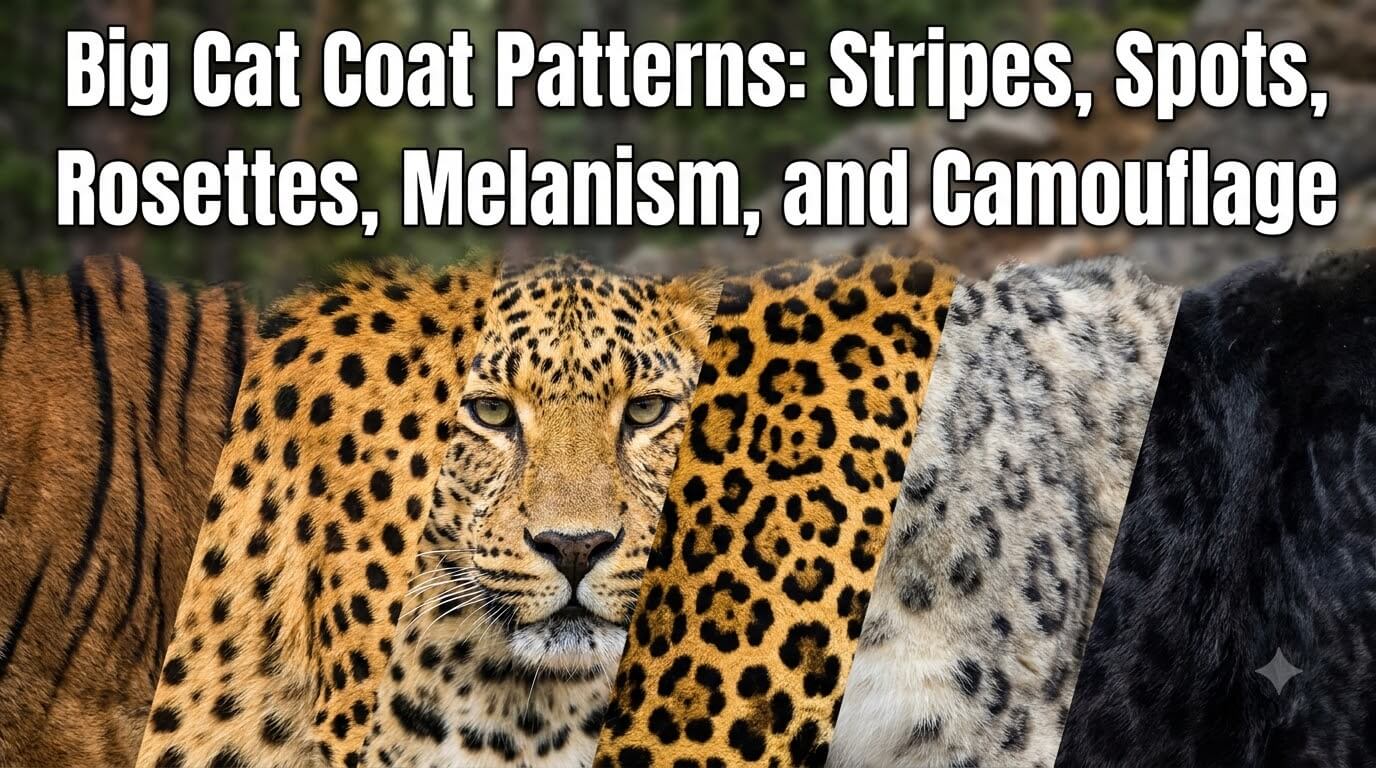
Big cat coat patterns do more than make species easy for people to recognize. Stripes, spots, rosettes, cloud-like blotches, pale winter-looking coats, and mostly plain fur can all change how a cat’s outline appears against vegetation, rock, shadow, or open ground. These markings do not make an animal invisible, and no single pattern works equally well in every habitat. Instead, coat pattern is one part of a larger visual system shaped by light, background texture, movement, and the way a species hunts or travels.
The familiar examples are strikingly different. Tigers carry dark vertical stripes. Leopards and jaguars have rosettes. Cheetahs have solid spots. Snow leopards have pale gray coats with dark rosettes and spots. Clouded leopards have large irregular blotches that resemble clouds. Adult lions are comparatively plain, although cubs are born with spotting that usually fades as they grow. The same family can therefore produce a surprising range of visual patterns.
Color variants add another layer. A “black panther” is not a species but usually a melanistic leopard or jaguar, depending on where the animal occurs. White tigers are not a separate species or subspecies and are not true albinos. Terms such as melanism, leucism, and albinism describe different kinds of pigmentation change and should not be used as synonyms.
Why Coat Patterns Matter to Big Cats
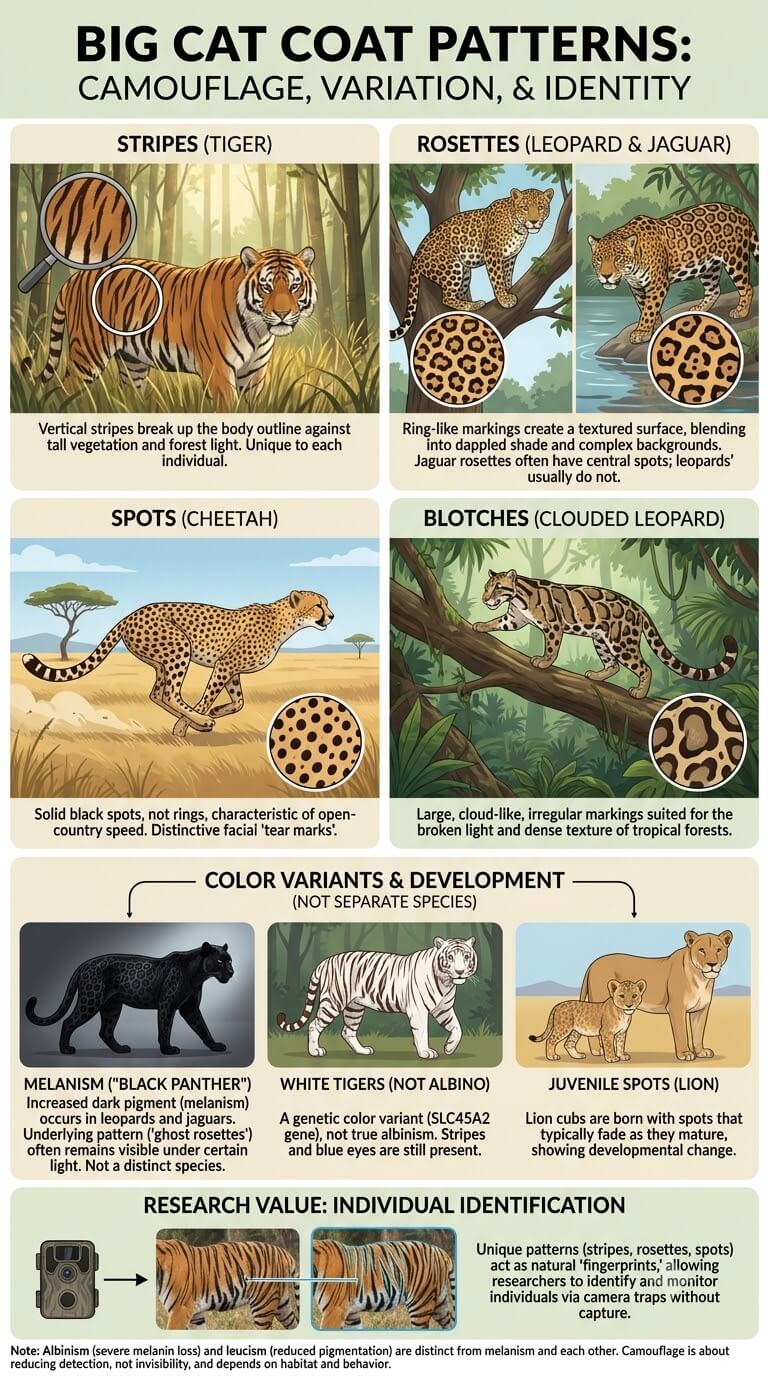
Most large cats depend on getting close enough to prey for a short, decisive attack. That makes concealment valuable. A pattern that reduces the visual contrast between a cat and its surroundings can help delay detection, especially when the animal is partly hidden by vegetation, broken light, or uneven terrain.
A comparative Royal Society study of felid coat patterns and ecology found that patterned coats, pattern complexity, and irregularity were associated with habitat structure, arboreality, and nocturnal activity across the cat family. The relationship was not a simple rule for every species, but the overall result supports camouflage as a major explanation for why felid patterns differ.
Camouflage Is About Reducing Detection, Not Disappearing
Camouflage can work through several visual effects. Background matching makes an animal resemble colors or textures around it. Disruptive coloration breaks up the apparent edge of the body, making the outline harder to separate from vegetation or shadow. Irregular patches can also make it difficult for an observer to judge where one body part ends and another begins.
None of these mechanisms makes a cat literally vanish. A moving tiger crossing open ground is still conspicuous. A leopard in full sunlight on bare rock may be easy to see. Camouflage works best when coat, posture, background, light, distance, and movement align in the animal’s favor.
Pattern Function Changes With Habitat and Behavior
Forest cats often live among leaves, trunks, vines, branches, shafts of sunlight, and deep shade. Such backgrounds contain many edges and patches. Open-country cats encounter different visual conditions, including grass stems, low shrubs, exposed soil, and longer sightlines. Mountain cats move through broken rock, pale ground, shadow, and snow patches rather than one uniform white environment.
This is why it is risky to explain one marking with a one-line story such as “tiger stripes are for grass.” Tigers use forests, wetlands, mangroves, and other habitats as well as grassier landscapes. Pattern function should be understood across the species’ ecology, not from one postcard image.
Tiger Stripes
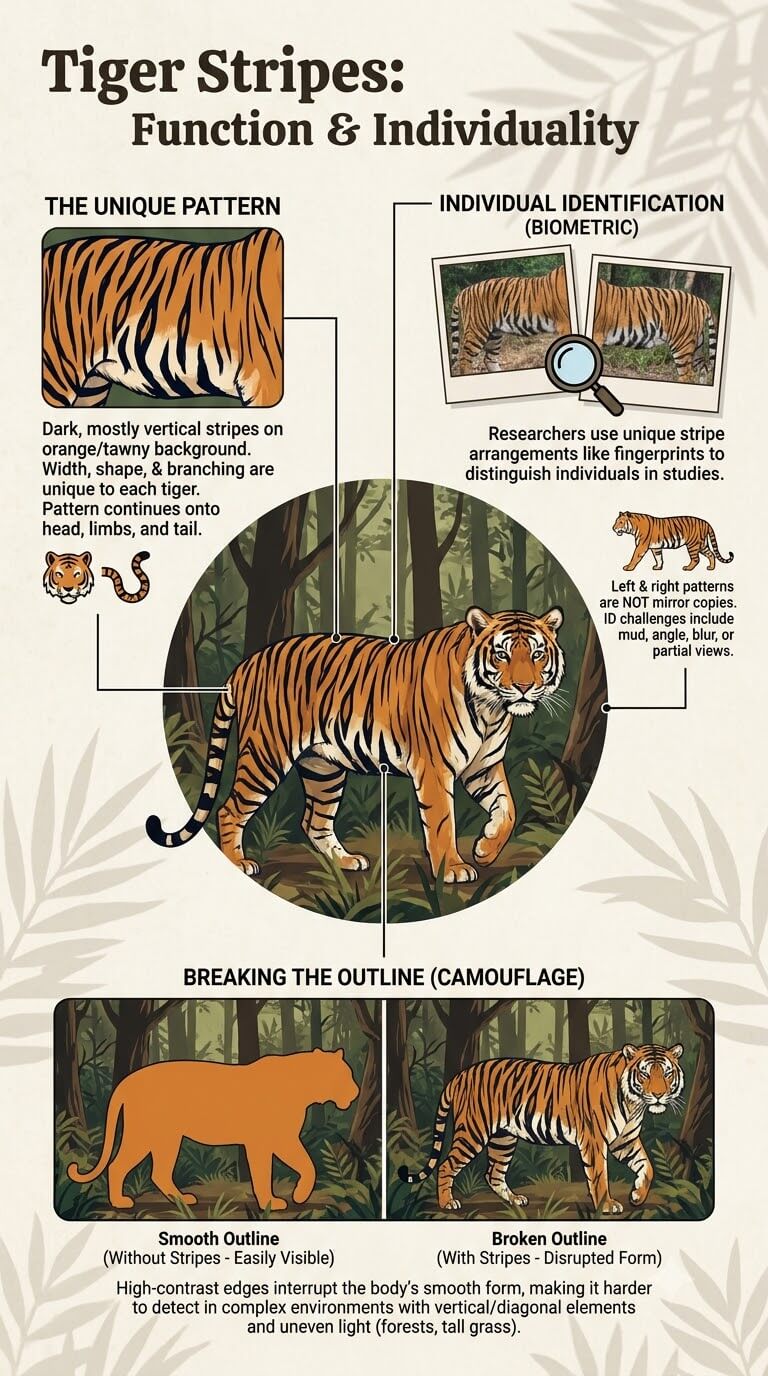
A tiger’s dark stripes run mostly vertically along the body, over an orange to tawny background with lighter fur underneath. Stripe width, shape, branching, and spacing vary among individuals. The pattern continues onto the head, limbs, and tail, giving a tiger a strongly broken outline when viewed through vegetation and shadow.
Why Vertical Stripes Can Help Conceal a Tiger
Dark stripes create repeated high-contrast edges across the body. When a tiger is partly obscured by stems, branches, trunks, or bands of shade, those edges can interrupt the smooth outline that would otherwise reveal a large animal. The effect is not limited to tall grass. Forest vegetation and uneven light can also produce long vertical and diagonal visual elements.
The broader felid comparison mentioned above did not find a simple universal link between vertical striping and grassland use. Tigers are therefore a good reminder that camouflage explanations must match real habitat diversity rather than a single popular image.
Every Tiger Has Its Own Stripe Arrangement
Stripe patterns vary enough for trained researchers to identify individuals in camera-trap photographs. A recent Sumatran tiger camera-trap study used visible stripe patterns on the flanks and hind legs to distinguish individual tigers and checked identifications between observers.
That does not mean stripes are a perfect biometric in every image. Mud, vegetation, angle, blur, shadows, partial views, and changes in camera position can hide important markings. Researchers often seek images of both sides because a tiger’s left and right patterns are not mirror copies.
Leopard Rosettes
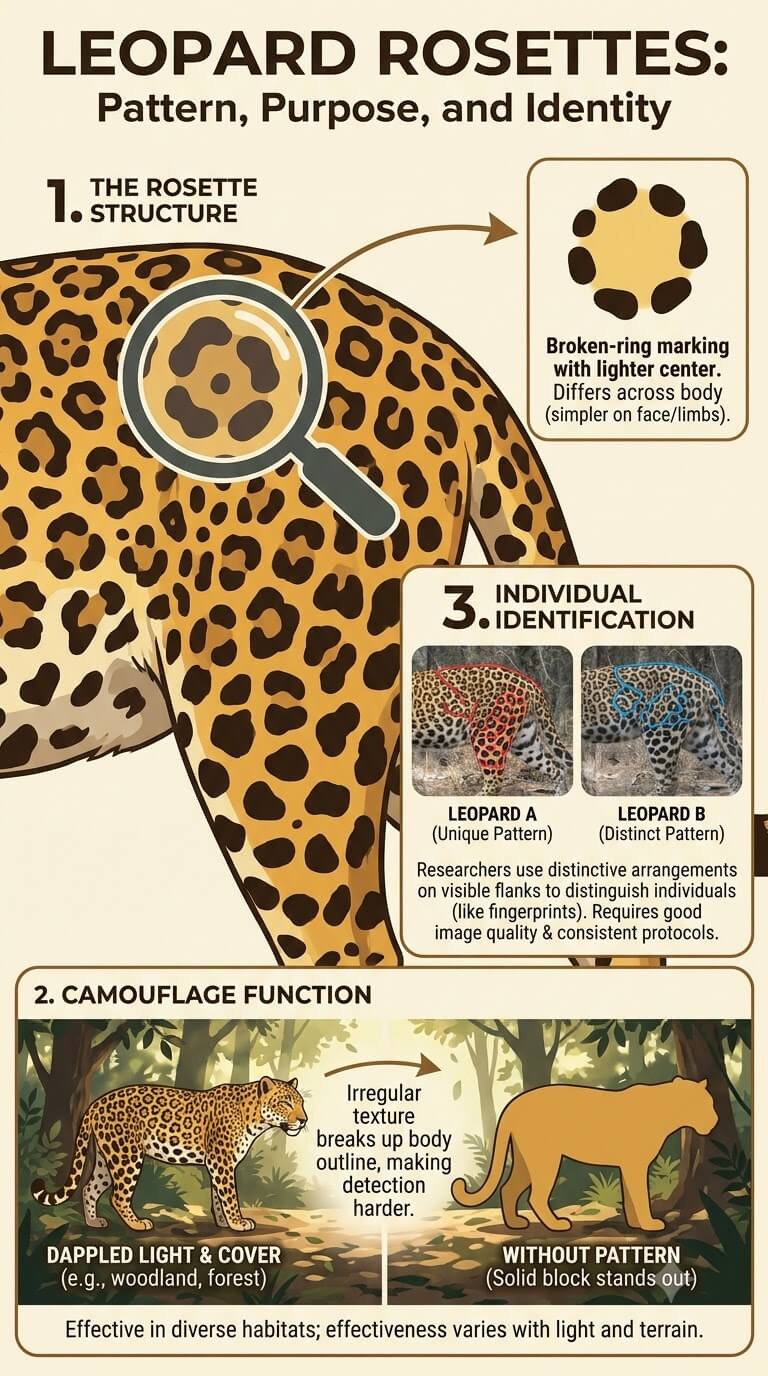
Leopards are covered with dark spots and rosettes over a yellowish to golden background that can vary considerably by region and individual. A rosette is a ring-like or broken-ring marking made from several dark spots or curved patches around a lighter center. The pattern differs across the body, with simpler spots often appearing on the face and lower limbs.
Rosettes Break Up the Body Outline
The irregular mixture of dark borders and lighter centers creates a textured surface rather than one solid block of color. In woodland, scrub, forest, rocky cover, or dappled shade, that texture can make the cat’s body harder to separate visually from its background.
Leopards occupy an unusually broad range of habitats, so no one background explains every leopard coat. Pattern effectiveness changes with light and vegetation, and a marking that works well in broken forest shade may function differently in dry woodland or rocky terrain.
Leopard Rosettes Are Useful for Individual Identification
Researchers routinely use distinctive rosette arrangements in camera-trap studies. The shapes and relative positions of markings on a visible flank can help distinguish one animal from another. As with tiger stripes, identification is strongest when image quality is good and analysts follow consistent protocols rather than assuming any random spot is unique enough on its own.
Jaguar Rosettes
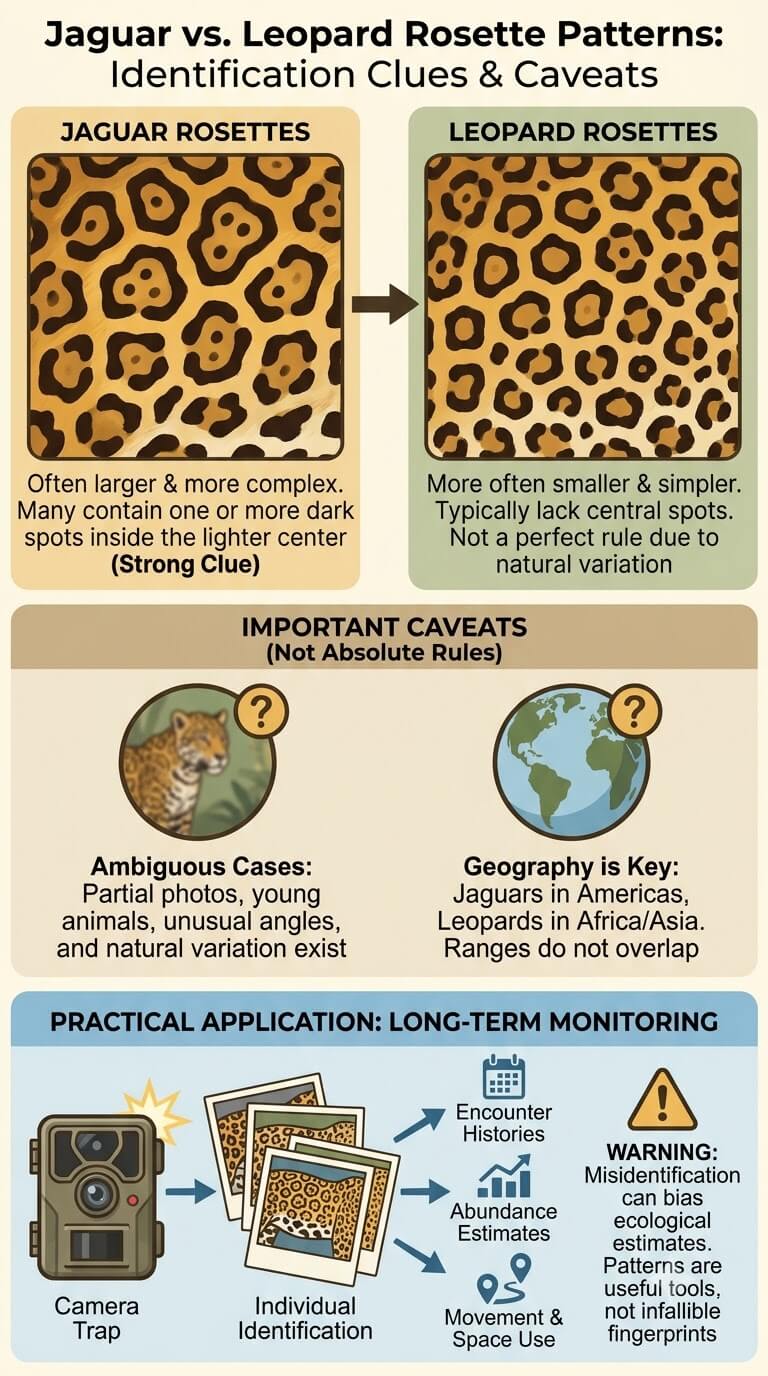
Jaguars also have rosettes, which is why photographs are sometimes confused with leopards. Jaguar rosettes are often larger and more complex, and many contain one or more dark spots inside the lighter center. Leopards more often have smaller rosettes without those central spots, although real coat variation prevents this from being a perfect rule.
Central Spots Are Helpful, Not Absolute
A rosette with obvious central dots is a strong jaguar clue, especially when combined with the animal’s broad head, robust body, and geographic location. But coat pattern should not be treated as the only diagnostic feature. Partial photographs, young animals, unusual angles, and naturally variable markings can produce ambiguous cases.
Geography often resolves the question quickly. Wild jaguars are native to the Americas, while wild leopards occur in Africa and Asia. Their present natural ranges do not overlap.
Jaguar Patterns Can Be Used in Long-Term Monitoring
Camera traps allow researchers to recognize jaguars across repeated encounters without physically capturing them each time. Studies can match rosette and spot arrangements, build encounter histories, and estimate abundance, movement, survival, or space use when survey design is appropriate.
A review of individual identification methods for large felids lists tiger stripes, leopard and jaguar rosettes, and cheetah spots among the pelage markings commonly used for field identification. The same review also stresses that misidentification can bias ecological estimates, so visible patterns are useful tools rather than infallible fingerprints.
Cheetah Spots
Cheetahs have solid black spots rather than rosettes. Their background color is usually tawny to pale gold, and the face carries distinctive dark lines running from the inner corners of the eyes toward the mouth. These “tear marks” are one of the easiest visual differences between a cheetah and a leopard.
Solid Spots Differ From Rosettes
A cheetah’s body markings are generally filled-in spots, while a leopard’s are dominated by ring-like rosettes across much of the torso. This difference is useful even when body shape is not obvious. Cheetahs also have a narrower build, long limbs, a relatively small head, and a long tail adapted for control during high-speed movement.
The Rare King Cheetah Shows How Pattern Genes Can Alter Markings
Rare cheetahs sometimes have broad dark stripes and large blotches instead of the usual evenly distributed spots. This is called the king cheetah pattern. Genetic work found that changes in a pattern-related gene called TAQPEP are associated with this phenotype.
A study of pigmentation patterns in domestic and wild cats showed that TAQPEP helps establish spatial patterning in feline skin and linked a variant in the gene to the king cheetah’s altered markings. The result is important because it demonstrates that stripes, blotches, and spots can arise from changes in developmental pattern systems rather than from each marking being built by a completely unrelated mechanism.
Snow Leopard Markings
Snow leopards have pale gray to smoky coats with darker rosettes and spots. The contrast is often softer than in a leopard or jaguar, and the long dense fur can make the markings appear blurred at their edges. The pale ground color blends well with rock, scree, dry mountain vegetation, snow patches, and shadow.
Snow Leopard Camouflage Is Not Just About Snow
Despite the name, snow leopards do not live on endless white snowfields. Their mountain ranges include exposed rock, cliffs, gravel slopes, sparse vegetation, and seasonal snow. A gray patterned coat works across this visually broken landscape better than a completely white coat would.
This distinction matters because illustrations sometimes show snow leopards as nearly pure white animals in deep snow. Real adults usually retain visible gray-brown patterning and spend much of their lives among rock rather than on featureless ice.
Clouded Leopard Blotches
Clouded leopards have some of the largest and most irregular markings among living cats. Their flanks carry dark-edged blotches with paler centers, creating the cloud-like appearance behind the common name. The pattern is especially suited to the broken light and dense visual texture of tropical and subtropical forests.
Clouded Leopards Are Not True Leopards
The name can be misleading. Mainland and Sunda clouded leopards belong to the genus Neofelis, not Panthera pardus, the true leopard. Their blotches also differ from the smaller rosettes typical of leopards.
That distinction is useful for visual education because “clouded” describes a marking style, not a taxonomic relationship close enough to make them varieties of leopard. Their coats are one more example of how common names can group animals by appearance even when scientific classification tells a more precise story.
Lion Coats: Plain Adults, Spotted Cubs
Adult lions are among the least patterned of the familiar large cats. Their coats are usually tawny, buff, or sandy, with relatively little body patterning compared with tigers or leopards. Yet lion cubs are born with spots and rosette-like markings that are much more obvious when they are young.
Juvenile Spots Usually Fade With Age
As lions mature, much of the juvenile pattern becomes faint or disappears from the torso, though traces can remain on some adults, especially on the legs or belly. This age-related change shows that coat pattern can be developmentally regulated within one species.
The effect also warns against assuming that a young animal must look like a small adult. Juvenile patterning may serve different visual needs during a stage when cubs spend more time hidden and are more vulnerable.
How Felid Coat Patterns Develop
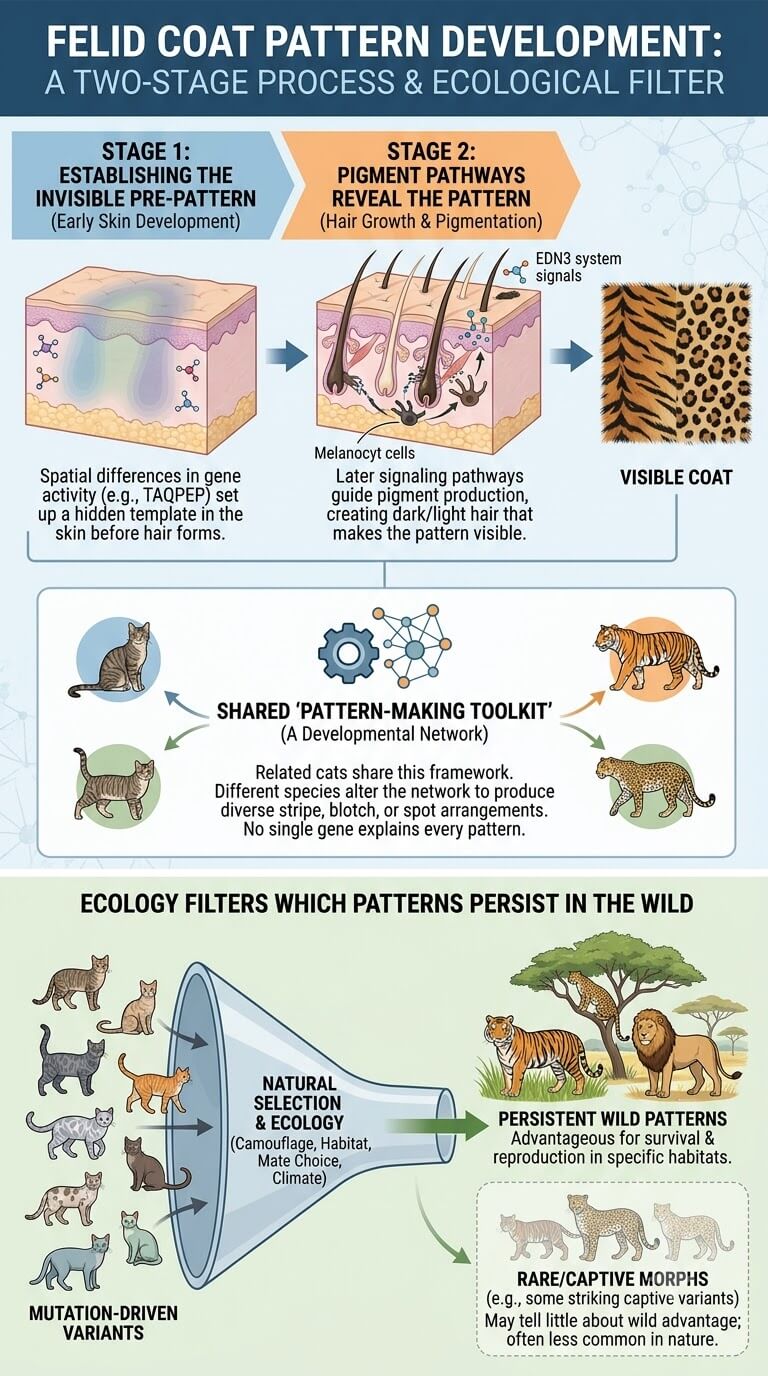
Coat patterns are not painted onto a finished animal. They emerge during development through spatial differences in gene activity and pigment production in the skin and hair follicles. Researchers have learned much from domestic cats because their stripes and blotches vary in ways that can be studied genetically, then compared with wild felids.
A Two-Stage Patterning Process
Work on feline pigmentation supports a model in which one set of developmental signals establishes a pre-pattern in the skin before the visible coat is fully formed, while later pigment pathways create the dark and light differences that reveal that pattern. Genes including TAQPEP and signaling systems involving EDN3 have helped researchers explain how a shared developmental framework can produce different stripe and blotch arrangements.
This does not mean one gene explains every tiger stripe, leopard rosette, or lion coat. Pattern formation is a network of developmental processes, and different species can alter that network in different ways. It is more accurate to say that related cats share parts of a common pattern-making toolkit.
Genes Shape Patterns, but Ecology Shapes Which Patterns Persist
A mutation can create a new color or pattern variant, but whether that variant spreads in a wild population depends on survival and reproduction. Camouflage, mate choice, climate, habitat, and chance can all influence the outcome. A visually striking captive color morph may therefore tell us little about what is common or advantageous in the wild.
Melanism and the Meaning of “Black Panther”
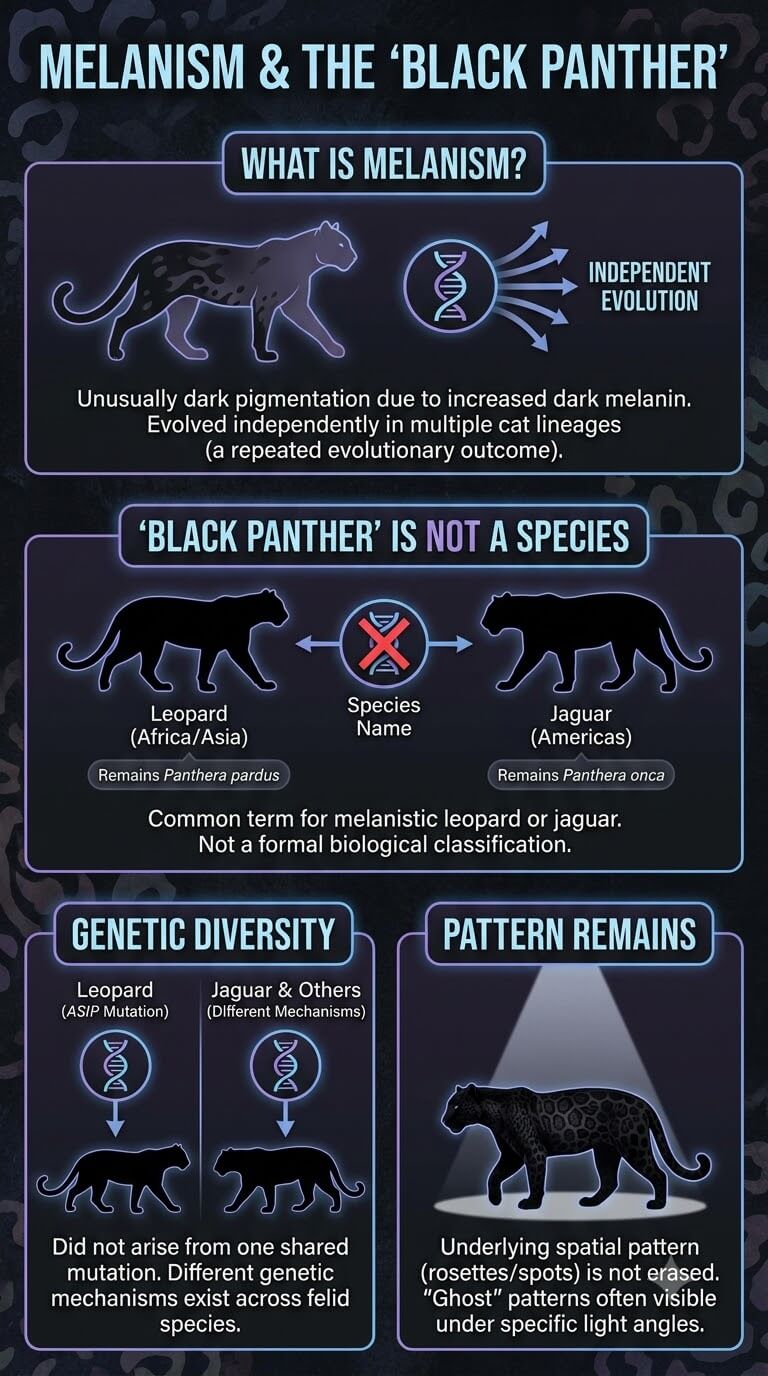
Melanism means unusually dark pigmentation caused by increased production or distribution of dark melanin. It has evolved independently in multiple cat lineages. A melanistic cat may look almost uniformly black at first glance, but its normal pattern can remain visible as “ghost” rosettes or spots under certain light.
Black Panther Is Not a Species
In common usage, “black panther” most often refers to a melanistic leopard in Africa or Asia or a melanistic jaguar in the Americas. It is not a formal species name. A black leopard remains Panthera pardus; a black jaguar remains Panthera onca.
Genetic studies show that melanism did not arise through one shared mutation across all cats. Research on melanism in leopards and other wild felids identified an ASIP mutation associated with black coloration in leopards, while other felid species have different genetic mechanisms. Melanism is therefore a repeated evolutionary outcome, not evidence that all black cats form one lineage.
Melanism Does Not Erase the Underlying Pattern
In many melanistic leopards and jaguars, rosettes can still be seen when light strikes the coat at the right angle. The animal is producing much more dark pigment, but the spatial pattern created during development can remain. That is why some “black panther” photographs reveal a shadowy rosette pattern across the body.
Leucism, Albinism, and Other Pale Color Variants
Pale animals are often mislabeled as albino. True albinism involves major disruption of melanin production and can affect pigmentation in the coat, skin, and eyes. Leucism is a broader and less consistently used term for reduced pigmentation, often with normal eye pigmentation. Because the terminology varies somewhat across scientific literature, it is better to describe a known genetic color variant specifically when the mechanism has been studied.
Melanism and Albinism Are Opposite Pigmentation Problems
Melanism involves increased dark pigmentation. Albinism involves a severe reduction or absence of melanin production. Neither term should be used just because an animal looks unusually dark or pale in one photograph. Lighting, age, molt, dust, camera exposure, and natural color variation can all change appearance.
Leucism Is Not Simply “Partial Albinism”
The term leucism is often used for reduced pigmentation that does not affect the eyes in the same way as albinism, but researchers do not use the word with perfect consistency across animal groups. Calling every partially white animal “partially albino” can therefore be misleading. When possible, the underlying pigmentation mechanism is more informative than the visual label.
White Tigers Are Color Variants, Not a Separate Kind of Tiger
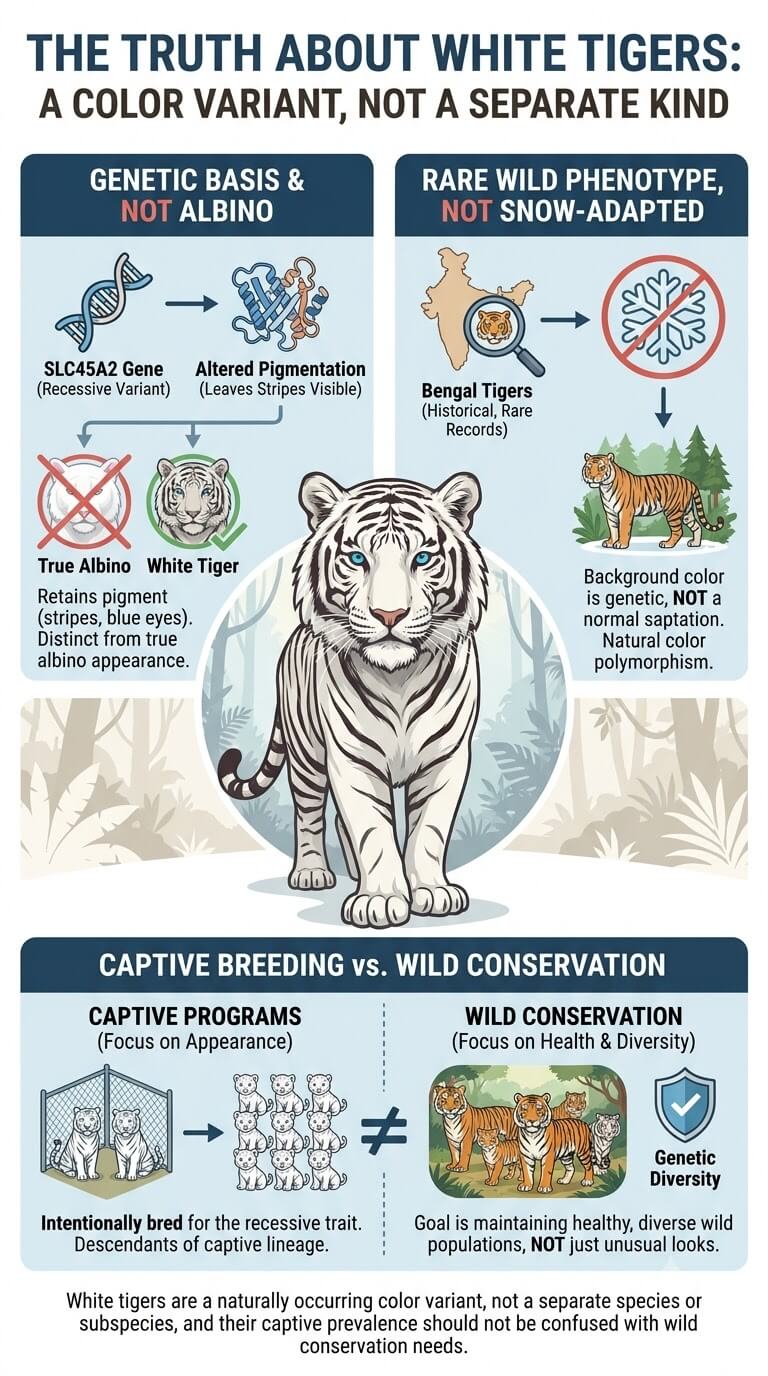
White tigers retain dark stripes on a very pale background and usually have blue eyes, which immediately distinguishes them from a classic true-albino appearance. Genetic research has traced the familiar white-tiger phenotype to a recessive variant in the pigmentation gene SLC45A2.
The peer-reviewed genetic study of white tigers identified an amino-acid change in SLC45A2 that alters pigmentation while leaving the stripe pattern visible. The study also explicitly concluded that the white tiger is not a true albino. It is a naturally occurring color polymorphism of tiger, not a separate species or subspecies.
White Color Does Not Mean a Wild Population Is Adapted to Snow
The white phenotype has been recorded historically in wild Bengal tigers, but it is rare. It should not be presented as a normal snow adaptation or as a distinct wild tiger type. Tigers with the white variant still carry the basic tiger stripe pattern, and their unusual background color results from pigmentation genetics rather than a separate ecological lineage.
Captive White Tigers Require Careful Context
Many white tigers seen today descend from captive breeding programs that intentionally reproduced the recessive color trait. That history should not be confused with conservation of a unique wild taxon. Breeding for an unusual appearance is not the same goal as maintaining healthy, genetically diverse wild tiger populations.
How Camera Traps Use Coat Patterns
Distinctive markings make several large cats especially suitable for noninvasive photographic monitoring. Researchers can place motion-triggered cameras along trails, roads, ridgelines, or other travel routes and compare images collected over weeks, months, or years.
Patterns Help Build Individual Encounter Histories
Tiger stripes, leopard rosettes, jaguar rosettes, and cheetah spots can help analysts recognize the same animal when it appears again. Those repeated detections can then feed into carefully designed studies of abundance, survival, movement, or habitat use.
Identification Still Requires Quality Control
No coat should be treated as a magical fingerprint that eliminates error. Different flanks show different markings. A poor angle may reveal only part of the body. Vegetation can cover the most useful region, and infrared night images can reduce contrast. Researchers therefore use standardized matching procedures, multiple observers, paired cameras, software tools, or other checks depending on the species and project.
The value of pattern recognition lies in repeatability. When the same arrangement of stripes, spots, or rosettes is visible in multiple images, researchers can monitor wild cats without needing to handle the animal every time it is detected.
Common Myths About Big Cat Coat Patterns
“Stripes and Spots Make Big Cats Invisible”
No coat creates invisibility. Patterning can reduce detection or break up the outline under favorable conditions, but distance, movement, light, vegetation, and the observer’s visual system all affect whether a cat is noticed.
“A Black Panther Is Its Own Species”
It is not. The term usually describes a melanistic leopard or jaguar. Geography and anatomy are needed to identify which species is involved.
“Melanism Is the Same as Albinism”
They involve opposite directions of pigmentation change. Melanism produces unusually dark coloration, while albinism involves severe loss of melanin production. Leucism is another term used for reduced pigmentation but should not be treated as a synonym for either one.
“Every White Tiger Is Albino”
The well-known white tiger phenotype is not true albinism. White tigers retain stripes and have a specific inherited pigmentation variant involving SLC45A2.
“Leopard and Jaguar Rosettes Always Tell You the Species Instantly”
Jaguar rosettes often contain central spots and tend to look larger or more complex, while leopard rosettes more often lack central dots. But coat variation, image quality, and viewing angle mean pattern should be combined with body build and geographic context.
FAQ
What is the difference between a spot and a rosette?
A spot is a relatively solid patch of dark color. A rosette is a ring-like or broken-ring marking with a lighter center. Cheetahs are best known for solid body spots, while leopards and jaguars have extensive rosettes. The exact shape and size of each marking can vary across the body and among individuals.
Why are some leopards and jaguars black?
They are melanistic individuals that produce unusually dark pigmentation. The genetic mechanisms differ between species, which shows that melanism evolved independently more than once in the cat family. Their normal rosette pattern can often still be visible in strong or angled light.
Are white tigers albino?
No. The familiar white tiger phenotype retains dark stripes and is associated with a recessive variant in the pigmentation gene SLC45A2. Genetic research specifically distinguishes it from true albinism.
Can scientists identify an individual big cat by its coat?
Often, yes, when the species has distinctive markings and the photographs are clear enough. Tiger stripes, leopard and jaguar rosettes, and cheetah spots are widely used in camera-trap studies. Reliable work still requires consistent methods because angle, lighting, vegetation, and partial views can cause mistakes.
Do all big cats have spots when they are young?
No. Juvenile patterning differs among species. Lion cubs are a useful example because they are born with visible spotting that usually fades with age. Tigers, leopards, jaguars, cheetahs, snow leopards, and clouded leopards retain their characteristic patterned coats into adulthood, although markings and contrast can change as the coat develops.
Final Thoughts
Big cat coat patterns are a combination of development, pigmentation, ecology, and individual variation. Tiger stripes, cheetah spots, leopard and jaguar rosettes, snow leopard markings, clouded leopard blotches, and the fading juvenile spots of lions show how many visual solutions can evolve within one cat family.
The most useful lesson is that markings are not decorative labels. They can help conceal an animal, reveal developmental genetics, distinguish species, and allow researchers to recognize individuals through camera traps. At the same time, unusual colors need careful language. A black panther is usually a melanistic leopard or jaguar, a white tiger is a color variant rather than a separate taxon, and albinism, leucism, and melanism should never be treated as interchangeable terms.

Ethan Walker is the founder and research editor of Animal Fact Central. He creates and reviews educational animal facts content using trusted wildlife, pet care, and science-based sources. His work focuses on making animal behavior, adaptations, habitats, and species facts clear, accurate, and engaging for everyday readers.
Read More Details About Ethan Walker: https://animalfactcentral.com/ethan-walker/