
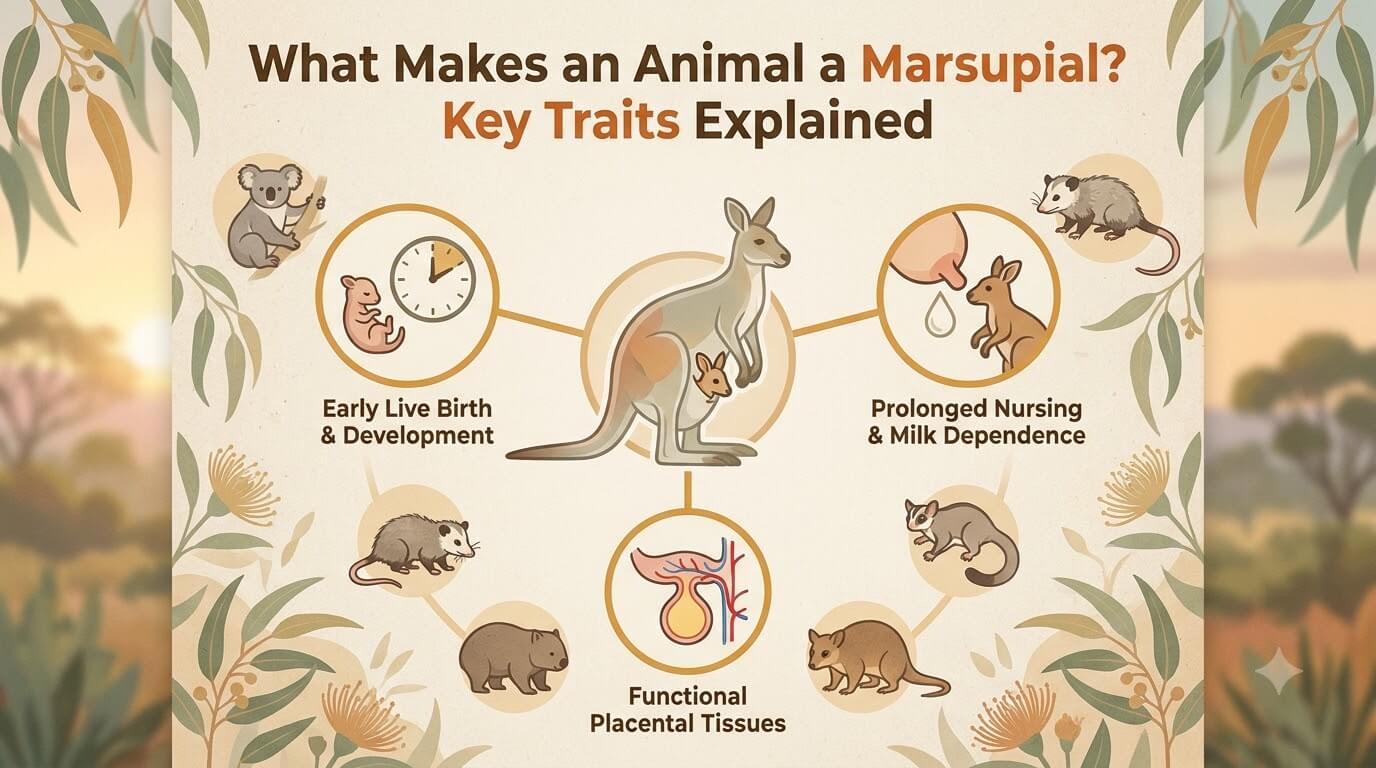
What makes an animal a marsupial is not simply the presence of a pouch. Marsupials are a living lineage of mammals defined by their evolutionary ancestry and a distinctive combination of reproductive and developmental traits. They give birth to live young, form functional placental tissues during pregnancy, and typically shift a large share of development to the period after birth, when very immature young depend closely on their mother’s teats and milk.
That definition includes animals as different as kangaroos, koalas, wombats, opossums, possums, quolls, Tasmanian devils, bandicoots, bilbies, numbats, and marsupial moles. Some have deep pouches, some have shallow folds around the mammary area, and some do not have a fully enclosed pouch. To understand why all of them are marsupials, it helps to look at lineage, reproduction, newborn anatomy, and development together rather than searching for one visible feature.
Quick Answer
A marsupial is a mammal belonging to the living lineage Marsupialia. In the current American Society of Mammalogists Mammal Diversity Database, Marsupialia is part of Theria, the branch of mammals that also includes placental mammals. The database’s current release is version 2.5, issued in July 2026.
Marsupials share a characteristic developmental strategy. Pregnancy is generally followed by birth at an early developmental stage, and much further growth occurs during a prolonged nursing period. Newborns have certain body systems that are relatively advanced for the job they must perform immediately after birth, especially structures involved in reaching and attaching to a teat, while many other organs and body regions remain immature.
A pouch can be part of this system, but it is not the biological definition of a marsupial. The lineage includes species with deep pouches, reduced pouches, skin folds, and no large enclosing pouch at all.
Marsupials Are a Mammalian Lineage, Not a Pouch Category
Where Marsupialia fits within Mammalia and Theria
Mammalia includes monotremes, marsupials, and placental mammals. Marsupials and placental mammals are both therians, meaning they share a more recent common ancestry with one another than either does with living monotremes. This classification does not make marsupials an intermediate step between egg-laying mammals and placental mammals. All three are modern lineages with long, separate evolutionary histories.
The current Mammal Diversity Database family table organizes living marsupials into seven orders: Didelphimorphia, Paucituberculata, Microbiotheria, Notoryctemorphia, Dasyuromorphia, Peramelemorphia, and Diprotodontia. Marsupialia therefore should not be described as a single order.
Those seven orders contain very different animals. Didelphimorphia includes American opossums. Microbiotheria includes the South American monito del monte. Diprotodontia includes kangaroos, wallabies, koalas, wombats, many possums, and gliders. Dasyuromorphia contains numerous predatory and insect-eating forms. Other orders include shrew opossums, bandicoots, bilbies, and marsupial moles.
Why ancestry and taxonomy matter
Classification works through shared evolutionary ancestry, not through a checklist of superficial similarities. A kangaroo and a Virginia opossum do not need to look alike to be marsupials, just as a whale and a bat do not need to look alike to be mammals. Their shared ancestry is reflected in patterns of anatomy, reproduction, development, and genetics.
This is also why common names can mislead. A marsupial mole is not a true mole in the placental family Talpidae. A sugar glider is not a flying squirrel. A wombat is not a rodent, and a koala is not a bear. Similar shapes or lifestyles can evolve in distantly related mammals when they face similar ecological challenges, a process called convergent evolution.
The Defining Biological Pattern
Live birth and an early developmental stage at birth
Living marsupials give birth to live young. They do not lay eggs. What is distinctive is how early in development birth usually occurs relative to the long nursing period that follows. The newborn is highly immature in many respects, but it is not a failed or pathologically premature infant. That stage is the normal starting point for postnatal development in its species.
The exact timing differs among marsupials, so a single gestation length should not be used as a definition. The important pattern is the division of development between pregnancy and lactation. Compared with the familiar pattern in many placental mammals, marsupials typically invest less developmental time before birth and more after birth through prolonged dependence on milk.
Functional forelimbs and oral structures in very immature newborns
A newborn marsupial may have poorly developed hindlimbs, eyes, ears, and other systems, yet the structures needed for its first task can be comparatively advanced. Research on marsupial development shows that the forelimbs develop unusually early because newborns must use them immediately to reach the mammary area. A recent developmental study of dunnarts and gray short-tailed opossums describes this accelerated forelimb development as an important feature of marsupial embryology.
The mouth and tongue also matter. The newborn must establish contact with a teat and begin nursing while many other body systems are still immature. Studies of marsupial neonates have found specialized early development of the oral apparatus as well as the forelimbs. These are functional priorities, not signs that the rest of the animal is somehow evolutionarily incomplete.
Not every species performs the same dramatic climb often shown in kangaroo footage. Pouch architecture, teat position, litter size, newborn size, and the route to the teat vary among lineages. The broader pattern is that newborn anatomy is shaped by the immediate need to reach and maintain access to milk.
Teat attachment and prolonged lactation
After birth, maternal milk supports a large amount of development that would occur before birth in many placental mammals. Early young can remain closely attached to a teat, and nursing continues as organs, sensory systems, limbs, fur, and behavior mature. The duration and details vary greatly among species.
Lactation is therefore not just a brief feeding phase added after pregnancy. It is a central part of marsupial development. In some lineages, milk composition changes substantially as the young grows, matching changing developmental demands. That does not mean every marsupial produces milk in exactly the same sequence or can support young at different stages simultaneously. Those more specialized patterns need species-level evidence.
Do Marsupials Have Placentas?
Placental tissues in marsupial pregnancy
Yes. The statement that marsupials “do not have placentas” is biologically inaccurate. A peer-reviewed review of marsupial placental biology describes marsupials as having fully functional placentas and emphasizes the importance of the yolk sac in forming the definitive chorio-vitelline placenta.
The placenta is an interface between maternal tissues and the developing young. Its structure varies widely across mammals. Marsupial pregnancy often relies heavily on tissues associated with the yolk sac, while placental mammals commonly use a chorioallantoic placenta as the principal organ of exchange. That difference is real, but it is not the same as saying one group has a placenta and the other does not.
Yolk-sac-based placentation and lineage variation
In marsupials, the yolk sac contributes to a functional placenta that can participate in nutrient, gas, and other exchanges during pregnancy. The exact degree of contact with the uterine lining and the structure of the placental interface differ among species. Bandicoots are especially notable because some have additional chorioallantoic placental development alongside the yolk-sac system.
This diversity is a useful reminder that “marsupial reproduction” is not one rigid mechanism. The seven living orders include different reproductive anatomies, gestation patterns, litter sizes, pouch configurations, and lactation strategies. The shared pattern is strong enough to characterize the lineage, but individual details still have to be checked at the appropriate taxonomic level.
Why placenta-versus-no-placenta is misleading
The common three-part shorthand of “monotremes lay eggs, marsupials use pouches, placental mammals use placentas” is memorable but oversimplified. It makes the placenta sound like an exclusive feature of eutherian mammals and the pouch sound universal among marsupials. Neither idea is accurate.
A better comparison focuses on developmental allocation. Marsupials and placental mammals both use maternal tissues during pregnancy, but they differ in how pregnancy, placental exchange, birth timing, and lactation contribute to development. This avoids turning mammal evolution into a ladder in which one living reproductive strategy is treated as more advanced than another.
Is a Pouch Required to Be a Marsupial?
Deep pouches, shallow folds, and reduced or absent full pouches
No. A pouch is common in marsupials, but its form is extremely variable. Kangaroos provide the classic image of a deep pouch that encloses developing young. Other marsupials have different pouch openings, shallower structures, or folds of skin around the mammary area. Some species do not have a large fully enclosing pouch.
The Australian Museum’s marsupial overview explicitly notes that not all marsupials have pouches and that in some species the structure is more like a fold than an enclosure large enough to hold the young through later development.
Pouch variation makes sense when marsupials are viewed as a broad lineage rather than a single body plan. Species differ in litter size, how long young remain attached, how mobile the mother is, where the teats lie, and how much physical enclosure the young receive. The classic kangaroo pouch is one successful version, not the universal model.
Why teat placement matters more than the kangaroo stereotype
For very young marsupials, access to a teat is more fundamental than having a large pouch. The teat supplies milk during the long period when development continues outside the uterus. A pouch can protect this relationship, but species without a fully enclosed pouch still nurse their young.
This distinction also clarifies why a pouch is not a womb. Prenatal development occurs in the reproductive tract before birth. After birth, the young may enter a pouch, remain within mammary folds, or use another arrangement depending on species. The animal is already born at that point, even if it is tiny, hairless, and extremely immature.
Other Anatomical Clues and Their Limits
Specialized reproductive anatomy
Marsupials also differ from placental mammals in several aspects of reproductive anatomy. Female marsupials generally retain paired lateral reproductive passages and paired uteri rather than the degree of fusion familiar in many placental mammals. Male reproductive anatomy also has characteristic patterns, including a bifid penis in many species. These features are useful comparative anatomy, but they are not practical field marks for identifying an unknown wild animal.
Comparative mammalian anatomy describes paired female reproductive tracts and other reproductive-anatomy differences in living marsupials. Details can vary among lineages, so these structures are best understood as part of a broader anatomical pattern rather than reduced to one universal diagram.
For general identification, taxonomy, geographic range, external anatomy, and known species characteristics are more useful. The reproductive system matters because it helps explain the lineage biologically, not because a reader should try to inspect a wild animal closely.
Epipubic bones as context, not a unique diagnostic trait
Marsupials possess paired epipubic bones that project forward from the pelvic region into the abdominal wall. They were historically associated with pouch support, which led to the misleading idea that they evolved specifically for carrying pouch young.
A detailed anatomical study of mammalian epipubic bones shows why that interpretation is incomplete. Epipubic bones occur in marsupials of both sexes, including pouchless species, and are also present in monotremes and several extinct mammalian lineages. Their anatomy is associated with abdominal musculature and locomotor function as well as their position near the pouch region.
Epipubic bones therefore cannot serve as a unique one-feature definition of Marsupialia. They are valuable evidence in comparative anatomy and mammal evolution, but a trait shared with monotremes and extinct relatives is not an exclusive marsupial marker.
How Marsupials Differ from Other Living Mammals
Contrast with monotremes
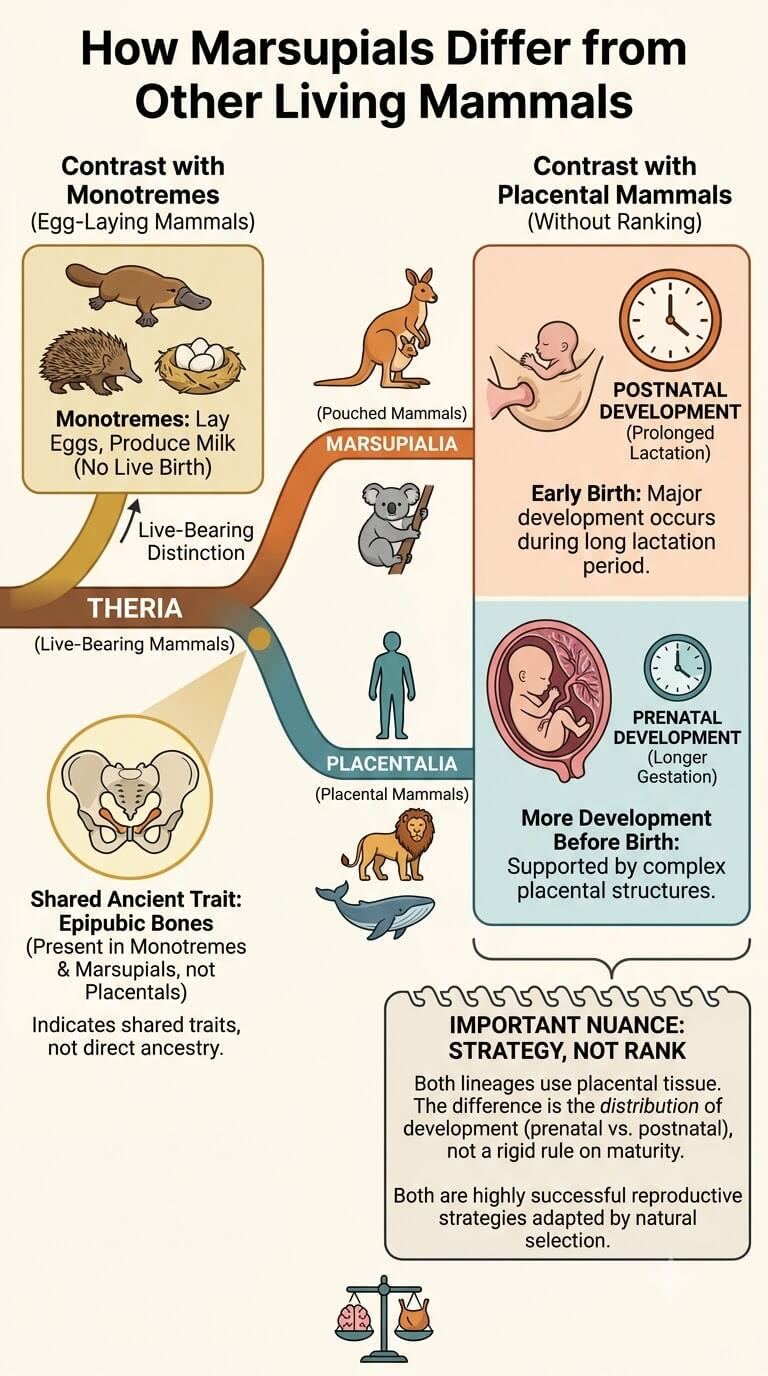
Monotremes, represented today by the platypus and echidnas, are mammals that lay eggs. They produce milk but do not give birth to live young in the marsupial manner. Marsupials, by contrast, are live-bearing therians. This difference helps place Marsupialia within Mammalia without implying that monotremes are ancestral to living marsupials.
The two groups also share some anatomical features, including epipubic bones, which is another reason a single skeletal structure cannot define a marsupial. Shared ancient traits can persist in more than one living branch.
Contrast with placental mammals without ranking lineages
Marsupials and placental mammals are both living therians. Both give birth to live young and use placental tissues during pregnancy. Their reproductive strategies differ most clearly in how prenatal and postnatal development are distributed. Marsupials generally transfer a large share of development to prolonged lactation after an early birth, while many placental mammals support more development before birth.
That contrast has many exceptions and degrees within each lineage, so it should not be turned into a rigid rule about gestation length or newborn maturity. It also says nothing about which lineage is “better.” Natural selection shapes reproductive strategies within ecological and developmental constraints, and both lineages have diversified into highly successful mammals.
Common Mistakes and Myths
Marsupials are primitive mammals
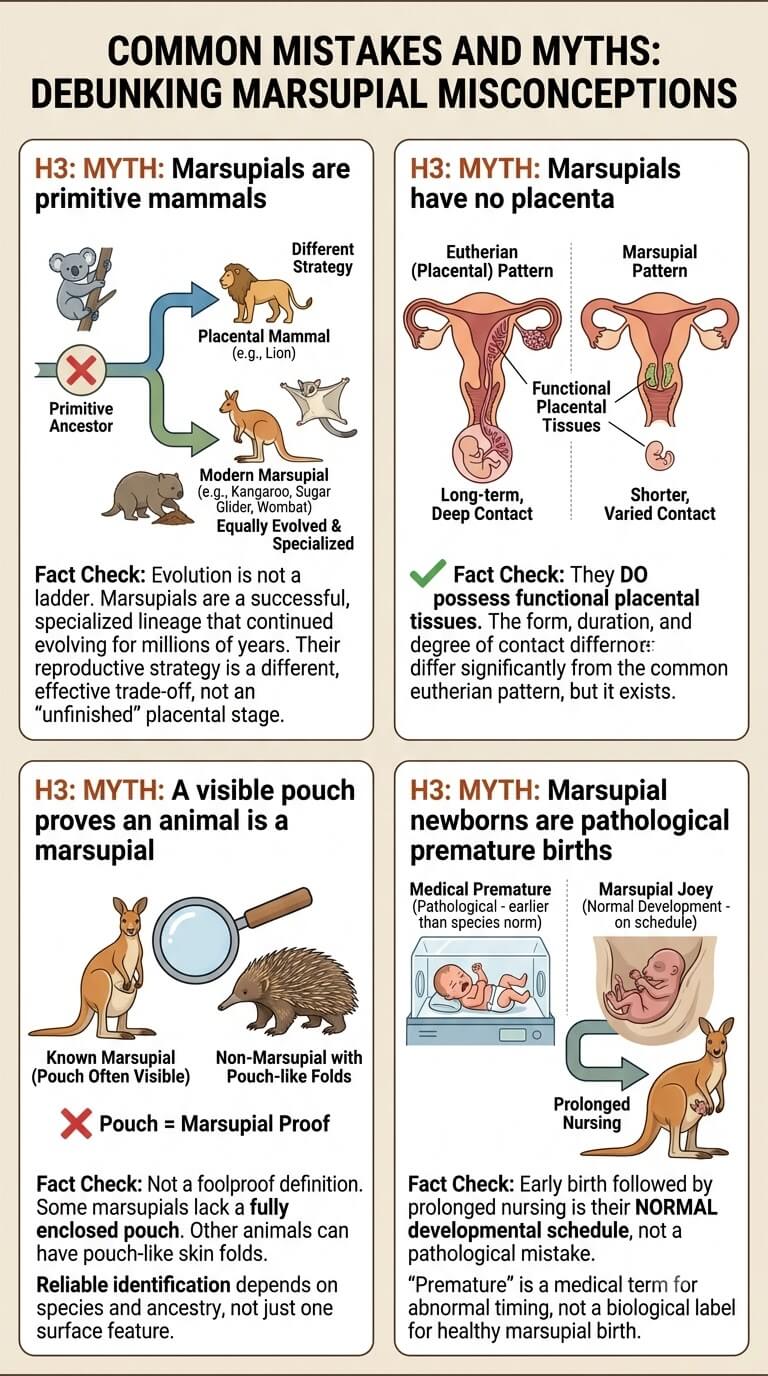
Calling marsupials primitive, lower, or less evolved creates a false picture of evolution. Modern marsupials are not living fossils frozen at an early stage of mammal progress. Their lineages have continued evolving for tens of millions of years, producing specialized climbers, grazers, predators, diggers, gliders, and many other forms.
Evolution does not aim toward placental reproduction as a final destination. Marsupial reproduction is a successful strategy with its own trade-offs and specializations. A kangaroo is no more an unfinished placental mammal than a bat is an unfinished bird.
Marsupials have no placenta
Marsupials do have functional placental tissues. The form, duration, and degree of maternal-fetal contact differ from the common eutherian pattern, and there is variation even among marsupial groups. The accurate question is how marsupial placentation works, not whether it exists.
A visible pouch proves an animal is a marsupial
A pouch can be a strong clue when it occurs in a known species, but it is not a foolproof definition. Some marsupials lack a fully enclosed pouch, and non-marsupial animals can have skin folds or other structures that might look pouch-like at a glance. Reliable identification depends on the animal’s species and ancestry, not one surface feature.
Marsupial newborns are pathological premature births
Marsupial newborns are often extraordinarily immature compared with the newborns people know from many placental mammals. That does not mean something has gone wrong. Early birth followed by prolonged nursing is the normal developmental schedule for these animals.
The term “premature” is useful in medicine when birth occurs earlier than the normal developmental schedule for a species. Using it as a blanket label for healthy marsupial birth confuses normal evolutionary biology with a pathological condition.
How the Defining Traits Shape Marsupial Diversity
Major living orders and familiar examples
Once Marsupialia is understood as a lineage rather than a pouch category, its diversity becomes easier to organize. The seven living orders include American opossums, shrew opossums, monitos del monte, carnivorous and insect-eating Australasian forms, bandicoots and bilbies, marsupial moles, and the large diprotodont group containing kangaroos, koalas, wombats, possums, and gliders.
These animals do not need to share one diet, gait, habitat, or pouch form. Their common ancestry and reproductive-developmental framework provide the deeper connection, while natural selection has produced very different ecological solutions within that framework.
Pouch structure and maternal protection
Pouches deserve attention because they are a remarkable maternal adaptation, but their biological role becomes clearer after separating them from the definition of Marsupialia. A pouch can protect nursing young, position them near teats, and allow the mother to remain mobile while offspring continue developing. Different pouch forms fit different reproductive and ecological contexts.
Questions about forward versus backward openings, shallow folds, pouch musculature, hygiene, and species without full pouches require more anatomical detail than the basic definition. The essential point here is that the pouch supports postnatal care and nursing rather than determining whether the animal belongs to Marsupialia.
Baby development after birth
The same distinction applies to the young. A newborn’s early forelimb and mouth development, teat attachment, prolonged lactation, later organ development, and eventual independence form a developmental sequence that varies among species. Kangaroo joeys provide a familiar example, but they should not be treated as the universal model.
Understanding that sequence helps explain why marsupials can give birth at such an immature stage without treating the strategy as defective. Development has not stopped. Much of it has simply shifted to a different maternal environment centered on nursing rather than continued residence in the uterus.
FAQ
Is every marsupial born at the same developmental stage?
No. Marsupial newborns share a broad pattern of being relatively immature and highly dependent on nursing, but species differ in gestation, newborn size, limb development, litter size, teat attachment, and the pace of later growth. It is safer to describe a characteristic marsupial pattern than to assign one exact developmental stage to the whole lineage.
Can a marsupial lack a fully enclosed pouch?
Yes. Some marsupials have deep permanent pouches, some have shallower folds around the mammary area, and some do not form the large enclosing structure associated with kangaroos. The young can still reach teats and continue postnatal development without a classic kangaroo-style pouch.
Are epipubic bones unique to marsupials?
No. Epipubic bones occur in living marsupials and monotremes and are known from several extinct mammalian groups. They are therefore useful for understanding anatomy and evolutionary history, but they cannot be treated as a uniquely marsupial feature or proof that a skeleton belonged to a marsupial.
Is a koala or opossum a marsupial for the same taxonomic reason?
Yes. Koalas and opossums belong to different marsupial orders, have different geographic histories, and differ greatly in diet, appearance, and behavior. Both are marsupials because they descend from the living Marsupialia lineage. Their shared ancestry is deeper than their obvious ecological differences.
Final Thoughts
What makes an animal a marsupial is a combination of ancestry and biology, not a single pouch test. Marsupials are live-bearing therian mammals whose reproductive strategy typically combines functional placental tissues, birth at an early developmental stage, specialized newborn structures for reaching and using the teats, and a long period of milk-supported growth after birth. Pouches are often part of that system, but they range from deep enclosures to shallow folds and are not universal. Epipubic bones and specialized reproductive anatomy add useful context, yet neither can replace taxonomy and evolutionary ancestry as the foundation of the definition. Once those pieces are viewed together, animals as different as kangaroos, opossums, koalas, quolls, bilbies, and marsupial moles make sense as members of one diverse mammalian lineage rather than variations on a kangaroo-shaped stereotype.

Ethan Walker is the founder and research editor of Animal Fact Central. He creates and reviews educational animal facts content using trusted wildlife, pet care, and science-based sources. His work focuses on making animal behavior, adaptations, habitats, and species facts clear, accurate, and engaging for everyday readers.
Read More Details About Ethan Walker: https://animalfactcentral.com/ethan-walker/