
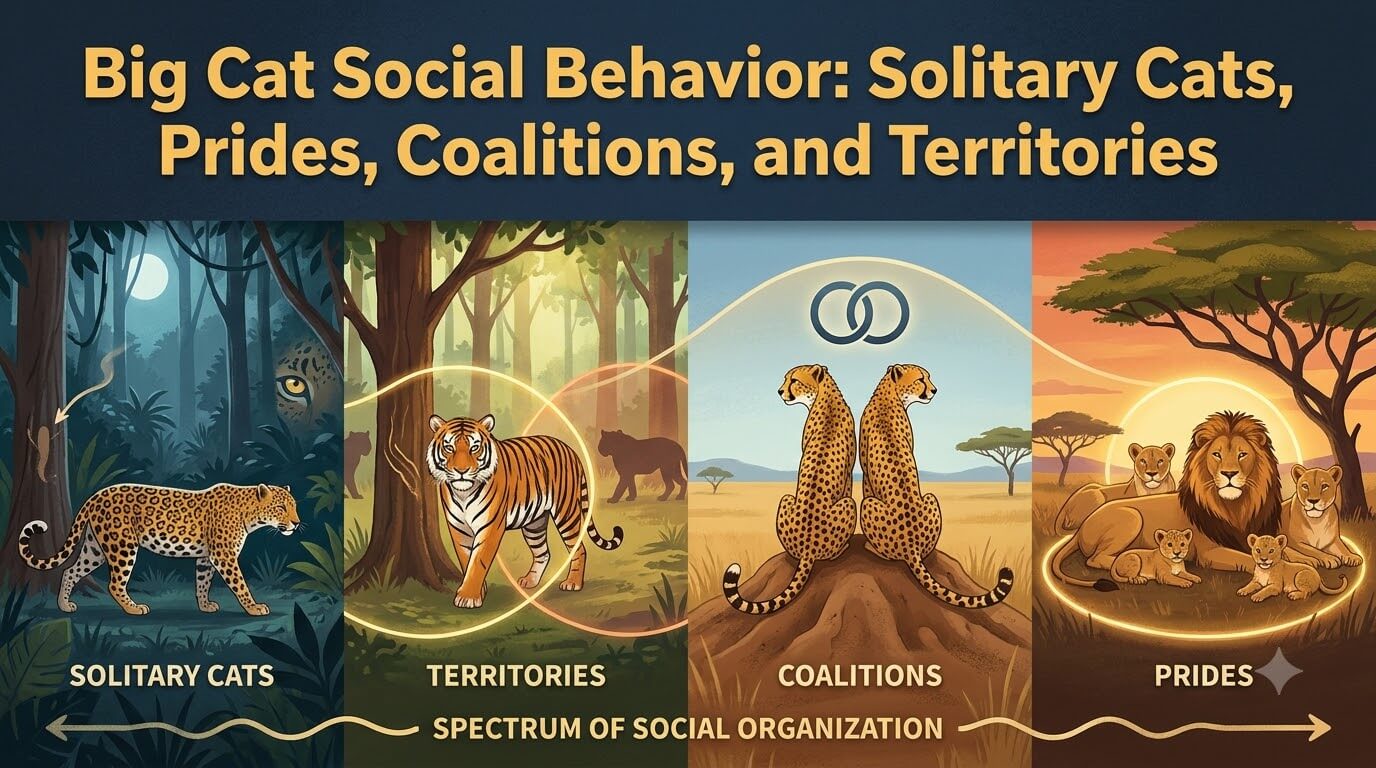
Big cat social behavior is more varied than the familiar idea that lions are social and every other large cat is solitary. Lions do form stable social groups called prides, but even they split and reunite over time rather than moving as one permanent unit. Tigers, leopards, jaguars, snow leopards, and clouded leopards usually travel and hunt alone, yet they still communicate, share or overlap space, meet to mate, interact with neighbors, and form strong mother-cub relationships. Cheetahs add another pattern: adult females usually live alone except when raising young, while males may live alone or form long-lasting coalitions.
The useful way to think about large cats is as a spectrum of social organization. At one end are lions, whose group life can include related females, dependent young, and coalitions of males. At the other end are cats whose adults usually keep more distance from one another. Between those extremes are many temporary associations, overlapping home ranges, repeated encounters, mating relationships, territorial negotiations, and family bonds. “Solitary” describes a common spacing pattern, not a complete absence of social life.
What Social Behavior Means in Wild Cats

Social behavior includes more than living in a group. It covers how animals space themselves, recognize one another, compete or tolerate neighbors, defend areas, mate, raise young, feed near one another, and exchange information. A cat that spends most nights alone can still be highly aware of who else uses the same landscape.
Group Living, Spacing, and Repeated Association
Some social systems are easy to see because animals rest, travel, or feed together. Lion prides are the clearest example among living cats. Other relationships are less obvious. A male tiger may maintain a range that overlaps those of several females. Neighboring jaguars may use some of the same ground but avoid one another in time. A male cheetah coalition can remain together for years while adult females use a very different spacing system.
These patterns are shaped by food distribution, mate access, cub care, competition, habitat structure, and risk. Social organization can also vary within one species from place to place. A label such as “social” or “solitary” is therefore a starting point, not a complete description.
Home Range Versus Territory
A home range is the area an animal normally uses for feeding, resting, mating, raising young, and other routine activities. A territory is an area that is defended, at least against certain competitors. The two terms are not interchangeable. A cat can have a large home range while defending only parts of it, and the ranges of neighboring animals may overlap.
Territorial behavior can also be selective. An adult male may tolerate females in overlapping space while being far less tolerant of a rival male. Females may adjust spacing around food or denning needs. Scent marks, scrapes, calls, and repeated use of travel routes can reduce the need for constant direct confrontation.
Temporary Encounters Are Still Social Behavior
Adult cats that usually move alone still meet. Mating pairs spend time together. Mothers remain with dependent cubs for many months. Animals may gather around a large carcass, pass through overlapping parts of home ranges, or tolerate a familiar neighbor differently from an unfamiliar intruder. Those interactions do not make the species group-living, but they show why “solitary” should never be translated as “never sees another cat.”
Lion Prides: The Most Group-Oriented Big Cat Society
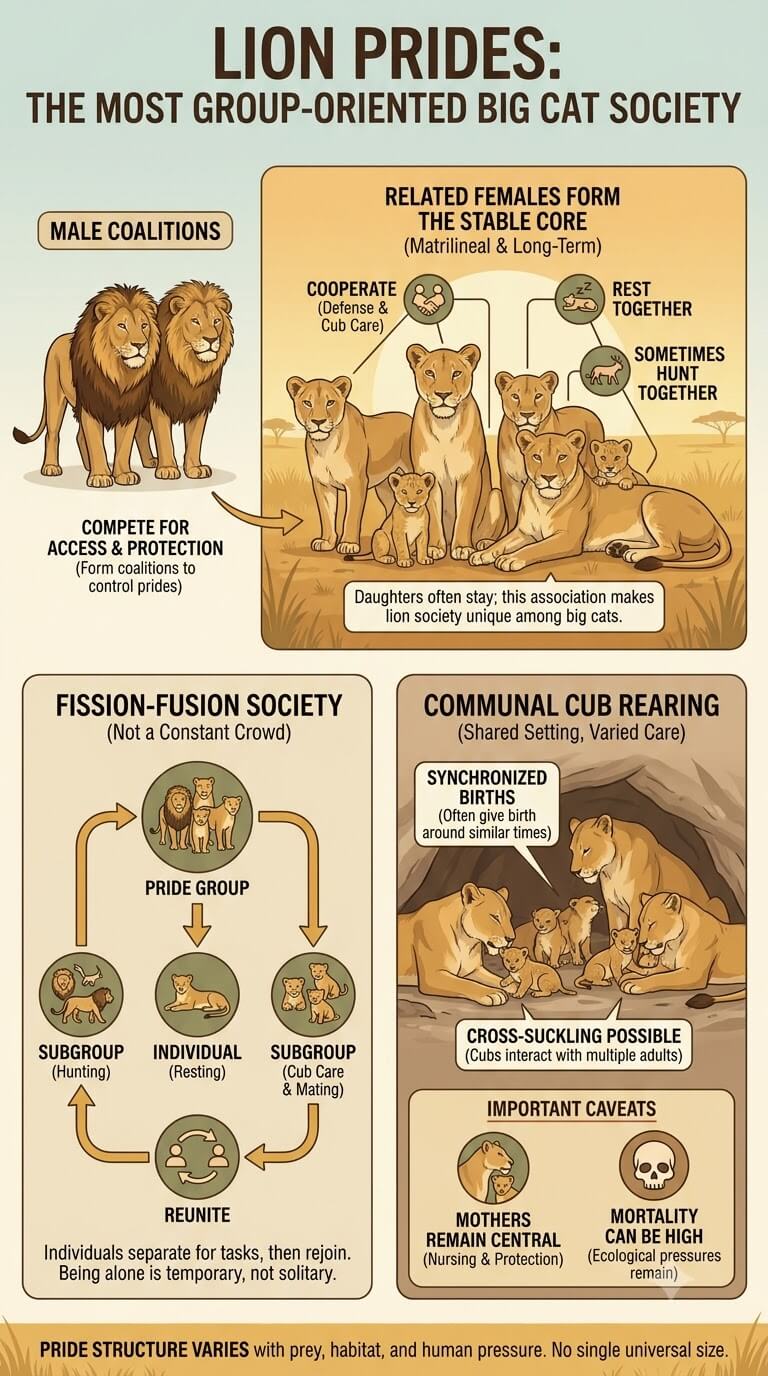
Lions are the most social living cats. The IUCN Cat Specialist Group lion account describes prides as complex social systems centered on adult females and their young, with males typically forming coalitions that compete for access to one or more prides. Pride structure varies with prey, habitat, human pressure, and local conditions, so there is no single universal pride size.
Related Females Form the Stable Core
In many African lion populations, related females form the most stable social core. Daughters may remain near their natal group, creating long-term matrilineal relationships. Females can rest together, defend shared areas, cooperate around cubs, and sometimes hunt together. Their continued association is one reason lion society looks so different from the dispersed spacing of most other large cats.
Even so, a pride is not a tight crowd that stays together every hour. Lion society has a fission-fusion quality: individuals or subgroups can separate for hunting, resting, mating, or cub care and later reunite. A photograph of one lioness alone therefore does not mean she has left social life behind.
Cub Rearing Can Be Communal
Females in a pride may give birth around similar periods and can rear cubs in a shared social setting. Cubs gain opportunities to interact with multiple adults and young lions. Cross-suckling has been recorded, although maternal investment and cub survival vary with condition and circumstances.
Communal care does not mean every cub receives equal attention from every lioness. Mothers remain central to nursing and protection, and cub mortality in the wild can be high. Pride life changes the social environment of cub rearing, but it does not remove the ecological pressures facing young lions.
Male Lion Coalitions Are Not an “Alpha Male” System
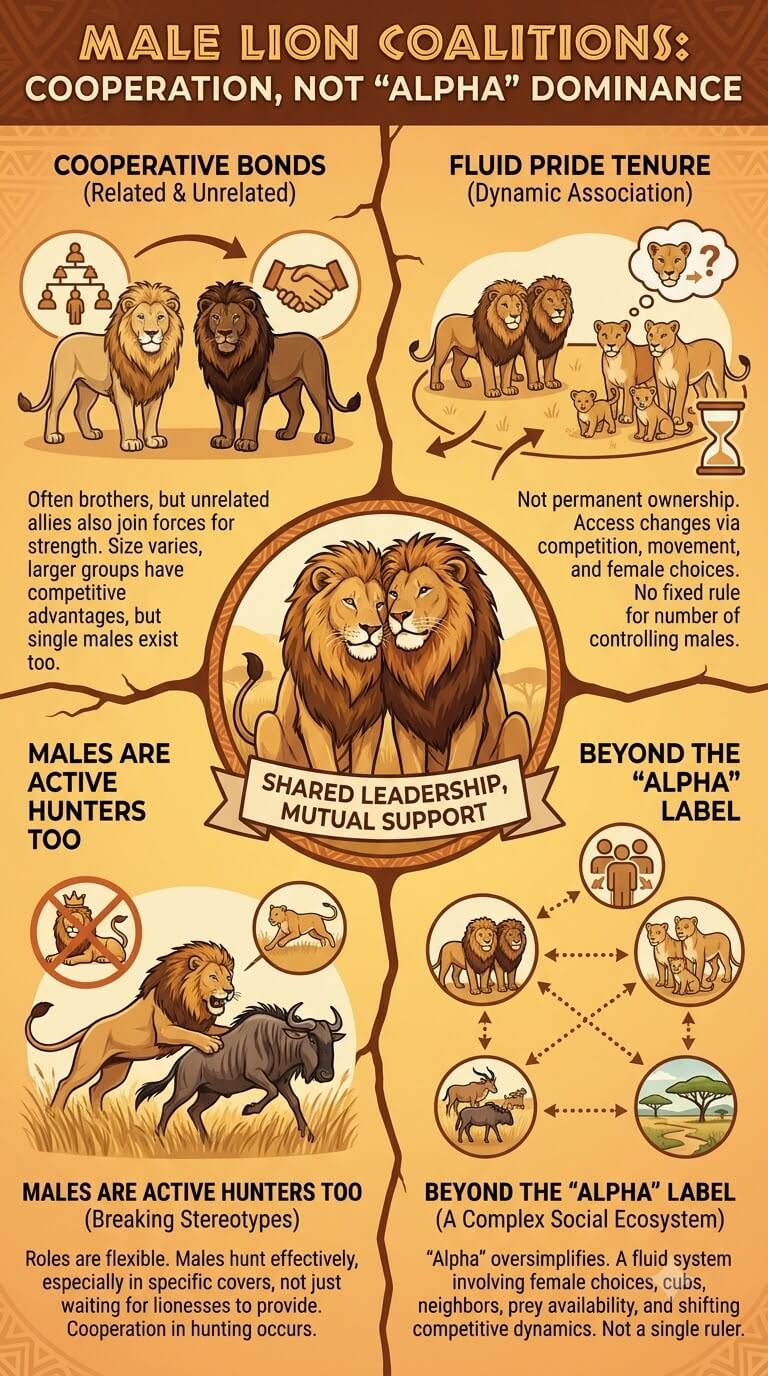
Adult male lions often form coalitions, commonly with relatives but not exclusively so. Coalition partners may cooperate in competing for access to prides and defending tenure against other males. The important concept is cooperation among males, not a rigid dominance story borrowed from outdated popular descriptions of wolves.
Coalitions Can Include Related or Unrelated Males
Brothers and other close relatives have obvious opportunities to remain together after leaving their natal pride, but unrelated males can also cooperate. Coalition size varies, and some males operate alone. Larger coalitions may have advantages in competition, but there is no fixed rule that every pride must be controlled by a particular number of males.
Pride Tenure Changes Over Time
Male association with a pride is not permanent ownership. Coalitions can lose access to a pride, move between areas, or compete with newcomers. Females also make behavioral choices that cannot be reduced to passive membership under one dominant male. Calling one lion the “alpha” or “king” oversimplifies a fluid system involving female kin groups, male coalitions, cubs, neighboring prides, prey, and changing competition.
Male Lions Hunt Too
The stereotype that lionesses do all the hunting while males simply wait to eat is inaccurate. Females often hunt cooperatively, especially in open habitats, but males also hunt and may be effective in different cover or prey contexts. Hunting roles vary with group composition, habitat, prey, and opportunity. Social organization should not be confused with one permanent division of labor.
Mother-Cub Units Are the Most Widespread Close Social Bond
Across large cats, the mother-cub relationship is the clearest and most persistent social association. A female provides milk, protection, warmth, movement guidance, and later access to prey while cubs learn the skills needed for independence. Even species described as strongly solitary spend a substantial part of early life in a family unit.
Cubs Learn While Traveling With Their Mother
Young cats gradually transition from den-bound dependence to following their mother. They observe stalking, feeding, scent investigation, route choice, resting-site selection, and responses to danger. Learning is not necessarily a formal teaching process, but repeated exposure gives cubs experience with the environment and prey.
Independence Changes the Spacing System
As juveniles mature, they eventually disperse or establish areas of their own. The timing differs by species, sex, and local conditions. This shift is socially important because a young animal moves from close family association into a landscape already occupied by adults. Finding space can involve long-distance dispersal, temporary tolerance, or competition.
For this reason, “solitary adult” and “social juvenile” are not contradictions. Social organization changes across the life cycle.
Tigers Are Mostly Solitary, but Not Socially Cut Off

Tigers usually travel and hunt alone, yet their spacing system creates regular social information and occasional direct contact. The IUCN Cat Specialist Group tiger profile notes that females establish individual territories while male territories can overlap those of several females. Home-range size changes with prey density and reproductive needs.
Territories Organize Access to Space
A resident tiger uses scent marks, scrapes, calls, and repeated travel routes to advertise its presence. These signals help neighboring animals assess who is nearby without forcing constant physical encounters. Boundaries are not invisible walls, however. Tigers can cross areas used by others, and overlap differs with sex, age, density, and local conditions.
Tigers Meet for More Than Mating
Mating is one obvious reason adults associate, but researchers also record social tolerance and repeated encounters under some conditions. Females with cubs may remain near offspring for extended periods, and older offspring can continue to interact during the transition toward independence. Food availability can also change how close individuals are willing to come to one another.
Calling tigers “antisocial” therefore gives the wrong impression. Their normal adult organization is dispersed rather than group-living, but they still maintain relationships and respond to other tigers in the same landscape.
Leopards and Jaguars Use Overlapping Space Selectively
Leopards and jaguars are generally solitary adults, but both species show more complicated spatial relationships than neat, non-overlapping territories. Sex, prey abundance, habitat quality, and local density influence how individuals use space.
Leopard Ranges Can Overlap
The IUCN Cat Specialist Group leopard account describes leopards as solitary and territorial while also noting that male and female home ranges commonly overlap. Same-sex overlap is often more limited, especially among males, but even this varies across habitats and populations.
A leopard may know neighboring animals largely through scent and indirect signs. Direct meetings can occur during mating, competition, maternal care, or around resources. The result is a dispersed network of individuals rather than a landscape of cats that are completely isolated from one another.
Jaguars Can Share Space but Avoid Each Other in Time
Jaguars show another useful example. The Cat Specialist Group jaguar profile reports that male ranges are generally larger than female ranges and can overlap several females. Same-sex range overlap has also been detected, while temporal avoidance can reduce direct encounters.
This distinction between spatial overlap and social closeness matters. Two jaguars using part of the same landscape are not necessarily traveling together or cooperating. They may visit the area at different times, responding to scent and recent presence while minimizing costly conflict.
Snow Leopards Live Far Apart, Yet Their Ranges Can Overlap
Snow leopards are usually solitary and inhabit low-density mountain landscapes where prey can be widely scattered. The IUCN Cat Specialist Group snow leopard account notes that individuals can occupy very large home ranges and that significant overlap occurs between some animals.
Mountain Terrain Makes Social Spacing Different
Ridges, cliffs, valleys, prey concentrations, and travel bottlenecks shape how snow leopards move. A home range drawn as a simple polygon on a map can hide the fact that usable paths are concentrated along particular terrain features. Several animals may therefore pass the same marking sites or travel corridors without forming a group.
Scent Marks and Scrapes Carry Social Information
Snow leopards frequently use prominent routes and terrain features for scent marking and scraping. Those signals help animals advertise presence in a landscape where direct encounters may be uncommon. During the breeding season, males and females become more likely to seek one another, showing again that solitary organization is compatible with a functioning social system.
Cheetahs Have One of the Most Unusual Felid Social Systems
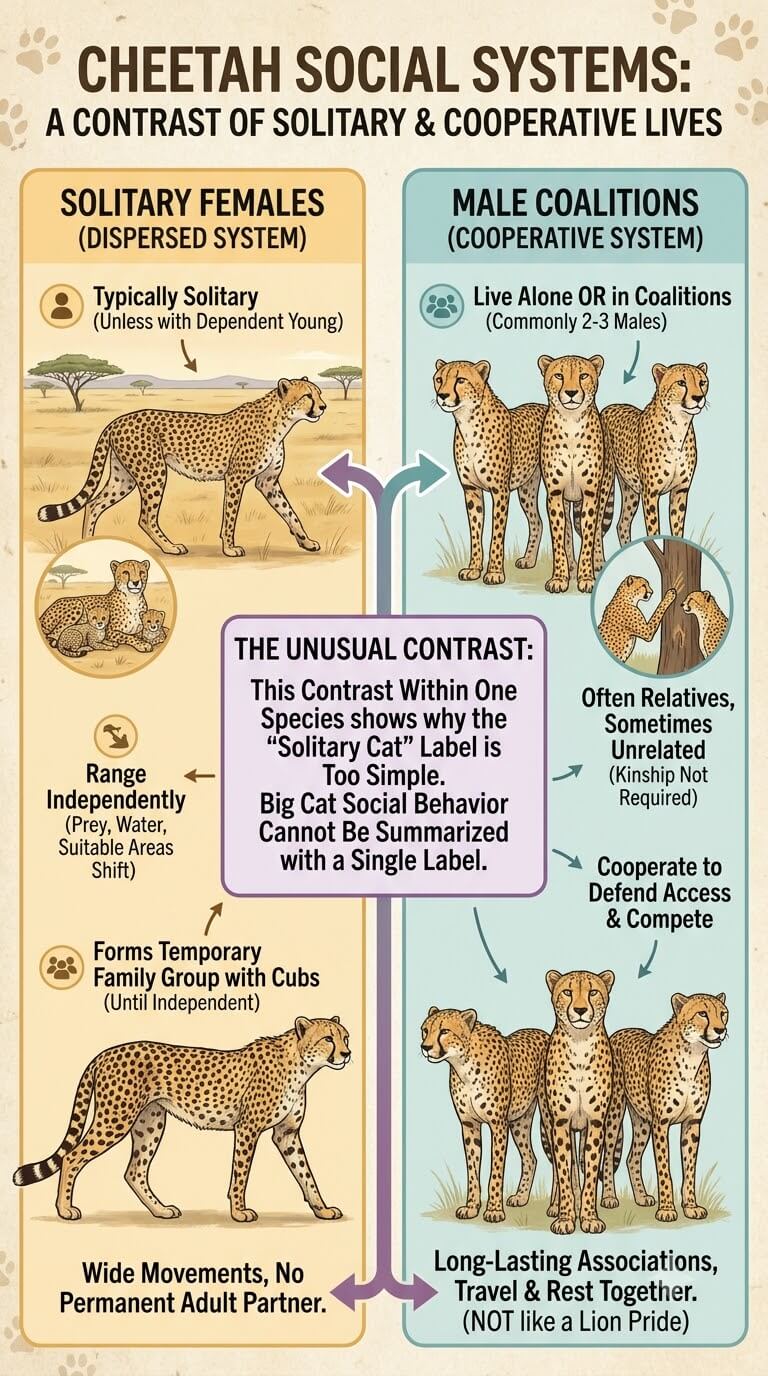
Cheetahs do not fit a simple “solitary cat” label. Adult females are typically solitary unless accompanied by dependent young, but adult males may live alone or in coalitions. The IUCN Cat Specialist Group cheetah profile describes coalitions commonly containing two or three males, often relatives but sometimes unrelated individuals.
Female Cheetahs Usually Use a Dispersed System
After separating from littermates, females generally range independently and raise cubs without a permanent adult partner. Their movements can be extensive because prey, water, competitors, and suitable denning or hunting areas shift across large landscapes. A female with cubs forms a temporary family group until the young become independent.
Male Coalitions Can Be Long-Lasting
Coalition males travel, rest, mark, and sometimes hunt together. Cooperation can help them defend access to valuable areas and compete with other males. Related males are common, but kinship is not an absolute requirement.
A coalition is not the cheetah equivalent of a lion pride. It is usually a smaller male association embedded in a species whose females follow a much more solitary spacing pattern. This contrast within one species is one of the clearest examples of why big cat social behavior cannot be summarized with a single label.
Clouded Leopards Show Why Evidence Limits Matter
Mainland and Sunda clouded leopards are difficult to study in dense forest. Camera traps, telemetry, and field observations have improved what scientists know, but the evidence base is still much thinner than for lions or cheetahs. Both clouded leopard species are generally described as solitary, yet that word should be used cautiously because secretive forest cats are especially difficult to observe directly.
Home-Range Overlap Does Not Equal Group Living
Field studies of mainland clouded leopards have found substantial home-range overlap in some areas. That suggests a spacing system more complicated than rigidly exclusive territories. It does not mean adults form persistent groups. Overlap may reflect travel routes, resource distribution, mating access, or tolerance without frequent direct association.
Captive Behavior Cannot Define Wild Social Structure
Clouded leopards in managed care can provide useful information about reproduction, communication, and individual interactions, but captive proximity changes space, food availability, and partner choice. Wild social organization has to be inferred from field evidence whenever possible. This is especially important for a secretive species where a few observations can otherwise become overgeneralized.
Territory, Home Range, and Scent-Mediated Spacing
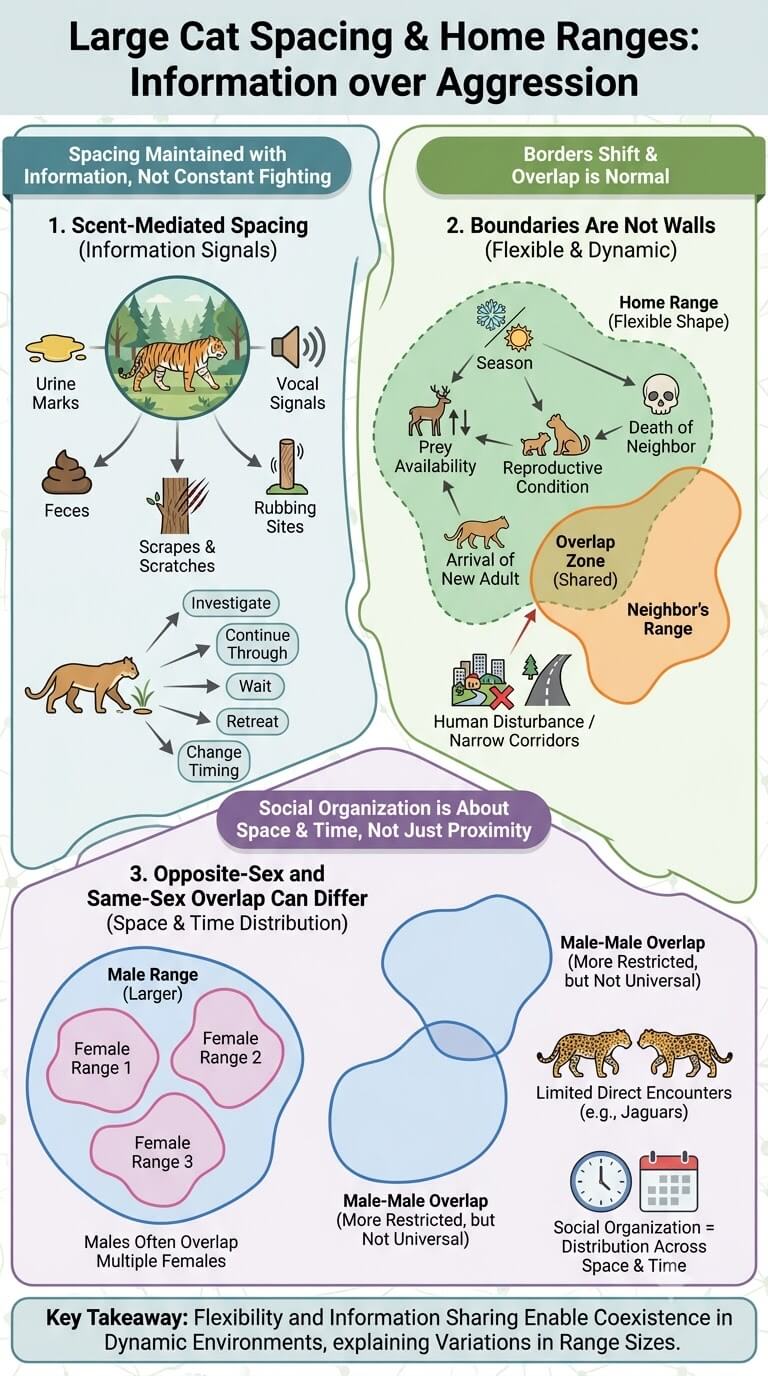
Across large cats, spacing is often maintained with information rather than constant fighting. Urine marks, feces, scrapes, scratches, rubbing sites, and vocal signals can tell another cat that an individual has recently used an area. The receiver can investigate, continue through, wait, retreat, or change its timing.
Boundaries Are Not Walls
Maps often show home ranges as colored shapes, but real animals do not experience those borders as fences. A boundary can shift with season, prey availability, reproductive condition, death of a neighbor, or arrival of a new adult. Shared edges and overlapping zones can be normal.
That flexibility helps explain why two studies of the same species can report very different range sizes or overlap. A cat in prey-rich habitat may meet its needs in a smaller area than one living where prey is sparse. Human disturbance can also compress movement or force cats through narrow corridors.
Opposite-Sex and Same-Sex Overlap Can Differ
For many large cats, adult males use larger areas than females and may overlap several female ranges. Same-sex competition can make male-male overlap more restricted, but this is not a universal rule. Jaguars, clouded leopards, and other felids show that overlap can occur even when direct encounters are limited.
Social organization is therefore not just about who stands next to whom. It is also about how individuals distribute themselves across space and time.
Social Life Changes With Food, Habitat, and Reproduction
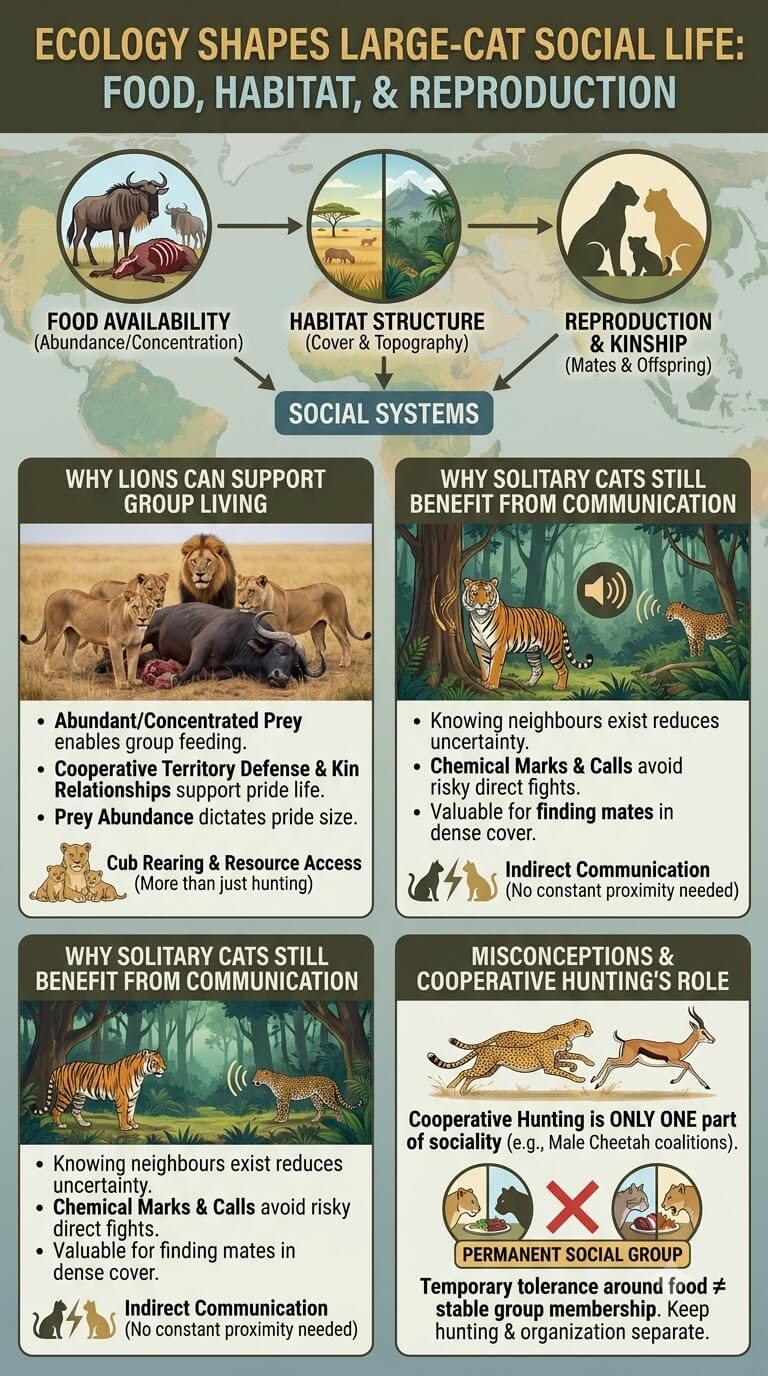
Large-cat social systems make more sense when ecology is included. Food has to be abundant or concentrated enough for group living to be worthwhile. Large prey can sometimes feed more than one lion, while scattered prey may favor widely spaced hunters. Dense cover changes how animals find one another. Open country can make visual contact easier. Mountains funnel movement through passes and ridges.
Why Lions Can Support Group Living
Lions often hunt medium to large ungulates and can defend carcasses and productive areas as a group. Female kin relationships and cooperative territorial defense further support pride life. Even so, prey abundance strongly influences pride size and ranging. Group living is not equally advantageous in every lion habitat.
Why Solitary Cats Still Benefit From Communication
A tiger or leopard does not need to travel beside a neighbor to benefit from knowing that neighbor exists. Chemical marks and calls can reduce uncertainty about rivals and potential mates. This is especially valuable when direct fights could cause serious injury.
Cooperative Hunting Is Only One Part of Sociality
Lions may hunt cooperatively, but hunting is not the sole reason a pride exists. Territory defense, cub rearing, kin relationships, and access to resources also matter. Likewise, male cheetahs can cooperate socially even though the species does not organize around lion-like prides.
Keeping hunting and social organization separate prevents another common mistake: assuming any cat seen feeding with another must be permanently social. Temporary tolerance around food can occur without stable group membership.
Common Myths About Big Cat Social Behavior
“All Big Cats Are Solitary Except Lions”
Lions are the clearest group-living large cat, but the statement is too simple. Cheetah males can form coalitions. Mothers of every large-cat species form prolonged associations with cubs. Tigers, leopards, jaguars, and snow leopards maintain overlapping social landscapes even when adults usually travel alone.
“Solitary Means a Cat Never Meets Another of Its Species”
Solitary usually means that independent adults do not routinely travel, hunt, and rest in stable groups. They still mate, compete, communicate, raise young, encounter neighbors, and sometimes tolerate one another around resources.
“Every Lion Pride Has One Alpha Male”
Lion society is not built around one universal alpha role. Prides can be associated with one male or a coalition, and male tenure changes. Related females form the stable core in many populations. Applying a simple hierarchy hides the actual structure.
“Female Lions Hunt While Males Do Nothing”
Female lions are important hunters and often cooperate, but adult males hunt as well. Habitat, prey type, cover, group size, and individual opportunity all influence who hunts and how.
“Tiger Territories Never Overlap”
Tiger spacing is territorial, but male ranges can overlap those of females, and boundaries are not perfect barriers. The amount of overlap varies with sex, density, habitat, prey, and local social conditions.
FAQ
Which big cats live in groups?
Lions form the most stable, complex groups among large cats, with prides centered on females and young and often associated with male coalitions. Male cheetahs can also form persistent coalitions, usually of two or three individuals. Other large cats are generally more dispersed, although mothers live with cubs and adults still interact with mates and neighbors.
Why do male cheetahs form coalitions?
Coalitions can improve a male cheetah’s ability to defend access to valuable areas and compete with other males. Many coalition partners are brothers, but unrelated males can sometimes join together. Coalition life is a male strategy and does not mean cheetahs as a whole live in pride-like groups.
Can tiger territories overlap?
Yes. Adult females usually maintain their own areas, while a male’s range can overlap those of multiple females. The details vary by prey density, habitat, sex, and local population structure. Territoriality means space is advertised and defended to some degree, not that every home-range boundary is completely exclusive.
Are snow leopards social?
Snow leopards are usually solitary in the sense that independent adults travel and hunt alone. They still communicate through scent marks and scrapes, seek mates, raise cubs, and can have overlapping home ranges. Their social system is dispersed rather than absent.
Do big cats recognize their neighbors?
Evidence from scent marking, repeated spatial relationships, and differentiated responses to nearby animals suggests that many felids can gather information about familiar individuals or recent users of an area. Exactly how recognition works and how much it matters differs among species and is much better studied in some cats than others.
Final Thoughts
Big cat social behavior is best understood as a range of strategies rather than a choice between “social” and “solitary.” Lions form prides, male cheetahs can form coalitions, and every species develops close mother-cub bonds. Tigers, leopards, jaguars, snow leopards, and clouded leopards usually organize their adult lives more independently, yet they still share landscapes, communicate, meet, compete, mate, and respond to neighbors.
The biggest misconception is that being alone means having no social system. For large cats, distance itself can be socially organized. Home ranges overlap, territories shift, scent marks carry information, and relationships change with sex, age, food, habitat, and reproduction. Seeing that full continuum gives a more accurate picture of how these predators live than the old rule that lions are social and every other big cat simply lives alone.

Ethan Walker is the founder and research editor of Animal Fact Central. He creates and reviews educational animal facts content using trusted wildlife, pet care, and science-based sources. His work focuses on making animal behavior, adaptations, habitats, and species facts clear, accurate, and engaging for everyday readers.
Read More Details About Ethan Walker: https://animalfactcentral.com/ethan-walker/