
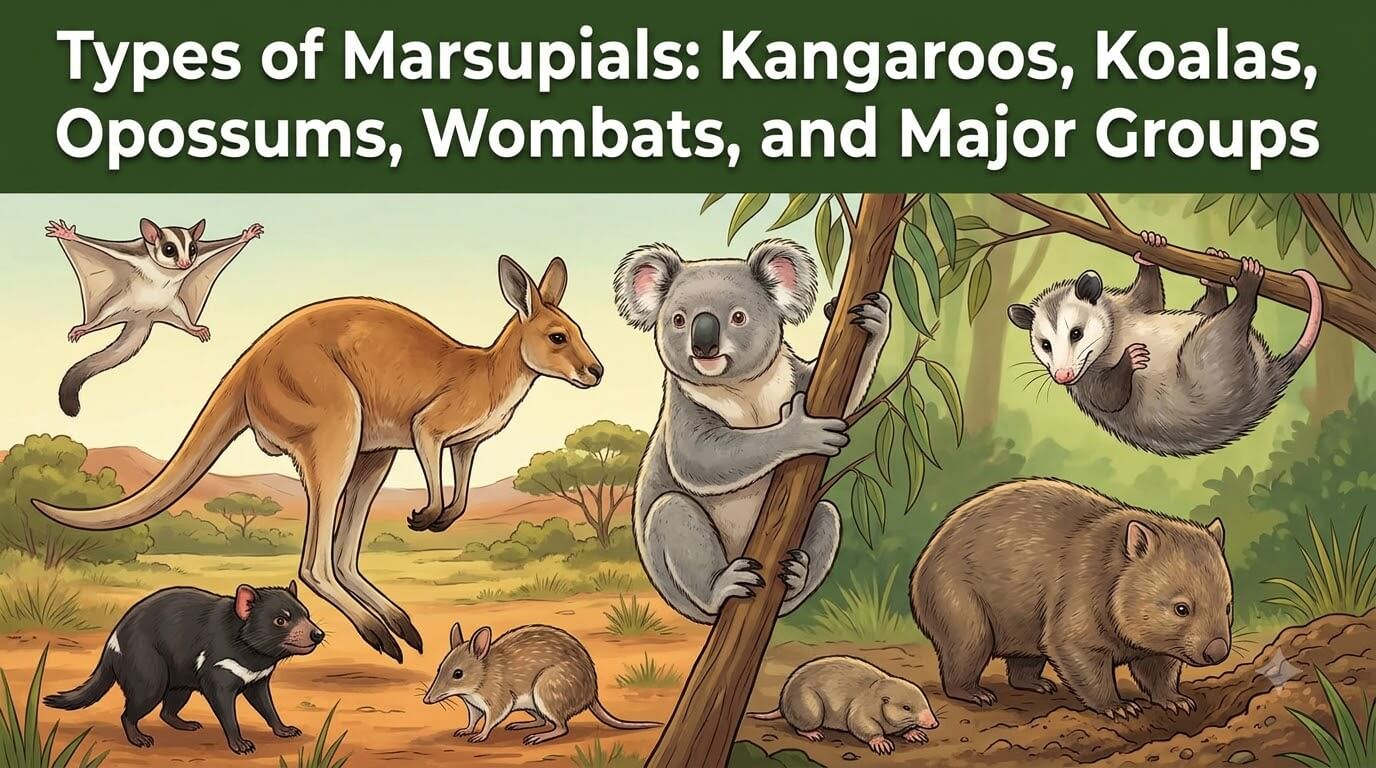
There are far more types of marsupials than kangaroos, koalas, and wombats. Living Marsupialia includes American opossums, shrew opossums, the South American monito del monte, Tasmanian devils and quolls, bandicoots and bilbies, marsupial moles, possums, gliders, kangaroos, wallabies, koalas, wombats, and other relatives. These animals differ enormously in body shape, diet, habitat, and movement, yet they belong to one living mammalian lineage.
The clearest way to understand marsupial diversity is through taxonomy rather than a simple list of famous animals. In the current Mammal Diversity Database framework, living marsupials are organized into seven orders. Each order represents a major branch of the marsupial family tree, and each contains its own combinations of geography, anatomy, feeding strategies, and ecological roles.
Quick Answer
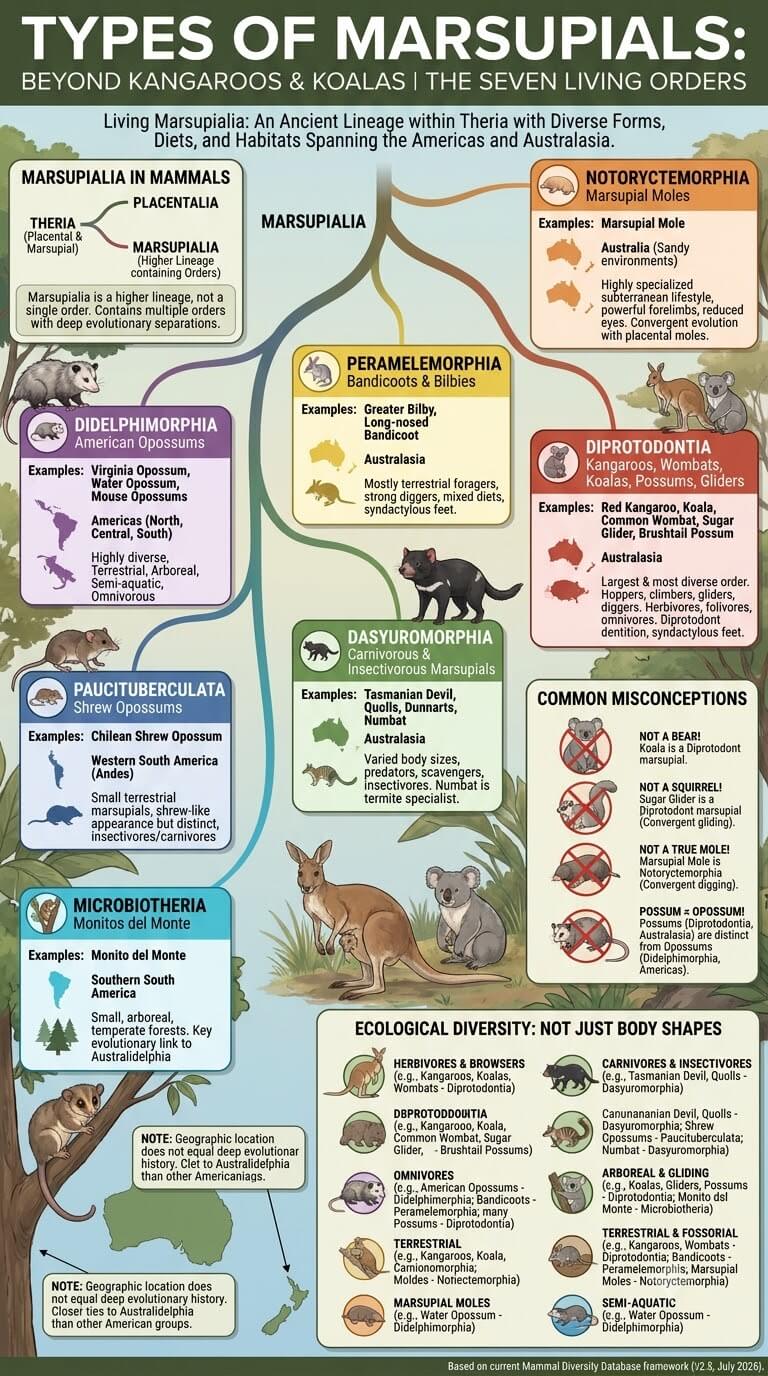
The seven major living marsupial orders recognized in the current Mammal Diversity Database framework are Didelphimorphia, Paucituberculata, Microbiotheria, Dasyuromorphia, Peramelemorphia, Notoryctemorphia, and Diprotodontia. The American Society of Mammalogists maintains the Mammal Diversity Database, whose current version is v2.5, released in July 2026.
These seven orders are not simply seven body types. Some contain many familiar animals, while others have only a small number of living representatives. Some are concentrated in the Americas, others in Australasia, and one especially important South American lineage helps show why present-day geography does not neatly match the evolutionary tree.
How Scientists Organize Living Marsupials
Marsupialia as a higher lineage within Theria
Marsupials are mammals within Theria, the branch that also contains placental mammals. Marsupialia is not itself one order. Instead, it is a higher-level lineage containing multiple orders. The current MDD taxonomy table places all seven marsupial orders within Marsupialia under Theria.
This distinction matters because readers often encounter phrases such as “the marsupial order” or see kangaroos treated as if they represent the whole lineage. A kangaroo and an opossum are both marsupials, but they belong to different orders that separated deep in marsupial evolutionary history.
Why common names are not the same as formal taxonomy
Common names are useful, but they can hide relationships. “Possum” refers to several Australasian marsupials, while “opossum” usually refers to American marsupials in Didelphimorphia. “Marsupial mole” sounds like a placental mole, but it belongs to a completely separate marsupial order. “Sugar glider” sounds similar to flying squirrel, yet sugar gliders are marsupials and flying squirrels are rodents.
Formal taxonomy helps prevent those mix-ups because it groups animals by evolutionary relationships rather than resemblance or everyday naming. Scientific order names can seem difficult at first, but pairing each with familiar animals makes them much easier to remember.
Why taxonomy versions and species counts can change
Mammal taxonomy is updated as researchers describe new species, combine or split previously recognized species, and revise relationships using genetics, anatomy, fossils, and other evidence. For that reason, an exact number of marsupial species or families can become outdated even when the broad seven-order framework remains stable.
This article therefore focuses on the current order-level structure and recognizable examples rather than presenting a supposedly permanent global species total. When precise counts matter, the database version and date should be checked.
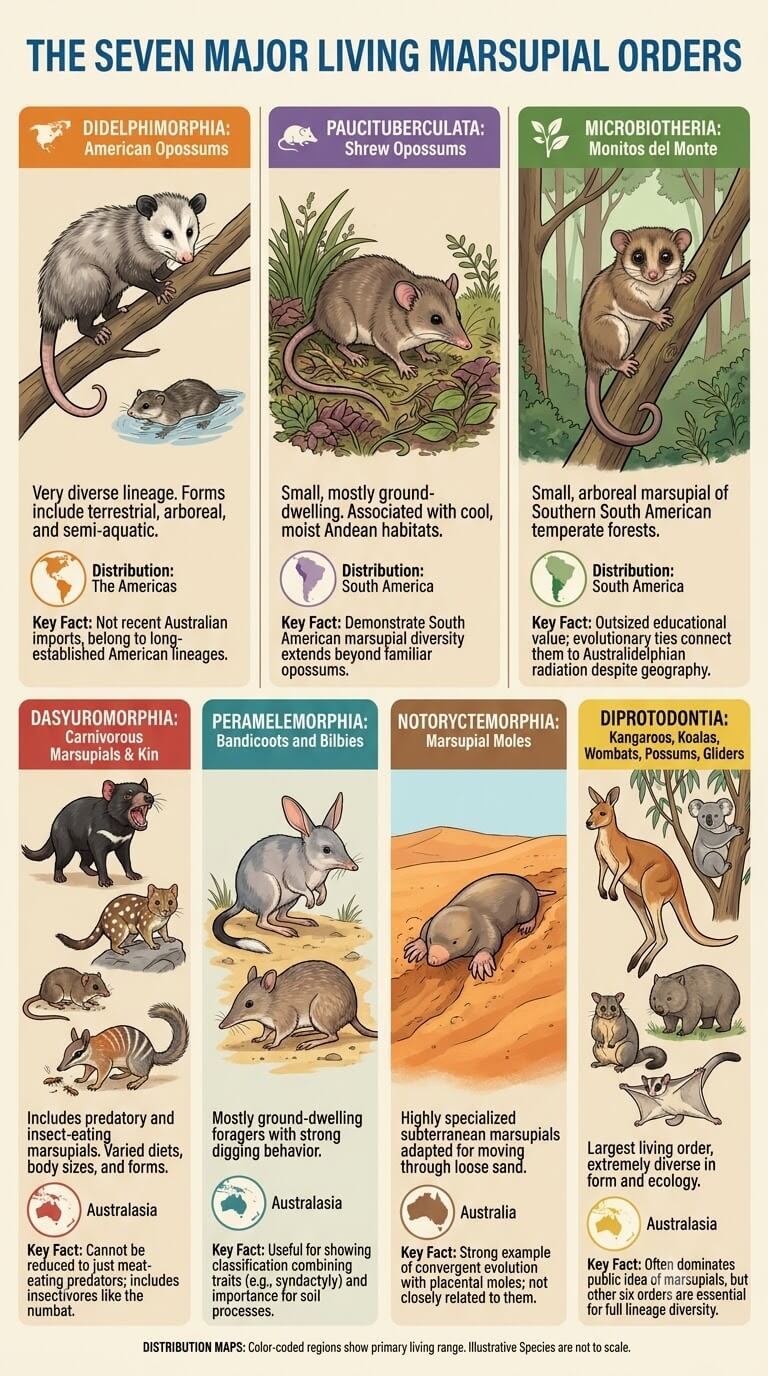
The Seven Major Living Marsupial Orders
| Order | Familiar members | Broad living distribution | Useful identifying context |
|---|---|---|---|
| Didelphimorphia | American opossums | The Americas | Very diverse opossum lineage with terrestrial, arboreal, and semi-aquatic forms |
| Paucituberculata | Shrew opossums | Western South America | Small terrestrial marsupials associated especially with cool, moist Andean habitats |
| Microbiotheria | Monitos del monte | Southern South America | South American living lineage with close evolutionary ties to the broader australidelphian radiation |
| Dasyuromorphia | Tasmanian devil, quolls, dunnarts, antechinus, numbat lineage | Australasia | Contains many predatory and insect-eating marsupials with varied body sizes and diets |
| Peramelemorphia | Bandicoots and bilbies | Australasia | Mostly ground-dwelling foragers, many with strong digging behavior |
| Notoryctemorphia | Marsupial moles | Australia | Highly specialized subterranean marsupials adapted for moving through loose sand |
| Diprotodontia | Kangaroos, wallabies, koalas, wombats, possums, gliders | Australasia | The largest living marsupial order in the current framework and extremely diverse in form and ecology |
Didelphimorphia: American opossums and relatives
Didelphimorphia contains the American opossums. For readers in the United States, the Virginia opossum is the most familiar member, but the order includes much more diversity farther south. Opossums occur across a broad sweep of the Americas, especially in tropical and subtropical regions of Central and South America.
Members of Didelphimorphia vary in size, habitat use, climbing ability, diet, and tail function. Some are mainly terrestrial, many climb well, and the water opossum is adapted to a semi-aquatic lifestyle. Omnivory is common, but individual species differ in how much they rely on insects, fruit, small vertebrates, carrion, and other foods.
The order is a useful corrective to the assumption that marsupials are fundamentally Australian. Opossums are not recent Australian imports. They belong to long-established American marsupial lineages with their own evolutionary history.
Paucituberculata: shrew opossums or caenolestids
Paucituberculata contains the shrew opossums, also called caenolestids. Despite the word “shrew” in their common name, they are not true shrews. True shrews are placental mammals. Caenolestids are marsupials and represent a distinct South American order.
Living shrew opossums are associated mainly with western South America, including Andean regions. Species such as the Chilean shrew opossum inhabit cool, wet forest environments with dense ground cover and woody debris. The Animal Diversity Web profile of the Chilean shrew opossum describes its occurrence in temperate forest in southern Chile and nearby Argentina.
These animals are small and mostly ground-oriented, with pointed snouts that help give them a superficially shrew-like appearance. Their existence matters because they demonstrate that South American marsupial diversity extends beyond the familiar opossums of Didelphimorphia.
Microbiotheria: monitos del monte
Microbiotheria is one of the most fascinating marsupial orders because its living members occur in South America while their evolutionary relationships connect them with the broader australidelphian radiation. Monitos del monte are small, arboreal marsupials of southern South American temperate forests.
This is exactly the kind of case that makes geography-based classification unreliable. A simple “American marsupials versus Australian marsupials” scheme would put Microbiotheria on the American side and assume that meant close relationship to American opossums. Modern phylogenetic research has instead repeatedly associated Microbiotheria with Australidelphia. Research on marsupial phylogenetic relationships also highlights why the old Ameridelphia grouping does not provide a simple natural clade for all American marsupials.
Monitos del monte therefore have outsized educational value. They show that where an animal lives today is not necessarily a map of its deepest evolutionary relationships.
Dasyuromorphia: devils, quolls, dunnarts, antechinus, and the numbat lineage
Dasyuromorphia includes many of the predatory and insect-eating marsupials of Australia and nearby regions. Familiar living examples include the Tasmanian devil and quolls. Smaller members include dunnarts and antechinus. The numbat belongs to its own living family within this order and is highly specialized for feeding on termites.
It is tempting to call Dasyuromorphia “the carnivorous marsupials,” but that label needs context. Many dasyuromorphs eat substantial animal prey, yet diets range from insects and other invertebrates to vertebrate prey and scavenged food. The numbat is an especially clear reminder that the order cannot be reduced to meat-eating predators.
Body form also varies considerably. Quolls are agile terrestrial and climbing predators, Tasmanian devils are stocky and powerful, and tiny dasyurids can occupy insectivore-like roles. The extinct thylacine also belonged within Dasyuromorphia, but living members should remain the focus when describing the order today.
Peramelemorphia: bandicoots and bilbies
Peramelemorphia contains bandicoots and bilbies. These marsupials are largely terrestrial and many are strong diggers that search through soil and litter for insects, other invertebrates, fungi, seeds, roots, and other foods. Their diets are often mixed rather than fitting neatly into a single herbivore or carnivore category.
The Animal Diversity Web overview of Peramelemorphia describes bandicoots and bilbies as an order with distinctive combinations of dental and foot traits, including syndactyly, in which two toes are joined by skin while retaining separate claws.
Peramelemorphs are particularly useful for showing how classification can combine traits that might otherwise seem contradictory. They share some features with groups once separated under older classification schemes, but current taxonomy recognizes them as their own order. Their digging behavior also gives many species important relationships with soil processes and ground-level food resources.
Notoryctemorphia: marsupial moles
Notoryctemorphia contains marsupial moles, highly specialized Australian mammals adapted for a mostly subterranean life in sandy environments. Their compact bodies, powerful forelimbs, reduced eyes, and streamlined shape help them move through loose substrate.
The name “marsupial mole” describes resemblance and lifestyle, not close kinship with true moles. True moles belong to Talpidae among placental mammals, while marsupial moles evolved a similar digging solution independently. This is a strong example of convergent evolution, where unrelated lineages develop similar features because they face similar functional challenges.
Marsupial moles are also a reminder that not every major marsupial lineage contains familiar zoo or backyard animals. Some branches are highly specialized and difficult to observe, yet they are essential for understanding the full range of marsupial body plans.
Diprotodontia: kangaroos, wallabies, koalas, wombats, possums, gliders, and relatives
Diprotodontia is the largest living marsupial order in the current taxonomy framework and contains many of the animals most strongly associated with Australia. Kangaroos and wallabies belong here, as do koalas, wombats, many possums, gliders, potoroos, bettongs, and other relatives.
The order’s name refers to a dental pattern in which a prominent pair of lower incisors plays an important role, but teeth alone do not capture the group’s diversity. The Animal Diversity Web overview of Diprotodontia describes the combination of diprotodont dentition and syndactylous hind feet as characteristic features of the order.
Ecologically, Diprotodontia is remarkably varied. Kangaroos and many wallabies are terrestrial hoppers. Koalas are specialized tree-dwelling folivores. Wombats are powerful diggers and grazers. Possums include arboreal species with varied diets, while several gliding lineages use a patagium, a membrane between the limbs, to travel through the canopy. Bettongs and potoroos can be important ground foragers and fungal consumers.
Because so many famous marsupials belong to Diprotodontia, it can accidentally dominate public ideas about Marsupialia. The other six orders are essential for seeing how much broader the lineage really is.
How the Orders Differ in Broad Ecological Terms
Herbivorous and browsing lineages
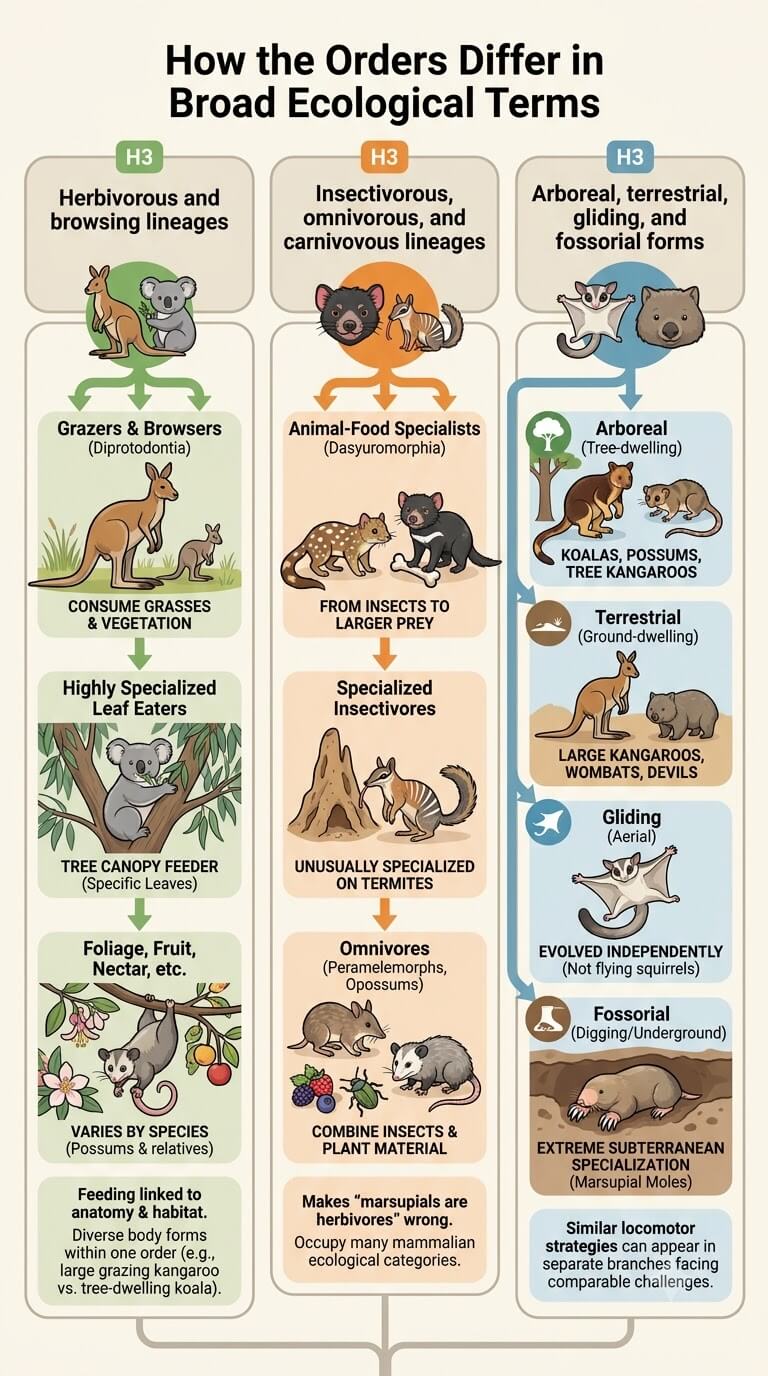
Plant eating is especially prominent in parts of Diprotodontia. Kangaroos and wallabies include grazers and browsers, wombats consume grasses and other vegetation, and koalas are highly specialized leaf eaters. Possums and related animals can include foliage, fruit, flowers, nectar, and other plant material in different proportions depending on species.
These feeding differences are linked to anatomy and habitat. A large grazing kangaroo needs a very different locomotor and digestive strategy from a koala feeding in a tree canopy. Even within one order, ecology can produce dramatically different body forms.
Insectivorous, omnivorous, and carnivorous lineages
Dasyuromorphia includes many animal-food specialists, from small insect-eating forms to quolls and Tasmanian devils. The numbat is unusually specialized on termites. Peramelemorphs often combine insects and other animal foods with plant material. Many American opossums are omnivores, although diets vary among species and habitats.
This range makes broad statements such as “marsupials are herbivores” clearly wrong. Marsupial feeding strategies occupy many of the same ecological categories seen across mammals more generally.
Arboreal, terrestrial, gliding, and fossorial forms
Marsupial orders also differ in how their members use space. Arboreal forms include koalas, many possums, gliders, tree kangaroos, monitos del monte, and some opossums. Terrestrial forms include large kangaroos, wombats, devils, many bandicoots, and numerous opossums. Fossorial species spend substantial time digging or underground, with marsupial moles representing an extreme subterranean specialization.
Gliding has evolved in more than one marsupial lineage. Sugar gliders are not simply smaller versions of greater gliders, and neither should be confused with flying squirrels. Similar locomotor strategies can appear in separate branches when animals face comparable challenges moving between trees.
Geography Does Not Equal Taxonomy
American marsupials are not one simple natural group
It is convenient to talk about American and Australasian marsupials geographically, but those labels are not formal orders. Didelphimorphia and Paucituberculata are American lineages, and Microbiotheria is also South American today. Yet modern phylogenetic interpretations do not support treating every American marsupial as one simple natural branch opposed to all Australasian marsupials.
The older term Ameridelphia has been used for Didelphimorphia and Paucituberculata, but modern work has challenged the idea that this grouping represents a straightforward monophyletic clade. For a general reader, the safest approach is to use the seven formal orders and describe geography separately.
Why the South American monito del monte matters for phylogeny
The monito del monte lives in South America, but Microbiotheria is closely tied to the australidelphian side of marsupial evolutionary history. A 2026 study of the species describes the monito del monte as the living representative of Microbiotheria and emphasizes its close evolutionary connection with Australasian marsupials.
This does not make the animal “Australian.” It makes it evidence that evolutionary history cannot be reconstructed by modern geography alone. Continents moved, climates changed, lineages dispersed and went extinct, and today’s distribution preserves only part of that history.
Why Australia versus America is not an order-level classification
No formal order called “Australian marsupials” contains all marsupials from Australia, and no formal order called “American marsupials” contains all marsupials from the Americas. Australia contains representatives of several orders. South America also contains representatives of several distinct orders.
Geographic labels remain useful when discussing habitats, conservation, or biogeography. They become misleading only when they replace the actual taxonomic structure.
Familiar Marsupials and Where They Fit
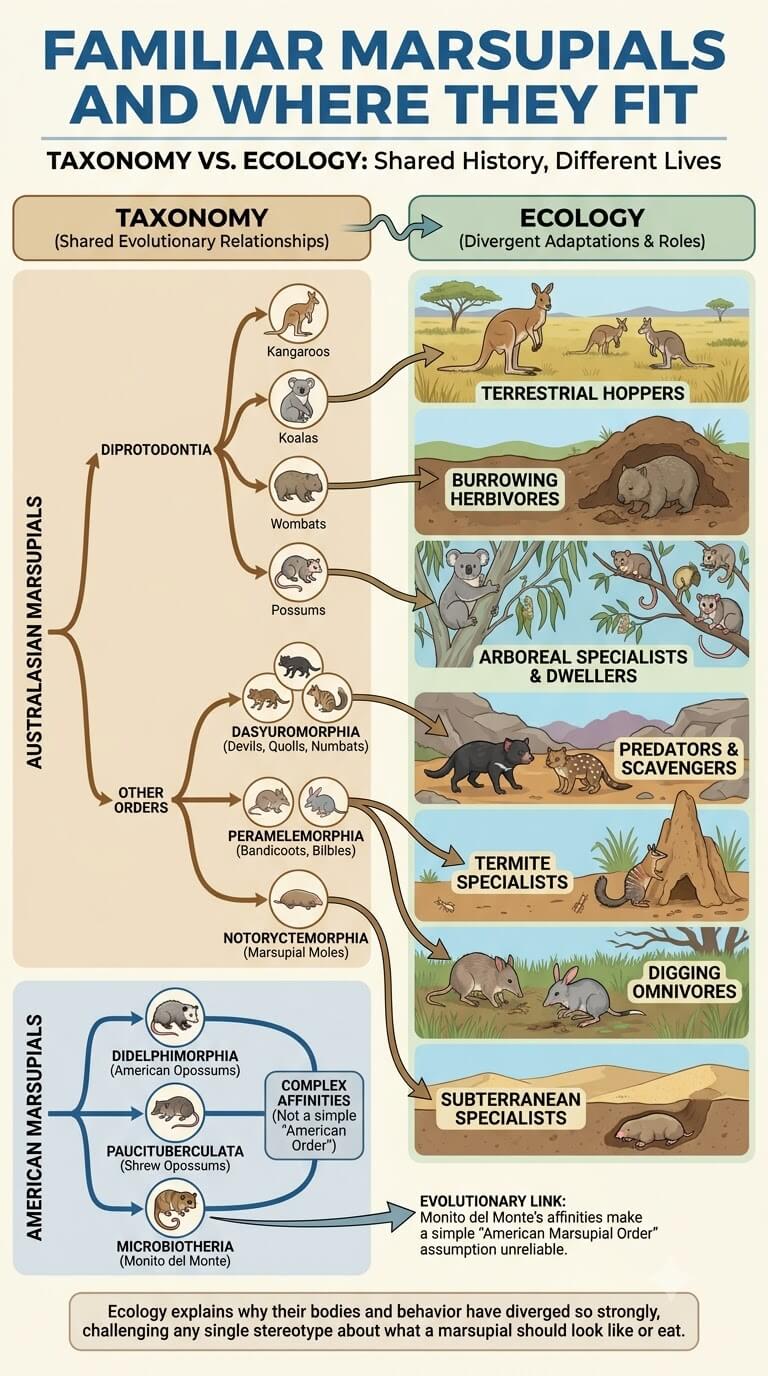
Kangaroos, koalas, wombats, and possums
Kangaroos, wallabies, koalas, wombats, and many animals commonly called possums all belong to Diprotodontia. Their shared order does not mean they live the same way. Kangaroos and wallabies are famous for hopping, wombats are burrowing terrestrial herbivores, koalas are arboreal leaf specialists, and possums include multiple tree-dwelling forms with different diets and lifestyles.
This is a good example of how formal taxonomy and ecology answer different questions. Taxonomy tells us these animals share a relatively close evolutionary relationship within Marsupialia. Ecology explains why their bodies and behavior have diverged so strongly.
Opossums, shrew opossums, and monito del monte
American marsupials are more diverse than the single Virginia opossum familiar to many US readers. Didelphimorphia contains American opossums. Paucituberculata contains shrew opossums. Microbiotheria contains monitos del monte.
Those three names can look like a neat geographic trio, but they do not form a simple formal “American marsupial order.” The monito del monte is particularly important because its evolutionary affinities make that assumption unreliable.
Devils, quolls, bandicoots, bilbies, numbats, and marsupial moles
Tasmanian devils and quolls belong to Dasyuromorphia, as does the numbat lineage. Bandicoots and bilbies belong to Peramelemorphia. Marsupial moles stand apart in Notoryctemorphia.
These animals occupy very different ecological roles. Devils and quolls are predators and scavengers to varying degrees. Numbats specialize heavily on termites. Bandicoots and bilbies are often digging omnivores. Marsupial moles are subterranean specialists. Together they make it difficult to sustain any single stereotype about what a marsupial should look like or eat.
Common Classification Mistakes
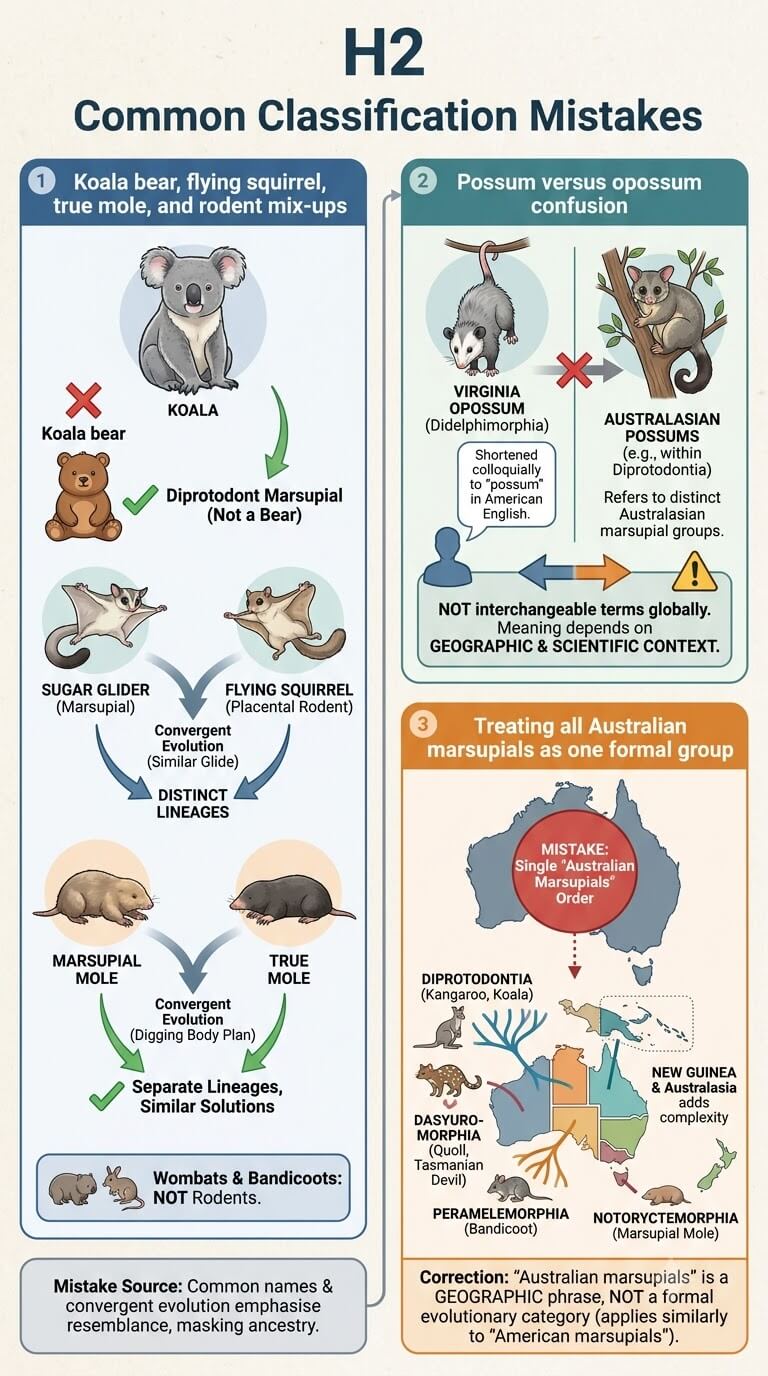
Koala bear, flying squirrel, true mole, and rodent mix-ups
A koala is not a bear. It is a diprotodont marsupial. A sugar glider is not a flying squirrel. Both glide using skin membranes, but flying squirrels are placental rodents. A marsupial mole is not a true mole, despite its similar digging body plan. Wombats and bandicoots are also not rodents.
These mistakes happen because common names and convergent evolution emphasize resemblance. Taxonomy reveals whether that resemblance comes from recent shared ancestry or from separate lineages solving similar problems in similar ways.
Possum versus opossum confusion
In everyday American English, people often shorten “opossum” to “possum” when talking about the Virginia opossum. That colloquial usage is common, but it should not erase the zoological distinction. Opossums usually refers to American marsupials in Didelphimorphia, while possums commonly refers to several Australasian marsupials within Diprotodontia.
The two words are therefore not simply interchangeable taxonomic names worldwide. Geographic and scientific context determine what each term means.
Treating all Australian marsupials as one formal group
Australia’s marsupials do not belong to a single order. The continent includes diprotodonts, dasyuromorphs, peramelemorphs, and notoryctemorphs. Nearby New Guinea and other parts of Australasia add further geographic complexity.
Using “Australian marsupials” as a convenient geographic phrase is fine. Treating it as a formal evolutionary category is not. The same caution applies to broad phrases such as “American marsupials.”
Why Marsupial Diversity Looks So Different Across Regions
Why so many familiar marsupials are Australasian
Australia and nearby regions contain spectacular marsupial diversity because of a long history involving continental movement, dispersal, isolation, extinction, climate change, and ecological diversification. That history cannot be reduced to the old story that marsupials survived in Australia only because placental mammals were absent or because they were sheltered from supposedly superior competitors.
Modern Australia also has native placental mammals, including bats and rodents that arrived without European introduction. Marsupial success in Australasia reflects a complex evolutionary history rather than a simple competition experiment.
How different groups eat, move, and use habitats
The seven-order framework becomes even more useful when combined with ecology. Diprotodontia includes hoppers, climbers, gliders, and burrowers. Dasyuromorphia includes predators and insect specialists. Peramelemorphia includes many digging ground foragers. Didelphimorphia includes terrestrial, arboreal, and even semi-aquatic lifestyles. Microbiotheria includes small arboreal forest animals, while Notoryctemorphia represents extreme subterranean adaptation.
That diversity is why a good understanding of types of marsupials should begin with relationships but not end there. Classification provides the branches. Diet, movement, habitat, and behavior show how differently those branches have evolved.
FAQ
What is the largest major living marsupial order under the current framework?
Diprotodontia is the largest living marsupial order in the current Mammal Diversity Database framework. It contains many familiar groups, including kangaroos and wallabies, koalas, wombats, possums, gliders, potoroos, and bettongs. Exact species totals can change as taxonomy is revised, so the order-level relationship is more stable than a fixed count copied from an older source.
Are opossums and possums in the same order?
No. American opossums belong to Didelphimorphia. Many Australasian animals called possums belong to Diprotodontia. In informal North American speech, people often call the Virginia opossum a “possum,” but that everyday usage should not be confused with the formal taxonomic difference between American opossums and Australasian possums.
Are marsupial moles related to placental moles?
Not closely. Marsupial moles belong to Notoryctemorphia within Marsupialia, while true moles belong to the placental mammal family Talpidae. Their similar digging shapes are an example of convergent evolution: unrelated mammals evolved comparable features because both faced the mechanical challenges of moving through soil.
Why is monito del monte important in marsupial classification?
The monito del monte is important because it lives in South America but belongs to Microbiotheria, a lineage closely tied to the broader australidelphian radiation. It demonstrates why scientists cannot divide marsupials into simple “American” and “Australian” evolutionary groups based only on where living species occur today.
Final Thoughts
The main types of marsupials are best understood through seven living orders rather than a list of famous animals. Didelphimorphia contains American opossums; Paucituberculata contains shrew opossums; Microbiotheria contains monitos del monte; Dasyuromorphia includes devils, quolls, dunnarts, antechinus, and the numbat lineage; Peramelemorphia includes bandicoots and bilbies; Notoryctemorphia contains marsupial moles; and Diprotodontia includes kangaroos, wallabies, koalas, wombats, possums, gliders, and many relatives. This framework reveals a lineage that spans the Americas and Australasia and includes grazers, browsers, insect specialists, omnivores, predators, climbers, gliders, hoppers, diggers, and subterranean specialists. Kangaroos and koalas may be the most recognizable examples, but they represent only part of what living Marsupialia has become.

Ethan Walker is the founder and research editor of Animal Fact Central. He creates and reviews educational animal facts content using trusted wildlife, pet care, and science-based sources. His work focuses on making animal behavior, adaptations, habitats, and species facts clear, accurate, and engaging for everyday readers.
Read More Details About Ethan Walker: https://animalfactcentral.com/ethan-walker/