
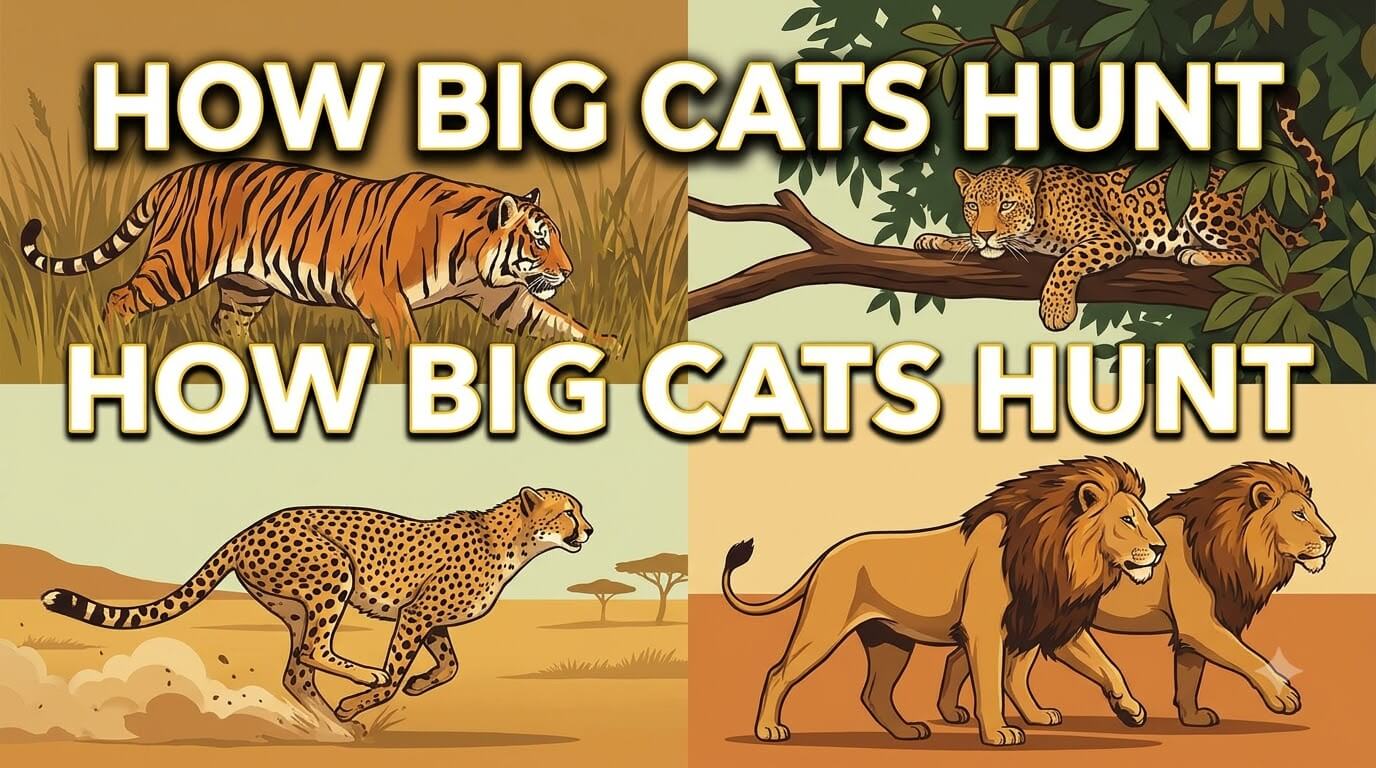
Big cats do not all hunt the same way. A tiger moving through tall grass, a leopard working the edge of dense cover, a lion hunting with pride-mates, a snow leopard using steep rock, and a cheetah accelerating across open ground are solving different versions of the same problem: get close enough to prey, control the final approach, and make a capture without spending more energy or taking more risk than the meal is worth.
Most large wild cats depend heavily on stealth and short bursts of intense effort, but that broad pattern contains major differences. Some wait at likely travel routes. Some stalk until only a short gap remains. Some chase fast-moving prey. Lions may coordinate with other lions, yet they also hunt alone. Jaguars can use riverbanks and wetlands as hunting terrain. Snow leopards use cliffs, ridges, and broken slopes. Clouded leopards add an arboreal dimension, although field evidence shows that they also spend time and hunt on the ground.
Quick Answer: Big Cats Use More Than One Hunting Strategy
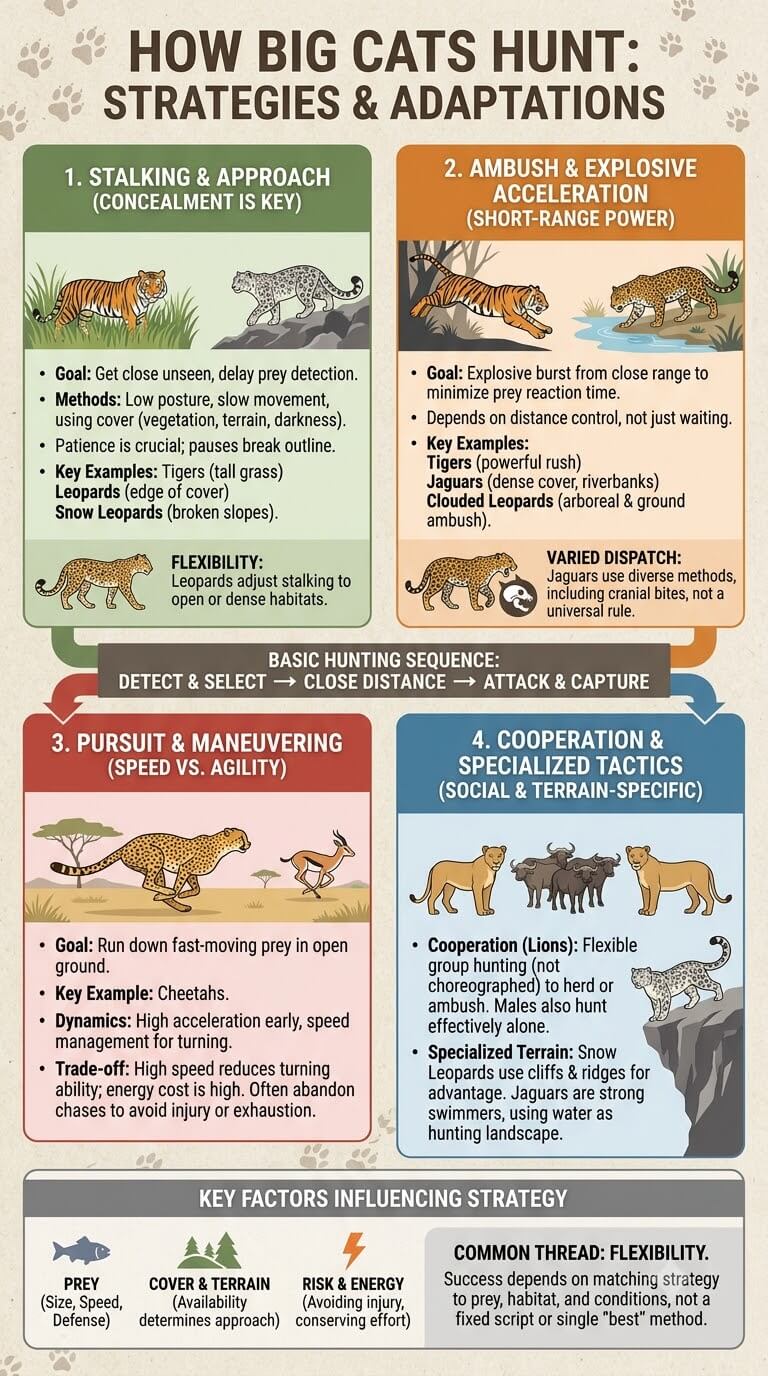
Stalking and ambush are common among large felids because getting close before the final attack reduces the distance prey has to detect and escape from the predator. That does not mean every big cat is an ambush hunter in exactly the same way. Leopards can shift between stalking and waiting in cover. Tigers both search for prey and ambush it. Lions may use group coordination or individual stalking. Cheetahs combine stalking with rapid acceleration and a short pursuit. Jaguars and snow leopards use terrain in ways that differ sharply from open-country cats.
Why Hunting Strategy Varies
Prey Size and Escape Behavior Change the Problem
A predator does not hunt a gazelle, wild pig, deer, monkey, or porcupine in exactly the same way. Prey differs in speed, group vigilance, weapons, body mass, preferred escape route, and willingness to stand its ground. Large prey may offer a bigger energetic return, but it can also injure a cat. Small prey may be safer but less rewarding. Selecting prey is therefore part of hunting, not a separate step that happens before the “real” action.
Cover Determines How Close a Cat Can Get
Vegetation, rock, shadows, gullies, dunes, stream banks, and even small changes in ground level can hide a cat’s approach. In dense habitat, prey may have little warning before a short attack. In open habitat, the cat may need to crawl slowly, use darkness, choose a distracted target, or accept a longer final chase.
Leopards show this flexibility clearly. The IUCN Cat Specialist Group’s leopard account describes stalking in open habitat and more ambush-oriented hunting in dense tropical forest, including use of game trails and places that attract prey. This is a useful reminder that “leopard hunting style” changes with the setting rather than following one fixed script.
Energy and Injury Risk Set Limits
Explosive acceleration, wrestling with prey, and repeated failed chases are expensive. A cat must also protect its own body. An injured wild predator may lose future hunting opportunities even if it survives the immediate encounter. This favors tactics that shorten the dangerous part of a hunt: approach unseen, attack from a favorable angle, use cover, and abandon attempts that become too costly.
The Basic Hunting Sequence
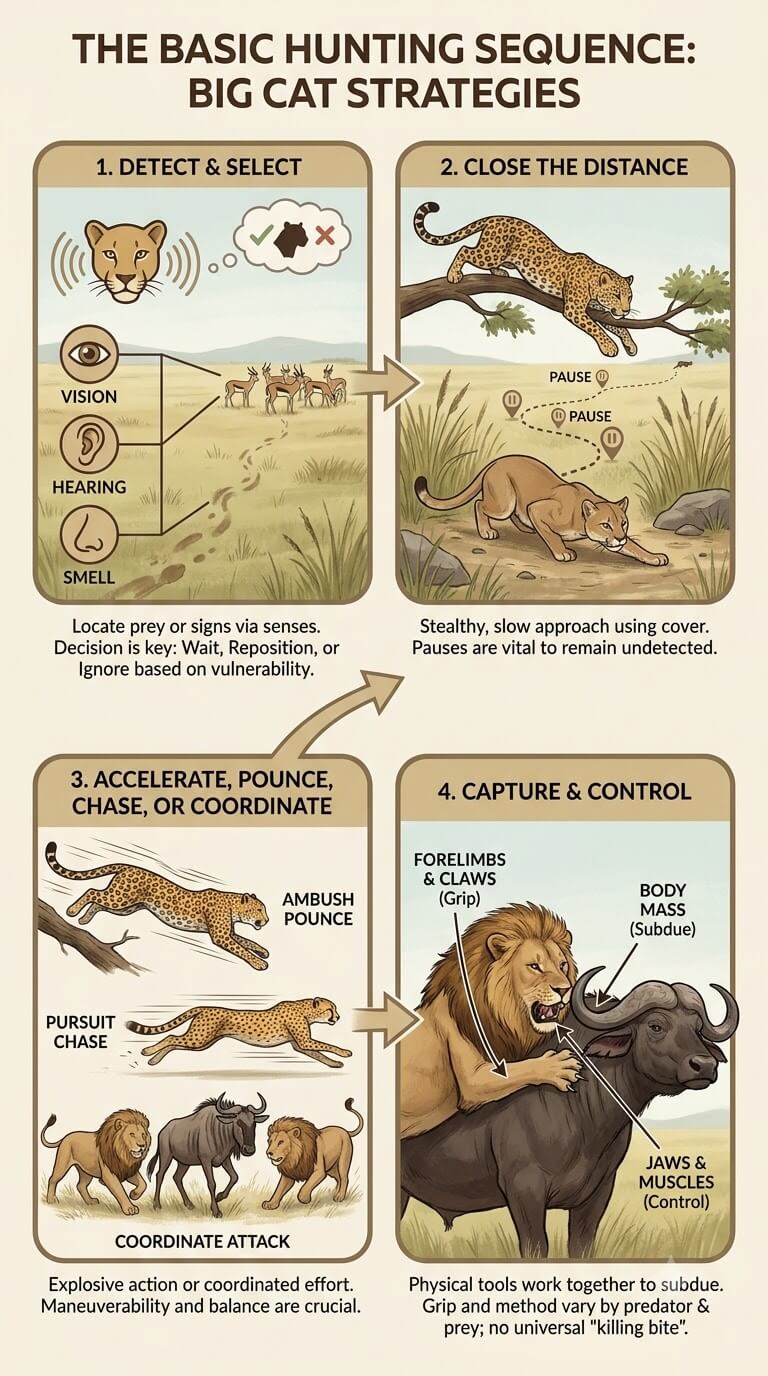
1. Detect and Select Potential Prey
Vision, hearing, and smell all contribute to locating prey or signs that prey is nearby. A cat may hear movement in vegetation, watch a herd from cover, follow a frequently used trail, or investigate scent. Detection alone does not automatically trigger attack. The predator may wait, reposition, or ignore a target that is too alert or poorly placed.
2. Close the Distance
For many big cats, the approach is the longest and quietest part of the hunt. The body lowers, movement slows, and the cat uses objects or vegetation to break its outline. Pauses are valuable because moving predators are easier to detect. A stalk may include repeated cycles of advancing, freezing, and changing direction.
3. Accelerate, Pounce, Chase, or Coordinate
The final attack compresses a great deal of work into seconds. An ambush cat may explode from cover. A cheetah may accelerate into a pursuit. A lioness may adjust to the movement of other lions and the herd. A mountain cat may use a slope or ridge to shorten distance. At this stage, balance and maneuvering can matter as much as straight-line speed.
4. Capture and Control
Forelimbs, claws, body mass, jaws, and neck muscles work together once contact is made. The exact grip and method of subduing prey varies with predator and prey. It is misleading to reduce this stage to one universal “killing bite.” Large cats deal with very different body shapes and defensive abilities, and real encounters are less standardized than diagrams suggest.
Stalking and Concealment
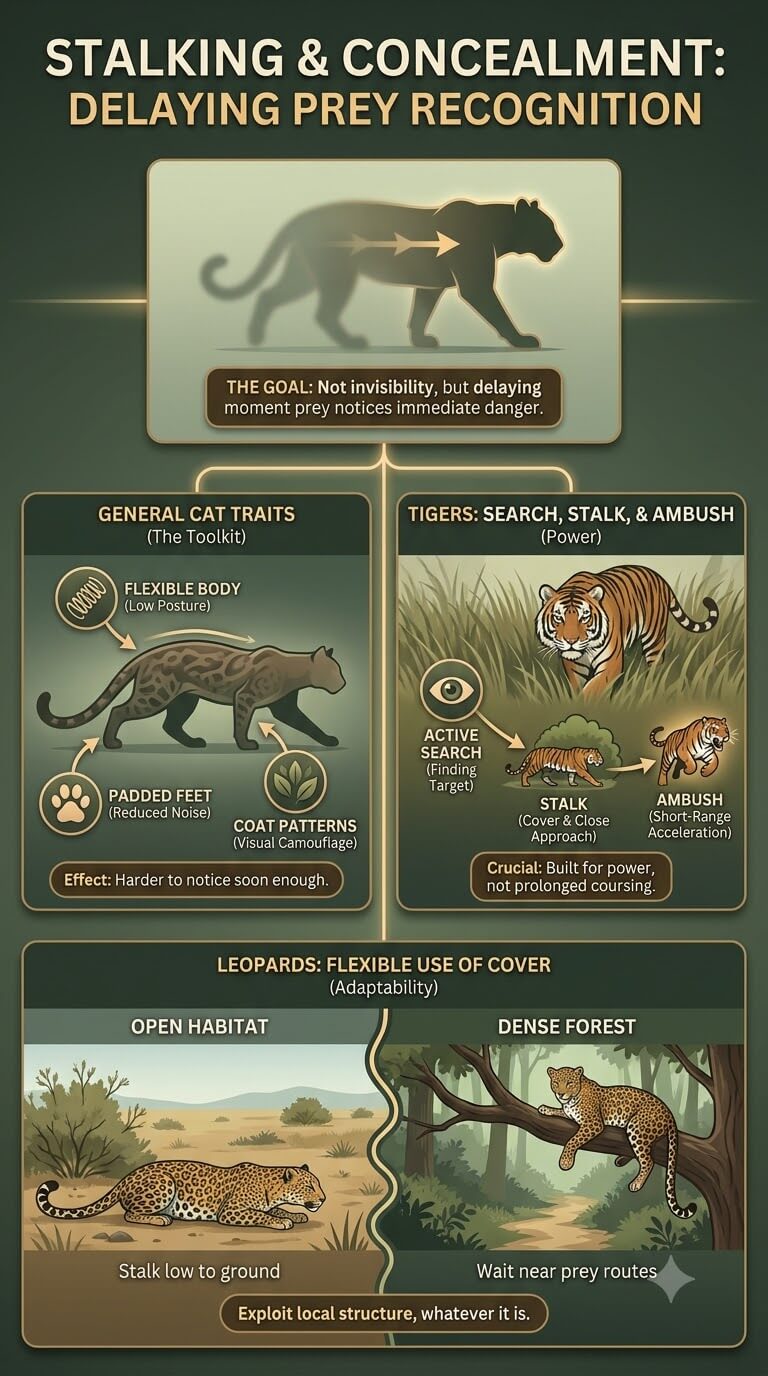
Stalking works by delaying the moment when prey recognizes immediate danger. Cats are well suited to this. Their flexible bodies allow a low posture, padded feet reduce obvious footfall noise, and coat patterns can reduce visual detection in the right background. The cat does not become invisible. It simply becomes harder to notice soon enough.
Tigers: Search, Stalk, and Ambush
Tigers are often described as ambush predators, which is broadly accurate but incomplete. The current IUCN Cat Specialist Group species account notes that tigers primarily ambush prey but also actively search for it. Once a potential target is found, cover and a close approach become important because the tiger is built for powerful short-range acceleration rather than prolonged coursing.
Leopards: A Flexible Use of Cover
Leopards are especially adaptable because they occupy environments ranging from forests to dry and open landscapes. In open habitat they may stalk low to the ground, while in dense forest they can wait near routes or feeding sites used by prey. This flexibility lets a leopard exploit local structure instead of depending on one ideal type of cover.
Ambush and Explosive Acceleration
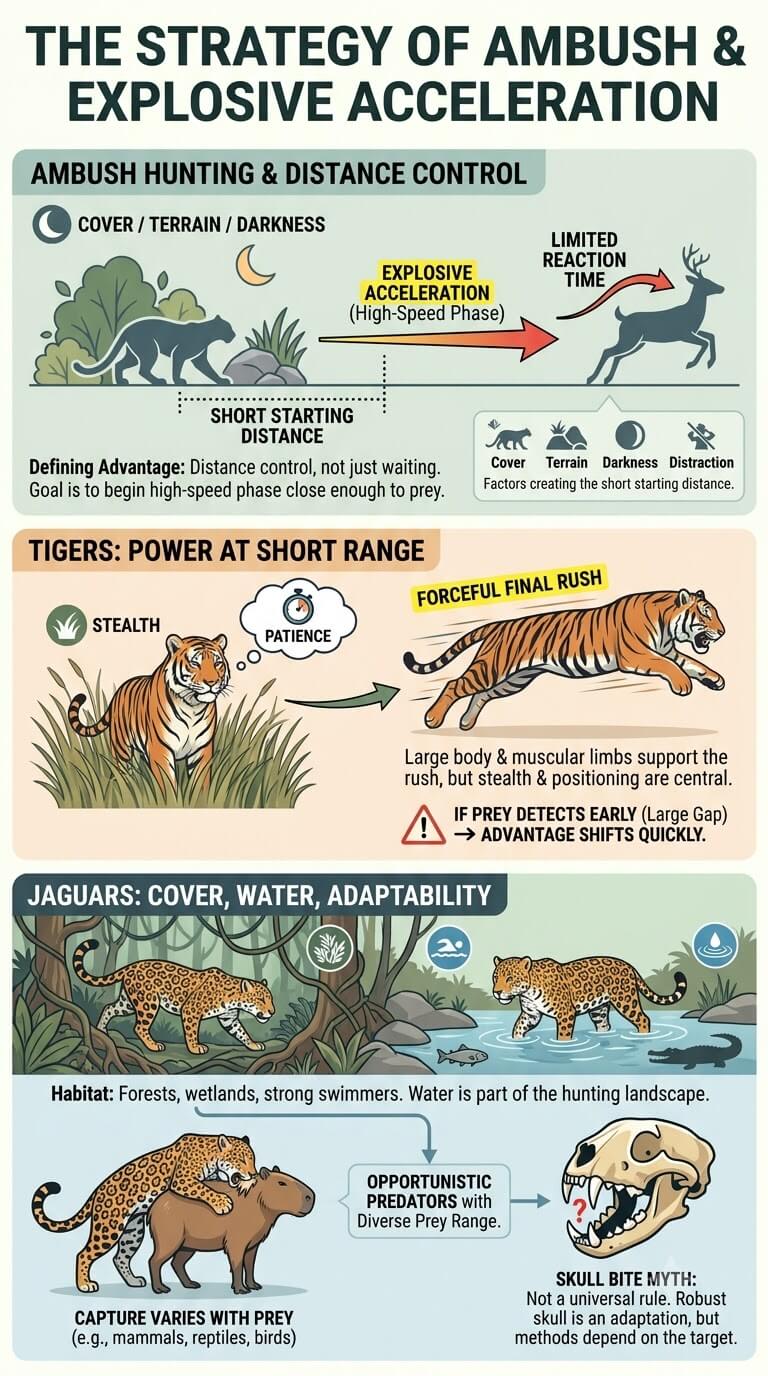
Ambush hunting is often described as waiting, but its defining advantage is really distance control. The predator tries to begin the high-speed phase close enough that prey has little time to accelerate or change course. Cover, terrain, darkness, and prey distraction can all help create that short starting distance.
Tigers Use Power at Short Range
A tiger’s large body and muscular limbs support a forceful final rush, but the hunt still depends on getting close first. If prey detects the tiger while the gap is large, the advantage can shift quickly. This is why stealth and positioning are just as central to tiger predation as strength.
Jaguars Use Dense Cover, Water, and Close-Range Control
Jaguars occupy forests, wetlands, savannas, and other habitats across the Americas and are strongly associated with water in many regions. The IUCN Cat Specialist Group jaguar profile describes them as opportunistic predators that can take mammals, reptiles, birds, and aquatic or semi-aquatic prey. They are also strong swimmers, so water is part of their hunting landscape rather than a barrier that must always be avoided.
Jaguars are sometimes reduced to the claim that they “always bite through the skull.” They do use unusual cranial or head-directed bites in some prey contexts, and their robust skull and canines are important adaptations, but one dramatic method should not be turned into a universal rule. Prey ranges from relatively small animals to large mammals and reptiles, so capture and dispatch vary with the target.
Pursuit Hunting: The Cheetah Is More Than Top Speed
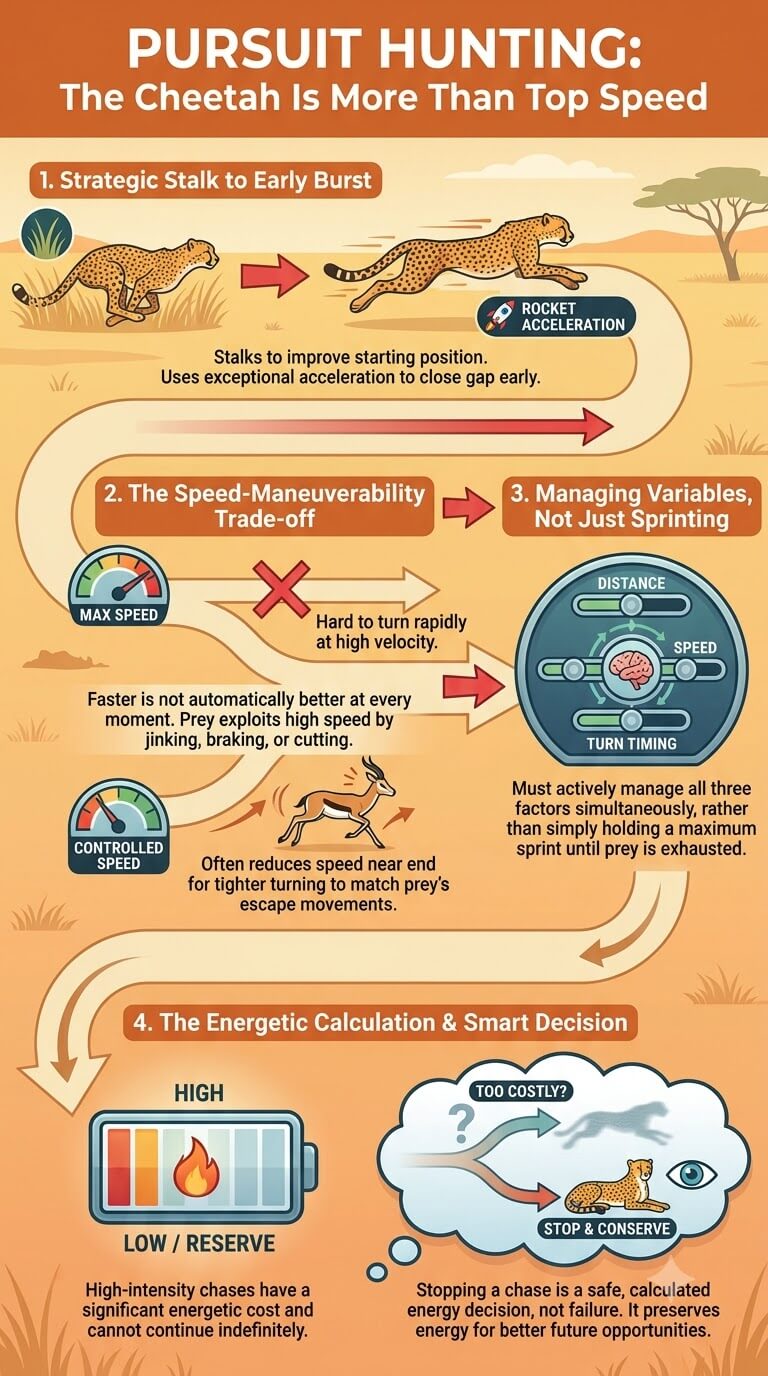
Cheetahs are often included in broad public discussions of big cats even though they belong to Felinae rather than Pantherinae. They provide the clearest contrast with the classic short ambush model. A cheetah still stalks to improve its starting position, but after the chase begins it can use exceptional acceleration and speed to close on running prey.
Acceleration Comes Before Maneuvering
Instrumented studies of free-ranging cheetahs show why maximum-speed stories are incomplete. In a field study of cheetah pursuit dynamics, cats accelerated early in chases and then often reduced speed near the end, when tighter turning became important for matching prey escape movements. Faster was not automatically better at every moment.
This speed-versus-turning trade-off is central to pursuit. High velocity makes rapid direction changes mechanically harder. Prey can exploit that by jinking, braking, or cutting across the predator’s line. The cheetah therefore has to manage distance, speed, and turn timing rather than simply hold a maximum sprint until the prey becomes exhausted.
Pursuit Has an Energetic Cost
A high-intensity chase cannot continue indefinitely. If the approach starts too far away or the prey forces repeated hard turns, the expected reward may no longer justify continuing. Stopping a chase is not evidence of failure in the everyday sense. It can be the safer energetic decision, especially when another opportunity may appear later.
Cooperative Hunting in Lions
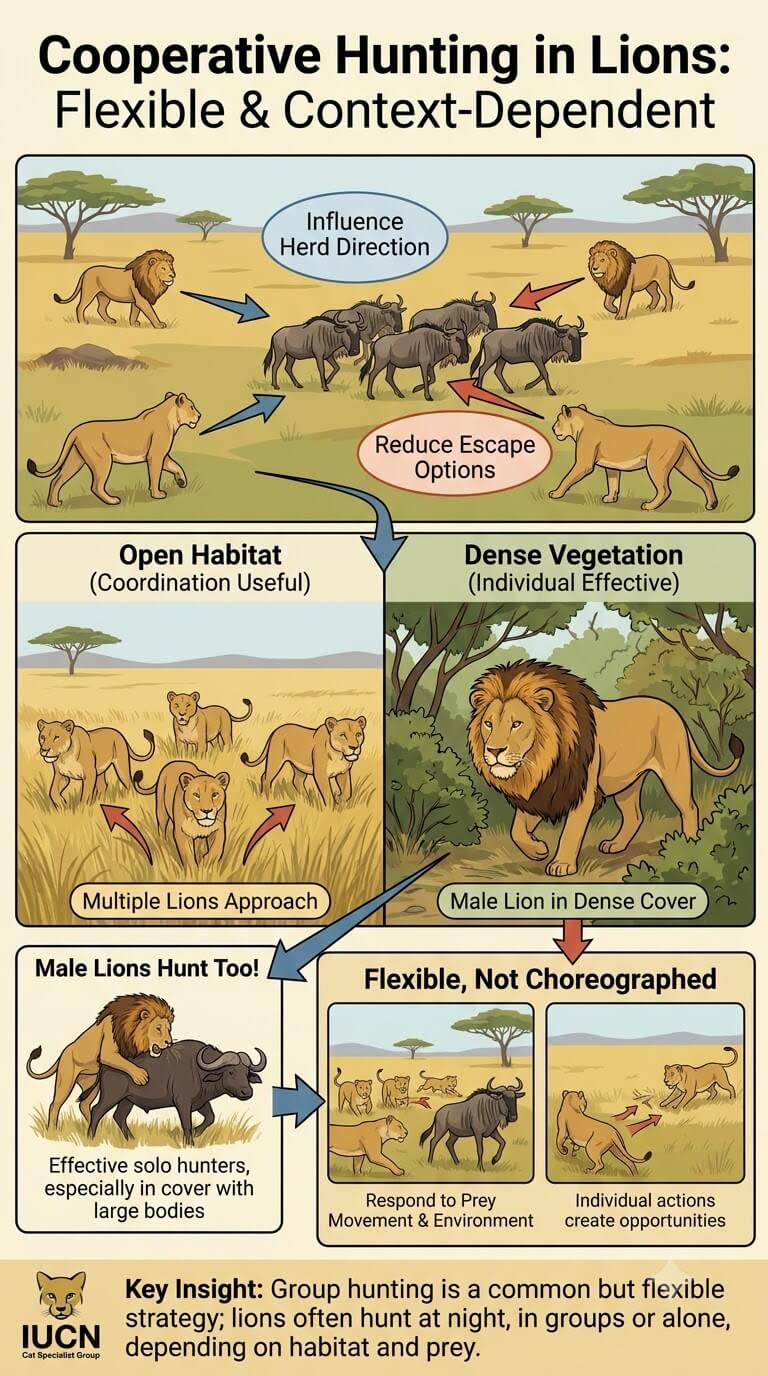
Lions are the most conspicuously social living cats, and group hunting is one benefit that can emerge from pride life. Several lions can approach from different positions, influence the direction a herd moves, or reduce escape options. Yet “lions hunt in teams” is still too simple as a universal description.
The IUCN Cat Specialist Group lion account notes that lions often hunt at night and in groups, while also documenting effective hunting by males when they are on their own. Habitat matters too. Coordinated hunting can be useful in more open settings, whereas an individual male in thick vegetation may be able to approach prey closely without a group.
Group Hunting Is Flexible, Not Choreographed
Cooperation does not mean every lion receives a fixed role or follows a rehearsed plan. Individuals respond to prey movement, vegetation, position, and the actions of other lions. Some group hunts may look highly coordinated because several cats converge at useful angles. Others are looser associations in which one individual’s movement creates an opportunity for another.
Male Lions Hunt Too
The old stereotype that females hunt while males simply wait for food is incorrect. Lionesses are important hunters and frequently hunt together, but males can capture prey on their own. Large male bodies may be useful against some prey, and dense cover can allow close approaches that reduce the need for a long chase.
Hunting in Trees and Complex Forest Cover
Leopards Use Three-Dimensional Terrain
Leopards can climb efficiently, rest in trees, move along branches, and sometimes use elevated positions around prey or carcasses. Their strongest hunting advantage, however, is broader than tree use. They combine stealth, powerful short acceleration, flexible prey choice, and the ability to function in dense vegetation, rocky country, and human-modified landscapes.
Clouded Leopards Are Arboreal, but the Evidence Needs Nuance
Clouded leopards are famous for climbing adaptations, but it would be a mistake to imagine them hunting only in the canopy. The IUCN Cat Specialist Group clouded leopard account lists both arboreal and terrestrial prey and emphasizes how limited field knowledge remains for many aspects of the species’ ecology.
The safest conclusion is that trees are an important part of clouded leopard life, while the ground also matters. Their forest environment offers a three-dimensional mix of trunks, branches, undergrowth, trails, and openings. Claims that assign a precise percentage of hunts to the canopy go beyond what field evidence can currently support.
Hunting Around Water
Water changes prey movement and can create both opportunities and barriers. Jaguars are the clearest large-cat example of regular use of rivers, wetlands, and flooded landscapes. They swim well and take prey associated with water, including capybaras, caimans, turtles, and fish in some regions.
Other big cats can use water too. Tigers are capable swimmers, and lions may cross or enter water when needed. It would be inaccurate to divide large cats into “water hunters” and “cats that avoid water.” The importance of water depends on habitat, prey, temperature, and local experience.
Hunting in Mountains
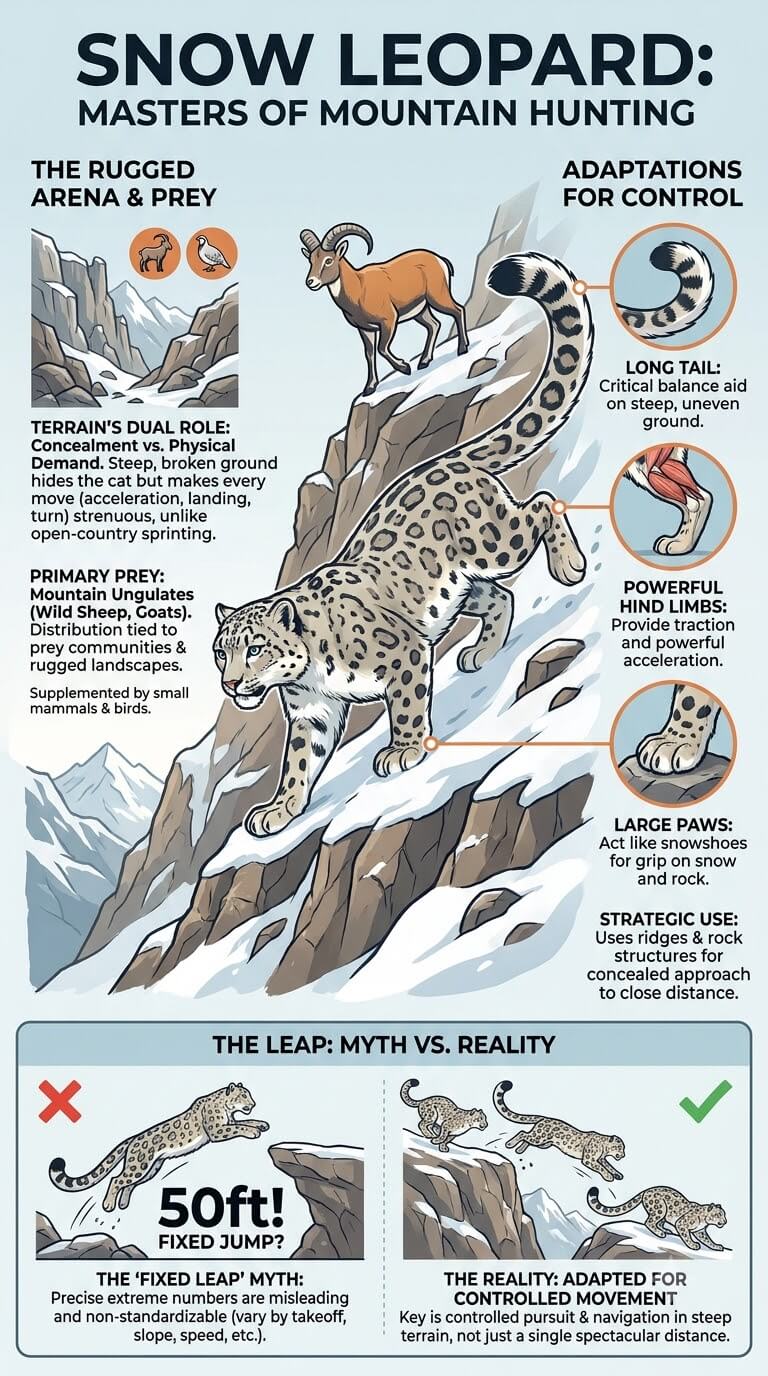
Snow leopards face a different mechanical problem from open-country sprinters. Their prey often travels across steep, broken ground where cliffs, gullies, ridgelines, and rock outcrops shape both approach and escape. Terrain can hide the cat but can also make every acceleration, landing, and turn more demanding.
The IUCN Cat Specialist Group snow leopard profile describes a diet centered on mountain ungulates such as wild sheep and goats, supplemented by smaller mammals and birds. The species’ distribution is closely tied to these prey communities and the rugged landscapes they occupy.
Terrain Is Part of the Hunting Strategy
A snow leopard can use ridges and rocky structure to move with concealment and reduce the open distance to prey. Long tails aid balance during movement on steep ground, while large paws and powerful hind limbs help with traction and acceleration. None of these traits means the cat routinely performs one fixed spectacular leap distance.
Popular accounts often attach precise extreme jump numbers to snow leopards. Such numbers are difficult to standardize in wild hunting because takeoff height, slope, landing height, speed, and whether a movement is a jump or downhill bound all change the measurement. The more useful fact is that snow leopards are adapted for controlled movement and prey pursuit in steep terrain.
Light, Timing, and Human Pressure
Many large cats are active at night or around dawn and dusk, but “all big cats are nocturnal” is inaccurate. Activity can shift with prey, temperature, competition, season, and people. A cat living near intense daytime human activity may move more at night than the same species in a quieter protected area.
Low light can favor a predator by reducing detection, but it does not eliminate the need for cover and timing. Cats still have to hear, see, or otherwise locate prey, judge distance, and move across real terrain. Their sensory adaptations support hunting under dim conditions, not in complete darkness without other information.
Prey Selection, Opportunism, and Scavenging
Big cats are predators, but they are not restricted to one prey size or one feeding pathway. Lions, leopards, jaguars, and tigers can take a broad range of prey, with local diets shaped by availability and competition. Snow leopards rely heavily on mountain ungulates but also take smaller animals. Cheetahs generally focus on prey they can pursue and subdue without excessive risk.
Large cats may also scavenge. Lions are well known for taking over kills and feeding on carcasses they did not make, but opportunistic scavenging is not exclusive to lions. A free meal can be energetically valuable if the cat can access it safely. Calling every big cat an animal that “only eats what it kills” creates an artificial rule that wild predators do not follow.
Why Hunting Success Rankings Mislead
Lists that rank predators by “hunting success rate” look scientific because they use percentages, but percentages taken from different studies are often not comparable. One study may count every stalk as an attempt, while another counts only full chases. Researchers may follow different prey species, seasons, habitats, age classes, or group sizes. Dense cover can also make failed attempts harder to observe than successful kills.
Common Myths About How Big Cats Hunt
“Every Big Cat Is an Ambush Hunter”
Stealth is widespread in Felidae, but hunting strategies differ. Cheetahs rely heavily on pursuit after a stalk. Lions may coordinate with companions. Jaguars exploit water and dense cover. Snow leopards use steep terrain. Even classic ambush predators actively search and reposition rather than simply wait in one place.
“Lions Always Hunt Cooperatively”
Lions often hunt with other lions, but individual hunting is normal too. Male lions can hunt effectively, and lionesses do not need a group for every capture. Group hunting is one flexible option within lion social life.
“Cheetahs Run at Maximum Speed Until Prey Gets Tired”
Field data show a much more tactical chase. Cheetahs accelerate, adjust speed, and often slow during the final phase so they can turn with evasive prey. Maneuverability and timing can matter as much as peak speed.
“Jaguars Always Kill by Biting Through the Skull”
Jaguars can use cranial or head-directed bites in some prey encounters, but their prey is too diverse for one universal dispatch method. The species’ robust feeding anatomy supports multiple ways of controlling prey.
“Snow Leopards Always Make Record-Breaking Leaps”
Snow leopards are powerful jumpers and skilled mountain movers, but fixed extreme-distance claims are difficult to verify under standardized wild conditions. Their real advantage is the combination of balance, traction, acceleration, concealment, and familiarity with steep terrain.
How Senses, Anatomy, and Habitat Shape the Hunt
Hunting behavior cannot be separated cleanly from the rest of a cat’s biology. Forward-facing eyes help judge distance during an approach. Sensitive hearing can reveal prey hidden by vegetation. Whiskers provide tactile information at close range. Claws and forelimbs help with control. Canines grip, while carnassial teeth process meat after the capture.
Habitat determines how those tools are used. A striped tiger moving through tall grass and woodland can exploit broken light and cover. A spotted leopard can work through patchy vegetation and rocky terrain. A pale snow leopard uses mountain backgrounds and relief. A cheetah in open country has less concealment available once the chase begins, making acceleration and steering especially important.
FAQ
Do big cats ever scavenge?
Yes. Large wild cats are active predators, but some will feed from carcasses or take over kills when the opportunity is worthwhile. Lions are particularly well known for scavenging and stealing kills from other carnivores. Opportunistic scavenging can save energy, so it is not biologically strange for a predator to use food it did not catch.
Do male lions hunt?
Yes. Male lions can and do hunt. Females are prominent hunters in many prides and may cooperate effectively in open habitat, but males are capable predators on their own. Local vegetation, prey, pride structure, and whether a male is resident or ranging independently can change how often observers see male hunting.
Why do cheetahs stop a chase?
A chase can become too costly or too unlikely to succeed. Prey may gain enough distance, force difficult turns, reach cover, or create an injury risk. Cheetahs also need to manage the intense physical demands of pursuit. Abandoning an unfavorable chase preserves energy for another opportunity.
Do all big cats hunt at night?
No. Many hunt at night or during twilight, but activity is flexible. Species, prey schedules, temperature, habitat, season, and human disturbance can all shift when a cat hunts. Daytime hunting can occur in several large felids.
Which big cat has the highest hunting success rate?
There is no reliable universal answer. Studies define attempts differently and examine different prey, habitats, seasons, group sizes, and sample sizes. A percentage from one population cannot automatically be compared with a percentage from another species somewhere else. Hunting success is best interpreted within the study that measured it.
Final Thoughts
How big cats hunt depends on much more than whether a species is labeled an ambush predator or pursuit predator. Most hunts begin with detection, selection, and careful positioning. What happens next can involve stalking through cover, explosive acceleration, a high-speed chase, group coordination, climbing, swimming, or using steep terrain to shorten the prey’s advantage.
Lions show that social cooperation can be useful without being mandatory. Tigers and leopards show how cover can support close-range attacks in different habitats. Jaguars make water and wetland prey part of the hunting landscape. Snow leopards turn mountain structure into concealment and movement opportunity. Cheetahs demonstrate that pursuit is about acceleration and maneuvering, not just maximum speed. Clouded leopards remind us that even within forests, hunting can move between the ground and a three-dimensional world of trees.
The common thread is flexibility. Big cats survive not because every hunt is successful or because one species owns a record for strength or efficiency, but because their bodies and behavior let them match different prey and landscapes. Looking at that complete system gives a more accurate picture of predation than any “deadliest cat” ranking ever could.

Ethan Walker is the founder and research editor of Animal Fact Central. He creates and reviews educational animal facts content using trusted wildlife, pet care, and science-based sources. His work focuses on making animal behavior, adaptations, habitats, and species facts clear, accurate, and engaging for everyday readers.
Read More Details About Ethan Walker: https://animalfactcentral.com/ethan-walker/