
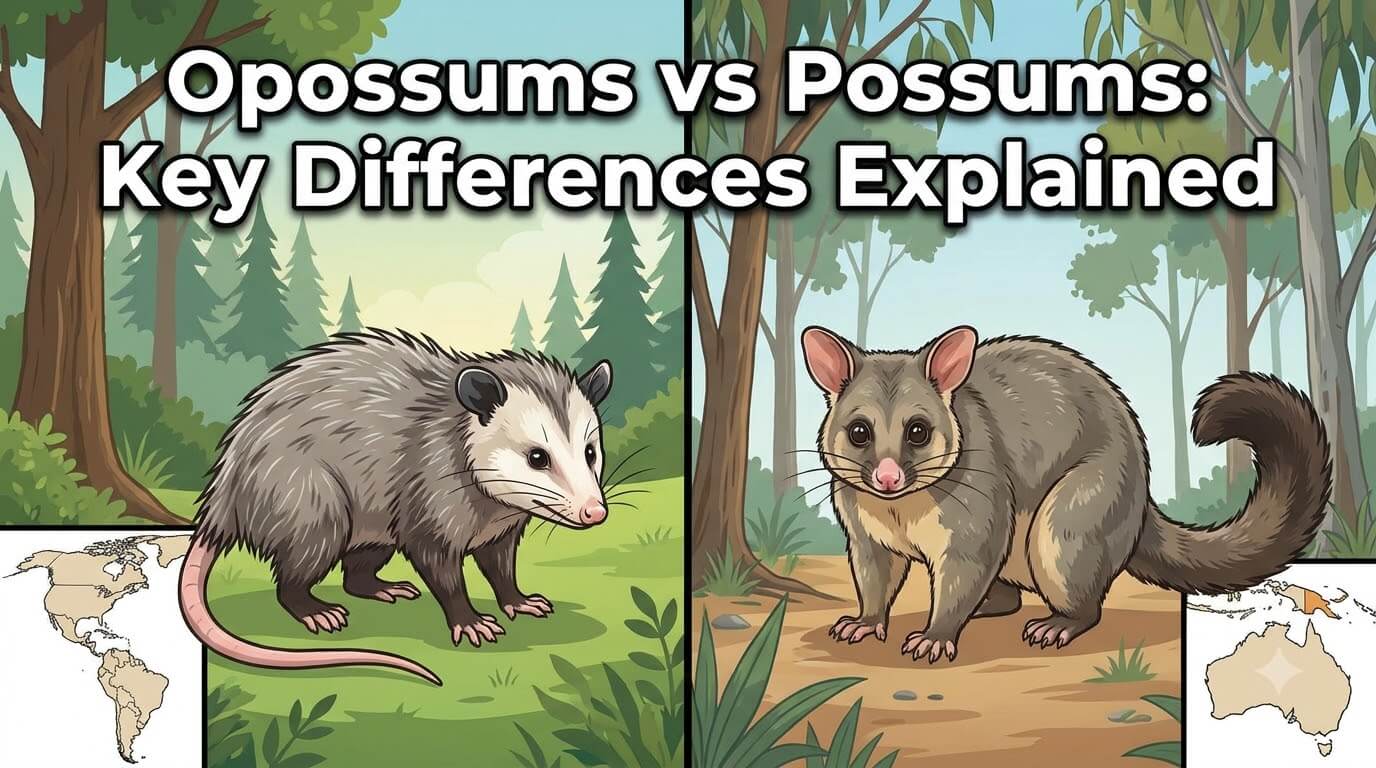
Opossums and possums are both marsupials, but they are not simply two spellings for the same worldwide animal group. In zoological usage, opossum usually refers to American marsupials in the order Didelphimorphia, while possum usually refers to several Australasian marsupials, especially groups within the order Diprotodontia. The familiar Virginia opossum in the United States and an Australian brushtail possum are therefore both marsupials, but they belong to different branches of the marsupial family tree.
The name can still be confusing for US readers because “possum” is a common informal shortening of “opossum” in American speech. That everyday usage is not necessarily wrong in conversation. The distinction matters most when identifying animals, discussing taxonomy, comparing wildlife from different regions, or writing clearly about species.
Quick Difference
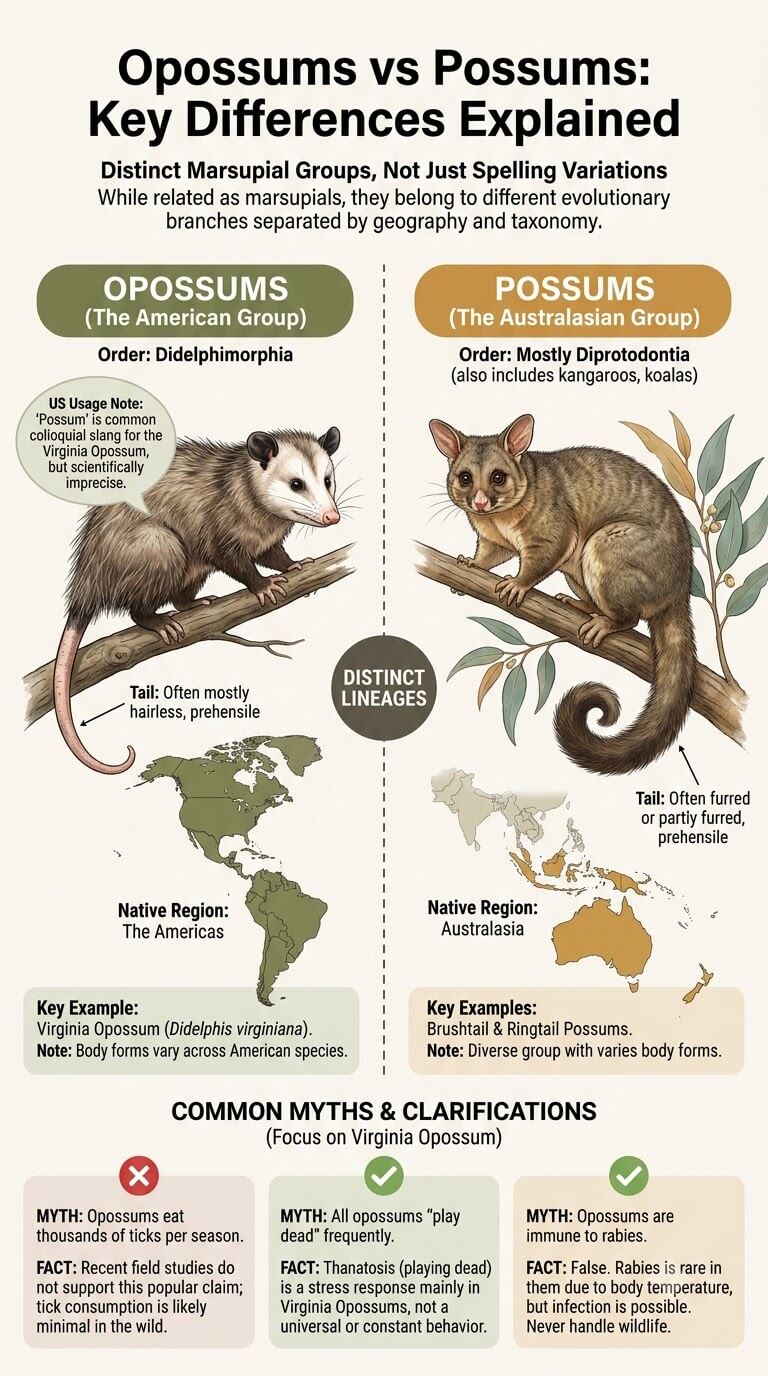
The simplest difference is geography plus taxonomy. Opossums are American marsupials, with living species in North, Central, and South America. Possums are Australasian marsupials, with familiar examples including brushtail possums, ringtail possums, and several other groups in Australia, New Guinea, and nearby regions.
For example, the Virginia opossum, Didelphis virginiana, belongs to Didelphimorphia and Didelphidae. By contrast, the common brushtail possum, Trichosurus vulpecula, belongs to Diprotodontia and Phalangeridae. Both are marsupials, but their shared ancestry is much deeper than their similar English names suggest.
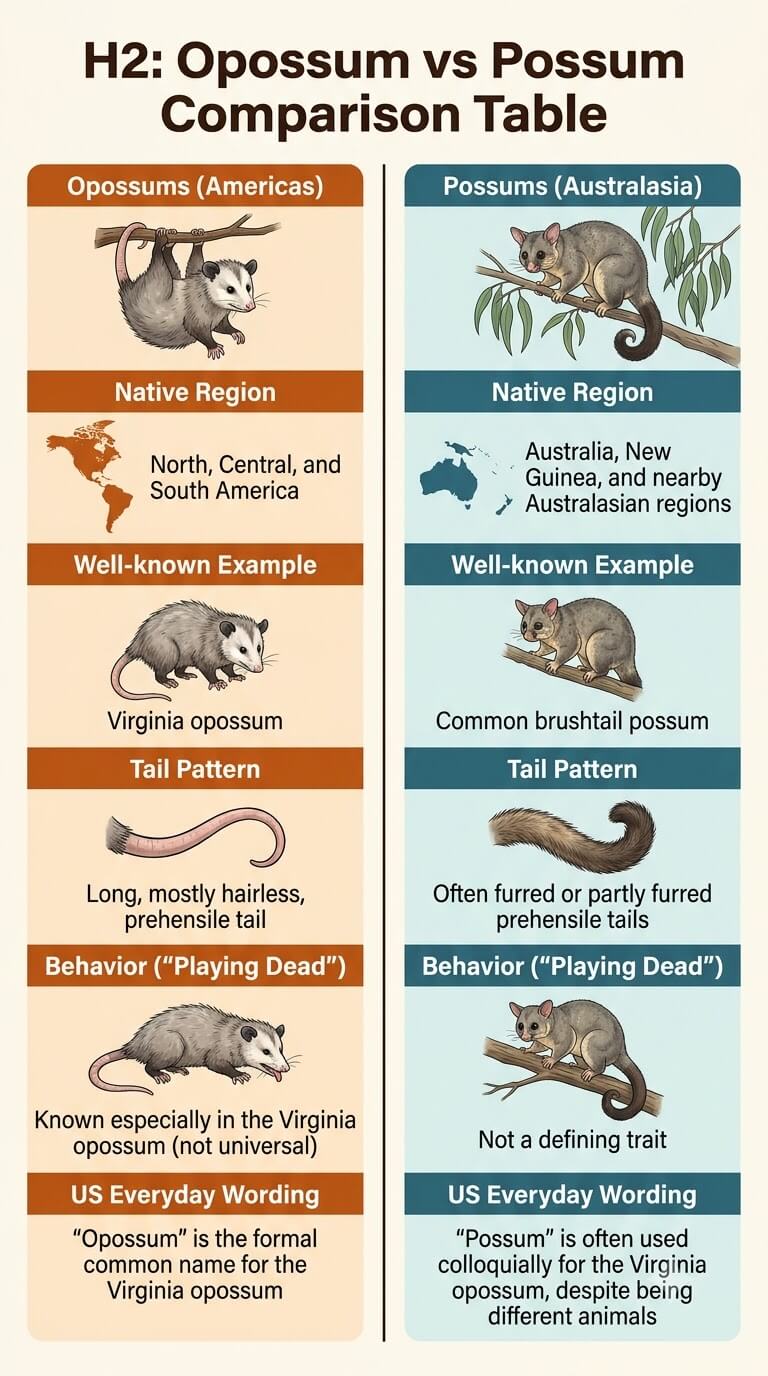
Opossum vs Possum Comparison Table
| Feature | Opossums | Possums |
|---|---|---|
| Usual zoological meaning | American marsupials, especially Didelphimorphia | Several Australasian marsupials, especially within Diprotodontia |
| Native region | North, Central, and South America | Australia, New Guinea, and nearby Australasian regions, depending on species |
| Well-known example | Virginia opossum | Common brushtail possum or eastern ringtail possum |
| Tail pattern | Varies; Virginia opossum has a long, mostly hairless, prehensile tail | Varies; many familiar possums have furred or partly furred prehensile tails |
| Typical lifestyle | Varies from terrestrial to climbing and semi-aquatic forms | Many familiar species are arboreal, but the group is ecologically diverse |
| Diet | Often omnivorous, but varies by species | Often includes leaves, fruit, flowers, nectar, insects, or mixed foods, depending on species |
| “Playing dead” | Known especially in the Virginia opossum, but not a universal opossum behavior | Not a defining possum trait |
| US everyday wording | “Opossum” is the formal common name for the Virginia opossum | “Possum” is often used colloquially for the Virginia opossum, even though Australasian possums are different animals |
Names, Geography, and Taxonomy
What opossum usually means in the Americas
In zoological writing, opossums are members of Didelphimorphia, an order of living marsupials native to the Americas. The current Mammal Diversity Database taxonomy table places Didelphimorphia within Marsupialia and lists Didelphidae as its living family.
The Virginia opossum is the species most US readers recognize, but it is only one member of a much larger American radiation. Other opossums occur through Mexico, Central America, and South America, and they differ in size, habitat, climbing ability, diet, and behavior. Some spend considerable time in trees, some forage heavily on the ground, and at least one lineage includes a strongly semi-aquatic species.
Calling every opossum a Virginia opossum erases that diversity. The correct general idea is that “opossum” covers an American marsupial group, while the Virginia opossum is one particular species within it.
What possum usually means in Australasia
Possum is a common name used for multiple Australasian marsupials. These animals are not all one species, genus, or family. Familiar examples include brushtail possums and ringtail possums, and other marsupials also carry the possum name.
The Australian Museum identifies the common brushtail possum as Trichosurus vulpecula in the family Phalangeridae and order Diprotodontia. The same order also contains kangaroos, koalas, wombats, gliders, and other marsupials, which shows how broad Diprotodontia is.
Ringtail possums illustrate another branch within the possum name. They are not simply small brushtails. Different possum groups have their own anatomy, diet, habitat use, and evolutionary relationships. “Possum” is therefore a useful common-name category, not one formal taxonomic unit containing every animal called a possum.
Why North Americans often say possum colloquially
In the United States, people commonly drop the first syllable of “opossum” and say “possum.” This usage is deeply established in everyday English. A homeowner saying “there’s a possum under the deck” is usually talking about a Virginia opossum, not an Australian marsupial.
That does not make the words taxonomically interchangeable everywhere. In a wildlife guide, classroom article, scientific context, or comparison involving Australia, using “opossum” for American Didelphimorphia and “possum” for Australasian animals is much clearer.
The distinction is similar to many other animal-name problems: everyday language develops through culture and region, while biological classification needs enough precision to identify the intended group.
Body Form and Tail Adaptations
Representative opossum body and tail traits
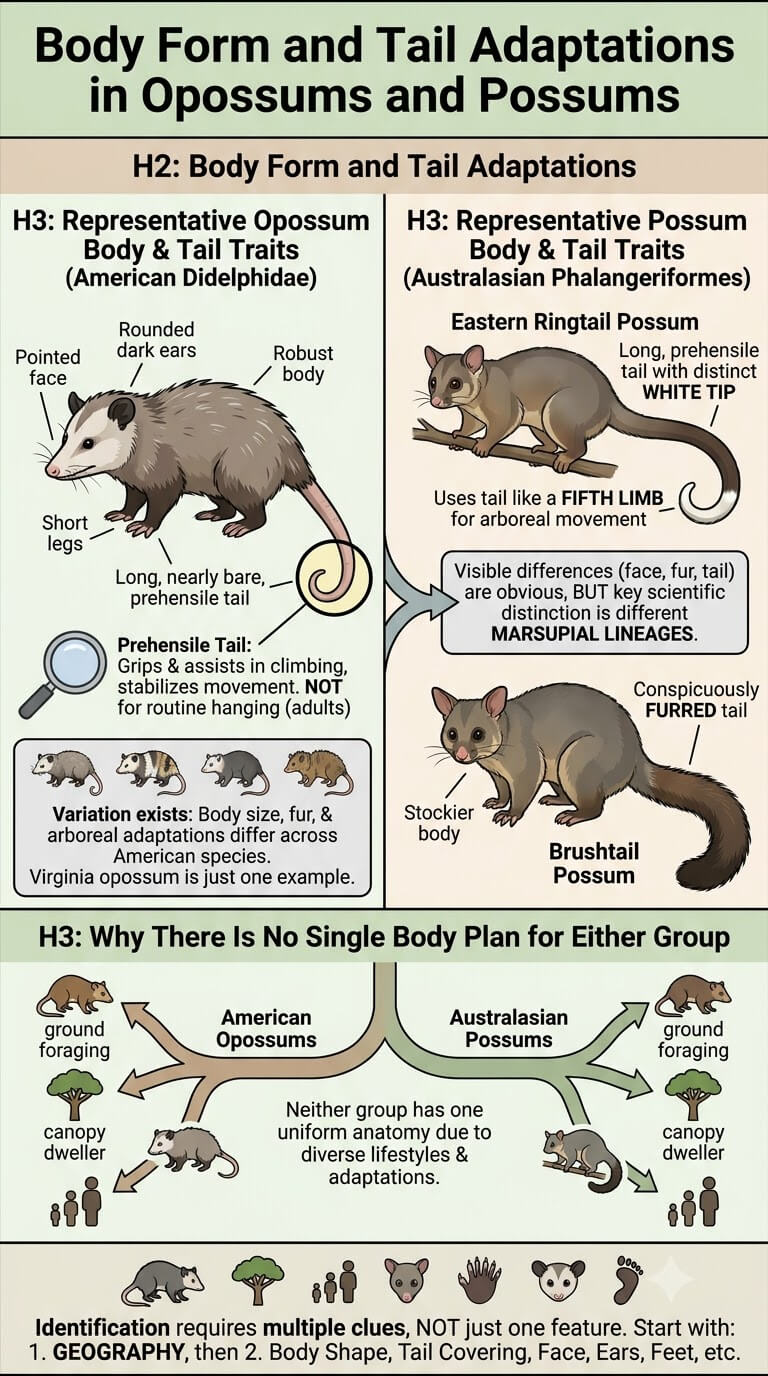
The Virginia opossum has the body shape many North Americans associate with opossums: a pointed face, rounded dark ears, a robust body, relatively short legs, and a long tail with little visible fur. The Smithsonian’s Virginia opossum profile describes the tail as prehensile, meaning it can grip and assist the animal while climbing.
A prehensile tail is useful, but popular images sometimes exaggerate what it does. Adult Virginia opossums are not normally hanging by the tail as a routine resting posture. The tail works with the feet and claws during climbing and can help stabilize movement. Young animals may be more capable of supporting themselves briefly with the tail than large adults.
Other American opossums can look quite different. Body size, coat texture, tail hair, limb proportions, and degree of arboreal specialization vary across Didelphidae. The Virginia opossum is a useful example, not a universal blueprint.
Representative possum body and tail traits
Australasian possums also vary, but many familiar species are well adapted to climbing. The eastern ringtail possum has a long prehensile tail with a distinctive white tip and uses its feet and tail while moving through branches. The Australian Museum’s eastern ringtail possum profile notes that the animal can use its tail like a fifth limb during arboreal movement.
Brushtail possums offer a different look. Their tails are conspicuously furred for much of their length, and their bodies are stockier than those of some ringtails. Ringtail and brushtail possums therefore should not be treated as one standardized possum shape.
The contrast with the Virginia opossum is easy to notice in photographs, especially around the face, ears, coat, and tail. Yet those visible differences are less important scientifically than the fact that the animals belong to different marsupial lineages.
Why there is no single body plan for either common-name group
Neither “opossum” nor “possum” describes one uniform anatomy. American opossums include species adapted to different combinations of climbing, ground foraging, and other lifestyles. Australasian possums include multiple families and a range of body sizes and canopy adaptations.
This variation is why identification should not rely on a single feature such as a bare tail or large eyes. Geography is often the first useful clue, followed by body shape, tail covering, face shape, ears, feet, and the species known from that region.
Diet and Feeding Tendencies
Omnivory among many opossums
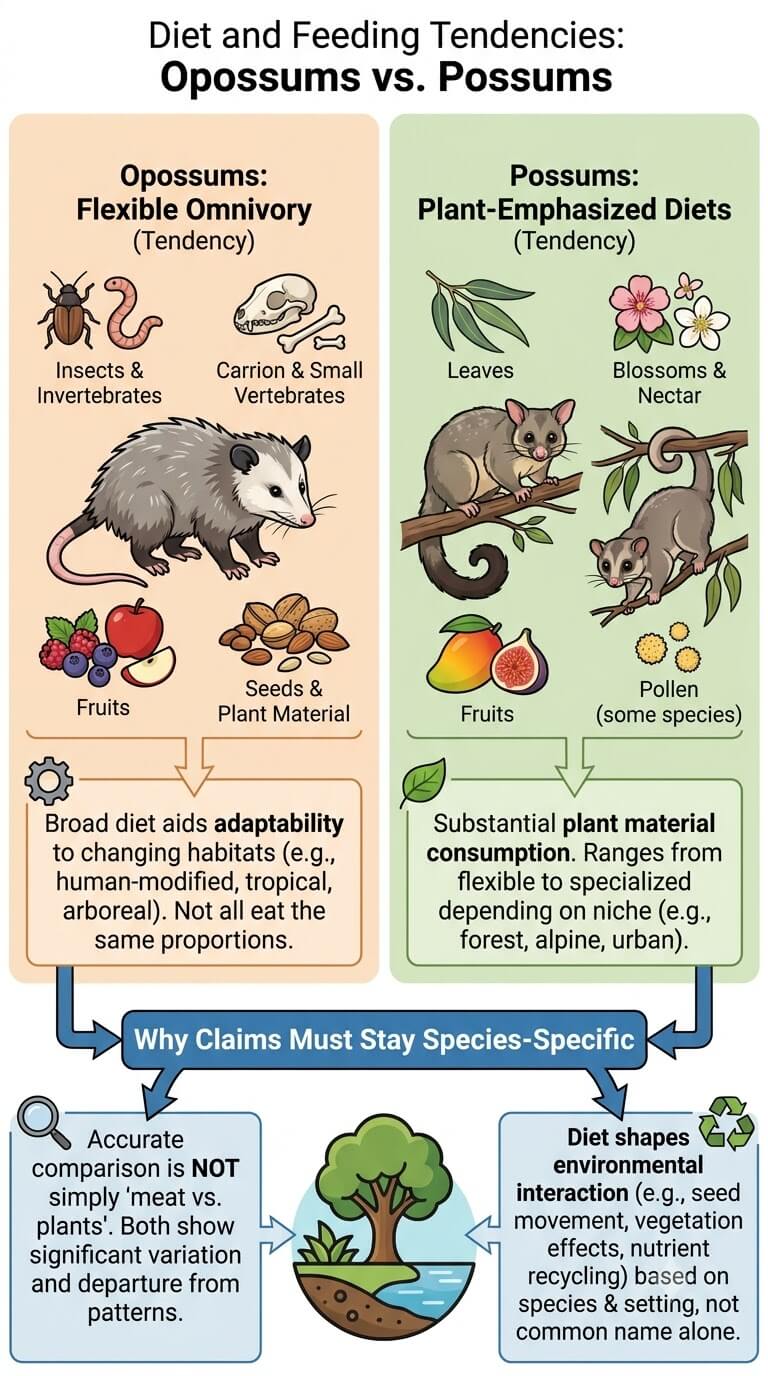
Many opossums are omnivorous, but “omnivore” does not mean they indiscriminately eat everything. The Virginia opossum, for example, uses a broad diet that can include insects, other invertebrates, small vertebrates, carrion, fruits, seeds, and other plant material depending on season and availability.
A broad diet can help an adaptable species use changing habitats, including some human-modified environments. It does not mean every member of Didelphidae eats the same proportions of foods. Tropical, arboreal, terrestrial, and semi-aquatic species encounter different feeding opportunities.
Leaf, fruit, flower, and mixed diets among possums
Many familiar Australasian possums eat substantial plant material. Common brushtail possums consume leaves, blossoms, and fruits, while the eastern ringtail possum eats leaves as well as flowers and fruits. Other possum-named marsupials can incorporate nectar, pollen, insects, or additional foods depending on species.
Plant feeding can range from broad flexibility to stronger specialization. An urban brushtail exploiting a variety of available foods should not be used as the model for every possum living in forests, alpine habitat, tropical environments, or specialized ecological niches.
Why diet claims must stay species-specific
The most accurate comparison is therefore not “opossums eat meat while possums eat plants.” Both sides contain variation. Many opossums are flexible omnivores, while many possums emphasize plant foods, but individual species can depart from a simple pattern.
Diet also changes how each animal interacts with its environment. Fruit eating may contribute to seed movement, leaf eating affects vegetation, insect consumption changes invertebrate predation, and scavenging recycles animal material. Those ecological effects depend on the species and setting rather than the common name alone.
Habitats and Shelter Use
Forest, suburban, and ground use in representative opossums
The Virginia opossum can occupy a wide range of environments, including woodlands, thickets, wet areas, agricultural edges, and many human-modified landscapes. It climbs well but also spends substantial time traveling and foraging on the ground. Rather than building one characteristic shelter type, it can use protected spaces such as hollow trees, brush piles, abandoned burrows, and structures created by people.
This flexibility helps explain why many US residents encounter the species near homes. That does not mean all opossums are equally comfortable in cities or suburbs. Many American species have more restricted tropical or forest associations.
Arboreal habitat and denning in representative possums
Many familiar Australian possums are strongly arboreal. Eastern ringtail possums live largely in trees and use spherical nests, often called dreys, as well as tree hollows and dense vegetation. Several individuals can sometimes share a nest. Common brushtail possums use forests and woodlands but also adapt well to urban areas, where roof spaces and other sheltered structures can substitute for natural hollows.
Those examples explain why possums are often associated with trees, but even here a universal rule would be misleading. “Possum” applies to several different marsupial groups, and habitat use varies with species, region, food, shelter availability, and disturbance.
Activity, Defense, and Behavior
Nocturnal tendencies and exceptions
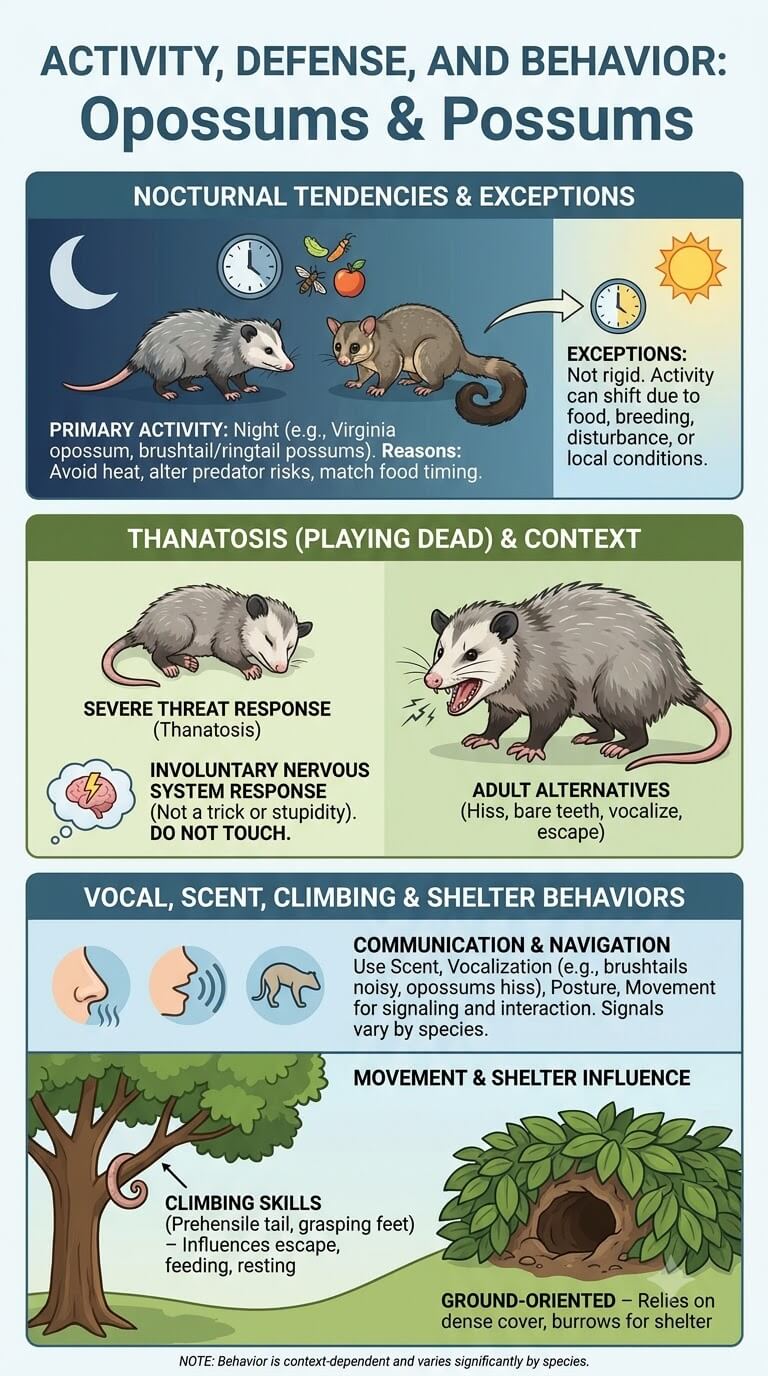
Night activity is common in both many opossums and many possums. The Virginia opossum is primarily nocturnal, and familiar brushtail and ringtail possums are also active mainly at night. Nocturnality can reduce daytime heat exposure, alter predator encounters, and match the timing of available foods.
However, a broad common-name group should not be assigned a rigid daily schedule without species evidence. Wildlife may also appear outside its usual activity period because of food, breeding, disturbance, weather, or local conditions.
Thanatosis or playing dead in context
The Virginia opossum is famous for “playing dead,” a defensive response known as thanatosis. When severely threatened, an animal can become limp and appear dead rather than continuing to flee or confront the threat. The Smithsonian notes that this response is seen especially in younger Virginia opossums, while adults may instead hiss, bare their teeth, vocalize, or escape.
This behavior should not be generalized to every opossum species. It is also misleading to describe it as stupidity or a deliberate theatrical trick. Defensive responses are shaped by the animal’s nervous system and the immediate threat. A motionless opossum should not be touched to see whether it is “really dead.”
Vocal, scent, climbing, and shelter behaviors
Both opossums and possums use combinations of scent, vocalization, posture, and movement to navigate their surroundings and interact with other animals. The exact signals vary by species. Brushtail possums can be noisy around homes, while opossums may hiss or open the mouth when threatened.
Climbing skills also influence behavior. A prehensile tail, grasping feet, and access to trees can change escape routes, feeding sites, resting locations, and interactions with predators. In more ground-oriented species, dense cover, burrows, or other shelters become more important.
Common Myths and Risk Claims
Possum is always wrong in American speech
It is too strict to say Americans are wrong whenever they call a Virginia opossum a “possum.” The shortened form is well established colloquially. The problem arises when that everyday nickname is treated as if it proves American opossums and Australasian possums are the same zoological group.
For precise animal writing, “Virginia opossum” is the clearest term for Didelphis virginiana. When discussing Australian animals, “possum” should be retained for species that genuinely carry that common name.
Every opossum routinely plays dead
Thanatosis is strongly associated with the Virginia opossum in popular culture, but it is not a defining behavior of Didelphimorphia. Even within Virginia opossums, other responses such as fleeing, hissing, vocalizing, or showing the teeth are possible.
The safest way to write about the behavior is species-specific: Virginia opossums can enter a death-feigning state under threat. That is very different from claiming that all opossums routinely collapse whenever frightened.
Opossums cannot get rabies
This is false. Rabies is uncommon in opossums in the United States, but uncommon does not mean impossible. The CDC’s rabies guidance says animals such as opossums and squirrels hardly ever have rabies, while still advising people to leave wildlife alone and seek professional medical guidance after concerning bites or scratches.
Documented rabies infection has occurred in opossums. People should never use the idea of “natural immunity” as a reason to handle a wild animal. Any mammal behaving abnormally, injured, trapped, or involved in a bite should be treated cautiously, and local public health or wildlife authorities can advise on the next step.
Opossums eat a fixed number of ticks each season
The often-repeated claim that one opossum reliably eliminates thousands of ticks is not supported well enough to be presented as established field biology. An influential laboratory-based idea suggested heavy tick grooming, but later field work tested stomach contents from wild Virginia opossums and found no ticks or tick parts in the sampled animals.
The 2021 study examining Virginia opossums and ticks concluded that the popular ecological-trap narrative was not supported by those field observations. That does not prove opossums never consume a tick. It does mean fixed claims such as “5,000 ticks per season” should not be used as a dependable ecological service or a reason to attract opossums to a property.
How to Tell the Terms Apart in Reliable Writing
Use scientific or regional context
If the animal is in the United States and has the familiar pointed face and long mostly hairless tail, “Virginia opossum” is the clearest formal common name. If the context is Australia or nearby regions and the animal is a brushtail, ringtail, pygmy possum, or another species formally called a possum, use “possum.”
When a sentence could be ambiguous, add the species name or region. “Virginia opossum” immediately removes doubt. “Common brushtail possum” does the same in an Australian context. Scientific names can help when closely related species or regional naming differences make common names unclear.
Avoid assuming one species represents the whole group
Many online comparisons quietly compare one Virginia opossum with one common brushtail possum and then present the result as universal. That can be useful as an example, but it should be labeled as an example.
Didelphidae contains many opossum species. Australasian possums span multiple evolutionary branches within Diprotodontia. Body size, coat, tail structure, diet, nesting, defense, and social behavior can all vary. A good comparison separates the broad taxonomic distinction from the traits of whichever representative species are being discussed.
Why the Difference Matters in Marsupial Biology
Different names point to different evolutionary branches
The opossum versus possum distinction becomes more useful when placed inside Marsupialia. American opossums in Didelphimorphia belong to a different order from the diprotodont marsupials commonly called possums in Australasia. That separation explains why similar English names do not imply close membership in one genus or family.
It also prevents confusion when learning about other marsupials. Kangaroos, koalas, wombats, and many possums are all diprotodonts, while American opossums belong elsewhere. Common names tell part of the story; the order-level framework shows the deeper relationships.
Habitat, diet, and behavior should be compared species by species
The same principle applies to ecology. A Virginia opossum in a North American woodland edge faces different foods, predators, climate, and shelter opportunities from an eastern ringtail possum in Australian forest or suburbia. Their diets and behaviors reflect those settings.
Comparing them can be educational, but neither animal is a complete stand-in for every opossum or possum. Once the names are separated correctly, it becomes easier to ask better questions about how each species lives.
FAQ
Is a Virginia opossum the same animal as an Australian possum?
No. The Virginia opossum is an American marsupial in Didelphimorphia. Australian possums belong to other marsupial groups, especially within Diprotodontia. They share deeper marsupial ancestry, but they are not the same species, genus, family, or order.
Is possum acceptable slang for Virginia opossum in the United States?
Yes. “Possum” is a common colloquial pronunciation and spelling for the Virginia opossum in American English. In precise wildlife or educational writing, however, “opossum” is clearer because it preserves the distinction from Australasian possums.
Do all opossums have naked tails?
No. Tail covering and structure vary among American opossums. The Virginia opossum has the long, mostly hairless prehensile tail familiar to many US readers, but it should not be treated as the universal tail design for every didelphid species.
Do all possums live in Australia?
No. Australia is home to many animals called possums, but native possum groups also occur in New Guinea and nearby parts of the Australasian region, depending on the species. Some possums have also been introduced outside their native range. Distribution should therefore be checked at the species level rather than reduced to “possum equals Australia.”
Final Thoughts
The key difference between opossums and possums is not just spelling. Opossums are American marsupials, especially members of Didelphimorphia, while possums are several Australasian marsupials, many within Diprotodontia. The Virginia opossum and Australian brushtail or ringtail possums differ in evolutionary relationships, geography, body form, tail structure, diet, habitat use, and behavior. At the same time, American speakers are not committing a biological error every time they casually shorten “opossum” to “possum.” Context is what matters. For clear animal identification, use the regional and species name, avoid turning one representative animal into a rule for the whole group, and be especially cautious with viral claims about playing dead, rabies, and tick control.

Ethan Walker is the founder and research editor of Animal Fact Central. He creates and reviews educational animal facts content using trusted wildlife, pet care, and science-based sources. His work focuses on making animal behavior, adaptations, habitats, and species facts clear, accurate, and engaging for everyday readers.
Read More Details About Ethan Walker: https://animalfactcentral.com/ethan-walker/