
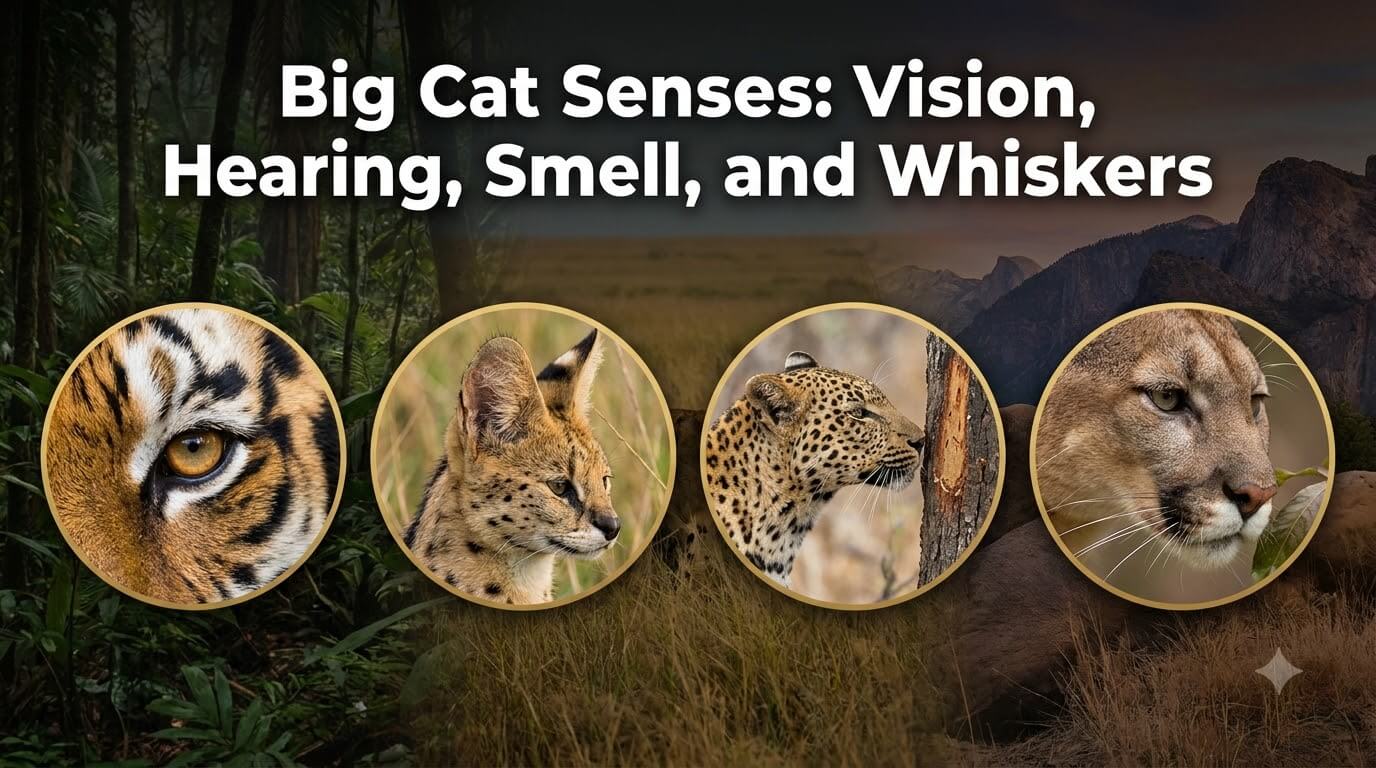
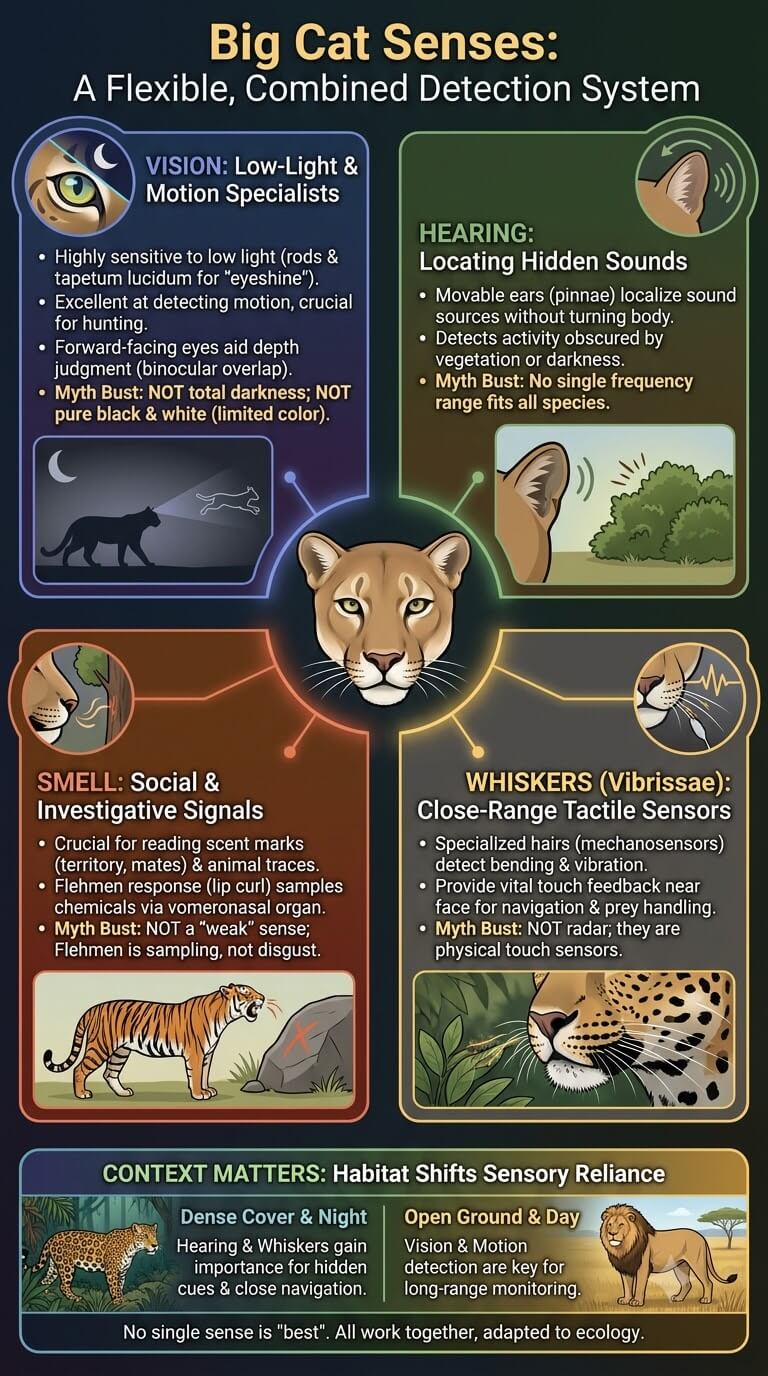
Big cat senses work as a combined detection system rather than a simple ranking of “best” abilities. Vision helps a cat judge distance and track movement. Hearing can reveal activity hidden by darkness or vegetation. Smell carries information about other animals, food, and scent marks. Whiskers provide close-range touch information when the face is near prey, branches, rocks, or other objects.
That combination is especially useful for large wild cats because many hunts depend on getting close before the final rush. A tiger moving through forest, a lion watching across open ground, a jaguar working along dense riverbank cover, and a snow leopard crossing broken mountain terrain face different sensory problems. Their shared feline anatomy gives them similar tools, but habitat, prey, activity period, and hunting style change how those tools are used.
Quick Answer: How Good Are Big Cat Senses?
Big Cats Combine Several Senses
There is no single “main sense” that explains how every big cat survives. Large felids have forward-facing eyes, sensitive hearing, a functional sense of smell, chemical-sensing structures, and specialized tactile hairs called vibrissae. The Animal Diversity Web overview of Felidae describes acute sight, hearing, smell, and well-developed vibrissae across the cat family.
These channels overlap. A cat may hear movement before it sees the animal making the sound, visually follow that movement once it becomes visible, then use touch around the muzzle during very close prey handling. Smell may matter more when investigating scent marks, a carcass, a potential mate, or an area used by another cat.
Habitat and Hunting Style Change Sensory Use
A sensory ability is useful only in context. Dense vegetation reduces long sightlines, so sound and close-range visual cues become especially valuable. Open habitats allow longer visual monitoring. Rocky terrain demands precise body placement and awareness of nearby surfaces. Activity at dusk, night, or dawn increases the value of low-light sensitivity, but many large cats can also be active during daylight.
This is why statements such as “big cats are nocturnal hunters” are too broad. Activity can shift with prey behavior, weather, season, competition, and human disturbance. Sensory systems support that flexibility rather than locking every species into one schedule.
Why Feline Sensory Ecology Matters
Detecting Prey Before the Final Approach
Large cats usually benefit from reducing the distance between themselves and prey before committing to a fast, energy-intensive attack. Vision and hearing can help identify where an animal is moving, while smell may provide information about prey presence, carcasses, or recent activity. The exact balance differs by species and setting.
Moving Through Cover and Low Light
Vision does not stop being useful after sunset. Feline eyes are adapted to collect limited light efficiently, and whiskers add close-range tactile information around the face. Hearing can fill in gaps when leaves, tall grass, tree trunks, or darkness hide the source of a sound.
Reading Other Cats and the Environment
Senses also matter when no prey is present. Large cats investigate urine, feces, scrapes, rubbed surfaces, claw marks, and other traces left by members of their species. These signals can carry information about occupancy, reproductive condition, or recent presence. Seeing a posture or hearing a call adds another layer of information during direct encounters.
That makes sensory biology part of social spacing as well as hunting. A mostly solitary cat does not need another cat in view to detect signs that it has entered a used area.
Vision and Forward-Facing Eyes
Binocular Overlap Helps With Depth Judgment
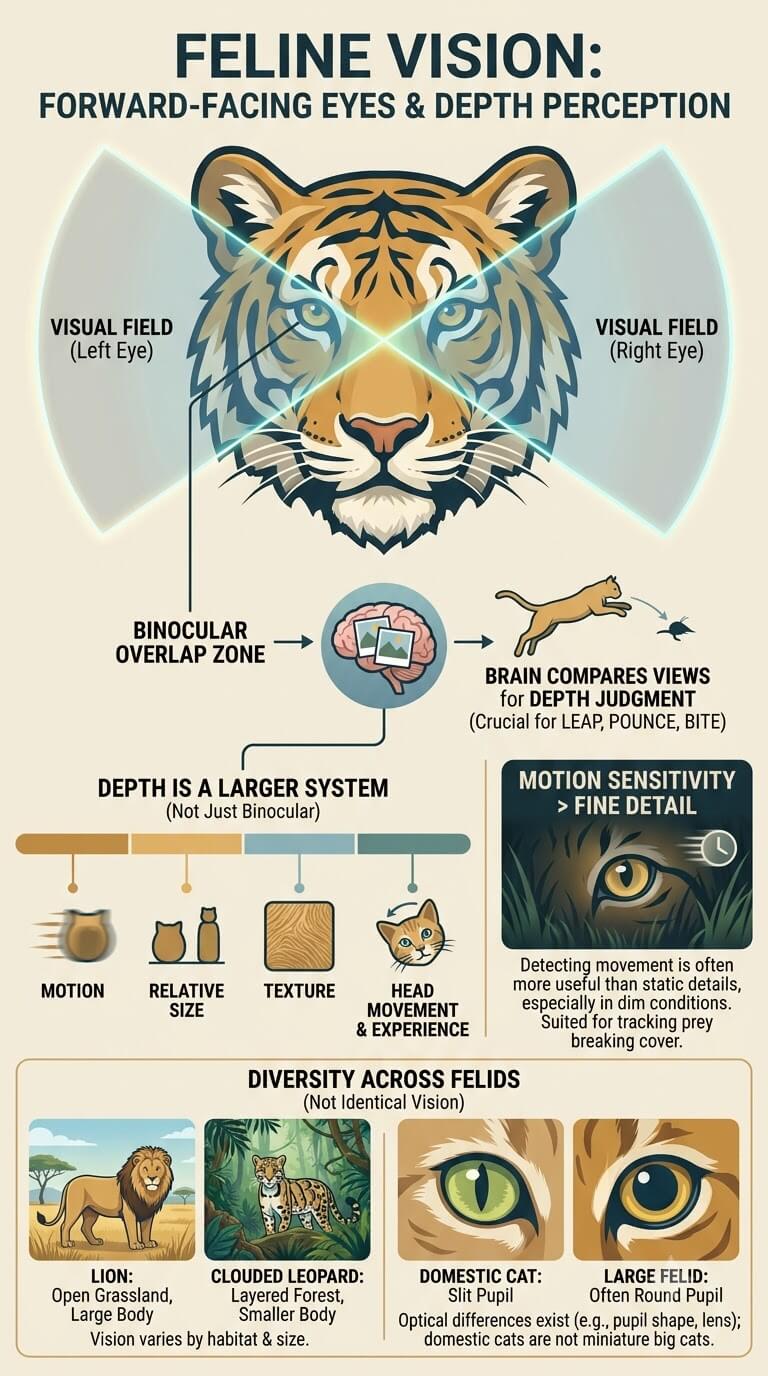
Big cats have eyes positioned toward the front of the skull. The visual fields from the two eyes overlap, allowing the brain to compare slightly different views of the same scene. This binocular information contributes to depth judgment, which is useful when a predator must estimate distance before a leap, pounce, bite, or rapid change in direction.
Depth does not come from binocular vision alone. Motion, relative size, texture, head movement, and experience also help an animal judge distance. Forward-facing eyes are therefore part of a larger visual system, not a guarantee of perfect range finding.
Motion Can Matter More Than Fine Detail
For a predator, noticing that something moved can be more useful than resolving tiny static details. Feline visual systems are well suited to detecting movement, especially under dim conditions where fine color and detail become less reliable. That helps explain why a small shift in grass or a prey animal breaking cover can rapidly attract a cat’s attention.
Forward-Facing Eyes Do Not Make Every Felid’s Vision Identical
The cat family contains species that differ greatly in body size, eye size, activity pattern, and habitat. A lion viewing prey across open grassland does not face the same visual conditions as a clouded leopard moving through layered tropical forest. Even when two species share the same basic eye plan, selection can favor different optical details.
Domestic cats are useful research models for feline vision, but they should not be treated as miniature lions or tigers. Research on pupil shape and lens optics shows clear differences between smaller and larger felids.
Seeing in Low Light
Rods Help When Light Is Limited
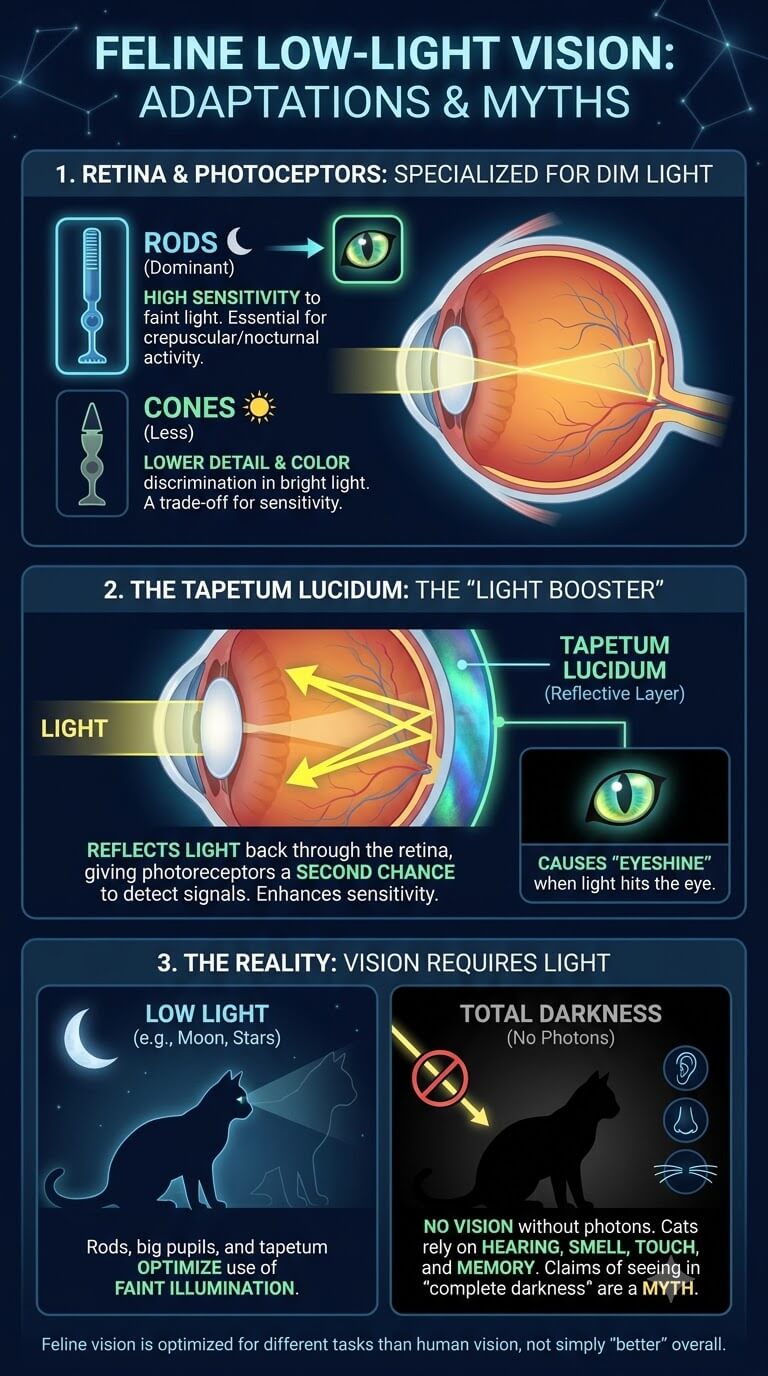
The retina contains photoreceptor cells that convert light into neural signals. Rods are especially important under dim illumination, while cones support vision in brighter conditions and contribute to color discrimination. Feline retinas are strongly adapted for sensitivity when light levels are low, which fits the crepuscular and nocturnal activity seen in many cats.
Low-light sensitivity comes with trade-offs. An eye optimized to detect faint signals does not necessarily maximize fine detail or color under every condition. This is one reason it is misleading to ask whether cat vision is simply “better” than human vision. The two systems emphasize different tasks.
The Tapetum Lucidum Gives Light Another Chance
Behind the light-sensitive retina, cats have a reflective structure called the tapetum lucidum. It sends some light back through the retina, giving photoreceptors another opportunity to respond. A comparative review of the tapetum lucidum in vertebrates describes this reflective system as an adaptation that enhances sensitivity at low light levels.
The same structure helps produce eyeshine when a light source is aligned with an animal’s eyes. Eyeshine is not light generated by the cat. It is reflected incoming light, which is why a flashlight, vehicle headlights, or a camera flash can make feline eyes appear to glow.
Big Cats Cannot See in Complete Darkness
Night vision still requires light. Rods, large pupils, and a tapetum can improve the use of faint illumination from the moon, stars, skyglow, or other sources, but they cannot create visual information when no photons reach the eye. In complete darkness, a cat must depend on hearing, smell, touch, memory, and other nonvisual information.
Claims that a tiger or lion can “see perfectly in total darkness” therefore confuse low-light sensitivity with vision without light. The real adaptation is impressive enough without that exaggeration.
Color Vision and Visual Detail
Big Cats Do Not See Only Black and White
Evidence from domestic cats supports limited color vision rather than pure black-and-white vision. A controlled study of feline color discrimination found strong evidence for dichromatic vision, meaning the tested cats relied on two main color channels rather than the three-channel system typical of humans with normal color vision.
Large wild felids have not all been tested with the same behavioral experiments, so it is safer to describe their color vision as feline and relatively limited rather than assign every species an identical human-style color chart. The important correction is that reduced color discrimination is not the same as seeing only shades of gray.
Color Is Only One Part of a Useful Image
Brightness, contrast, edges, movement, and spatial layout can be more useful than rich color when a predator is working in dim light. A prey animal does not need to look vividly colored to be detectable. Its outline, movement against the background, or change in contrast may be enough to reveal it.
This is also why coat camouflage does not need to match a human’s perception of color perfectly. What matters is how the cat and its prey detect contrast, shape, and movement in the actual light environment.
Pupils and Eye Form in Large Cats
Large Cats Are Not Just Domestic Cats With Bigger Eyes
People often picture a vertical slit when they think of a cat’s pupil. That shape is common in many small felids, but it is not universal. In a comparative study of pupil shape and lens optics, the domestic cat had slit pupils and multifocal optics, while a Siberian tiger had a circular pupil and monofocal optics. The Eurasian lynx showed an intermediate pattern.
The useful lesson is not that one design is superior. Pupil shape, eye size, lens properties, and ecology interact. A large felid’s round pupil can still change diameter dramatically to regulate how much light enters the eye.
Pupil Size Helps Manage Changing Light
A pupil widens in dim conditions and narrows when light is strong. That changes the amount of light reaching the retina. Because big cats may move between shade and open ground or remain active across different times of day, flexible light control is more useful than a fixed pupil opening.
Hearing: Detecting What the Eyes Cannot See
Felid Hearing Covers a Broad Range of Sounds
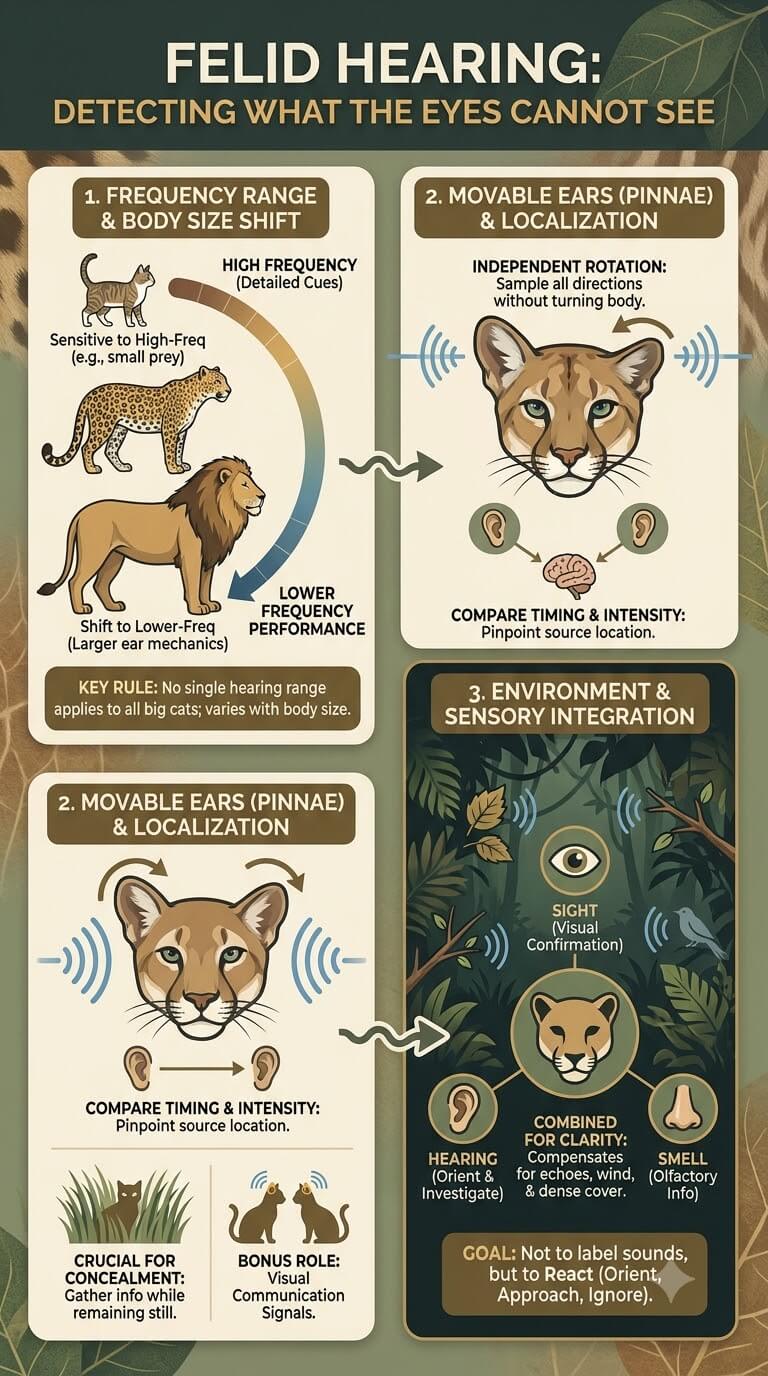
Cats are sensitive to high-frequency sounds, a useful ability for detecting small prey and fine acoustic details. But applying one domestic-cat frequency limit to every lion, tiger, leopard, or jaguar would be poor science. Ear dimensions and middle-ear mechanics vary with body size across the family.
A comparative study of middle-ear acoustics across felids found a general shift toward lower-frequency performance in larger species. That result reinforces a broader rule for this topic: there is no single hearing range that should be copied across all big cats.
Movable Ears Help Localize Sound
Felids can rotate their external ears, or pinnae, to sample sound from different directions without turning the entire body. Changing the orientation of each ear helps the auditory system compare timing and intensity differences, which contributes to locating a source.
That is useful when visual confirmation would reveal the cat’s position. An animal concealed in grass can remain still while its ears gather information. Ear movement also appears in visual communication, so the same structure serves both sensory and signaling roles.
Sound Is Especially Valuable in Vegetation and Darkness
Leaves, grass, footsteps, wingbeats, alarm calls, and prey vocalizations can all provide clues. A big cat does not need to identify a sound with human-like labels. It only needs enough information to orient, investigate, ignore, or approach.
Sound localization becomes more difficult when echoes, wind, water, or dense vegetation distort signals. Cats compensate by moving their head or ears, pausing to listen, and combining what they hear with visual and olfactory information.
Smell: More Important Than the “Cats Have Poor Noses” Myth
Big Cats Investigate Prey, Competitors, and Scent Marks
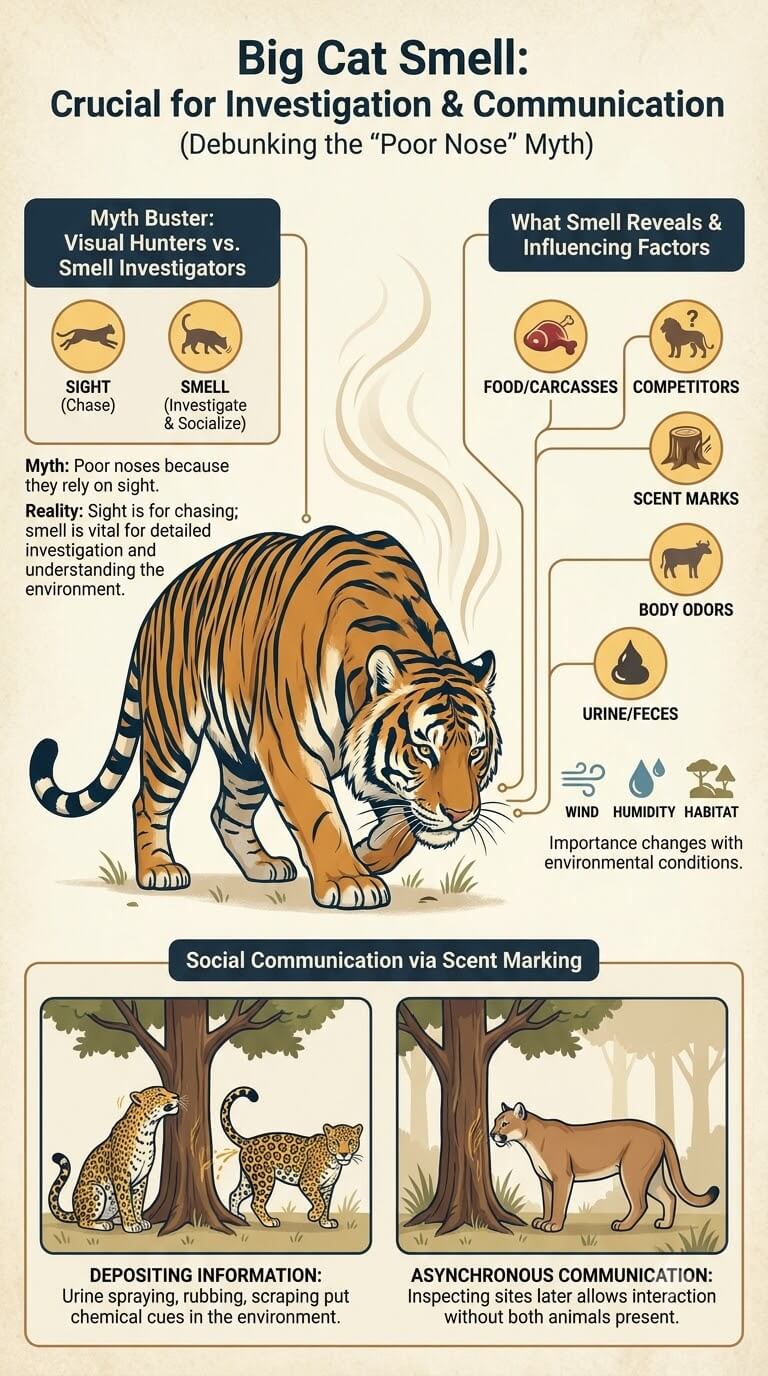
Large cats use ordinary olfaction to investigate the world around them. Smell can reveal food, carcasses, urine, feces, body odors, and scent left on rubbed or marked surfaces. Its importance changes with wind, humidity, habitat, and the type of information being sought.
Compared with dogs, felids are often described as “visual hunters,” but that contrast can lead to a false conclusion that smell barely matters. Hunting and social communication are different tasks. A cat may rely heavily on sight during a chase while still using smell extensively to investigate another cat’s recent presence.
Smell and Scent Marking Work Together
Urine spraying, rubbing, scraping, and other marking behavior put chemical information into the environment. Another cat can inspect those sites later, which allows communication without both animals being present at the same time.
Flehmen and the Vomeronasal System
What Flehmen Actually Does
Flehmen is the characteristic expression in which a cat raises or curls the upper lip after closely investigating a scent. It is associated with sampling chemical cues through the vomeronasal organ, an accessory chemosensory structure separate from the main olfactory pathway.
A scientific review of chemical communication in tigers and other big cats describes flehmen in the context of scent investigation and the vomeronasal system. The behavior is particularly associated with close inspection of urine and other biologically important chemical cues.
Flehmen Is Not a Sign That a Cat “Hates the Smell”
The facial expression can look like a grimace to human observers, but treating it as disgust is anthropomorphic. Flehmen is a sampling behavior. It helps the animal process chemical information that may be relevant to reproduction, identity, or recent presence.
It also should not be reduced to a single “pheromone detector” explanation. Chemical communication can involve complex mixtures, and researchers have not identified every biologically active compound used by every big cat species.
Whiskers and Tactile Sensing
Mystacial Vibrissae Are Specialized Touch Hairs
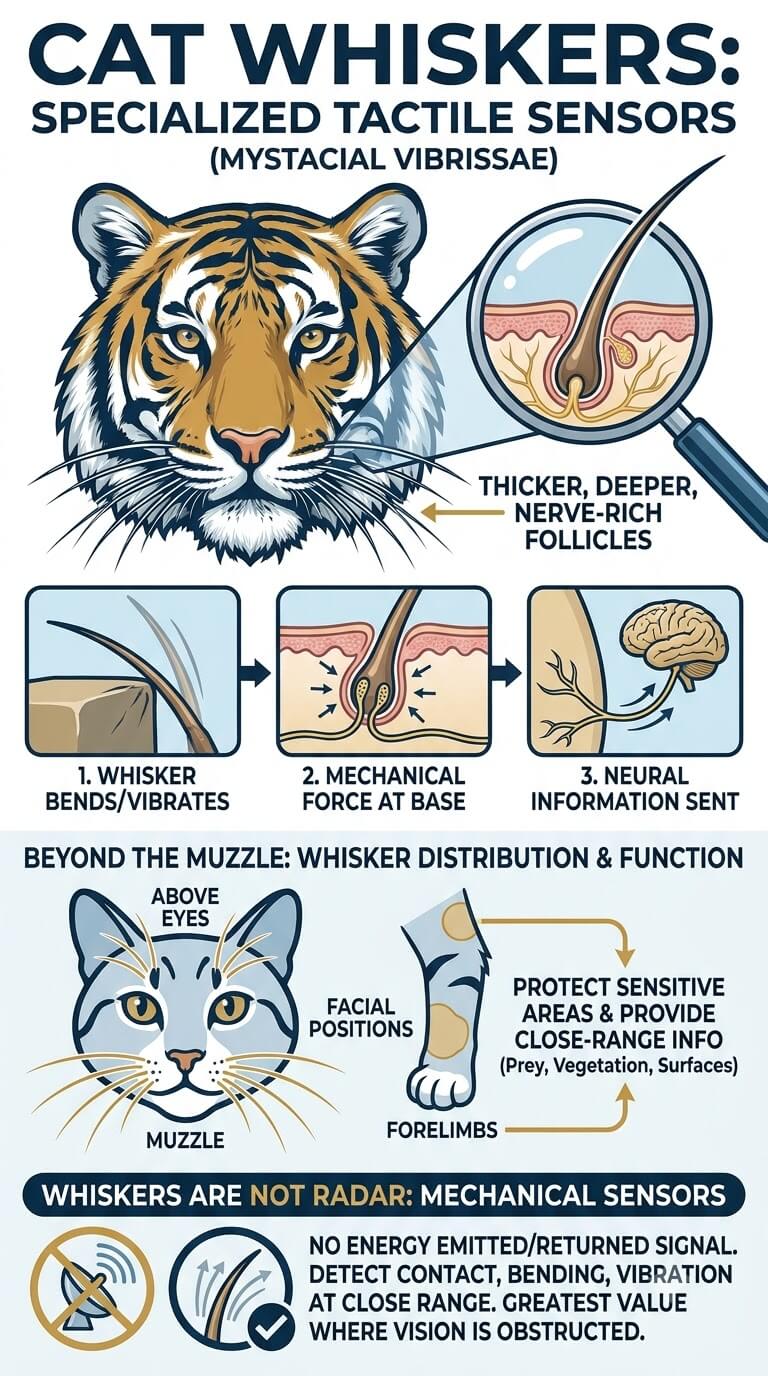
The long whiskers on the muzzle are called mystacial vibrissae. They are thicker and more deeply rooted than ordinary coat hairs, and their follicles are richly supplied with sensory nerves. When a whisker bends or vibrates, mechanical forces reach receptors at the base, turning contact into neural information.
Classic physiological work on cat vibrissae found that sensory fibers respond to whisker deflection and can carry information about the direction and dynamics of movement. This makes whiskers genuine tactile sensors, not decorative hairs.
Big Cats Have More Than Muzzle Whiskers
Felids also have tactile hairs above the eyes and in other facial positions, and some vibrissae occur on the forelimbs. Different sets can help protect sensitive areas or provide information when the cat is close to vegetation, prey, or a surface.
The exact role of each whisker group should not be overstated. Much of the fine experimental work on vibrissal mechanics comes from domestic cats and other mammals rather than free-ranging tigers or jaguars. The family-level anatomy supports tactile function, while species-specific use in the wild is harder to observe directly.
Whiskers Do Not Work Like Radar
Radar sends out energy and analyzes the returning signal. Whiskers do nothing like that. They are mechanical sensors. Contact, bending, vibration, and possibly near-field disturbances around objects can move the whisker, and receptors in the follicle detect those mechanical changes.
That distinction matters because the radar metaphor makes whiskers sound like a long-distance detection system. Their greatest value is at close range, where vision may be obstructed or the cat’s face is very near an object.
How the Senses Work Together During a Hunt
Detection, Orientation, Approach, and Contact Use Different Information
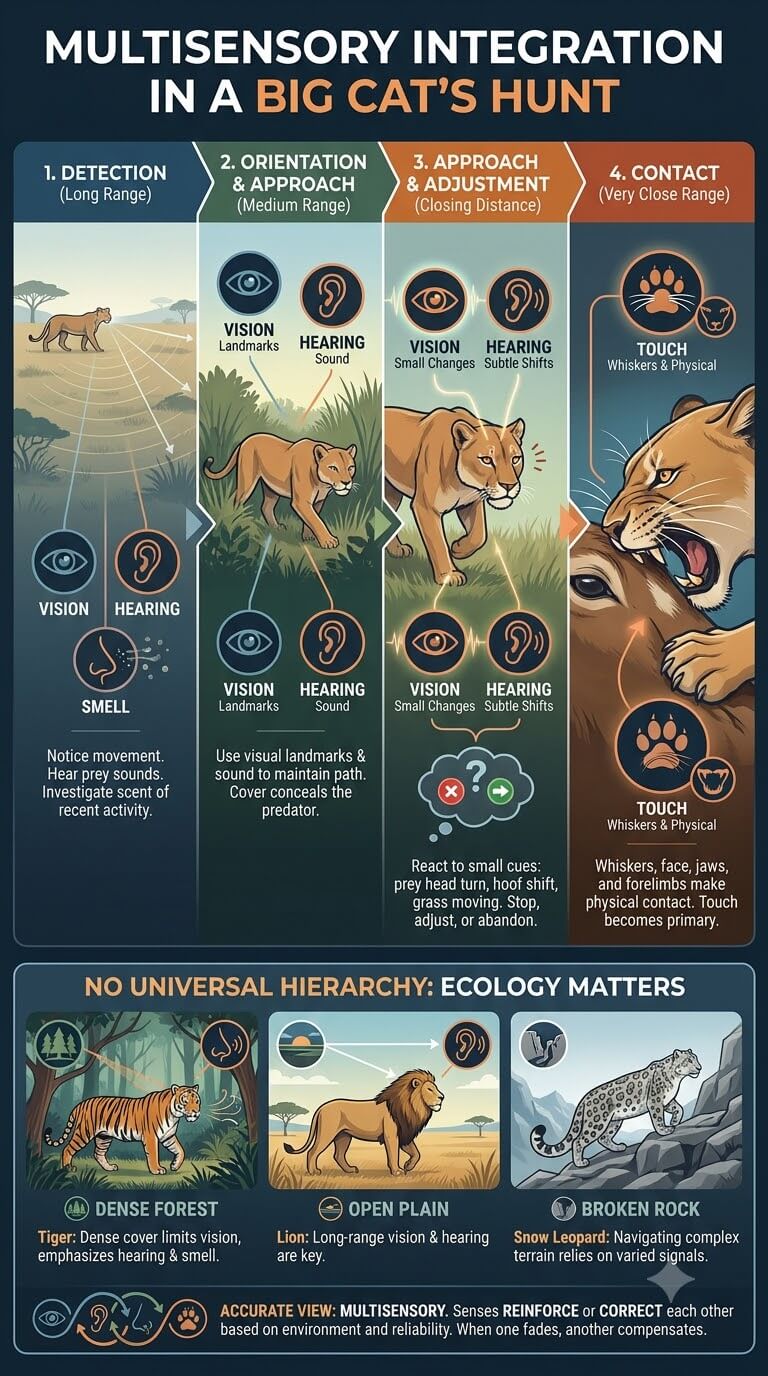
A hunt can be divided into changing sensory problems. At long range, a cat may notice movement, hear prey, or investigate a place where prey has recently been active. During the approach, visual landmarks and sound help the predator maintain orientation while cover hides it.
As distance closes, small changes matter more. A prey animal turns its head, a hoof shifts, or grass moves. The cat may stop, adjust its body, or abandon the attempt. At very close range, touch from whiskers and the physical contact of the face, jaws, and forelimbs become more important.
No Universal Sensory Hierarchy Fits Every Big Cat
It is tempting to rank vision first, hearing second, and smell third, but that ignores ecology. A tiger working through dense forest, a lion monitoring an open plain, and a snow leopard moving through broken rock do not receive the same signals at the same distances.
The more accurate view is multisensory. Vision, hearing, smell, and touch reinforce or correct one another. When one channel becomes unreliable, another may carry more weight.
How Habitat Changes Sensory Demands
Dense Forest and Low Visibility
Forest cats often deal with short sightlines, layered vegetation, heavy shade, and many moving branches. Hearing can reveal activity behind cover, while low-light vision helps in deep shade and at twilight. Whiskers are useful when moving close to trunks, vines, foliage, and prey.
Smell also carries information through these environments, but odor plumes can be broken and redirected by vegetation and air currents. A cat cannot simply follow a scent as though it were a painted line.
Open Grassland and Long Sightlines
Open ground can increase the distance at which movement is visible, but it also makes concealment harder. Lions and cheetahs may monitor prey across wider spaces than a forest cat can, then use terrain, grass height, light, or group position to reduce detection during approach.
Mountain Terrain and Night Activity
Steep slopes and rocky surfaces place extra demands on depth judgment, balance, and close-range awareness. A snow leopard moving across broken ground must coordinate vision with body-position information and tactile feedback from paws and whiskers.
At night, all large cats face the same physical limit: less light means less visual information. Their adaptations improve sensitivity, but hearing and smell become especially useful when visual detail drops.
Common Myths About Big Cat Senses
“Big Cats Can See in Total Darkness”
They cannot. Their eyes are highly effective in low light, but vision still requires light reaching the retina. The tapetum lucidum improves the use of available light rather than creating light from nothing.
“Big Cats See Only Black and White”
Feline color discrimination is more limited than normal human trichromatic vision, but black-and-white vision is an oversimplification. Domestic-cat research supports dichromatic color vision, and broad claims about individual wild species should remain cautious where direct testing is limited.
“Big Cats Have a Weak Sense of Smell”
Smell may not dominate every hunting sequence, but it is important in scent investigation, marking, reproductive behavior, and recognition of animal traces. Comparing cats with exceptionally smell-oriented canids does not make the feline nose unimportant.
“Whiskers Are a Form of Radar”
Whiskers are tactile mechanosensors. They respond when mechanical forces bend or vibrate them. They do not emit a signal, bounce it off an object, and calculate distance the way radar does.
How Sensory Biology Shapes Big Cat Behavior
Hunting, communication, habitat use, and movement all depend on the same sensory equipment. A scent mark has little value without smell and chemical sampling. A stalk requires visual and auditory updates. A close approach through vegetation becomes safer when tactile hairs add information near the face.
These systems also help explain why large cats can change their routines. If human activity makes a landscape riskier during daylight, some populations may shift activity toward darker hours. If vegetation changes, the balance between long-range vision and short-range sensory cues changes with it. Sensory ecology is therefore not a separate feature of a cat’s biology. It is woven into almost everything the animal does.
FAQ
Do Big Cats Have Better Night Vision Than Humans?
Big cats are better adapted than humans for seeing under low-light conditions because feline eyes emphasize light sensitivity and include a tapetum lucidum that reflects light back through the retina. That does not mean every visual task is better. Humans generally have advantages in daylight detail and color discrimination, while cats are specialized for detecting useful visual information when illumination is limited.
What Are Big Cat Whiskers For?
Whiskers are specialized tactile hairs. The follicles at their bases contain sensory receptors that respond when a whisker bends or vibrates. This gives a cat close-range information around the face and can help when navigating vegetation, positioning the head near objects, or handling prey. They are not a long-distance radar system.
Do Big Cats Use Smell to Find Prey?
They can use smell as one source of information about prey, carcasses, or recently used areas, but its importance varies with species, habitat, wind, and hunting context. Large cats often depend heavily on vision and hearing during active stalking, while smell is especially important for scent marks and social or reproductive investigation.
Why Do Big Cats’ Eyes Shine at Night?
Eyeshine occurs when incoming light reflects from the tapetum lucidum behind the retina and travels back out of the eye. The effect is easiest to see when a light source is close to the observer’s line of sight. The cat’s eyes are reflecting light, not producing their own glow.
Do All Big Cats Have Round Pupils?
Many large felids have round pupils, but eye design varies across the cat family and should not be used as a definition of big cat. Research comparing felids has found round pupils in large species such as tigers and slit pupils in smaller species such as domestic cats, with intermediate designs in some medium-sized cats.
Final Thoughts
Big cat senses are best understood as a flexible system. Forward-facing eyes support depth judgment and motion tracking. Low-light-sensitive vision and a tapetum lucidum help cats use dim illumination efficiently. Hearing adds information hidden by darkness or cover. Smell and the vomeronasal system reveal chemical traces, while whiskers provide detailed touch information at close range.
None of those abilities works in isolation, and none supports a universal ranking such as “vision first” or “best eyesight among big cats.” A lion, tiger, jaguar, snow leopard, cheetah, leopard, or clouded leopard uses its senses according to the habitat, prey, social situation, and light conditions it faces. That sensory flexibility is more useful, and more biologically accurate, than any single superpower claim.

Ethan Walker is the founder and research editor of Animal Fact Central. He creates and reviews educational animal facts content using trusted wildlife, pet care, and science-based sources. His work focuses on making animal behavior, adaptations, habitats, and species facts clear, accurate, and engaging for everyday readers.
Read More Details About Ethan Walker: https://animalfactcentral.com/ethan-walker/