
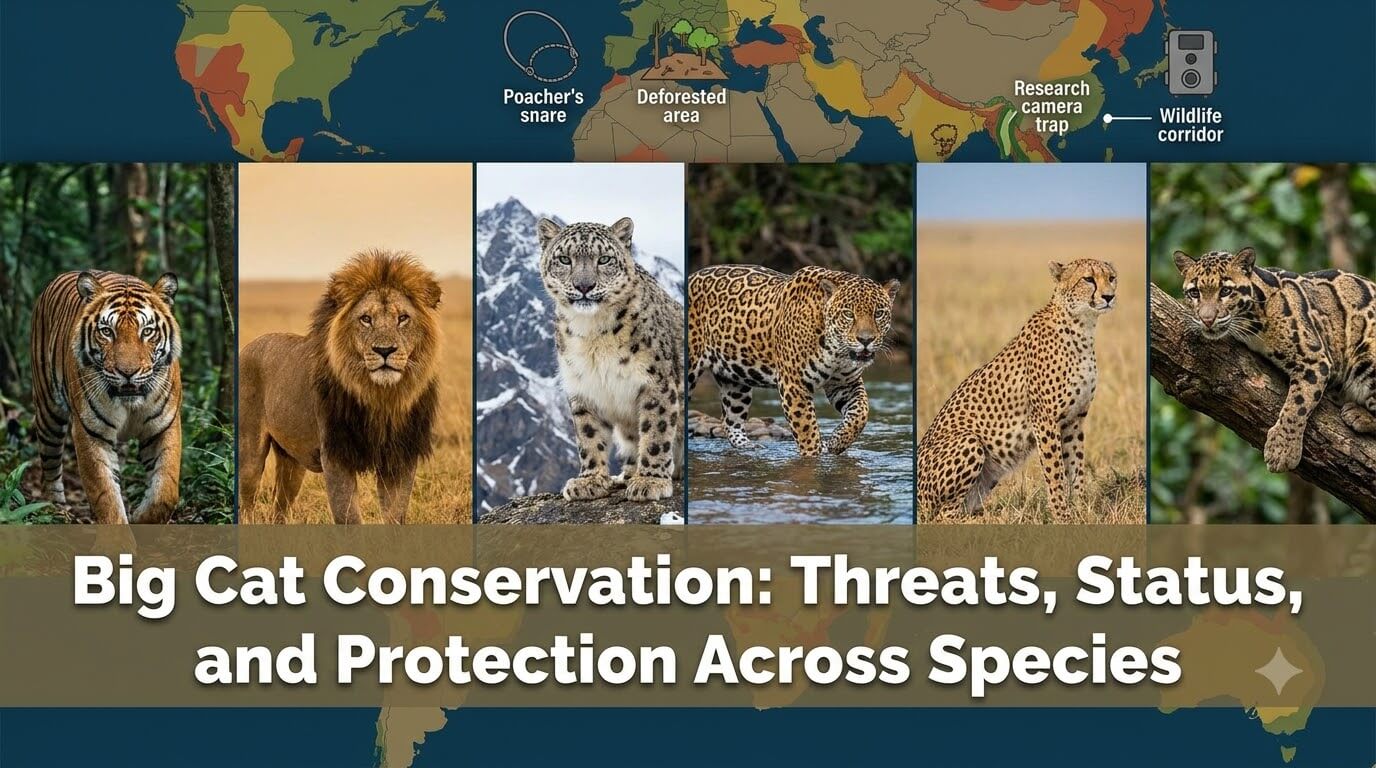
Big cat conservation is not one problem with one solution. Tigers are currently listed as Endangered on the IUCN Red List, while lions, leopards, snow leopards, cheetahs, and both living clouded leopard species are listed as Vulnerable. Jaguars are listed as Near Threatened. Those labels describe species-level extinction risk, but they do not mean every population faces the same danger or that every cat is declining at the same rate.
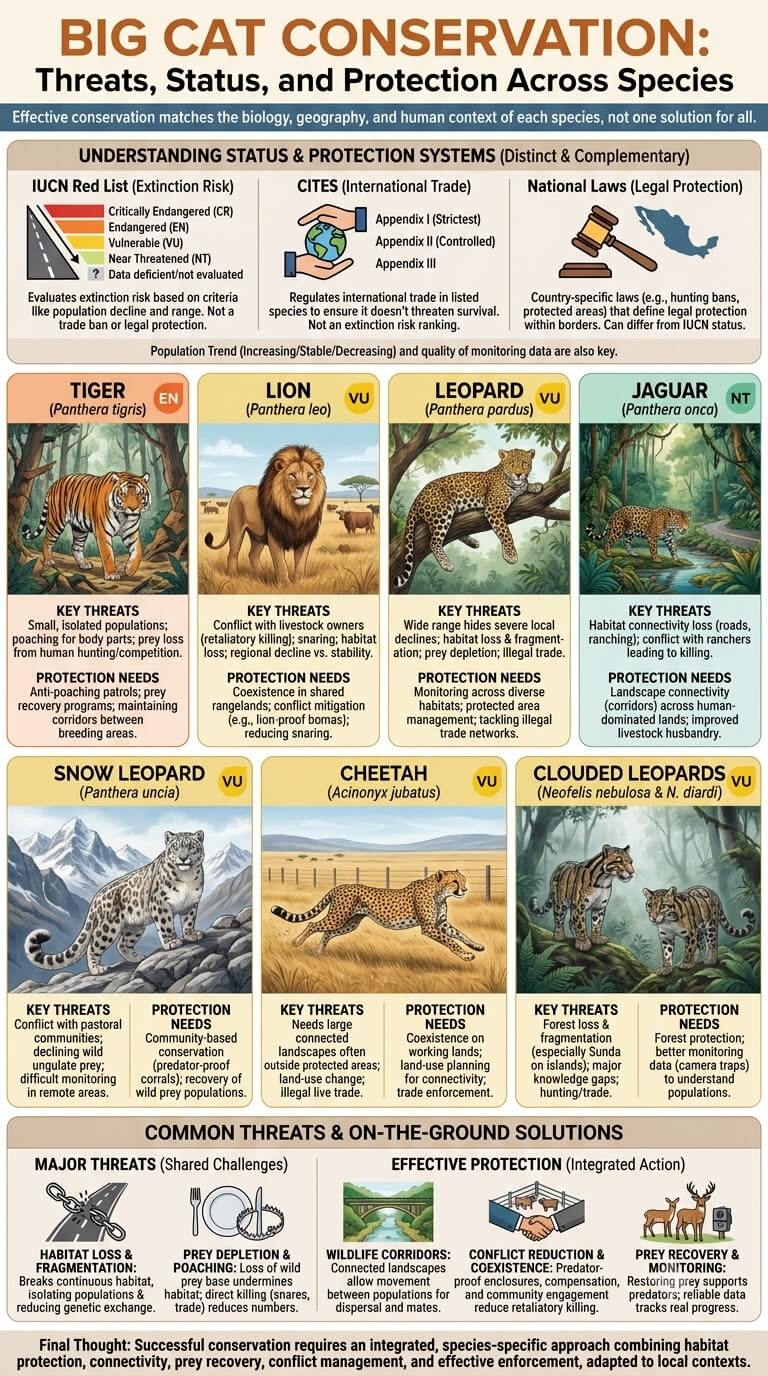
The pressures also differ. A tiger population in a fragmented Asian forest may be limited by poaching, prey loss, and isolation. Lions can be heavily affected by livestock conflict, snaring, and loss of wild prey. Jaguars may lose connectivity as forests and ranching landscapes are divided by roads and development. Snow leopards face mountain-specific conflict with pastoral communities and declining wild ungulates. Cheetahs need unusually large connected landscapes, much of them outside protected areas. Clouded leopards depend heavily on forest systems that are difficult to monitor and increasingly fragmented.
Understanding these differences is more useful than saying simply that “big cats are endangered.” Conservation works best when it matches the biology, geography, and human context of the particular species and population.
How to Read Big Cat Conservation Status
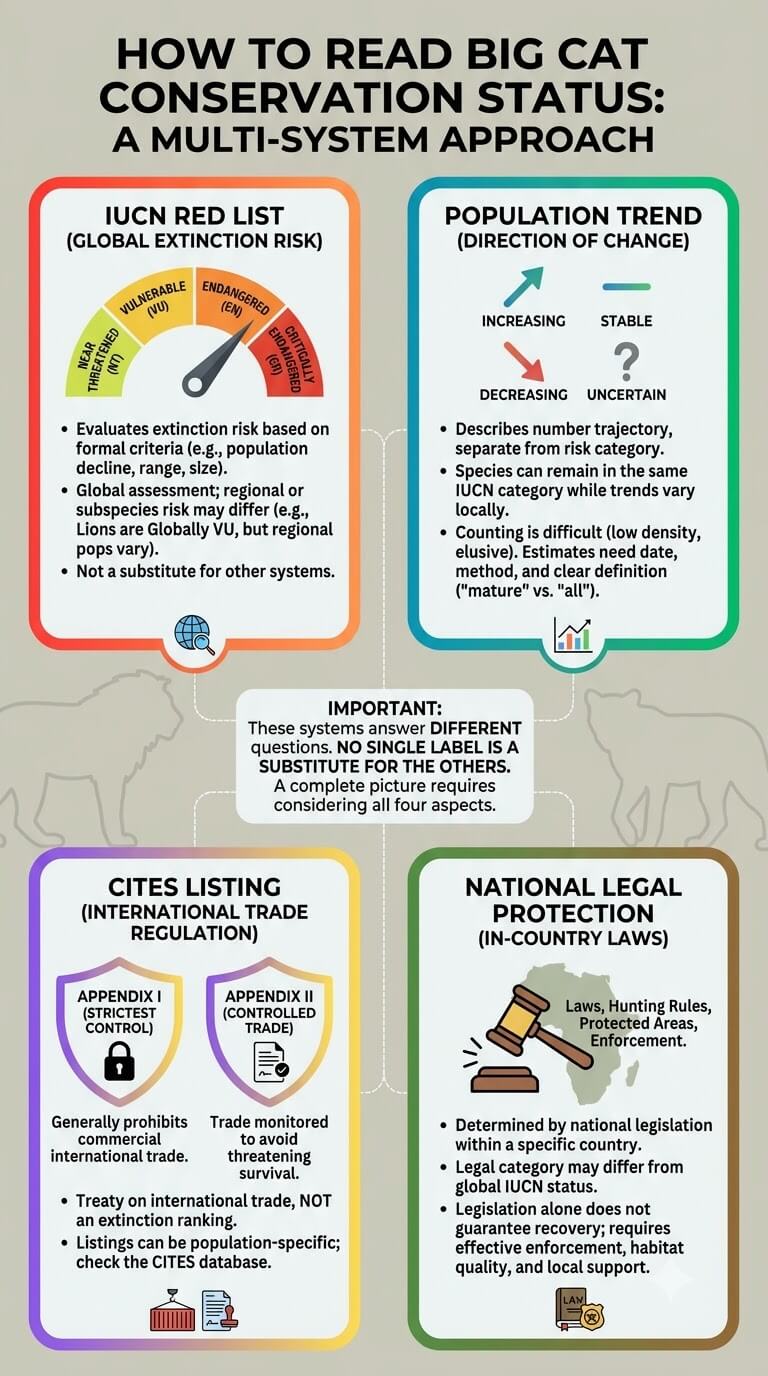
Several conservation systems are often mixed together in popular articles, even though they answer different questions. The IUCN Red List evaluates extinction risk. CITES regulates international trade in listed wildlife. National laws determine legal protection within a country. Population trend describes whether numbers are increasing, stable, decreasing, or uncertain. None of these labels can substitute for the others.
IUCN Red List Category
The IUCN categories most often seen in large-cat conservation are Near Threatened, Vulnerable, Endangered, and Critically Endangered. They are based on formal criteria involving factors such as population decline, geographic range, population size, fragmentation, and extinction probability. A global category applies to the species assessment, while regional or subspecies assessments may show a different level of risk.
For example, the IUCN Cat Specialist Group lion account currently lists the lion as Vulnerable globally while also describing major regional differences. Some lion populations are relatively secure or recovering, while others are highly fragmented or face much greater extinction risk.
Population Trend
A conservation category and a population trend are related but not identical. A species can remain in the same Red List category while particular populations increase, decline, or disappear. Trend estimates also depend on survey quality. Large cats are difficult to count because they occur at low densities, cover large areas, and are often active when people are not present.
That is why an old global population estimate should not be repeated as if it were a current census. A useful estimate needs a date, geographic scope, method, and definition. “Mature individuals,” “adults and subadults,” and “all wild individuals” are not interchangeable counts.
CITES Listing
CITES is a treaty about international trade, not an extinction-risk ranking. Species in Appendix I generally receive the strictest controls on commercial international trade, while Appendix II includes species for which trade must be controlled to avoid threatening survival. Some felids have population-specific listings or annotations, so it is safer to check the CITES-listed species database than to assume one rule applies to every large cat everywhere.
National Legal Protection
Countries also use their own endangered-species laws, hunting restrictions, protected-area rules, trade laws, and wildlife-crime statutes. A national legal category may differ from the global IUCN category because the law applies to a particular jurisdiction or population.
Legal protection is important, but legislation alone does not guarantee recovery. Enforcement, habitat quality, prey availability, local tolerance, protected-area management, and movement between populations often determine whether protection works on the ground.
Current IUCN Status of Familiar Big Cats
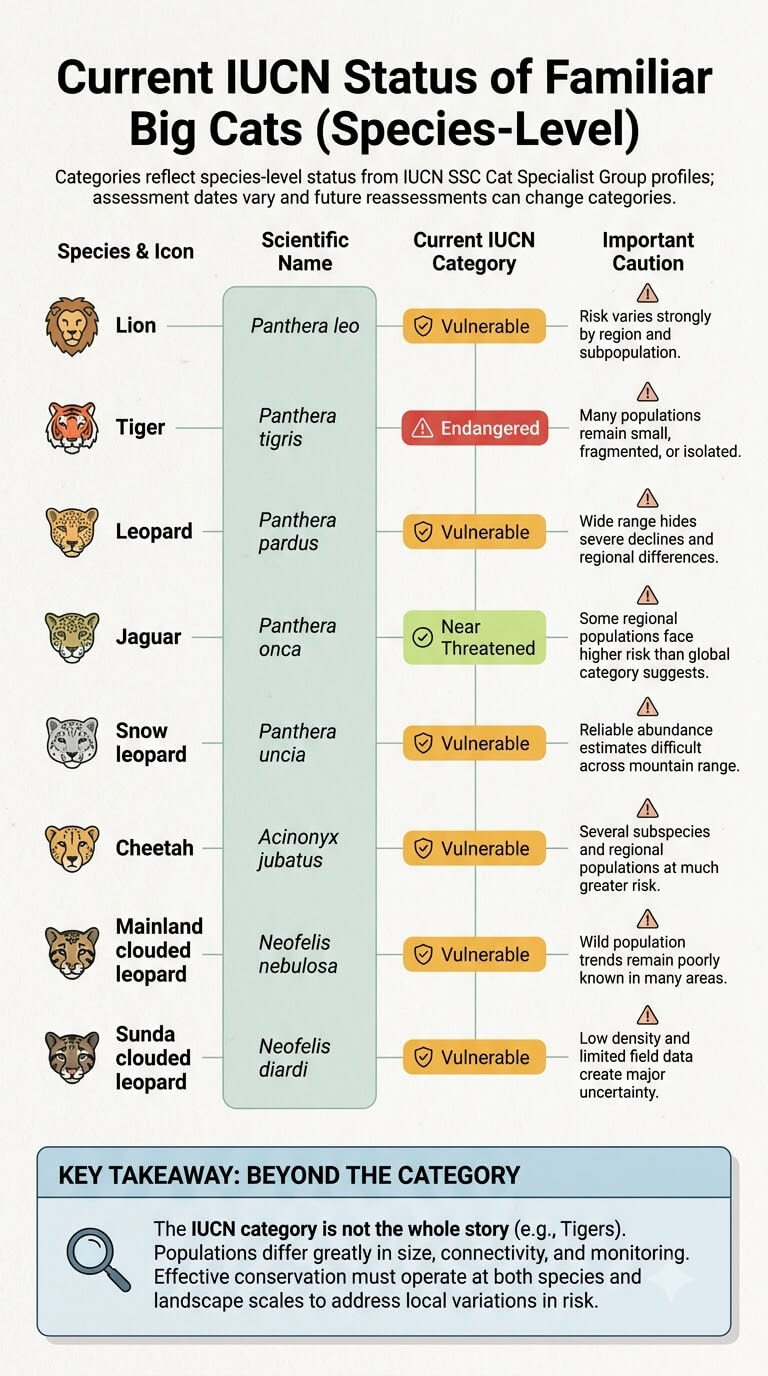
The categories below reflect the current species-level status presented by IUCN SSC Cat Specialist Group profiles available at the time of writing. Assessment dates differ among species, and future reassessments can change these categories.
| Species | Scientific name | Current IUCN category | Important caution |
|---|---|---|---|
| Lion | Panthera leo | Vulnerable | Risk varies strongly by region and subpopulation. |
| Tiger | Panthera tigris | Endangered | Many populations remain small, fragmented, or isolated. |
| Leopard | Panthera pardus | Vulnerable | Its wide range hides severe declines and regional differences. |
| Jaguar | Panthera onca | Near Threatened | Some regional populations face much higher risk than the global category suggests. |
| Snow leopard | Panthera uncia | Vulnerable | Reliable abundance estimates remain difficult across much of its mountain range. |
| Cheetah | Acinonyx jubatus | Vulnerable | Several subspecies and regional populations are at much greater risk. |
| Mainland clouded leopard | Neofelis nebulosa | Vulnerable | Wild population trends remain poorly known in many areas. |
| Sunda clouded leopard | Neofelis diardi | Vulnerable | Low density and limited field data create major uncertainty. |
The Cat Specialist Group tiger profile illustrates why the category alone is not the whole story. Tigers are Endangered globally, but surviving populations differ greatly in size, connectivity, monitoring quality, and management. Conservation therefore has to operate at both species and landscape scales.
Habitat Loss and Fragmentation
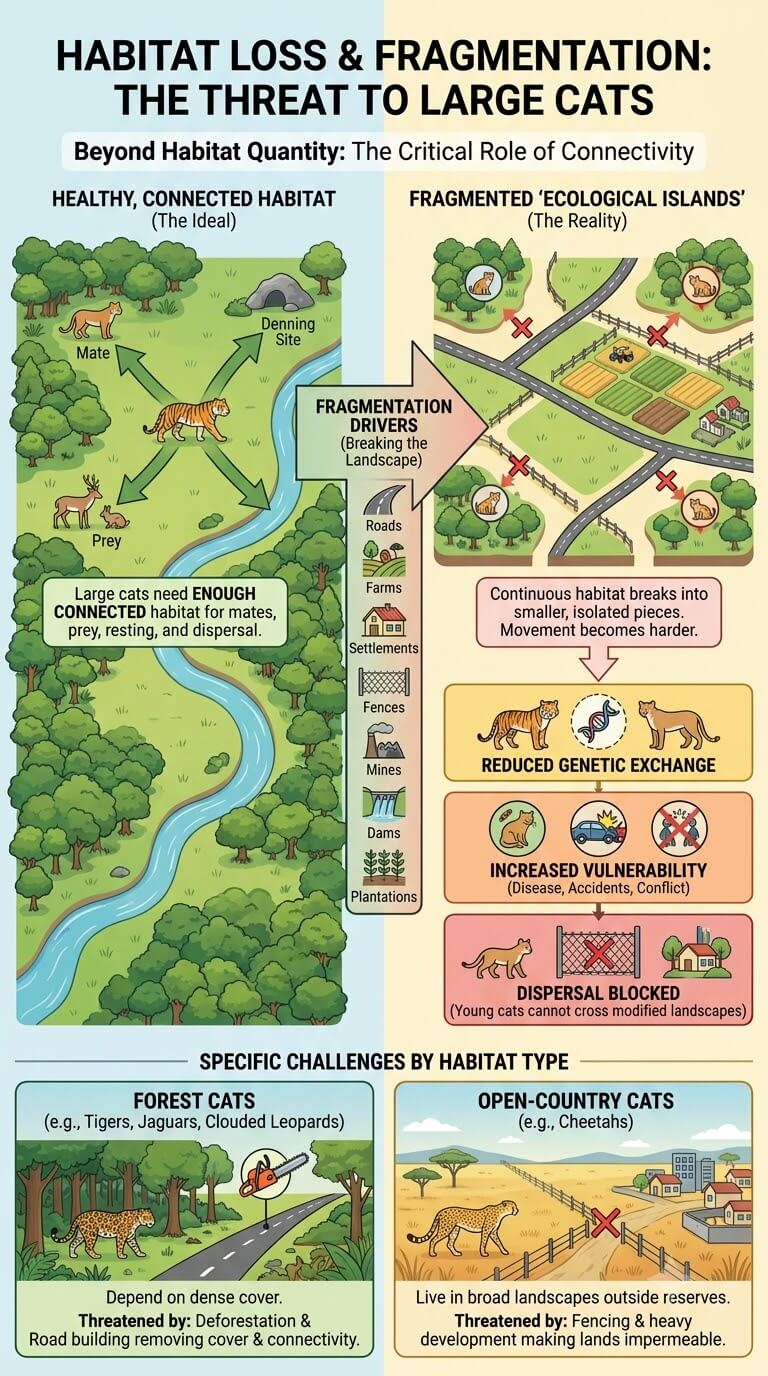
Large cats need habitat, but they also need enough connected habitat to find mates, prey, denning or resting sites, and room to disperse. A forest patch or grassland reserve can look intact on a map while still being too isolated to support movement between populations.
Fragmentation Can Turn One Population Into Several Small Ones
Roads, farms, settlements, fences, mines, dams, plantations, and other development can break continuous habitat into smaller pieces. Animals may still survive in each piece, but movement between them becomes harder. That can reduce genetic exchange and make local populations more vulnerable to disease, demographic accidents, conflict, or sudden habitat change.
Connectivity is especially important for animals that naturally travel long distances. Young cats dispersing from their birth areas need to cross landscapes that may include farms, roads, villages, or heavily modified habitat. If those routes disappear, a protected population can become an ecological island.
Forest Cats and Open-Country Cats Face Different Fragmentation Problems
Tigers, jaguars, and clouded leopards often depend on forested or densely vegetated landscapes, so deforestation and road building can remove both cover and connectivity. Cheetahs face a different problem because many live in broad open landscapes outside reserves. Their survival can depend on ranching and community lands remaining permeable rather than becoming fenced or heavily developed.
Prey Depletion Can Undermine Otherwise Suitable Habitat
A landscape can contain trees, grass, water, and cover yet fail to support large cats if wild prey has been depleted. Hunting for bushmeat, competition with livestock, habitat degradation, and other pressures can reduce deer, antelope, wild pigs, or other prey species.
Prey decline affects more than nutrition. Cats may expand their ranges, spend more time near livestock, or experience lower reproductive success. Increased livestock predation can then trigger retaliation, creating a feedback loop between ecological decline and conflict with people.
For tigers, loss of large ungulate prey can limit recovery even in areas where direct poaching of tigers is reduced. For snow leopards, declining wild mountain ungulates can increase dependence on domestic animals. For lions and leopards, depleted prey around protected areas can intensify encounters with pastoral communities.
Poaching, Snaring, and Illegal Wildlife Trade
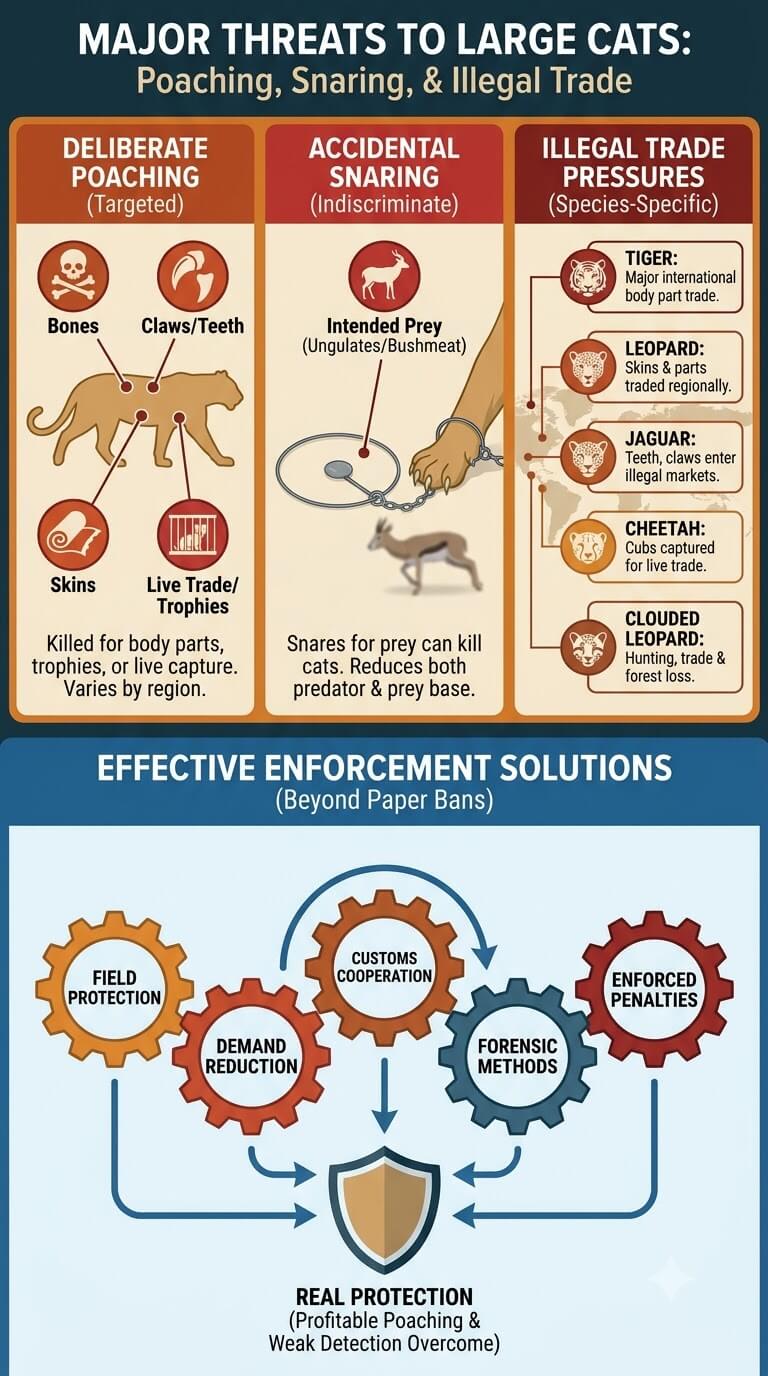
Large cats can be killed deliberately for skins, bones, teeth, claws, live trade, trophies, or other body parts. They can also die accidentally in snares set for different animals. These pressures vary sharply by region and species.
Snares Can Kill Cats That Were Not the Intended Target
Wire snares placed for ungulates or bushmeat can injure or kill lions, leopards, tigers, and other carnivores. A cat may be caught directly or may approach a snared prey animal and become entangled. Snaring can therefore reduce both predator numbers and the prey base they depend on.
Illegal Trade Creates Species-Specific Pressures
Tiger body parts remain a major international wildlife-crime concern. Leopard skins and other parts are traded in some regions. Jaguar teeth, claws, and other products have entered illegal markets. Cheetah cubs have been captured for live trade. Clouded leopards can be affected by hunting and trade as well as forest loss.
Trade enforcement works best when paired with field protection, demand reduction, customs cooperation, forensic methods, and penalties that are actually enforced. A trade ban on paper cannot protect a population if poaching remains profitable and detection is weak.
Retaliatory Killing and Livestock Conflict
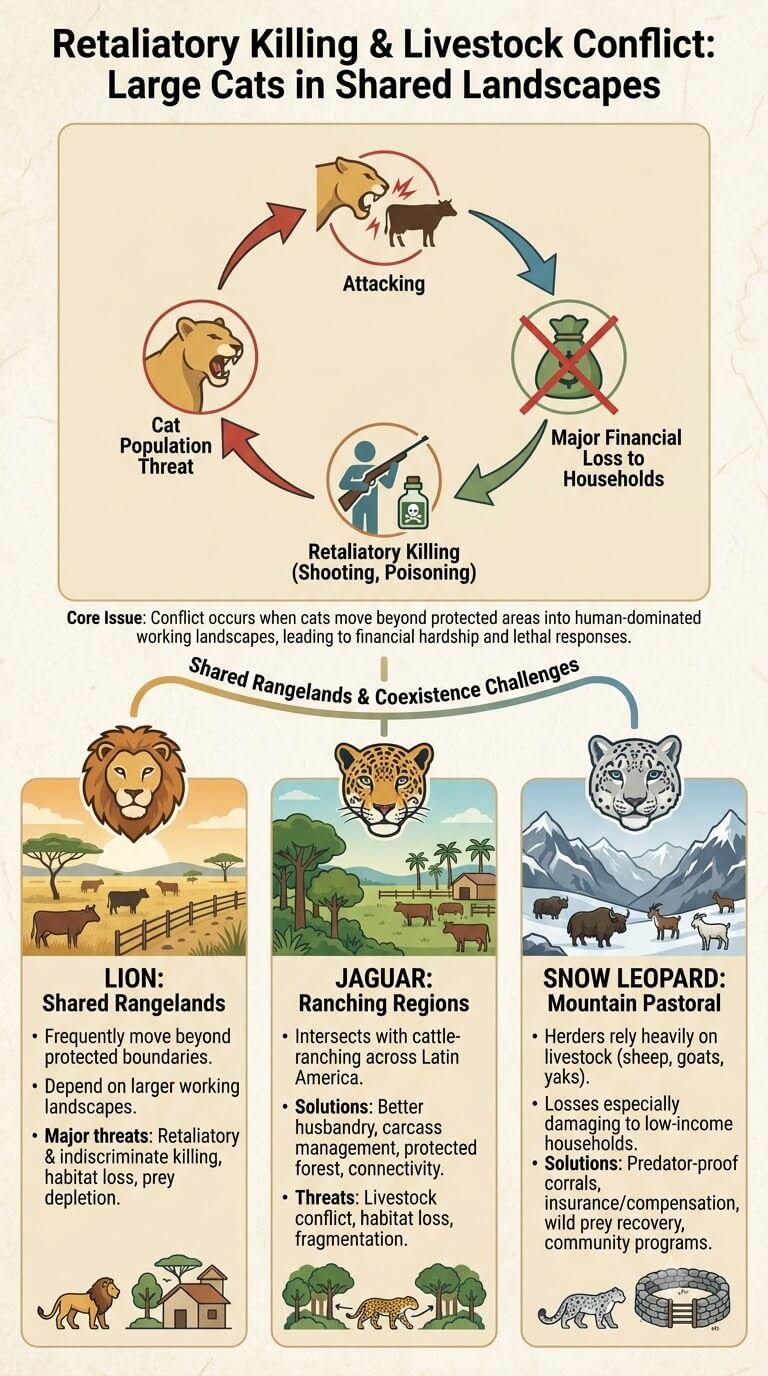
Conflict with livestock owners is one of the most important recurring threats across large-cat ranges. A single attack on cattle, goats, sheep, or other domestic animals can represent a major financial loss to a household. If people see no safe or affordable alternative, the cat may be shot, poisoned, trapped, or pursued.
Lion Conflict Often Occurs in Shared Rangelands
Lions frequently move beyond protected-area boundaries into landscapes used by people and livestock. The Cat Specialist Group identifies retaliatory and indiscriminate killing as major threats, along with habitat loss and prey depletion. The challenge is not simply keeping lions inside parks. Many populations depend on larger working landscapes where people, livestock, and wildlife overlap.
Jaguar Conflict Often Intersects With Ranching
Jaguars can move through cattle-ranching regions across Latin America. The Cat Specialist Group jaguar account identifies livestock conflict, habitat loss, fragmentation, prey reduction, and illegal killing among major threats. Better livestock husbandry, carcass management, protected forest, and landscape connectivity can reduce the conditions that lead to repeated conflict.
Snow Leopard Conflict Has a Mountain Pastoral Context
Snow leopards inhabit landscapes where herders may rely heavily on sheep, goats, yaks, or other livestock. Losses can be especially damaging to households with limited income. Predator-proof corrals, improved herd management, insurance or compensation programs, and recovery of wild prey can all form part of coexistence programs when designed with local communities.
Roads and Infrastructure Can Divide Populations
Infrastructure can affect large cats even when relatively little habitat is physically removed. Roads increase vehicle mortality, create human access into remote areas, change prey distribution, and can make illegal hunting easier. Railways, fences, pipelines, mines, and expanding towns may create additional barriers.
Cheetahs Are Especially Dependent on Large Connected Landscapes
The IUCN Cat Specialist Group cheetah profile emphasizes habitat loss, fragmentation, land-use change, roads, conflict, prey decline, and illegal trade. Much of known cheetah range lies outside formally protected areas, making land-use planning and coexistence on working landscapes unusually important.
That does not mean every cheetah population needs one enormous fenced reserve. In many places, the more useful goal is a network of compatible lands that allows animals to move between core areas without encountering continuous barriers or intense persecution.
Climate Change Matters When the Evidence Is Species-Specific
Climate change is often added to wildlife articles as a generic threat, but its importance should be evaluated species by species. For mountain cats, altered snow patterns, vegetation, water availability, livestock grazing, and shifts in wild prey could change habitat quality. In drylands, changes in rainfall and productivity can affect prey and livestock competition. In forests, climate can interact with fire, drought, and land conversion.
The strongest conservation writing avoids claiming that climate change affects every big cat in the same way. Habitat destruction, poaching, conflict, and prey depletion are often more immediate and directly documented threats. Climate effects should be added where field data or modeling show a meaningful mechanism.
Why the Conservation Problem Looks Different for Each Species
Tigers: Small Populations, Poaching, Prey, and Connectivity
Tigers remain Endangered and survive in a fraction of their former range. Some landscapes support recovering populations, especially where anti-poaching, prey protection, habitat management, and monitoring are strong. Elsewhere, populations remain small or isolated. A successful tiger program therefore has to protect both cats and prey while maintaining movement between breeding areas.
Lions: Conflict, Prey Loss, Snaring, and Regional Unevenness
Lion conservation cannot be summarized by one Africa-wide trend. Conditions differ greatly among protected areas and surrounding landscapes. Some populations are comparatively secure, while others are fragmented and declining. Human-lion conflict, prey depletion, snaring, habitat loss, and weak management can combine in especially vulnerable regions.
Leopards: A Wide Range Can Hide Local Collapse
Leopards occur across an enormous geographic area and tolerate more habitat types than many large cats. That adaptability can create the false impression that they are secure everywhere. The species is globally Vulnerable, and regional populations differ sharply in abundance and pressure. Habitat loss, prey decline, persecution, illegal trade, and conflict all contribute.
Jaguars: Connectivity Across Human-Dominated Landscapes
Jaguars are Near Threatened globally, but several regional populations face much higher risk. Forest clearing and fragmentation can isolate populations, while conflict with ranchers increases direct killing. Maintaining connected landscapes between core jaguar areas is therefore a major conservation priority in parts of the Americas.
Snow Leopards: Pastoral Conflict and Mountain Connectivity
Snow leopards are Vulnerable and difficult to survey across remote mountain systems. Conservation often depends on cooperation with herding communities, recovery of wild ungulate prey, protection from poaching, and maintenance of movement across international borders and high-elevation corridors.
Cheetahs: Space Outside Protected Areas
Cheetahs are Vulnerable globally, but the species’ conservation problem is unusual because many animals live beyond protected-area boundaries. They need large landscapes with adequate prey and relatively low conflict. Roads, fences, livestock systems, competing carnivores, and illegal live trade can all shape survival.
Clouded Leopards: Forest Loss Plus Major Knowledge Gaps
Mainland and Sunda clouded leopards are both Vulnerable. Dense forest, low population density, and secretive behavior make them difficult to study, so abundance estimates carry substantial uncertainty. The mainland clouded leopard is strongly affected by forest fragmentation, hunting, and trade, while the Sunda clouded leopard is restricted to islands where forest loss and fragmentation can be especially consequential.
These species show why uncertainty is itself a conservation issue. Managers cannot wait for perfect data, but they also should not present weak estimates as precise facts. Camera traps, genetic sampling, and long-term field work are particularly valuable for improving what is known.
What Big Cat Conservation Looks Like on the Ground
Protected Areas Need Effective Management
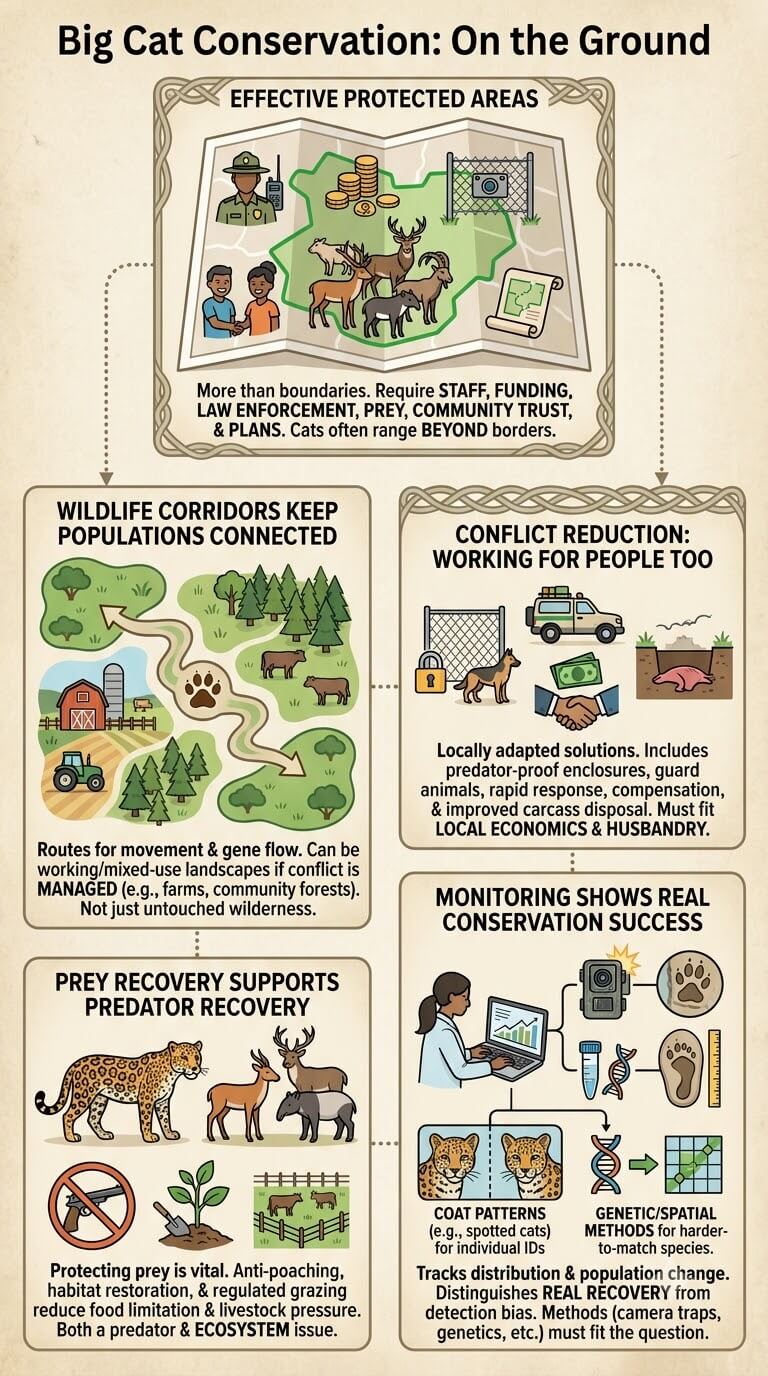
National parks and reserves can protect habitat and reduce some forms of hunting or development, but a boundary on a map is not enough. Protected areas need staff, funding, law enforcement, prey populations, community relationships, and management plans. Many big cats also range beyond reserve borders.
Wildlife Corridors Keep Populations Connected
Corridors are routes or landscapes that allow animals to move between larger habitat areas. They can preserve gene flow, allow dispersal, and help populations recolonize suitable habitat. A corridor does not have to be untouched wilderness. In some regions, working farms, community forests, ranches, or mixed-use landscapes can remain permeable if conflict and barriers are managed.
Conflict Reduction Has to Work for People Too
Predator-proof livestock enclosures, better herding, guard animals where appropriate, rapid response, compensation or insurance systems, and improved carcass disposal can reduce losses in some settings. The details must fit local husbandry and economics. A measure that works for snow leopard herders in Central Asia may not fit cattle ranches in jaguar country or pastoral systems around lion habitat.
Prey Recovery Supports Predator Recovery
Protecting large cats without protecting their prey can fail. Anti-poaching programs, habitat restoration, regulated grazing, and recovery of wild ungulates can reduce food limitation and may also reduce pressure on livestock. Prey restoration is therefore both a predator issue and an ecosystem issue.
Monitoring Shows Whether Conservation Is Working
Camera traps, genetic samples, spoor surveys, telemetry, occupancy models, and other field methods can track distribution and population change. Good monitoring matters because conservation programs need to distinguish real recovery from better detection or a temporary concentration of animals in a small area.
For spotted and striped cats, individual coat patterns can sometimes help researchers recognize animals across repeated camera-trap photographs. For species with less easily matched markings, genetic and spatial methods may be more useful. The method should fit the question and species.
Captive Big Cats and U.S. Law Are a Different Issue
Wild-population conservation and captive-animal regulation overlap in public discussion but are not the same problem. In the United States, the Big Cat Public Safety Act was enacted in 2022 and placed new restrictions on private possession, breeding, commerce, and public contact involving specified big cats. The U.S. Fish and Wildlife Service guidance on the Big Cat Public Safety Act explains the current federal requirements and exceptions.
The law addresses captive possession and public safety. It should not be used as a substitute for discussing habitat loss, prey decline, poaching, or conflict affecting wild populations. Likewise, preventing cub-petting attractions does not by itself restore tiger forests, lion rangelands, jaguar corridors, or snow leopard prey.
Common Misunderstandings About Big Cat Conservation
“All Big Cats Are Endangered”
No. The species discussed here occupy several IUCN categories. Tiger is Endangered, jaguar is Near Threatened, and several others are Vulnerable. Regional populations and subspecies can face higher or lower risk than the global category.
“CITES Appendix I Means the Same Thing as IUCN Endangered”
No. IUCN assesses extinction risk, while CITES regulates international trade. The systems use different criteria and serve different purposes. A species can be in a strict CITES trade category without having the word Endangered as its global IUCN label.
“Legal Protection Means a Population Is Safe”
Law is only one part of conservation. A protected species can still decline if enforcement is weak, habitat disappears, prey is depleted, or conflict remains unresolved. Recovery requires conditions that allow animals to survive and reproduce over the long term.
“One Population Number Tells the Whole Story”
Global estimates can hide local extinctions, isolated populations, and differences in survey methods. Numbers should be interpreted with their year, geographic scope, age class, and method. Older estimates should not be recycled as if they were a live count.
“Protected Areas Alone Can Save Every Big Cat”
Protected areas are essential, but many cats move beyond them. Cheetahs, lions, jaguars, leopards, and tigers can all depend on broader landscapes that include farms, ranches, forests, roads, villages, or community lands. Connectivity and coexistence often matter as much as the core reserve.
FAQ
Which big cats are most threatened today?
There is no single answer because “most threatened” can refer to global species status, a subspecies, or a regional population. Among the species covered here, tiger is globally Endangered, while several other large cats are Vulnerable and jaguar is Near Threatened. Some regional populations or subspecies face substantially higher risk than those global categories suggest.
Why do big cat population estimates change?
Estimates change because surveys improve, populations genuinely rise or fall, study areas change, and researchers use different methods. Camera trapping, genetic analysis, occupancy modeling, and telemetry do not all measure the same thing. A good estimate should always be read with its year, location, method, and definition of which animals were counted.
How do wildlife corridors help big cats?
Corridors allow animals to move between larger habitat areas. That can help young cats disperse, allow adults to find mates, preserve genetic exchange, and reduce the isolation of small populations. Corridors are especially important where roads, farms, towns, or other development have broken formerly continuous habitat into separate pieces.
Does stopping poaching solve big cat conservation?
It can be essential, but it is rarely sufficient by itself. A population also needs suitable habitat, enough prey, movement routes, and tolerable levels of conflict with people. In some landscapes, reducing livestock losses or restoring prey may be just as important as direct protection from killing.
Can ordinary people help conserve big cats?
People can avoid wildlife products from illegal trade, reject attractions that allow direct contact with big-cat cubs, support reputable conservation programs, and choose tourism operators that follow responsible wildlife-viewing practices. The most effective large-scale outcomes still depend on range-country communities, governments, researchers, land managers, and long-term habitat protection working together.
Final Thoughts
Big cat conservation works only when the differences among species are taken seriously. Tigers, lions, leopards, jaguars, snow leopards, cheetahs, and clouded leopards do not share one conservation status, one habitat, or one dominant threat. Some depend heavily on forest protection, others on vast open landscapes, mountain coexistence, prey recovery, trade enforcement, or safe movement across working lands.
The most useful conservation picture is therefore species-specific and current. IUCN category, CITES listing, national law, population trend, and local threat level answer different questions. When those distinctions are kept clear, it becomes easier to understand why connected habitat, healthy prey, conflict reduction, effective enforcement, and reliable monitoring are all needed to keep large wild cats on the landscape.

Ethan Walker is the founder and research editor of Animal Fact Central. He creates and reviews educational animal facts content using trusted wildlife, pet care, and science-based sources. His work focuses on making animal behavior, adaptations, habitats, and species facts clear, accurate, and engaging for everyday readers.
Read More Details About Ethan Walker: https://animalfactcentral.com/ethan-walker/