
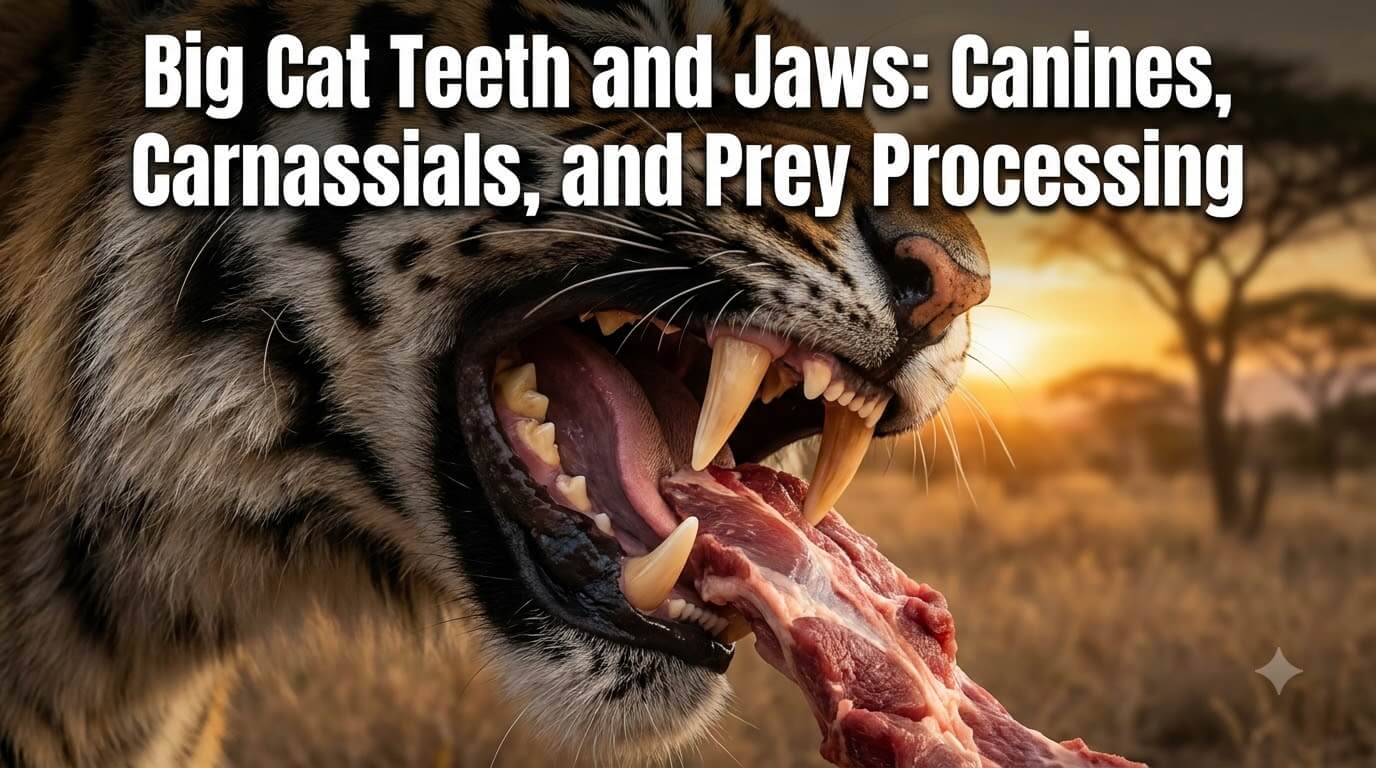
Big cat teeth are not a collection of interchangeable “fangs.” Different teeth do different jobs, and the skull, jaw muscles, jaw joint, and tongue work with them as one feeding system. The long canines are built mainly for gripping and penetrating prey, while the blade-like carnassials farther back in the mouth slice meat. Small incisors help with close handling of food, and the remaining cheek teeth reflect the strongly meat-focused diet shared by cats.
That arrangement matters because a lion, tiger, leopard, jaguar, snow leopard, or clouded leopard does not process food the way a bear, raccoon, or human does. Cats have comparatively short tooth rows and reduced grinding surfaces. Their mouths are especially effective at seizing, cutting, and swallowing animal tissue rather than repeatedly crushing and grinding a mixed diet. The details vary among species, but the same basic feline plan runs through the family.
How the Big Cat Feeding System Works
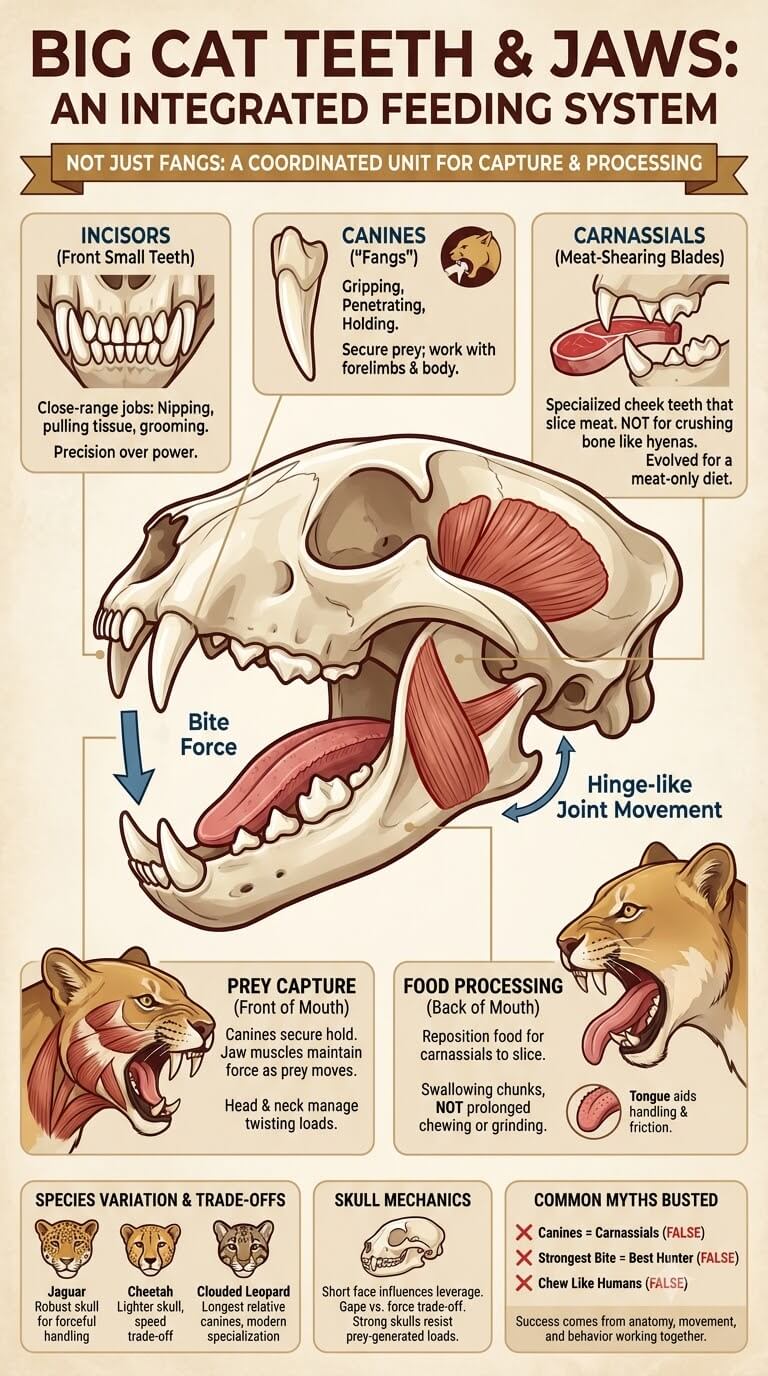
The easiest way to understand a big cat’s mouth is to separate prey capture from food processing. During a hunt, the front of the mouth is especially important. Canines help secure a hold, while jaw muscles and the shape of the skull allow the cat to maintain force as prey moves. After capture, the cat can reposition food so the rear cutting teeth do more of the slicing.
Felids are unusually specialized carnivorans. The Animal Diversity Web account of Felidae describes the family’s short rostrum, shortened tooth row, reduced cheek teeth, and well-developed carnassials. In a typical felid, the adult dental formula totals 30 teeth, although dental variation can occur in individuals. That compact arrangement is very different from the broader crushing and grinding surfaces found in many omnivorous mammals.
No single feature explains the system. A long canine without a skull able to support loading would be a poor tool. Powerful muscles without enough gape would limit where those canines could be placed. Sharp carnassials without controlled jaw movement would not shear efficiently. Feeding performance comes from the interaction of the entire head.
The Felid Skull Is Built as a Mechanical Unit
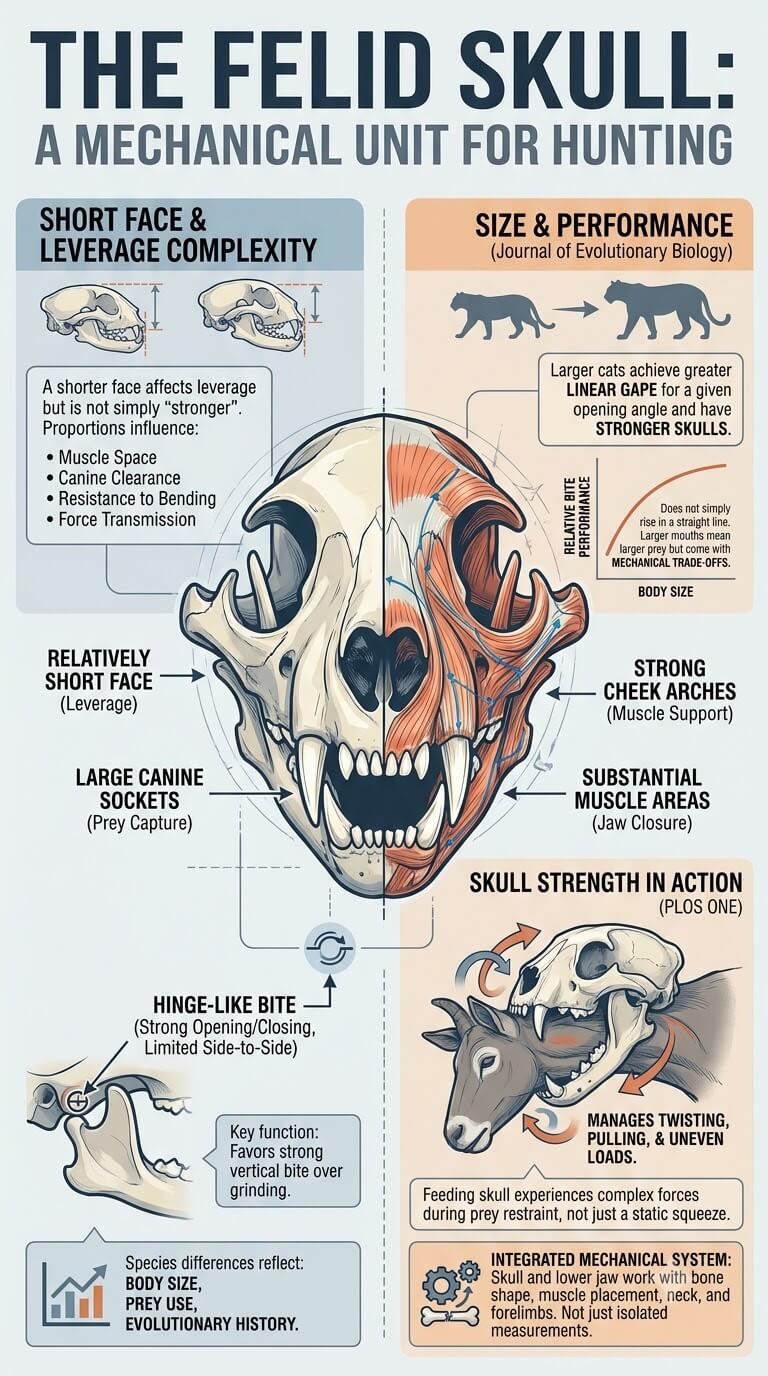
Big cats share the recognizable feline skull plan: a relatively short face, large canine sockets, strong cheek arches, and substantial areas for jaw-closing muscles. The lower jaw meets the skull in a joint that favors strong opening and closing movement. Compared with an animal that grinds food side to side, a cat’s jaw is much more strongly biased toward a hinge-like bite.
A Short Face Changes Jaw Leverage
A shorter distance between the jaw joint and the teeth can affect leverage, but it would be misleading to reduce feline performance to “short face equals stronger bite.” Skull proportions also influence space for muscles, canine clearance, resistance to bending, and the way forces travel through bone. Species differ in these proportions because they differ in body size, prey use, and evolutionary history.
Research on felid skull mechanics shows that size changes more than raw force. A Journal of Evolutionary Biology study of felid skull form and function found that larger cats can achieve greater linear gape for a given opening angle and have stronger skulls overall, while relative bite performance does not simply rise in a straight line with body size. In practical terms, a larger mouth can accommodate larger prey structures, but that comes with mechanical trade-offs.
Skull Strength Matters When Prey Moves
A feeding skull experiences more than a neat downward squeeze. During prey restraint, the head can be exposed to twisting, pulling, and uneven loads. Bone shape, muscle placement, the neck, and the forelimbs all help the animal manage those forces. This is one reason laboratory or modeled bite-force numbers cannot stand in for real hunting performance.
A comparative PLOS ONE analysis of felid skull and mandible shape treats the skull and lower jaw as an integrated mechanical system rather than a set of isolated measurements. That is a better way to think about big cats: their feeding anatomy works through coordinated structures, not through one record-setting tooth or muscle.
Incisors: Small Teeth With Close-Range Jobs
The incisors are the small teeth across the front of the mouth between the canines. They attract less attention than the large canines, but their position makes them useful when a cat needs precision near the lips. Incisors can help nip and pull small pieces of tissue, scrape close to surfaces, and assist with grooming.
They are not miniature versions of the carnassials. Their job is closer to gripping, picking, and fine handling than to the powerful slicing performed farther back in the mouth. In a carcass, that can mean working on small pieces that would be awkward to position between the large cheek teeth.
Canines: Gripping, Penetrating, and Holding
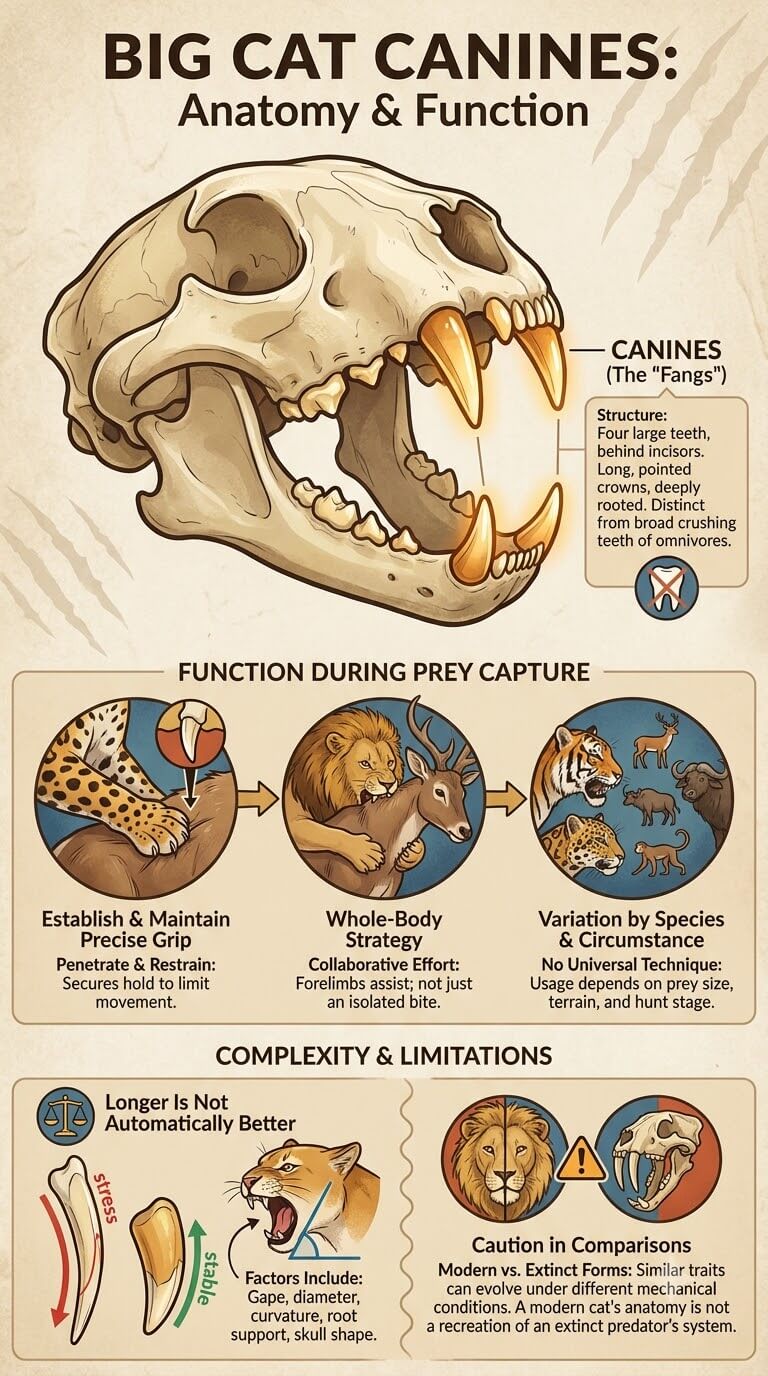
The four large canine teeth sit behind the incisors, one on each side of the upper and lower jaws. These are the teeth people usually mean when they call a big cat’s teeth “fangs.” Their crowns are long, pointed, and rooted deeply in the jaws, giving them a very different form from the broad crushing teeth of many omnivores.
What Canines Do During Prey Capture
Canines help a cat establish and maintain a precise grip. Depending on species, prey size, and the stage of a hunt, a bite may be directed toward areas where a secure hold can limit movement and support dispatch. The forelimbs often contribute by gripping or controlling prey, so canine use is part of a whole-body capture strategy rather than an isolated bite.
It is safer to describe canines as penetrating and restraining structures than to claim every big cat uses one universal killing technique. Lions, tigers, leopards, jaguars, snow leopards, and clouded leopards encounter different prey and operate in different terrain. Even within a species, prey size and circumstance can change how the mouth is used.
Longer Is Not Automatically Better
A longer canine increases reach, but it also changes bending stresses and the gape needed to place the tooth effectively. Tooth diameter, curvature, root support, skull shape, and how the animal positions prey all matter. This is why simply measuring canine length cannot tell you which cat is a “better” predator.
The same caution applies to comparisons between living cats and extinct saber-toothed forms. Similar-looking traits can evolve under different mechanical conditions. A living species with unusually long canines is still operating within the anatomy of a modern felid, not recreating an extinct predator’s entire skull, jaw, neck, and prey-capture system.
Carnassials: The Main Meat-Shearing Teeth
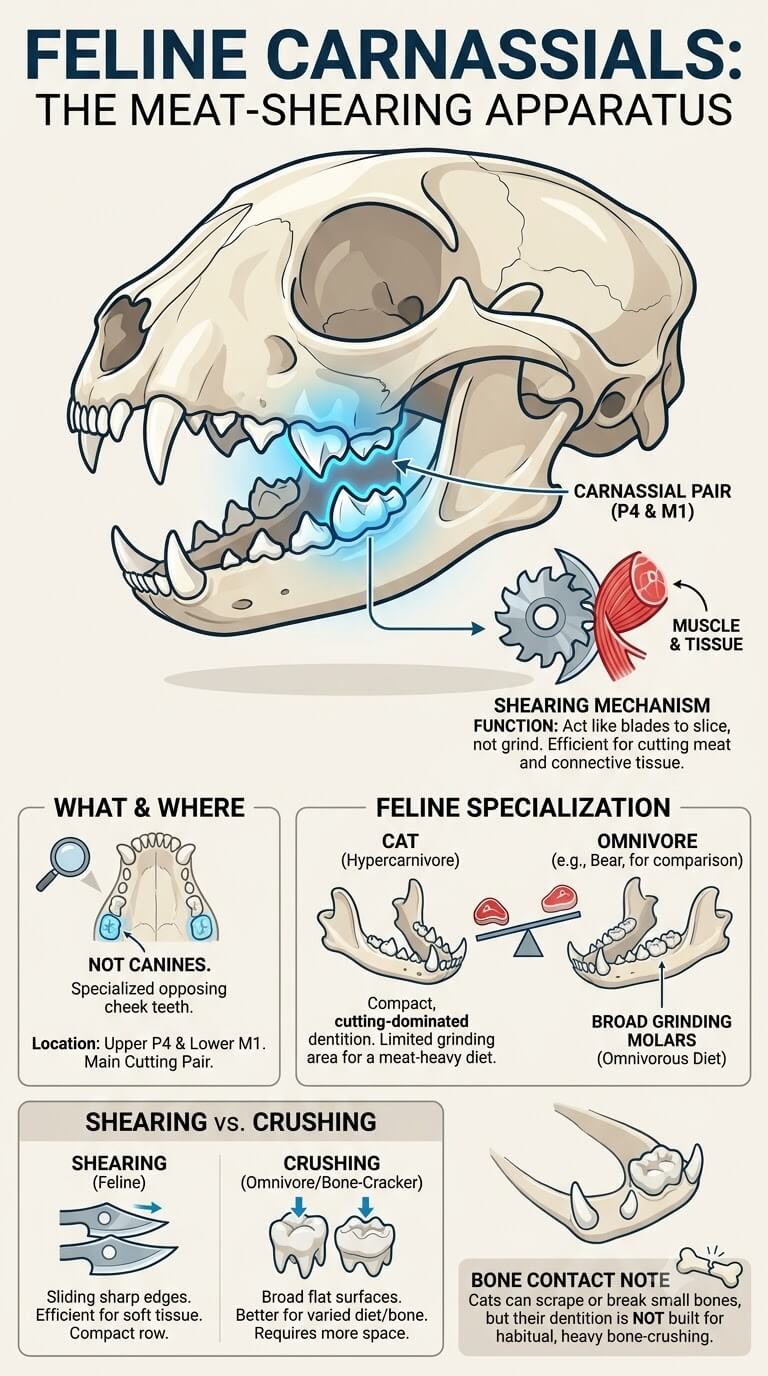
Carnassials are not the canines. In living carnivorans, the term refers to a specialized opposing pair of cheek teeth that form a cutting apparatus. In cats, those teeth act like blades as the jaws close, allowing the animal to slice through muscle, connective tissue, skin, and other food that is easier to cut than to grind.
Where the Cutting Pair Sits
For cats, the main carnassial pair is formed by the upper fourth premolar and lower first molar on each side. That tooth-position detail is useful for identifying the system, but the more important idea is functional: the cutting edges meet in a way that produces shearing rather than broad crushing.
The general carnivoran carnassial plan appears in many members of Carnivora, so it is not uniquely feline. What makes cats especially specialized is how strongly the rest of their dentition is organized around a meat-heavy diet. The rear grinding area is limited compared with many omnivorous carnivorans.
Why Shearing Works Better Than Grinding for a Cat
Muscle and connective tissue can be divided efficiently by sliding sharp edges past one another. Broad flat molars would be better for crushing and grinding a varied diet, but they would take up space and lengthen the tooth row. Cats instead retain a compact set of cheek teeth dominated by cutting function.
This does not mean big cats never contact bone with their teeth. They can scrape, pull, and sometimes break or consume smaller bones. The point is that their dentition is not built around habitual bone-crushing in the same way as the heavily reinforced cheek teeth of specialist bone-cracking carnivores.
Premolars and Molars Beyond the Main Cutting Blades
The terms premolar and molar describe tooth position and developmental identity, not a single function. In felids, some premolars help puncture and grip chunks of food, while the enlarged upper fourth premolar forms the upper half of the carnassial pair. The lower first molar forms the opposing lower blade.
Behind that cutting system, the remaining grinding area is small. That reduction is an important clue to feline feeding ecology. A cat does not need a long row of broad, bunodont molars like an omnivore that routinely crushes fruit, roots, seeds, and animal material into smaller pieces.
Jaw Muscles, Gape, and the Trade-Offs of a Large Bite
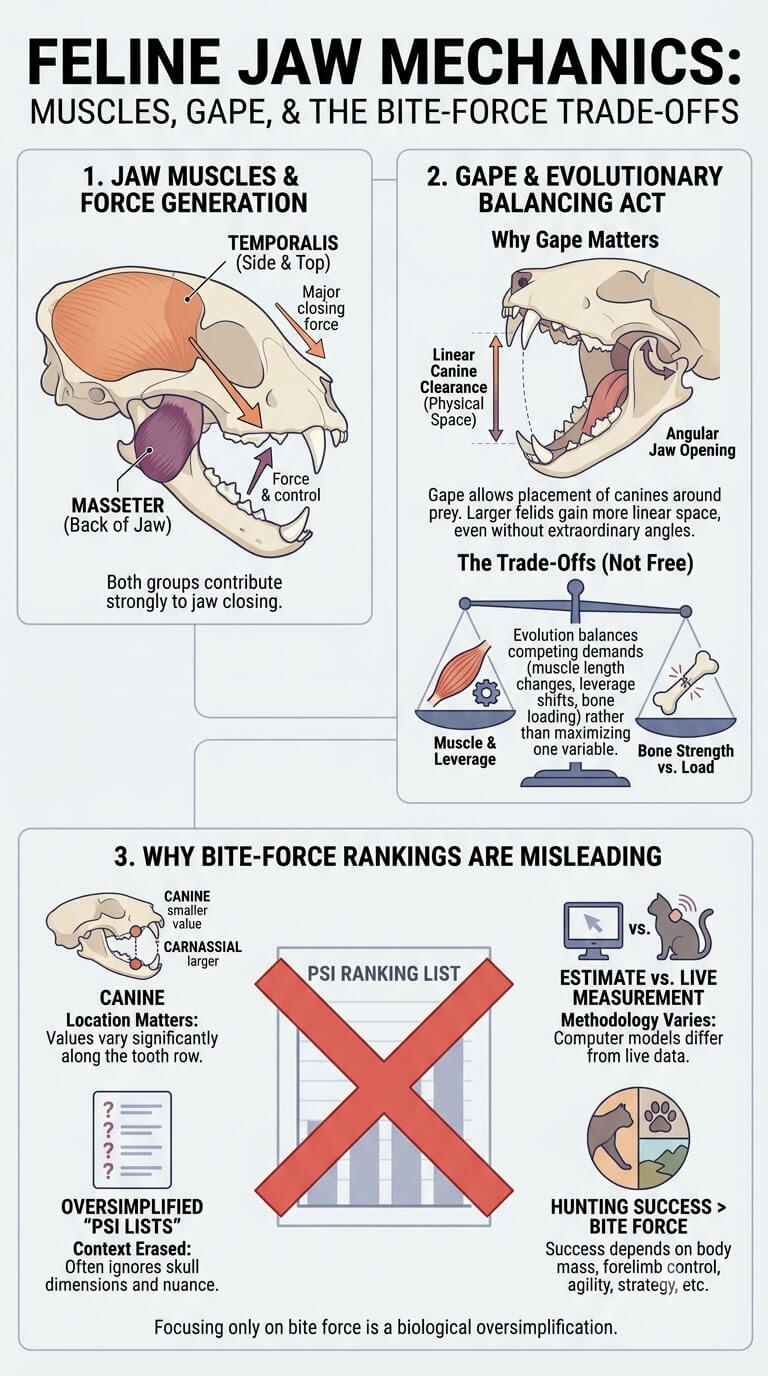
Jaw-closing force is produced by several muscles, especially the temporalis and masseter groups. In cats, the temporalis occupies a major area around the side and top of the skull and contributes strongly to closing the jaws. The masseter also matters, particularly for force and control around the back of the jaw.
Why Gape Matters
Gape is the opening between the upper and lower jaws. A cat that uses long canines on relatively large prey must open far enough to place those teeth around the target. Linear canine clearance therefore matters alongside angular jaw opening. Larger felids can gain more physical space between the canine tips even when the opening angle itself is not extraordinary.
Greater gape is not free. Muscle fibers change length as the jaw opens, and leverage changes through the movement. Bone must also resist the loads that arise when the jaws close and prey struggles. Evolution balances these competing demands rather than maximizing one variable.
Why Bite-Force Rankings Are Usually Misleading
Bite force depends on where along the tooth row it is measured or estimated, jaw opening, muscle assumptions, skull dimensions, and the method used. A value at the canine is not directly interchangeable with a value at the carnassial. A computer estimate is not the same thing as a force measured in a living animal. “Pounds per square inch” lists often erase those distinctions.
More importantly, hunting success depends on far more than bite force. Body mass, forelimb control, acceleration, balance, prey choice, experience, cover, terrain, and where the bite is placed can all matter. A jaguar’s robust skull, a tiger’s body size, and a leopard’s flexible prey use are biologically interesting without turning them into a single strongest-jaws contest.
The Tongue Helps With Food Handling Too
A big cat’s tongue is covered with several types of papillae. The most visually obvious mechanical papillae are keratinized projections that give the tongue its rough feel. They can help move food, scrape material, and groom the coat. Taste-related papillae have a different sensory role.
Comparative work on wild felids shows that mechanical tongue papillae vary in form across the tongue while retaining a shared role in food handling and grooming. A peer-reviewed study of lingual papillae in wild felids documented these structures in clouded leopard, lion, Eurasian lynx, and Pallas’s cat, including backward-oriented mechanical papillae that can help move food toward the throat.
The tongue is useful, but claims that it can “lick flesh off bone instantly” or act like a metal rasp are exaggerated. Keratinized papillae improve friction and handling. They do not turn the tongue into a cutting tool comparable with the carnassials.
From Capture to Eating: How the Parts Work Together
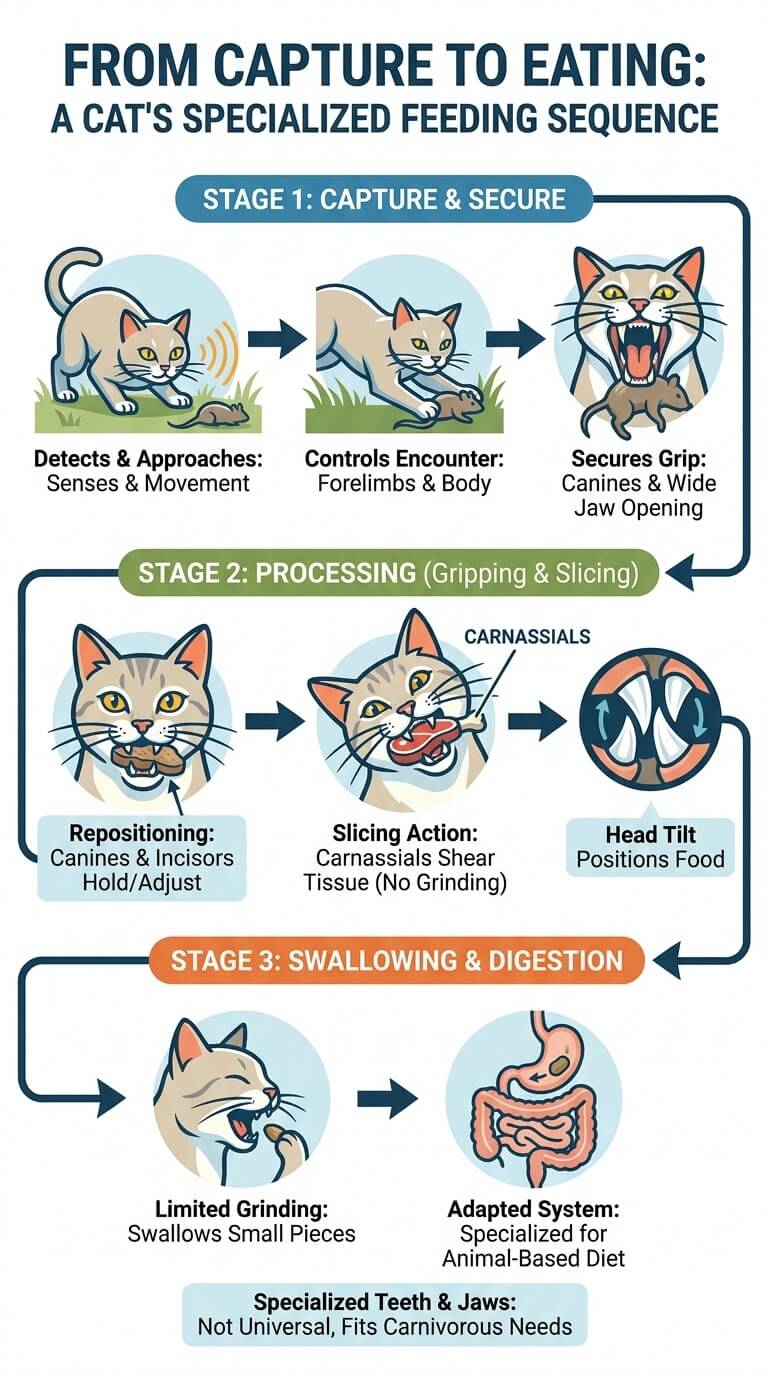
A simplified feeding sequence shows why tooth labels alone are not enough. First, the cat detects and approaches prey using its senses and movement. The forelimbs and body help control the encounter. The jaws then open far enough to place the canines, which help secure a grip. After the prey has been subdued, the mouth shifts from capture to processing.
Gripping and Repositioning Food
The canines and incisors can hold or adjust pieces while the head and neck apply pulling forces. A cat may turn its head so one side of the cheek teeth engages the food. Because the jaw does not have the broad sideways grinding stroke of many herbivores and omnivores, food is often positioned deliberately at the cutting teeth.
Slicing With the Carnassials
When the upper and lower carnassial blades close past one another, they divide tissue into pieces that can be swallowed. The motion is closer to shearing than to mashing. This is why photographs of feeding cats often show the head tilted and food positioned toward one side of the mouth.
Swallowing With Limited Grinding
Big cats do not need to pulverize every mouthful. Once a piece is small enough to manage, it can be swallowed. That feeding style fits a digestive system adapted for an animal-based diet, but it also means the teeth and jaws are specialized rather than universally suited to every kind of food.
How Big Cat Skulls and Teeth Vary Among Species
The shared feline plan does not make every large cat mechanically identical. Differences in skull breadth, rostrum length, canine dimensions, body size, and prey ecology create meaningful variation. Those differences are best understood as trade-offs, not a ladder from weak to powerful.
Jaguars and Robust Cranial Form
Jaguars have a notably robust head and skull compared with many similarly sized cats. That anatomy supports forceful prey handling and a flexible diet that can include heavily protected or difficult prey. It is reasonable to discuss the jaguar as a mechanically robust felid, but claims such as “strongest bite in the world” or universal pound-for-pound records require standardized comparisons that popular rankings rarely provide.
Cheetahs and a Different Performance Balance
Cheetahs are shaped by intense selection for high-speed terrestrial pursuit. Their head is relatively small and light compared with the large, massive heads of many Panthera cats. Comparative research finds differences in cheetah skull and jaw-muscle proportions, but those should be described as part of an integrated locomotor and feeding system rather than as proof that cheetahs are poorly equipped predators.
The cheetah still has the core feline cutting dentition and uses a precise bite to subdue prey. Its success depends on acceleration, maneuvering, prey selection, grip, breathing, recovery, and many other traits. A smaller-looking skull is therefore a trade-off within a successful hunting specialization, not a defect.
Large Panthera Cats and Greater Canine Clearance
Lions and tigers illustrate how body size changes the scale of the same basic system. Bigger skulls provide more absolute space between canine tips and more bone to resist loading. That helps when the animal handles large prey, but it does not mean every anatomical variable scales upward in the same proportion.
Clouded Leopards: A Modern Long-Canine Edge Case
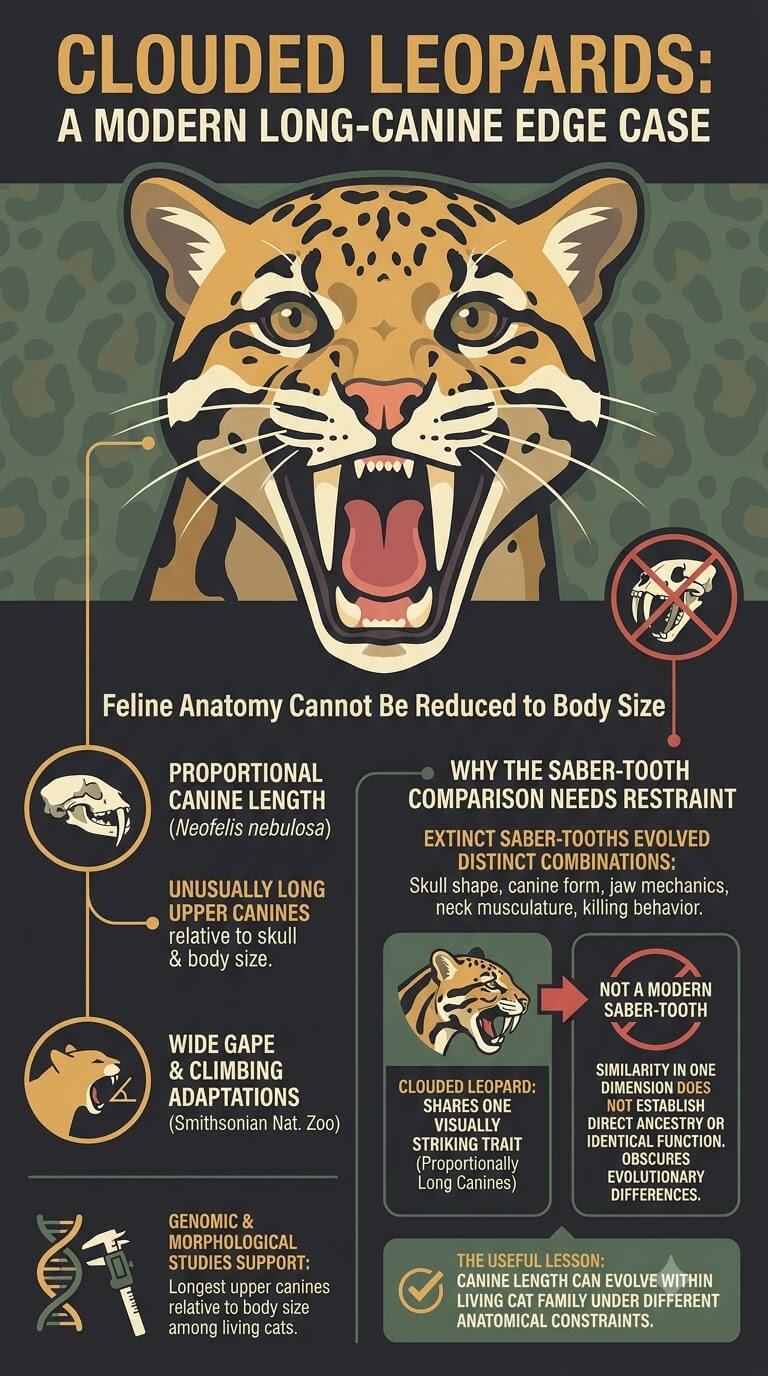
Clouded leopards are especially useful for showing why feline anatomy cannot be reduced to body size. The mainland clouded leopard, Neofelis nebulosa, has unusually long upper canines relative to its skull. The Smithsonian National Zoo clouded leopard profile highlights this proportional canine length along with the species’ wide gape and climbing adaptations.
Modern genomic and morphological work supports the same point. A study of clouded leopard evolutionary history reports that clouded leopards have the longest upper canines relative to body size among living cat species. This is a real specialization, but it does not make them miniature leopards, members of Panthera, or surviving saber-toothed cats.
Why the Saber-Tooth Comparison Needs Restraint
Extinct saber-toothed cats evolved combinations of skull shape, canine form, jaw mechanics, neck musculature, and killing behavior that differ from living felids. Clouded leopards happen to share one visually striking trait, proportionally long canines. Similarity in one dimension does not establish direct ancestry or identical function.
Calling a clouded leopard a “modern saber-tooth” may be catchy, but it obscures more than it explains. The useful lesson is that canine length can evolve within the living cat family under a different set of anatomical constraints.
Common Mistakes About Big Cat Teeth and Jaws
“The Canines Are the Carnassials”
They are different teeth in different positions. Canines are the long pointed teeth near the front of the mouth. Carnassials are specialized cheek teeth farther back that form a shearing pair. Both contribute to feeding, but they do not have the same structure or job.
“The Strongest Bite Is the Best Hunter”
Predation is not a jaw-strength contest. A cat must find prey, approach it, accelerate or stalk effectively, control it with the whole body, place a bite, and avoid injury. Different habitats and prey reward different combinations of traits.
“Big Cats Chew Like People”
They do not rely on prolonged side-to-side grinding. Their cheek teeth emphasize cutting, and many pieces are swallowed after being sliced to manageable size. That is one reason a feline jaw looks and moves differently from a human jaw.
“All Big Cats Have Identical Dentition”
The family shares a strongly conserved dental pattern, but tooth size, skull proportions, canine relative length, and occasional tooth-number variation are not identical among species or individuals. Clouded leopards make the point especially clear.
“One PSI Number Tells You How Powerful a Cat Is”
It does not. Bite-force values vary with measurement location, gape, modeling assumptions, and method. Even a well-measured bite is only one component of prey capture. Rankings that ignore those details create false precision.
How Feeding Anatomy Shapes Hunting and Diet
Teeth and jaws are most useful when viewed in ecological context. An ambush hunter needs to turn a brief opportunity into a controlled capture. Long canines, strong forelimbs, a flexible neck, and a skull able to tolerate prey-generated loads all contribute to that task. Once the prey is down, carnassials make the transition from capture to efficient meat processing.
Habitat and prey also influence how heavily different parts of the system are used. A cat taking relatively small prey faces different mechanical demands from one regularly confronting animals near or above its own body mass. A mountain cat, forest cat, open-country sprinter, and wetland hunter can share the same basic feline tooth pattern while using it within very different movement and hunting strategies.
This is also why dramatic labels such as “perfect killing machine” are poor biology. Big cat feeding anatomy is specialized, but specialization brings trade-offs. Cats are excellent at cutting animal tissue, yet they have much less dental equipment for grinding fibrous plant foods or crushing hard material than mammals built for those tasks.
FAQ
How many types of teeth do big cats have?
Big cats have the four standard mammalian tooth categories: incisors, canines, premolars, and molars. What makes the feline arrangement distinctive is the strong specialization within those categories. The canines are enlarged for prey grip, while specific cheek teeth form the carnassial shearing pair and the grinding surfaces are comparatively reduced.
Why are carnassial teeth shaped like blades?
Their sharp cusps and edges pass against one another during jaw closure, creating a shearing action. That is efficient for dividing muscle and connective tissue into pieces. The carnassials are therefore better compared with biological shears than with the broad grinding molars of an omnivore or herbivore.
Why do clouded leopards have such long canines?
Clouded leopards have evolved exceptionally long upper canines relative to body size within the range of living cats. Researchers continue to study how that trait fits their skull mechanics and prey use. The safe conclusion is that it is a distinctive modern felid specialization, not evidence that clouded leopards are living saber-toothed cats.
Do jaguars have the strongest bite of all cats?
Jaguars have robust skulls and powerful prey-handling anatomy, but a universal “strongest bite” statement depends on what is being measured. Absolute force, force relative to body size, canine force, carnassial force, gape, and modeling method can produce different comparisons. It is more accurate to describe the jaguar’s robust cranial specialization than to repeat an unsupported record claim.
Do big cats chew bones?
They can bite, scrape, and sometimes consume smaller bones, but felid teeth are not specialized for habitual bone-crushing in the way seen in dedicated bone-cracking carnivores. Their cheek teeth are dominated by slicing function. What is consumed also varies with prey size, species, hunger, competition, and access to the carcass.
Final Thoughts
Big cat teeth and jaws make sense when the mouth is treated as one coordinated feeding system. Incisors handle small, precise tasks. Canines penetrate and hold. Carnassials shear meat. Jaw muscles, gape, skull strength, the tongue, neck, and forelimbs help those teeth work in the real conditions of prey capture and feeding.
The shared feline plan is highly specialized, but it is not identical across species and it does not produce a simple ranking of strongest or best. Jaguars, cheetahs, lions, tigers, leopards, snow leopards, and clouded leopards all show different proportions and trade-offs. Understanding those differences gives a much clearer picture than viral bite-force lists: the success of a big cat comes from how anatomy, movement, prey choice, and behavior work together.

Ethan Walker is the founder and research editor of Animal Fact Central. He creates and reviews educational animal facts content using trusted wildlife, pet care, and science-based sources. His work focuses on making animal behavior, adaptations, habitats, and species facts clear, accurate, and engaging for everyday readers.
Read More Details About Ethan Walker: https://animalfactcentral.com/ethan-walker/