
Big cats live in a much wider range of habitats than the familiar images of lions on savannas or tigers in tropical forests suggest. Large wild cats occupy grasslands, dry woodlands, scrub, deserts, tropical and temperate forests, wetlands, mangroves, river corridors, and some of the highest mountain landscapes used by any mammalian predator. Where a species lives depends on more than climate. It also depends on prey, cover, water, competition, human pressure, and whether enough connected habitat remains for animals to move and reproduce.
The phrase “where big cats live” can also be misleading if current and historical range are mixed together. Lions once occupied parts of Europe, the Middle East, and much more of Asia. Tigers formerly ranged far west of their present distribution. Jaguars historically occurred farther north in the United States, and leopards have disappeared from many areas they once occupied. A useful habitat picture therefore has two parts: the kinds of environments a species can use, and the places where viable wild populations still remain today.
Big Cats Occupy Many More Habitats Than Savannas and Jungles
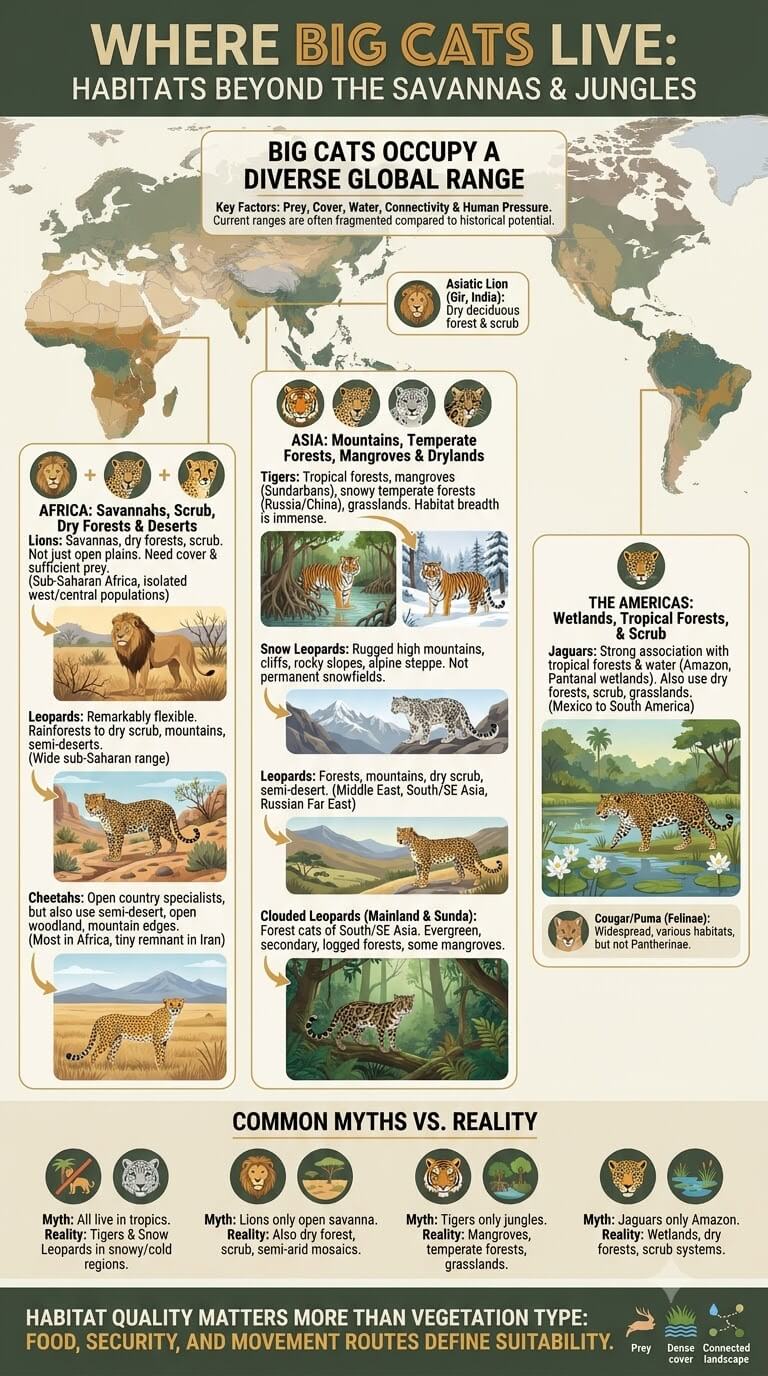
There is no single “big cat habitat.” The species most commonly grouped under the big-cat label belong to different lineages, live on different continents, and solve different environmental problems. Lions often use open or semi-open country, but they can also live in dry forest and scrub. Tigers occupy everything from tropical forest and mangroves to snowy temperate forest. Leopards may live in rainforest, mountain terrain, dry scrub, woodland, or semi-desert. Jaguars use tropical forest heavily but also occur in wetlands, dry forests, scrub, and grassland mosaics.
Snow leopards are specialists of rugged high mountains. Mainland clouded leopards are strongly associated with forests across parts of South and Southeast Asia, while Sunda clouded leopards occur on Borneo and Sumatra. Cheetahs, although they belong to Felinae rather than Pantherinae, are often included in broader public use of “big cat” and are especially associated with open, dry landscapes.
Current Range and Historical Range Are Different
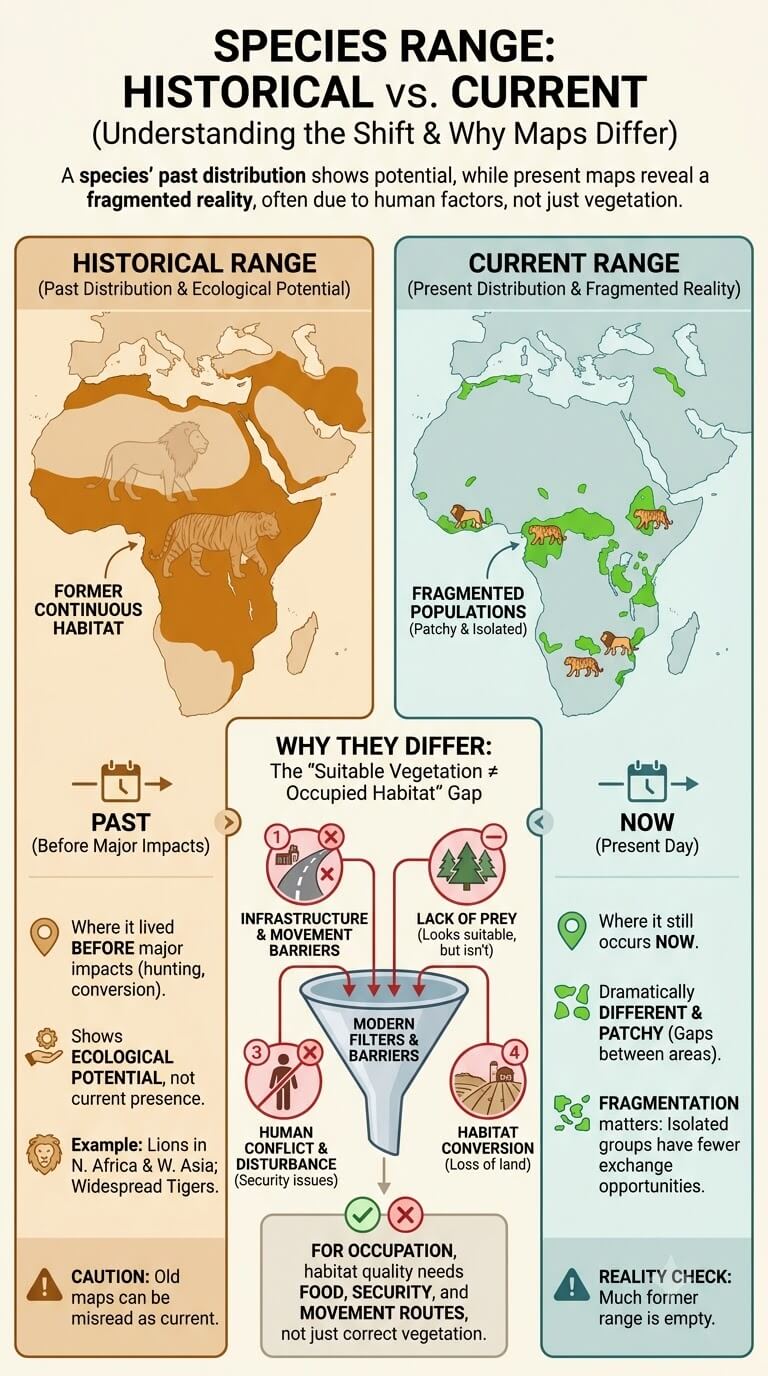
A species’ historical range describes where it lived in the past, sometimes before major habitat conversion, hunting, persecution, infrastructure growth, or regional extinction. Current range describes places where the species still occurs now. Those two maps can be dramatically different.
Why Historical Maps Can Be Misread
Old range maps are useful for showing ecological potential and past distribution, but they should not be interpreted as current presence. A historical lion map may include North Africa and western Asia, for example, even though wild lions no longer occupy most of those regions. Likewise, former tiger range extended across a broad swath of Asia that is now mostly empty of tigers.
Range can also be patchy rather than continuous. A species may remain in separated protected areas, forest blocks, mountain systems, or mixed-use landscapes with large gaps between them. That fragmentation can matter as much as total area because isolated populations have fewer opportunities to exchange individuals.
Habitat Does Not Mean Every Place With the Right Vegetation Is Occupied
A forest may look suitable but lack enough prey. A grassland may have prey but too much disturbance. A mountain corridor may be physically suitable but cut by roads or settlements. For large predators, habitat quality includes food, security, movement routes, and the ability to avoid chronic conflict with people.
A Global Overview of Big Cat Geography
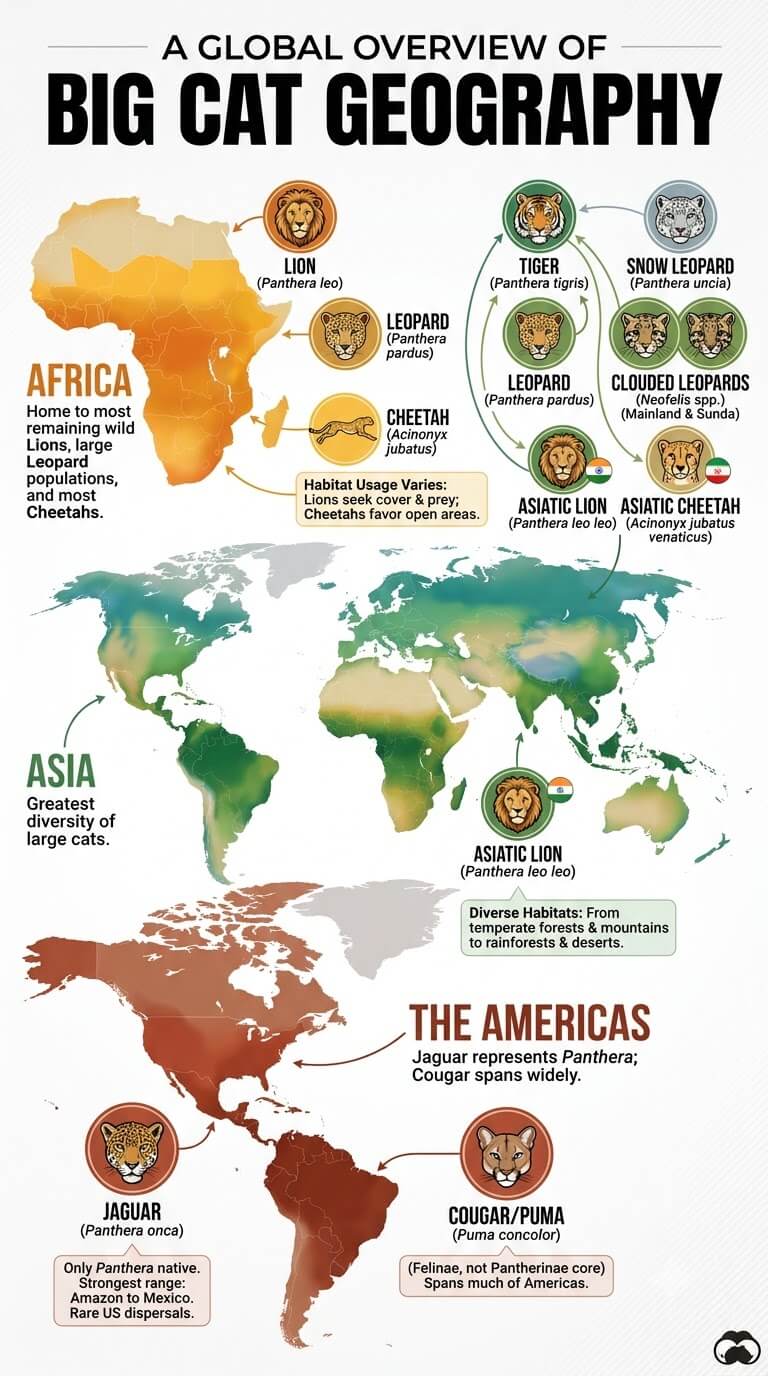
Most familiar large wild cats are concentrated in Africa and Asia, while the jaguar represents Panthera in the Americas. The cougar or puma also spans much of the Americas and is sometimes included in broad common-language big-cat discussions, but it belongs to Felinae and is not part of the Pantherinae core used here.
Africa
Africa is home to most of the world’s remaining wild lions, large populations of leopards, and most cheetahs. These species can overlap in some landscapes, yet they do not use habitat in identical ways. Lions often benefit from areas with abundant medium to large prey and sufficient cover for stalking and denning. Leopards can persist in a remarkable variety of terrain and vegetation. Cheetahs often favor more open environments where their running ability can be useful.
Asia
Asia contains the greatest diversity of the large cats discussed here. Tigers, leopards, snow leopards, mainland clouded leopards, Sunda clouded leopards, the remaining Asiatic lions, and the remnant Asiatic cheetah all occur there. Their habitats range from Russian temperate forests and Himalayan mountains to Indian dry forest, Southeast Asian rainforest, mangroves, and Iranian desert landscapes.
The Americas
The jaguar is the only living Panthera species native to the Americas. Its current distribution runs from Mexico through parts of Central and South America, with the strongest continuous range in the Amazon region. Individual jaguars also occasionally appear in the southwestern United States after dispersing north from Mexico, but the United States does not currently support a resident breeding population.
Lions Live in More Than Open Savanna
The iconic lion landscape is open African savanna, but that image is incomplete. The IUCN Cat Specialist Group lion account describes lions using savannas, dry forests, scrub, woodland, and even desert-edge environments. They need enough prey, shelter or cover, and space with tolerable levels of disturbance.
African Lions
Most wild lions live in sub-Saharan Africa. Their range is highly fragmented, with major strongholds in eastern and southern Africa and smaller, more isolated populations in parts of western and central Africa. Open grasslands and woodland savannas are especially familiar lion habitats, but lions can also occupy thorn scrub, dry forest, and other semi-arid landscapes.
Cover still matters even in open country. Tall grass, brush, drainage lines, woodland edges, and uneven terrain can help lions approach prey and provide shade or denning security. A completely bare plain is not necessarily better habitat than a mixed landscape with patches of cover.
Asiatic Lions
The surviving Asian lion population is in western India, centered on the Gir landscape and surrounding areas of Gujarat. Unlike the stereotype that lions belong only to African grasslands, these lions use dry deciduous forest, scrub, woodland, and human-influenced mosaics. Their survival shows why the phrase “savanna animal” should not be treated as a strict habitat definition.
Tigers Occupy Tropical Forests, Mangroves, and Snowy Woodlands
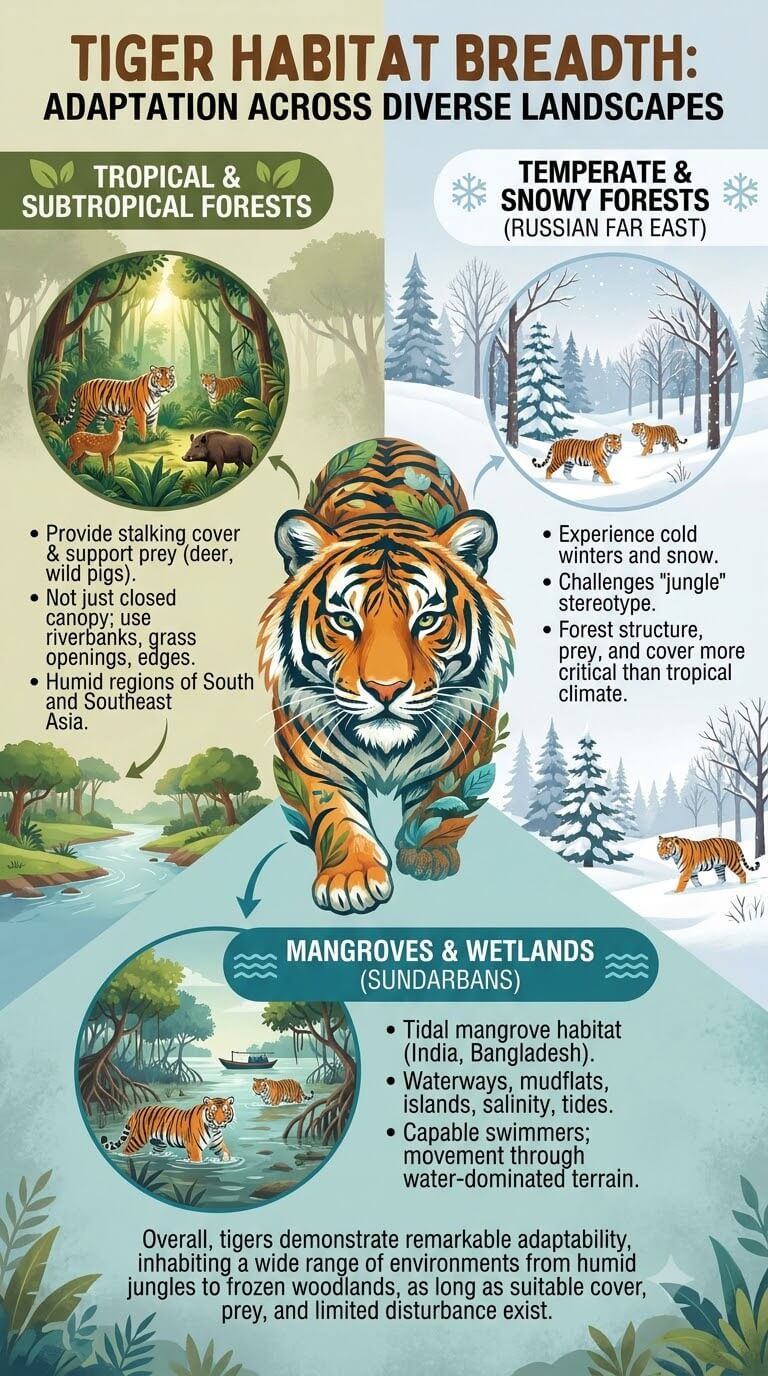
Tigers are among the best examples of habitat breadth within one large-cat species. The IUCN Cat Specialist Group tiger profile lists tropical and subtropical forest, evergreen and deciduous forest, mangrove swamp, grassland, and temperate forest among their habitats. Tigers persist from humid South and Southeast Asia to cold regions of the Russian Far East.
Tropical and Subtropical Forests
Many tiger populations live in forested landscapes where vegetation provides stalking cover and supports prey such as deer and wild pigs. Dense forest does not mean tigers spend all their time inside closed canopy. They may use riverbanks, grass openings, roads, forest edges, and other travel routes depending on prey and disturbance.
Mangroves and Wetlands
The Sundarbans region of India and Bangladesh is a well-known example of tigers using tidal mangrove habitat. Here, waterways, mudflats, mangrove islands, salinity, tides, and dense vegetation create a very different environment from central Indian dry forest. Tigers are capable swimmers and can move through landscapes where water is a major part of the terrain.
Temperate and Snowy Forests
In the Russian Far East and northeastern China, tigers live in temperate forests that experience cold winters and snow. These landscapes challenge the idea that tigers are strictly “jungle” animals. Forest structure, prey, and cover matter more than whether the climate is tropical.
Leopards Have One of the Broadest Habitat Niches
Leopards are extraordinarily flexible in habitat use. The Cat Specialist Group leopard account records them in tropical rainforest, temperate forest, alpine terrain, savanna, grassland, bushland, dry scrub, semi-desert, and desert environments across Africa and Asia.
Africa and Asia
Current leopard populations stretch across much of sub-Saharan Africa and through parts of the Middle East, Caucasus, South Asia, Southeast Asia, China, and the Russian Far East. Their distribution is far less continuous than a simple continent-scale map may imply. Leopards have disappeared from many historical areas, especially where habitat loss, prey depletion, persecution, and fragmentation have been severe.
Forests, Mountains, and Drylands
A leopard in a humid African forest, a leopard in rocky Iranian mountains, and a leopard in dry southern African scrub are the same species using very different settings. Their flexible diet, climbing ability, secretive behavior, and capacity to use cover in many forms help explain that breadth.
This does not mean leopards can thrive anywhere. Habitat flexibility has limits. Intensive development, loss of prey, repeated killing by people, and isolation can remove leopards even from vegetation types they could otherwise use.
Jaguars Are Not Limited to the Amazon Rainforest
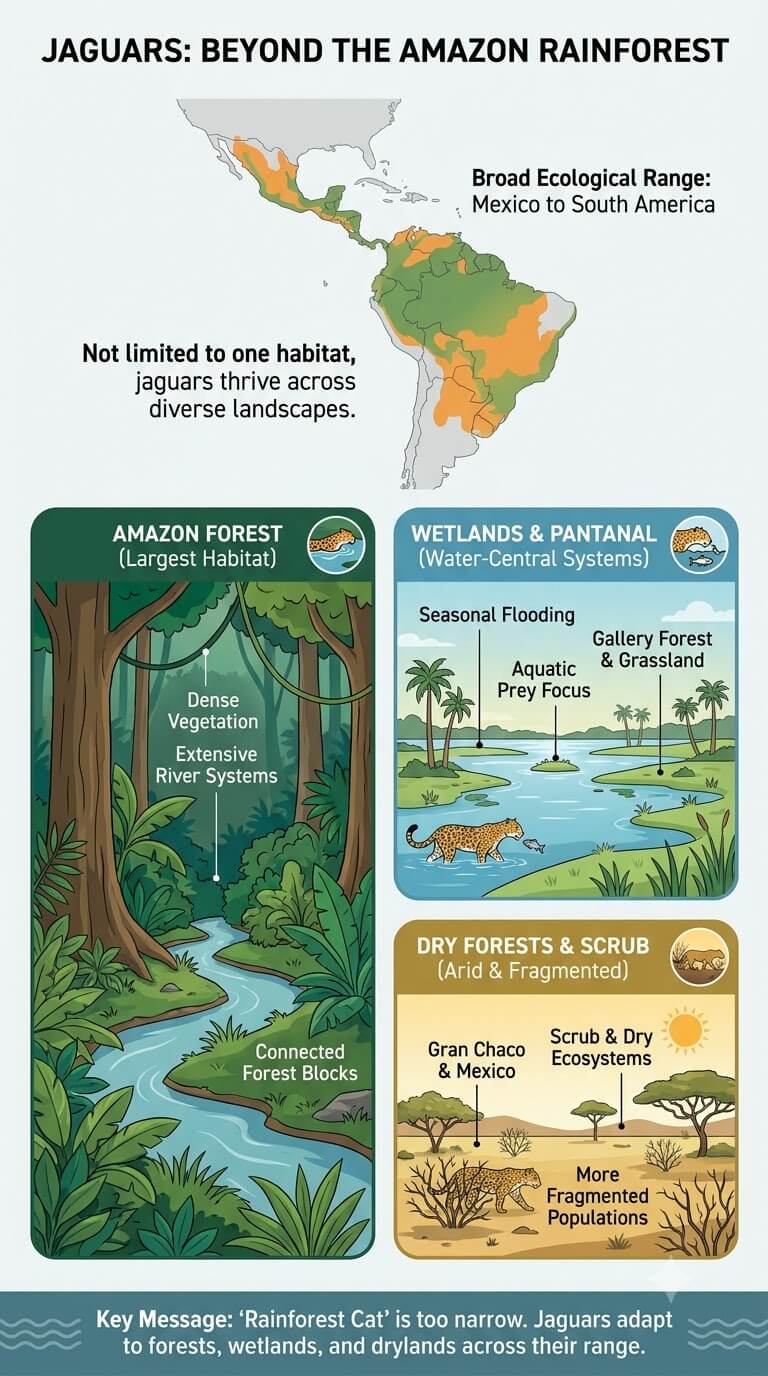
Jaguars are strongly associated with tropical forest and water, but their ecological range is broader. The IUCN Cat Specialist Group jaguar profile places the species from Mexico through Central America and much of South America, with current distribution heavily concentrated in large tropical forest blocks but extending into wetlands, dry forest, savanna, and scrub in some regions.
Amazon Forest
The Amazon holds the largest continuous jaguar habitat and the largest remaining population. Dense vegetation, extensive river systems, and large areas of relatively connected forest support jaguars across enormous landscapes. Even within Amazonia, however, jaguars use riverbanks, floodplains, forest interiors, and other habitat features differently depending on prey and season.
The Pantanal and Other Wetlands
The Pantanal demonstrates how well jaguars can function in wetland systems. Seasonal flooding, rivers, gallery forest, grassland, and aquatic prey create a landscape where water is central rather than incidental. Jaguars can swim readily and may hunt along waterways or in flooded environments.
Dry Forests and Scrub
Jaguar range also reaches drier ecosystems such as the Gran Chaco and parts of Mexico and Brazil. These populations may be more fragmented and exposed to human conflict, but they show why “rainforest cat” is too narrow a description.
Snow Leopards Live in High Mountains, Not Just Snowfields
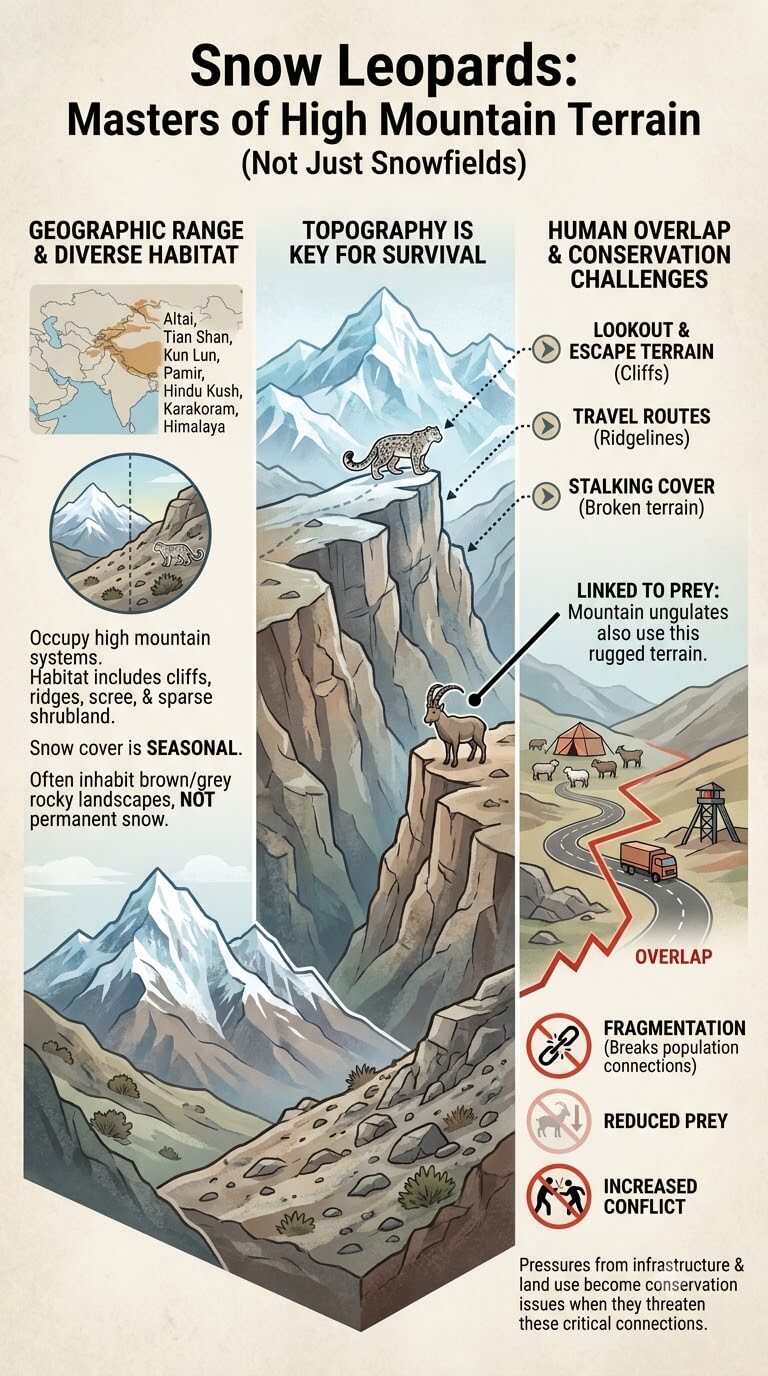
Snow leopards occupy mountain systems across Central and High Asia. The Cat Specialist Group snow leopard account identifies major ranges including the Altai, Tian Shan, Kun Lun, Pamir, Hindu Kush, Karakoram, and Himalaya.
Rocky Slopes and Alpine Terrain
Their habitat is often steep, broken, and rocky, with cliffs, ridges, scree, alpine meadows, and sparse shrubland. Snow cover changes seasonally and with elevation. A snow leopard may spend long periods in brown or gray rocky landscapes with little visible snow, so the species should not be described as requiring permanent snow.
Terrain Can Matter More Than Vegetation
For snow leopards, rugged topography itself is a major habitat feature. Cliffs and ridgelines provide travel routes, stalking cover, lookout points, and escape terrain. Mountain ungulates also use these landscapes, linking predator habitat closely to prey distribution.
Human land use is part of the same mountain system. Pastoral communities, livestock, roads, mining, and infrastructure can overlap snow leopard range. Those pressures become conservation issues when they reduce prey, increase conflict, or break connections among populations.
Clouded Leopards Are Forest Cats of South and Southeast Asia
Clouded leopards belong to the genus Neofelis, not to the true leopard species Panthera pardus. The two living species also have different geographic distributions. Mainland clouded leopards occur on the Asian mainland, while Sunda clouded leopards are native to Borneo and Sumatra.
Mainland Clouded Leopard
The mainland clouded leopard, Neofelis nebulosa, ranges from the eastern Himalayan region through parts of South and Southeast Asia and southern China. It is most strongly associated with forest. The Cat Specialist Group mainland clouded leopard profile emphasizes evergreen forest but also records the species in secondary and logged forest, coniferous forest, coastal hardwood forest, scrub, and some more open forest types.
Forest structure remains important. Even when clouded leopards occur in altered habitat, they are not simply open-country cats. Trees, dense vegetation, connected forest, and prey availability shape where they can persist.
Sunda Clouded Leopard
The Sunda clouded leopard, Neofelis diardi, occurs on Borneo and Sumatra, including parts of Indonesia, Malaysia, and Brunei. It is considered forest-dependent but can use several forest types, including lowland rainforest, hill and submontane forest, logged forest, mangroves, and peat swamp. It does not readily use oil palm plantation as a substitute for forest.
Keeping the two species separate matters for both maps and habitat descriptions. A single “clouded leopard range” that blends mainland Southeast Asia with Borneo and Sumatra hides an important taxonomic and geographic split.
Cheetahs Are Open-Country Specialists, but Not Just Grassland Cats
Cheetahs are often associated with open savanna because high-speed pursuit works best where there is room to accelerate and maneuver. Most surviving populations are in Africa, with a very small Asiatic remnant in Iran. Their habitat includes grassland, savanna, shrubland, open woodland, semi-desert, and desert landscapes.
Open Habitat Helps, but Cover Still Matters
A cheetah does not need a featureless plain. Low shrubs, grass, ridges, and uneven terrain can provide concealment before a chase and resting cover afterward. Prey distribution and competition with larger carnivores also influence where cheetahs spend time.
Deserts and Mountain Edges
Cheetahs can occur in very dry landscapes, including parts of the Sahara and Iranian deserts. In such places they may use plains, foothills, mountain edges, and dry drainage systems rather than classic green savanna. This wider habitat picture is important because the species’ remaining range is increasingly fragmented.
Habitats Shape Hunting, Movement, and Coat Patterns
Habitat is not just the background behind a cat. It changes how the animal moves, hunts, rests, communicates, and avoids detection. A tiger stalking through dense vegetation can approach prey differently from a cheetah using open country. A snow leopard moving along a ridge faces different balance and visibility problems from a jaguar navigating a floodplain.
Cover Changes Hunting Distance
Dense forest, tall grass, scrub, boulders, and terrain folds can all shorten the distance a cat needs to cross in the open. Cats that rely heavily on stalking and ambush often use these features to hide their outline until they are close enough to accelerate.
Water Can Be Habitat, Barrier, or Travel Route
For jaguars and some tiger populations, rivers and wetlands are integral parts of the landscape. For other cats, water may mainly be a drinking resource or a boundary crossed only when necessary. The same habitat feature can therefore have very different ecological meaning among species.
Coat Patterns Work in Context
Stripes, rosettes, spots, and cloud-like blotches can help break up a cat’s outline against vegetation, shadows, rocks, or patchy light. Camouflage does not make a cat invisible, and the usefulness of a pattern depends on viewing distance, movement, light, and background. Habitat and coat pattern work together rather than acting as separate traits.
Habitat Fragmentation Changes Where Big Cats Can Survive
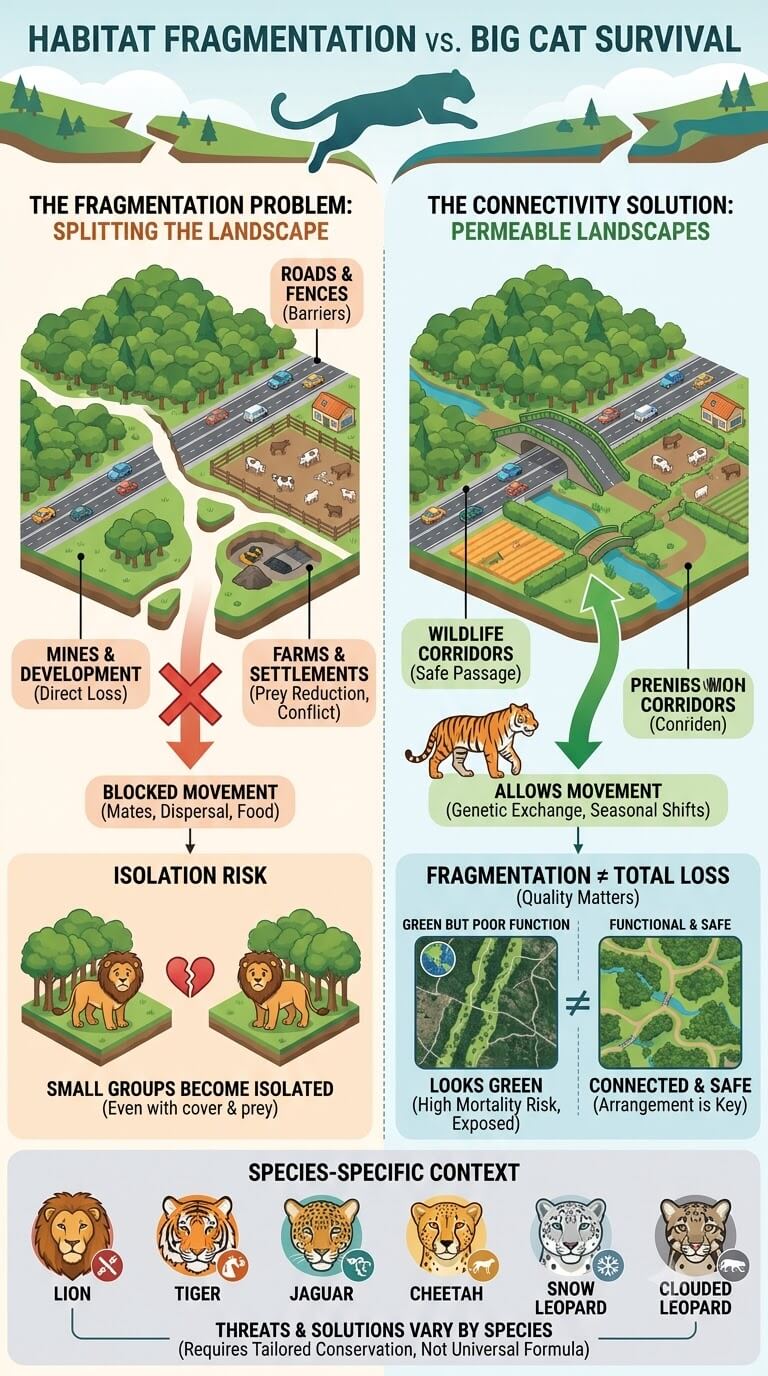
A large cat may need far more space than a single patch of attractive vegetation. Individuals must move among feeding areas, find mates, disperse from their birth areas, and sometimes shift seasonally. Roads, farms, fences, settlements, mines, and other development can split habitat into pieces.
Connected Habitat Matters
Wildlife corridors and permeable landscapes can allow animals to move between core populations. Without that movement, small groups can become isolated even when each remaining patch still contains suitable cover and prey. Connectivity is especially important for wide-ranging predators and species already reduced to scattered populations.
Fragmentation Is Not the Same as Total Habitat Loss
A landscape can still look green on a satellite image while functioning poorly for a large predator. Roads may increase mortality risk. Farms may reduce prey. Human activity can change when cats move. Narrow forest strips may be too exposed or disconnected. Habitat quality therefore depends on arrangement and safety as well as total area.
The causes and consequences of fragmentation differ among lions, tigers, jaguars, cheetahs, snow leopards, and clouded leopards. Those species-specific threats belong to conservation assessments rather than one universal formula.
Common Myths About Where Big Cats Live
“All Big Cats Live in Tropical Places”
They do not. Tigers live in snowy temperate forests, snow leopards occupy cold high mountains, leopards reach arid and temperate regions, and lions can live in dry landscapes. Tropical forest is important for several species, but it is only one part of the global picture.
“Lions Live Only in Open Savanna”
Savannas are major lion habitat, but lions also use woodland, scrub, dry forest, and semi-arid environments. Asiatic lions in western India make the point especially clearly.
“Tigers Are Jungle Animals”
Tigers do use tropical forests, but they also live in mangroves, grasslands, deciduous forests, and cold temperate forests. “Jungle” is too vague to describe their ecological range.
“Jaguars Live Only in the Amazon”
The Amazon is their largest stronghold, but jaguars also occur in Central America, Mexico, wetlands such as the Pantanal, dry forests, and scrub systems. Their range has contracted sharply, but their habitat tolerance is broader than rainforest alone.
“Snow Leopards Live on Permanent Snow”
Snow leopards are mountain cats, not snow-surface specialists. They use rocky slopes, alpine steppe, cliffs, ridges, and seasonal snow zones. Much of their habitat can be bare rock or sparse vegetation for long periods.
“Leopards Live Only in Africa”
Leopards occur in both Africa and Asia. Asian populations survive from parts of the Middle East and Caucasus through South Asia and into sections of Southeast and East Asia, including the Russian Far East.
FAQ
Which continents have native big cats today?
Wild cats commonly called big cats occur naturally in Africa, Asia, North America, and South America. Lions, leopards, and most cheetahs occur in Africa; Asia supports tigers, leopards, snow leopards, clouded leopards, Asiatic lions, and a tiny remnant of Asiatic cheetahs; jaguars occur in the Americas. Cougars, which belong to Felinae, also range across the Americas and are sometimes included in broad common-language big-cat lists.
Do any big cats live in snowy climates?
Yes. Snow leopards live in cold high mountains of Central and High Asia, and Amur tigers occupy temperate forests in the Russian Far East and northeastern China where winters can be snowy. Leopards also occur in cold mountain and temperate regions. Snow is therefore part of the habitat of several large cats, not only the snow leopard.
Which big cats use wetlands or mangroves?
Jaguars frequently use riverine forests and wetlands, including the Pantanal. Tigers occupy mangrove habitat in the Sundarbans and use other wetland systems across parts of their range. Sunda clouded leopards have also been recorded in mangrove and peat-swamp forest. Wetland use varies greatly by species and region.
Why do big cats need such large areas?
Large predators often need enough space to find prey, water, resting sites, mates, and safe movement routes. Required area varies enormously with prey density, habitat productivity, sex, season, and species. A cat in prey-rich habitat may meet its needs in a much smaller area than an individual living where food is sparse.
Can big cats live near people?
Some species can use landscapes containing farms, roads, grazing land, or settlements, especially leopards and lions in certain regions. That does not mean close coexistence is easy or safe. Human-dominated landscapes can increase conflict, persecution, vehicle risk, and habitat fragmentation, and wild large cats should never be approached, fed, baited, or encouraged to remain near homes.
Final Thoughts
Big cats live in an extraordinary range of environments, from African grasslands and Indian dry forests to Amazonian floodplains, Southeast Asian rainforests, Russian temperate forests, Iranian deserts, and the high mountains of Central Asia. Their habitats differ because the cats themselves differ in body form, prey, hunting strategy, climate tolerance, and evolutionary history.
The most useful distinction is between habitat potential and current range. A species may be capable of using many environments yet survive today in only a fraction of the places it once occupied. Understanding where big cats live therefore means looking at both ecology and geography: what each cat needs from a landscape, where those landscapes still remain connected, and where wild populations continue to persist.

Ethan Walker is the founder and research editor of Animal Fact Central. He creates and reviews educational animal facts content using trusted wildlife, pet care, and science-based sources. His work focuses on making animal behavior, adaptations, habitats, and species facts clear, accurate, and engaging for everyday readers.
Read More Details About Ethan Walker: https://animalfactcentral.com/ethan-walker/