
Wildlife crossings are structures that help animals move across roads without stepping directly into traffic. They can look like planted bridges, wide underpasses, small tunnels, modified culverts, canopy ropes, or fenced guide systems that lead animals toward a safer route. The idea is simple, but the biology behind it is not: different animals move for food, mates, territory, seasonal migration, den sites, nesting areas, water, and dispersal, so a crossing has to match both the road and the animals that actually need to use it.

For people, wildlife crossings can reduce dangerous animal-vehicle collisions. For animals, they can reconnect habitat that pavement, traffic, fences, lights, and noise have divided. The best projects are not random animal bridges dropped beside a highway. They are placed where animals already try to move, designed around species behavior, and paired with fencing or other features that make the safe path easier to find than the risky one.
Quick Answer: What Are Wildlife Crossings?
Wildlife crossings are road-design features that let animals pass over or under a road while reducing direct contact with vehicles. They are often built as overpasses, underpasses, culverts, tunnels, canopy bridges, or modified drainage structures. Many projects also use fencing, escape ramps, vegetation, natural ground cover, and monitoring cameras.
The Federal Highway Administration Wildlife Crossings Program describes its goal as reducing wildlife-vehicle collisions while improving habitat connectivity for terrestrial and aquatic species. That two-part goal matters. A crossing that reduces crashes but does not support animal movement is incomplete, and a crossing that looks natural but does not guide animals away from traffic may not solve the safety problem.
A useful way to understand wildlife crossings is to think of them as part of a larger movement system. The structure is the visible piece, but the full system includes the nearby habitat, the location on the landscape, traffic volume, fencing, drainage, maintenance, lighting, noise, and the behavior of the target species.
Why Roads Are a Problem for Wildlife
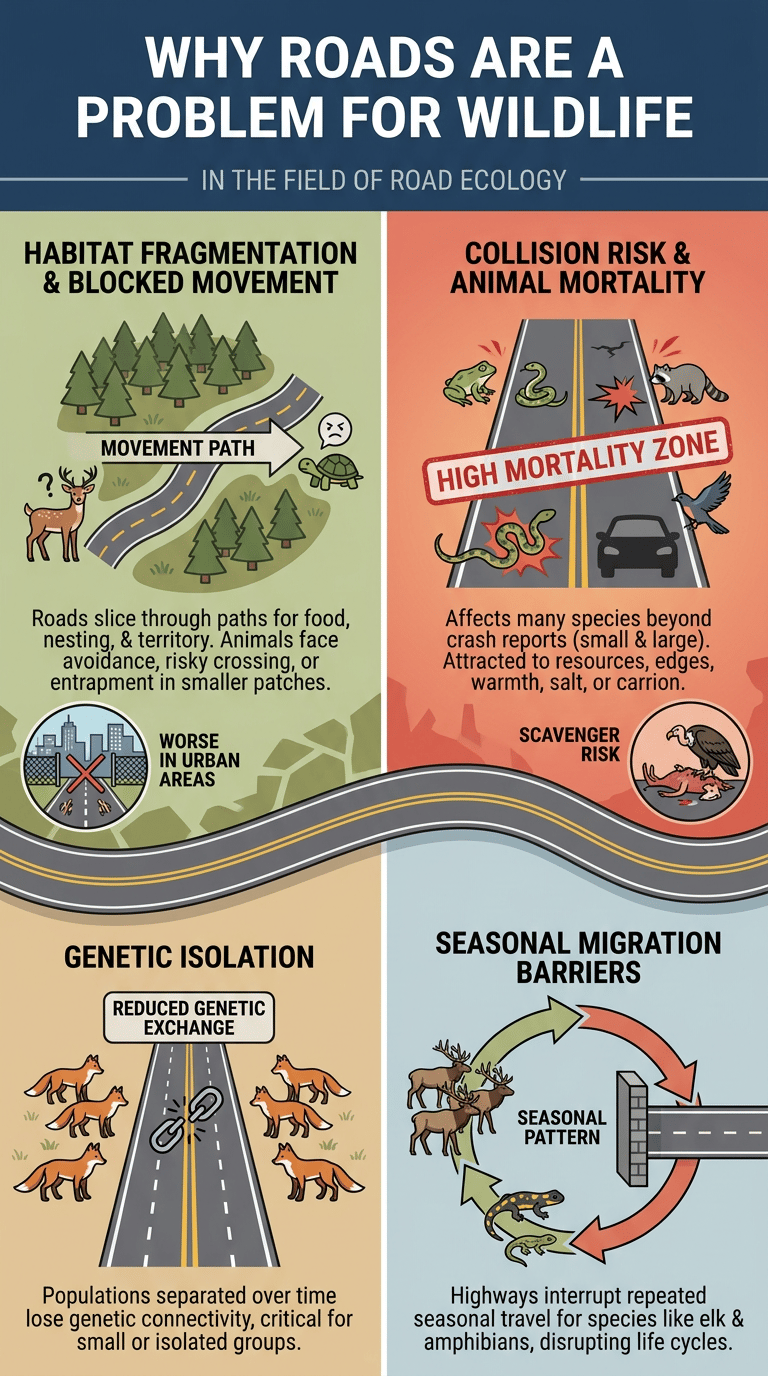
Roads are more than strips of pavement. In ecology, a road can act like a barrier, a source of mortality, a noisy disturbance zone, a corridor for some species, and a divider between populations. That is why wildlife crossings sit inside the field of road ecology, which studies how roads affect animals, plants, water, and landscapes.
Habitat fragmentation and blocked movement
Animals do not use habitat in neat boxes. A deer may feed in one patch and rest in another. A turtle may spend much of the year in wetland habitat but move across land to nest. A young mountain lion may disperse long distances to find a territory. When a road slices through these movement paths, the animal faces a choice: avoid the area, try to cross, or get trapped in a smaller piece of habitat.
A USGS publication on wildlife-friendly roads in urban areas explains that roads can replace habitat, reduce nearby habitat quality, fragment remaining habitat, and increase mortality through vehicle collisions. The effect can be especially strong in urban and suburban landscapes, where roads, buildings, fences, and development may leave fewer alternate routes.
Collision risk and animal mortality
Wildlife-vehicle collisions are often discussed because of deer, elk, and moose, but road mortality affects many animals that never appear in crash reports. Frogs, salamanders, snakes, turtles, rabbits, raccoons, foxes, birds, and insects may die on roads in large numbers, especially near wetlands, forests, grasslands, or migration routes.
The main causes are not mysterious. Animals cross roads because the road lies between resources they need. Others are attracted to road edges, roadside vegetation, warmth from pavement, salt residue, carrion, or open travel space. Scavengers may then be drawn to carcasses and face the same traffic risk.
Genetic isolation and seasonal migration barriers
Roads can also separate populations over time. If animals on one side of a highway rarely breed with animals on the other side, the population may lose genetic exchange. That can matter for species that already live in small, isolated, or urban-fragmented populations.
Seasonal migrants face a different version of the same problem. Elk, pronghorn, mule deer, amphibians, and other animals may need to move between seasonal habitats. If a highway blocks that path, the effect is not just one dangerous crossing. It can interrupt a repeated life-history pattern.
Main Types of Wildlife Crossings
There is no single best wildlife crossing for every place. A large planted overpass may help elk, deer, bears, or mountain lions in one landscape, while a small moist tunnel may be more useful for salamanders near a breeding pond. The design depends on the species, road width, traffic, topography, hydrology, available land, budget, and maintenance needs.
Overpasses and green bridges
Wildlife overpasses carry animals above a road. Many are wide, soil-covered, and planted with vegetation so the top feels more like habitat than a bare bridge. They can be especially useful for animals that avoid dark, narrow underpasses or need open sightlines.
Underpasses, culverts, and tunnels
Underpasses let animals move beneath the road. They may be large open-span structures, smaller tunnels, box culverts, or adapted drainage crossings. Some carry both water and wildlife, especially where roads cross streams, wetlands, or riparian corridors.
The FHWA Wildlife Crossing Structure Handbook notes that crossings can be designed for movement above or below roads and may be exclusive to wildlife, mixed with human use, or adapted from other infrastructure such as creeks and canals. This is why some successful crossings look like large engineering projects, while others look like ordinary culverts with the right placement and habitat connection.
Canopy bridges, amphibian tunnels, and small-animal passages
Not all wildlife crossings are built for large mammals. Canopy bridges can help arboreal animals move over roads without descending to pavement. Depending on the region, these may be designed for squirrels, possums, monkeys, gliding mammals, or other tree-living species. In the United States, canopy-style structures are less famous than large overpasses but still show how crossing design can match animal movement.
Amphibian tunnels and small-animal passages are often built near wetlands or known migration routes. Frogs, salamanders, and toads may move in large numbers during wet nights, and even a low-traffic road can cause heavy mortality if it crosses their route. These passages often need moisture, suitable substrate, low barriers that guide animals into the opening, and careful seasonal timing.
Reptile and turtle crossings may need different details. Turtles may require fencing that they cannot climb or push through, dry ledges within culverts, and placement near nesting or wetland movement routes. A generic pipe is rarely enough if it does not match the animal’s behavior.
Fencing, escape ramps, and guide structures
Fencing is not a crossing by itself, but it is often what makes a crossing work. A well-placed fence guides animals toward the overpass or underpass and discourages them from crossing at road level. Without fencing, some animals may simply walk onto the pavement beside the structure.
Escape ramps or jump-outs can help animals leave the road corridor if they end up trapped inside the fenced zone. Guide walls, drift fences, curb modifications, grates, and vegetation management can also steer animals toward safer passages.
Fencing has to be designed for the species involved. A fence that stops deer may not stop snakes, turtles, frogs, or small mammals. A fence that works when new may fail if it is damaged, undermined, blocked by debris, or left with open gaps near driveways and side roads.
How Wildlife Crossings Work
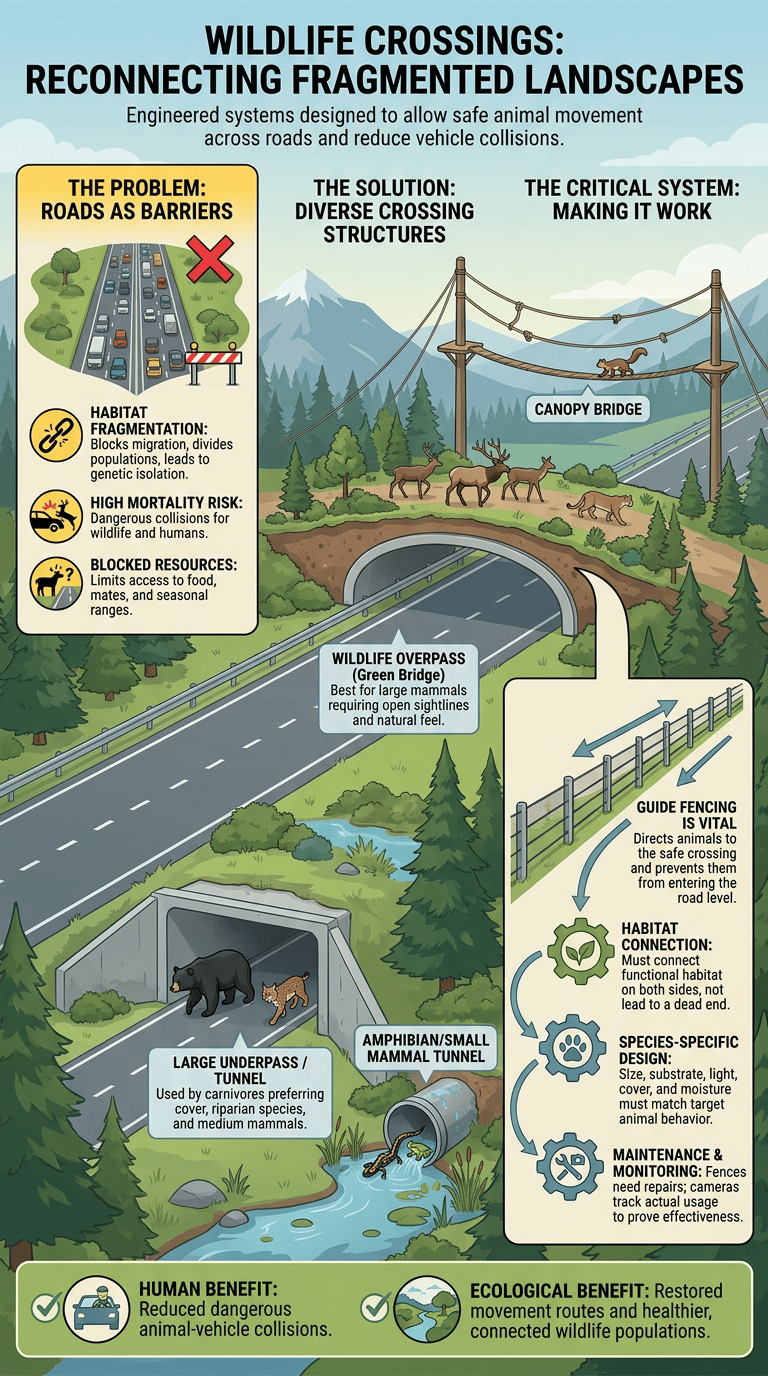
A crossing succeeds when animals find it, enter it, pass through it, and continue to suitable habitat on the other side. That may sound obvious, but each step can fail. The animal may never approach the structure. It may approach and turn away. It may use the crossing but still face danger at an unfenced road opening nearby. It may cross safely but end up in poor habitat.
Matching structure size to species behavior
Different species evaluate space differently. Large ungulates such as deer and elk may prefer open, wide crossings with natural sightlines. Some carnivores may accept narrower routes if they provide cover and connect territories. Amphibians may need damp, protected passages. Small mammals may use brush piles, logs, ledges, or low cover that make them feel less exposed.
Vegetation, cover, moisture, and natural substrate
Animals respond to the details around the crossing entrance. A bare concrete opening beside mowed roadside grass may be less inviting than an entrance connected to shrubs, trees, rocks, logs, water, or natural soil. Cover can make small animals less visible to predators and give cautious animals a reason to keep moving.
Natural substrate also helps. Some animals may avoid metal grates, hard concrete, or surfaces that feel unfamiliar. Tracks in soil or sand can also help researchers monitor use. In wetland areas, moisture and drainage can determine whether amphibians will use a tunnel or dry out before they reach it.
Vegetation should not be treated as decoration. It can provide shade, scent continuity, food cues, and a visual connection between habitats. At the same time, managers must avoid creating a trap where animals are attracted to a roadside but not safely guided across.
Location, migration routes, and landscape connectivity
Location is one of the biggest reasons crossings succeed or fail. Animals are more likely to use a structure placed where they already move, such as a stream corridor, saddle, ridge, canyon, drainage, forest edge, wetland approach, or migration bottleneck. Placing a crossing only where construction is easiest can miss the biological target.
Transportation agencies and biologists may use carcass records, GPS collar data, track surveys, camera traps, habitat maps, local knowledge, and crash reports to identify likely crossing zones. No single data type is perfect. Carcass data can miss small animals, GPS data may cover only a few tagged individuals, and camera data may show presence without proving population-level benefit.
Connectivity also means the habitat on both sides must be worth reaching. A crossing that leads from one good habitat patch into a fenced industrial site is not functioning like a true ecological corridor.
Why fencing often matters as much as the crossing itself
Many people picture the bridge first, but fencing may be the feature that determines whether animals actually avoid traffic. The fence creates the decision path: continue along the barrier until a crossing appears, rather than step onto the road.
A USGS-published study on underpasses and fencing on U.S. Highway 64 in North Carolina found that underpasses were used by many species, with deer making up most photographed crossings, and that the highway section had fewer wildlife mortalities than adjacent sections. The same study also showed why design details matter: mortalities increased farther from underpasses, and some smaller animals appeared less likely to reach the safe passage.
That is a useful caution. A crossing system can be helpful and still have weaknesses. Fencing height, length, buried edges, gaps, maintenance, side roads, and distance between crossings can all affect results.
Animals That Use Wildlife Crossings
Many animals can use wildlife crossings, but their response depends on the design. Some species adapt quickly. Others may need time, repeated safe experience, or a crossing that better matches their movement style. Monitoring often reveals more species using a structure than people expect, including small animals that are easy to overlook.
Large mammals such as deer, elk, bears, moose, and mountain lions
Large mammals are often central to crossing projects because collisions with them can be dangerous for people and costly for transportation agencies. Deer, elk, moose, and bears also need room to move, and roads can interrupt access to feeding areas, seasonal ranges, or mates.
Mountain lions and other wide-ranging carnivores show why crossings are not only about crash reduction. In fragmented landscapes, safe movement can help individuals find territories and breeding opportunities. The National Park Service discussion of the Wallis Annenberg Wildlife Crossing explains that the project is expected to support mountain lions and many other animals by improving movement between habitat areas in the Santa Monica Mountains region.
Large mammals may prefer different crossing types. Elk and deer may favor broad, open routes. Bears may use underpasses if they feel secure. Mountain lions may move through covered routes or vegetated overpasses if human disturbance is low.
Medium mammals such as coyotes, foxes, bobcats, and raccoons
Medium mammals can be frequent crossing users because many are mobile, curious, and willing to travel along edges. Coyotes, foxes, bobcats, raccoons, skunks, and similar animals may use underpasses, culverts, drainage corridors, or overpasses when the entrance connects to cover.
These species also show why a crossing can serve more than its target animal. A project built for deer or mountain lions may be used by smaller carnivores and omnivores, especially if the crossing has vegetation, natural substrate, and quiet approach zones.
However, not every use is automatically a conservation win. If a crossing increases predator access to a sensitive nesting area, or if it concentrates animals near a road edge without enough fencing, managers may need to adjust the design.
Reptiles, amphibians, turtles, and small mammals
Reptiles and amphibians are often vulnerable to roads because they may move slowly, freeze when threatened, migrate during specific weather, or cross between wetlands and uplands. Turtles are a classic example because some females cross roads to reach nesting sites. Snakes may be drawn to warm pavement, which can increase risk.
Small-animal crossings must be more precise than many people assume. A tunnel for frogs may need moist conditions, low entrance barriers, and drift fencing. A turtle passage may need secure fencing and a route that aligns with nesting or wetland movement. A small mammal passage may need cover inside or near the entrance.
Small species are also undercounted. A deer collision is easy to record. A crushed salamander or snake may disappear quickly, be missed by road crews, or never be included in transportation data.
Arboreal animals and canopy crossing examples
Arboreal animals live or travel in trees, so forcing them to descend to a road can create danger. Canopy bridges, rope systems, glider poles, or connected tree corridors can reduce that risk in places where roads break the overhead habitat.
The species vary by region. In some landscapes, canopy structures are designed for squirrels, possums, martens, monkeys, or gliding mammals. The principle is the same: the crossing must match the animal’s normal movement layer. A tree-living animal may not respond well to a ground tunnel if its usual route is above the road.
Do Wildlife Crossings Really Work?
Wildlife crossings can work, but the honest answer is not that every crossing works equally well. Effectiveness depends on design, placement, target species, fencing, traffic, monitoring period, surrounding habitat, and maintenance. A successful project should be judged by evidence, not by how attractive the structure looks to people.
What researchers monitor with cameras, tracks, and collision data
Researchers may use motion-triggered cameras, track beds, sand strips, snow tracks, GPS collars, genetic sampling, carcass surveys, crash reports, and before-and-after comparisons. Each method answers a different question.
Cameras show which species entered or passed through a crossing. Tracks can detect smaller or more secretive animals. GPS collars can reveal whether animals changed movement paths. Carcass and crash data help evaluate road mortality. Genetic data can show whether populations on both sides are mixing over longer periods.
A complete evaluation often needs more than one method. Seeing a coyote on camera is useful, but it does not prove that the crossing reduced collisions or improved population connectivity. Likewise, a drop in carcasses near one road segment may reflect fencing, traffic changes, reporting differences, or animal behavior shifts.
Why effectiveness varies by species and design
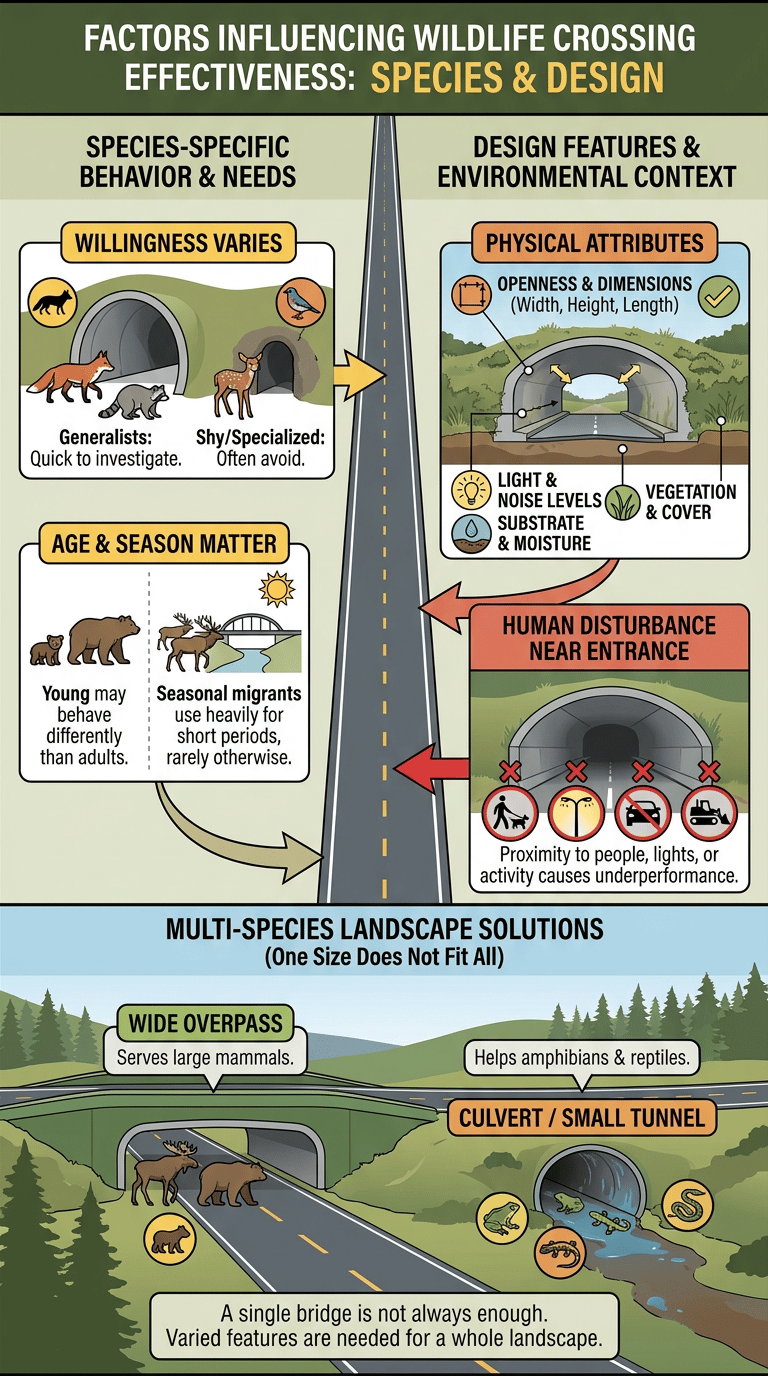
Some animals are more willing to use human-made structures than others. Generalists may investigate quickly, while shy or specialized species may avoid exposed openings. Young animals may behave differently than adults. Seasonal migrants may use a crossing heavily for a short period and rarely during the rest of the year.
Design also shapes use. Openness, length, height, width, light, noise, substrate, moisture, vegetation, scent, human disturbance, and approach cover can all matter. Even the best structure may underperform if the entrance is too close to people, dogs, parking lots, bright lights, or heavy maintenance activity.
Because animals differ, multi-species crossings often include varied features. A wide overpass may serve large mammals, while nearby culverts or small tunnels help amphibians or reptiles. A single bridge is not always enough for a whole landscape.
Limits, costs, and maintenance challenges
Wildlife crossings can be expensive, especially when they span major highways or require land acquisition, engineering, drainage, fencing, and long-term monitoring. Smaller retrofits may cost less, but they still need careful design and upkeep.
The FHWA Wildlife-Vehicle Collision Reduction Study found that wildlife-vehicle collisions are a major safety and wildlife issue in the United States and discussed mitigation methods including fencing and crossing structures. That broad safety context helps explain why transportation agencies may consider wildlife crossings even when construction costs are high.
Maintenance is easy to underestimate. Fences need repairs. Culverts can clog. Vegetation can die or become overgrown. Floods can change drainage. Human foot traffic can discourage sensitive animals. If a crossing is built and then ignored, its value may decline.
Common Myths and Mistakes
Wildlife crossings are popular because they offer a hopeful solution to a visible problem. That popularity can also create misunderstandings. The most effective projects are practical, evidence-based tools, not magic bridges.
Myth that one bridge solves all wildlife-road conflict
One overpass can help a specific movement route, but road ecology problems happen across networks. A highway may need multiple crossings, fencing, retrofitted culverts, speed management, habitat restoration, and long-term monitoring. Smaller roads, side roads, driveways, rail lines, and urban development may still block movement.
This does not make crossings weak. It means they must be placed inside a broader connectivity plan. A bridge is strongest when it connects real habitat on both sides and is supported by measures that keep animals away from pavement.
Myth that animals instantly know how to use crossings
Some animals may use a crossing quickly, especially if it follows an existing route. Others may take time. Individuals may investigate, avoid, return, or learn through repeated experience. Seasonal animals may not appear until the right movement period.
Early monitoring can be encouraging, but long-term evaluation is often more useful. A project built for gene flow or migration may need years of data before its full biological effect is clear.
Mistake of building crossings without habitat connections
A crossing that does not connect habitat is like a door that opens into nowhere. Animals need safe approaches, useful destination habitat, and a reason to move through the structure. If development removes the habitat on one side, the crossing may lose much of its purpose.
Green corridors, riparian areas, parks, conservation lands, and undeveloped patches can make crossings more functional. In urban areas, even small habitat connections may matter, but they need to be managed carefully so animals are not drawn into more traffic or human conflict.
How Wildlife Crossings Connect to Urban Ecology
Wildlife crossings are often pictured in wild mountain landscapes, but they also matter near cities and suburbs. Urban roads can divide parks, wetlands, river corridors, canyons, and open spaces. In these settings, crossings may help animals move through a human-dominated landscape without turning every road into a hazard.
Roadkill reduction as a related but separate issue
Roadkill reduction is one goal of many wildlife crossing projects, but it is not the full topic. A roadkill article focuses on why animals are hit, which species are vulnerable, and how drivers and agencies reduce mortality. A wildlife crossings article focuses on the structures and systems that help animals cross safely.
The overlap is natural. If crossings and fencing reduce animals on the pavement, roadkill may decline. But a project can also be valuable because it reconnects habitat, supports migration, and reduces isolation even when collision numbers are not the only measure.
Green corridors and parks as movement networks
Green spaces help crossings function by giving animals cover and destination habitat. A vegetated river corridor, park chain, utility corridor, or restored roadside edge can guide movement toward a crossing. Without these connections, animals may not find or trust the structure.
Urban planners often think about human mobility, but wildlife mobility has its own logic. Animals follow cover, water, scent trails, terrain, edges, and familiar routes. A crossing that respects those patterns is more likely to become part of the landscape instead of a standalone object.
Noise, light, and traffic as barriers near crossings
Even when a crossing exists, nearby disturbance can affect use. Bright lighting may discourage some nocturnal animals or attract others into risky areas. Traffic noise can mask cues or make an approach feel unsafe. Heavy human activity can cause shy species to avoid a structure.
Noise pollution can make an otherwise suitable crossing area less useful if animals avoid the road edge or fail to detect important sounds nearby.
Designers may respond with shielded lighting, vegetation buffers, restricted human access, quiet approach zones, and crossing placement away from the most intense disturbance. These details do not make the crossing perfect, but they make it more animal-centered.
FAQ
These common questions focus on how wildlife crossings differ, which animals use them, and what makes them effective.
What is the difference between a wildlife overpass and underpass?
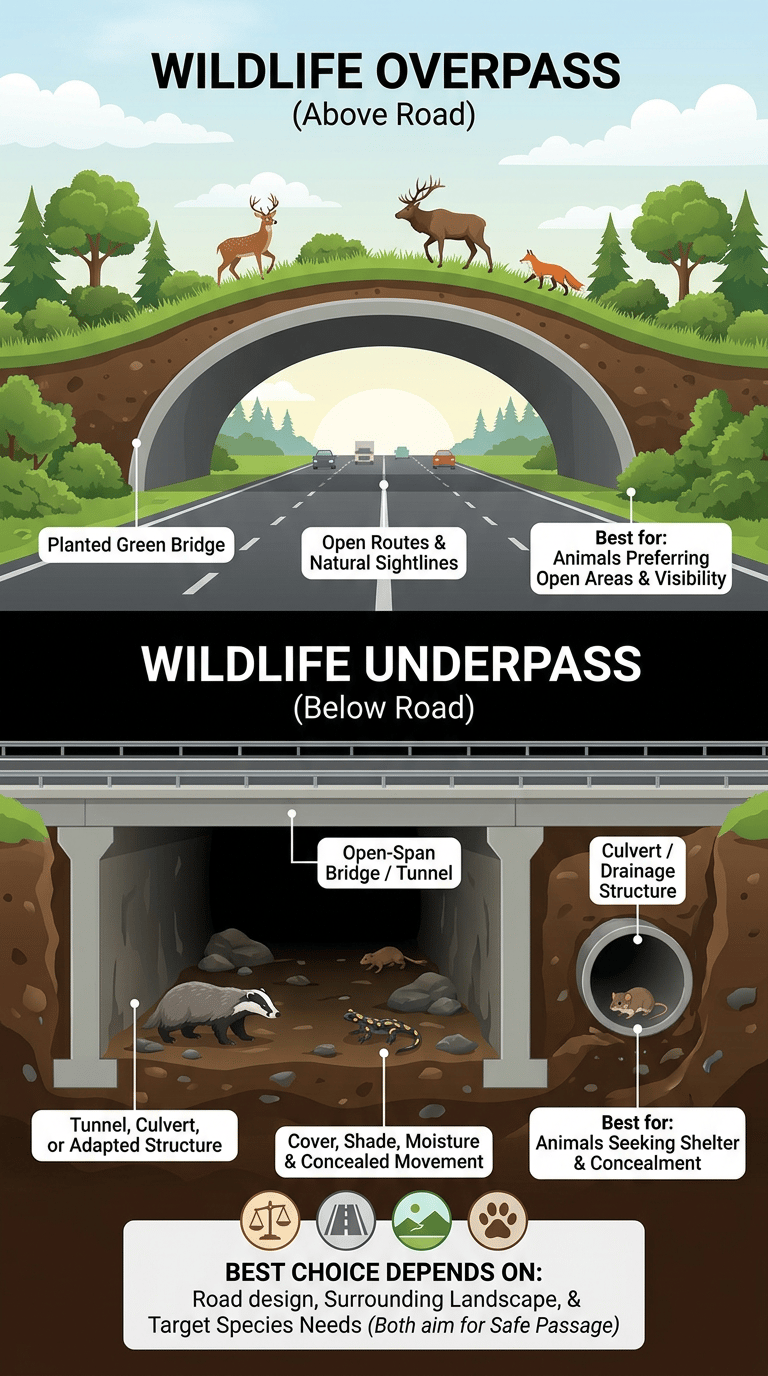
A wildlife overpass carries animals above the road, often on a planted bridge or green bridge. A wildlife underpass carries animals below the road through a tunnel, culvert, open-span bridge, or adapted drainage structure. Overpasses may work better for animals that prefer open routes and natural sightlines, while underpasses may suit species that prefer cover, shade, moisture, or concealed movement. The best choice depends on the road, landscape, and target species.
What animals use wildlife crossings most often?
Use varies by region and design. Deer, elk, bears, moose, mountain lions, coyotes, foxes, bobcats, raccoons, turtles, snakes, frogs, salamanders, small mammals, and birds may all use crossing structures in the right context. Large mammals are often emphasized because they create serious collision risk, but smaller animals can be important users and may need different crossing designs.
Do wildlife crossings reduce roadkill?
Wildlife crossings can reduce roadkill when they are correctly placed, designed for the target species, paired with effective fencing or guide structures, and maintained over time. They are not a guarantee. A crossing with gaps in fencing, poor habitat connections, or unsuitable dimensions may help some animals while leaving others at risk. Monitoring is needed to measure whether road mortality actually changes.
Why are wildlife crossings so expensive?
Many wildlife crossings are expensive because they are transportation infrastructure, not simple garden bridges. A project may require engineering, drainage work, soil, vegetation, fencing, land agreements, safety standards, construction crews, traffic control, environmental review, and years of monitoring. Some smaller retrofits cost less, but large overpasses and underpasses across major highways can require major investment.
Final Thoughts
Wildlife crossings are one of the clearest examples of designing roads with animals in mind. They help solve two connected problems: animals need to move through their habitat, and people need safer roads. The most effective crossings are not just attractive bridges or tunnels. They are carefully placed systems that combine structure type, fencing, habitat connection, species behavior, monitoring, and maintenance.
For readers, the main takeaway is that wildlife crossings work best when they are treated as ecology, not decoration. A safe crossing must make sense to the animals that use it. When roads, green corridors, fencing, light, noise, and movement routes are planned together, a highway can become less of a wall and more of a passable edge in the landscape.
Ethan Walker is the founder and research editor of Animal Fact Central. He creates and reviews educational animal facts content using trusted wildlife, pet care, and science-based sources. His work focuses on making animal behavior, adaptations, habitats, and species facts clear, accurate, and engaging for everyday readers.
Read More Details About Ethan Walker: https://animalfactcentral.com/ethan-walker/