
Light pollution affects animals by changing the natural darkness they use to navigate, feed, rest, avoid predators, reproduce, and time seasonal behavior. Artificial light at night can pull migrating birds toward cities, draw insects into dangerous places, disrupt sea turtle hatchlings on beaches, change how bats and mammals use habitat, and alter the balance between predators and prey.

The effects are not the same for every species. Some animals avoid bright areas. Some are attracted to light. Some appear to benefit in one situation while losing out in another. A streetlight may help a predator see prey, but it may also make the same area unusable for a light-sensitive animal. That is why artificial light at night is best understood as a habitat change, not just a visual nuisance.
Quick Answer: What Does Light Pollution Do to Wildlife?
Light pollution can confuse animals that evolved with predictable cycles of daylight, darkness, moonlight, and seasonal change. It can change when animals are active, where they move, how they communicate, how they find food, and how easily they avoid danger. In some cases, artificial light creates an ecological trap, which means an animal is attracted to a place or cue that lowers its chance of survival.
DarkSky International summarizes the broader problem by explaining that plants and animals depend on natural light and dark cycles for behaviors such as reproduction, nourishment, sleep, and protection from predators, and its page on light pollution harms wildlife and ecosystems describes effects across birds, insects, mammals, amphibians, and plants.
For readers, the simple takeaway is this: outdoor light is not automatically bad, but unnecessary, poorly aimed, overly bright, or all-night lighting can turn useful habitat into a more stressful or dangerous place for wildlife. The most wildlife-friendly lighting is usually shielded, dimmer, warmer in color, limited to where it is needed, and turned off or reduced when it is not needed.
Why Artificial Light at Night Matters
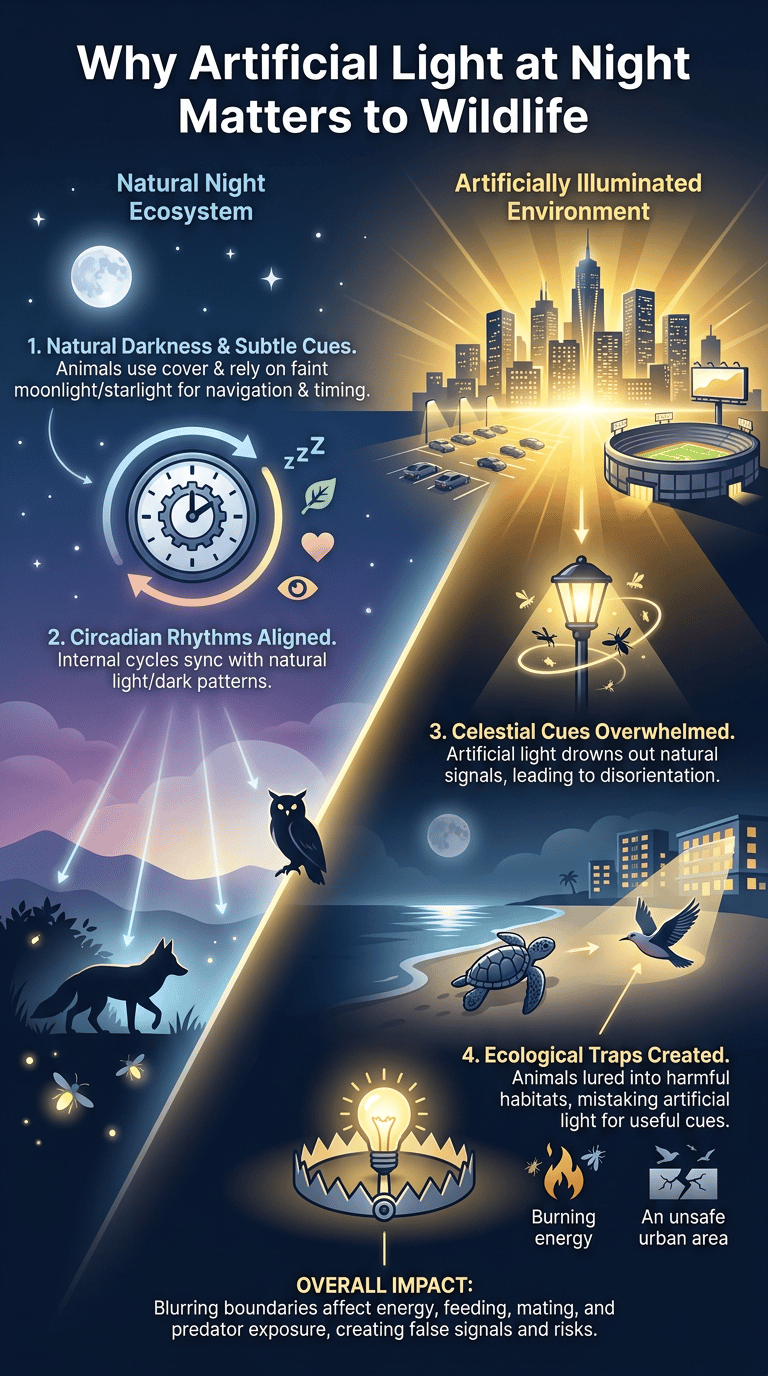
Night is not an empty period in animal life. Many animals use darkness as cover. Others use subtle light cues from the moon, stars, horizon glow, or changing day length. A bright parking lot, stadium, porch, billboard, bridge, or beachfront building can add new signals that animals did not evolve to interpret.
Natural Light Cycles and Circadian Rhythms
A circadian rhythm is a roughly 24-hour internal cycle that helps living things organize sleep, feeding, movement, hormone release, and other body processes. Animals do not rely only on clocks inside their bodies. They also use environmental cues, especially light and darkness, to keep those rhythms aligned with the outside world.
When nights become brighter, the boundary between day and night can blur. A bird may begin activity earlier. A frog may call differently. A mammal may shift away from an open area that is no longer dark enough to feel safe. These changes can look small from a human window, but they can affect energy use, feeding success, mating opportunities, and exposure to predators.
Moonlight, Starlight, and Seasonal Cues
Natural nights are not always equally dark. Many animals respond to moon phase, cloud cover, seasonal day length, and the pattern of sunrise and sunset. Some predators hunt more effectively on brighter moonlit nights. Some prey species reduce movement when visibility is high. Some migratory animals use celestial cues along with magnetic fields, smell, landscape features, or other signals.
Artificial light can overwhelm those subtle cues. A coastal hatchling that should move toward the brighter ocean horizon may crawl toward beachfront lights. A night-flying insect that uses distant celestial light for orientation may spiral around a nearby lamp. A migrating bird passing over a city may be drawn downward toward illuminated structures, especially under certain weather conditions.
Why City Lighting Can Create Ecological Traps
An ecological trap happens when an animal chooses a habitat or cue that seems useful but is actually harmful. Artificial light can create traps because it changes what animals see without changing the underlying risk. Insects may gather around lights where they burn energy, become easier prey, or fail to feed and mate normally. Birds may land in bright urban areas that have fewer safe resting places than natural stopover habitat.
Main Mechanisms of Light Pollution Effects
Light pollution affects wildlife through several overlapping mechanisms. The same light can disrupt navigation, shift feeding behavior, alter rest, and change predator-prey interactions at the same time.
Navigation Disruption in Migratory Animals
Many birds migrate at night, when air is often calmer and cooler. Artificial light can distract or attract nocturnally migrating birds, pulling them toward cities, towers, stadiums, and illuminated buildings. The U.S. Fish and Wildlife Service explains in its page on nighttime lighting and bird collisions that lighting can attract night-migrating birds and cause them to circle illuminated areas, wasting energy and increasing risk.
Navigation disruption is not only about birds hitting glass. The attraction itself can matter. A bird that lands in a brightly lit urban area may lose migration time, use energy reserves, face predators, or encounter buildings and roads. For an individual bird, one difficult night may be survivable. Across millions of migrants, repeated light exposure can become a conservation concern.
Changes to Feeding and Hunting Behavior
Light changes who can see whom. A predator that hunts by sight may gain an advantage under lamps. A prey animal that relies on darkness may avoid lit areas, even if those areas contain food. Insects may cluster around lights, which can create temporary feeding opportunities for some bats, spiders, birds, or other predators. At the same time, the insects caught in the light may lose time they would otherwise spend feeding, finding mates, laying eggs, or pollinating plants.
The result is not simply “more light equals more food.” A bright spot can concentrate some prey while emptying darker nearby habitat. It can favor species that tolerate light and disadvantage species that avoid it. That uneven pressure can reshape local food webs, especially in parks, waterfronts, forests edges, and suburban yards where wildlife still depends on night conditions.
Sleep, Hormone, and Breeding Timing Disruption
Animals use day length and darkness to time many body processes. Artificial light can shift daily activity and, in some species, may affect seasonal timing. Birds may begin singing earlier near lights. Amphibians may change calling behavior. Mammals may avoid resting or feeding in illuminated areas. Even when an animal survives, a disrupted schedule can carry costs if it reduces feeding time, mate attraction, parental care, or predator avoidance.
It is better to avoid one-size-fits-all claims here. The effect of light on breeding or hormones varies by species, intensity, spectrum, timing, and habitat. A cautious article should say that artificial light can disrupt biological timing in some animals, rather than claiming every animal responds in the same way.
Predator-Prey Imbalance Around Bright Edges
Many wild animals use edges: the boundary between forest and lawn, water and land, shrub and sidewalk, or dark habitat and lit pavement. Artificial light can sharpen those edges. A lit trail beside a dark woodland may become a hunting lane for some predators and a barrier for cautious prey. A bridge light over water may attract aquatic insects and fish, changing where predators feed.
Bright edges can also expose animals that normally move under cover of darkness. A small mammal may avoid crossing an open lit patch. A frog may stop calling in a bright area. A bat species that dislikes light may abandon a corridor even if insects are present. In urban ecology, the absence of an animal can be as important as the animals gathered under a lamp.
Birds and Light Pollution
Birds are among the clearest examples of how artificial light at night can change animal behavior. The risk is especially visible during migration, but light can also affect daily rhythms, stopover choices, and collision risk around buildings.
Night Migration and Attraction to Illuminated Buildings
Many migratory birds pass over cities at night. On clear nights, they may continue high overhead. Under cloudy, foggy, or rainy conditions, or around very bright light sources, birds can become more likely to descend or circle. The Cornell Lab’s All About Birds has reported on research showing that high-flying migrant birds can be distracted by lights near ground level, which matters because many artificial lights are not on skyscrapers but on streets, homes, parking lots, and smaller buildings.
This is why lights-out programs often focus on peak migration nights. Turning off unnecessary lights during migration does not solve every bird hazard, but it removes a cue that can pull birds toward risky urban spaces. It also saves energy and can reduce skyglow that affects wildlife beyond the immediate building.
Disorientation, Exhaustion, and Collision Risk
When birds circle bright structures, they can burn energy they need for migration. Some may collide with glass, walls, cables, or other structures. Others may land in places where food and cover are limited. Light and glass are closely linked problems in cities, but they are not identical. Light can attract or disorient birds, while glass creates a physical collision hazard because reflections or transparency can look like open habitat.
Why Window Strikes Overlap With Lighting but Are a Separate Problem
Window strikes deserve their own focused explanation because birds hit windows for more than one reason. During the day, reflections of trees and sky can make glass look like habitat. At night, interior and exterior lights can draw birds into built areas where glass becomes more dangerous. The two problems overlap, but their solutions are not the same.
For this light pollution article, the key point is that reducing unnecessary light can lower one major risk factor for nocturnal migrants. For a full window safety approach, the glass itself must also be treated so birds can see it as a barrier.
Insects, Bats, and Nocturnal Food Webs
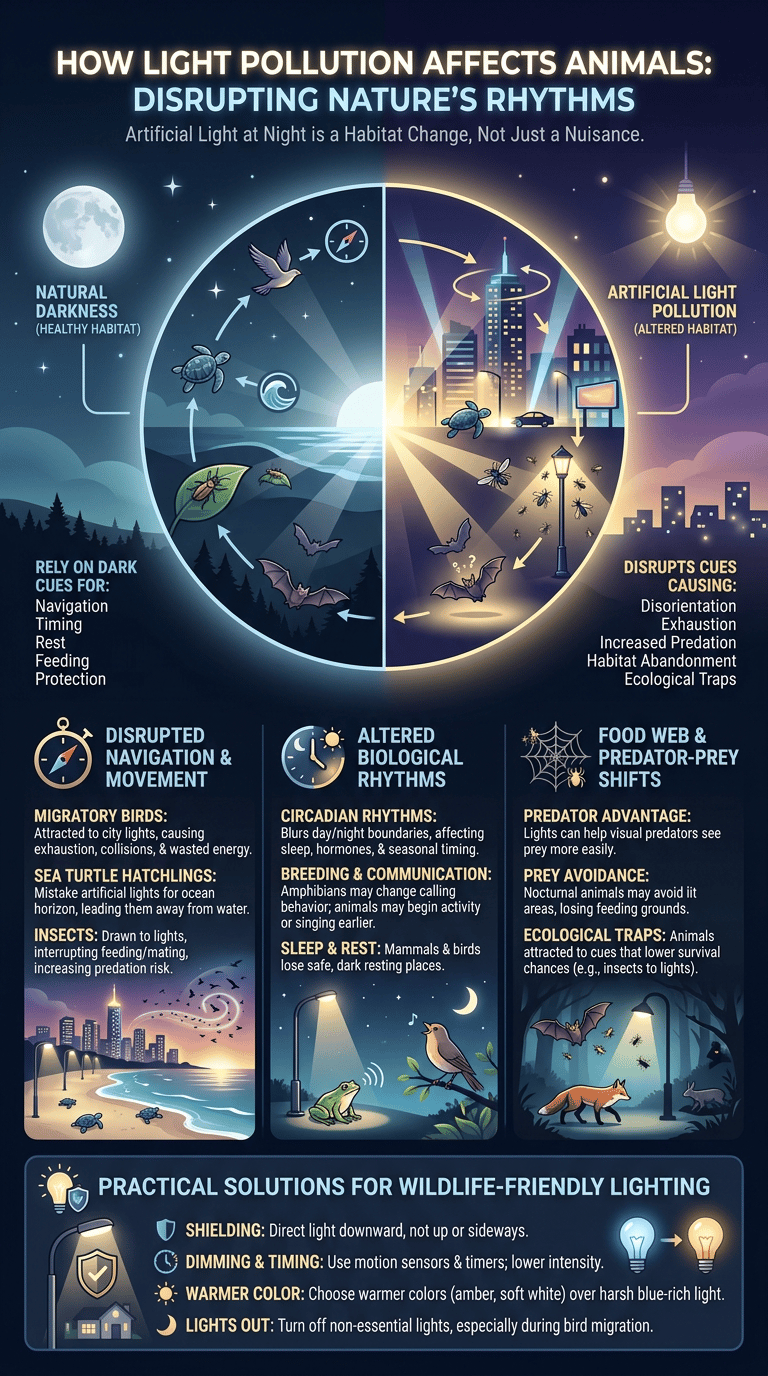
Insects and bats show why light pollution should be understood as a food-web issue. A lamp does not only affect the animals visible in its glow. It can affect the predators that feed on them, the plants they pollinate, and the animals that depend on insects as food.
Insect Attraction to Lights and Population Pressure
Many night-flying insects are attracted to artificial lights, although the reasons vary by species and are still studied. A review in the journal Ecology and Evolution, available through PubMed Central on artificial light at night and nocturnal insects, describes several impact categories, including attraction, disrupted movement, altered predator-prey interactions, and changes to development or reproduction.
For insects, being attracted to a light can mean wasted energy, increased predation, reduced feeding, interrupted mating, or death from exhaustion or heat. Even when the effect is local, lights are now spread across roads, homes, businesses, bridges, farms, and parks. That makes small disruptions easier to repeat across a landscape.
How Light Can Change Bat Foraging Patterns
Bats do not all respond to light the same way. Some fast-flying species may hunt insects around lights. Other species avoid illumination and need darker corridors to move safely between roosts and feeding areas. A lit bridge, trail, or road edge can therefore help one bat species find insects while making the same route less usable for another.
This is a good example of why “wildlife-friendly” lighting cannot be judged only by whether some animals appear around it. Seeing bats or insects near a lamp does not prove the light is harmless. It may simply show that certain tolerant species are using a changed environment while more sensitive species are absent.
Ripple Effects for Birds, Spiders, Amphibians, and Fish
Insects are food for many animals. If artificial light changes where insects gather or how many survive, the effects can ripple outward. Spiders may build webs near lights. Birds may feed on insects gathered around buildings. Frogs and fish may respond to changes in insect emergence near water. These interactions can make lit areas look busy, but busier does not always mean healthier.
Reptiles, Amphibians, and Marine Animals
Light pollution can be especially serious for animals that rely on light cues during movement or breeding. Sea turtles, frogs, salamanders, and some aquatic animals illustrate how lighting near water or breeding habitat can change survival odds.
Sea Turtle Hatchlings and Coastal Lighting
Sea turtle hatchlings usually move from the nest toward the ocean after emerging from the sand. On a natural beach, the open ocean horizon is often brighter than the dune line. Artificial lights from beachfront buildings, roads, signs, flashlights, or vehicles can confuse that cue. NOAA Fisheries notes on its loggerhead turtle species profile that artificial lighting on or near nesting beaches can deter nesting females and disorient hatchlings.
This is a clear case where the wrong light in the wrong place can have direct survival consequences. Hatchlings that crawl inland or wander too long may face exhaustion, dehydration, predators, vehicles, or failure to reach the water. Coastal lighting rules vary by location, but the biological principle is consistent: beaches used by nesting sea turtles need lighting that does not pull turtles away from the sea.
Frogs, Salamanders, and Nighttime Breeding Behavior
Many amphibians are active at night, especially during wet weather or breeding seasons. Frogs may call to attract mates. Salamanders may move between forests and breeding pools. Artificial light can change how exposed these animals feel and may alter movement or calling behavior in some settings.
Amphibians also face other urban pressures, including road mortality, pollution, habitat loss, and disease. Light pollution should not be treated as the only threat. It is one pressure that can combine with others, especially around stormwater ponds, roadside wetlands, suburban yards, and park edges.
Fish and Aquatic Animals Near Lit Shorelines and Bridges
Water reflects and transmits light differently than land. Lights on docks, bridges, waterfront paths, boats, and buildings can brighten shallow water and change activity patterns near the surface. Some fish may gather where insects fall into lit water. Some predators may use the visibility. Other animals may avoid the area.
Urban Mammals and Night Behavior
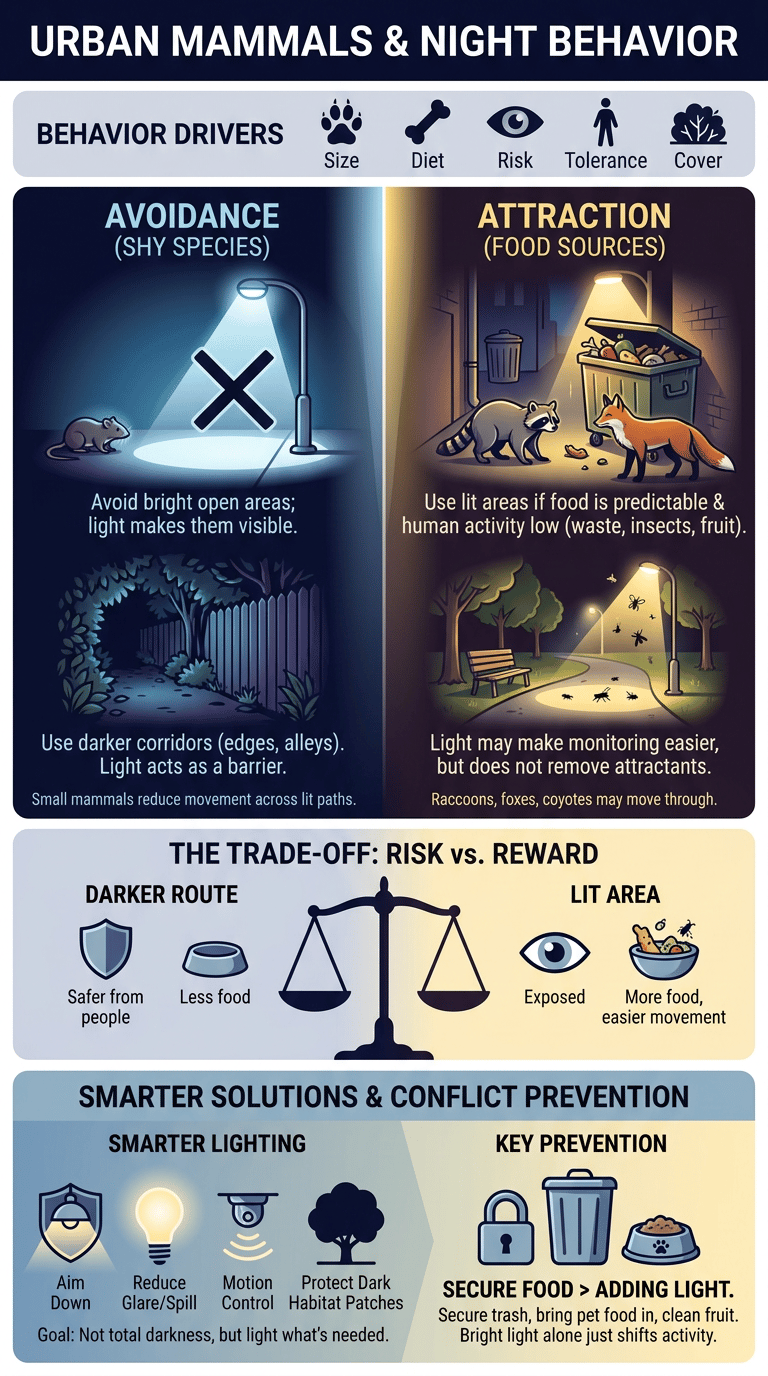
Mammals in cities often deal with light by changing where and when they move. The pattern depends on the animal’s size, diet, predator risk, tolerance of people, and need for cover.
Avoidance of Bright Areas by Shy Species
Some mammals avoid bright open areas because light makes them more visible. Small mammals may reduce movement across lit pavement or lawns. Larger mammals may use darker corridors, wooded edges, drainage routes, or quiet alleys. In this way, artificial light can act like a barrier even when there is no fence.
Increased Nighttime Activity Near Food Sources
Other mammals may use lit areas if food is predictable and human activity is low. Raccoons, rats, mice, foxes, and coyotes may move through alleys, parks, or commercial areas at night when food waste, insects, fruit, or prey are available. Light may make these places easier for people to monitor, but it does not remove the underlying attractants.
For conflict prevention, reducing food access is usually more important than adding more light. Secure trash, bring pet food indoors, clean up fallen fruit when practical, and avoid feeding wildlife. Bright lighting alone may shift activity rather than solve the ecological reason animals are there.
Trade-Offs Between Visibility, Safety, and Food Access
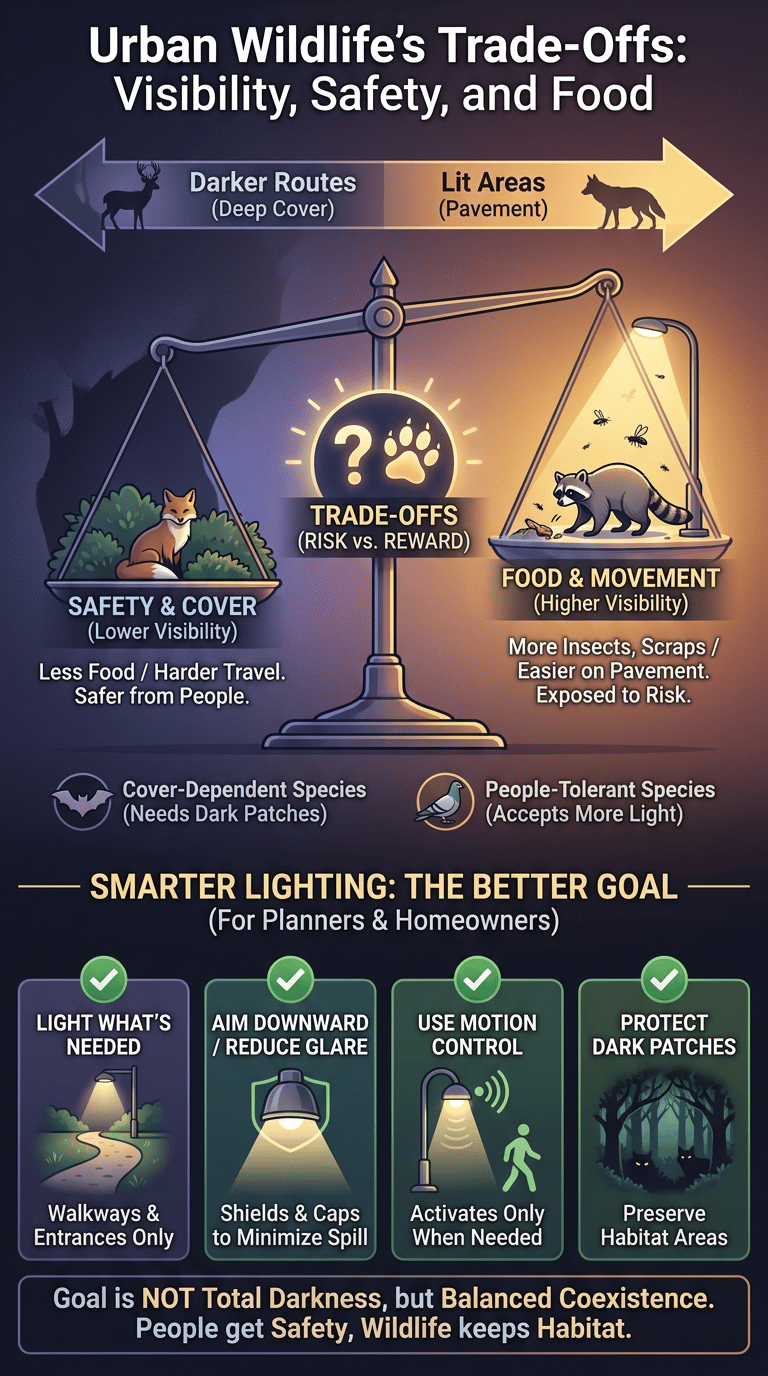
Urban animals constantly trade risk against reward. A darker route may be safer from people but have less food. A lit area may expose an animal but also provide insects, scraps, or easier movement along pavement. A species that tolerates people may accept more light than a species that depends on deep cover.
For city planners and homeowners, this means the goal is not total darkness everywhere. People need safe walkways and entrances. The better goal is smarter lighting: light what needs to be lit, aim it downward, reduce glare and spill, use motion control when appropriate, and protect dark habitat patches where wildlife still needs them.
Common Myths and Mistakes
Light pollution is easy to misunderstand because people experience light differently from wild animals. What seems comforting, decorative, or harmless to us may be a powerful signal to another species.
Myth That More Light Always Makes Animals Safer
More light can make some hazards easier for humans to see, but it does not automatically make animals safer. A light may help one predator hunt, expose prey, attract insects, or draw birds toward buildings. Safety depends on the species and situation.
A better question is not “how much light can we add?” but “what light is needed, where should it point, when should it be on, and what habitat is nearby?” Those details decide whether lighting is useful, wasteful, or harmful.
Myth That Only Nocturnal Animals Are Affected
Nocturnal animals are often strongly affected because they are active at night. But daytime animals can also be affected if light changes sleep, migration, hormone timing, predator exposure, or early morning activity. Birds that migrate at night but feed by day are a good example.
Plants can also be affected by artificial light, which can indirectly affect animals through flowers, leaves, fruit, insects, and seasonal timing. Light pollution is not just a problem for owls and bats.
Mistake of Treating All Light Colors and Directions as Equal
Brightness matters, but so do direction, color, glare, duration, and location. A shielded, warm, motion-activated path light is not the same as an unshielded cool-white floodlight shining into trees all night. Lights near beaches, wetlands, migration corridors, roosts, or nesting areas deserve extra care.
Color effects vary by species, so no single bulb color is perfect for all wildlife. Still, reducing unnecessary brightness and spill is usually a safer first step than trying to solve every problem by changing color alone.
Practical Ways Cities and Homeowners Can Reduce Harm
Reducing light pollution does not require removing every light. It means using light more deliberately. The best changes often save energy, reduce glare, improve night sky visibility, and lower wildlife disturbance at the same time.
Shielding, Dimming, Timing, and Warmer Lighting Principles
Shielding keeps light pointed downward instead of sideways or upward. Dimming reduces intensity. Timers and motion sensors limit how long lights stay on. Warmer lighting can reduce some ecological effects compared with harsh, blue-rich lighting, although species responses vary.
For homes, useful changes include closing curtains at night, turning off decorative outdoor lights, choosing fixtures that do not spill into trees or water, and using motion sensing where safety allows. For cities, lighting plans can identify parks, waterways, migration corridors, and sensitive habitat edges where darkness is part of habitat quality.
Lights-Out Periods During Migration Seasons
Lights-out efforts ask buildings and homeowners to turn off or reduce nonessential lighting during peak bird migration periods. These programs are especially useful in cities along major migration routes. They are not a replacement for bird-safe glass, but they address the attraction and disorientation part of the problem.
Migration timing varies by region and weather. The most effective programs use local bird migration forecasts, building participation, and public awareness so lights are reduced on nights when many birds are moving.
Why Wildlife-Friendly Lighting Is Not the Same as Darkness Everywhere
Wildlife-friendly lighting balances human safety with ecological needs. A stairway, crosswalk, or building entrance may need lighting. A tree canopy, beach, wetland edge, empty parking lot, or backyard garden may not need bright light all night. The goal is contrast: keep necessary light useful and keep unnecessary light out of habitat.
How This Connects to Nearby Animal Topics
Light pollution overlaps with several urban wildlife issues, but it should not be merged with all of them. Keeping the categories clear helps readers understand cause and solution.
Noise Pollution as a Separate Sensory Stressor
Noise pollution affects animals through sound rather than light. Traffic, construction, aircraft, boats, and machinery can mask calls, alter stress, change movement, or reduce habitat quality. Light and noise often occur together in cities, but an animal may be sensitive to one more than the other.
Window Strikes as a Building-Collision Issue
Artificial light can draw birds into risky building zones, but window strikes also happen in daylight because of reflection and transparency. A complete bird-safe building strategy addresses both nighttime lighting and visible glass treatments.
Green Spaces and Dark Corridors as Refuges
Urban green spaces help wildlife most when they provide real food, cover, water, and connected movement routes. Darkness can be part of that habitat. A park that is bright all night may be less useful for light-sensitive animals than one with safe, dark patches and lighting limited to necessary paths.
FAQ
What Animals Are Most Affected by Light Pollution?
Animals most affected by light pollution often include nocturnal insects, migratory birds, bats, sea turtle hatchlings, amphibians, and animals that depend on dark corridors for movement. The exact answer depends on the location and type of lighting. Coastal lights may be especially important for sea turtles, while city skyglow and building lights are major concerns for migrating birds.
It is also possible for less obvious animals to be affected. Fish, spiders, small mammals, and daytime birds can all experience indirect effects if artificial light changes food webs, sleep timing, or predator-prey interactions.
Does Light Pollution Affect Bird Migration?
Yes, artificial light at night can affect bird migration, especially for species that migrate at night. Bright lights can attract, distract, or disorient birds, causing some to circle illuminated areas, land in urban spaces, or face greater collision risk near buildings.
The risk is not equal every night. Weather, migration intensity, building design, geography, and light level all matter. That is why many conservation groups focus lights-out efforts during peak migration periods rather than treating every night as identical.
Are Insects Dying Because of Artificial Lights?
Artificial light is one of several pressures that can harm insects. It can attract night-flying insects, disrupt movement, increase predation, affect feeding and reproduction, and alter development in some species. Habitat loss, pesticides, climate change, invasive species, and pollution can also affect insect populations.
The careful answer is that artificial light can contribute to insect stress and decline in some contexts, but it should not be described as the only cause. The effect depends on insect species, light type, habitat, season, and the amount of exposure.
What Color Light Is Better for Wildlife?
No single light color is best for every animal. Many wildlife-friendly lighting recommendations favor warmer, less blue-rich light, but color is only one part of the issue. Brightness, direction, shielding, timing, glare, and location are often just as important.
A dim, shielded, warm light used only when needed is usually better than a bright unshielded light left on all night. Near beaches, wetlands, roosts, nesting areas, or migration corridors, local wildlife agencies may have more specific lighting guidance.
Final Thoughts
How light pollution affects animals depends on species, habitat, timing, and the type of light involved. The common thread is that artificial light at night changes natural darkness, and darkness is a real part of wildlife habitat. Birds, insects, bats, sea turtles, amphibians, fish, and mammals all use night conditions in different ways, so lighting choices can change how they move, feed, rest, reproduce, and survive.
The practical lesson is not to fear every outdoor bulb. It is to use light carefully. Shield it, dim it, warm it, time it, and turn off what is not needed. In cities, suburbs, beaches, parks, and yards, smarter nighttime lighting can make human spaces safer and more useful while leaving animals the dark cues they still need.

Ethan Walker is the founder and research editor of Animal Fact Central. He creates and reviews educational animal facts content using trusted wildlife, pet care, and science-based sources. His work focuses on making animal behavior, adaptations, habitats, and species facts clear, accurate, and engaging for everyday readers.
Read More Details About Ethan Walker: https://animalfactcentral.com/ethan-walker/