

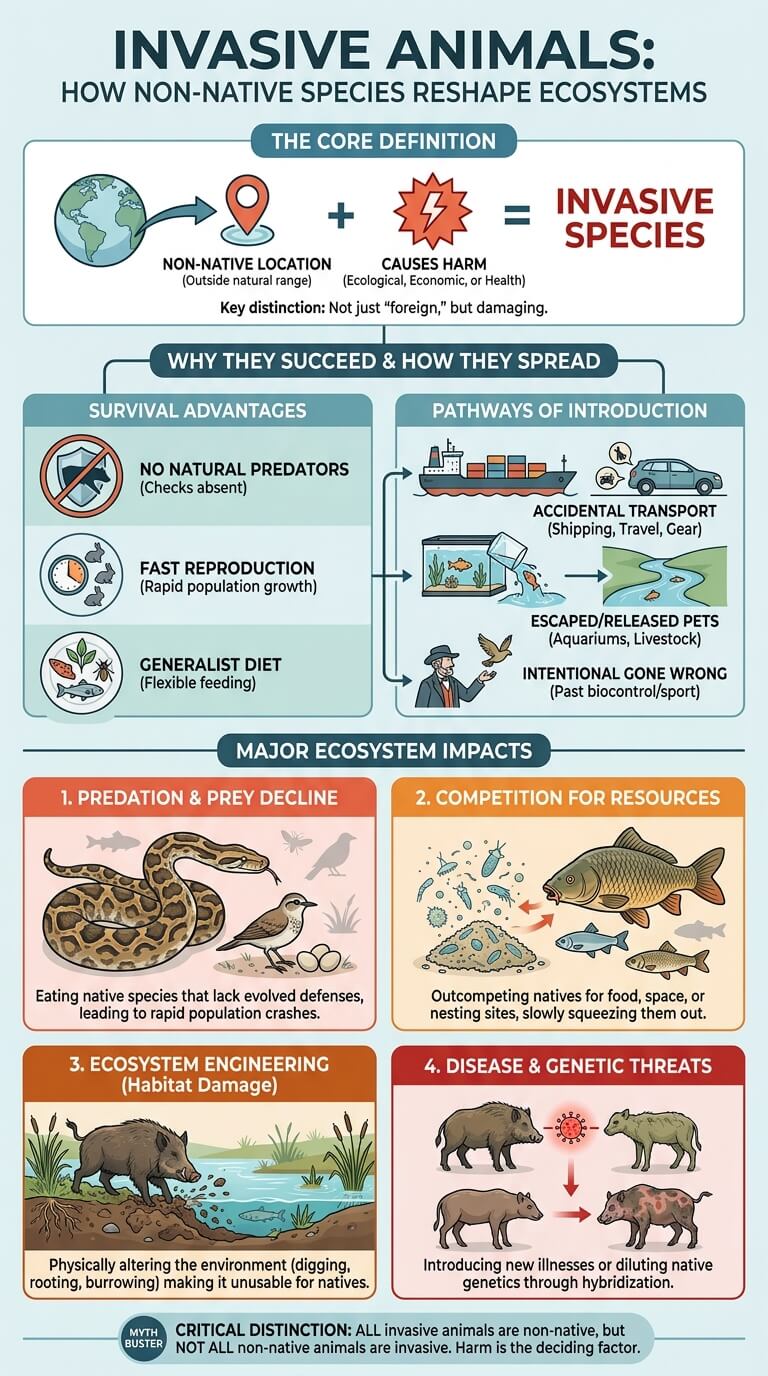
Invasive animals are non-native animals that establish in a place where they did not naturally live and cause, or are likely to cause, harm. That harm can affect native wildlife, habitats, farms, waterways, pets, people, or local economies. The key point is not that the animal is strange, aggressive, or from another country. The key point is that it is outside its natural range and is changing the ecosystem around it.
This topic matters because invasive animals can alter food webs in ways that are hard to reverse. A snake released into a wetland, a fish escaping into a river system, or a pig population spreading through forests can all create different problems. Some eat native animals. Some compete for food. Some damage soil and vegetation. Some carry diseases or parasites. Understanding invasive animals helps readers separate real ecological concerns from simple fear of unfamiliar wildlife.
Quick Overview
An invasive animal is usually described by three connected ideas: it is non-native to the ecosystem under discussion, it can survive or spread there, and it causes harm or is likely to cause harm. The U.S. Fish and Wildlife Service definition describes invasive species as non-native living organisms that thrive where they do not naturally live and cause economic, environmental, or health-related harm.
That definition helps explain why invasive animal problems vary so much. A species can be native in one region and harmful in another. A non-native animal may stay contained in a farm, aquarium, zoo, or home without becoming invasive. Another may escape, reproduce, spread through suitable habitat, and put pressure on native species that did not evolve with it.
For readers, the simplest way to think about invasive animals is this: location plus impact matters. A fish, frog, snake, bird, insect, or mammal is not invasive just because it came from somewhere else. It becomes an invasive concern when its presence changes the biological, economic, or health balance of the new place.

What Invasive Animals Are and Why the Term Matters
Words like native, non-native, introduced, exotic, pest, nuisance, and invasive are often used as if they mean the same thing. They do not. The differences matter because wildlife agencies, land managers, veterinarians, farmers, and conservation workers may respond very differently depending on which term fits the situation.
Native, non-native, introduced, established, and invasive explained
A native animal is one that occurs in a place through natural processes, not because people transported it there. A non-native animal lives outside the area where it naturally occurs. An introduced animal is a non-native animal that arrived through human action, whether intentional or accidental. An established animal is able to survive and reproduce in the new area without constant human help.
An invasive animal goes one step further. It is not just present. It causes ecological, economic, or health-related harm, or it is likely to do so. The National Invasive Species Information Center explanation separates non-native species from invasive species by emphasizing harm, not just origin.
This distinction prevents overreaction. Many useful domestic animals and crops are non-native in the United States, but they are not automatically invasive. A cow in a managed pasture, a goldfish in an indoor aquarium, or a parrot in a legal captive setting is not the same as a self-sustaining wild population spreading through sensitive habitat.
Why not every non-native animal becomes invasive
Most introduced animals do not become major invasive problems. Some cannot survive local climate. Some cannot find enough food. Some fail to reproduce. Some remain limited to small areas. Others are kept in controlled human settings and never become wild populations.
For a non-native animal to become invasive, several conditions often line up. The new habitat may provide food, shelter, and breeding sites. The animal may lack the predators, parasites, competitors, or diseases that limited it in its native range. Human-altered landscapes can also create openings. Canals, roads, farms, suburbs, ports, and disturbed wetlands may all help certain animals move or settle.
This is why invasion risk is not only about the animal. It is about the match between the animal and the new environment. A species that is harmless in one context can become damaging in another if the local ecosystem has no good way to absorb the pressure.
The Main Ways Invasive Animals Change Ecosystems
Invasive animals affect ecosystems through many pathways, but most impacts fall into a few major categories. These categories help readers compare very different animals without treating every invasion as the same story.

Predation and prey decline
Some invasive animals become powerful predators in places where native prey have not evolved defenses against them. This can be especially serious on islands, in isolated wetlands, or in habitats where native animals nest on the ground and have limited escape options.
Predation impact is not only about the size of the predator. A small mammal, snake, fish, insect, or amphibian can have major effects if it eats eggs, larvae, young animals, or small adults that are critical to the local food web. Invasive predators can also change animal behavior. Native animals may avoid feeding, nesting, or moving in areas where the new predator is common, even before population declines are easy to measure.
Burmese pythons in South Florida are a well-known example of predation pressure in a sensitive ecosystem, but the broader principle applies to many invasive animals. A predator that arrives without its usual ecological checks can reshape which native animals survive, reproduce, and remain visible.
Competition with native wildlife
Competition happens when invasive animals use food, nesting sites, shelter, water, or space that native species also need. This pressure can be direct, such as an invasive bird taking nest cavities from native birds. It can also be indirect, such as an invasive fish consuming plankton that young native fish depend on.
Competition is often harder for the public to notice than predation. A predator leaves obvious clues when it kills prey. A competitor may slowly reduce feeding success, breeding success, or growth rates across many seasons. By the time the problem is obvious, the food web may already have shifted.
Invasive carp help show how competition can work in aquatic ecosystems. Some species feed heavily on plankton, which forms the base of many freshwater food webs. When a large population consumes that shared food resource, the effects can move through native fish, mussels, birds, and people who depend on healthy waterways.
Habitat damage and ecosystem engineering
Some invasive animals change the physical structure of habitats. They dig, root, graze, burrow, trample, or build in ways that alter soil, water flow, vegetation, and shelter. These animals are sometimes described as ecosystem engineers because they physically reshape the environment around them.
Feral pigs are one of the clearest land-based examples. Their rooting can disturb soil, uproot plants, expose seeds, increase erosion, and affect wetlands and streambanks. In an area where native plants, amphibians, reptiles, ground-nesting birds, and small mammals depend on stable cover, that disturbance can ripple far beyond the first patch of damaged ground.
Habitat damage also matters because it can make ecosystems more vulnerable to other invasions. Disturbed soil may favor invasive plants. Clouded water may affect aquatic plants and fish. Broken vegetation cover may expose nests or reduce hiding places for native animals.
Disease, parasites, and genetic impacts
Invasive animals can carry diseases or parasites into new areas. They can also amplify existing pathogens by serving as new hosts. These concerns are especially important when invasive wildlife overlaps with livestock, pets, humans, or threatened native species.
Disease risk should be described carefully because not every individual animal carries a pathogen, and not every encounter creates the same risk. Still, wildlife agencies take these pathways seriously because diseases and parasites can move through ecosystems in ways that are difficult to see early.
Genetic impacts can happen when a non-native animal breeds with a closely related native species or local population. Hybridization may reduce the genetic distinctiveness of native animals, especially when small populations are already under pressure. This kind of impact is less visible than predation or habitat damage, but it can matter for long-term conservation.
How Invasive Animals Spread
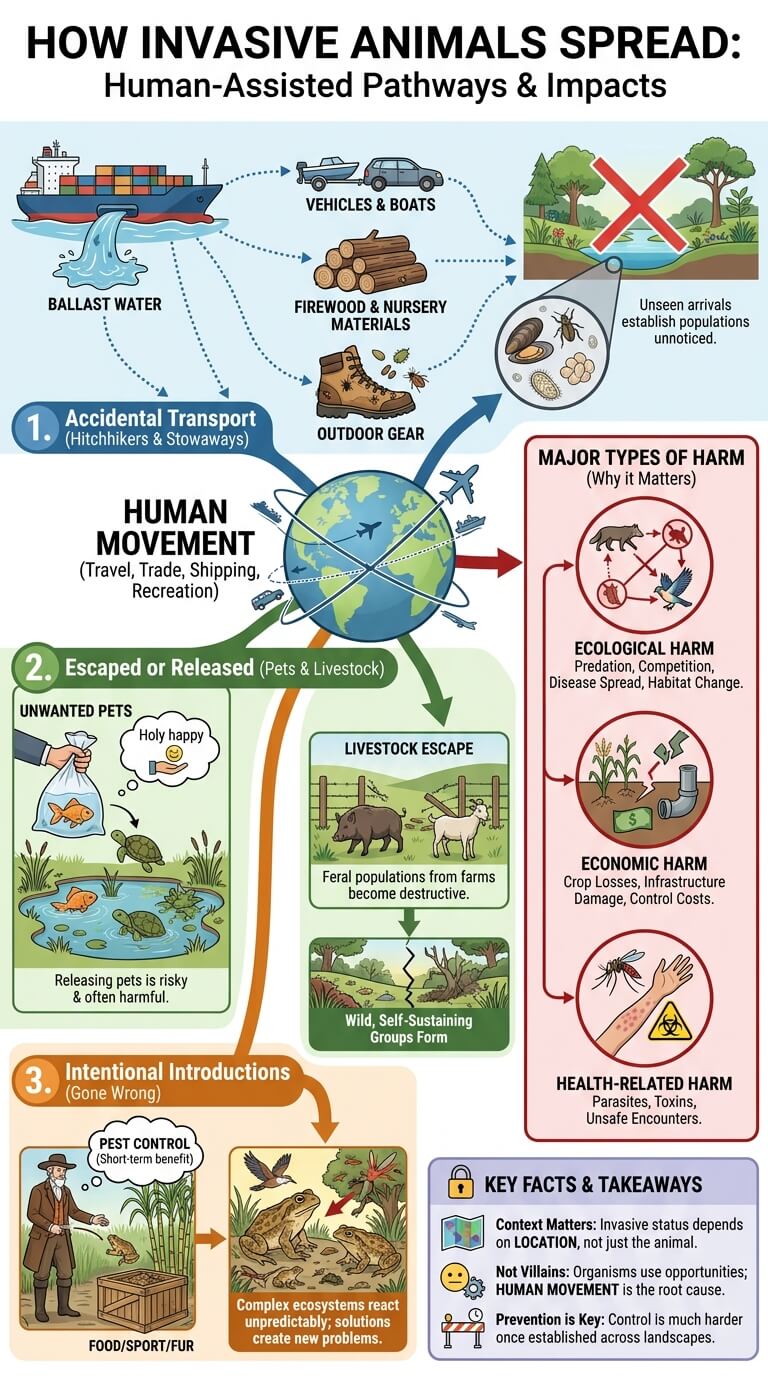
Invasive animals usually spread with help from people, even when the help is accidental. Modern travel, shipping, trade, outdoor recreation, agriculture, aquaculture, and pet ownership move living things across barriers that once kept ecosystems separate.
Accidental transport through trade and travel
Animals can hitchhike in cargo, packaging, ballast water, nursery materials, vehicles, boats, trailers, firewood, soil, or outdoor gear. Aquatic animals may move between waters on equipment or in bait buckets. Insects and eggs can travel in wood products. Small organisms can arrive unnoticed and become visible only after they have reproduced.
The National Park Service pathway overview notes that vehicles, watercraft, bait, firewood, people, and pets can all create routes for invasive species to reach new places.
These pathways show why prevention is such a major part of invasive species work. Once an animal is established across a connected river system, large wetland, or broad landscape, control becomes far more difficult than stopping the arrival in the first place.
Escaped or released pets and livestock
Some invasive animals begin as pets, aquarium animals, bait animals, livestock, or farmed species. A release may seem harmless to one person, but a single released animal can become part of a larger problem if enough individuals survive and reproduce.
Releasing unwanted pets is risky because captive animals may carry diseases, may not survive humanely, or may become predators or competitors in the new environment. Releasing aquarium fish, reptiles, amphibians, birds, or small mammals into the wild is not a kind solution. Safer options include contacting local rescues, shelters, veterinarians, or legal rehoming programs.
Livestock and farmed animals can also become feral when they escape or are allowed to roam. Feral pig populations show how domestic ancestry does not prevent an animal from becoming ecologically damaging once it forms wild, self-sustaining groups.
Intentional introductions that went wrong
Some invasive animals were introduced on purpose for food, pest control, sport, fur, aquaculture, or agriculture. At the time, people may have focused on one short-term benefit and underestimated how the species would behave in a new ecosystem.
Cane toads are often discussed as a cautionary example of pest-control introductions outside their native range. Invasive carp have histories tied to aquaculture and water management. Some birds and mammals were introduced for hunting, farming, or aesthetic reasons. The lesson is not that every introduction fails. The lesson is that ecosystems are complex, and solving one problem by moving animals can create another.
Modern risk assessment is much more careful than many older introductions, but mistakes still happen. Global trade and climate shifts can also create new invasion risks that earlier generations of managers did not face.
Key Facts Readers Should Know
The first key fact is that invasive animals are ecological context problems. The same species can be native in one place, non-native in another, and invasive only where it causes harm. That is why good invasive species writing must name the location, not just the animal.
The second key fact is that harm can be ecological, economic, or health-related. Ecological harm includes predation, competition, habitat change, disease spread, and food web disruption. Economic harm may include crop losses, damaged infrastructure, control costs, or impacts on fisheries and recreation. Health-related harm may involve parasites, diseases, toxins, or unsafe encounters, depending on the animal.
The third key fact is that invasive animals are not villains. They are organisms using available food, shelter, and breeding opportunities. The problem usually begins with human movement across ecological boundaries. Blaming the animal may make the story feel simple, but it can hide the real causes and the best prevention steps.
The fourth key fact is that control is rarely simple. Removing one animal from a backyard is not the same as reducing a breeding population across wetlands, islands, forests, farms, or connected waterways. Successful management depends on detection, timing, funding, habitat type, public cooperation, and clear legal authority.
How These Animals Live, Feed, Move, or Survive
Invasive animals often succeed because ordinary survival traits become unusually powerful in a new place. A generalist diet, fast reproduction, broad habitat tolerance, mobility, camouflage, social behavior, or resistance to local predators can all give a species an advantage.
Generalist feeders are especially likely to become problems because they are not locked into one rare food. Feral pigs can eat many plant and animal foods. Some invasive fish consume widely available plankton or aquatic organisms. Some amphibians and reptiles take insects, small vertebrates, eggs, or carrion. When food choices are broad, the animal has more ways to survive seasonal changes and disturbed habitat.
Reproduction also matters. Animals that produce many young, breed often, mature quickly, or disperse well can grow from a small founding population into a large ecological force. High reproduction does not guarantee invasion success, but it can make control harder once the population is established.
Movement ability shapes spread. Fish can move through connected rivers and canals. Birds can expand through suitable nesting and feeding areas. Mammals may follow forests, farms, suburbs, or waterways. Reptiles and amphibians may spread more slowly in some climates, but a warm, wet region with abundant food can support them if other conditions line up.
Survival also depends on what is missing. In their native range, animals interact with predators, competitors, parasites, diseases, and seasonal pressures that help limit their numbers. In a new range, some of those checks may be weaker or absent. That release from normal limits is one reason an animal that is part of a balanced food web at home may become disruptive elsewhere.
Common Myths or Misunderstandings
Invasive animals are easy to misunderstand because the topic sits at the intersection of animal behavior, human responsibility, conservation, agriculture, and public safety. These myths can lead to poor decisions.
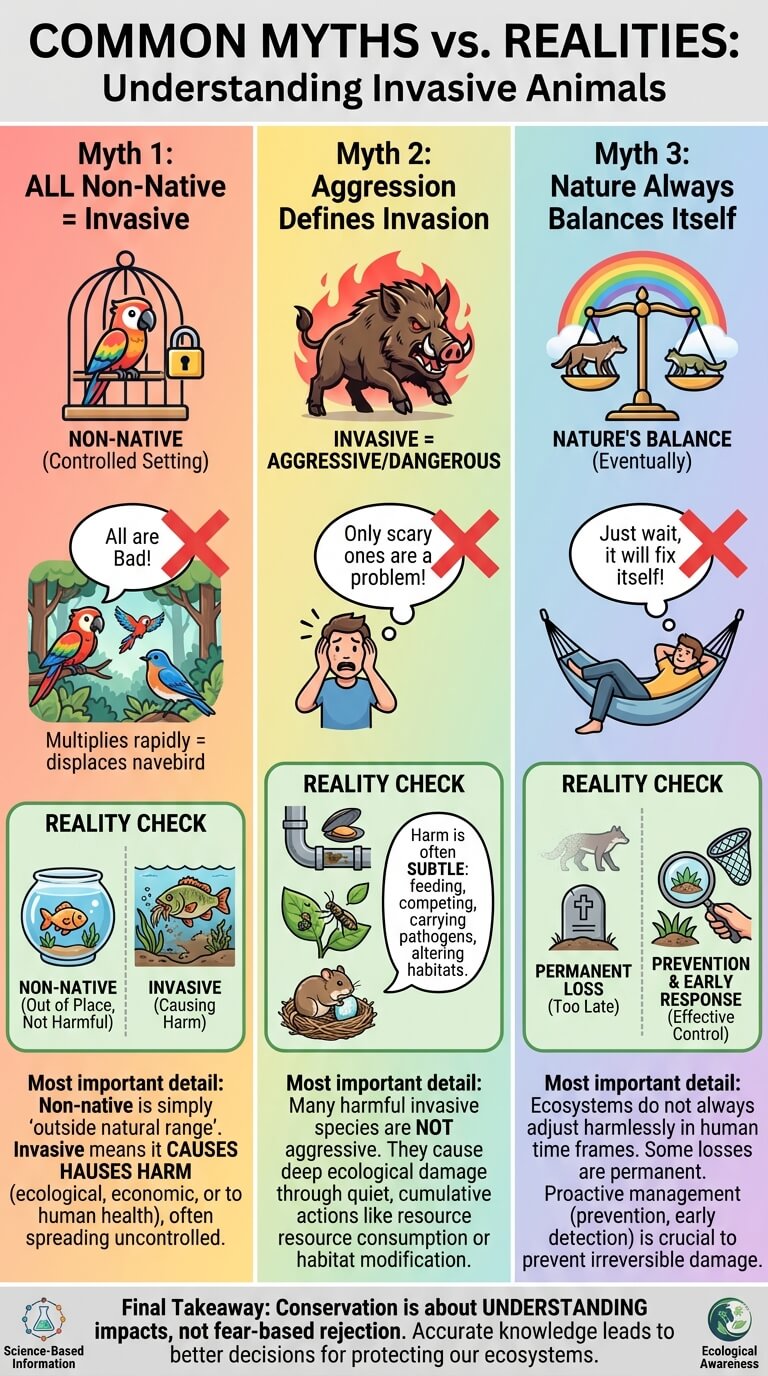
Myth: all non-native animals are invasive
This is the most common mistake. Non-native means the animal is outside its natural range. Invasive means it causes, or is likely to cause, harm. A non-native animal kept responsibly in a controlled setting is not the same as a wild population spreading through a sensitive ecosystem.
The National Park Service terminology guide makes this distinction by separating native species, non-native species, invasive species, pests, and range-expanding species.
This difference also helps reduce fear-based thinking. Conservation is not about rejecting every organism from another region. It is about understanding where an animal is, how it got there, whether it is reproducing, and what effects it has on local systems.
Myth: invasive animals are bad because they are aggressive
Some invasive animals can be bold, defensive, or dangerous in certain encounters, but aggression is not what defines invasion. Many invasive animals cause harm by feeding, breeding, competing, digging, carrying pathogens, or altering habitat. A quiet animal can be highly disruptive if it eats eggs, consumes shared food, or changes the physical structure of a habitat.
This myth can make people focus on the wrong risk. A dramatic animal may get public attention, while a less visible species may cause deeper ecological damage. Invasive carp, mussels, insects, or small predators may not look frightening, but they can still transform waterways, forests, or island ecosystems.
Myth: nature will always balance invasions on its own
Ecosystems do change over time, but that does not mean every invasion will settle into a harmless balance within a human time frame. Some native species decline before predators or competitors can adjust. Some habitats are permanently altered. Some islands or isolated wetlands have no replacement species ready to fill the lost roles.
Natural controls may eventually develop in some cases, but relying on that hope can allow preventable damage to continue. Conservation managers often focus on prevention, early detection, and rapid response because small populations are usually easier to address than widespread ones.
Because impacts can involve both land and water systems, agencies often combine field monitoring with ecological research; USGS work on invasive species impacts highlights how aquatic and terrestrial invasions can alter ecosystem function.
How This Topic Connects to Related Animal Questions
Invasive animals connect naturally to many animal fact questions. They help explain why habitat context, diet, reproduction, predator pressure, and human behavior matter as much as the animal itself.
What counts as an invasive species
The definition question is the foundation. Readers often ask whether an animal is invasive because it is unfamiliar, disliked, or expanding its range. The better question is whether it is non-native to that ecosystem and causing harm. This keeps the discussion grounded and prevents confusing native nuisance wildlife with invasive wildlife.
For example, coyotes expanding in parts of North America are not the same kind of issue as a non-native snake establishing in a wetland. A native animal can cause conflict near homes or farms, but that does not automatically make it invasive.
Why some invasive animals become major US problems
The United States has many habitats, ports, farms, pet markets, waterways, and climates, so invasive animal problems are not evenly distributed. Florida faces different risks than the Great Lakes. Islands face different risks than the Great Plains. Wetlands face different risks than forests or suburbs.
The National Park Service invasive animal examples show how different animals can affect parks through predation, erosion, disease concerns, competition, and impacts on threatened native species.
This regional variation is why a list of invasive animals in the US should be read with local context. The same animal may be a severe problem in one state, absent from another, and regulated differently across jurisdictions.
How conservation controls invasive species
Conservation control can include prevention, monitoring, physical barriers, habitat restoration, public education, removal, targeted harvest, detection dogs, traps, environmental DNA, or other tools. The right tool depends on the animal, habitat, legal status, scale of spread, and risk to native species.
Control also raises ethical questions. Invasive species management often involves difficult choices because managers are trying to reduce suffering and ecological harm at the same time. Doing nothing can allow native species, habitats, and ecosystem functions to decline. Acting without planning can create other problems.
The most responsible message for readers is simple: do not release animals, do not move wildlife, do not handle unfamiliar animals, and do not attempt private control of risky species without local guidance. Invasive animal management is usually a job for trained people working under official rules.
FAQ
What is the difference between invasive and non-native animals?
A non-native animal is living outside the area where it naturally occurs. An invasive animal is non-native and causes, or is likely to cause, harm to the environment, economy, or health. The difference is impact. A non-native animal in a controlled setting may not be invasive, but a self-sustaining wild population that damages native ecosystems can be.
What are the most damaging invasive animals?
There is no single answer that applies everywhere. The most damaging invasive animal depends on the habitat and the type of harm being measured. Burmese pythons are a major concern in parts of South Florida, invasive carp are a major freshwater concern, feral pigs damage land and water resources in many regions, and some invasive insects and mussels can reshape forests or waterways. Economic damage, biodiversity loss, disease risk, and habitat damage are different measures.
Can an invasive animal ever be harmless in a new place?
If a non-native animal is not causing harm and is not likely to cause harm, it is more accurate to call it non-native, introduced, or established rather than invasive. However, risk can change if the animal spreads, climate conditions shift, predators decline, or the population grows. This is why wildlife agencies monitor some non-native species even before major impacts are visible.
Why are invasive animals hard to remove?
They are hard to remove because many reproduce quickly, hide well, use broad food sources, move across connected habitats, or live in places where detection is difficult. Control becomes much harder after a species spreads across rivers, wetlands, forests, farms, or urban edges. Prevention and early detection are usually more effective than waiting until the population is widespread.
Final Thoughts
Invasive animals change ecosystems because they arrive outside their natural ecological relationships and then survive, reproduce, and affect native life in the new place. Some hunt native species. Some compete for food or shelter. Some damage habitat. Some spread disease or alter water, soil, and vegetation. The most useful way to understand them is not through fear, but through context: where the animal is, how it got there, what harm it causes, and what responsible prevention or management looks like.
For AnimalFactCentral readers, the takeaway is clear. Invasive animals are not simply animals from somewhere else. They are animal populations whose presence can reshape ecosystems. Learning the difference helps people make better choices about pets, outdoor gear, boating, fishing, travel, and wildlife encounters, while also making the deeper case studies in this cluster easier to understand.

Ethan Walker is the founder and research editor of Animal Fact Central. He creates and reviews educational animal facts content using trusted wildlife, pet care, and science-based sources. His work focuses on making animal behavior, adaptations, habitats, and species facts clear, accurate, and engaging for everyday readers.
Read More Details About Ethan Walker: https://animalfactcentral.com/ethan-walker/