

How pollination works is simpler than it first sounds: pollen has to move from the pollen-producing part of a flower to the pollen-receiving part of a compatible flower. That transfer can happen by bees, butterflies, moths, flies, beetles, birds, bats, wind, water, or even within the same flower in some plants. When the right pollen lands in the right place, the plant may be able to make seeds and, in many flowering plants, fruit.
The part people often miss is that pollination and fertilization are not the same step. Pollination is the delivery of pollen to the stigma. Fertilization happens later, after a pollen tube grows and sperm cells reach an ovule. The U.S. Forest Service defines pollination as the transfer of pollen grains from the male anther to the female stigma in its clear overview of what pollination is.
Understanding this process explains why flowers look and smell different, why some insects move pollen efficiently, and why a plant can bloom but still fail to set good fruit or seeds.
Quick Answer
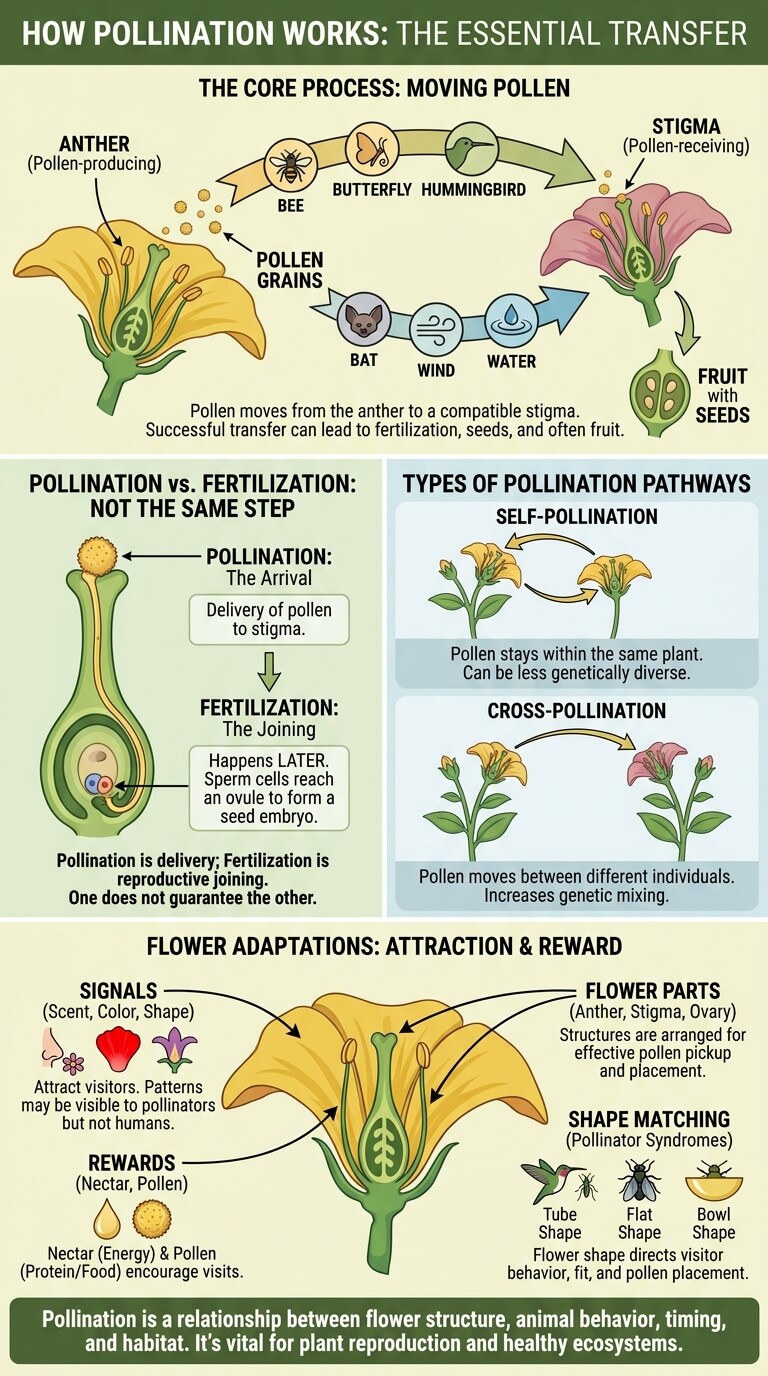
Pollination works when pollen from a flower’s anther reaches a stigma of the same plant species, either in the same flower, another flower on the same plant, or a flower on a different plant. If the pollen is compatible, it can germinate on the stigma and grow a pollen tube down through the style toward the ovary. Fertilization can then occur when sperm cells from the pollen reach an ovule. After that, the ovule can develop into a seed, and the surrounding ovary may develop into fruit.
Animal pollination usually happens as a side effect of feeding. A bee may collect pollen as food for its young. A butterfly, moth, hummingbird, bat, fly, beetle, or wasp may visit a flower for nectar or pollen. While the animal moves, pollen grains can stick to its body and later brush onto another flower’s stigma. The animal is not trying to help the plant. The plant and the animal are each following their own needs, and the pollination result comes from the fit between flower structure and visitor behavior.
Why Pollination Matters
Pollination matters because it is one of the main ways flowering plants reproduce. Seeds are the next plant generation. Many fruits exist because a flower was pollinated and fertilized, although fruit development varies by species and crop. In ecosystems, pollination helps maintain plant communities that feed and shelter wildlife.
Plant reproduction in simple terms
A flower is not just a colorful decoration. In flowering plants, it is a reproductive structure. Some flowers have both pollen-producing and pollen-receiving parts. Others are mostly male or mostly female. Some plants place male and female flowers on the same individual plant, while others have separate male and female plants.
Pollen carries the male genetic material. The ovules inside the ovary contain the structures that can become seeds. For a seed to form in typical flowering plant reproduction, the correct pollen must reach a receptive stigma, grow through the flower tissue, and deliver sperm cells to an ovule. That is why pollination is a delivery step, not the whole reproductive process.
Why pollination is not the same thing as fertilization
Pollination is often described casually as a flower being fertilized, but that wording skips an important middle stage. Pollination is the arrival of pollen on the stigma. Fertilization is the joining of reproductive cells after the pollen tube reaches an ovule.
The difference matters because a flower can receive pollen but still fail to produce good seed or fruit if the pollen is incompatible, the pollen tube fails, weather damages flowers, or the plant lacks resources.
The Flower Parts Involved in Pollination

To understand how pollination works, picture a flower as a landing station, food source, and reproductive structure at the same time. Its parts are arranged to increase the chance that pollen is picked up and deposited where it can work.
Pollen and anthers
Pollen is made in the anthers, which are part of the stamen. Anthers may hang in the open, sit deep inside a flower tube, or be positioned where visiting animals are likely to brush against them.
Pollen grains are tiny, but their texture and placement matter. In many animal-pollinated plants, pollen is sticky, rough, or positioned in a way that helps it attach to a visiting animal. In wind-pollinated plants, pollen is often lighter and produced in large quantities because it must travel without a targeted animal carrier.
Stigma, style, ovary, and ovules
The stigma is the pollen-receiving surface. It may be sticky, feathery, lobed, or shaped in a way that catches pollen. The style is the tissue connecting the stigma to the ovary. The ovary contains the ovules, and the ovules can become seeds if fertilization succeeds.
Once compatible pollen lands on the stigma, it may germinate. In this context, germination does not mean a whole new plant starts growing. It means the pollen grain begins growing a pollen tube. That tube carries the sperm cells toward the ovule. The flower has to receive the right pollen and support the next steps for seed development to follow.
Nectar, scent, color, and shape as animal signals
Flowers often use nectar, scent, color, shape, pattern, or timing to attract visitors. Nectar rewards animals with energy. Pollen can be a protein-rich food source for many insects. Some flower patterns are visible to pollinators in ways humans do not fully see.
Flower shape also directs behavior. A flat flower may work well for flies, beetles, or short-tongued bees. A deep tubular flower may favor long-tongued bees, butterflies, moths, hummingbirds, or bats, depending on the species and time of day. The U.S. Forest Service describes these matching traits as pollinator syndromes, meaning sets of flower features that often correspond with certain pollinator groups.
The Step-by-Step Pollination Process

Animal pollination is best understood as a sequence. The process does not begin when a seed forms. It begins when a flower becomes available and a visitor interacts with it in a way that moves pollen.
A pollinator visits a flower
The first step is a visit. A bee may land to collect nectar or pollen. A hummingbird may hover and place its bill into a tube-shaped bloom. A moth may fly to a pale, scented flower at night. A beetle may crawl through a bowl-shaped flower.
Not every visitor is a pollinator. An insect can rest on a flower, eat petals, steal nectar from the side, or visit without touching anthers or stigma. For pollination to occur, the visitor needs to contact pollen and later deliver compatible pollen to a stigma.
Pollen sticks to the body, mouthparts, feathers, or fur
As the visitor moves, pollen can stick to legs, face, antennae, mouthparts, belly, feathers, fur, or other body surfaces. Bees can be especially visible pollen carriers because many species have branched hairs or specialized pollen-carrying structures. Birds and bats may carry pollen on their heads, bills, faces, or fur when they reach deep into flowers.
Flower structure influences where pollen is placed. Some flowers dust pollen onto a bee’s back. Others place pollen on a bird’s forehead or a bat’s muzzle, where it may hit the stigma of the next compatible flower.
Pollen reaches another flower of the same species
The next key step is delivery. When the animal visits another flower of the same species, some pollen may rub off onto the stigma. Pollen from the wrong species usually will not lead to seed formation, and some plants reject their own pollen.
Cross-pollination happens when pollen moves between different individuals of the same species. This can increase genetic mixing. Self-pollination happens when pollen reaches a stigma within the same flower or plant. Some plants use both routes, while others depend more strongly on one route than the other.
Pollen tube growth and fertilization
After compatible pollen lands on a receptive stigma, the pollen grain may germinate and grow a pollen tube. The tube grows through the style toward an ovule in the ovary. Here the process shifts from pollen transfer to possible fertilization.
Fertilization depends on timing and compatibility. The flower has to be receptive, the pollen must be viable, and the pollen tube has to reach the ovule. Weather, plant health, and flower age can all affect success.
Seeds, fruits, and the next generation of plants
If fertilization succeeds, the ovule can develop into a seed. In many flowering plants, the ovary or nearby tissues may develop into fruit. Botanically, fruit is a seed-bearing structure, even when people use those foods differently in the kitchen.
Good pollination can affect the number, shape, or quality of fruits and seeds in some crops. The University of Minnesota Extension explains that pollinators help crops complete life cycles and connect pollen movement to fruit and seed development in its guide to pollination on fruit and vegetable farms.
Different Types of Pollination
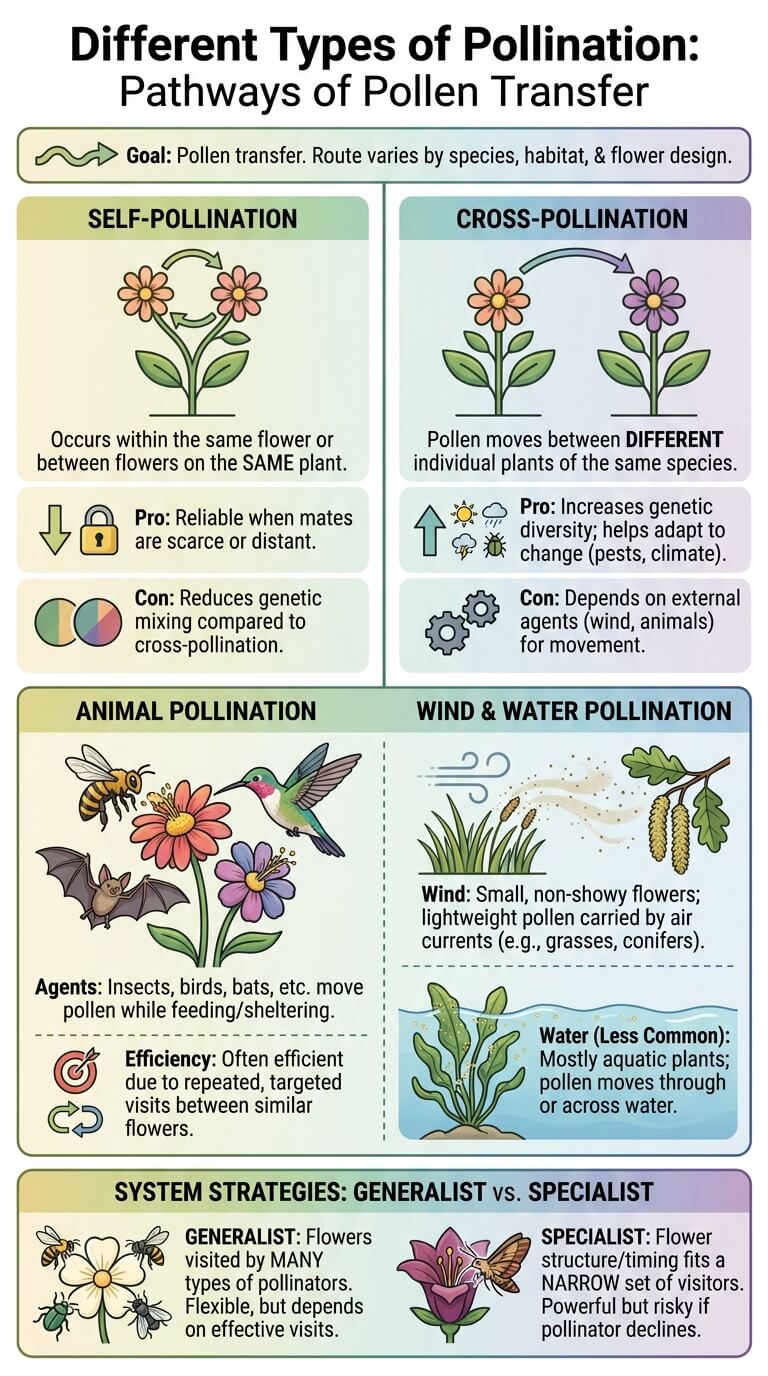
Pollination is not one single pathway. The basic goal is pollen transfer, but the route can change by species, habitat, weather, and flower design.
Self-pollination and cross-pollination
Self-pollination occurs when a flower receives pollen from itself or from another flower on the same plant. This can help when pollinators are scarce or individuals are far apart, but it may reduce genetic mixing compared with pollen moving between separate plants.
Cross-pollination occurs when pollen moves between different individual plants of the same species. It often depends on wind or animal movement. In many plant systems, cross-pollination can increase genetic diversity, which may help populations respond to pests, disease, climate variation, or changing local conditions.
Animal pollination
Animal pollination happens when an animal moves pollen while feeding, collecting pollen, seeking nectar, sheltering, or exploring a flower. Insects perform much of the animal pollination people notice in gardens and farms, but they are not the only animals involved. Birds, bats, and a few other vertebrates pollinate some plants.
Animal pollination is often efficient because a flower can attract visitors that repeatedly move between flowers of the same kind. That repeated pattern is useful for the plant. It means pollen is more likely to land on a compatible stigma instead of drifting randomly.
Wind and water pollination
Wind-pollinated plants do not depend on showy animal signals in the same way. They often have small, reduced flowers and produce lightweight pollen that air currents can carry. Grasses, many conifers, ragweed, oaks, birches, and other plants rely heavily on wind, although flower and pollen biology vary across groups.
Water pollination is less common and mostly involves aquatic plants. In these systems, pollen can move through or across water. The important point is that flowers and pollen are shaped by the transport method. A plant that depends on wind does not need to reward a bee with nectar. A plant that depends on a nectar-feeding animal often benefits from signals and rewards that encourage visits.
Specialist and generalist systems
Some plants are generalists. Their flowers can be visited and pollinated by many kinds of insects or animals. This can be useful when pollinator communities change across seasons or habitats. Other plants are specialists, with flower structures or timing that fit a narrow set of visitors.
Specialization can be powerful but risky. If a plant depends heavily on one pollinator and that pollinator declines locally, seed production may suffer. Generalist systems are more flexible, but still depend on effective visits.
Why Animals Visit Flowers
Animals usually visit flowers for their own reasons. They are seeking food, not volunteering as plant helpers. The flower’s job is to make those visits likely to move pollen.
Nectar as energy
Nectar is rich in sugars, making it a useful energy source for flight, hovering, crawling, and daily activity. Hummingbirds need high-energy food to support rapid wingbeats. Bees and butterflies use nectar as flight fuel. Bats that feed at flowers may rely on nectar during nighttime foraging.
Nectar placement often controls contact. If nectar sits deep inside a flower, an animal may have to push its head, bill, tongue, or body past the anthers and stigma to reach it. That makes pollen pickup and pollen delivery more likely.
Pollen as food
Pollen is not only reproductive material for plants. It is also food for many insects. Bees are the best-known example because they collect pollen to feed larvae. Some beetles and flies also feed on pollen. Pollen contains proteins, fats, vitamins, and minerals that can make it valuable to growing insects.
This creates a tension. The plant needs some pollen to reach another flower, but animals may eat or collect it. Flowers may produce more pollen than needed for fertilization, place pollen where it is harder to eat all at once, or offer nectar as an alternate reward that still gets the visitor moving between blooms.
Accidental pollination versus targeted flower adaptations
Much animal pollination is accidental from the animal’s point of view. A bee gets dusted with pollen while feeding. A moth picks up pollen while reaching into a night-blooming flower. A bird brushes against a stigma while sipping nectar.
From the plant’s side, the process can be highly shaped by evolution. The U.S. Forest Service notes that animal-pollinated flowers may use visual cues, scent, food, mimicry, or other methods to attract visitors, and that animal-pollinated flowering plants often have pollen that is sticky or barbed enough to attach to animals in its page on why pollination is important.
Animal Examples That Make the Process Clear

Examples help, but the goal here is to understand the mechanism. Each animal group below shows a different way pollen can move from flower to flower.
Bees and pollen collection
Bees are often effective pollinators because their flower visits can be frequent, focused, and physically messy. Many bees have hairy bodies that catch pollen. Some carry pollen in baskets or dense hair patches. While collecting nectar and pollen, they may contact anthers and stigmas repeatedly.
Different bee species work different flowers. A large bumble bee may buzz flowers that hide pollen in tight anthers. A small sweat bee may fit into flowers a honey bee ignores. This is why pollinator diversity matters. One bee species does not replace every other bee in every flower system.
Butterflies and long-tubed flowers
Butterflies often feed with a long, coiled mouthpart called a proboscis. When uncoiled, it lets them reach nectar in flowers that may be too deep for some short-tongued insects. Their long legs and light bodies mean they do not always contact pollen as heavily as bees, but they can pollinate flowers whose shape places pollen on the right body parts.
Butterfly-pollinated flowers are often open during the day and may use bright colors, landing surfaces, or nectar guides. This is a broad pattern, not a rule for every species. A butterfly visit only counts as useful pollination if pollen reaches a compatible stigma.
Moths and nighttime scent cues
Moths show why pollination does not stop at sunset. Some night-blooming flowers release strong sweet scents after dark and have pale or tubular flowers that are easier for nocturnal visitors to find. Long-tongued moths can reach deep nectar and may carry pollen between flowers during nighttime foraging.
Some moths are major pollinators in specialized plant relationships. Others visit flowers without moving much pollen, and some adult moths do not feed at all. That is why it is better to say that many moths can be pollinators, not that all moths pollinate flowers.
Hummingbirds, bats, flies, beetles, and wasps as varied examples
Hummingbirds can move pollen when they feed at tubular flowers and pollen brushes onto their bills or feathers. The U.S. Fish and Wildlife Service describes bird pollination, or ornithophily, and explains that pollen can stick to birds as they feed on nectar in its article on bird pollinators.
Bats can pollinate some night-blooming flowers, especially in tropical and desert ecosystems. Flies can be important visitors to shallow flowers and flowers with unusual scents. Beetles may crawl through large, bowl-shaped blooms. Wasps can pollinate certain plants, but many wasps visit flowers mainly for nectar and are not always as hairy or pollen-focused as bees. Ladybugs are helpful garden predators, but they are not usually treated as major pollinators.
Common Mistakes and Myths
Pollination myths usually come from taking one true example and applying it to every plant or animal. The process is broad, but the details are specific.
Myth: pollination always creates fruit right away
Pollination does not instantly create fruit. It begins a chain of events that may lead to fertilization, seed development, and fruit development. Those steps can fail or partly succeed. That is why some fruit may be misshapen, small, seedless by breeding design, or absent even after a plant flowers.
Timing matters. A flower has to be receptive when pollen arrives. The pollen must be from a compatible plant. Weather can interfere with pollinator activity and flower function. A garden full of blooms is not a guarantee of a heavy harvest.
Myth: every flower visitor is an effective pollinator
A flower visitor is simply an animal that visits a flower. A pollinator is a visitor that transfers pollen in a way that helps plant reproduction. The difference is important. An ant may drink nectar without moving useful pollen. A butterfly may feed without touching the stigma. A bee may collect pollen but groom most of it away before the next flower.
Effectiveness depends on behavior, body fit, timing, and flower biology. The best pollinator for one flower may be a poor match for another.
Myth: pollen is the same as a seed
Pollen and seeds are not the same thing. Pollen is part of the male side of plant reproduction. A seed is a young plant embryo with stored resources and a protective covering, formed after successful reproductive steps. Pollen can help start the process that leads to a seed, but pollen is not a baby plant by itself.
This distinction helps make sense of allergies, food, gardening, and botany vocabulary. Pollen in the air is not a cloud of seeds. It is plant reproductive material moving by wind or being produced by flowers.
Edge Cases and Exceptions
Nature does not fit every classroom diagram neatly. Some of the most useful lessons come from exceptions.
Flowers that do not need animal pollinators
Many plants rely mostly on wind, and a smaller number use water. Wind-pollinated plants often have small flowers, little showy color, and pollen that is built to travel through the air. These plants may produce huge amounts of pollen because wind is less targeted than an animal that moves from flower to flower.
Some plants can self-pollinate with little help from animals. This can be useful in isolated conditions, but it does not mean pollinators are unimportant overall. It means plant reproduction has many strategies.
Plants with very specialized pollination systems
Some flowers have specialized relationships with particular pollinators. A flower may open at night, produce scent at a certain time, hold nectar in a deep tube, or place pollen on a precise part of an animal’s body. In these systems, the flower and pollinator are often closely matched.
Specialization can improve accuracy, but it can also make the system sensitive. If the pollinator disappears from an area, the plant may have trouble reproducing. If the plant declines, the animal may lose a food source. These relationships are one reason habitat change can affect more than one species at a time.
Pollination failure and poor fruit set
Pollination failure can happen when too few pollinators visit, flowers open during cold or rainy weather, plants lack compatible pollen nearby, or pesticides reduce pollinator activity. Poor fruit set can also come from stress, heat, frost, disease, or poor nutrition.
For gardeners, the lesson is to look at the whole system. More flowers, diverse bloom times, nesting habitat, reduced pesticide exposure, and nearby compatible plants may all matter. But the answer depends on the crop or wild plant, not just the presence of a single bee.
How This Connects to Nearby Animal Topics
Pollination connects plant biology with animal behavior. Once the process is clear, related animal questions become easier to understand.
Why bee traits make many bees efficient pollinators
Bees often visit many flowers in a focused foraging trip, collect pollen deliberately, and have bodies that can carry pollen well. That combination makes many bees important pollinators in both wild and farm systems. Still, different bees serve different flowers, and managed honey bees are only one part of a much larger bee community.
Why pollinator diversity matters beyond one animal group
Pollinator diversity matters because flowers vary. Some bloom in cool spring weather, some open at night, and some are deep, shallow, flat, scented, tubular, bowl-shaped, or hard to access. A diverse pollinator community can better match those differences.
How garden insects can help or disrupt flower systems
Garden insects are not all good or all bad. Bees, flies, butterflies, moths, beetles, and wasps may visit flowers. Ladybugs often help by eating aphids, but they are not usually the main pollen movers. Pesticides, lost nesting sites, and fewer native flowers can disrupt useful relationships.
FAQ
What is the difference between pollination and fertilization?
Pollination is the transfer of pollen to a stigma. Fertilization happens later, when sperm cells from the pollen reach and fuse with cells in an ovule. Pollination is the delivery step. Fertilization is the reproductive cell-joining step that can lead to seed development.
This difference explains why a flower can be pollinated but still fail to produce good seeds or fruit. The pollen may be incompatible, the pollen tube may not reach the ovule, or conditions may prevent successful development.
Can a plant pollinate itself?
Yes, some plants can self-pollinate. Pollen may move within the same flower or between flowers on the same plant. Self-pollination can help a plant reproduce when pollinators or nearby compatible plants are scarce.
Other plants depend heavily on cross-pollination, where pollen comes from a different individual of the same species. Some plants have systems that reduce self-fertilization, so the answer depends on the plant species.
Does pollination always require insects?
No. Insects are important pollinators for many plants, but pollination can also be done by birds, bats, wind, water, and in some cases by movement within the flower itself. Many grasses and trees rely heavily on wind, while some aquatic plants use water.
Insect pollination is common and ecologically important, but it is not the only route. The best pollination method for a plant depends on its flower structure, habitat, timing, and evolutionary history.
Why do flowers have nectar?
Many flowers have nectar because it rewards animal visitors with energy. When an animal reaches for nectar, it may touch anthers and pick up pollen, then touch a stigma at the next compatible flower. Nectar can make the animal’s visit more likely and can guide the animal’s movement through the flower.
Not every flower has nectar, and not every nectar visitor is an effective pollinator. Nectar is one tool among many, along with scent, color, shape, timing, and pollen itself.
Final Thoughts
How pollination works comes down to a precise transfer with big ecological consequences. Pollen must reach a compatible stigma, and then the plant still has to complete the later steps of pollen tube growth, fertilization, seed development, and sometimes fruit development. Animals often make that first transfer while feeding on nectar or pollen, but wind, water, and self-pollination can also move pollen in the right systems.
The most useful takeaway is that pollination is not just a bee touching a flower. It is a relationship between flower structure, plant reproduction, animal behavior, timing, and habitat. Bees, butterflies, moths, hummingbirds, bats, wasps, flies, beetles, and garden insects matter when their bodies and behavior match a flower’s needs.

Ethan Walker is the founder and research editor of Animal Fact Central. He creates and reviews educational animal facts content using trusted wildlife, pet care, and science-based sources. His work focuses on making animal behavior, adaptations, habitats, and species facts clear, accurate, and engaging for everyday readers.
Read More Details About Ethan Walker: https://animalfactcentral.com/ethan-walker/