

An invasive species is a living organism that is outside its native range and causes, or is likely to cause, harm in the place where it has been introduced. That harm may affect native wildlife, habitats, agriculture, local economies, human health, animal health, or plant health. The key point is that non-native and invasive do not mean exactly the same thing.
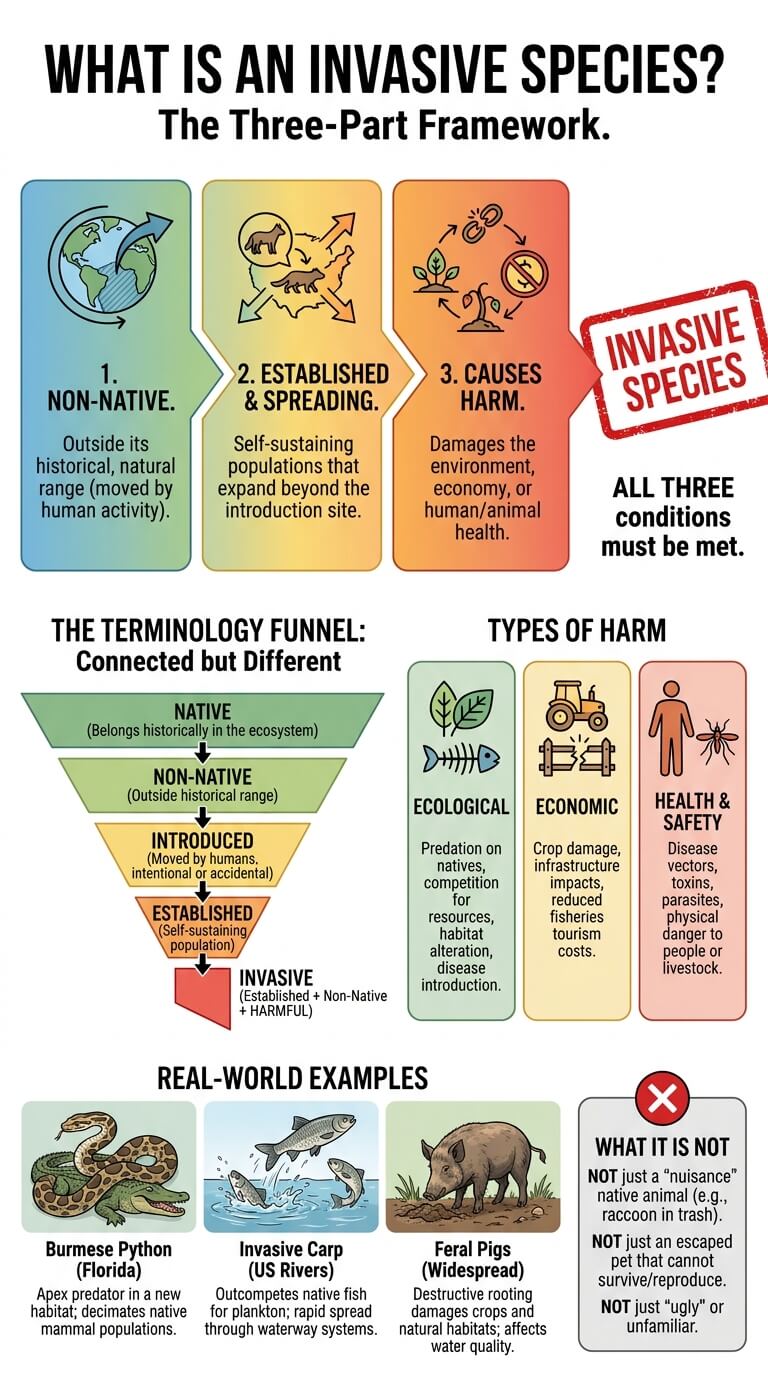
A non-native animal is simply an animal living somewhere it did not historically occur. It becomes invasive only when it establishes itself, spreads, and creates real or likely damage. The National Invasive Species Information Center uses the widely cited federal definition: an invasive species is non-native to the ecosystem under consideration and causes or is likely to cause economic, environmental, or human health harm.
That definition may sound simple, but real-world cases can be messy. A fish, snake, insect, mammal, fungus, or plant can be harmless in one location and damaging in another. A species can be native to one part of a country but introduced somewhere else inside the same country. Some introduced animals never spread enough to matter, while others become major conservation problems because they prey on native species, compete for food, alter habitat, or move diseases into places where native animals have little defense.
Quick Answer
An invasive species is not just an animal that looks unusual, reproduces quickly, or bothers people. It meets three basic conditions: it is outside its native range, it becomes established or spreads in the new place, and it causes or is likely to cause harm. Those three conditions help separate invasive species from native species, non-native species, introduced species, and ordinary nuisance wildlife.
For animal examples, Burmese pythons in parts of South Florida are invasive because they are not native to Florida, they have established breeding populations, and they can affect native wildlife in the Everglades. Invasive carp in some North American waterways are invasive because they are introduced fish that can spread through connected river systems and compete with native aquatic life. Feral pigs are invasive in many places because they disturb soil, damage crops, affect water quality, and compete with or prey on native wildlife.
But an animal does not become invasive just because people dislike it. A raccoon digging through trash in its native range is usually a nuisance wildlife issue, not an invasive species issue. A pet snake that escapes but does not survive, reproduce, or spread is an introduced animal event, not necessarily an established invasive population. The label depends on range, establishment, spread, and harm.

Why the Definition Matters
The invasive species definition matters because it shapes how people respond. Conservation agencies, land managers, scientists, farmers, boaters, pet owners, and homeowners all use the term, but they may not mean the same thing in casual conversation. If every unfamiliar animal is called invasive, the word loses value. If harmful introduced animals are treated as harmless curiosities, serious ecosystem damage can be missed until control becomes much harder.
Good definitions also protect native wildlife. They help people focus on real ecological risk rather than fear or appearance. Some invasive animals are large and dramatic, such as pythons or feral pigs. Others are small, easy to overlook, and still capable of changing habitats or food webs. The biology matters more than the animal’s reputation.

Why wording affects conservation decisions
Conservation work often depends on legal and management categories. Agencies may need to decide whether an animal should be monitored, restricted, removed, quarantined, or simply observed. The U.S. Fish & Wildlife Service explains invasive species as organisms not native to an ecosystem that likely cause economic or environmental harm, or harm to humans. That definition connects the label to action, not just geography.
Why the same animal can have different labels in different places
A species can be native in one region and invasive in another. This is one of the most common reasons people get confused. Native range is not a global label. It is tied to where a species evolved, spread naturally, and interacted with other organisms over time. A species that belongs in one watershed, island, grassland, or continent may become disruptive if people move it beyond that historical context.
Native, Non-Native, Introduced, Established, and Invasive Explained
Many invasive species conversations get confusing because people use several related terms as if they are identical. They are connected, but each word answers a different question. Native asks where an organism belongs historically. Non-native asks whether it is outside that range. Introduced asks how it got there. Established asks whether it is reproducing and persisting. Invasive asks whether it is causing or likely to cause harm.
Thinking of the terms as steps makes the idea easier. A species can be non-native without being invasive. A species can be introduced without becoming established. A species can be established for years before scientists understand its effects. The invasive label should come after evidence or strong risk of harm, not just after surprise.

What native means
A native species is one that occurs in an area because of natural processes rather than recent human introduction. Native animals are part of local ecological relationships. They may be predators, prey, seed dispersers, pollinators, grazers, scavengers, nest builders, soil turners, or competitors. Their presence does not mean they are always gentle or convenient for people. It means they belong to the region’s ecological history.
Native animals can still create conflicts. Coyotes may take pets, deer may damage gardens, beavers may flood roads, and raccoons may enter attics. Those problems are real, but they are not automatically invasive species issues. They are usually wildlife conflict, habitat overlap, or population management issues. The animal’s native status changes the conservation context.
What non-native means
A non-native species is a species living outside its historical or natural range. People may also use terms such as alien, exotic, introduced, or nonindigenous, depending on the field and agency. The USGS description of nonindigenous species makes a key distinction: non-native species do not necessarily cause harm, but they may be considered invasive when they establish and threaten native species or environments.
This distinction prevents overreaction. Many familiar organisms in human-dominated landscapes are non-native, and not all are conservation emergencies. Some introduced animals fail to survive. Others survive only with human help. Others persist without spreading much. The invasive concern rises when the species begins reproducing, expanding, and affecting the ecosystem around it.
What introduced means
An introduced species is one that people have moved, directly or indirectly, into a new area. Introductions can be intentional or accidental. Intentional introductions may involve agriculture, biological control, hunting, pets, ornamental ponds, aquaculture, or attempts to solve another pest problem. Accidental introductions may happen through shipping, ballast water, cargo, contaminated equipment, bait buckets, nursery plants, firewood, soil, or escaped captive animals.
What established means
An established species is one that can maintain a self-sustaining population in the new area. That usually means individuals are surviving long enough to reproduce and produce new generations without constant human release. Establishment is a major turning point because it means the species is no longer just a one-time arrival.
What invasive means
Invasive is the harm-based label. In plain English, it means a non-native organism is not just present, but causing or likely to cause damage. The USGS explanation of invasive species describes them as introduced, nonnative organisms that spread or expand from the original site and have the potential to harm the environment, economy, or human health.
For animals, that harm can happen in many ways. A predator may eat native animals that lack defenses. A fish may compete with native young fish for plankton. A pig may root through soil and wetlands. An insect may damage trees that support birds and mammals. A disease-carrying organism may create health risks for wildlife, livestock, pets, or people.
The Three-Part Framework for Calling a Species Invasive
The clearest way to understand the invasive species definition is to use a three-part framework. First, the species is outside its native range. Second, it establishes or spreads in the new area. Third, it causes or is likely to cause harm. All three pieces matter.
This framework is useful because it keeps the conversation balanced. It avoids panic over every unusual sighting. It also avoids ignoring introduced animals until their effects are obvious and difficult to manage. A good definition should help readers ask better questions, not just memorize a label.

It is outside its native range
The first question is geographic and historical: where is this species naturally from? For animals, native range can be defined by continents, islands, watersheds, coastlines, mountain ranges, climate zones, or smaller ecological boundaries. A species may be native to one part of North America and non-native in another if people moved it across barriers it would not normally cross.
It establishes or spreads in the new area
The second question is population-based: can the animal survive and reproduce in the new place? Establishment turns an introduction into a continuing ecological issue. Spread makes the issue larger, especially when the species moves through connected waterways, fragmented forests, agricultural lands, or human transportation networks.
It causes or is likely to cause harm
The third question is impact: what damage is happening or likely to happen? This is where invasive species become more than a range map. Harm can be direct, such as predation on native animals. It can be indirect, such as changes to food webs, water quality, plant communities, soil structure, or disease dynamics. It can also affect farms, fisheries, tourism, infrastructure, or public health.
The phrase “likely to cause harm” matters because waiting for complete damage can be risky. If a species is spreading fast and similar invasions have caused serious problems elsewhere, agencies may act before every effect is measured. That does not mean guesses should replace evidence. It means risk assessment, monitoring, and prevention are part of responsible management.
What Counts as Harm?
Harm is broader than one animal eating another. Invasive species can affect ecosystems in layers. They may change which species survive, how nutrients move, how plants grow, how water flows, how fires behave, how diseases spread, and how people use land or water. A small organism can produce a large effect if it changes a key ecological process.
For animal-focused articles, the most common harm categories include ecological harm, habitat and food web disruption, economic damage, and health or safety concerns. These categories often overlap. Feral pigs, for example, can damage habitat, crops, water quality, and disease management at the same time.

Ecological harm to native wildlife
Ecological harm often means native species lose food, shelter, breeding sites, or survival chances. Invasive predators may feed on animals that have not evolved defenses against them. Invasive competitors may take nesting cavities, burrows, plankton, insects, plants, or other resources. Invasive grazers or browsers may remove vegetation that native animals need for cover.
Habitat and food web disruption
Some invasive animals change the physical habitat. Feral pigs root through soil and wetlands. Burrowing animals may destabilize banks or levees. Aquatic invaders may alter water clarity, plankton communities, or the base of the food web. Insects can weaken trees that provide shade, nesting space, and food for many other animals.
Economic and agricultural damage
Invasive animals can also cause economic damage. They may reduce crop yields, damage pasture, harm fisheries, clog water systems, weaken forests, affect tourism, or increase management costs. The National Invasive Species Information Center’s economic impact overview describes costs that can include agriculture, property, utilities, fisheries, tourism, recreation, and control efforts.
Human health or safety concerns
Some invasive species can affect human health, pet health, livestock health, or safety. The risk may involve bites, stings, allergens, toxins, parasites, disease vectors, or dangerous encounters. This does not mean every invasive animal is dangerous to people. It means health and safety can be part of the harm definition when a species creates a credible risk.
Cane toads are a useful example because they have toxins that can harm predators and pets in areas where the toads occur. Some invasive mosquitoes are important because they can spread diseases. Feral pigs can be a safety concern because they are large, strong animals and may carry diseases relevant to livestock, wildlife, pets, or people.
Animal Examples That Make the Definition Clear
Examples help because the definition becomes easier when applied to real animals. The goal here is not to cover every detail of each species. It is to show how the invasive species framework works: outside native range, established or spreading, and harmful or likely harmful.
Different invasive animals create different problems. Some are predators. Some are competitors. Some are ecosystem engineers. Some are toxic prey. Some affect farms or waterways more than wild forests. Comparing examples prevents the common mistake of thinking invasive species all behave the same way.
Burmese pythons in Florida
Burmese pythons are native to parts of Asia, not Florida. In South Florida, they became a major invasive predator case because they found suitable wetland habitat, established breeding populations, and can prey on a wide range of native animals. The National Park Service overview of invasive species uses Burmese pythons in the Everglades as a clear example of an invasive animal.
This case shows why non-native predators can be especially disruptive. Native prey may not recognize the new predator well. Dense vegetation and wetlands can make detection difficult. Large snakes can remain hidden for long periods, making removal challenging once they are established.
Invasive carp in US rivers
Invasive carp show a different kind of problem. They are not famous because they hunt people or act like top predators. Their impact comes from spread, feeding ecology, reproduction, and competition in freshwater systems. Some species feed heavily on plankton, which can affect food available to young native fish and other aquatic life.
Feral pigs across many landscapes
Feral pigs are widely recognized as damaging invasive mammals in many landscapes. They root in soil, disturb vegetation, damage crops, affect water quality, and may prey on eggs, young animals, or other small wildlife. They are also adaptable, intelligent, and capable of reproducing quickly under favorable conditions.
Cane toads outside their native range
Cane toads are native to parts of the Americas but became invasive in several places where people introduced them. They are often discussed because their toxins can harm predators that try to eat them. That makes them a strong example of how a defense that works in a native setting can become especially disruptive when moved into a new predator community.
What an Invasive Species Is Not
Understanding what an invasive species is not can prevent confusion. The term should not be used as a catch-all insult for animals that are annoying, unfamiliar, abundant, or disliked. It is a specific ecological and management label.
Misusing the term can lead to poor decisions. People may target native wildlife unfairly, ignore real introduced threats, or assume they can handle the problem themselves. Clear categories help protect both people and animals.
Not simply a strange-looking animal
An animal is not invasive just because it looks exotic, colorful, large, scary, or out of place to one person. Many native animals look unusual. Armadillos, alligators, salamanders, horseshoe crabs, snapping turtles, and many insects can seem strange to people who are not familiar with them. Appearance alone tells us very little about native status.
Not always an aggressive animal
Invasive animals do not need to be aggressive to cause harm. Some of the most important invasive species affect ecosystems through reproduction, competition, feeding, disease, or habitat change. A quiet animal can still be ecologically powerful if it removes key food resources or changes the physical environment.
Not always the animal’s fault
Invasive species problems are usually created by human movement, trade, releases, travel, habitat disturbance, or management mistakes. The animal is not making a moral choice. It is using food, shelter, and breeding opportunities available in a new place.
Common Mistakes and Myths
The invasive species topic attracts myths because it sits between science, law, animal behavior, public safety, and personal experience. A person may see one animal causing trouble and assume the same rule applies everywhere. Another person may love a non-native pet species and assume it could never become a problem outside captivity. Both reactions can miss the ecological context.
Mistake: using invasive and non-native as perfect synonyms
The most common mistake is treating non-native and invasive as the same word. Invasive species are non-native, but not all non-native species are invasive. The harm component is what changes the label.
Mistake: assuming all native animals are beneficial in every context
Native animals can cause serious conflicts. A native herbivore can overbrowse a park. A native predator can kill livestock or pets. A native rodent can enter buildings. These situations may need management, but they are not the same as invasive species unless the animal is outside its native range and causing harm there.
Myth: invasive species are always easy to identify
Some invasive animals are easy to recognize, but many are not. Young animals, similar-looking species, hybrids, regional variation, and poor viewing conditions can make identification difficult. A person may mistake a native species for an invasive one or miss a harmful invader because it looks ordinary.
How This Connects to Nearby Animal Topics
The definition of invasive species is the foundation for deeper questions. Once readers understand the terms, they can better evaluate US examples, species case studies, and conservation control methods. Without the definition, those topics can blur into one broad idea: animals in the wrong place. With the definition, each case becomes easier to understand.
Why invasive animals in the US vary by region
The United States contains many ecosystems, and invasive animal problems vary across them. A species that spreads in warm wetlands may not survive northern winters. A fish that matters in a connected river may be irrelevant in a dry grassland. An island ecosystem may be more vulnerable to introduced predators than a mainland ecosystem with a longer history of predator-prey relationships.
Why conservation control depends on definitions
Control decisions depend on whether a species is introduced, established, spreading, and harmful. Early detection may focus on preventing establishment. Long-term management may focus on reducing damage rather than complete eradication. In some cases, agencies may prioritize protecting the most vulnerable habitats or native species.
Why species case studies need local context
Species case studies are useful only when they include place. Burmese pythons in Florida, invasive carp in US waterways, feral pigs in many landscapes, and cane toads outside their native range are not interchangeable examples. Each has different biology, pathways, impacts, and control challenges.
Readers who want more regional examples can compare these labels across invasive animals in the US, where the same definition plays out differently in rivers, wetlands, farms, and suburbs.
FAQ
Can a native species become a problem?
Yes. A native species can become overabundant, damage property, compete with other species, or create safety concerns. That does not automatically make it invasive. In the strict sense, invasive species are non-native to the ecosystem under consideration and cause or are likely to cause harm.
A native animal problem is usually described with terms such as nuisance wildlife, overpopulation, wildlife conflict, or habitat imbalance. The correct label matters because management options, laws, and ecological goals may be different.
Is an introduced species always invasive?
No. An introduced species has been moved to a new place by people, either intentionally or accidentally. It becomes invasive only if it establishes or spreads and causes, or is likely to cause, harm.
Some introduced animals do not survive. Some survive only briefly. Some establish small populations without clear damage. Others become major problems. That range of outcomes is why introduced and invasive should not be used as perfect synonyms.
Who decides whether a species is invasive?
Scientists, wildlife agencies, land managers, agricultural agencies, and conservation authorities may all be involved, depending on the species and location. They look at native range, introduction pathway, establishment, spread, ecological effects, economic effects, and health or safety concerns.
There is not always one simple global answer. A species may be listed or managed differently by country, state, park, watershed, or agency. For practical questions, local wildlife or agricultural authorities are usually the best place to check.
Can plants, animals, and microbes all be invasive?
Yes. Invasive species can include animals, plants, fungi, pathogens, parasites, and other organisms. Animal-focused examples are often easier to picture, but invasive plants and pathogens can also reshape ecosystems and affect wildlife.
The same basic framework applies: the organism is outside its native range, establishes or spreads, and causes or is likely to cause harm. The details differ because a mammal, fish, insect, plant, fungus, and disease organism affect ecosystems in different ways.
Final Thoughts
So, what is an invasive species? It is a non-native organism that establishes or spreads in a new place and causes, or is likely to cause, harm. The word is not just a synonym for strange, unwanted, aggressive, or introduced. It is a place-based ecological label that depends on range, spread, and impact.
For animal readers, this distinction makes real-world examples clearer. Burmese pythons, invasive carp, feral pigs, and cane toads all show different ways an introduced animal can disrupt an ecosystem. They also show why prevention, accurate identification, and local guidance matter. The best way to understand invasive species is not to blame the animal, but to understand the ecological mismatch created when people move organisms beyond the systems that shaped them.

Ethan Walker is the founder and research editor of Animal Fact Central. He creates and reviews educational animal facts content using trusted wildlife, pet care, and science-based sources. His work focuses on making animal behavior, adaptations, habitats, and species facts clear, accurate, and engaging for everyday readers.
Read More Details About Ethan Walker: https://animalfactcentral.com/ethan-walker/