

Animals that pollinate plants include bees, butterflies, moths, wasps, flies, beetles, hummingbirds, sunbirds, honeyeaters, nectar-feeding bats, some small mammals, and a few highly specialized insects such as fig wasps and yucca moths. Bees get the most attention because many species are especially good at collecting and moving pollen, but they are only one part of a much wider pollination story.
A pollinator is not just any animal that lands on a flower. To count in a meaningful way, the animal has to move pollen from the male part of a flower to the female part of a flower of the same plant species often enough to help seed or fruit production. The USDA overview of pollinator importance names honeybees, butterflies, birds, bats, and other animals as pollinators that help many crops and flowering plants.
Quick Answer
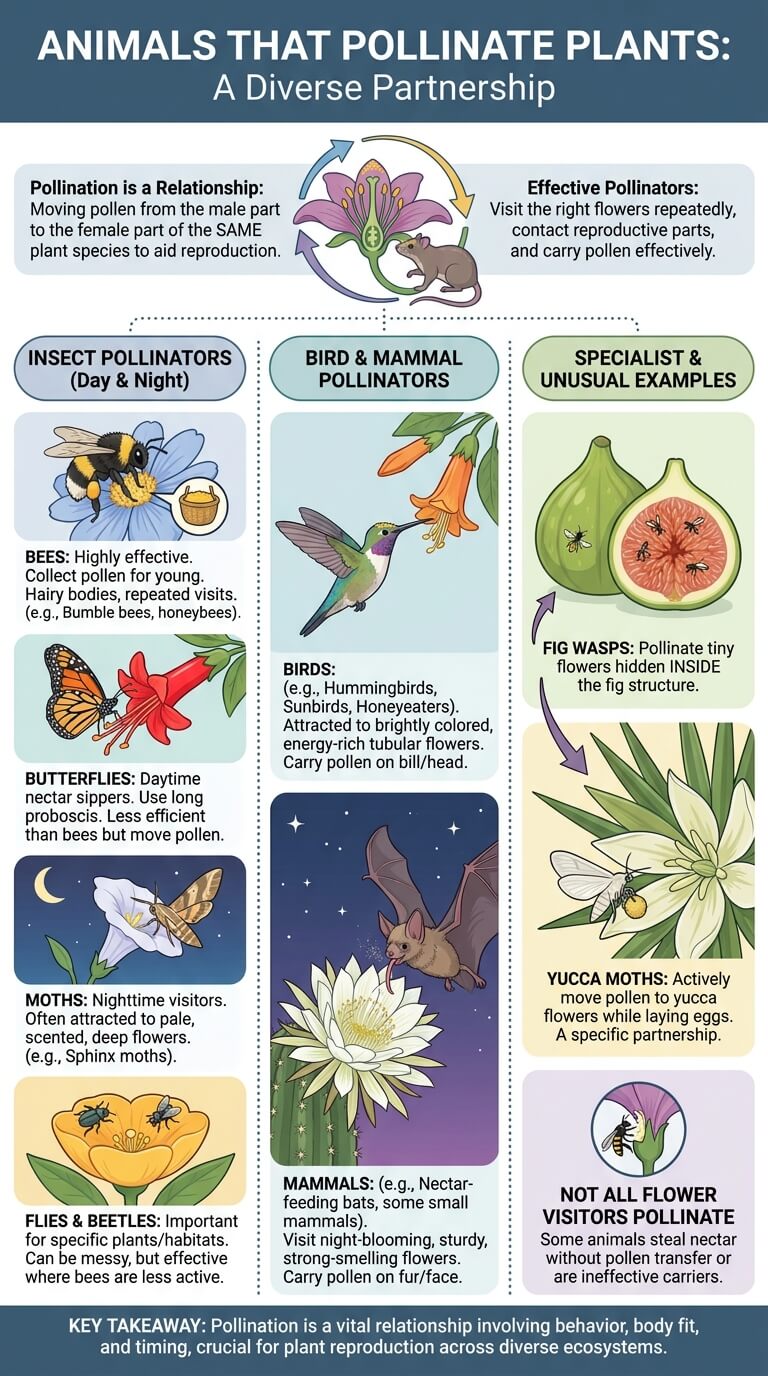
The most familiar animal pollinators are insects. Bees, butterflies, moths, wasps, flies, beetles, and some tiny flower-visiting insects can move pollen as they feed. Bees are often the most efficient insect pollinators because many collect pollen on purpose, but flies, beetles, moths, and wasps can be important for particular plants or habitats.
Birds and mammals can pollinate plants too. Hummingbirds are the best-known bird pollinators in the Americas. Elsewhere, sunbirds and honeyeaters fill similar nectar-feeding roles. Nectar-feeding bats visit night-blooming flowers and can carry pollen on their faces, fur, and bodies. In some ecosystems, small mammals such as rodents, marsupials, or primates may transfer pollen when they feed on nectar or flower parts.
The most unusual examples are often specialists. Fig wasps pollinate figs inside the fig structure itself. Yucca moths actively move pollen onto yucca flowers while laying eggs, creating one of the most famous plant-insect partnerships. These examples show why pollination is better understood as a relationship, not just a quick flower visit.
How Animals Become Pollinators
Food rewards, accidental pollen transfer, and flower fit
Most animal pollination begins with food. Flowers may offer nectar, pollen, oils, scents, resins, or edible flower tissues. An animal visits for that reward, brushes against pollen, then carries some of it to another flower. If the pollen reaches a receptive stigma, the plant may be fertilized and later produce seeds or fruit.
Flower fit is the reason different pollinators are linked with different flower traits. A long tubular flower may suit a hummingbird bill or a long-tongued moth. A bowl-shaped flower may be open to beetles and flies. A night-blooming flower with pale color and strong scent may match the habits of moths or bats. These patterns are useful clues, not perfect rules.
What makes a pollinator effective
An effective pollinator does more than touch pollen once. It tends to visit the right kind of flowers, move between individuals of the same plant species, contact the right flower parts, and carry pollen in a way that does not simply fall off or get eaten. Body hair, feathers around the face, sticky legs, scales, or rough body surfaces can all help pollen cling long enough to travel.
Effectiveness also depends on the plant. A messy beetle may not be an efficient pollinator for one flower but may work well for another with exposed pollen and sturdy floral parts. A wasp may be a casual flower visitor in one garden but an essential pollinator in a specialist system. That is why a good list of pollinating animals needs categories, examples, and cautions.
Selection Criteria for This List
Animals with documented pollination roles
This list focuses on animal groups with known pollination roles, not every creature ever photographed on a flower. A pollination role can be broad, such as bees pollinating many wildflowers, or narrow, such as fig wasps pollinating figs. Both count, but they are not the same kind of relationship.
The strongest examples involve repeated flower visitation and a clear link to pollen movement. Hummingbirds visiting tubular flowers, bats visiting night-blooming desert plants, and yucca moths pollinating yucca flowers are more than decorative wildlife moments. They show how animal behavior can influence plant reproduction.
Groups that show distinct pollination methods
The list also favors groups that pollinate in different ways. Bees often collect pollen directly. Butterflies usually carry less pollen but can move it while sipping nectar. Moths can work at night when many people do not notice them. Flies may pollinate flowers that smell or look different from classic garden blooms. Birds and bats show how vertebrates can be part of plant reproduction too.
Avoiding shallow flower-visitor examples
Not every flower visitor is a good pollinator. Some animals drink nectar without touching the flower’s reproductive parts. Some chew holes in flowers to steal nectar from the side. Some visit only rarely. Others carry pollen but mostly between flowers where it cannot fertilize the plant.
Insect Pollinators
Bees as highly effective pollen movers
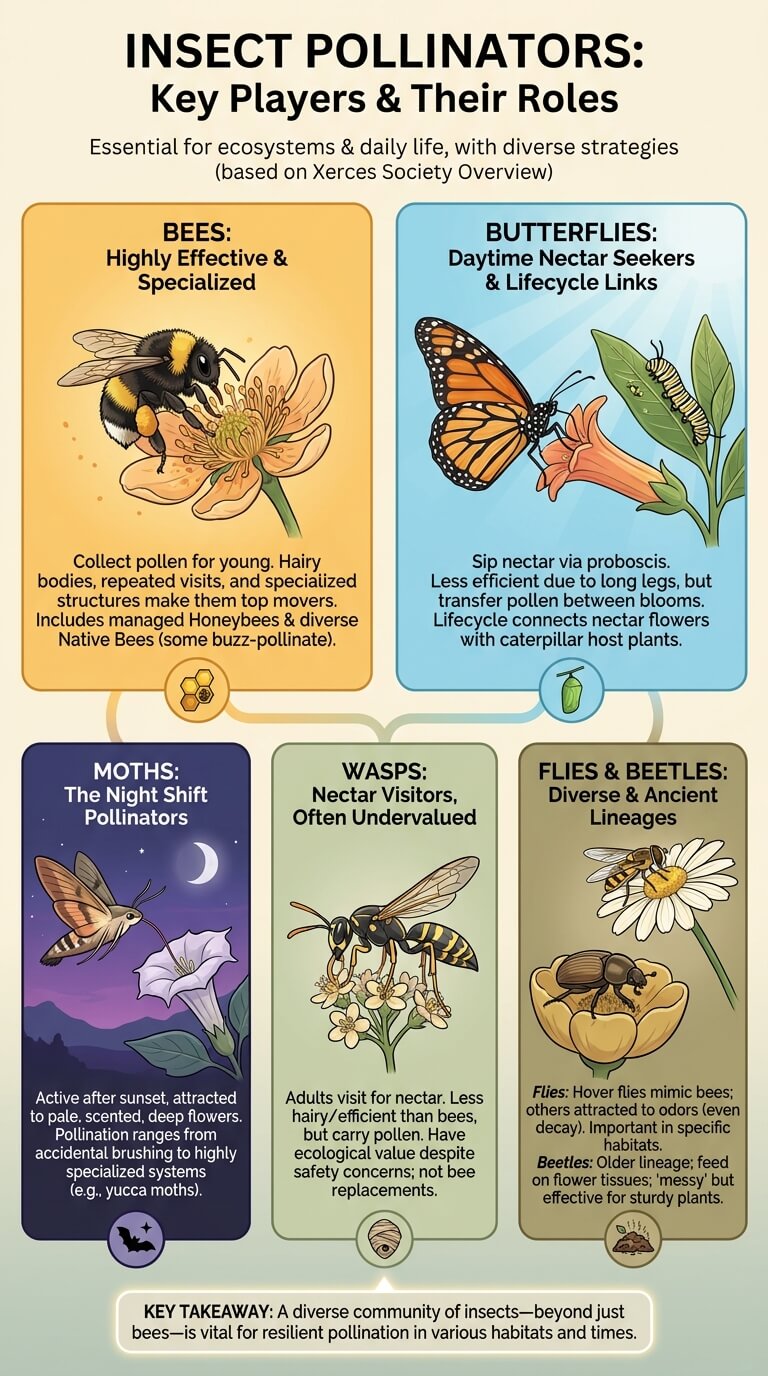
Bees are among the most important insect pollinators because many species collect pollen to feed their young. Their hairy bodies, repeated flower visits, and pollen-carrying structures make them especially good at moving pollen. The Xerces Society’s pollinator overview explains that insects do much of the pollination that affects daily life and highlights bees, butterflies, flies, wasps, and beetles as major insect groups.
Honeybees are familiar because they live in large managed colonies and are used in agriculture. Native bees are often less visible but extremely important in local ecosystems. Bumble bees, sweat bees, mining bees, mason bees, and leafcutter bees can all visit flowers in different ways. Some buzz-pollinate flowers by vibrating their flight muscles, which helps release pollen from certain flowers.
Butterflies as daytime nectar visitors
Butterflies are daytime flower visitors that often pollinate while sipping nectar through a long, coiled mouthpart called a proboscis. Their long legs and lighter contact with flower parts can make them less efficient than many bees on some plants, but they can still transfer pollen as they move from bloom to bloom.
Butterflies are also useful because their life cycles connect flowers with host plants. Adults may need nectar, while caterpillars need specific leaves. Monarch butterflies, for example, are strongly linked to milkweed during the caterpillar stage and use many nectar flowers as adults. That does not make monarchs the only important butterfly pollinators, but it shows how pollination sits inside a larger life-history pattern.
Moths as nighttime pollinators
Moths are easy to overlook because many are active after sunset. Night-blooming flowers often use pale color, strong scent, and deep nectar tubes to attract moths. Hawk moths and sphinx moths can hover near flowers, extend long tongues, and carry pollen as they visit multiple blooms.
Some moth pollination is casual and accidental. A moth brushes against pollen while drinking nectar, then visits another flower. Other moth systems are far more specialized, especially in yucca moths. This range makes moths important examples for understanding why pollination does not stop when the sun goes down.
Wasps as overlooked flower visitors
Wasps are often treated only as stinging insects, but many adult wasps visit flowers for nectar. Some carry pollen while feeding, and a few plant-wasp relationships are highly specialized. Wasps are usually less hairy than bees, so they may not carry pollen as efficiently on many open flowers, but they should not be dismissed as ecologically useless.
Safety matters too. Wasps should not be handled, swatted near nests, or treated as harmless just because some are helpful. A fair view is better than either extreme: wasps are not simply villains, and they are not pollination replacements for bees.
Flies, beetles, and small insects that pollinate certain plants
Flies are surprisingly important pollinators in some habitats. Hover flies can resemble bees and visit open flowers for nectar and pollen. Other flies pollinate flowers with odors that attract them, including some plants that smell like decaying material. Their importance varies, but they can be especially noticeable where bees are less active or where flowers are shaped for small insects.
Beetles are among the older lineages of flower visitors. They may feed on pollen, petals, or other flower tissues, and they often work on sturdy, open flowers. Beetle pollination can look messy, but it can still be effective when the flower structure tolerates chewing and places pollen where beetles will move it.
Bird Pollinators
Hummingbirds and tubular flowers
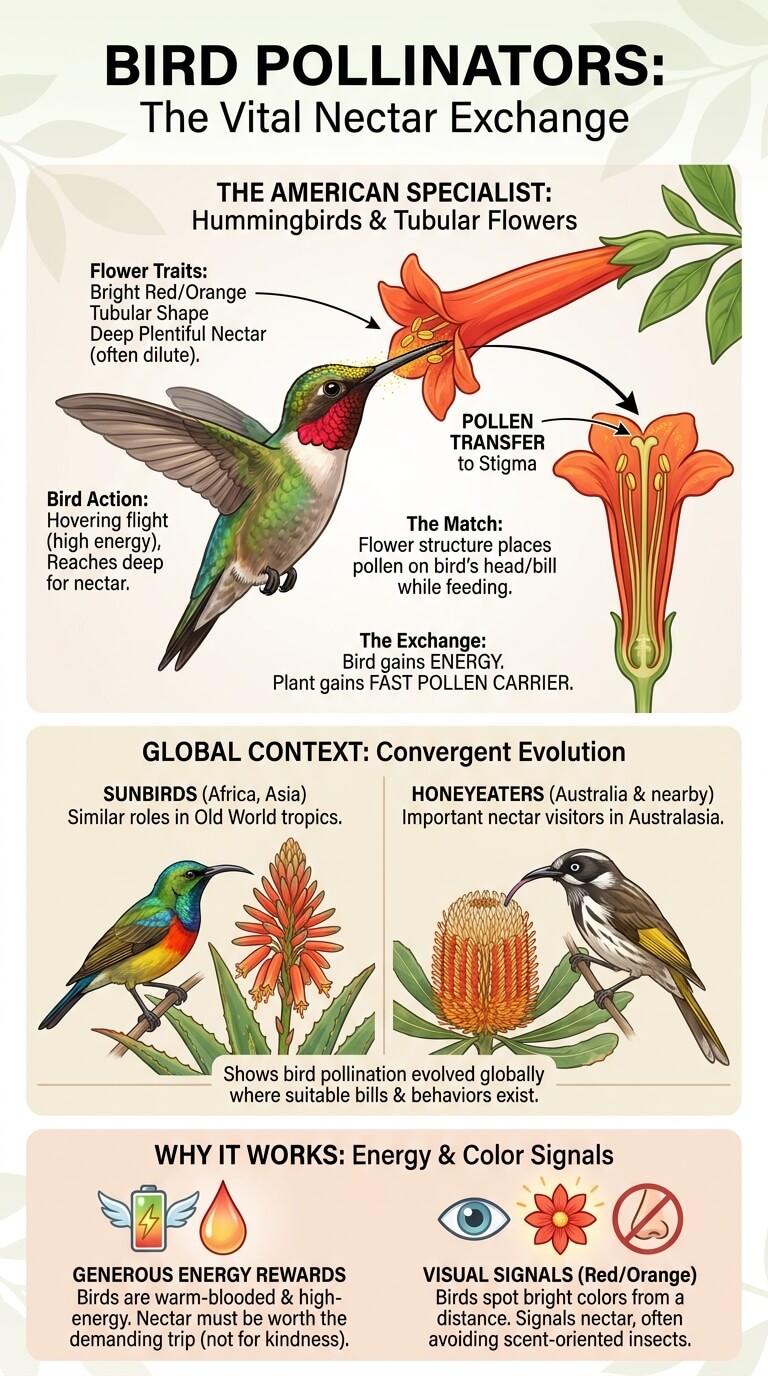
Hummingbirds are the most familiar bird pollinators for many US readers. They feed on nectar, hover or perch near flowers, and may carry pollen on the bill, forehead, throat, or feathers. Many hummingbird-visited flowers are tubular and brightly colored, especially red or orange, with nectar positioned deep inside the bloom. The U.S. Forest Service profile of the ruby-throated hummingbird describes red or orange tubular flowers with plentiful dilute nectar as especially attractive to hummingbirds.
The match makes sense. A tubular flower can place pollen on a bird’s head or bill as it reaches in for nectar. When the hummingbird visits another flower of the same kind, some of that pollen may reach the stigma. The bird is chasing energy, while the plant gains a pollen carrier that can move between flowers quickly.
Sunbirds and honeyeaters in global context
Outside the Americas, other nectar-feeding birds play similar roles. Sunbirds are common nectar visitors in parts of Africa and Asia. Honeyeaters are important in Australia and nearby regions. These birds are not the same as hummingbirds, but they show how bird pollination has evolved in different parts of the world.
Because AnimalFactCentral mainly serves US readers, hummingbirds are the most familiar example. Still, global context helps explain why bird pollination is not a local oddity. When flowers offer enough energy-rich nectar and birds have bills, tongues, and behaviors suited to feeding, bird pollination can become a major pathway for pollen movement.
Why bird pollination often involves color and energy-rich nectar
Birds are warm-blooded and energetic. A hummingbird’s hovering flight is demanding, so nectar rewards must be worth the trip. Flowers associated with bird pollination often provide generous nectar compared with many small insect flowers. The nectar does not exist for kindness. It is part of an exchange that makes repeated visits more likely.
Color is also important because birds can spot bright flowers from a distance. Red, orange, and other vivid colors may signal nectar without attracting as many scent-oriented insects. In some cases, a flower shape may also reduce access by animals that would take nectar without moving pollen effectively.
Mammal Pollinators
Nectar-feeding bats and night-blooming flowers
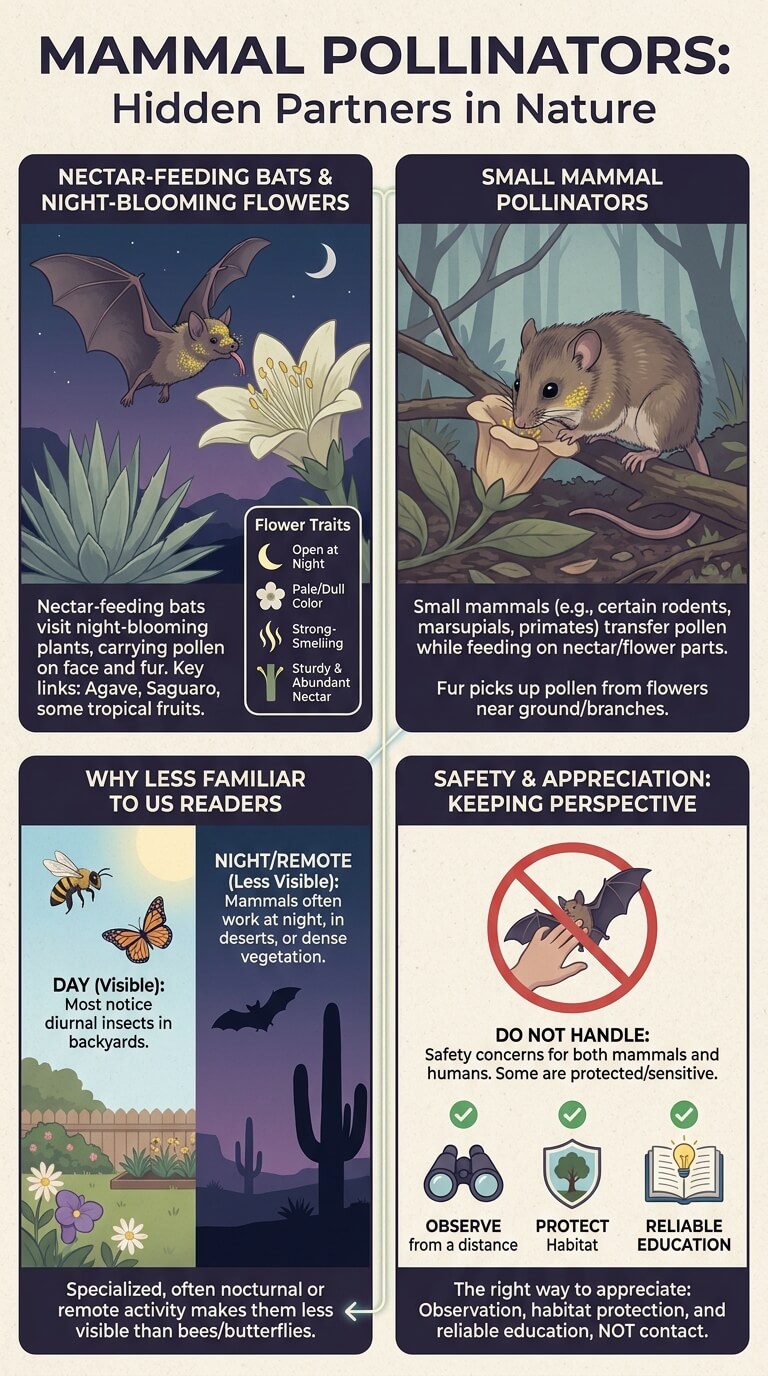
Bats are real pollinators, but only some bats pollinate flowers, and many US bats are insect eaters rather than flower visitors. Nectar-feeding bats visit night-blooming plants and can carry pollen on their faces and fur. The U.S. Forest Service bat pollination page notes links between bats and plants such as agave and saguaro, along with tropical fruits associated with bat pollination.
Bat-pollinated flowers are often open at night, pale or dull in color, strong-smelling, and sturdy enough for a larger visitor. Some offer abundant nectar. A bat may push its face into a flower, drink nectar, and leave dusted with pollen. When it visits another flower, pollen can be transferred.
Small mammals that can transfer pollen in some ecosystems
Some small mammals can move pollen when they feed on nectar or flower parts. Examples around the world may include certain rodents, marsupials, primates, and other mammals that visit flowers. Their fur can pick up pollen, especially when flowers are positioned close to branches or the ground.
Mammal pollination is less familiar because it is often more local, more specialized, or less visible than bee and butterfly activity. Many mammals visit flowers at night, in dense vegetation, or in habitats far from typical suburban gardens. Scientists usually need close observation, camera traps, pollen analysis, or controlled studies to confirm their role.
Why mammal pollination is less familiar to many US readers
Most US readers see bees, butterflies, beetles, flies, and hummingbirds more often than nectar-feeding mammals. That shapes public understanding. We tend to notice pollinators that visit backyard flowers in daylight. We miss animals that work at night, live in deserts or tropical forests, or visit flowers high in trees.
There is also a safety reason to keep mammal pollination in perspective. Bats and wild mammals should never be handled for curiosity or photography. Some are protected, some are sensitive to disturbance, and any close contact with wild mammals can create safety concerns. The right way to appreciate mammal pollinators is through observation, habitat protection, and reliable education, not contact.
Unusual and Specialist Pollination Stories
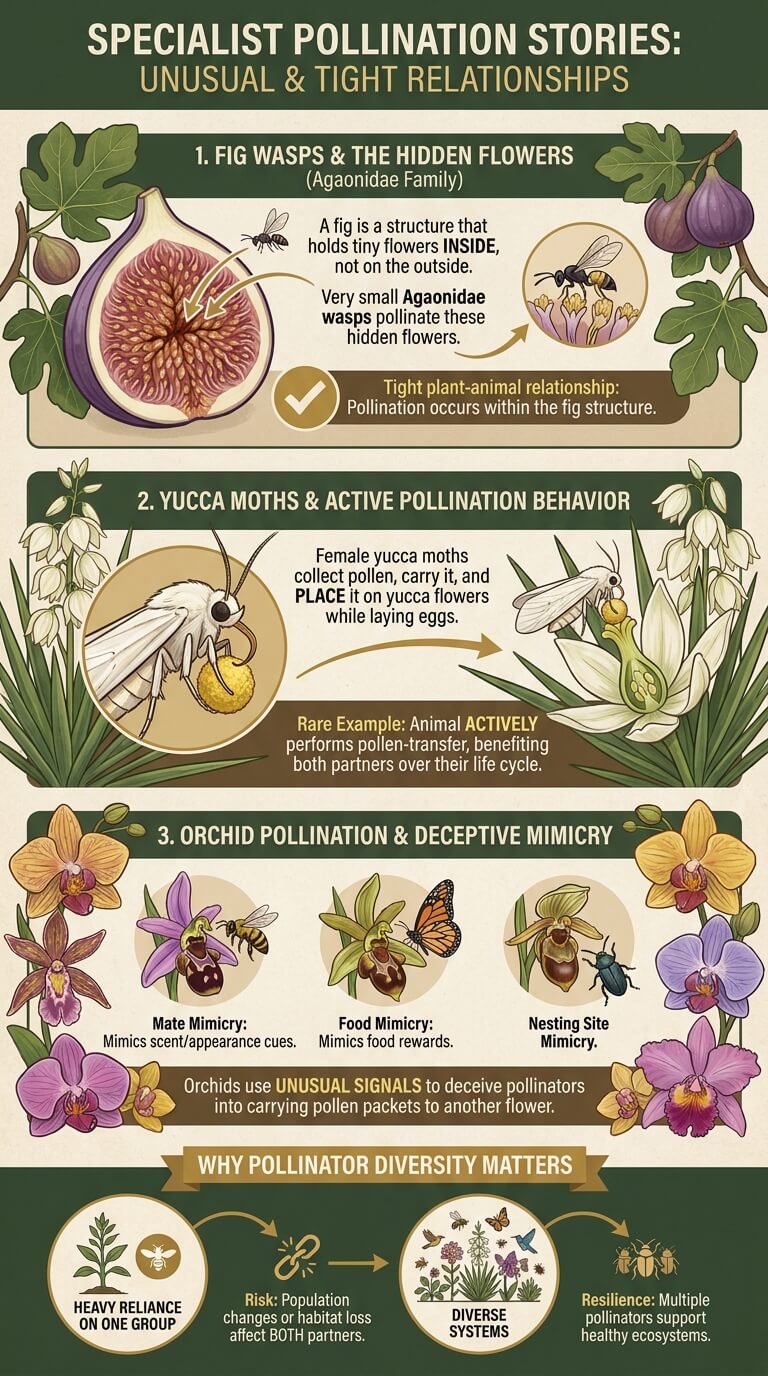
Fig wasps and tight plant-animal relationships
Fig wasps are among the most remarkable specialist pollinators. A fig is not a simple fruit with flowers on the outside. It is a structure that holds tiny flowers inside. The U.S. Forest Service fig wasp profile explains that fig trees are pollinated by very small wasps in the family Agaonidae and that the flowers are hidden within the fig structure.
Yucca moths and yucca plants
Yucca moths show that some pollinators do more than accidentally move pollen. Female yucca moths collect pollen, carry it, and place it on yucca flowers while laying eggs. The U.S. Forest Service page on yucca moths describes females gathering pollen and holding it under the chin with specialized structures before visiting yucca flowers.
Yucca moths are useful in this article because they make pollination visible as behavior. Many pollinators help plants by accident. Yucca moths are a rare example where the animal actively performs a pollen-transfer action that benefits both partners over the life cycle.
Orchid pollination and mimicry examples
Some orchids use unusual signals to attract pollinators. Depending on the species, orchids may mimic food rewards, nesting sites, or even the scent and appearance cues associated with potential mates. The animal investigates, pollen packets attach to the body, and the animal may carry them to another flower.
Specialist systems help explain why pollinator diversity matters. If a plant relies heavily on one animal group, changes in that animal’s population or timing can affect the plant. If an animal relies on one plant for part of its life cycle, habitat loss can affect both partners.
Pollinators by Habitat and Time of Day
Garden and meadow pollinators
Gardens and meadows often show the easiest pollinator activity to observe. Bees may work through patches of native flowers. Butterflies may stop on broad, nectar-rich blooms. Flies and beetles may gather on open flower heads. Hummingbirds may visit tubular flowers, especially when blooms are well matched to their feeding style.
A good garden is not useful to every pollinator equally. Flower shape, bloom time, pesticide exposure, nearby nesting habitat, and plant diversity all matter. A yard with only one ornamental flower type may look attractive but support fewer pollinator needs than a layered planting with native flowers across the season.
Forest and desert pollinators
Forests support pollinators that may be less obvious than garden bees. Flies, beetles, moths, bees, birds, and mammals can all use forest flowers depending on the region. Some flowers bloom early before the canopy closes. Others appear on shrubs, vines, or trees and attract animals at different heights.
Daytime versus nighttime pollination
Daytime pollinators include many bees, butterflies, flies, beetles, wasps, and hummingbirds. They often respond to visual cues such as color, shape, and flower pattern. Daylight also makes them easier for people to notice, which is one reason many readers first think of bees and butterflies.
Nighttime pollinators include many moths and some bats. Night-blooming flowers may use strong scent, pale color, large openings, and abundant nectar. These flowers are not less important just because people miss the activity. A pollinator system can be active while a garden looks quiet.
Common Mistakes and Myths
Myth: only bees pollinate plants
Bees are major pollinators, but they are not the only animals that pollinate plants. Butterflies, moths, flies, beetles, wasps, birds, bats, and some mammals all have documented roles. The better statement is that bees are often especially effective and widespread, while other animals are important in particular plants, habitats, regions, or times of day.
Myth: every animal on a flower pollinates it well
A flower visitor may be a pollinator, a nectar robber, a pollen eater, a predator waiting for prey, or simply an animal resting on a plant. Effective pollination requires pollen to reach the right flower part of the same plant species. A photo of an insect on a flower is a clue, not proof.
Myth: pollinators are always harmless to people
Helpful animals are still wild animals. Bees and wasps may sting, especially when disturbed or near nests. Bats and birds should not be handled. Some beetles or caterpillars can irritate skin. A pollinator’s ecological value does not make it safe to touch, capture, or relocate.
The safest approach is to observe from a respectful distance, avoid disturbing nests and roosts, and use professional help for conflicts involving stinging insects or wildlife in buildings. Pollinator conservation should not put people or animals at unnecessary risk.
Edge Cases and Exceptions
Plants pollinated by wind or water
Not all plants need animal pollinators. Many grasses, conifers, and grains rely mostly on wind. Some aquatic plants use water. These systems release pollen into the environment instead of using a nectar reward to recruit animals.
Animals that steal nectar without pollinating
Nectar robbing happens when an animal gets nectar without contacting the flower parts that would transfer pollen effectively. Some insects bite holes near the base of flowers. Some birds or insects may use a route that bypasses the flower’s normal pollen placement.
Introduced species and disrupted pollination systems
Introduced species can change pollination relationships. A non-native plant may attract local pollinators away from native plants. A managed animal pollinator may compete with wild pollinators for floral resources in some contexts. An invasive insect may damage plants or alter flower visitation patterns.
These issues are complex and local. The safest wording is not that every introduced species ruins pollination or that every managed hive is harmful. Instead, pollination networks can be sensitive to changes in habitat, timing, plant diversity, and animal communities.
How This Connects to Nearby Animal Topics
Why bees deserve a separate importance article
Bees deserve deeper coverage because they combine specialized bodies, pollen-collecting behavior, nesting ecology, agriculture, native species diversity, and conservation questions. This list places bees among other animals, but a bee-focused article can explain why native bees and honeybees should not be treated as interchangeable.
Why butterflies and moths need a comparison guide
Butterflies and moths are both Lepidoptera, but their pollination roles often differ by body form, activity time, flower preference, and behavior. A comparison guide can explain antennae, resting posture, day versus night activity, and the exceptions that make simple rules risky.
How the pollination process explains the whole list
The list makes more sense when paired with the basic pollination process. Pollen must move from anther to stigma, and the animal has to contact the right parts of the flower. Once that mechanism is clear, it becomes easier to understand why a bee, bat, bird, beetle, or moth can all be pollinators in different situations.
FAQ
What animals pollinate plants besides bees?
Animals that pollinate plants besides bees include butterflies, moths, flies, beetles, wasps, hummingbirds, sunbirds, honeyeaters, nectar-feeding bats, some small mammals, fig wasps, and yucca moths. Their importance varies by plant species, habitat, region, and time of day. Some are broad flower visitors, while others are specialists tied closely to particular plants.
Do bats really pollinate plants?
Yes, some bats really pollinate plants. Nectar-feeding bats can visit night-blooming flowers and carry pollen on their faces and fur. In North America, bat pollination is especially associated with desert plants such as agaves and cacti. Most bats are not flower pollinators, though, so it is more accurate to say some bat species pollinate plants.
Are flies and beetles pollinators?
Yes, some flies and beetles are pollinators. Hover flies visit many open flowers, and other flies pollinate plants with odors or shapes that attract them. Beetles can pollinate sturdy flowers while feeding on pollen or floral tissues. They may not look as tidy as bees, but they can be effective for plants suited to their behavior.
What is the strangest animal pollinator?
The strangest animal pollinator depends on what you find surprising. Fig wasps are unusual because they pollinate flowers hidden inside figs. Yucca moths are remarkable because females actively collect and place pollen on yucca flowers while laying eggs. Nectar-feeding bats also surprise many readers because they pollinate at night and may visit large, sturdy flowers.
Final Thoughts
Animals that pollinate plants are far more diverse than the familiar image of a bee on a flower. Bees are central players, but butterflies, moths, wasps, flies, beetles, birds, bats, small mammals, and specialist insects also help move pollen in different habitats and at different times of day.
The most useful way to understand pollination is to look at the fit between the animal and the flower. A pollinator needs the right behavior, body contact, and repeated visits to move pollen where the plant can use it. Once you see that relationship, a quiet night moth, a desert bat, a tiny fig wasp, and a backyard hummingbird all become part of the same larger story of plants and animals depending on one another.

Ethan Walker is the founder and research editor of Animal Fact Central. He creates and reviews educational animal facts content using trusted wildlife, pet care, and science-based sources. His work focuses on making animal behavior, adaptations, habitats, and species facts clear, accurate, and engaging for everyday readers.
Read More Details About Ethan Walker: https://animalfactcentral.com/ethan-walker/