

Invasive animals in the US are non-native animals that establish populations and cause, or are likely to cause, ecological, economic, agricultural, or health-related harm. Some are large and obvious, such as feral pigs tearing up wetlands and farms. Others are small or easy to overlook, such as zebra mussels covering native mussels and water infrastructure. The pattern is the same: an animal arrives outside its native range, spreads, and changes the system around it.

The United States has many invasive animal problems because it has busy ports, connected waterways, a long history of agriculture and aquaculture, a major pet trade, and a huge variety of habitats. A species that fails in one region may thrive in another. That is why a US-focused view matters. The National Invasive Species Information Center’s US resources organize invasive species information by state and region because status and risk can depend heavily on place.
Quick Answer
Major invasive animals in the US include feral pigs, nutria, Burmese pythons in South Florida, invasive carp in large river systems, sea lamprey in the Great Lakes, zebra and quagga mussels, European starlings, fire ants, and spotted lanternflies. Their impacts differ. Some damage soil and crops. Some prey on native wildlife. Some compete for food or nesting sites. Some clog water systems or change aquatic food webs.
There is no single “most invasive animal” that applies everywhere. Feral pigs are among the most damaging land mammals in many states. Invasive carp are a major freshwater concern in parts of the Mississippi River basin and near Great Lakes protection efforts. Burmese pythons are a famous South Florida case. Zebra and quagga mussels have caused long-running aquatic problems in many water bodies. Each example matters because it shows a different way a non-native animal can reshape ecosystems.
A safe rule for readers is simple: do not release pets, bait, aquarium animals, or unwanted livestock into the wild. Do not move live fish, mussels, reptiles, amphibians, insects, or other wildlife between places. If you think you found an invasive animal, follow state wildlife agency reporting instructions rather than handling it yourself.

Why the United States Has So Many Invasive Animal Problems
The US is not unusually vulnerable because its ecosystems are weak. It is vulnerable because modern movement is fast. Ships, trucks, canals, farms, aquaculture ponds, pet markets, garden centers, and recreational equipment can move organisms across barriers that once separated ecosystems. A small animal attached to a boat, a fish released from a pond, or a reptile escaped from captivity can become the start of a much larger problem if conditions are suitable.
The U.S. Fish & Wildlife Service invasive species program describes invasive species as non-native organisms that thrive where they do not naturally live and cause, or are likely to cause, environmental, economic, or health harm. In the US, that definition can apply to animals in rivers, lakes, forests, grasslands, deserts, islands, farms, suburbs, ports, and wetlands.
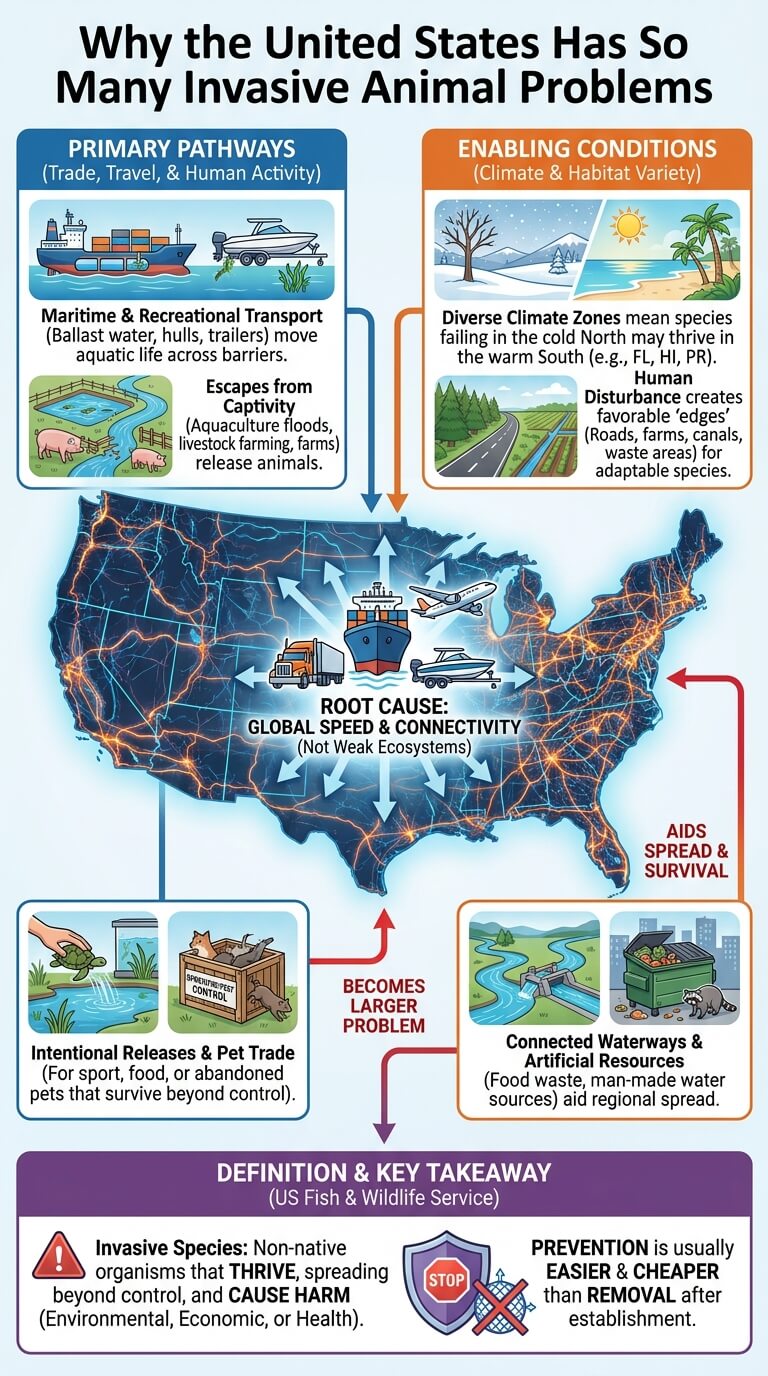
Trade, travel, waterways, agriculture, and pet releases
Many invasive animal pathways are linked to ordinary human activity. Ships can move aquatic organisms in ballast water or on hulls. Boats and trailers can carry mussels or plant fragments from lake to lake. Aquaculture facilities can unintentionally release fish during floods. Livestock and farm animals can escape and form feral populations. Pet owners sometimes release reptiles, fish, amphibians, birds, or mammals when they become difficult to keep.
Some introductions were intentional at first. Animals have been brought in for pest control, food production, sport, fur, agriculture, or the pet trade. The problem appears when an introduced animal survives beyond human control and finds enough food, shelter, and breeding opportunities to spread. That is why prevention is usually easier and cheaper than removal after establishment.
Why climate and habitat variety matter
The United States contains many climate zones and habitat types. A species that cannot survive northern winters may still thrive in South Florida, Hawaii, Puerto Rico, Guam, or coastal regions. A fish that spreads through connected rivers may not need the same habitat as a wetland mammal. An insect that feeds on plants may follow urban trees, orchards, vineyards, or forests.
Climate does not work alone. Habitat disturbance can help invasive animals by creating open edges, roads, ditches, canals, crop fields, ponds, or waste areas that favor adaptable species. Human food waste and artificial water sources can support some animals. Connected waterways can turn a local aquatic issue into a regional one.
How to Read This US Invasive Animal Guide
A national overview needs careful wording because invasive status is local. The same animal may be native in one part of the world, non-native in another, established in one state, watched in another, and legally restricted somewhere else. The examples below are chosen because they illustrate major US invasive animal patterns, not because every species has the same impact everywhere.
Native range vs US invaded range
Native range means the area where a species occurs naturally because of historical ecological processes. Invaded range means the area where it has been introduced and is spreading or causing harm. For example, a species can be native to Europe or Asia and invasive in North America. Another species may be native to part of the Americas but introduced to a US island or watershed where it did not naturally occur.
This difference helps avoid moral language. Invasive animals are not “bad animals” in a biological sense. They are organisms living in the wrong ecological context. A predator, grazer, competitor, or filter feeder may be ordinary in its native range and disruptive in a new one because local species did not evolve with it.
Ecological impact vs nuisance impact
Not every annoying animal is invasive. A native raccoon in a trash can, a native deer eating garden plants, or a native squirrel in an attic can be a real problem for homeowners, but that is usually nuisance wildlife, not invasive species. Invasive status depends on non-native origin and harm to ecosystems, economies, agriculture, animal health, plant health, or human health.
Ecological impact can include predation, competition, habitat damage, disease movement, changes to water quality, or food web disruption. Nuisance impact may involve noise, mess, property damage, or inconvenience. Sometimes an invasive animal creates both, but the terms should not be treated as identical.
Why local status can change
Invasive species information changes as animals spread, monitoring improves, and agencies update regulations. A species may be newly detected in one state, established in another, and absent from a third. Some states may list an animal as prohibited, regulated, or reportable. Others may focus on prevention because the species has not yet arrived.
For that reason, local reporting pages and state wildlife agencies matter. A national article can explain patterns, but the practical answer to “What should I do if I see this animal?” often depends on the state, county, water body, or protected area.
Major Invasive Mammals in the US
Invasive mammals often get attention because their damage is visible. They can dig, graze, trample, prey on native wildlife, spread diseases, damage crops, or compete with native animals. Their impacts also overlap with agriculture and property, which makes them especially visible to landowners.

Feral pigs and landscape damage
Feral pigs, also called feral swine or wild hogs, are one of the most destructive invasive mammals in many parts of the US. They root through soil with their snouts, disturb wetlands, damage crops and pastures, eat a wide range of plant and animal foods, and can affect water quality. The USDA APHIS feral swine program states that feral swine damage and control cost the US agricultural sector an estimated $2.5 billion each year.
Their success comes from flexibility. Feral pigs can use forests, marshes, agricultural land, rangeland, and suburban edges. They are intelligent, wary, social, and capable of high reproduction under favorable conditions. They also create safety and disease concerns around livestock, pets, and people, so they should not be approached or fed.
Nutria and wetland erosion
Nutria are large semi-aquatic rodents native to South America that have become invasive in parts of the US. They were historically associated with fur farming, and released or escaped animals established populations in some wetlands. Nutria feed heavily on wetland plants, including roots and stems, which can reduce vegetation that holds marsh soil together.
Their impact is easiest to understand as habitat loss. When wetland vegetation is removed faster than it can recover, marsh areas may erode or convert to open water. That can affect birds, fish nurseries, amphibians, water quality, and storm-buffering habitat. Nutria also show why an invasive mammal does not need to be a predator to cause ecosystem damage.
Feral cats and wildlife predation context
Feral and free-roaming domestic cats are a sensitive invasive animal topic because many people love cats. The conservation issue is not whether individual cats are valued companions. It is that outdoor cats can kill birds, small mammals, reptiles, and amphibians, especially in places where wildlife evolved without similar predators or where native species are already under pressure.
This topic is especially serious on islands and near vulnerable wildlife colonies. It also connects pet care with conservation. Keeping pet cats indoors, using enclosed outdoor spaces, and supporting humane local management can reduce wildlife predation while protecting cats from cars, disease, fights, and other outdoor hazards.
Major Invasive Reptiles and Amphibians in the US
Reptile and amphibian invasions often begin through the pet trade, accidental transport, or releases. Warm regions are especially vulnerable because many reptiles and amphibians cannot survive long cold periods. South Florida is the best-known US example, but introduced reptiles and amphibians can appear in many states.

Burmese pythons in Florida
Burmese pythons are large constrictor snakes native to parts of Asia. In South Florida, they have established breeding populations and are strongly associated with the Greater Everglades ecosystem. The USGS overview of invasive Burmese pythons in southern Florida describes their invasion of protected lands such as Everglades National Park and Big Cypress National Preserve.
Their impact comes from predation. Burmese pythons eat mammals, birds, and reptiles, and they are difficult to detect in dense wetlands. This US overview uses pythons mainly to show how released or escaped exotic pets can become a conservation problem when climate and habitat allow them to reproduce.
Brown anoles and other introduced lizards
Brown anoles are small lizards that are now common in many parts of Florida and have spread elsewhere through plant shipments and human transport. Their story is different from the Burmese python story. Brown anoles are not giant predators, but they can still affect native lizards through competition, habitat shifts, and pressure on young animals.
This example shows that invasive reptiles do not need to be frightening to matter. Small animals can change local communities if they are numerous, adaptable, and able to thrive around houses, gardens, nurseries, parks, and disturbed habitats.
Cane toads in limited US contexts and broader invasion lessons
Cane toads are toxic amphibians native to parts of the Americas, but they have become famous worldwide as invasive animals outside their native range. In the US, the topic is most relevant in Florida and in broader education about toxic invasive amphibians. Their large parotoid glands can secrete toxins that may harm predators and pets that bite or mouth them.
For US readers, the key safety lesson is caution around unfamiliar toads in areas where cane toads occur. People should not handle wild toads casually, and pet owners should seek veterinary help immediately if a pet mouths a toxic toad or develops sudden concerning signs. The broader ecological lesson is that an animal introduced for one purpose can create unexpected food web effects.
Major Invasive Fish and Aquatic Animals in the US
Aquatic invasive animals can be especially hard to manage because water connects habitats. Rivers, canals, reservoirs, ballast water, floods, and recreational boats can move animals or their larvae far beyond the first introduction point. Once an aquatic invader spreads through a large basin, removal becomes extremely difficult.

Invasive carp and river food webs
In the US and Canada, “invasive carp” usually refers to bighead carp, black carp, grass carp, and silver carp. These fish were introduced for uses such as aquaculture, wastewater treatment, vegetation control, or food, then escaped or spread into open waters. The USGS invasive carp FAQ explains that these carp were brought to the United States in the 1970s and later spread into the Mississippi River basin and other large rivers.
Their impacts vary by species. Bighead and silver carp can compete with native fish by consuming plankton, the tiny organisms that support many aquatic food webs. Grass carp feed on aquatic vegetation. Black carp feed on mollusks and can raise concerns for native mussels and snails. Silver carp are also known for jumping when startled by boat motors, which can create a safety issue for boaters in some areas.
Sea lamprey in the Great Lakes
Sea lamprey are parasitic jawless fish that attach to other fish and feed on body fluids. In the Great Lakes, they became a major invasive problem after gaining access to the upper lakes through human-altered waterways. Their impact on lake trout and other fish made them one of the best-known aquatic invasive species stories in North America.
Sea lamprey control has required long-term, coordinated management. That makes them a useful example of a different kind of invasive animal problem. The issue is not a pet release or a farm escape, but a waterway connection that allowed a parasitic species to reach vulnerable fish communities.
Zebra and quagga mussels as aquatic ecosystem disruptors
Zebra and quagga mussels are small freshwater mussels that can attach in dense numbers to hard surfaces, boats, pipes, docks, and even native mussels. The National Park Service zebra mussel overview explains that zebra mussels can attach to native mussels, outcompete them for food and space, and overwhelm water systems because of fast reproduction.
These mussels also change water clarity and nutrient movement. Clearer water may sound good, but it can shift algae growth, aquatic plants, and food availability in ways that alter the whole system. Their spread also creates expensive maintenance problems for water infrastructure and recreational boating.
Major Invasive Birds and Invertebrates Readers May Recognize
Some invasive animals are familiar because people see them in cities, yards, orchards, roadsides, or parks. Familiarity can make them seem harmless, but ecological effects depend on abundance, behavior, and location.

European starlings and competition
European starlings are now common across much of the United States. They nest in cavities and can compete with native cavity-nesting birds for nesting sites. They also form large flocks that may affect agriculture, create sanitation problems, and concentrate around human food sources.
Starlings are a good reminder that an invasive animal can become so familiar that people stop noticing it as introduced. Their impact is not based on being rare or strange. It comes from population success, flexible behavior, and interactions with native birds and human landscapes.
Spotted lanternfly as a non-native invasive insect example
The spotted lanternfly is an invasive planthopper that has become a major concern in parts of the eastern US. It feeds on plant sap and is strongly associated with tree-of-heaven, another non-native species, though it can affect a range of plants. Its spread has raised concern for grapes, orchards, hardwoods, and ornamental trees.
It also shows how invasive animals can move with vehicles, outdoor equipment, nursery stock, and human travel. Adults are noticeable, but egg masses can be easy to miss, so public reporting and avoiding transport of infested materials can matter.
Fire ants and ecosystem disturbance
Imported fire ants are invasive insects in parts of the southern United States. They can sting, build mounds in lawns and fields, affect young wildlife, interfere with ground-nesting animals, and create problems for agriculture, pets, and people. Their colonies can be especially noticeable after rain or in disturbed open areas.
Fire ants matter because they combine ecological impact with daily human contact. They are not just a backyard annoyance. In invaded areas, they can change small-animal communities, affect farm operations, and create safety concerns for people who accidentally step on nests.
Which US Habitats Are Most Vulnerable?
Any habitat can be affected by invasive animals, but some settings are especially vulnerable. Vulnerability usually rises when ecosystems are isolated, disturbed, highly connected by water or transport, or already stressed by habitat loss, pollution, climate shifts, or heavy human use.

Wetlands and coastal marshes
Wetlands and marshes are vulnerable because they support dense wildlife communities and often sit at the edge of land and water. Nutria can damage marsh vegetation. Feral pigs can root through wet soils. Burmese pythons can use South Florida wetlands for cover and hunting. Aquatic invaders can move through connected waters and canals.
When wetlands are damaged, the effect can extend beyond one species. Wetlands filter water, store floodwater, support fish and bird life, and buffer storms in some areas. An invasive animal that removes vegetation or disrupts food webs can reduce those functions.
Rivers, lakes, and the Great Lakes
Freshwater systems are vulnerable because water creates pathways. A boat moved from one lake to another can carry mussels. A flood can connect ponds to rivers. Canals can let species cross natural drainage boundaries. The Great Lakes receive special attention because they are ecologically and economically important and connected to shipping, recreation, and many communities.
Invasive carp, zebra mussels, quagga mussels, and sea lamprey all show different freshwater invasion pathways. Some compete for food. Some attach to surfaces. Some parasitize fish. Some move through connected basins. The shared challenge is that water makes containment difficult.
Islands and isolated ecosystems
Islands are often highly vulnerable because native species may have evolved without certain predators, grazers, or competitors. Introduced cats, rats, pigs, snakes, insects, or amphibians can cause intense pressure on birds, reptiles, amphibians, plants, and invertebrates that have limited defenses or small ranges.
The US includes island ecosystems such as Hawaii, Puerto Rico, Guam, the US Virgin Islands, and many smaller protected islands. In these places, invasive animal management can be directly tied to preventing extinctions and protecting rare habitats.
Farms, forests, and suburbs
Human-altered landscapes can favor adaptable invasive animals. Farms may provide crops, water, and shelter. Forest edges can help some mammals and insects spread. Suburbs can provide food waste, ornamental plants, ponds, patios, woodpiles, and transportation corridors.
That does not mean every animal near people is invasive. It means human landscapes can make invasion easier by creating repeated opportunities for food, shelter, and movement. Prevention often starts with ordinary habits, such as securing animal feed, cleaning outdoor equipment, not dumping aquariums, and reporting unusual species early.
Common Mistakes and Myths
Invasive animals are often discussed with fear, frustration, or viral exaggeration. Clear thinking helps readers avoid both panic and complacency.
Myth: the same species is invasive everywhere in the US
A species’ status depends on geography. An animal can be native in one place, non-native in another, invasive in one region, and only occasionally reported somewhere else. Local context matters for law, ecology, and safety. A national map cannot replace local agency guidance.
Myth: only big predators become invasive
Large predators can create dramatic impacts, but many invasive animals are not big predators. Mussels, insects, rodents, fish, and grazing animals can be just as disruptive. Some alter habitat. Some compete for food. Some damage plants. Some spread pathogens. Some affect infrastructure or agriculture.
Mistake: confusing nuisance wildlife with invasive wildlife
A native animal causing problems around a home is not automatically invasive. The correct response may involve securing trash, removing attractants, repairing entry points, protecting pets, or calling a licensed wildlife professional. Calling every conflict animal invasive can lead to poor decisions and misunderstanding of native wildlife.
How This Connects to Nearby Animal Topics
A US list works best as a map of examples. Each animal here can lead to a deeper question about definitions, biology, ecosystem impact, or management.
Why Burmese pythons became a Florida case study
Burmese pythons show how a pet-trade species can become a major predator in a warm, wet habitat. Their story connects animal size, camouflage, reproduction, diet, and the difficulty of detecting a secretive reptile in a huge wetland. They deserve a focused species case study because their Florida invasion has details that a broad US list cannot fully cover.
Why invasive carp are a freshwater example
Invasive carp show how connected rivers can spread a problem across large regions. Their impacts are tied to feeding ecology, waterway connections, boating safety, and Great Lakes prevention. They need a separate deep dive because the term invasive carp includes multiple species with different biology.
Why feral pigs show how land animals reshape ecosystems
Feral pigs show how a land mammal can damage ecosystems without being a specialized predator. Rooting, wallowing, crop feeding, disease concerns, and high reproductive potential make them a major example of landscape disturbance. Their story also requires safety caution because people should not try to handle or trap feral pigs on their own.
After identifying the major examples, the next practical question is how conservation controls invasive species without creating new problems for native wildlife.
FAQ
What is the most invasive animal in the US?
There is no single answer that fits every ecosystem. Feral pigs are among the most damaging invasive mammals across many states, especially for agriculture and natural resources. Invasive carp are major freshwater invaders in large river systems. Burmese pythons are a serious South Florida predator problem. Zebra and quagga mussels are major aquatic invaders in many lakes and rivers. The best answer depends on whether you mean ecological damage, economic cost, geographic spread, or difficulty of control.
Are all invasive animals in the US illegal to own?
No. Legal status varies by species, state, locality, and situation. Some invasive or potentially invasive animals are prohibited, some are regulated, and some may still be present in trade under certain rules. Laws can also change. Anyone considering an exotic pet, aquarium animal, reptile, fish, bird, or unusual livestock should check current state and local rules before buying, selling, transporting, or releasing an animal.
Which US states have the biggest invasive animal problems?
Many states have serious invasive animal problems, but the type of problem differs. Florida is well known for invasive reptiles and amphibians because of climate, trade, and habitat conditions. Southern and central states often deal with feral pig impacts. Great Lakes states focus heavily on aquatic invaders such as mussels, sea lamprey, and invasive carp prevention. Island regions such as Hawaii and Guam can be highly vulnerable because many native species evolved in isolation.
Can invasive animals spread because of climate change?
Climate change can affect invasive animals by changing temperature limits, rainfall patterns, habitat suitability, and the timing of reproduction or movement. It does not explain every invasion, and human transport is still a major pathway. But in some cases, warmer conditions or altered habitats may make it easier for introduced animals to survive in places that were once less suitable.
Final Thoughts
Invasive animals in the US are not one kind of creature or one kind of problem. They include mammals, reptiles, amphibians, fish, mollusks, birds, and insects that affect ecosystems in different ways. The most useful way to understand them is by habitat and impact: feral pigs disturb land and wetlands, Burmese pythons pressure South Florida wildlife, invasive carp change river food webs, zebra and quagga mussels alter freshwater systems, and insects such as spotted lanternflies affect plants and agriculture.
The practical takeaway is prevention. Do not release pets or bait. Clean boats and outdoor gear when moving between waters. Do not transport live invasive animals. Report unusual sightings through the appropriate local agency. The earlier an invasive animal is detected, the better chance people have to protect native wildlife, farms, waterways, and habitats before the problem becomes much harder to manage.

Ethan Walker is the founder and research editor of Animal Fact Central. He creates and reviews educational animal facts content using trusted wildlife, pet care, and science-based sources. His work focuses on making animal behavior, adaptations, habitats, and species facts clear, accurate, and engaging for everyday readers.
Read More Details About Ethan Walker: https://animalfactcentral.com/ethan-walker/