

Invasive carp are non-native freshwater fish that can spread through rivers and lakes and change how those ecosystems work. In North America, the phrase usually refers to four species: bighead carp, silver carp, grass carp, and black carp. They are often discussed together, but they are not the same fish and they do not cause harm in exactly the same way.
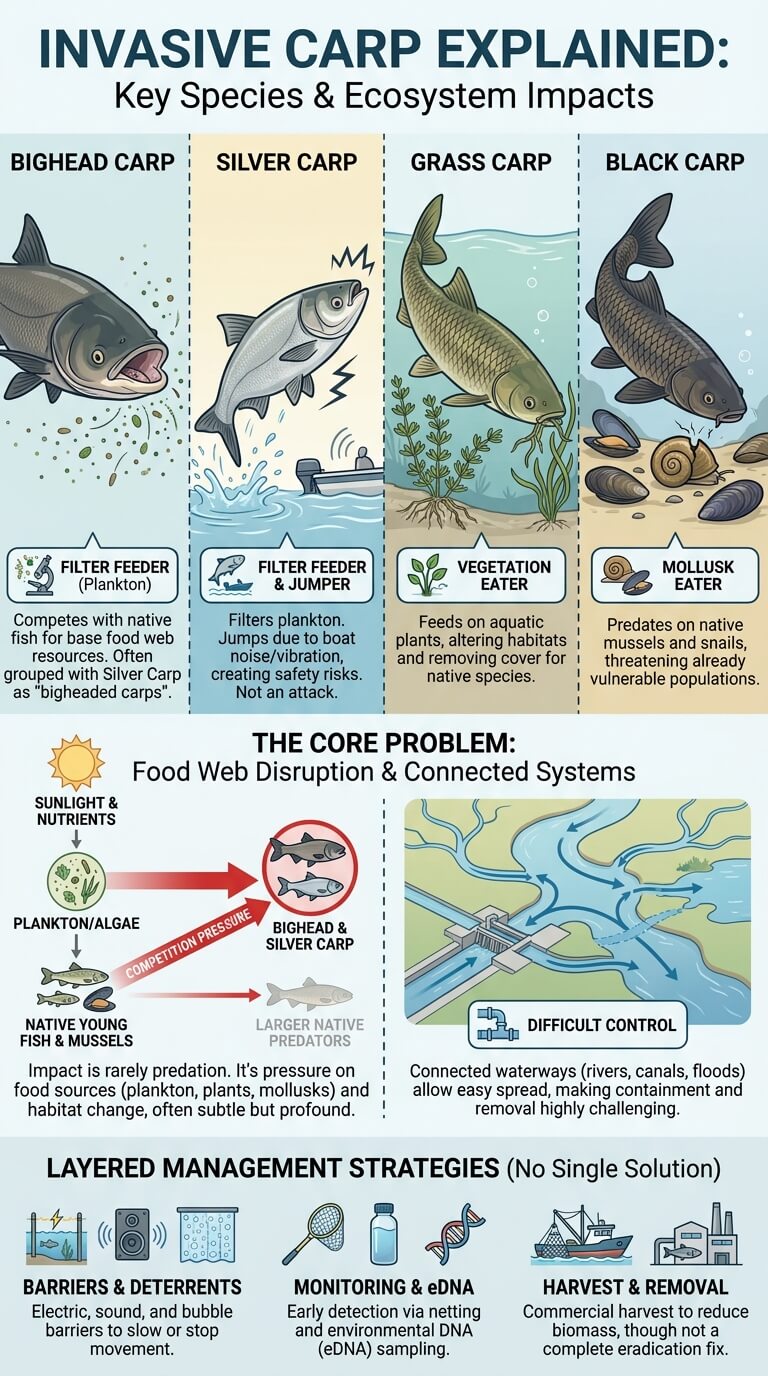
The problem is not that invasive carp are scary predators. Their impact usually comes from food web pressure, habitat change, high reproduction, and the difficulty of controlling fish in connected waterways. The U.S. Fish and Wildlife Service invasive carp program describes the U.S. and Canadian invasive carp concern as centered on bighead, black, grass, and silver carp.
This guide explains what invasive carp are, how they reached U.S. waterways, why they can affect native fish and mussels, why silver carp jump, and why large river systems make control so difficult.
Quick Answer
Invasive carp are carp species introduced outside their native range that have established or may establish in ways that harm ecosystems, fisheries, recreation, or water management. Bighead carp and silver carp are best known for filtering plankton from the water. Grass carp feed on aquatic plants. Black carp feed on mollusks such as snails and mussels.
Because these food sources are tied to many other animals, invasive carp can affect a river without acting like top predators. They can compete with native fish, reduce habitat, add pressure to native mussels, and complicate fisheries management. Silver carp also create a visible safety concern because they may leap from the water when startled by boat noise or vibration.
A good way to understand the issue is to separate presence from impact. A single report of a carp species does not tell you the whole story. Managers look at whether the fish are reproducing, how many are present, which habitats they use, and whether native species or fisheries are being affected.
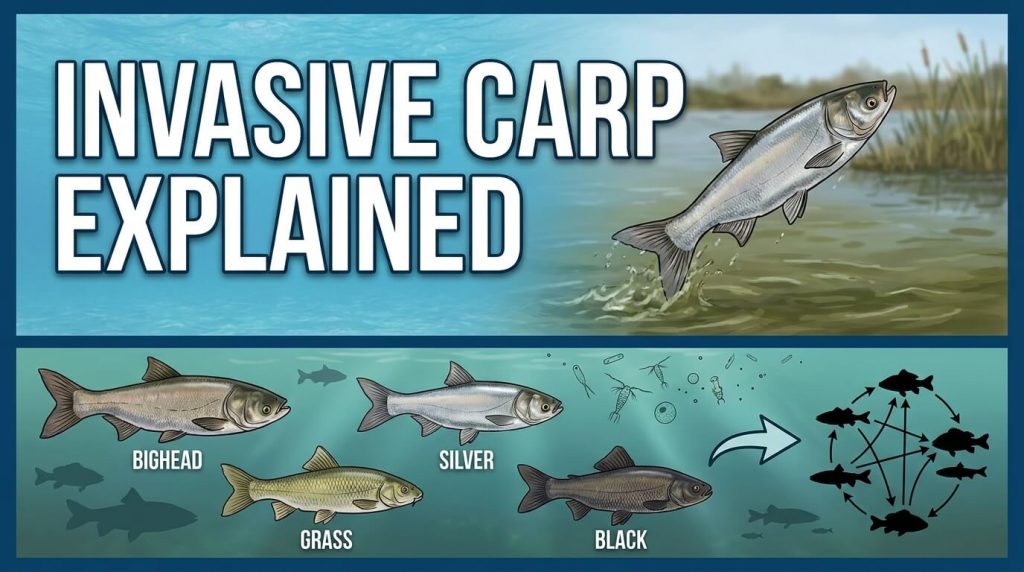
What Are Invasive Carp?
Carp are freshwater fish in the large family Cyprinidae, which also includes minnows. Some carp species have been moved by people for food, aquaculture, vegetation control, algae control, or ornamental ponds. A carp becomes an invasive concern when it spreads beyond human control and causes, or is likely to cause, ecological or economic harm.
Which carp are usually included in the invasive carp problem
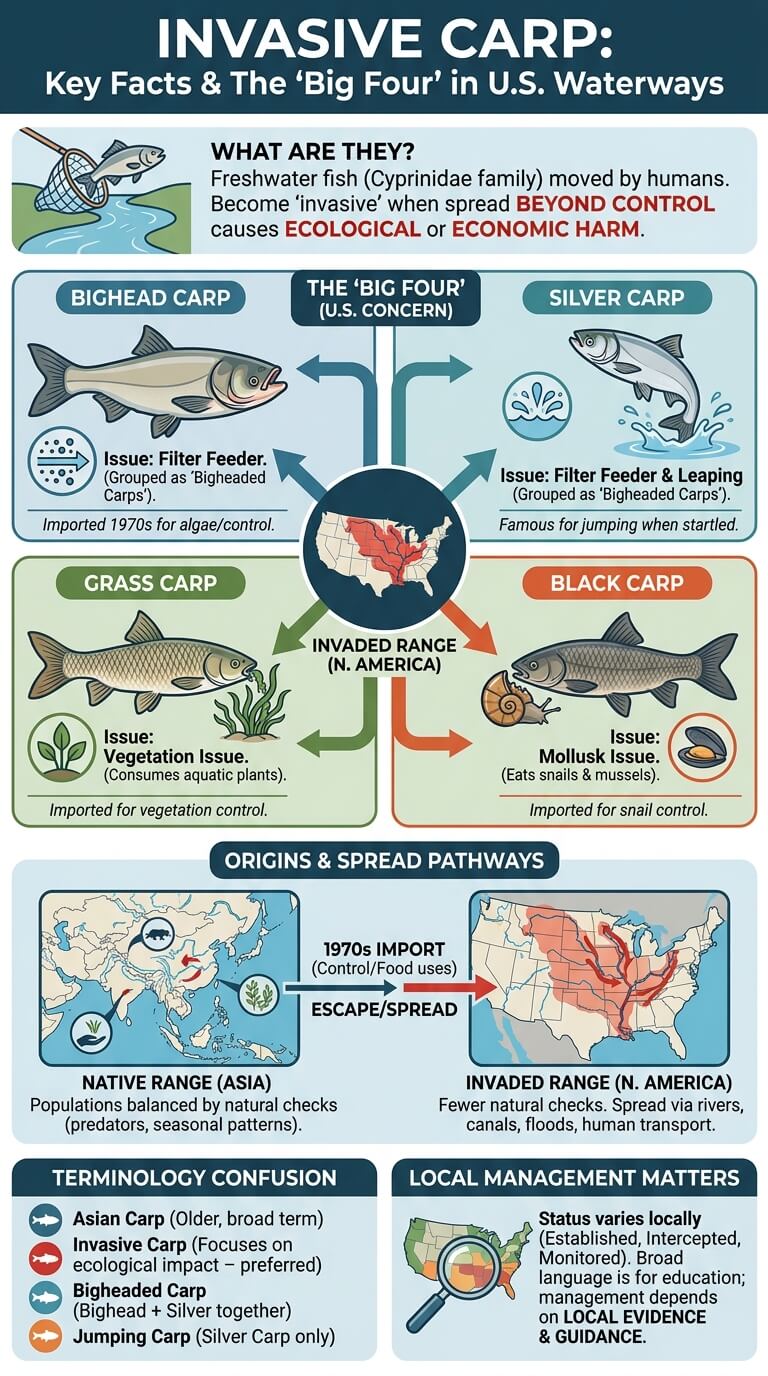
In U.S. waterway management, invasive carp usually means bighead carp, silver carp, grass carp, and black carp. Bighead and silver carp are often grouped as bigheaded carps because both are filter feeders. Grass carp are mainly a vegetation issue. Black carp are a mollusk issue. Treating them as one identical animal can lead to bad explanations, because the diet and impact of each species differ.
The U.S. Geological Survey overview says these four species were imported to the United States in the 1970s for uses such as controlling algae, snails, and aquatic vegetation in managed systems, as well as for food. That introduction history explains why carp that once seemed useful in ponds or aquaculture later became a river-basin problem.
Why common names can confuse readers
The names Asian carp, invasive carp, bigheaded carp, and jumping carp are often used loosely. Asian carp is a broad older phrase for several carp species native to Asia. Invasive carp is now common in agency communication because it focuses on the ecological issue. Bigheaded carp usually refers to bighead and silver carp together. Jumping carp usually points to silver carp, the species famous for leaping when startled.
Native range vs North American invaded range
The main invasive carp species discussed in North America are native to parts of Asia, especially large river systems. In their native range, they exist with predators, competitors, diseases, and seasonal patterns that help shape their populations. In North America, they entered waterways where those same checks may not limit them in the same way.
The invaded range is not uniform. Invasive carp are strongly associated with the Mississippi River Basin and connected waters, but management concern extends beyond that basin because rivers, canals, floods, bait movement, and human transport can create spread pathways. Their status can vary by state, watershed, and species.
This is why local maps and state wildlife guidance matter. A species may be established in one river, intercepted in another, and only monitored as a future risk somewhere else. Broad national language is useful for education, but local management depends on local evidence.
How Invasive Carp Got Into US Waterways
The invasive carp story began with intentional human use. Several species were brought into controlled settings because their feeding habits seemed helpful. The problem developed when fish escaped or spread into open water, reproduced, and moved through connected river systems.

Aquaculture and water management introductions
Silver carp and bighead carp can filter small organisms and particles from water. Grass carp can eat large amounts of aquatic vegetation. Black carp can consume snails. These traits had practical uses in aquaculture, wastewater, retention pond, and vegetation control settings. Once the fish were outside containment, those same traits could affect native food webs and habitats.
The lesson is not that every biological control idea fails. It is that animals can behave differently once they leave the narrow setting where people planned to use them. A trait that is useful in a pond can become disruptive in a river with native fish, mussels, plants, and many routes for spread.
Flooding, escape, and river connections
Flooding can connect ponds, drainage areas, canals, and rivers that are separated during normal water levels. A fish held in a managed system can reach an open waterway during high water. Once in a river, it may encounter tributaries, floodplains, navigation channels, locks, dams, and backwaters that create many possible routes for movement.
Why connected waterways make spread difficult to stop
Freshwater invasions are difficult because water links habitats. A fence can sometimes slow a land animal, but a river barrier must work with flow, boats, fish movement, flood events, and public access. The National Park Service overview notes that invasive carp can move through large river systems and that silver carp may jump over some low barriers under certain conditions.
Why Invasive Carp Can Take Over Freshwater Systems
Invasive carp succeed when several traits meet suitable habitat. They can grow quickly, reproduce effectively, feed on abundant resources, and move through connected waters. Their success is not magic and not guaranteed everywhere. It depends on species, water temperature, flow, spawning habitat, food, predators, and barriers.

Fast growth and high reproduction
Fast growth can help young carp move through vulnerable life stages, and high reproductive potential can make established populations hard to reduce. Some species need flowing water conditions for eggs and larvae to develop properly, which is why long river systems can be important. A short pond, cold lake, or isolated waterbody may not offer the same opportunity.
Because reproduction depends on conditions, careful wording is important. Invasive carp do not automatically explode in every lake or stream. Their risk rises when temperature, flow, food, and spawning habitat line up with enough adult fish to create a self-sustaining population.
Filter feeding and competition for plankton
Bighead carp and silver carp filter plankton and other tiny particles from the water. Plankton may be small, but it supports young fish, mussels, invertebrates, and the wider freshwater food web. When bigheaded carp become abundant, they can compete with native plankton-feeding species and may reduce food available to early life stages of other fish.
Schooling behavior and movement through river systems
Invasive carp can concentrate in areas with suitable food and water conditions, then move as flow, season, or habitat changes. This makes them hard to monitor. A river reach with many visible carp may be close to another reach where fish are present but less obvious. Managers must think about both abundance and movement, not just single sightings.
Ecosystem Impacts of Invasive Carp
The clearest way to understand invasive carp impact is through food webs. A food web connects algae, plankton, plants, insects, mussels, fish, birds, mammals, and decomposers. Invasive carp can change how energy moves through that web, especially where their numbers become high.

Pressure on native fish and mussels through food web changes
Native fish may be affected when bighead and silver carp compete for plankton, especially if young fish or their prey depend on the same food base. Native mussels are a different concern. Black carp eat mollusks, and many native mussels already face pressure from habitat change, pollution, dams, and other invasive species. A mollusk-eating invasive fish can add risk in places where it establishes.
These effects are often indirect. A reader may expect an invasive animal to cause obvious damage, but aquatic food web changes can be subtle at first. Fewer young fish surviving, fewer mussels in a local bed, or less plant cover for small animals may take monitoring to detect clearly.
Effects on sport fish and commercial fisheries
Invasive carp can affect fisheries by competing with native fish, changing habitat, clogging nets, or altering public use of a river. The USGS invasive carp research program describes detrimental effects on native fish and economically important fisheries where invasive filter-feeding carp are abundant. The phrase “where abundant” is important because impact depends on place and population size.
Why the Great Lakes receive so much attention
The Great Lakes support major fisheries, recreation, shipping, and coastal communities. They have also dealt with other invasive species, including sea lamprey and zebra and quagga mussels. Bighead and silver carp receive special attention because they could affect plankton-based food webs if they enter, survive, and reproduce in suitable habitats.
NOAA has summarized these concerns in its Great Lakes invasive carp risk assessment. Careful wording matters here. Risk does not mean every Great Lakes habitat is equally suitable, and it does not mean establishment is inevitable. It means prevention matters because removing an established aquatic invader from such a large system would be extremely difficult.
The Silver Carp Jumping Behavior Explained
Silver carp are famous because they can leap from the water when startled. This behavior is real and can be dangerous for boaters, but it is often misunderstood. Jumping carp are not attacking people. The danger comes from collision and surprise, not aggression.

Why silver carp jump
Silver carp may jump in response to boat motors, vibration, or sudden disturbance. In areas with high fish density, many fish can leap at once. Conditions such as water depth, boat speed, noise, and fish abundance can affect what people see. Not every silver carp jumps every time, and not every waterway with invasive carp has the same hazard level.
Why jumping carp create boating safety concerns
A large leaping fish can hit a person, knock equipment loose, or cause someone to lose balance. This is especially risky when a boat is moving. The safest message is simple: follow local boating advisories, slow down in known silver carp areas, wear proper safety gear, and avoid treating jumping fish as entertainment.
What this behavior does and does not mean
Jumping is a visible behavior, not the whole invasive carp problem. Bighead carp, grass carp, and black carp can create serious ecological concerns without dramatic leaps. Even silver carp are important mainly because of food web pressure and spread, not because they jump. Viral videos can draw attention, but they should not replace species-specific ecology.
How Agencies Try to Control Invasive Carp
Agencies use layered management because no single tool solves the problem everywhere. The goal may be prevention, early detection, containment, population reduction, or protection of a specific waterbody. A small pond can be handled differently from the Mississippi River or a Great Lakes connection point.

Barriers and monitoring
Barriers may include electric barriers, physical structures, acoustic deterrents, bubble curtains, carbon dioxide deterrents, or combinations of tools. Monitoring can include netting, telemetry, larval sampling, public reports, and water sampling. Barriers are more useful when managers know what is happening above and below them.
Each barrier also has trade-offs. Waterways may need to support navigation, flood control, recreation, and native fish movement. A management tool that looks simple on a diagram can become complicated when it has to work every day in a living river.
Commercial harvest and removal
Commercial harvest and targeted removal can reduce carp biomass in certain areas and may support markets for fish that are already present. However, harvest alone is rarely enough across a huge connected river basin. If removal does not keep pace with reproduction and movement, populations can rebound or shift.
Environmental DNA and early detection
Environmental DNA, or eDNA, is genetic material that animals shed into water through mucus, waste, scales, or other biological traces. The USGS early detection work explains how molecular tools can help detect invasive carp genetic material in water. eDNA can warn managers before fish are easily seen or captured, but it must be interpreted with other evidence because DNA can move through water or arrive by indirect pathways.
Limits of control in large river systems
Large rivers are open, dynamic, and shared by many users. Floods change access and movement. Locks and channels connect waters. Backwaters and tributaries provide refuge. Fish may be hard to detect when rare and hard to remove once common. This is why prevention and early detection are usually more effective than trying to reverse a widespread invasion later.
Common Myths and Mistakes
Invasive carp attract attention because they involve dramatic images, confusing names, and real ecological stakes. Clearing up the most common myths helps readers understand the problem without exaggerating it.
Good public information matters because people make decisions around boats, bait, live fish, food markets, and local reporting. Clear explanations can reduce panic while still taking the ecological risk seriously.
Myth: all carp are equally invasive
All carp are not the same. Bighead carp, silver carp, grass carp, black carp, common carp, and koi differ in diet, history, behavior, and legal status. Even the four main invasive carp species are not identical. A useful explanation names the species and explains the specific risk.
Myth: invasive carp are dangerous predators
Invasive carp can be damaging without being top predators. Bighead and silver carp affect ecosystems mainly through filter feeding and competition for plankton. Grass carp affect vegetation. Black carp affect mollusks. Predator language can make the issue sound more dramatic but less accurate.
Mistake: focusing only on jumping carp
Jumping silver carp are memorable, but jumping is only one part of the issue. The deeper questions involve reproduction, spread, plankton competition, vegetation change, mussel pressure, and protection of vulnerable waters. A quiet river can still have an invasive carp problem even if fish are not flying into boats.
How This Connects to Nearby Animal Topics
Invasive carp show how freshwater invasions differ from land and wetland invasions. The same broad idea, a non-native animal causing harm, can play out through very different mechanisms depending on habitat and species biology.
How invasive carp compare with Burmese pythons as ecosystem disruptors
Burmese pythons in Florida are a predator case study tied to ambush hunting, large prey, camouflage, and Everglades food webs. Invasive carp are a freshwater food web case study tied to plankton, plants, mollusks, water flow, and basin connectivity. Both are invasive animals, but their ecological mechanisms are very different.
How freshwater invasions differ from land invasions like feral pigs
Feral pigs damage land through rooting, wallowing, crop damage, competition, and disease concerns. Invasive carp work underwater, where many impacts are harder for casual observers to see. Plankton competition, larval fish survival, and mussel pressure may be less visible than a torn-up field, but they can still matter.
Why control methods depend on habitat connectivity
Control tools must match the habitat. A trap or fence may make sense for some land animals, but carp management has to consider water flow, fish movement, boat traffic, locks, tributaries, and floods. The more connected the habitat, the harder it is to keep an invader contained.
Among invasive animals in the US, invasive carp stand out because connected rivers can move the problem across state lines.
This makes invasive carp a useful example of how conservation controls invasive species with barriers, monitoring, harvest, and long-term containment.
FAQ
Are invasive carp the same as Asian carp?
They overlap, but they are not always identical terms. Asian carp is an older broad phrase for several carp species native to Asia. Invasive carp is often preferred now because it focuses on the species causing ecological concern in North America. The clearest approach is to name the species: bighead, silver, grass, or black carp.
Do invasive carp eat other fish?
The main invasive carp species are not usually fish-eating predators. Bighead and silver carp filter plankton. Grass carp eat aquatic vegetation. Black carp feed on mollusks. They can still harm fish indirectly by changing the food web, reducing habitat, or competing for resources used by young fish.
Why are invasive carp a threat to the Great Lakes?
The main concern is that bighead and silver carp could compete for plankton and alter food webs if they enter and establish in suitable Great Lakes habitats. The lakes support valuable fisheries and recreation, so prevention receives strong attention even when scientists use cautious, habitat-specific risk language.
Can people eat invasive carp?
Yes, invasive carp can be eaten when harvested, processed, and prepared safely under local guidance. In some regions, markets for carp are promoted as part of removal efforts. Eating them is not a complete solution, and people should follow local fish consumption advisories because safety guidance can vary by waterbody.
Final Thoughts
Invasive carp are a freshwater ecosystem issue, not just a jumping-fish curiosity. Bighead and silver carp can compete in the plankton-based food web, grass carp can alter aquatic vegetation, and black carp can add pressure to mollusks. Their spread is difficult because rivers connect habitats and fish can move before people notice a problem.
The most useful takeaway is that prevention, early detection, and careful waterway management matter. Once invasive carp are established in a large river system, control becomes long-term work. Readers can help by not moving live fish, not releasing bait or unwanted aquatic animals, and treating local invasive species rules as part of protecting rivers, lakes, and native wildlife.
That makes invasive carp a useful case study for the entire invasive animals topic. The fish themselves are not villains, but their movement into new waters can create problems that people must manage carefully, locally, and for a long time.

Ethan Walker is the founder and research editor of Animal Fact Central. He creates and reviews educational animal facts content using trusted wildlife, pet care, and science-based sources. His work focuses on making animal behavior, adaptations, habitats, and species facts clear, accurate, and engaging for everyday readers.
Read More Details About Ethan Walker: https://animalfactcentral.com/ethan-walker/