
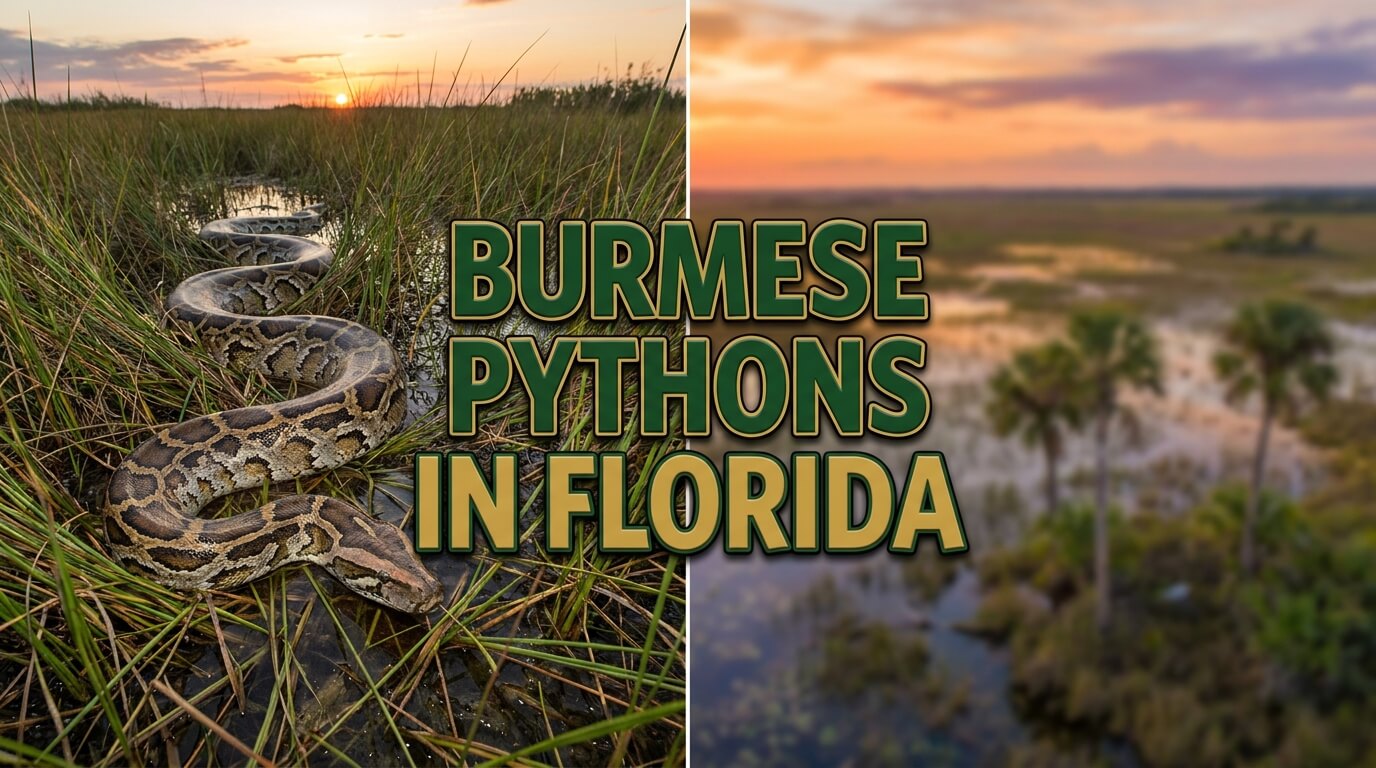
Burmese pythons in Florida are large, nonvenomous constrictor snakes that have become established in South Florida, especially in and around the Greater Everglades ecosystem. They are invasive there because they are not native to Florida, can reproduce in the wild, and prey on native animals in a fragile wetland system. The Florida Fish and Wildlife Conservation Commission describes the Burmese python as a nonnative invasive species and notes that the established population is centered in South Florida, with the Everglades as the best-known core area.

The story is not simply about a big snake in the wrong place. It is about how the pet trade, wetland habitat, secretive behavior, high reproductive potential, and difficult detection can combine to create a long-term conservation problem. Burmese pythons are impressive animals in their native range, but in Florida they function as a powerful introduced predator in ecosystems that did not evolve with them.
Quick Answer
Burmese pythons are invasive in Florida because released or escaped captive snakes established a breeding population in South Florida. In the Everglades, they can hide in dense vegetation and water, eat a wide variety of mammals, birds, and reptiles, and are hard for people to find before they reproduce. They do not chase people around the landscape, and most visitors will never see one, but they can create serious ecological pressure because they are large, adaptable predators.
For readers, the most useful way to understand this issue is to separate three questions. First, what makes the snake biologically successful? Second, what makes the Everglades vulnerable? Third, why is removal so hard once an invasive animal is already established? Burmese pythons in Florida sit at the intersection of all three.

Why Burmese Pythons Are a Florida Invasive Species
Native range vs Florida invaded range
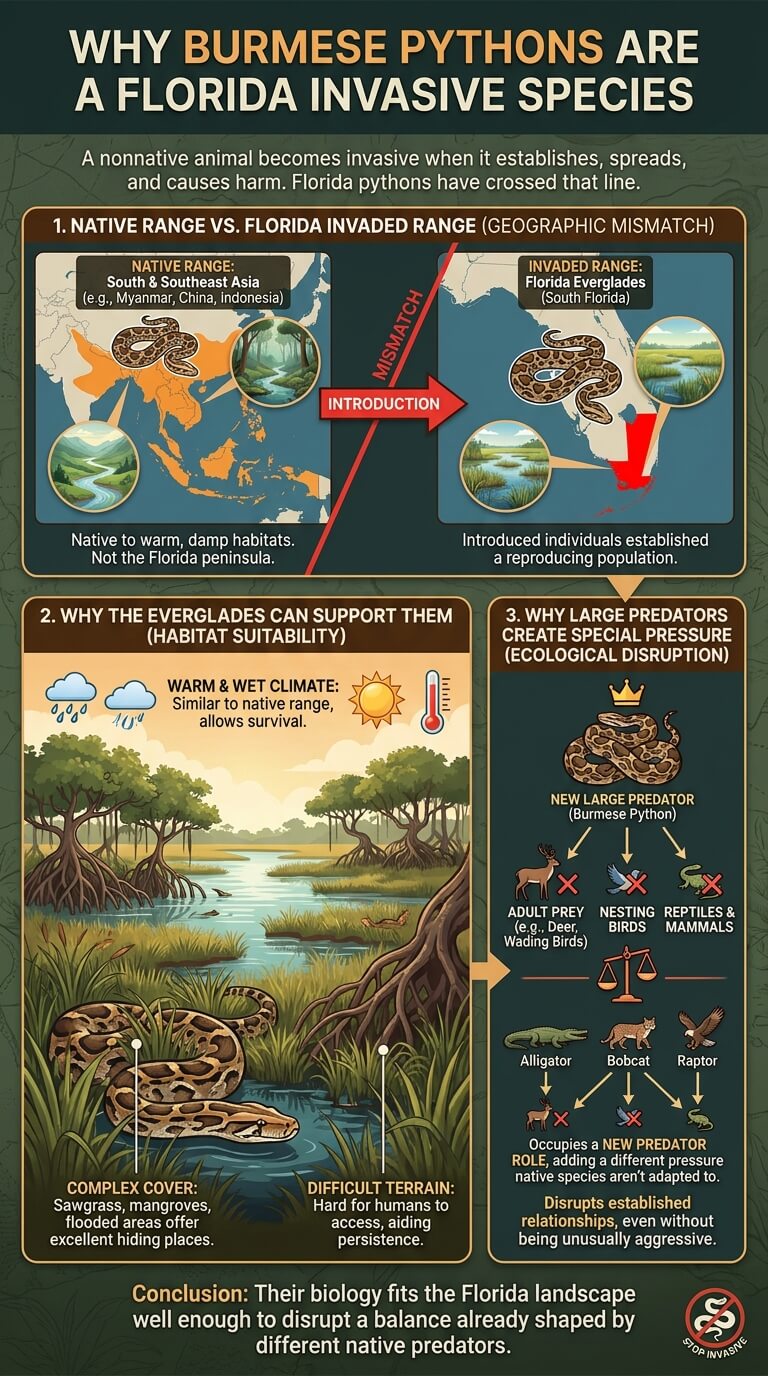
Burmese pythons are native to parts of South and Southeast Asia, not to the Florida peninsula. Animal Diversity Web describes the Burmese python form as ranging from Myanmar eastward across southern Asia through China and Indonesia, while introduced individuals have been recorded in the Florida Everglades. That geographic mismatch is the first part of the invasive species story.
Being outside a native range does not automatically make an animal invasive. A nonnative animal becomes an invasive concern when it establishes, spreads, and causes harm or likely harm. In Florida, Burmese pythons have crossed that line because they have a reproducing population and measurable links to native wildlife impacts.
Why the Everglades can support them
The Everglades are warm, wet, low, and full of hiding places. That setting matters because Burmese pythons are semi-aquatic snakes that often use water and heavy cover. In their native range, they are associated with damp habitats such as river valleys, marshes, forests, and areas near water. South Florida offers a similar enough climate and habitat structure for the snakes to survive, at least in the regions where they are established.
The Everglades are also difficult terrain for people. Sawgrass marsh, mangrove edges, canals, tree islands, and flooded areas create excellent cover for a patterned ambush predator. That does not mean every part of Florida is equally suitable. It means South Florida has enough compatible habitat that an introduced population was able to persist.
Why large predators create special ecological pressure
Large predators can change an ecosystem even when they are not abundant in the way small insects or plants might be. A big constrictor does not need to eat every day to have an effect. It can remove adult prey, nesting birds, reptiles, and mammals that are important parts of the local food web.
Florida pythons are especially concerning because they occupy a predator role that is new to the ecosystem. Native predators such as alligators, bobcats, raptors, and snakes already shape Everglades life, but a giant nonnative constrictor adds a different kind of pressure. The problem is not that Burmese pythons are evil or unusually aggressive. The problem is that their biology fits the landscape well enough to disrupt relationships that were already balanced under different predator pressures.
How Burmese Pythons Got to Florida
Pet trade and escaped or released snakes
Burmese pythons likely became established through the release or escape of captive animals. Everglades National Park explains that Burmese pythons became established in the park because captive pet animals were accidentally or intentionally released. This is why Florida agencies repeatedly emphasize the message not to release unwanted exotic pets.
The pet pathway matters because young pythons can seem manageable while small, but the species can grow into a very large, powerful snake. Owners who become overwhelmed may think release is humane. In reality, release can be dangerous for the pet, native wildlife, and the surrounding ecosystem. Even one released animal is a problem, and repeated releases increase the odds that males and females will survive close enough together to reproduce.

Why early detection was difficult
Early detection is one of the most important parts of invasive species prevention. Unfortunately, Burmese pythons are built to avoid detection. Their brown and tan blotched pattern blends with grasses, leaves, mud, and wetland shadows. They can remain still for long periods. They may use water, burrows, dense vegetation, and hard-to-reach areas.
That means a python population can grow quietly before most people notice it. The first sightings of a nonnative species may look like isolated escaped pets. By the time reproduction is confirmed, managers may already be dealing with a population spread across a landscape that is difficult to search.
What is known and what is uncertain
The broad pathway is clear: captive pythons were released or escaped, and a wild breeding population became established. The exact contribution of each event, each year, and each release source is harder to prove. Some popular summaries focus on one storm, one facility, or one dramatic origin story, but the safer conclusion is that pet release and escape were the key pathways, with multiple opportunities for snakes to enter the landscape.
Good invasive species writing should leave room for uncertainty. We know Burmese pythons are established in South Florida. We know they came from captivity rather than natural range expansion. We know they prey on native animals. We should be cautious, however, about turning a complex establishment history into a single simple incident.
Burmese Python Biology That Helps Them Survive
Size, strength, and constriction
Burmese pythons are among the world’s largest snakes. FWC reports that adult Burmese pythons caught in Florida average about 6 to 9 feet, while the largest captured in Florida measured more than 18 feet. Larger females can produce many eggs, overpower relatively large prey, and move through habitats where smaller snakes might have different limits.
They kill prey by constriction. That means the snake bites and coils around an animal, then tightens in a way that interferes with circulation and breathing. It is not venomous, and it does not poison prey. This distinction matters because people often mix up venom, poison, and constriction when talking about snakes.

Camouflage and ambush hunting
A Burmese python’s pattern is not just decoration. The irregular brown blotches help break up the snake’s body outline in grass, leaf litter, and wetland edges. This camouflage makes the animal harder for prey to notice and harder for humans to detect during surveys.
As ambush predators, pythons do not need to run down prey over long distances. They can wait in a useful position, sense nearby movement, strike when an animal comes close, and then use their body strength to subdue it. In a wetland full of narrow travel routes, burrow entrances, levees, canals, and thick vegetation, that strategy can work especially well.
Reproduction and hidden nests
Reproduction is one reason Burmese pythons are so difficult to manage once established. Females lay eggs, coil around the clutch, and use body movements to help maintain conditions around the eggs. A single successful nesting event can add many young snakes to the landscape, although not all young survive.
Finding nests in the Everglades is extremely challenging. Eggs are hidden in remote habitat, and adult females may choose covered spaces that protect the clutch from weather and predators. Removal of adult females is valuable, but it is difficult to find enough of them at the right time to stop reproduction across a large wetland system.
Heat, water, and habitat tolerance in South Florida
South Florida’s climate gives Burmese pythons a better chance than colder regions would. Like other reptiles, pythons depend on external heat to regulate body temperature. Warm conditions allow them to digest, move, and reproduce more effectively. Water access also matters because the species is strongly associated with damp environments.
This does not mean Burmese pythons can thrive anywhere in the United States. Cold snaps, unsuitable habitat, and lack of year-round conditions can limit range. Claims that pythons are about to occupy every southern state should be treated cautiously. The confirmed problem is serious enough without exaggerating it beyond what evidence supports.
What Burmese Pythons Eat in Florida
Mammals, birds, and reptiles in the Everglades
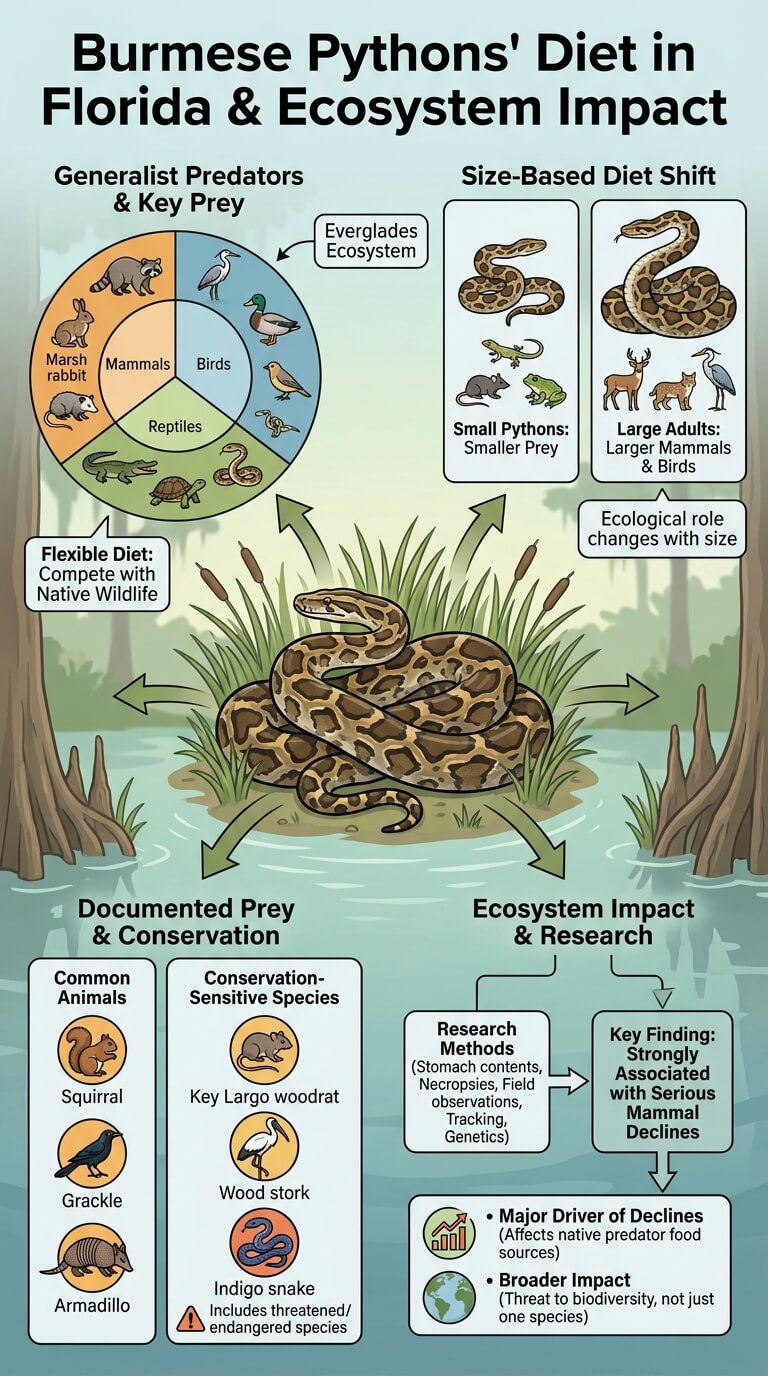
Burmese pythons are generalist predators, which means they can eat many kinds of animals rather than depending on one prey species. USGS notes that pythons in South Florida compete with native wildlife for food and consume mammals, birds, and other reptiles. That flexible diet is one reason they are successful invaders.
Documented prey has included common animals and conservation-sensitive species. The exact prey list varies by site, python size, and what researchers find during necropsies or field studies. Small pythons may take smaller prey, while very large adults can handle larger mammals and birds. This size-based shift is important because the ecological role of a young python is not identical to that of a large adult female.
Why prey decline claims need careful wording
One of the most widely repeated claims about Florida pythons is that they caused sharp mammal declines in parts of the Everglades. There is strong scientific concern behind that claim, but wording still matters. Mammal declines can be measured in areas where pythons are established, and research has linked pythons to those patterns. At the same time, ecosystems are complex, and careful articles should not pretend that every missing animal has one simple cause.
The safest wording is that Burmese pythons are strongly associated with serious declines of some mammal populations in areas where they are established, and they are considered a major driver of those declines. That is different from saying they have eliminated all wildlife from the Everglades, which is false and sensational.
How diet studies reveal ecosystem impact
Scientists learn about python diet through stomach contents, necropsies, field observations, tracking, and genetic tools. These methods help show what pythons are actually eating rather than what people assume they might eat. Diet evidence is important because ecosystem impact is not measured by snake size alone. It is measured by the relationship between predators, prey, reproduction, and habitat.
For example, a python eating a common mammal may still matter if that mammal is a key prey source for native predators. A python eating a threatened or endangered species can create a more direct conservation concern. A python eating an invasive rat may seem beneficial at first glance, but that does not cancel out its broader impact on native animals.
Ecosystem Effects in the Everglades
Pressure on native mammals
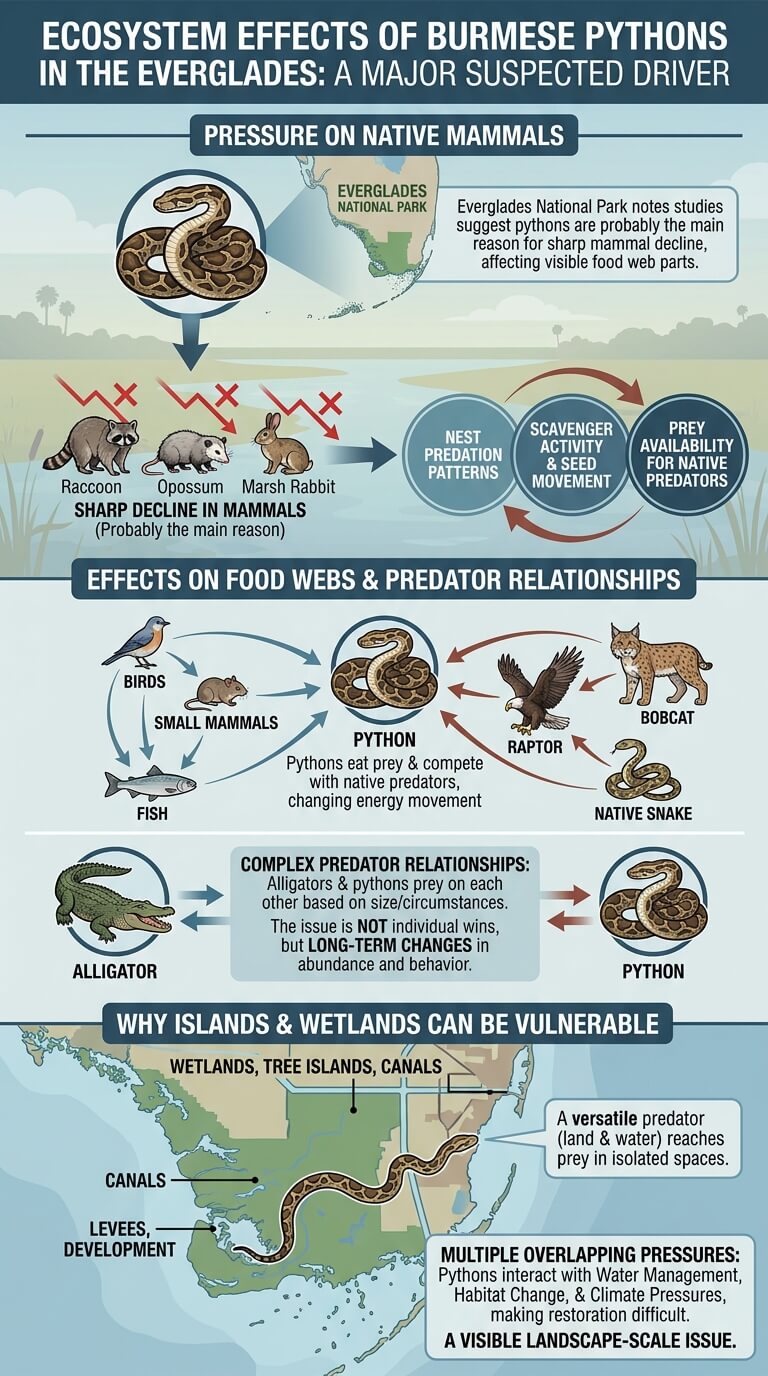
Everglades National Park highlights mammal declines as one of the major reasons Burmese pythons matter. The park notes that studies show pythons are probably the main reason mammals have declined very sharply in Everglades National Park. That phrasing is careful, and it is worth preserving: pythons are a major suspected driver in a complex ecosystem.
Medium-sized mammals such as raccoons, opossums, and marsh rabbits are often discussed in this context because they are visible parts of the food web and can be vulnerable to a large ambush predator. When mammals decline, other relationships may change too. Nest predation patterns, scavenger activity, seed movement, and prey availability for native predators can all shift.
Effects on food webs and predator relationships
A food web is the network of who eats whom in an ecosystem. Burmese pythons affect food webs both by eating prey and by competing with native predators. If pythons remove animals that bobcats, alligators, raptors, or native snakes also use, they can change how energy moves through the ecosystem.
Predator relationships can also be direct. Alligators and pythons may prey on each other depending on size and circumstances. This makes the story more complex than a simple snake-versus-alligator headline. Both animals are powerful predators, but the ecological issue is not who wins one encounter. It is whether the introduced snake changes the abundance and behavior of native species over time.
Why islands and wetlands can be vulnerable
The Everglades is not an oceanic island, but it behaves like an isolated system in some ecological ways. Wetlands, tree islands, canals, levees, and surrounding development create boundaries and corridors that shape how animals move. A predator that can use both land and water can reach prey in many of those spaces.
Wetlands are also hard to restore once multiple pressures overlap. Water management, habitat change, climate pressures, and invasive species can interact. Burmese pythons are not the only conservation problem in the Everglades, but they are one of the most visible examples of how a released animal can become a landscape-scale issue.
How Florida Manages Burmese Pythons
Detection challenges
Detection is the central management problem. A giant snake sounds easy to find, but Burmese pythons are secretive, camouflaged, and spread through habitat where visibility is poor. A person can be close to a python and never see it. This makes population estimates uncertain and removal programs labor-intensive.
Managers use public reports, trained searchers, road surveys, research tools, and targeted removal efforts. Even so, every removed python represents only the snake that was found. The unknown number of hidden snakes is what makes eradication so difficult.

Removal programs and trained search efforts
Florida’s python response includes organized removal programs, trained contractors, public reporting, and educational campaigns. A USGS synthesis of Burmese python biology and management describes the issue as one that requires multiple tools, including research on detection, removal, and ecological impacts. No single method is likely to solve the problem across the Greater Everglades by itself.
Removal can still matter. Taking out large reproductive females, collecting data from captured snakes, and slowing spread at key boundaries can help protect specific places. The realistic goal in many areas is control and impact reduction, not a quick return to a python-free Everglades.
Research, tracking, and public reporting
Research programs have tested tools such as radio-tracked scout snakes, detector dogs, environmental DNA, habitat modeling, and improved search timing. These tools help managers learn where pythons move, when they are more detectable, and which habitats deserve extra attention.
Public reporting also plays a role, especially at the edges of the known range. Reports outside the established area must be evaluated carefully because mistaken identifications happen. A photo, location, and safe distance are more useful than an attempted capture by an untrained person.
Common Myths and Mistakes
Myth: Burmese pythons are everywhere in the United States
Burmese pythons are a major invasive problem in South Florida, not a confirmed nationwide infestation. FWC describes the established Florida population as being in South Florida, with records outside that area often treated as possible escaped or released captive animals unless evidence shows establishment. This distinction matters because exaggerated range claims can distract from the places where action is most urgent.
The snake’s potential range is a legitimate research question, but public articles should not confuse climate modeling with confirmed distribution. A map of possible suitable habitat is not the same as evidence of breeding pythons across that entire area.
Myth: every large snake in Florida is a python
Florida has native snakes, including large native species, and not every big snake is a Burmese python. Misidentification can lead to unnecessary fear and harm to native wildlife. Burmese pythons usually have tan bodies with dark blotches, a distinct head pattern, and a heavy body shape, but identification from a quick glance can still be difficult.
When a person sees a suspicious large snake in South Florida, the safer response is to take a photo from a distance, note the location, and report it to the appropriate wildlife system. Guessing, chasing, or handling the animal can create risk for both people and wildlife.
Myth: python control is just a public hunting contest
Public events receive attention because they are visible and dramatic, but python management is broader than contests. It includes scientific monitoring, trained removal, detection research, regulation, public education, and prevention of future releases. The most important lesson is prevention. Once a secretive invasive predator is established in a huge wetland, control becomes far more expensive and uncertain.
Another mistake is to treat the issue as entertainment. A python is a living animal, and the ecological problem was created by human choices. Responsible management must consider safety, humane methods, legal rules, native species protection, and long-term ecosystem goals.
How This Connects to Nearby Animal Topics
How this case explains invasive species definitions
Burmese pythons make the invasive species concept easier to understand because all parts of the definition are visible. The snake is outside its native range, reproduces in a new region, and affects native wildlife. It is not invasive because it is scary-looking. It is invasive because it changes ecological relationships in a place where it did not naturally occur.
This distinction also helps readers understand why nonnative and invasive are not identical terms. Some nonnative animals do not establish or cause major harm. Burmese pythons in South Florida are different because they have both establishment and impact.
How it compares with feral pigs and invasive carp as ecosystem disruptors
Burmese pythons, feral pigs, and invasive carp all show different invasion pathways. Pythons are a predator problem in a wetland. Feral pigs are land-disturbing mammals that root soil and damage crops, wetlands, and native plant communities. Invasive carp are aquatic animals that can alter freshwater food webs and complicate river management.
The comparison is useful because it shows why invasive animal control is not one-size-fits-all. A snake hiding in sawgrass requires different tools from a pig rooting in a pasture or a fish moving through connected rivers.
Why control methods differ by species and habitat
Control depends on biology. Managers ask how the animal reproduces, how it moves, what it eats, where it hides, when it is detectable, and what legal tools are available. They also consider whether the goal is eradication, containment, impact reduction, or early detection.
The U.S. Fish and Wildlife Service lists Burmese pythons as injurious wildlife under the Lacey Act, which is one federal tool meant to limit harmful wildlife introductions and movement. Regulation cannot remove every snake already in the Everglades, but it can help prevent the same mistake from spreading or repeating.
Among invasive animals in the US, Burmese pythons are one of the best-known predator case studies because their impact is tied closely to South Florida wetlands.
This is why python removal is best understood as part of how conservation controls invasive species, not as a simple contest to catch the largest snake.
FAQ
Are Burmese pythons dangerous to people in Florida?
Burmese pythons can pose a safety risk because they are large, powerful constrictors, but they are not roaming the Everglades looking for people. Most visitors are unlikely to see one. The practical safety message is simple: keep your distance, do not handle wild snakes, do not pose with them, and report suspected sightings through official channels. Pets, especially small pets, should also be kept away from areas where large constrictors may occur.
How big do Burmese pythons get in Florida?
Adult Burmese pythons caught in Florida often fall in the 6 to 9 foot range, but much larger individuals occur. Florida has documented snakes over 18 feet. Size varies by age, sex, food availability, and individual growth. Because large females are especially important for reproduction, removal programs often pay close attention to big adult snakes.
Can Burmese pythons survive outside Florida?
They can survive in some places outside their native range when climate and habitat are suitable, but the established US problem is concentrated in South Florida. Cold weather can limit survival, and a single escaped python in another state does not prove that a breeding population exists there. Claims about future range should be framed cautiously and based on current evidence.
What should someone do if they see a Burmese python?
Do not approach or attempt to capture it unless you are trained and legally allowed to do so. Take a photo from a safe distance if you can, record the location, and report the sighting to Florida wildlife authorities or the appropriate local invasive species reporting system. A clear report is more helpful than a risky encounter.
Final Thoughts
Burmese pythons in Florida are a powerful example of how an animal can be fascinating in one context and harmful in another. The snake itself is not the villain. It is a large, well-adapted predator that ended up in a wetland ecosystem where it did not belong. In South Florida, that combination has created a difficult conservation challenge involving native wildlife, public safety, research, regulation, and long-term control.
The biggest takeaway is prevention. Once a secretive animal establishes in a huge landscape like the Everglades, removal becomes hard, costly, and incomplete. Responsible pet ownership, strong reporting systems, science-based management, and clear public education all matter. Understanding the Burmese python problem helps readers understand invasive animals more broadly: the real issue is not whether an animal is impressive, but what happens when it changes an ecosystem that was not built around it.

Ethan Walker is the founder and research editor of Animal Fact Central. He creates and reviews educational animal facts content using trusted wildlife, pet care, and science-based sources. His work focuses on making animal behavior, adaptations, habitats, and species facts clear, accurate, and engaging for everyday readers.
Read More Details About Ethan Walker: https://animalfactcentral.com/ethan-walker/