
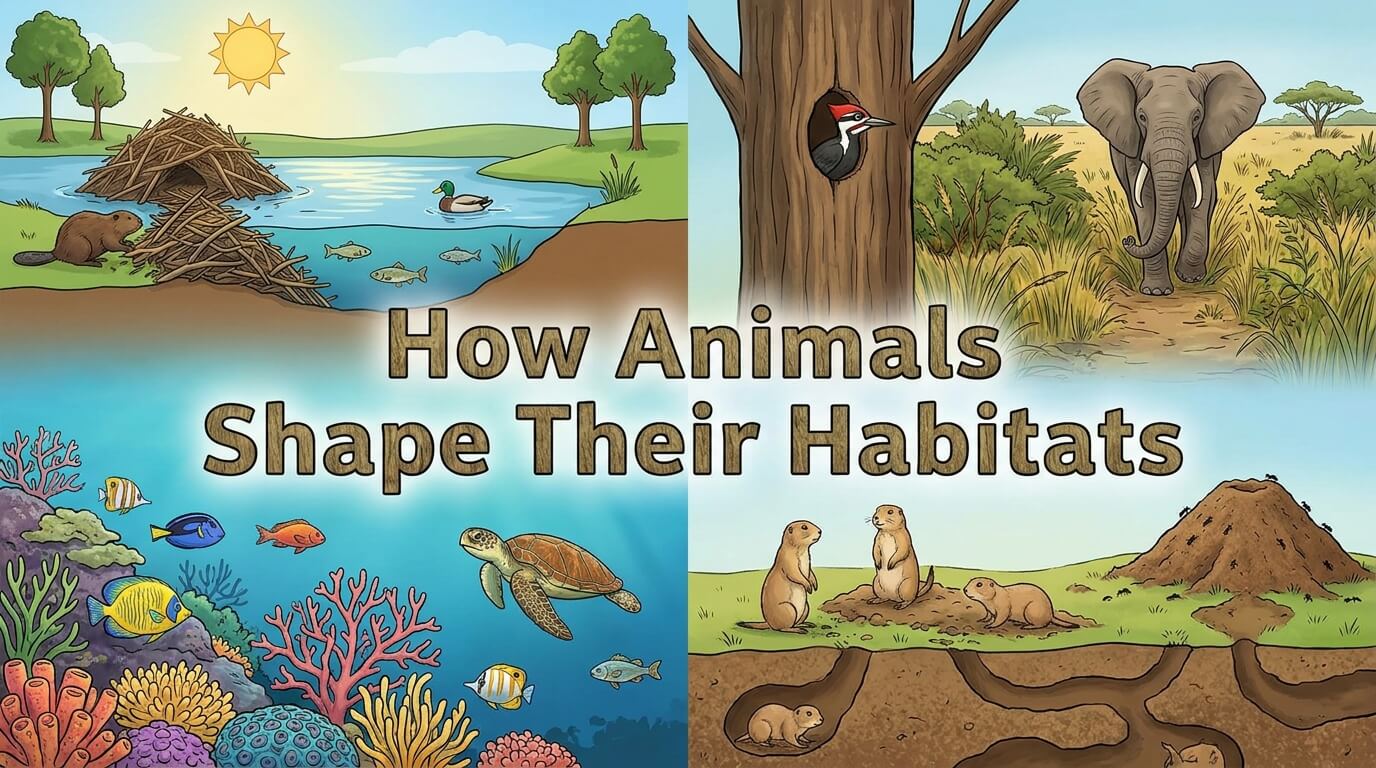
Animals shape their habitats when their daily behavior changes the physical places where other organisms live. A beaver dam can turn moving water into a pond, coral polyps can build reef structure, prairie dog burrows can open underground shelter, elephants can push paths through dense vegetation, and woodpeckers can leave tree cavities that other animals later use. These changes are sometimes called ecosystem engineering, a term used for organisms that create or physically modify habitat. Some habitat changes begin as trophic cascades that alter grazing or browsing pressure.
The big idea is simple: animals are not just passengers in an ecosystem. Many of them dig, build, graze, trample, tunnel, carve, fertilize, or transport seeds in ways that change water flow, soil, plant cover, shelter, and nesting space. Those effects can help some species, hurt others, and become complicated when the animal is introduced, overabundant, or living in a landscape that people have already changed.
Quick Answer
Animals shape their habitats by changing the structure of land, water, plants, soil, or shelter. Some create obvious structures, such as dams, reefs, mounds, lodges, nests, and burrows. Others shape habitat more gradually through grazing, browsing, digging, trampling, seed dispersal, nutrient movement, or the creation of dead wood and cavities.
In ecology, these animals are often described as ecosystem engineers. The label does not mean an animal plans a habitat for other species. It means the animal’s normal survival behavior changes the environment in a way that affects other organisms. A USGS wetland ecology module describes ecosystem engineering as animal activity that creates or physically modifies wetland environments, using animals such as alligators and beavers as examples of important wetland habitat modifiers the USGS wetland ecology module.
Not every habitat-shaping effect is automatically good. A beaver pond may support amphibians and water birds in one place while flooding a road culvert in another. Grazing can maintain open grassland at one intensity but damage vegetation if animal numbers become too high. Coral reefs create some of the most complex marine habitats on Earth, yet they are vulnerable to warming, pollution, and physical damage. Context matters.
Why Habitat-Shaping Animals Matter
Habitat is more than scenery. It is the set of conditions an animal needs to feed, hide, reproduce, move, thermoregulate, and avoid predators. When one animal changes habitat structure, it can change which other species can survive there. That is why habitat-shaping animals matter far beyond their own bodies.

Animals can create living space for other species
Many animals indirectly become landlords. Beavers create ponds and wet meadows used by fish, frogs, insects, ducks, songbirds, mammals, and wetland plants. Coral polyps build hard reef framework where fish, crabs, shrimp, mollusks, sponges, and algae find attachment surfaces or shelter. Prairie dog burrows can provide refuge for animals that do not dig large tunnel systems themselves.
The living space may be large, like a reef or wetland, or tiny, like a water-filled elephant footprint, a beetle hole in dead wood, or a woodpecker cavity in a tree trunk. Small structures still matter because many animals need very specific microhabitats. A microhabitat is a small, local habitat within a larger ecosystem, such as a damp burrow entrance, a shaded log crevice, or a hollow branch.
Habitat shaping can be helpful, harmful, or context-dependent
It is tempting to divide animal engineers into helpful species and harmful species, but real ecosystems are rarely that neat. A species can be beneficial in its native range, disruptive where introduced, and controversial where it overlaps with roads, crops, water systems, or homes.
The same behavior can also help one group of organisms while hurting another. Heavy browsing may keep woody plants from taking over a grassland, which can benefit species adapted to open areas. In a different setting, too much browsing may reduce young trees, simplify vegetation, and remove cover for nesting birds. Habitat effects depend on the animal, population density, season, climate, soil, predators, and human land use.
Physical changes can outlast the animal itself
Some animal-built features continue to shape habitat after the animal leaves. An old beaver pond may become a wet meadow. A tree cavity may be reused for nesting or roosting after the original woodpecker is gone. Abandoned burrows can remain as shelter, soil openings, or drainage pathways. Coral skeletons can provide reef framework even as living coral grows only on the outer surface.
This time delay matters because habitats have memory. A single season of animal activity may affect future plant growth, water storage, erosion, nesting opportunities, or predator hiding cover for years. That is one reason habitat engineering connects so naturally to biodiversity and ecosystem balance.
The Main Ways Animals Change Habitats
Habitat shaping is not one behavior. It is a set of physical and biological processes that change the environment. The clearest examples involve animals that build large structures, but the quiet processes can be just as important.

Building structures such as dams, nests, mounds, and reefs
Building is the easiest form of habitat engineering to picture. Beavers build dams and lodges. Termites create mounds. Birds build nests. Some fish move sand or stones while preparing nesting sites. Social insects can create complex underground chambers. Corals build reef framework through the skeletons of many tiny animals living together.
These structures can change temperature, moisture, water flow, shade, shelter, oxygen conditions, and access to food. A dam slows water and spreads it across a valley floor. A mound can alter soil chemistry and drainage. A reef breaks wave energy, adds vertical structure, and creates hiding places in a mostly open marine environment.
Digging burrows, tunnels, dens, and soil openings
Digging animals shape habitat by moving soil and opening underground space. Prairie dogs, gophers, badgers, armadillos, burrowing owls, crayfish, ants, termites, earthworms, and many rodents can change soil mixing, aeration, drainage, and shelter availability.
Burrows can buffer animals from heat, cold, wind, wildfire, and predators. They can also create entry points for water and organic material. In dry grasslands, a burrow entrance may collect moisture and seeds. In softer soils, repeated digging can create mounds and patches where plants grow differently from the surrounding area.
Grazing, browsing, trampling, and vegetation control
Animals also shape habitat by eating or damaging plants. Grazers feed mostly on grasses and low plants, while browsers feed more on leaves, twigs, shrubs, or tree parts. Trampling can crush vegetation, compact soil, open bare patches, or create trails.
At moderate levels, grazing and browsing can maintain open habitats and create patchy vegetation that matters for insects, ground-nesting birds, small mammals, reptiles, and predators. At high intensity, the same process can remove too much cover, expose soil, reduce plant regeneration, and simplify the habitat.
Moving nutrients through feeding, waste, and carcasses
Animals move nutrients when they eat in one place and release waste in another. Fish can move nutrients between deep and shallow water. Seabirds can carry marine nutrients to islands through guano. Bears feeding near salmon streams can move nutrients from fish into nearby forests. Large herbivores spread plant material and microbes through dung.
This type of habitat shaping is less visible than a dam or burrow, but it can change plant growth and soil life. Nutrient movement can also connect food webs to physical habitat. A place with more nutrients may support different plants, more insects, or more cover than a nutrient-poor patch nearby.
Transporting seeds, spores, and small organisms
Many animals reshape future habitat by moving living things. Birds, bats, bears, fish, monkeys, elephants, ants, and rodents can disperse seeds. Some seeds pass through digestive systems. Others stick to fur, feathers, mud, or feet. Animals may also move fungal spores, pollen, algae, small invertebrates, or aquatic organisms between wet places.
Seed movement is not just a plant story. Where plants establish, future animal habitat changes. A shrub patch may offer nesting cover, a fruiting tree may attract wildlife, and streamside plants may shade water for insects and fish.
Animal Examples of Habitat Engineering
The best way to understand how animals shape their habitats is to look at examples that work in different environments. These examples are not identical. Each one changes habitat through a different mechanism.

Beavers creating wetlands and slow-water habitats
Beavers are the classic example of habitat-shaping mammals in North America. By cutting trees, building dams, and maintaining lodges, they slow moving water and can create ponds, wetlands, wet meadows, and side channels. The National Park Service describes North American beavers in Acadia as forest ecosystem engineers that create wetlands and ponds by building dams and lodges the National Park Service’s beaver profile.
The main habitat change is hydrology, which means how water moves and stores in a landscape. Slower water can raise local water levels, trap sediment, create shallow edges, and support wetland vegetation used by amphibians, fish, insects, birds, reptiles, and mammals.
Beavers can also create conflict. Their dams may flood roads, yards, culverts, farm fields, or managed forest areas. That does not erase their ecological importance, but it explains why beaver management often requires local expertise. People should not destroy dams, move animals, or alter waterways without checking laws and working with wildlife or land-management professionals.
Coral animals building reef structure
Coral reefs are built by animals, not rocks or plants. Reef-building corals are colonies of tiny polyps that secrete calcium carbonate skeletons. Over time, many generations can form reef structure. NOAA explains that hard corals produce a rigid calcium carbonate skeleton and that colonial hard corals include many individual polyps cemented together by the skeletons they secrete NOAA’s coral tutorial.
Reef structure creates three-dimensional habitat in the ocean. Fish can hide in crevices, invertebrates can attach to surfaces, predators can hunt along edges, and young animals can use protected spaces. Reefs also influence water movement and sediment patterns. In that sense, coral animals help create the physical world used by many other marine species.
Coral habitat engineering is fragile because living coral depends on suitable water temperature, light, water quality, and chemistry. Touching coral, anchoring on reefs, collecting coral, or stirring sediment can damage living tissue. Climate stress, pollution, disease, and coastal development can also reduce living coral cover, which weakens the habitat-building function over time.
Prairie dogs and burrowing mammals opening grassland habitat
Prairie dogs shape grasslands through burrowing, clipping vegetation, grazing, and living in colonies often called towns. Their tunnels provide underground structure, while their aboveground activity can create open patches of short vegetation. The National Park Service notes that prairie dog burrows provide shelter for black-footed ferrets and other animals, while predators such as eagles, foxes, and ferrets rely on prairie dogs for food the National Park Service prairie dog overview.
The habitat effect is partly physical and partly ecological. Burrows create shelter and soil disturbance. Clipped vegetation changes visibility and plant structure. Prairie dog colonies can attract predators, scavengers, insects, reptiles, and birds, but they can also conflict with ranching, crop production, and development.
Prairie dogs are also a good reminder that habitat engineers can become culturally controversial. Some people view them as pests. Others see them as native grassland animals tied to many other species. A careful article about them should avoid simple hero or villain labels.
Elephants shaping savannas and forest openings
Elephants shape habitat through feeding, movement, dung, trail-making, bark stripping, branch breaking, seed dispersal, and water-related behavior. Their large bodies and wide-ranging movements can open pathways through dense vegetation and influence the balance between woody plants and open areas. World Wildlife Fund describes elephants as ecosystem engineers that make pathways through dense forested habitat and help maintain forest and savanna ecosystems for other species WWF’s elephant species overview.
Elephant effects vary by species, habitat, season, and population density. In some landscapes, their browsing can help maintain open savanna structure. In forests, seed dispersal through dung can help some trees spread. Their footprints may hold water long enough for tiny organisms to use. Their trails may become movement corridors for smaller animals.
These effects are not always simple. Where elephants are compressed into smaller areas by fences, farms, conflict, or habitat loss, their impact on vegetation can become intense. Their habitat-shaping role has to be understood in the context of space, migration routes, water access, and human pressure.
Woodpeckers, cavity nesters, and shelter for other animals
Woodpeckers are forest habitat shapers because many species excavate cavities in trees. Those holes may be used for nesting by the woodpeckers first and later by animals that cannot carve their own cavities. Cornell Lab’s All About Birds explains that dozens of North American birds and mammals use tree cavities but do not excavate them, and in some forests these secondary cavity nesters rely on woodpeckers to create needed holes Cornell Lab’s woodpecker cavity article.
This kind of habitat engineering is about shelter rather than water or vegetation. Cavities can become nest sites, roosting sites, escape cover, or winter shelter. Birds such as bluebirds, chickadees, owls, kestrels, and some ducks may use cavities, as can bats and small mammals depending on the habitat.
Woodpecker engineering also depends on dead or decaying trees. Where dead trees are not a safety risk, leaving some standing dead wood can support cavity-using wildlife.
Benefits and Trade-Offs
Animals that shape habitats often create a more complex landscape. Complexity can help biodiversity, but it can also create conflicts or favor some species at the expense of others. The useful question is not whether habitat engineers are good or bad. The useful question is what they change, where they change it, and who is affected.
New habitats for amphibians, insects, fish, birds, and mammals
Habitat engineers often increase the number of usable habitat types in a landscape. A stream with beaver ponds may include deep pools, shallow edges, wet meadows, standing dead trees, muddy banks, and slow channels. A coral reef includes outer slopes, crevices, ledges, coral heads, sandy pockets, and algae-covered surfaces. A prairie dog town includes burrow entrances, clipped grass, mounds, and underground shelter.
More habitat types can support more ways of living. Amphibians may need shallow water, insects may need wet soil or dead wood, birds may need cavities or pond edges, and mammals may need trails, cover, den sites, or feeding patches.
Increased water storage, shelter, and nesting opportunities
Water storage is one of the most valuable habitat effects in dry or seasonal landscapes. Beaver activity can slow runoff, while footprints, burrows, wallows, and animal-created depressions may hold water briefly.
Shelter and nesting are equally important. Tree cavities, burrows, reef crevices, dense vegetation patches, and mound structures can reduce exposure to predators and weather. For many animals, survival depends less on finding food in general and more on finding the right shelter at the right time.
Conflicts with farms, roads, homes, or native vegetation
Habitat shaping can conflict with human land use. Beaver dams may flood infrastructure. Burrowing animals may create holes in fields or near development. Large herbivores may damage crops or fences. Birds may nest in structures where people do not want them. Introduced animals may transform habitats in ways native species are not adapted to handle.
Good wildlife management tries to solve the problem without ignoring the animal’s ecological role. The safest response is often to contact a state wildlife agency, local extension office, licensed wildlife professional, or land manager. Handling wildlife, destroying active nests, digging out burrows, damaging coral, or altering waterways can be unsafe and may be illegal.
Common Mistakes and Myths
Because the idea of animal ecosystem engineers is powerful, it can also be oversimplified. These myths are common in online animal content.
Myth that ecosystem engineers are always beneficial everywhere
A habitat engineer is not automatically beneficial in every place. Native beavers in a suitable watershed can create valuable wetland habitat, but unmanaged flooding near roads can still be a real problem. Large grazers can maintain grassland mosaics, but overgrazing can damage soil and vegetation. Introduced animals may create habitat changes that native species cannot tolerate.
The better framing is context-dependent impact. Ask whether the species is native, whether predators and migration routes are functioning, and whether people have changed the landscape in ways that intensify the animal’s effect.
Myth that only large mammals shape habitats
Large mammals are easy to notice, but many smaller animals are powerful habitat shapers. Ants move soil. Termites build mounds. Earthworms mix soil layers. Mussels filter water and form beds. Oysters create reefs. Woodpeckers carve cavities. Corals are tiny animals whose colonies can create enormous reef systems.
Small animals often matter because they are numerous, repeated, or structurally precise. One ant mound may look minor, but many mounds can alter soil texture. One coral polyp is tiny, but a coral colony adds skeleton over time. Habitat engineering is about effect, not body size.
Myth that animal-built habitats are separate from food webs
Habitat structure and food webs are connected. A burrow is shelter, but it also changes who can hunt, hide, breed, or overwinter. A beaver pond is water habitat, but it also changes insect life, fish access, bird feeding, plant growth, and predator movement. A reef is physical structure, but it supports feeding relationships among algae, corals, fish, invertebrates, and predators.
This is why habitat-shaping animals belong in a food web and ecosystem balance cluster. They do not simply add scenery. They change the stage on which feeding, reproduction, competition, and survival happen.
Edge Cases and Exceptions
Some habitat-shaping animals create effects that are hard to judge in simple terms. These edge cases are where careful wording matters most.
Native vs introduced habitat shapers
A native ecosystem engineer usually has a long ecological history with the other species in its habitat. That does not mean every effect is gentle, but it means other organisms may have evolved around its disturbance patterns. An introduced habitat shaper may create changes that local species did not evolve with.
Examples can include introduced grazers, burrowing mammals, fish that stir sediment, or plants and animals that alter wetlands. The same category of behavior, such as digging or grazing, can have very different consequences depending on whether the animal is part of that ecosystem’s natural history.
Overabundant animals and damaged habitats
Even native animals can damage habitat when their numbers become unusually high or when their movement is restricted. Overabundant deer may reduce forest understory and young tree growth. Concentrated elephants may damage vegetation where they cannot move across a wider range. Dense colonies of some animals may create conflict in altered landscapes.
Overabundance is often a human-shaped issue. Predator loss, migration barriers, supplemental food, habitat fragmentation, suburban landscaping, and management decisions can all change animal numbers and behavior.
Human-altered landscapes that change animal engineering effects
Roads, dams, fences, drainage ditches, lawns, farms, ports, and cities can change how animal engineering works. A beaver dam in a remote valley and a beaver dam in a roadside culvert are not the same problem. A prairie burrow and a burrow under a building foundation create different risks.
Human-altered landscapes can also remove natural checks. If predators are missing, large herbivores may browse more heavily. If old trees are removed, cavity nesters may lose shelter even when food remains available.
How This Connects to Nearby Animal Topics
Habitat shaping connects naturally with several nearby animal topics, but it should not be confused with them. It is one piece of ecosystem function.
Keystone species when habitat effects are unusually large
Some habitat-shaping animals are also keystone species, but the terms are not identical. A keystone species has a large effect on its ecosystem relative to its abundance. An ecosystem engineer physically changes habitat. A beaver can be discussed under both ideas in some places because its dams may strongly affect wetlands and many other species.
Still, not every engineer is keystone everywhere, and not every keystone species works by building habitat. Some keystone effects come through predation, pollination, seed dispersal, or other interactions.
Biodiversity created by more varied habitat structure
Habitat structure often supports biodiversity because different species need different conditions. A simple, uniform habitat may support fewer niches. A patchy habitat with wet and dry areas, tall and short plants, cavities, burrows, edges, open space, and shelter may support more ways of living.
That does not mean more disturbance is always better. The right amount and type of habitat variation depends on the ecosystem. A desert, coral reef, prairie, wetland, and old forest do not need the same kind of engineering.
Trophic cascades that indirectly change vegetation and habitat
Some habitat changes happen indirectly through feeding relationships. If predators reduce heavy grazing in certain areas, vegetation may recover. If herbivore numbers rise after predator loss, plant cover may decline. These are trophic cascade questions, not exactly the same as physical engineering, but they can lead to visible habitat change.
The overlap is important. A predator may shape habitat indirectly by changing herbivore behavior. A beaver shapes habitat directly by building a dam. Both can alter plants, water, shelter, and animal communities, but the pathway is different.

FAQ
What animals are ecosystem engineers?
Ecosystem engineers include animals that create or physically modify habitat. Common examples include beavers, corals, prairie dogs, termites, ants, earthworms, elephants, woodpeckers, alligators, oysters, mussels, gophers, and many burrowing mammals. The category is broad because animals can engineer habitat by building, digging, grazing, trampling, filtering water, forming reefs, carving cavities, or moving nutrients.
The most important point is effect, not size. A tiny coral polyp, a termite colony, or a group of ants can shape habitat just as meaningfully as a large mammal if their activity changes the living space for other organisms.
How do beavers help ecosystems?
Beavers can help ecosystems by slowing water, creating ponds and wetlands, spreading water across floodplains, adding habitat edges, and supporting wetland plants and animals. Their activity can benefit amphibians, fish, insects, birds, and mammals that use slow water, shallow edges, or wet meadows.
Beaver effects are still context-dependent. In some places they create conflict by flooding roads, yards, farm fields, or culverts. The best response is not to treat all beavers as pests or all beaver dams as untouchable. Local conditions, laws, safety, and habitat value all matter.
Are coral reefs built by animals?
Yes. Coral reefs are built by coral animals called polyps, especially reef-building hard corals. These polyps secrete calcium carbonate skeletons. Over many generations, those skeletons form hard reef structure that supports many other marine organisms.
Corals are easy to mistake for plants or rocks because many remain fixed in place and form hard structures. Living coral is animal tissue on or within a skeleton, and the reef is a biological structure created by generations of coral growth.
Can animals damage their own habitat?
Yes, animals can damage habitat when their numbers become unusually high, when they are introduced to places without natural checks, or when human-altered landscapes concentrate their effects. Overgrazing, excessive browsing, soil disturbance, water-quality changes, and vegetation loss can all happen under certain conditions.
That does not mean the animal is bad. It means habitat effects depend on context. Native range, population density, predator presence, migration access, climate, and human land use all influence whether habitat shaping supports a diverse ecosystem or creates stress for other species.
Final Thoughts
Animals shape their habitats every time they build, dig, graze, carve, trample, fertilize, disperse seeds, or create shelter that other organisms can use. Some of these changes are dramatic, like a beaver pond or coral reef. Others are quiet, like a woodpecker cavity, a burrow entrance, a dung pile, or a trail through dense vegetation.
The useful takeaway is that habitats are active systems. Animals do not simply live in them. They help make them. Understanding habitat-shaping animals makes food webs, biodiversity, predator effects, scavengers, and ecosystem balance easier to see because it reveals the physical foundation that other animal relationships depend on.

Ethan Walker is the founder and research editor of Animal Fact Central. He creates and reviews educational animal facts content using trusted wildlife, pet care, and science-based sources. His work focuses on making animal behavior, adaptations, habitats, and species facts clear, accurate, and engaging for everyday readers.
Read More Details About Ethan Walker: https://animalfactcentral.com/ethan-walker/