
Animals that live in cities are not just strays, pests, or occasional visitors. Many are wild species that have learned to use streets, parks, rooftops, storm drains, gardens, bridges, and building ledges as part of their habitat. Some eat a wide range of foods. Some hide in small spaces. Some are active at night when people are less active. Others use city structures as substitutes for cliffs, hollow trees, caves, wetlands, or open fields.

Quick Answer: What Animals Commonly Live in Cities?
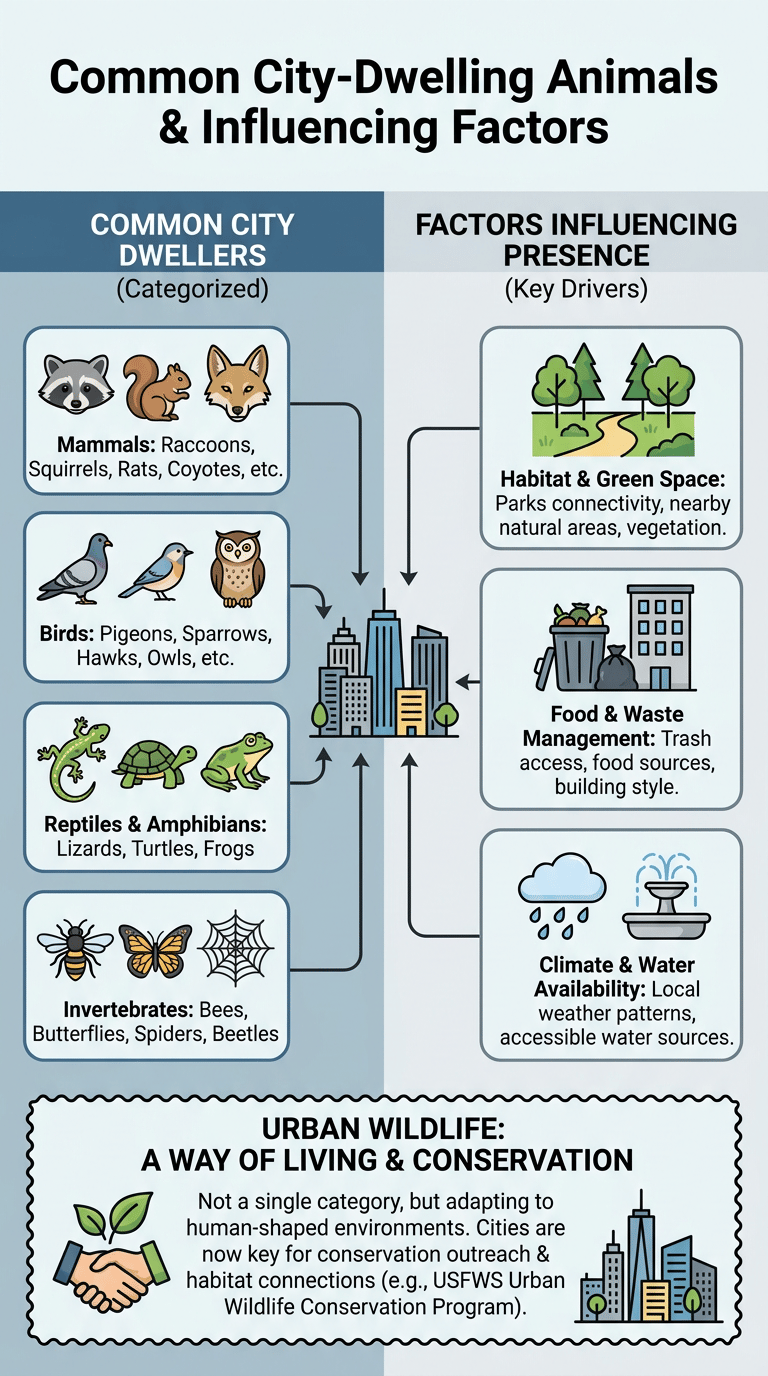
Common city-dwelling animals include raccoons, opossums, squirrels, rabbits, rats, mice, coyotes, foxes, bats, pigeons, sparrows, starlings, crows, gulls, hawks, falcons, owls, lizards, turtles, frogs, bees, butterflies, ants, beetles, spiders, and many other invertebrates. Which animals appear in a particular city depends on climate, water, vegetation, building style, waste management, nearby natural habitat, and how connected parks and green spaces are.
Urban wildlife is not a single category of animal. It is a way of living in a human-shaped environment. The U.S. Fish and Wildlife Service treats cities as important places for conservation outreach and habitat connections through its Urban Wildlife Conservation Program, which reflects a bigger point: wildlife and city life now overlap across much of the United States.
How This List Was Chosen
This list focuses on wild animals that use cities often enough to be recognizable to US readers. It includes mammals, birds, reptiles, amphibians, and invertebrates because city ecosystems are made of food webs, not just the animals people notice first.
Truly Wild Animals, Not Pets or Livestock
Dogs, cats, chickens, and escaped pets can affect urban wildlife, but they are not the main focus here. The animals in this article are wild species, even when they live very close to people. A raccoon denning under a deck, a crow feeding near a school field, or a bat roosting in a bridge is still a wild animal responding to habitat, food, and shelter opportunities.
This distinction matters because wild animals should not be treated like pets. Feeding them can change their behavior, concentrate disease risk, increase conflicts, and draw predators or scavengers into places where they are more likely to be hit by cars. Watching from a distance is very different from trying to tame, handle, trap, or relocate them.
Species That Use Urban Food, Shelter, or Movement Corridors
City animals often succeed because they can use at least one major urban resource. Some find food in gardens, compost, insects around lights, fruit trees, garbage, bird seed, or small prey. Others use buildings, bridges, culverts, storm drains, attics, tree cavities, ledges, and dense shrubs as shelter. Many depend on corridors such as rivers, railroad edges, utility rights-of-way, greenways, and linked parks to move through fragmented neighborhoods.
Examples Common or Recognizable to US Readers
This article leans toward animals many readers in the United States may see in cities, suburbs, or urban edges. That means it includes familiar names such as raccoons, opossums, coyotes, squirrels, pigeons, crows, hawks, bats, bees, ants, and spiders. It also includes less obvious groups, such as amphibians in stormwater ponds and lizards on warm walls, because they show how diverse urban wildlife can be.
Mammals That Thrive in Cities
Raccoons and Opossums as Flexible Foragers
Raccoons are classic city mammals because they are curious, dexterous, and omnivorous. The Animal Diversity Web profile for raccoons describes them as opportunistic omnivores and notes that raccoons have adapted to include trash and other food available in suburban and urban areas. In a city, that flexible diet can include fruit, insects, crayfish near water, bird eggs, pet food left outside, spilled human food, and garbage.
Opossums use a different strategy. The Virginia opossum is a North American marsupial that often moves slowly compared with raccoons, but it benefits from an extremely broad diet and nighttime activity. The Animal Diversity Web account of the Virginia opossum lists diets that include vertebrates, invertebrates, plant material, fruits, grains, and carrion, with seasonal variation. That variety helps explain why opossums can turn up in alleys, yards, wooded edges, drainage areas, and parks.
Coyotes and Foxes as Adaptable Urban Predators
Coyotes and foxes are predators, but in cities they are also careful risk managers. They often move at dawn, dusk, or night, using parks, golf courses, cemeteries, rail corridors, drainage channels, and quiet streets. Their prey can include rodents, rabbits, insects, fruit, carrion, and sometimes unattended small pets, which is why coexistence requires caution without panic.
Coyotes are especially good examples of urban adaptability. They can live in large metropolitan areas while remaining unseen by many residents. They tend to avoid close contact with people when not fed, but they may become bolder where food is predictable. Foxes, depending on species and region, can use similar edge habitats. Red foxes may den near buildings or in quiet landscaped areas, while gray foxes are more tied to brushy or wooded cover in many places.
Squirrels, Rabbits, Rats, Mice, and Other Small Mammals
Small mammals often form the base of visible urban mammal life. Tree squirrels use parks, street trees, campuses, and yards where mature trees provide food, escape routes, and nesting sites. Rabbits use lawns, shrubby edges, vacant lots, and landscaped spaces where grass and cover sit close together. Chipmunks, voles, and shrews may persist where soil, leaf litter, logs, and planted beds create small pockets of habitat.
Rats and mice are different because they are strongly associated with human food systems, buildings, sewers, and waste. They are wild animals, but they are also major public-health and sanitation concerns in many cities. Their success comes from fast reproduction, small body size, secretive behavior, and the ability to exploit food scraps and shelter in human-made structures.
Bats Using Buildings, Bridges, and Insect-Rich Areas
Bats are easy to overlook because they are active at night and often fly quickly overhead. Some species roost in tree cavities, loose bark, caves, or mines, but city structures can also provide crevices and protected spaces. The U.S. Fish and Wildlife Service notes in its story on hidden urban nightlife that cities can provide bat roosts in buildings and bridges, water sources, and streetlamps that attract insects.
Bats also show why city wildlife should be handled carefully. If a bat is inside a home or found on the ground, people should avoid bare-handed contact and follow local public-health or wildlife guidance. Watching bats outdoors is very different from handling them.
Birds That Live Around Buildings and Streets
Pigeons, Sparrows, Starlings, Gulls, and Crows
Rock pigeons are one of the clearest examples of a bird using city structures as habitat. Cornell Lab’s Rock Pigeon guide notes that city pigeons nest on buildings and window ledges and are commonly seen in streets and public squares. Their cliff-nesting ancestry helps explain why ledges, bridges, and building edges work so well for them.
Crows are another major city bird group. American crows are intelligent, social, and flexible. They feed on insects, grain, fruit, carrion, small animals, eggs, and human-associated foods. They also learn from one another and can use roads, parking lots, parks, and rooftops in ways that more specialized birds cannot. Gulls, especially near coasts, rivers, and landfills, show similar generalist strengths.
Raptors Such as Peregrine Falcons, Hawks, and Owls
Birds of prey can live in cities when food and nesting places line up. Peregrine falcons are famous for nesting on tall buildings, bridges, and towers that resemble cliff ledges. Their prey often includes pigeons and other birds. Red-tailed hawks may hunt rodents and pigeons from light poles, trees, or building edges. Cooper’s hawks and sharp-shinned hawks may follow songbirds into neighborhoods with tree cover and feeders.
Owls are present in some cities too, especially where mature trees, parks, cemeteries, ravines, or wooded neighborhoods provide cover. Great horned owls, barred owls, screech-owls, and barn owls may use different urban or suburban settings depending on region. Because owls are mostly active at night or twilight, many residents hear them more often than they see them.
Songbirds Using Yards, Parks, Trees, and Ledges
Songbirds vary widely in how well they use cities. Robins, cardinals, mockingbirds, chickadees, finches, swifts, swallows, and wrens can be common in neighborhoods with trees, shrubs, insects, and safe nesting spots. Some use building ledges or vents. Others depend more on vegetation structure, leaf litter, native plants, and seasonal insect availability.
Migration adds another layer. A small city park can become a temporary feeding and resting site for warblers, vireos, thrushes, and other migrants during spring or fall. These birds may not live in the city year-round, but they still use urban habitat during a vulnerable journey. Lighted buildings and reflective glass can create hazards, which is why city birds connect naturally to topics such as light pollution and window strikes.
For readers, the takeaway is that birds respond to details. A block with older trees, shrubs, fewer pesticides, and less glass risk may support a different bird community than a block dominated by pavement and short lawn.
Reptiles, Amphibians, and Invertebrates in Urban Spaces
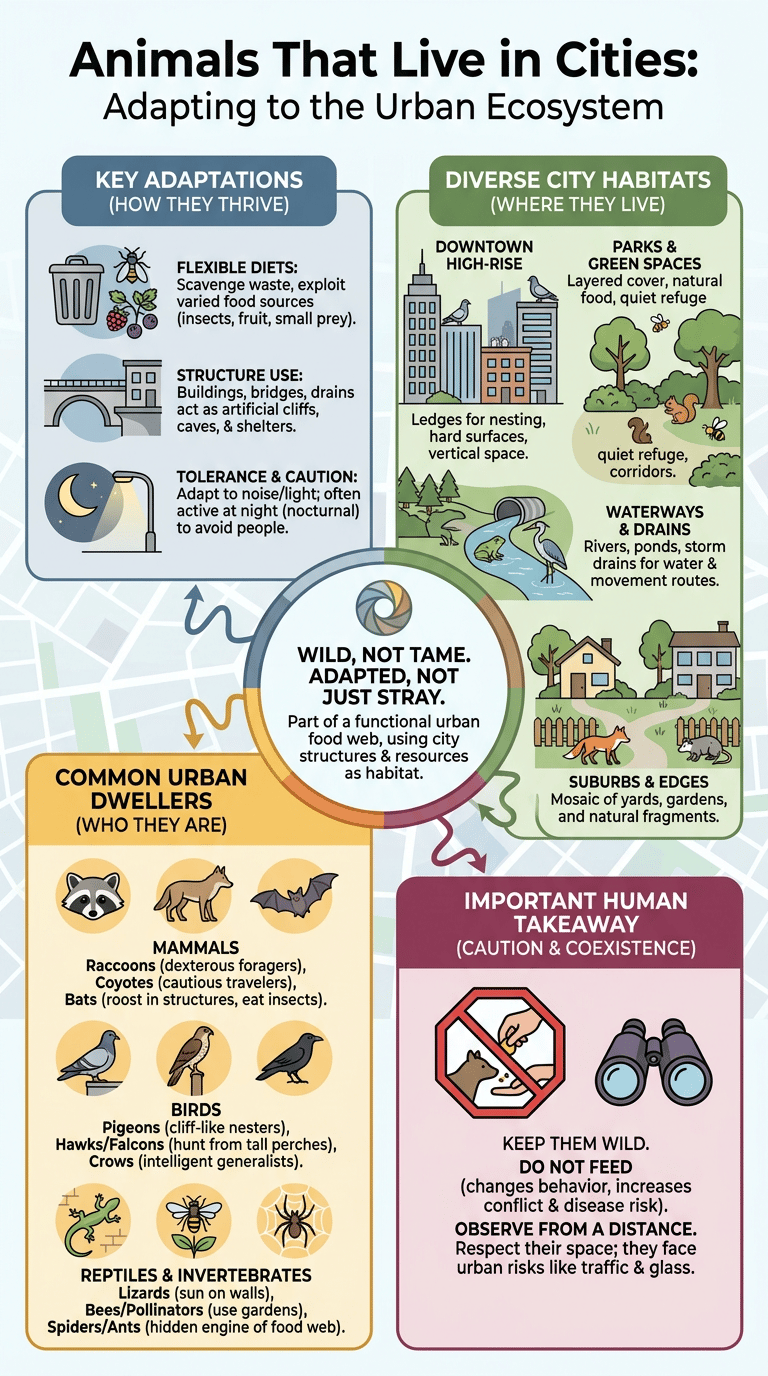
Lizards, Turtles, and Snakes in Warm or Green Areas
Reptiles can do surprisingly well in warm urban microhabitats. Lizards may use walls, rock borders, gardens, vacant lots, and sunlit sidewalks where heat and insects are available. Turtles can occur near ponds, canals, wetlands, golf course water features, and slow streams, although roads are a major hazard when they move between water and nesting areas. Some snakes persist in greenways, brushy lots, riparian corridors, and yards with cover and prey.
North Carolina State Extension’s guide to reptiles and amphibians in backyard habitats emphasizes practical habitat features such as water, cover, reduced chemical use, and awareness that storm drains lead directly to streams. Those same ideas apply broadly to urban spaces, where small habitat decisions can affect animals that depend on moisture, cover, and clean water.
Frogs and Salamanders in Ponds, Drains, and Wetlands
Amphibians are sensitive to moisture, water quality, and habitat connections, so they are not equally common in all cities. Frogs may breed in ponds, wetlands, ditches, rain gardens, or stormwater basins if water remains long enough and conditions are suitable. Salamanders are usually harder to notice because many spend time under logs, leaf litter, soil, or near shaded wetlands.
Urban amphibians show both the promise and the limits of city habitat. A stormwater pond with vegetation and nearby upland cover may support frogs. A steep concrete basin with polluted water, no shoreline plants, and surrounding roads may support little. Even when breeding habitat exists, animals may need safe routes to move between water and land.
Bees, Butterflies, Ants, Beetles, Spiders, and Urban Insects
Invertebrates are the hidden engine of many city food webs. Bees, butterflies, moths, beetles, flies, wasps, ants, spiders, worms, and many other small animals pollinate plants, recycle organic matter, aerate soil, feed birds and bats, and help control other insects. A city with no insect life would be a poor place for many birds, reptiles, amphibians, and small mammals.
Pollinators use gardens, street trees, balconies, parks, green roofs, vacant lots, and roadside plantings when flowers and host plants are available. Spiders and predatory insects use walls, shrubs, lights, and plant beds where prey gathers. Ants and beetles can thrive in cracks, soil patches, lawns, compost, and tree bases.
Why Some Animals Adapt to Cities Better Than Others
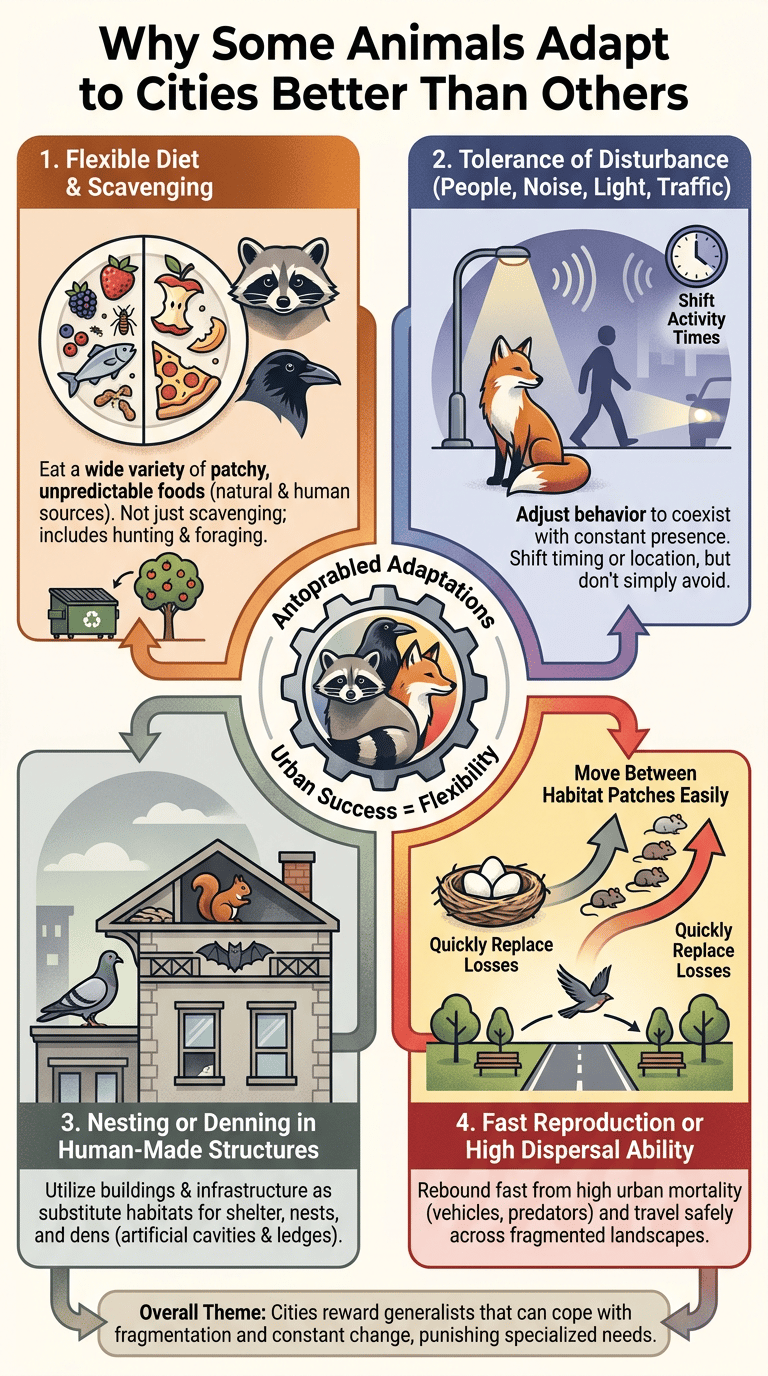
Urban success is not random. The animals that do well in cities tend to share a few traits, though no single trait guarantees success. Cities reward flexibility and punish animals that need large, quiet, connected, specialized habitats.
Flexible Diet and Scavenging Ability
Diet flexibility is one of the strongest patterns among city animals. Raccoons, crows, rats, pigeons, gulls, coyotes, opossums, and foxes can use different foods depending on what is available. This matters because city food is patchy and unpredictable. A fruiting tree, a dumpster, a squirrel population, a storm drain full of insects, or a park lawn after rain may become a temporary feeding opportunity.
Scavenging is part of this flexibility, but it is not the whole story. Many urban animals hunt, graze, browse, pollinate, or forage naturally as well. The problem begins when human food becomes too easy. Regular feeding can make animals bolder, increase crowding, and raise the chance of conflict.
Tolerance of People, Noise, Lights, and Traffic
Animals that live in cities must tolerate disturbance, but tolerance has limits. A pigeon may keep feeding while people walk nearby. A coyote may shift activity later at night. A squirrel may freeze, flee up a tree, then return to feeding. Different species solve disturbance in different ways.
Noise and light can change behavior even when animals remain present. Some birds sing at different times or in different pitches near loud traffic. Some nocturnal animals avoid bright areas, while others use lit places where insects gather. Traffic can block movement or kill animals that attempt to cross roads. Presence does not always mean the city is harmless for that species.
Nesting or Denning in Human-Made Structures
Buildings and infrastructure create substitute habitat for some animals. Pigeons use ledges. Peregrine falcons use tall buildings. Bats use bridge crevices. Swifts may use chimneys. Raccoons and squirrels may use attics or wall spaces when access points exist. Foxes may den in quiet embankments or under structures.
This trait can create conflict because shelter for wildlife may also be a home, school, office, or bridge that people maintain. Exclusion and repair should be handled humanely and legally, especially when young animals may be present. The ecological point is simple: cities are full of artificial cavities, ledges, tunnels, and warm spaces, and adaptable animals notice them.
Fast Reproduction or High Dispersal Ability
Many city animals face high mortality from vehicles, predators, disease, weather, building collisions, and habitat disturbance. Species that reproduce quickly or disperse well can replace losses more easily than slow-breeding species. Mice, rats, pigeons, insects, and some small birds can rebound fast when conditions allow.
Dispersal matters too. Animals that can fly, climb, travel along corridors, or cross open spaces can find new habitat patches. A bird can move between parks more easily than a salamander. A coyote can travel through a drainage corridor that a small turtle cannot safely cross. These differences shape which animals become familiar city residents.
City Animals by Habitat Type
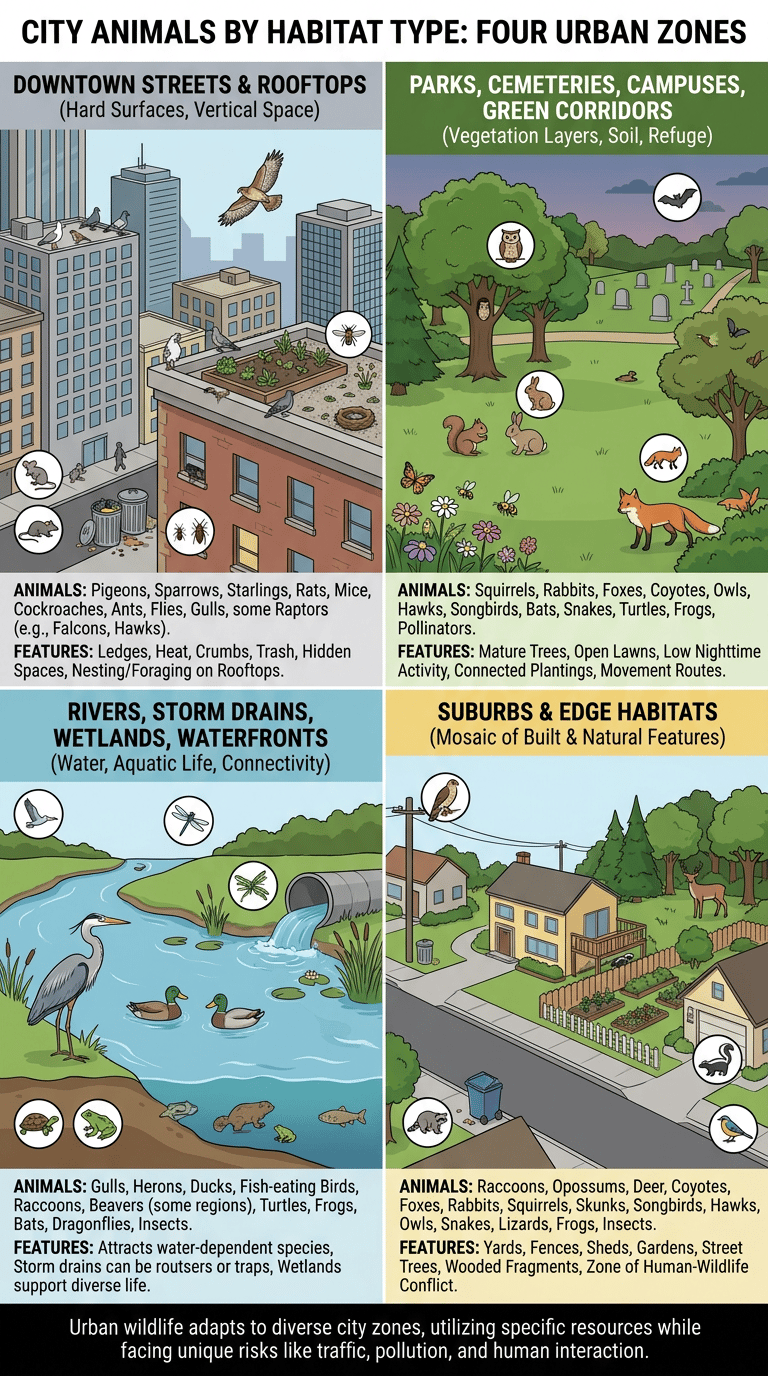
Different parts of a city act like different habitats. A downtown plaza, a riverbank, a cemetery, and a suburban street may all be urban, but they offer different food, cover, water, and risks.
Downtown Streets and Rooftops
Downtown areas favor animals that can use hard surfaces, ledges, heat, crumbs, trash, and vertical space. Pigeons, house sparrows, starlings, rats, mice, cockroaches, ants, flies, gulls, and some raptors may fit this setting. Peregrine falcons and hawks can hunt where prey birds gather, while rodents use hidden spaces below sidewalks, in alleys, and around buildings.
Rooftops can act as nesting, resting, or foraging spaces depending on design. Gravel roofs may resemble open ground for some birds. Green roofs can support insects and plants. Mechanical structures can create perches or cavities, but they can also create hazards if animals become trapped.
Parks, Cemeteries, Campuses, and Green Corridors
Large green spaces often support more diverse wildlife than heavily paved blocks because they provide vegetation layers, soil, insects, tree cavities, water, and quieter refuge. Squirrels, rabbits, foxes, coyotes, owls, hawks, songbirds, bats, snakes, turtles, frogs, butterflies, bees, and spiders may all use these areas depending on region and habitat quality.
Cemeteries and campuses can be important because they often contain mature trees, open lawns, low nighttime activity, and connected plantings. Green corridors along trails, rail lines, rivers, or utility routes may let animals move between otherwise isolated habitat patches.
Rivers, Storm Drains, Wetlands, and Waterfronts
Water reshapes city wildlife. Rivers and waterfronts attract gulls, herons, ducks, fish-eating birds, raccoons, beavers in some regions, turtles, frogs, bats, dragonflies, and many insects. Storm drains and culverts can be movement routes for some animals, but they can also carry pollution and become dangerous traps.
Wetlands and rain gardens can support amphibians, birds, pollinators, and aquatic invertebrates when designed and maintained well. They also connect urban wildlife to bigger issues such as stormwater, water quality, and habitat restoration.
Suburbs and Edge Habitats
Suburbs often blend features of cities and natural edges. Yards, fences, sheds, gardens, street trees, parks, drainage ponds, and wooded fragments create a mosaic used by raccoons, opossums, deer in some regions, coyotes, foxes, rabbits, squirrels, skunks, songbirds, hawks, owls, snakes, lizards, frogs, and insects.
Edge habitat can be productive, but it also creates conflict. Wildlife may cross roads, raid unsecured trash, den under decks, collide with windows, or be chased by pets. Suburban wildlife is not separate from urban wildlife. It is often the zone where people notice city-adapted animals most directly.
Common Mistakes and Myths
City wildlife myths often come from seeing animals out of context. A raccoon in daylight, a coyote on a sidewalk, or a hawk eating a pigeon can look alarming if the viewer does not know what normal urban wildlife behavior can include.
Assuming Every City Animal Is a Pest
Some animals create real problems in buildings, food storage areas, roads, or public spaces. But the word pest is a human conflict label, not an ecological category. A squirrel planting forgotten nuts, a bat eating insects, a spider catching flies, or a hawk hunting rodents may be providing ecological functions even in a city.
The better question is whether the animal is simply present, causing damage, creating a safety concern, or being attracted by a human-controlled resource. That distinction leads to better decisions than treating all wildlife as a problem.
Assuming City Animals Are Tame
An animal that tolerates people is not tame. Pigeons, squirrels, raccoons, gulls, and crows may appear comfortable near humans because they have learned that people are predictable or associated with food. They still have wild instincts, stress responses, parasites, diseases, defensive behaviors, and legal protections in some cases.
This is why feeding and close contact are risky. It can make animals bolder, increase bites or scratches, and create conflicts that end badly for the animal. Respectful distance keeps wildlife wild and keeps people safer.
Confusing Common Urban Species With Invasive Species
Some city animals are introduced or invasive in certain regions, such as European starlings and house sparrows in North America. Others, such as raccoons, opossums, coyotes, and many native birds, are native to broad parts of the continent but have adapted to urban environments. Common does not automatically mean invasive, and native does not automatically mean conflict-free.
Invasive status depends on species, location, history, and ecological impact. A careful article should not label an animal invasive just because people see it often or dislike its behavior.
How This Connects to Nearby Animal Topics
Animals that live in cities connect naturally to other urban wildlife questions. The goal here is not to cover those topics fully, but to show how they fit into the same ecological map.
How Green Spaces Support More Diverse Wildlife
Parks, street trees, gardens, river corridors, wetlands, and native plantings can increase food, cover, nesting sites, and movement routes. A city with connected green spaces can support more than pigeons and rats. It may also support migrating birds, bats, pollinators, amphibians, turtles, and small predators.
How Light and Noise Change Behavior
Artificial light and city noise do not affect all animals in the same way. Some species avoid them. Some tolerate them. Some exploit side effects, such as insects gathering near lights. These pressures help explain why certain animals become common in cities while others disappear from the same area.
Why Roads and Windows Can Make City Life Dangerous
Roads and glass are two of the clearest hazards for urban animals. Roads can block movement or kill animals that cross them. Windows can reflect sky or vegetation and confuse birds. A city may provide food and shelter while also creating new risks, which is why urban wildlife success is always a trade-off rather than a simple win.
FAQ
What Is the Most Common Wild Animal in Cities?
There is no single most common wild animal in every city. Pigeons, rats, mice, squirrels, ants, flies, spiders, cockroaches, sparrows, starlings, and crows are all common in many urban areas, but the answer depends on region, habitat, season, and whether you mean visible animals or total numbers.
If you include invertebrates, insects and other small arthropods usually outnumber mammals and birds by a huge margin. If you mean animals people notice daily, pigeons, squirrels, rats, and common urban birds are often the first examples that come to mind.
Why Do Raccoons and Coyotes Live in Cities?
Raccoons live in cities because they are flexible foragers, good climbers, mostly active at night, and able to use human-made shelter. Trash, fruit, insects, pet food, water, and den sites can all support them when access is available.
Coyotes live in cities because they can move through fragmented habitat, hunt small animals, scavenge, and avoid people by shifting activity patterns. They do best when they have cover, travel corridors, and food sources. Feeding coyotes, intentionally or accidentally, increases the chance of conflict.
Are City Animals Different From Rural Animals?
Sometimes they are different in behavior, activity timing, diet, stress tolerance, or movement patterns. A city squirrel may be more used to pedestrians than a rural squirrel. A coyote in a metropolitan area may travel mostly at night. A bird near traffic may sing differently from one in a quieter area.
That does not always mean they are genetically different. Some differences are learned or flexible responses during an animal’s lifetime. Other changes may involve long-term selection over generations. It is best to be cautious and say that urban animals often behave differently, while genetic adaptation depends on the species and evidence.
Do Cities Help or Hurt Wildlife Diversity?
Cities can do both. Urbanization often removes, fragments, or simplifies natural habitat, which hurts many sensitive species. At the same time, parks, rivers, wetlands, gardens, green roofs, and vacant lots can provide habitat for animals that tolerate people or use edge environments.
The result is usually a reshaped wildlife community, not simply more or less wildlife. Generalists often become common, while specialists may decline. Better green space design, safer buildings, reduced pollution, and connected habitat can make cities more useful for a wider range of species.
Final Thoughts
Animals that live in cities are not accidents. They are species using food, shelter, water, warmth, structures, and movement routes in a landscape built mainly for people. Raccoons, opossums, coyotes, squirrels, bats, pigeons, crows, hawks, lizards, frogs, bees, ants, spiders, and many others show that urban ecosystems are active, layered, and constantly changing.
The main lesson is balance. City wildlife can be fascinating and ecologically valuable, but it is still wild. The safest and most respectful approach is to observe from a distance, avoid feeding or handling animals, reduce attractants when conflicts occur, and support urban spaces that provide real habitat without drawing wildlife into unnecessary danger.

Ethan Walker is the founder and research editor of Animal Fact Central. He creates and reviews educational animal facts content using trusted wildlife, pet care, and science-based sources. His work focuses on making animal behavior, adaptations, habitats, and species facts clear, accurate, and engaging for everyday readers.
Read More Details About Ethan Walker: https://animalfactcentral.com/ethan-walker/