
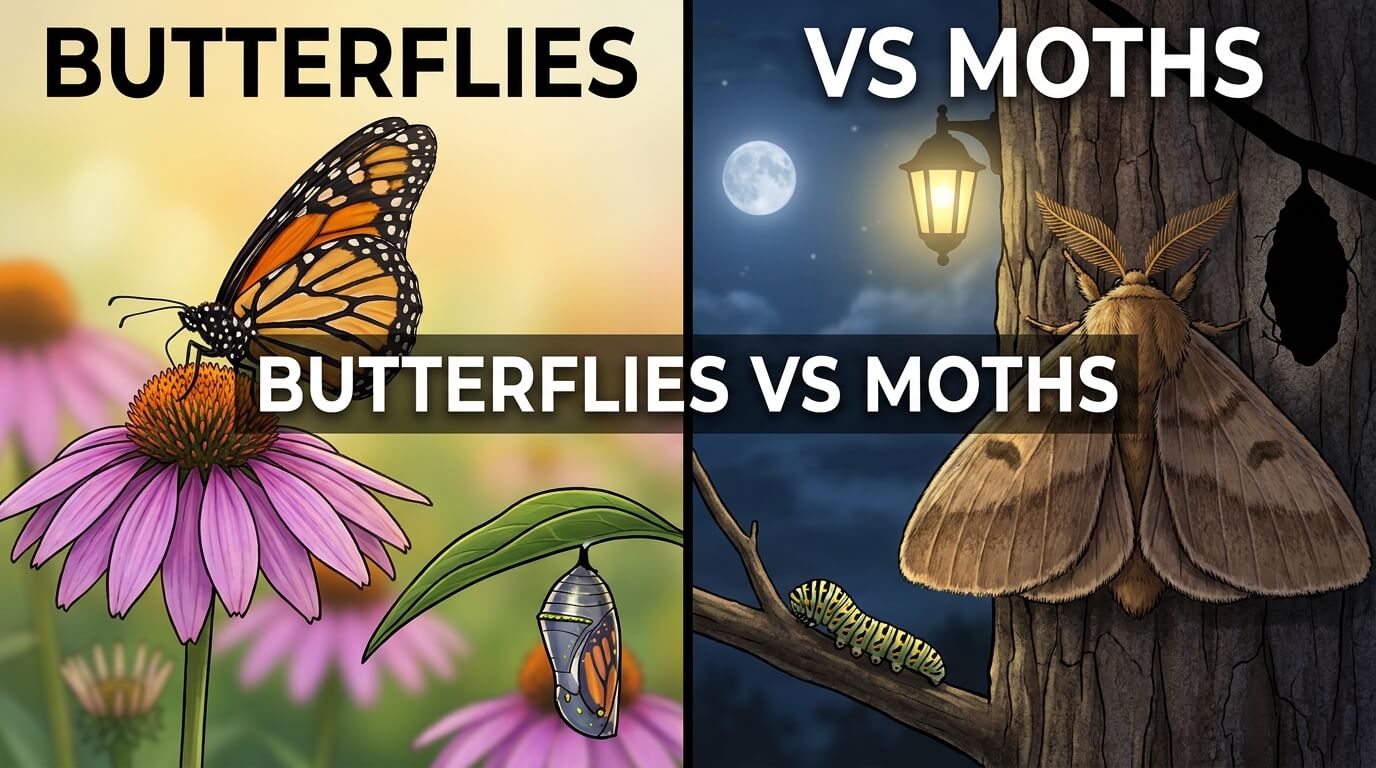
Butterflies vs moths is one of the easiest insect comparisons to start with, but it is also one of the easiest to oversimplify. In general, butterflies are day-active insects with clubbed antennae and wings often held upright at rest, while many moths are night-active insects with feathery, threadlike, or saw-edged antennae and wings often held flatter or tent-like. That quick rule works surprisingly well for many backyard sightings, but it is not perfect.
This comparison focuses on practical identification, behavior, life cycle, pollination, and common myths. It will help you make a good first guess in a garden, park, forest edge, porch light, or classroom activity without turning every exception into a contradiction.
Quick Difference
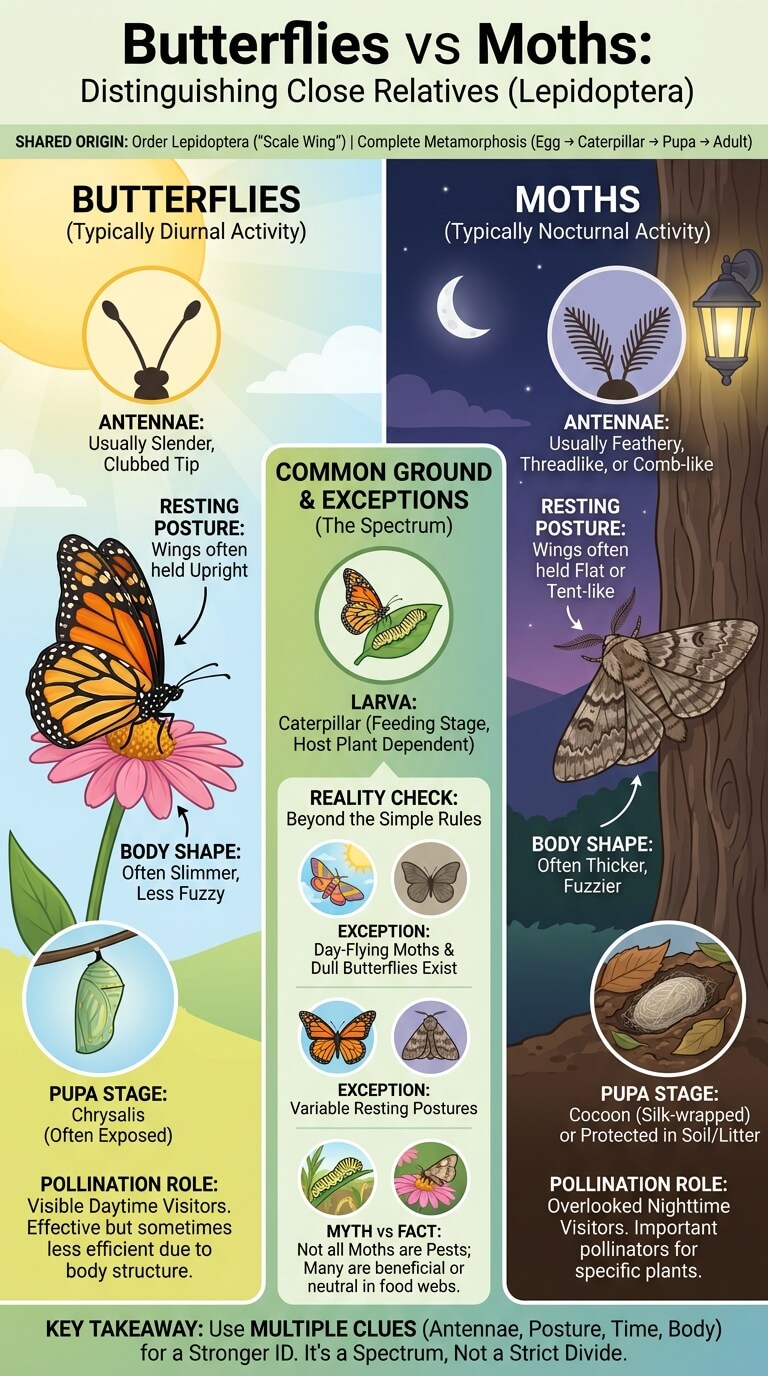
The quickest way to separate most butterflies from most moths is to look at the antennae. Butterflies usually have slender antennae with a club or knob at the tip. Moths usually have antennae that are feathery, threadlike, comb-like, or tapered without a clear club. The Smithsonian explains this broad difference while also noting that moths and butterflies belong to the same order of scale-winged insects, Lepidoptera, in its Smithsonian moth profile.
After antennae, check activity time and resting posture. A butterfly visiting flowers on a sunny afternoon is probably a butterfly. A fuzzy insect circling a porch light at night is probably a moth. Many butterflies rest with wings folded upright, while many moths rest with wings spread flat or held like a low tent.
Butterfly vs Moth Comparison Table

| Feature | Butterflies | Moths | Important exceptions |
|---|---|---|---|
| Antennae | Usually slender with a clubbed or knobbed tip | Usually feathery, threadlike, comb-like, or tapered | Some moth groups have antennae that can confuse quick identification |
| Activity time | Often active in daylight | Often active at night | Some moths fly by day, and some butterflies fly near dawn or dusk |
| Body shape | Often slimmer and smoother-looking | Often thicker or fuzzier-looking | Size and body texture vary widely within both groups |
| Resting wings | Often held upright over the back | Often spread flat or tent-like over the body | Many species break the simple posture rule |
| Pupal covering | Often a chrysalis | Often a cocoon or protected pupa in soil or leaf litter | Not every moth makes a neat visible cocoon |
| Pollination role | Visible daytime flower visitors | Often overlooked nighttime flower visitors | Visiting a flower does not always mean effective pollination |
Antennae, Wings, Body Shape, Activity Time, Resting Posture, Cocoon or Chrysalis, and Pollination Role
A good identification starts with antennae, then checks several supporting clues. If the insect has clubbed antennae, visits flowers in bright daylight, and folds its wings upright, butterfly is a strong guess. If it has feathery or threadlike antennae, a thicker body, and appears at night near lights or night-blooming flowers, moth is a strong guess.
Life cycle language can also confuse people. Butterflies and moths both have an egg, larva, pupa, and adult stage. The larva is the caterpillar. The pupa is the transformation stage. A butterfly pupa is often called a chrysalis. A moth pupa may be protected inside a silk cocoon, in soil, in leaf litter, or in another sheltered place. The clean classroom version is useful, but real species are messier.
What Butterflies and Moths Have in Common
Before focusing on differences, it helps to understand how similar these insects are. Butterflies and moths are not two unrelated kinds of insects that happen to look alike. They are close relatives with the same basic body plan, the same kind of metamorphosis, and many of the same ecological relationships with plants.
Both Are Lepidoptera
Butterflies and moths belong to Lepidoptera, an insect order whose name is often explained as “scale wing.” Their wings and bodies are covered with tiny scales, which can create color, pattern, camouflage, shimmer, and visual signals. If you have ever seen powdery scales rub from a dead butterfly or moth wing, you have seen one of the features that gives this group its name.
The group is much larger than the familiar garden butterflies most people recognize. Smithsonian gives broad global figures of about 160,000 moth species and 17,500 butterfly species, with nearly 11,000 moth species in the United States. Those numbers are best treated as broad reference figures because taxonomy changes as species are described, revised, or reclassified.
Both Have Scales, Complete Metamorphosis, and Flower Relationships
Both butterflies and moths go through complete metamorphosis. That means the young stage and adult stage look and live very differently. A caterpillar is built for feeding and growth. The adult is built more for dispersal, mating, and in many species, feeding on nectar or other liquid foods. This split lets one animal use different resources at different life stages.
Many adults drink nectar through a coiled mouthpart called a proboscis. Some species also feed at sap, rotting fruit, mud, dung, or other moisture and mineral sources. Not all adults feed, and some short-lived adult moths have reduced or nonfunctional mouthparts. That is one reason broad statements like “all butterflies and moths drink nectar” are inaccurate.
Plants matter in both life stages. Caterpillars often need particular host plants, while adults may visit flowers for nectar. The University of Minnesota Extension notes that butterfly caterpillars have limited host ranges and lists examples such as monarch caterpillars using milkweeds in its butterfly garden guidance.
Both Can Be Important in Food Webs
Butterflies and moths are more than pretty adults. Caterpillars are food for many birds, spiders, wasps, small mammals, amphibians, reptiles, and predatory insects. Adults can also feed birds, bats, dragonflies, spiders, and other predators. In some habitats, caterpillars are especially important because they turn plant leaves into protein-rich prey that other animals can use.
Key Physical Differences

Physical traits are the most useful starting point when you are looking at a butterfly or moth closely. The three field marks to check first are antennae, body shape, and wing posture. None is perfect alone, but together they usually narrow the answer quickly.
Antennae Shapes and Why They Help Identification
Antennae are the most dependable beginner clue. Butterflies usually have clubbed antennae. The shaft is slender and ends in a noticeable knob or thickened tip. Moths usually have antennae that are not clubbed. They may look feathery, bristly, threadlike, comb-like, or gently tapered.
These antennae are not decorative. They are sensory organs. Many moths use antennae to detect chemical cues, including mate-related scent signals. In some male moths, very feathery antennae increase the surface area available for detecting those cues. Butterflies also use their antennae to sense the environment, but the clubbed shape is a helpful visual marker for many groups.
Body Shape and Wing Texture
Many moths look fuzzier or heavier-bodied than butterflies. That fuzzy appearance often comes from scales and hairlike structures on the body. A thicker body can be useful for retaining heat, especially for insects that fly at night or in cooler conditions. Some moths can warm their flight muscles before takeoff by vibrating them.
Butterflies often look slimmer, with broader, more showy wings relative to the body. Their colors can be used in mate recognition, warning patterns, mimicry, or camouflage. Still, body shape is not a guaranteed divider. Large butterflies can look sturdy, and many small moths are delicate.
Resting Wing Positions and Common Exceptions
Resting posture is helpful when the insect is still. Many butterflies fold their wings upright over their backs. Many moths rest with wings spread out, roof-like, or wrapped around the body. This is why a flat-winged insect on a wall at night often looks “mothy” even before you see the antennae.
There are exceptions. Some butterflies bask with wings open to absorb warmth. Some moths hold wings in ways that do not match the simple tent rule. Posture can also change with temperature, time of day, and whether the insect is warming up, hiding, or preparing to fly.
Behavior Differences
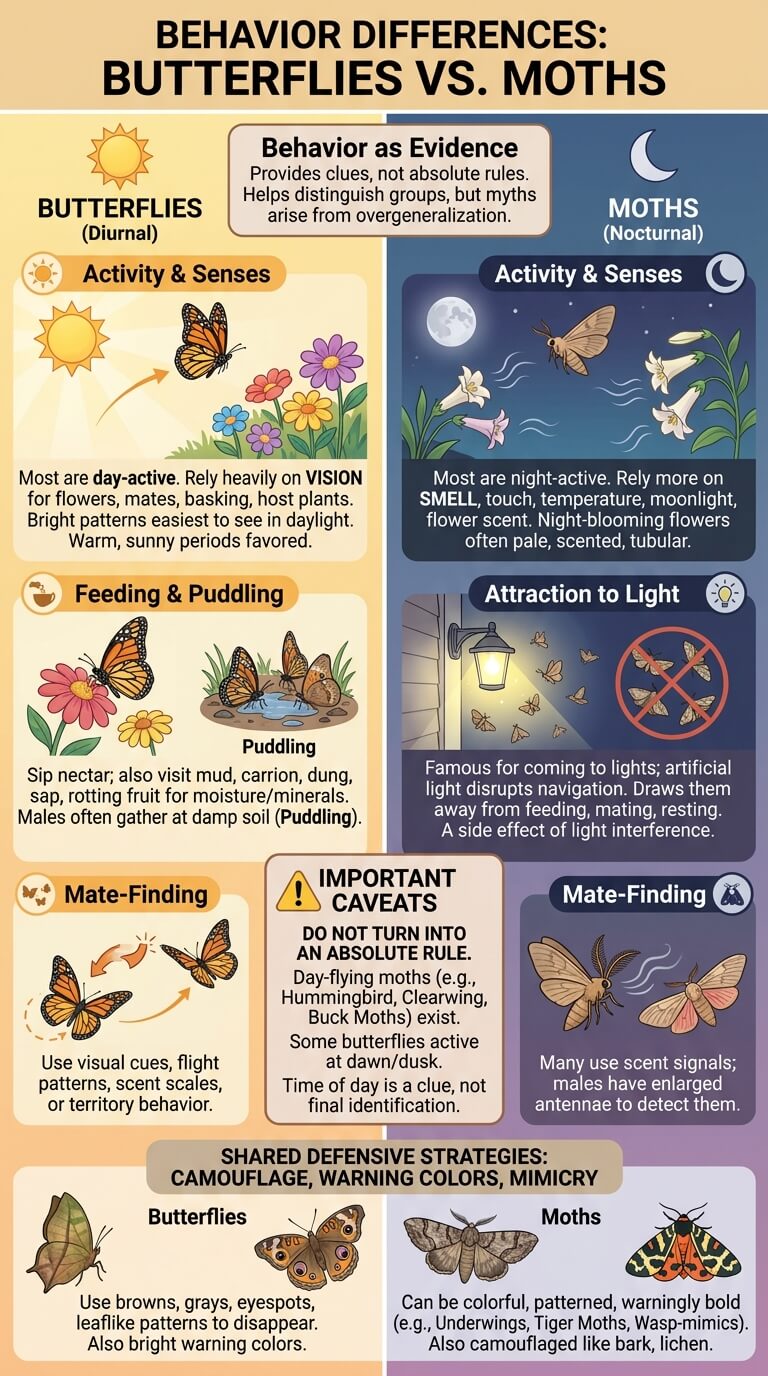
Behavior gives another layer of evidence. When an insect flies, where it rests, what attracts it, and how it avoids predators can all help separate butterflies from moths. This is also where many myths begin, because people often notice one dramatic behavior and apply it to the whole group.
Day-Active Butterflies and Night-Active Moths
Most familiar butterflies are diurnal, meaning they are active during the day. They often rely heavily on vision for finding flowers, mates, sunny basking spots, and host plants. Their bright patterns are easiest to see in daylight, and many butterfly watchers look for them during warm, sunny periods when flight is most likely.
Many familiar moths are nocturnal, meaning they are active at night. Night flight changes the sensory problem. A moth may rely more on smell, touch, temperature, moonlight, or flower scent than on the same visual cues used by many butterflies. This is also why night-blooming flowers are often pale, scented, or tubular, although flower traits vary widely.
Do not turn this into an absolute rule. Hummingbird moths, clearwing moths, buck moths, and other day-flying moths may visit flowers in full daylight. Some butterflies may be active around dawn or dusk. Time of day is a clue, not a final identification.
Feeding, Mate-Finding, and Attraction to Light
Adult butterflies are often seen sipping nectar from flowers, but nectar is only part of the story. Some butterflies visit mud, carrion, dung, sap, or rotting fruit for moisture and minerals. Male butterflies in particular may gather at damp soil in a behavior often called puddling.
Moths are famous for coming to lights, although scientists still debate the details of why artificial light disrupts moth navigation and behavior. Porch lights, streetlights, and bright outdoor lighting can draw moths away from feeding, mating, or resting. The attraction is not proof that moths want to be near people; it is often a side effect of how artificial light interferes with nocturnal behavior.
Defensive Colors, Camouflage, and Mimicry
Butterflies and moths both use defenses that make predators hesitate, miss, or learn to avoid them. Some are camouflaged like bark, leaves, lichen, or dead plant material. Others use warning colors associated with toxins or distasteful chemicals. Some mimic species that predators already avoid.
Butterflies often get attention for bright warning colors, but moths can be just as visually sophisticated. Underwings, tiger moths, wasp-mimicking clearwing moths, and day-flying burnet moths can be colorful, patterned, or warningly bold. On the other hand, many butterflies use browns, grays, eyespots, or leaflike patterns to disappear when resting.
Life Cycle Differences and Similarities
Life cycle is where butterflies and moths are most similar. Both begin as eggs, hatch into caterpillars, pupate, and emerge as winged adults. The names people use for the pupal stage are different, but the biological process is closely related.
Egg, Caterpillar, Pupa, Adult
The caterpillar stage is the main feeding stage. Caterpillars shed their skin as they grow, often changing size and appearance several times. Their job is not to look like miniature adults. Their job is to turn food into body mass and stored energy for the transformation ahead.
The pupa is the transformation stage. Inside, the insect reorganizes from a crawling larva into a winged adult. After emergence, the adult expands and dries its wings before flying. The adult stage may last days, weeks, or longer depending on species, weather, season, and whether the insect overwinters or migrates.
Chrysalis Versus Cocoon Explained Carefully
A chrysalis is a butterfly pupa. A cocoon is a protective silk structure that often surrounds a moth pupa. The pupa is the animal stage. The cocoon is a covering around that stage. Mixing up those terms is one of the most common butterfly vs moth mistakes.
The classroom shortcut says butterflies make chrysalises and moths make cocoons. That is broadly useful, but real pupation can vary. Some moths pupate in silk cocoons attached to plants. Others pupate in soil, leaf litter, bark crevices, or loose shelters. Some butterfly chrysalises are smooth and exposed, while others are camouflaged or attached in hidden places.
Host Plants and Caterpillar Feeding
Host plants are one of the most important links between butterflies, moths, and ecosystems. A host plant is a plant that a caterpillar can eat and develop on. Adult nectar flowers are not always host plants. A garden can be full of nectar and still fail to support caterpillars if the right host plants are missing.
This matters for both butterflies and moths. Monarch caterpillars are tied to milkweeds, but many less famous butterflies and moths also depend on particular native plants. Some caterpillars feed on grasses, trees, shrubs, vines, wildflowers, or even seeds and flowers. Others are more flexible but still have limits.
Habitat and Pollination Roles

Butterflies and moths live in many habitats, including meadows, forests, wetlands, deserts, farms, gardens, city parks, and woodland edges. Their pollination roles depend on the species, the flower, the time of day, and whether the insect contacts the flower parts that transfer pollen.
Butterflies as Visible Daytime Flower Visitors
Butterflies are among the most visible daytime flower visitors. Their long legs and wings often keep much of the body above the flower, so some butterflies are less efficient pollen movers than bees on certain flowers. Still, they can move pollen while feeding, especially when their bodies, legs, head, or proboscis contact pollen-bearing structures.
Butterflies are also helpful indicators for people because they are easy to notice. A yard with a variety of butterflies often has sunny flowers, host plants, reduced pesticide pressure, and enough habitat structure to support more than just adult nectar feeding. That does not mean butterflies alone prove a landscape is healthy, but their presence can be a visible sign of plant-insect relationships.
Moths as Overlooked Nighttime Pollinators
Moths are often overlooked because much of their activity happens after dark. Many adult moths visit flowers for nectar, and some can carry pollen between plants at night. Xerces highlights research showing that moths can transport pollen from many wildflower species after dark in its discussion of moths as nocturnal pollinators.
This does not mean every moth is an important pollinator. Some adult moths do not feed. Some visit flowers without moving much pollen. Some are more important as caterpillars in food webs than as adult pollinators. The point is that moths should not be dismissed just because people notice them less often than butterflies and bees.
Why Not Every Visit Means Effective Pollination
A flower visit is not the same as effective pollination. An animal may drink nectar without touching the right flower parts. It may carry pollen from the wrong plant species. It may groom the pollen off before visiting another compatible flower. It may visit a flower that can self-pollinate or is mainly wind-pollinated.
Effective pollination depends on fit. The insect’s body size, tongue length, behavior, and movement pattern must match the flower’s structure and reproductive biology. This is why a bee, butterfly, moth, fly, beetle, bird, or bat can be a great pollinator in one plant relationship and a poor pollen mover in another.
Common Confusions and Myths
Many butterfly vs moth myths come from true patterns stretched too far. The safest way to remember the difference is to say “usually” more often than “always.”
Myth: All Moths Are Dull and All Butterflies Are Colorful
Many moths are brown, gray, or bark-patterned because camouflage helps them rest safely during the day. But many moths are bright, metallic, transparent-winged, or boldly patterned. Day-flying moths can be especially colorful because they operate in a visual daytime world.
Many butterflies are colorful, but plenty are subtle. Hairstreaks, satyrs, duskywings, skippers, and folded-wing butterflies may look brown, gray, tan, or leaflike at rest. Color is useful for appreciation, photography, and curiosity, but it is a weak single-test identification tool.
Myth: Moths Are Just Pests
A few moth species damage clothes, stored foods, crops, or garden plants. Those species are the ones people notice because they create problems. But most moth species are not eating sweaters or destroying pantry goods. Many are part of native food webs, and many adult moths feed at flowers, sap, fruit, or other natural food sources.
It is more accurate to say that some moths are pests in specific settings, while moths as a whole are a large and ecologically varied group. Treating all moths as pests can lead people to remove beneficial or harmless insects from gardens and outdoor spaces.
Myth: Butterflies Are Always Better Pollinators
Butterflies are easier to see on flowers, so people often assume they are the more important pollinators. In some flower relationships, they can be effective. In others, their long legs, light bodies, or feeding angle make them less efficient than bees, flies, beetles, or moths.
Moths can be important pollinators in night-blooming systems, while butterflies may be more visible in sunny gardens. The best comparison is not “which group is better?” but “which animal fits this flower, habitat, and time of day?”
Edge Cases and Exceptions
The exceptions are not random trivia. They are the reason butterfly vs moth identification should use multiple clues. Evolution does not design animals to fit human categories neatly. It shapes bodies and behaviors around survival, reproduction, predators, climate, and available food.
Day-Flying Moths
Some moths are active during daylight and can fool even careful observers. Hummingbird moths hover at flowers, clearwing moths can mimic wasps or bees, and some brightly colored moths look more like butterflies than the average person expects. Smithsonian notes that many day-flying moths exist and that some are brightly colored.
For these species, antennae and body shape are more useful than activity time. A fast, hovering insect at a flower may be a moth even if the sun is high. A colorful insect is not automatically a butterfly.
Dull-Colored Butterflies
Some butterflies are easy to miss because they blend into bark, leaves, soil, or dry grass. Their upper wings may be brighter than their underside, or their colors may only flash during flight. When they land and close their wings, they can look like a dead leaf or a small brown triangle.
This is why identification apps and field guides often need clear photos from more than one angle. Wing underside patterns, antenna shape, body form, size, location, season, and host plant can all matter. The Butterflies and Moths of North America project is useful because it treats identification as a regional, evidence-based process rather than a single visual shortcut.
Species That Break the Simple Rules
The best approach is a probability checklist. First, check antennae. Then look at activity time, resting wings, body texture, flight style, and habitat. If several traits point the same direction, your identification is probably right. If the clues conflict, use a regional guide or expert identification.
How This Connects to Nearby Animal Topics
Butterflies and moths connect naturally to pollination, plant ecology, conservation, backyard wildlife, and insect life cycles. The comparison is useful because it gives readers a bridge between a single insect sighting and bigger questions about how animals interact with plants.
Monarch Butterflies as a Species-Level Conservation Story
Monarchs are butterflies, not moths, and they are often used as a familiar example of host plant dependence because their caterpillars feed on milkweeds. They also raise broader conservation questions about migration, habitat loss, pesticide exposure, climate pressures, and regional population trends.
Still, a monarch conservation article should not be treated as the same thing as a butterfly vs moth comparison. Monarchs are one species-level story within the larger butterfly group. This article uses them only as an example of how host plants and adult nectar sources can both matter.
Pollination as a Broader Animal-Plant Process
Butterflies and moths can both visit flowers, but pollination is a broader process involving pollen transfer, plant reproduction, flower structure, and animal behavior. Bees, flies, beetles, wasps, birds, bats, butterflies, and moths can all participate in different systems.
Understanding butterflies vs moths helps readers see why time of day matters. A flower open in bright sunlight may attract a different set of animals than a pale, fragrant flower opening at night. Daytime and nighttime pollination are not competing stories. They are different parts of the same ecological network.
Other Animals That Pollinate Flowers by Day and Night
Once you notice butterflies and moths, it becomes easier to notice other flower visitors. Bees may collect pollen directly. Flies may mimic bees or wasps while visiting flowers. Beetles may feed on pollen or floral parts. Hummingbirds can pollinate tubular flowers. Bats pollinate some night-blooming plants in warmer regions.
The key is not to assume that every flower visitor is equally effective. Observation starts the question. Pollination biology answers it by asking whether pollen is actually transferred to a compatible flower in a way that helps the plant produce seeds or fruit.
FAQ
Are Moths Older Than Butterflies?
In broad evolutionary terms, butterflies are generally understood as arising from moth-like ancestors, so it is reasonable to think of butterflies as a more specialized branch within the wider Lepidoptera story. That does not mean any modern moth is the direct ancestor of a modern butterfly. Living moths and living butterflies are present-day relatives, not a ladder from primitive to advanced.
For everyday identification, this evolutionary history is less important than shared traits. Both groups have scaled wings, caterpillar larvae, pupae, and adult forms. The fact that butterflies are nested within a wider moth-rich order helps explain why the boundary can feel blurry.
Can Moths Be Pollinators?
Yes, some moths can be pollinators. Adult moths that visit flowers for nectar may pick up and move pollen, especially at night when many people are not watching. Some night-blooming flowers are strongly associated with moth visitors.
However, not every moth is a pollinator. Some adult moths do not feed, some feed away from flowers, and some flower visitors may not transfer pollen effectively. It is safest to say moths include important pollinators, not that all moths are pollinators.
How Can You Tell a Butterfly From a Moth Quickly?
Start with the antennae. Clubbed antennae usually point to a butterfly. Feathery, threadlike, comb-like, or tapered antennae usually point to a moth. Then check activity time, body shape, and resting wings.
If the insect is active in bright daylight, has a slim body, and holds its wings upright, butterfly is likely. If it appears at night, has a fuzzier body, and rests with wings spread or tent-like, moth is likely. If the clues conflict, treat the identification as uncertain and compare it with regional records or a field guide.
Do Butterflies and Moths Both Start as Caterpillars?
Yes. Butterflies and moths both have caterpillars as their larval stage. The caterpillar is the feeding and growth stage, while the adult is the winged reproductive stage. The caterpillar does not simply grow wings on the outside. It transforms during the pupal stage.
Because caterpillars often depend on specific host plants, protecting butterflies and moths usually means thinking beyond adult nectar flowers. A landscape that supports caterpillars, pupae, and adults is more useful than one that only provides colorful flowers for adult visitors.
Final Thoughts
Butterflies vs moths is best understood as a comparison of close relatives, not a battle between two completely separate insect types. Butterflies are usually day-active, club-antennaed, and easy to spot on sunny flowers. Moths are usually more diverse, often night-active, and frequently identified by their non-clubbed antennae, fuzzier bodies, and different resting postures.
The most accurate takeaway is to use several clues at once and leave room for exceptions. Both butterflies and moths are Lepidoptera. Both begin life as caterpillars, depend on plants, serve as prey, and can take part in pollination or food-web relationships. Learning the differences helps you identify what you see, but learning the overlap helps you understand why both groups matter.

Ethan Walker is the founder and research editor of Animal Fact Central. He creates and reviews educational animal facts content using trusted wildlife, pet care, and science-based sources. His work focuses on making animal behavior, adaptations, habitats, and species facts clear, accurate, and engaging for everyday readers.
Read More Details About Ethan Walker: https://animalfactcentral.com/ethan-walker/