
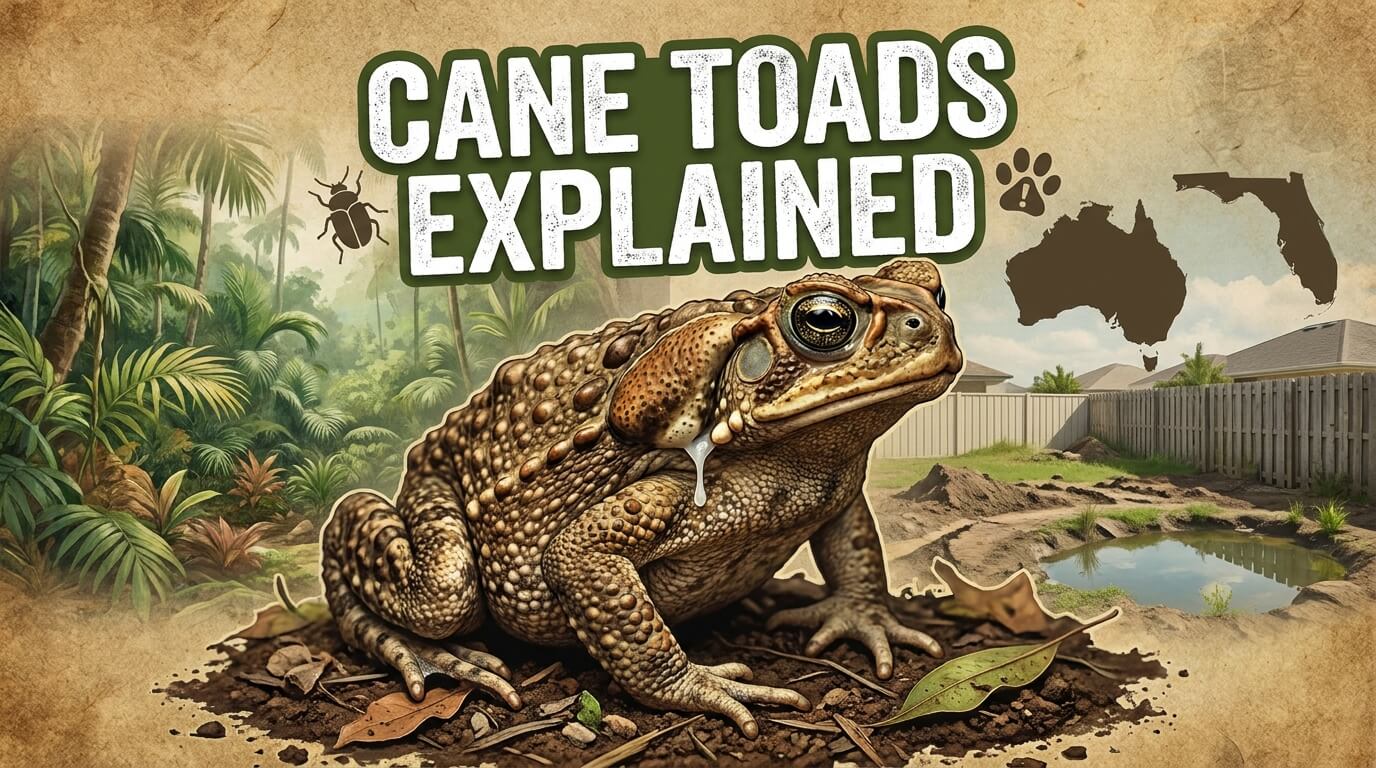
Cane toads are large, toxic true toads that have become one of the best-known examples of an invasive animal. They are not dangerous because they chase or attack people. The problem is that their defensive toxins can poison predators and pets that try to bite, mouth, or eat them.

In their native range, cane toads are part of a normal tropical ecosystem. Outside that range, especially in places where local predators have not evolved with them, the same defenses can disrupt food webs. Understanding cane toads means looking at their body structure, invasion history, toxins, survival traits, and the myths that make people either underestimate or overreact to them.
Quick Answer
Cane toads are large, warty, ground-dwelling amphibians in the true toad family. They are native to parts of the Americas, but people introduced them to many islands and regions outside their native range. In some places, including Australia and parts of Florida, they became invasive because they reproduce efficiently, eat many kinds of prey, tolerate disturbed habitats, and carry potent toxins that many predators cannot handle.
The most important distinction is that cane toads are poisonous, not venomous in the usual animal-facts sense. A venomous animal injects toxins with a bite, sting, spine, or similar structure. A poisonous animal harms another animal when it is eaten, mouthed, touched in certain ways, or when toxins are absorbed. Cane toads release defensive secretions from skin glands, especially the large parotoid glands behind the head.
For people, the main practical message is simple: do not handle unfamiliar toads, do not let pets mouth them, and do not move toads from place to place. In areas where cane toads occur, a dog or cat that mouths a cane toad needs prompt veterinary guidance, especially if drooling, mouth irritation, weakness, tremors, abnormal heart signs, or seizures appear.

What Are Cane Toads?
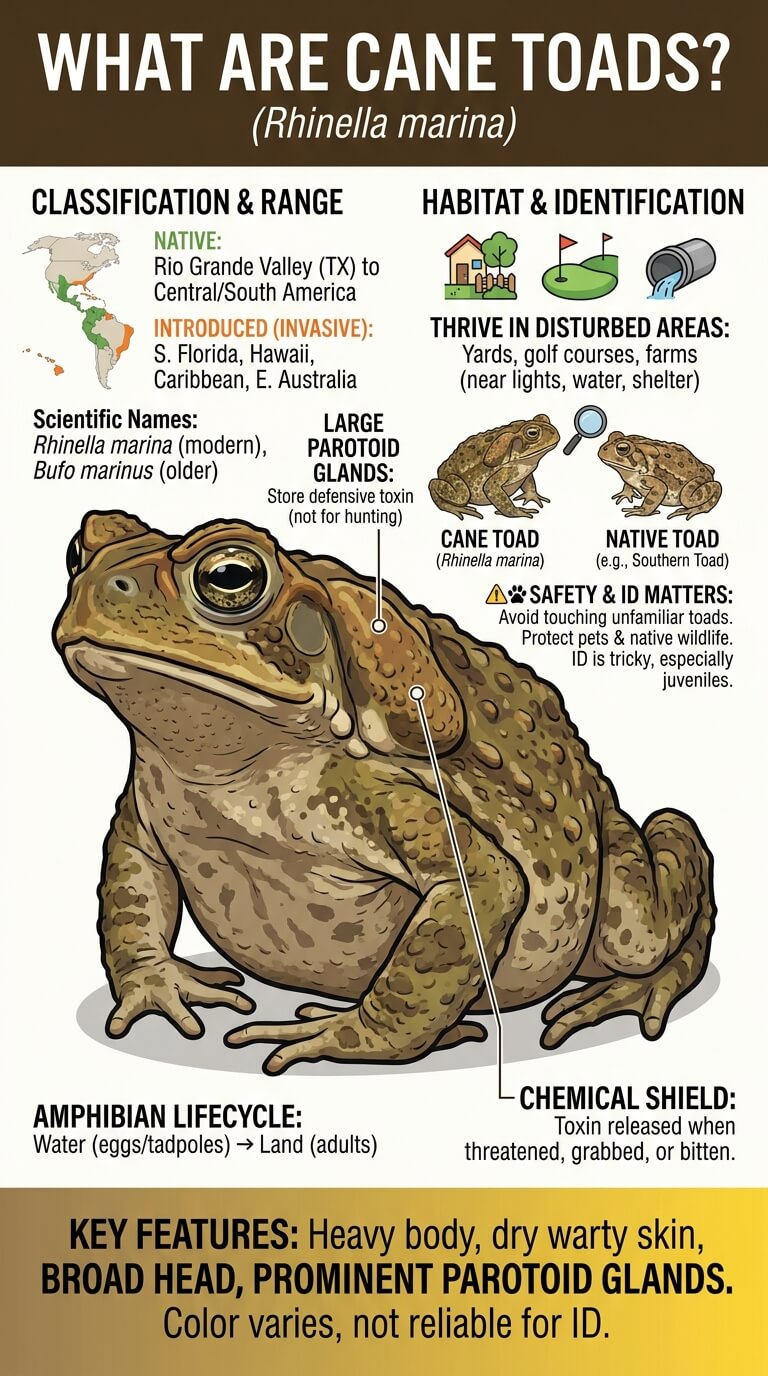
Cane toads are amphibians, which means they begin life in water as eggs and tadpoles and later live mostly on land as adults. They are true toads, so they have stout bodies, dry-looking warty skin, relatively short legs, and large poison glands behind the eyes. Their scientific naming history can be confusing because older materials often call them Bufo marinus, while many modern references use Rhinella marina.
The Animal Diversity Web profile for cane toads describes a natural range from the Rio Grande Valley of Texas south through parts of Central and South America, and it also notes introductions to places such as South Florida, Hawaii, Caribbean islands, and eastern Australia. That wide introduced range is one reason the species appears so often in invasive species discussions.
Native range and basic identification
A cane toad is usually recognized by its heavy body, broad head, dry warty skin, and large glands on the shoulders behind the eyes. Color varies. Many are brown, grayish, tan, olive, or mottled, which means color alone is not a safe way to identify them.
Identification matters because some native toads look similar at a glance. In Florida, for example, native southern toads and oak toads can be confused with cane toads by people who are not used to looking at head shape, gland position, size, and ridge patterns. A wrong identification can lead people to harm native wildlife or underestimate risk around pets.
Cane toads are mostly ground animals. They do not need pristine wilderness to survive. In many invaded areas, they do well around yards, golf courses, drainage areas, farms, and disturbed landscapes where lights, insects, standing water, and shelter can make life easier.
Size, body shape, and parotoid glands
Cane toads are among the larger toads people are likely to notice. Adults can be several inches long, and large individuals look bulky compared with many native toads. Size can help with identification, but it should not be the only clue because young cane toads are smaller and some native toads can still look surprisingly robust.
The parotoid glands are the key feature. These are the raised swellings behind the eyes and shoulders. They store defensive secretions that can be released when the toad is threatened, grabbed, bitten, or handled roughly. The toxin is not a hunting weapon. It is a chemical shield meant to discourage predators.
Cane toads vs native toads
The safest approach is to assume that unfamiliar toads should not be touched. People sometimes want a fast visual rule, but field identification is not always simple. In Florida, the UF/IFAS guide to cane toads in Florida explains that cane toads can be confused with native toads and that correct identification matters before anyone takes action on private property.
A cane toad tends to be larger than most native Florida toads, has prominent glands, and lacks some of the features used to recognize native species. Still, juveniles and worn-looking adults can be tricky. For general readers, the useful lesson is not to memorize every ridge and wart. It is to understand that native amphibians deserve caution and that pet safety does not require touching the toad.
Why Cane Toads Became Invasive
Cane toads became invasive because people moved them, and the toads had traits that helped them survive after introduction. They did not become a global problem because they were unusually aggressive. They became a problem because they could find food, reproduce, tolerate human-modified landscapes, and defend themselves chemically in places where many predators were unprepared.
Why they were introduced in some regions
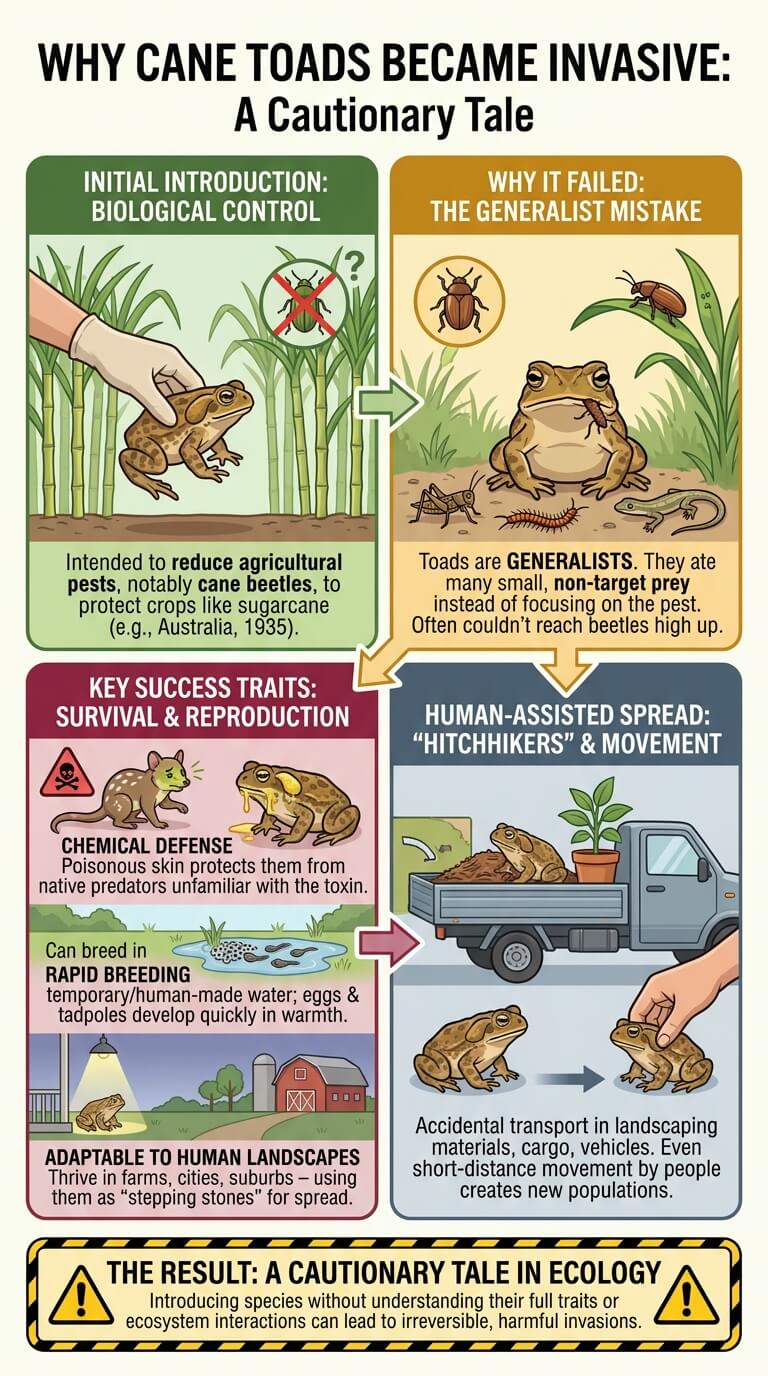
Cane toads were introduced to some areas as biological control agents. The idea was that a hungry toad might help reduce agricultural pests, especially beetles associated with sugarcane. That plan sounds simple, but ecosystems rarely follow a simple script.
Australia is the most famous example. The National Museum of Australia overview of cane toad introduction describes their 1935 release in Queensland as an attempt to control cane beetles. The toads spread, but they did not solve the pest problem in the way people hoped.
This is one reason cane toads are often used as a cautionary story in conservation. Introducing a predator or pest-control species can create new problems if the animal does not target the intended pest, has few checks in the new environment, or harms native animals that were never part of the original plan.
Why introduction goals failed in famous cases
The core mistake was assuming that a toad that eats many small animals would neatly focus on the pest people wanted controlled. Cane toads are generalists. They feed on many insects and other small prey, not just one crop pest. They also live mostly on the ground, while some target beetle life stages were not always easy for them to reach.
Biological control can work when it is carefully researched, but cane toads became a classic example of what can go wrong. Once a hardy animal spreads across a landscape, removing it becomes much harder than releasing it. The introduced animal becomes part of the problem rather than a clean solution.
What helps cane toads spread
Cane toads have several traits that support invasion. They eat many kinds of small prey. They can breed in temporary or human-made water sources. Their eggs and tadpoles can develop quickly in warm conditions. Adults can use disturbed habitats near people, which means cities, suburbs, farms, and golf courses can become stepping stones.
Human movement also matters. Toads can be transported accidentally in landscaping materials, cargo, potted plants, or vehicles. Even short-distance movement can create new pockets of cane toads. That is why people should not relocate animals they find, even when they think they are helping.
Cane Toad Toxins Explained
Cane toad toxins are defensive chemicals. They are not used to chase prey. A cane toad usually relies on sitting still, blending in, inflating its body, and releasing toxins when attacked. The toxin is most concentrated in the parotoid glands, but skin and life stages can also matter in some contexts.
How their toxin glands work
The parotoid glands sit behind the eyes and over the shoulders. When a cane toad is bitten or squeezed, these glands can release a thick, milky secretion. That secretion contains compounds often discussed as bufotoxins or related cardiac-active chemicals. The exact mixture is complex, and its effects depend on the species exposed, the dose, the size of the animal, and whether the toxin is swallowed or absorbed through the mouth or eyes.

The USGS Nonindigenous Aquatic Species profile for cane toads notes that the large parotoid glands contain milky bufotoxins and that dogs, cats, humans, and wildlife can be harmed through serious exposure. This is why the article uses the word poisonous in a practical sense, even though some veterinary pages may use the word venom for toad secretions.
For animal facts, the clean distinction is useful: cane toads do not inject venom like a snake or scorpion. Their danger comes from contact with defensive secretions, especially when another animal mouths or eats them.
Why predators can be harmed
A predator that grabs a cane toad with its mouth may receive toxin directly on sensitive tissues. Some predators vomit, spit the toad out, or learn to avoid them. Others can suffer serious poisoning or die. The risk is not evenly spread across every predator species.
Large lizards, snakes, mammals, crocodilians, and other animals that swallow or chew toads can be especially vulnerable if they lack resistance or avoidance behavior. In some places, predators have adapted behaviorally or physiologically over time. In other places, cane toads may cause sharp local declines soon after arrival.
This is why cane toad impact is not just about the toads eating insects. A toxic prey animal can alter predator behavior, predator survival, scavenger activity, and the balance between species that can tolerate the toxin and those that cannot.
Why pets are at risk in cane toad areas
Dogs are a major concern because many dogs investigate animals with their mouths. A curious bite or lick can expose the mouth and gums to toxin. Cats can also be exposed, although dogs are often discussed more often because their behavior puts them at higher risk.
The Merck Veterinary Manual page on toad poisoning warns that dogs and sometimes cats can be poisoned after mouthing certain toads, and it describes signs that can range from mouth irritation and drooling to severe neurologic or cardiovascular effects. If a pet mouths a cane toad or shows sudden symptoms after outdoor contact, the safest next step is veterinary guidance right away.
This article does not give a home treatment protocol because pet poisoning is time-sensitive and can vary by animal. The useful prevention message is clearer: supervise pets outdoors in cane toad areas, reduce attractants such as standing water and outdoor lights where possible, and keep pets away from toads rather than trying to test or handle the animal.
What toxins do not mean about aggression
Cane toads are often described as dangerous, but that word can be misleading. They are not predators of pets, and they do not attack people. Their defense becomes dangerous when another animal bites, licks, eats, or roughly handles them.
A better way to think about cane toads is this: they are low-aggression animals with high-consequence defenses. They are not villains. They are toxic amphibians in the wrong places, often because people moved them there.
Ecosystem Impacts of Cane Toads
Cane toad impacts can include poisoning predators, competing with native species, eating many invertebrates, and changing food web interactions. The severity depends on the region, the predators present, habitat type, climate, and how long cane toads have been established.
Effects on native predators
The most dramatic impacts often involve native predators that try to eat cane toads. In Australia, researchers and government agencies have paid close attention to animals such as northern quolls, monitor lizards, crocodilians, and some snakes because many of these predators naturally eat frogs or toads.

The Australian government’s assessment of biological effects caused by cane toads describes concern about lethal toxic ingestion, notes that all life stages can be poisonous, and explains that impact evidence varies by predator group and region. That careful wording is important because cane toad impacts are serious, but not every predator species is affected in the same way.
Some predators decline when cane toads first arrive. Others learn to avoid them, select smaller individuals, attack in ways that reduce toxin exposure, or show some tolerance. Over time, ecosystems may shift, but that does not erase the damage that can occur during the invasion front.
Competition and food web changes
Cane toads are generalist feeders. Adults eat many ground-dwelling insects and other small animals. Tadpoles feed differently, but they are still part of aquatic food webs. When cane toads reach high densities, their feeding can overlap with native frogs, reptiles, birds, and other insect-eating animals.
Competition is harder to measure than a dead predator found near a toad, but it can still matter. If cane toads consume large numbers of insects around lights, lawns, or water edges, they may reduce food available to native insectivores. They may also change how predators search for prey if toxic toads become common.
Why impact varies by place and predator community
Cane toads do not have the same impact everywhere. In Florida, they are strongly associated with human-modified habitats, and current guidance often emphasizes nuisance issues and pet danger more than widespread invasion of natural areas. In Australia, the story is broader because cane toads spread across huge regions and interact with many native predators.
That difference helps explain why searchers get conflicting impressions. One article may describe cane toads as a massive biodiversity problem. Another may say their Florida ecological impact appears more limited than their pet-safety impact. Both can be true if the place, habitat, and species community are different.
Adaptations That Help Cane Toads Survive
Cane toads have a successful invasive toolkit. They are not unbeatable, but they combine broad diet, chemical defense, high reproductive output, and tolerance of disturbed habitats. Each trait becomes more powerful when humans create warm, open, water-rich places around homes, farms, and roads.
Generalist diet
A specialist animal depends on a narrow set of foods. A generalist can switch. Cane toads are generalists, and that flexibility helps them survive in unfamiliar environments. They can feed on many insects and other small prey, including animals attracted to porch lights, irrigation, and disturbed ground.
This diet helps explain both their success and their limits. They do not need the exact same prey found in their native range. But they are not magical pest-control machines either. Eating many things means they may ignore the pest humans hoped they would target and instead become another consumer in the food web.

High reproduction and tadpole survival
Female cane toads can produce large numbers of eggs in long jelly-like strings. Not all eggs or tadpoles survive, and many young toads die early, but high reproductive output increases the chance that enough offspring will reach land and keep the population going.
Warm water can speed amphibian development, and temporary ponds, ditches, pools, and other water sources can provide breeding opportunities. This is one reason local prevention often focuses on reducing artificial water and shelter around homes in cane toad areas.
High reproduction also makes eradication difficult once a population is established. Removing visible adults may help reduce encounters in a specific yard, but a landscape-level population can persist if breeding sites remain and nearby toads move back in.
Tolerance of disturbed habitats
Cane toads often do well in places altered by people. Lawns, golf courses, agricultural edges, drainage ditches, and suburban landscapes can provide open foraging areas, insects, moisture, and shelter. That does not mean they can live anywhere. They still need suitable climate and breeding conditions.
Disturbed habitat tolerance is common among successful invasive animals. Burmese pythons are tied to South Florida wetlands, invasive carp spread through connected waterways, and feral pigs thrive in many land habitats. Cane toads show another version of the pattern: an animal moved by people can use human-made environments to keep spreading.
Common Myths and Mistakes
Cane toads attract dramatic stories because they are large, toxic, and invasive. Some stories are true in a careful sense. Others become exaggerated. The goal is not to make cane toads sound harmless. It is to understand the risk accurately.
Myth: cane toads are dangerous because they attack
Cane toads are dangerous mostly because of defensive poison, not because of aggression. They do not chase pets or stalk people. A dog that bites one is at risk because the dog initiates contact with the toxic animal.
This matters for safety messaging. Running toward a toad, grabbing it, or trying to prove what species it is can create more risk. Avoidance is safer than confrontation.
Myth: every large toad is a cane toad
Many people call any big warty amphibian a cane toad or bufo toad. That is not reliable. Native toads can be large enough to surprise people, and juvenile cane toads can be small enough to confuse identification.
Bad identification can harm native amphibians. In places with both native and non-native toads, the responsible approach is to use local wildlife guidance, clear photographs, and professional identification when needed. Pet safety does not require a perfect ID before taking the pet away from the animal.
Mistake: touching or moving unfamiliar toads
People sometimes try to move a toad out of kindness or kill it out of fear. Both responses can be risky if done without local guidance. Handling can expose people to secretions, and moving animals can spread invasive species, diseases, or parasites.
If a toad is in a risky place for pets, the safest general step is to separate pets from the animal and check local rules. Invasive species control is not the same everywhere, and humane handling rules matter.
Edge Cases and Regional Context
Cane toads are a global topic, but the details depend strongly on place. The same animal can be native in one region, introduced in another, a pet-safety concern in a suburban yard, and a major conservation concern at an invasion front.
Why Australia is the best-known cane toad case
Australia became the most famous cane toad case because the introduction was well known, the spread was dramatic, and the effects on native predators received major attention. The story also has a clear lesson: a species introduced for one agricultural purpose can become a long-term ecological problem.
Australia is not the only place cane toads have been introduced, but it is the case that many readers know from documentaries, conservation articles, and school lessons. It remains useful because it shows the difference between an animal being successful and an introduction being successful. The toads succeeded. The original pest-control goal largely did not.
What US readers should know about Florida and pet safety context
In the United States, cane toads are especially relevant to readers in parts of Florida, Hawaii, Texas, and other warm areas where severe toad poisoning risk may be discussed. Florida readers often encounter them in yards, neighborhoods, and other human-modified spaces rather than remote wilderness.
For pet owners, the main issue is not whether cane toads are destroying a national park near them. It is whether dogs or cats can reach them around the home. Outdoor lights that attract insects, pet food left outside, standing water, and dense hiding places can all make a yard more inviting to toads and their prey.
If a pet mouths a toad or suddenly drools, paws at the mouth, vomits, shakes, becomes weak, has abnormal movements, or seems disoriented after outdoor contact, treat it as urgent and contact a veterinarian or emergency clinic. This is not a situation for online diagnosis.
Why some predators adapt while others remain vulnerable
Predator responses to cane toads can change over time. Some animals learn to avoid them. Some attack smaller toads that carry less toxin. Some populations may show selection for traits that reduce risk. Other predators remain vulnerable because their feeding style exposes them to too much toxin.
How This Connects to Nearby Animal Topics
Cane toads connect several animal-facts topics at once: invasive species definitions, chemical defense, predator learning, pet safety, and conservation ethics. They are useful because the same animal can be understood through different lenses without reducing the story to a single scary fact.
How cane toads clarify invasive species definitions
Cane toads show why invasive does not simply mean non-native. A species becomes invasive when it establishes outside its native range and causes, or is likely to cause, harm. Cane toads fit that definition in places where they spread, affect predators or pets, and disrupt local ecological relationships.
They also show why location matters. A cane toad in its native range is native wildlife. A cane toad in a vulnerable introduced range may be an invasive species. The animal is the same, but the ecosystem context is different.
How toxins make this case different from Burmese pythons, carp, and feral pigs
Burmese pythons affect Florida ecosystems mostly as large predators. Invasive carp reshape freshwater food webs through feeding, reproduction, and movement. Feral pigs disturb soil, water, crops, and native wildlife through rooting, feeding, and disease concerns. Cane toads stand apart because their strongest impact often comes from being toxic prey.
Why control is ethically and practically difficult
Cane toad control can be difficult because they reproduce quickly, use human-modified habitats, and may return from nearby areas after local removal. At the same time, they are living animals, and control programs must balance conservation goals with humane practices, local law, public safety, and the risk of harming native species by mistake.
That is why casual advice like “just get rid of them” is not enough. The better approach is prevention, public education, accurate identification, pet protection, habitat management around homes, and official guidance where removal is allowed.
For US readers, cane toads are one small but memorable piece of the wider picture of invasive animals in the US, especially in places where pet safety is part of the concern.
FAQ
Are cane toads poisonous or venomous?
Cane toads are best described as poisonous in everyday animal-facts language. Their toxins are released from glands in the skin, especially the parotoid glands behind the eyes. They do not inject venom through fangs or a stinger. A predator, pet, or person is most at risk when toxin contacts the mouth, eyes, or is swallowed.
Can cane toads kill pets?
Yes, severe exposure can be life-threatening for pets, especially dogs that bite or mouth a cane toad. Risk depends on the pet’s size, the amount of toxin exposure, the toad species, and how quickly veterinary care is obtained. Sudden drooling, mouth irritation, vomiting, weakness, tremors, seizures, or abnormal behavior after a toad encounter should be treated as urgent.
Why were cane toads introduced?
Cane toads were introduced to some regions in attempts to control agricultural pests, especially insects associated with sugarcane. The best-known Australian introduction happened in the 1930s. The plan failed as a clean pest-control solution because the toads did not limit themselves to the target pests and instead became established invasive animals.
Are cane toads invasive in the United States?
Cane toads are non-native and established in parts of the United States, including areas such as Florida and Hawaii, and they are most often discussed as a pet-safety and nuisance concern in Florida’s human-modified habitats. Their ecological impact in the US is not identical to the Australian case, so it is better to discuss their status by region rather than treating the entire country as one invaded habitat.
Final Thoughts
Cane toads are a powerful example of how an animal can be ordinary native wildlife in one place and a serious invasive problem in another. Their success comes from a mix of generalist feeding, high reproduction, disturbed-habitat tolerance, and strong chemical defense. Their risk comes less from aggression and more from what happens when predators or pets try to eat them.
Cane toads should not be sensationalized as monsters, but they should not be dismissed as harmless backyard animals either. In cane toad areas, protect pets, avoid handling unfamiliar toads, follow local wildlife guidance, and remember that moving animals between ecosystems is often where the real trouble begins.

Ethan Walker is the founder and research editor of Animal Fact Central. He creates and reviews educational animal facts content using trusted wildlife, pet care, and science-based sources. His work focuses on making animal behavior, adaptations, habitats, and species facts clear, accurate, and engaging for everyday readers.
Read More Details About Ethan Walker: https://animalfactcentral.com/ethan-walker/