
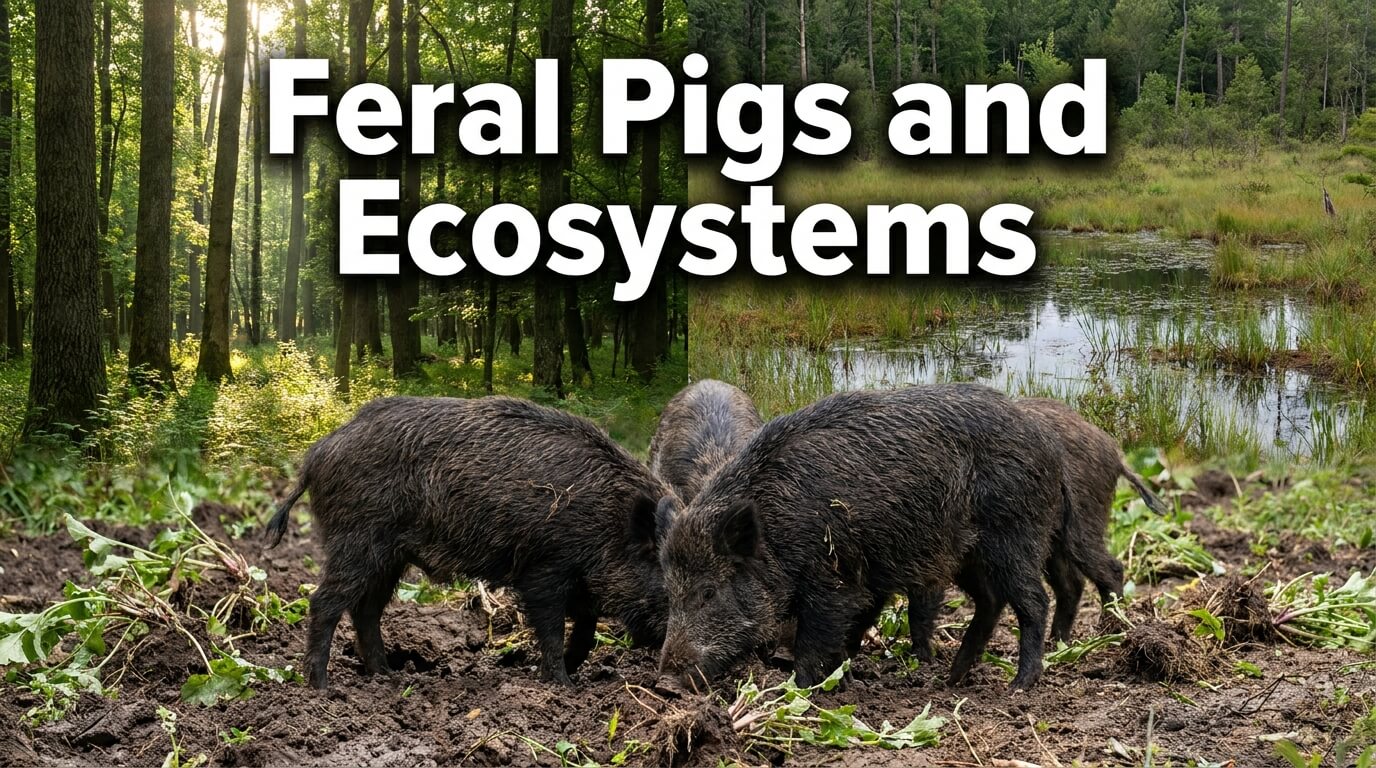
Feral pigs and ecosystems are closely connected because wild pigs do not just pass through a landscape. They dig, wallow, eat many kinds of food, disturb soil, muddy water, damage crops, compete with native wildlife, and may carry diseases that matter to livestock, pets, wildlife, and people. In many parts of the United States, feral pigs are considered one of the most destructive invasive mammals because their feeding behavior physically changes the ground they use.

The most useful way to understand feral pigs is not to treat them as ordinary farm pigs living outside. They are adaptable, wary, social animals that can survive in forests, wetlands, river bottoms, grasslands, farms, and suburban edges. Their impact depends on local habitat, population density, food availability, and how long they have been established. A small, newly detected group can be a warning sign. A large established population can become a long-term ecosystem problem.
Quick Answer
Feral pigs affect ecosystems mainly through rooting, wallowing, trampling, feeding, and disease risk. Rooting turns over soil while pigs search for roots, tubers, fungi, acorns, insects, worms, and other food. Wallowing can muddy wet areas and damage streambanks. Their broad diet lets them compete with native wildlife and sometimes prey on eggs, young animals, reptiles, amphibians, and invertebrates.
They also affect farms and property. Crops, pasture, fences, irrigation systems, lawns, roadsides, and cultural sites can all be damaged. USDA APHIS describes feral swine as an invasive species that damages agriculture, natural resources, property, animal health, and human health and safety, and it reports large national costs tied to damage and management efforts through its feral swine management overview.
For readers, the practical takeaway is simple: feral pigs are not animals to approach, feed, relocate, or try to manage casually. Sightings and damage should be handled through local wildlife, agricultural, or land-management authorities because laws and safe response options vary by state.

What Are Feral Pigs?
Feral pigs are free-ranging members of the species Sus scrofa that live outside human control. In the United States, they may descend from escaped or released domestic pigs, introduced Eurasian wild boar, or crosses between the two. That mixed background is one reason they vary so much in size, coat color, body shape, tusk length, and behavior.

Feral pigs, wild hogs, wild boar, and feral swine terminology
People use several names for these animals. “Feral pig,” “wild pig,” “wild hog,” and “feral swine” often refer to the same free-ranging invasive animals in North America. “Wild boar” can refer to Eurasian wild boar ancestry, but in everyday US conversations it is sometimes used loosely for any wild-living pig. “Razorback” is another regional nickname, especially in parts of the South.
The wording matters because casual names can hide the management problem. A pig that looks like a farm animal may behave like wildlife once it lives and breeds outdoors. A pig with Eurasian boar traits may still be part of a hybrid population. For ecosystem impact, the main issue is not the name but whether the animals are free-ranging, reproducing, and damaging land, water, wildlife, or agriculture.
Native ancestry vs introduced populations
Pigs in the genus Sus are native to parts of the Old World, not to the Americas. Mississippi State University Extension explains that wild pigs in the United States trace back to domestic stock brought by European explorers and settlers, later Eurasian wild boar introductions, escapes, releases, and interbreeding, as summarized in its wild pig history overview.
That history is important for invasive species context. Feral pigs did not evolve as native members of North American food webs. Native plants, ground-nesting animals, wetland systems, and soil communities did not develop under the same long-term pressure from large rooting pigs. In some places, that mismatch helps explain why their disturbance can be so severe.
Why feral pigs adapt so well
Feral pigs adapt well because they combine physical strength, flexible feeding, intelligence, and social behavior. They can eat plant material, animal matter, fungi, agricultural crops, carrion, and human-associated foods when available. They have strong snouts for digging, can travel through dense cover, and often become more cautious after people pressure them.
They are also behaviorally flexible. In quiet areas they may move during the day, while in heavily disturbed areas they may become more active at night. They can use thick vegetation, creek bottoms, marsh edges, crop fields, and brushy refuges. That flexibility makes them difficult to predict and harder to remove once established.
Where Feral Pigs Live and Spread
Feral pigs are now a widespread problem across much of the southern United States and have been reported in many other regions. Their distribution is not uniform. Some states have large, established populations, while others focus on rapid response when small groups appear. Local conditions, land use, climate, food supply, and human movement all shape where pigs persist.
US range and regional variation
Feral pigs are especially associated with the Southeast, Texas, parts of California, Hawaii, and other warm or food-rich regions, but their range has expanded beyond the areas most people expect. In colder regions, survival may be more limited by winter, food availability, and management pressure, yet pigs can still persist where cover and food are adequate.
Regional variation matters because a homeowner in a suburban fringe, a farmer near crop fields, and a park biologist protecting wetlands may experience very different problems. One site may show torn-up lawns. Another may show damaged streambanks. Another may see fewer ground-nesting animals where pig activity is intense.

Habitat flexibility from forests to wetlands to farms
Feral pigs use forests for mast such as acorns, wetlands for water and soft soil, river corridors for movement, crop fields for high-energy food, and brushy areas for cover. They are not tied to a single habitat type. That is one reason they can affect natural ecosystems and human-managed landscapes at the same time.
Wetlands and stream edges can be especially vulnerable because pigs concentrate there for water, cooling, foraging, and movement. Their wallows can churn up sediment. Their trails can cut through vegetation. Their rooting can expose soil that washes into waterways. In drier landscapes, water sources can become focal points for repeated damage.
Why reproduction and movement make control difficult
Feral pigs can reproduce quickly compared with many large mammals, although exact rates vary with food, climate, age, and local conditions. Groups may include adult females and young, often called sounders. Males may move more widely, especially as they mature. When food is plentiful and control is inconsistent, populations can rebound.
Human behavior can also spread pigs. Illegal relocation for hunting, escapes from fenced properties, and failure to report new groups can turn a local problem into a regional one. Movement through river corridors, wooded cover, and agricultural areas adds another layer of difficulty because pigs do not respect property or jurisdiction lines.
How Feral Pigs Damage Ecosystems
The ecological impact of feral pigs starts with how they feed and move. They are not only eating food from an ecosystem. They are physically reshaping the surfaces where plants grow, insects live, seeds germinate, and water flows. That physical disturbance can set off secondary effects that last after the pigs leave.
Rooting and soil disturbance
Rooting is one of the clearest signs of feral pig activity. Pigs use their snouts to flip, push, and tear soil while searching for underground food. In small patches, this can look like rough tilling. In heavy-use areas, it can expose bare soil, uproot vegetation, disturb seed banks, and create uneven ground.
USDA APHIS notes that feral swine rooting can damage pasture by turning over sod and exposing roots, grubs, and invertebrates, which can destroy useful plant cover and make fields difficult to work, as described on its feral swine agriculture damage page.
In natural habitats, the same behavior can disrupt native plant communities. Seedlings may be uprooted before they establish. Soil layers may be mixed in ways that favor disturbance-tolerant plants. Invasive plants can sometimes benefit from open ground, although the outcome depends on local plant species and management.

Wetland, streambank, and water quality impacts
Wallowing is different from rooting but just as important. Pigs wallow in mud to cool themselves and may revisit the same wet spots repeatedly. Those wallows can expand, become muddy pits, and increase sediment movement. Along streams, repeated trampling and rooting can weaken banks and reduce vegetation that helps hold soil in place.
Water quality effects are not only about mud. Fecal contamination, disturbed sediment, and damaged riparian vegetation can affect how a small stream, pond edge, or wetland functions. In protected areas, this matters because wetlands often support amphibians, reptiles, birds, fish, invertebrates, and rare plants in compact spaces.
Competition with native wildlife for food
Feral pigs compete with native wildlife because they eat many of the same foods. Acorns, beechnuts, fruit, roots, tubers, insects, worms, and other seasonal foods may also be important to deer, turkeys, bears, squirrels, small mammals, and many birds. The effect is strongest when pigs are abundant and food is limited.
Competition is not always easy to measure because ecosystems have many moving parts. A low number of pigs may have a smaller effect than a dense population using the same food patches repeatedly. Still, their ability to consume large amounts of food and disturb feeding sites gives them an advantage in many invaded landscapes.
Predation on eggs, young animals, and ground-nesting species
Feral pigs are omnivores, so they do not rely only on plants. They may eat eggs, nestlings, reptiles, amphibians, small mammals, carrion, and invertebrates. This matters for ground-nesting birds, turtles, and other animals whose nests are accessible to a strong snout and a good sense of smell.
The National Park Service highlights feral swine as a threat to natural and cultural resources in parks, noting damage from rooting, impacts on native plant communities and habitat, disease concerns, and the need for sustained control in a National Park Service feral swine project profile.
Agricultural and Property Impacts
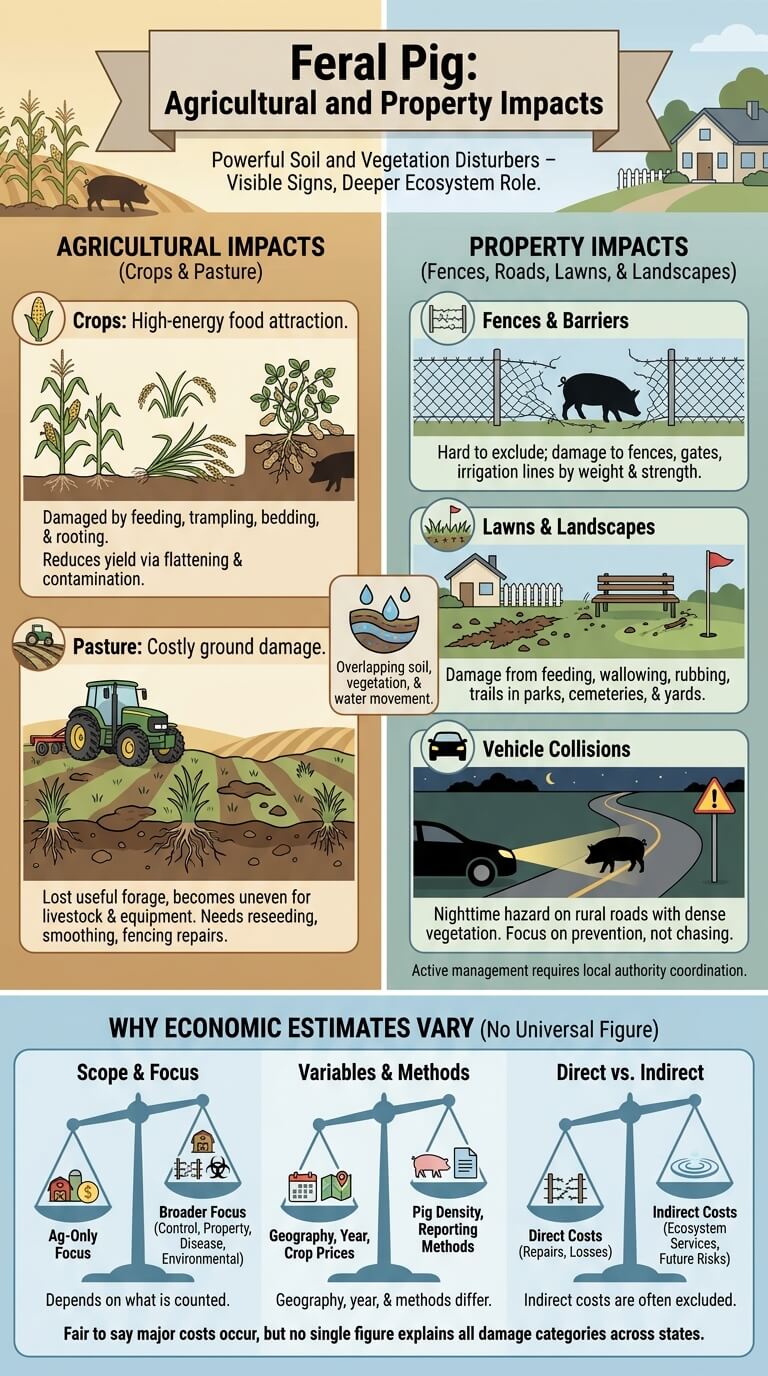
Feral pig damage often becomes visible to people before the full ecological impact is understood. A field may look plowed overnight. A lawn may be torn up. A fence may be damaged where pigs push through. These visible signs are frustrating, but they are also clues to the animal’s deeper ecosystem role as a powerful soil and vegetation disturber.
Crop damage and pasture damage
Crops can attract feral pigs because agricultural fields offer concentrated, high-energy food. Corn, rice, peanuts, sorghum, hay fields, fruits, and other crops can be damaged by feeding, trampling, bedding, and rooting. Even when pigs do not eat an entire crop, they can reduce yield by flattening plants or contaminating fields.
Pasture damage is especially costly because rooted ground can lose useful forage and become uneven. That creates problems for livestock movement and equipment. Damaged pasture may also need reseeding, smoothing, weed control, or fencing repairs. The ecological and agricultural problems overlap because both involve soil, vegetation, and water movement.
Fences, roads, lawns, and landscape disturbance
Feral pigs can damage fences, gates, irrigation lines, golf courses, cemeteries, parks, roadsides, and residential landscapes. In some cases, the damage is caused by feeding. In others, it comes from wallowing, rubbing, trails, or attempts to move through barriers. Their weight and strength make them harder to exclude than many smaller wildlife species.
Vehicle collisions are another concern in areas where pigs cross roads at night. Dense vegetation, curves, and rural roads can make encounters sudden. The safest approach is prevention and awareness, not chasing or trying to herd pigs away. Any active management around roads, farms, or neighborhoods should be coordinated through proper local authorities.
Why economic impact estimates vary
Economic damage estimates vary because they may count different things. Some focus on agriculture. Others include control costs, property damage, disease risk, environmental damage, and public safety. The result depends on geography, year, crop prices, pig density, reporting methods, and whether indirect costs are included.
That is why strong articles and agency reports often use careful wording rather than one universal number. It is fair to say feral pigs cause major costs in the United States. It is less safe to claim a single figure explains every kind of damage in every state. A farmer’s loss, a park’s restoration cost, and a county’s road hazard are related but not identical categories.
Disease and Safety Context
Disease and safety are part of the feral pig problem, but they should not be exaggerated into fear-based claims. Feral pigs can carry pathogens and parasites, and some can affect livestock, pets, wildlife, or people. Risk depends on exposure. People are more likely to face disease concerns through handling carcasses, butchering, contact with fluids or tissues, unsafe meat preparation, or close contact involving dogs or livestock.
Diseases and parasites associated with feral swine
USDA APHIS states that feral swine are known to carry at least 30 viral and bacterial diseases and nearly 40 parasites that can be transmitted to humans, pets, livestock, or wildlife, and its feral swine pets and people page emphasizes the risks linked to handling, butchering, and undercooked meat.
That does not mean every feral pig is visibly sick or that a distant sighting is an emergency. It means direct contact should be avoided and professional guidance matters. Animals can appear healthy while still carrying organisms that create risk under the wrong exposure conditions.

Why pets, livestock, and people need caution
Dogs may be injured during encounters with feral pigs, and hunting or roaming dogs can be exposed to blood, tissues, parasites, or bacteria. Livestock can face disease concerns where feral pigs share pastures, water, feed, or fence lines. People can also be at risk if they handle pigs without proper training or safety precautions.
The CDC explains that people can get brucellosis through contact with infected animals or contaminated animal products and specifically lists wild hogs among animals hunters may encounter in its brucellosis and animals guidance.
Pet owners should be cautious if dogs have had direct contact with feral pigs, pig carcasses, or potentially contaminated material. A veterinarian is the right person to call if a pet is injured, bitten, suddenly ill, lethargic, feverish, vomiting, or acting abnormal after wildlife contact. This article cannot diagnose an animal or replace veterinary care.
What to do and not do during an encounter
If you see feral pigs, give them space. Do not approach, feed, corner, chase, film at close range, or try to scare them with a pet. Sows with young can be defensive, and any large wild animal can be unpredictable when trapped or pressured. Keep dogs leashed in areas where pigs are known to occur.
If pigs are damaging property, contact your state wildlife agency, USDA Wildlife Services office, county extension office, park staff, or local agricultural authority. Do not relocate pigs. Moving them can spread the problem and may violate state law. Do not attempt trapping or control without knowing local regulations and safety requirements.
Why Feral Pig Control Is So Difficult
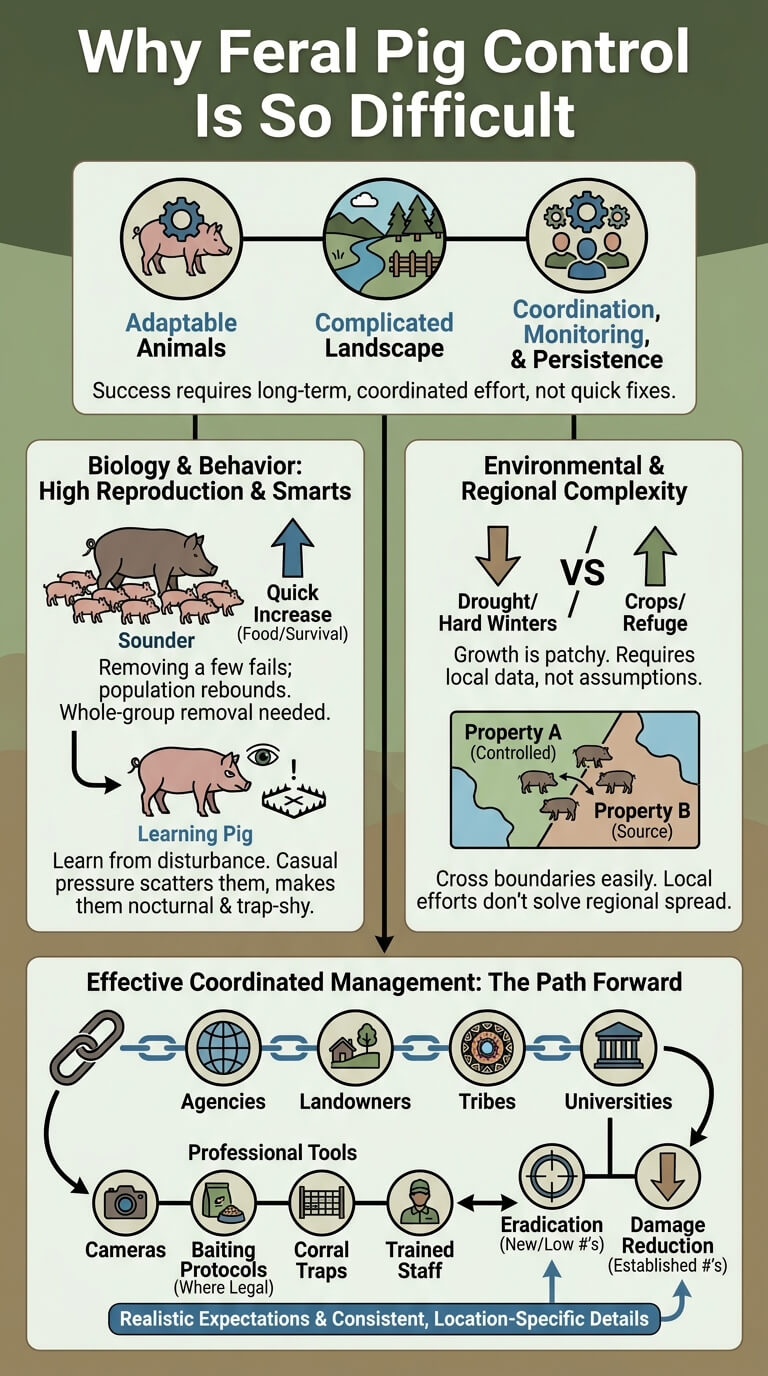
Feral pig control is difficult because the animals are adaptable and the landscape is often complicated. A strategy that works on a fenced property may not work in a river corridor. A tool that helps reduce crop damage may not eliminate pigs from a large forest. Success usually requires coordination, monitoring, and persistence.
High reproduction and social groups
Feral pigs can increase quickly when food is abundant and survival is high. Sounders, or female-led groups, can contain multiple related animals, and removing only a few individuals may leave the population able to rebound. This is why managers often focus on whole-group removal where legal, practical, and professionally supervised.
Population growth is also patchy. Drought, hard winters, disease, food shortages, or intensive control can reduce numbers. Crop availability, mild weather, and refuge habitat can help numbers rise. Because of this variation, control plans need local data instead of one-size-fits-all assumptions.
Intelligence, wariness, and pressure from failed control
Feral pigs learn from disturbance. If a group survives poor control attempts, remaining animals may become more nocturnal, avoid traps, shift routes, or use thicker cover. This is one reason casual pressure can make management harder rather than easier. It can scatter pigs and reduce the chance of removing the whole group.
The animals are not magically impossible to manage, but they reward consistency and punish half-measures. Professional programs often rely on cameras, baiting protocols where legal, corral traps, trained staff, landowner cooperation, and careful timing. The details are location-specific and should not be copied from a general internet article.
Why local efforts may not solve regional spread
A landowner may reduce damage on one property while pigs continue to move in from neighboring land. A park may remove pigs from priority habitat while nearby private land remains a source. A county may respond quickly while a neighboring area does not. Feral pigs are a landscape-level problem because they cross boundaries easily.
That is why coordinated programs matter. Agencies often work with landowners, tribes, states, universities, and federal partners. The goal may be eradication where numbers are low and populations are new, or damage reduction where populations are already established. Both goals require realistic expectations.
Common Myths and Mistakes
Feral pigs attract strong opinions. Some people see only a hunting opportunity. Others imagine them as unstoppable monsters. Neither view is enough. The ecological reality is more useful: they are intelligent invasive mammals with real impacts, but management still depends on law, safety, local conditions, and professional planning.
Myth: feral pigs are just farm pigs living outside
Some feral pigs may look similar to domestic pigs, especially if they have recent domestic ancestry. But living and breeding in the wild changes the situation. They select their own food, avoid people, use cover, form wild social groups, and may develop traits associated with survival outside captivity. Their ecosystem impact comes from free-ranging behavior, not from whether they look like a barnyard animal.
Myth: hunting alone solves the problem everywhere
Hunting can remove individual pigs and may be part of management in some areas, but it does not automatically solve established feral pig problems. If hunting pressure is uncoordinated, it may educate pigs, scatter groups, or remove too few animals to reduce reproduction. In some regions, illegal movement of pigs for hunting has also contributed to spread.
Effective management is not simply a matter of more people chasing pigs. It is a matter of matching tools to goals, laws, terrain, animal behavior, disease concerns, and land ownership patterns. That is why wildlife agencies often emphasize coordinated, integrated management instead of relying on one method.
Mistake: feeding or relocating pigs
Feeding feral pigs encourages them to return and can increase conflict around homes, roads, farms, or public areas. It can also draw pigs into closer contact with pets, livestock, and people. Relocating pigs is even worse because it can create new populations, spread disease risk, and violate wildlife laws.
If a pig appears in a new area, rapid reporting can matter. Early detection gives agencies a better chance to remove small populations before they become established. Waiting until damage is widespread makes the problem harder and more expensive.
How This Connects to Nearby Animal Topics
Feral pigs fit into the larger invasive animals topic because they show how one non-native animal can affect soil, water, plants, wildlife, agriculture, and safety at the same time. They are especially useful for understanding land-based invasions because their impact is visible in the ground itself.
How feral pigs compare with Burmese pythons and invasive carp
Burmese pythons in Florida are mainly discussed as invasive predators in a subtropical wetland. Invasive carp are usually discussed through freshwater food webs and connected waterways. Feral pigs are different because they combine ecosystem engineering, broad feeding, property damage, agricultural loss, and disease concerns in many land habitats.
Those differences show why invasive animal management cannot use one simple template. A python, a carp, and a pig all cause harm outside their native range, but they move, feed, reproduce, and interact with people in very different ways.
Why land-based invasions differ from aquatic invasions
Land-based invasions often involve property boundaries, farms, roads, forests, parks, and private land access. Aquatic invasions often involve connected rivers, boat traffic, water infrastructure, and fish movement. Feral pigs are hard to manage partly because they use both natural cover and human landscapes.
Their tracks, rooting, wallows, and crop damage can be seen directly. That visibility can help with detection, but it can also create conflict when neighbors disagree about response. Control often depends on cooperation across land ownership boundaries.
How conservation control balances safety, ethics, and ecology
Feral pig control raises ethical questions because pigs are intelligent mammals, yet their damage can be severe. Conservation management has to weigh animal welfare, ecosystem protection, agricultural loss, public safety, disease risk, and legal requirements. That balance is difficult, but ignoring the problem can allow harm to spread.
The most responsible public role is not to improvise control. It is to avoid feeding or moving pigs, report new sightings where agencies request reports, protect pets and livestock, and support science-based management led by qualified professionals.
Among invasive animals in the US, feral pigs show how a land mammal can damage farms, wetlands, forests, and suburban edges at the same time.
They create a different kind of invasion problem from cane toads, where toxins and predator vulnerability are central to the story.
FAQ
Are feral pigs dangerous to humans?
Feral pigs can be dangerous in the wrong context, especially if they are cornered, injured, protecting young, surprised at close range, or involved in a vehicle collision. The greater everyday risks for many people involve property damage, road hazards, and disease exposure through handling or butchering. The safest response is to keep distance, secure pets, and contact local authorities if pigs are causing damage or appearing in areas where they do not belong.
What do feral pigs eat?
Feral pigs are omnivores. They may eat roots, tubers, acorns, fruit, crops, grasses, fungi, insects, worms, eggs, reptiles, amphibians, small animals, carrion, and human-associated food when available. Their flexible diet is one reason they succeed in so many habitats. It also explains why they can compete with native wildlife, damage crops, and disturb soil while searching for food.
Why are feral pigs so hard to eradicate?
They are hard to eradicate because they reproduce quickly under good conditions, move across property boundaries, use dense cover, learn from failed control attempts, and can be spread by people. In places where populations are small or newly detected, eradication may be possible with coordinated action. In heavily established areas, managers may focus on reducing damage and preventing further spread.
Should homeowners try to trap feral pigs themselves?
Homeowners should not casually trap feral pigs without local guidance. Trapping large wild animals can be dangerous, may be regulated, and can make the problem worse if done poorly. A better first step is to contact a state wildlife agency, local agricultural extension office, USDA Wildlife Services office, or licensed wildlife professional. Never relocate trapped pigs.
Final Thoughts
Feral pigs and ecosystems are linked through disturbance. These animals dig, wallow, feed broadly, damage crops and property, compete with wildlife, and create safety and disease concerns where people, pets, livestock, and wild animals overlap. They are not just a nuisance animal and not simply a hunting topic. They are a serious invasive species problem that changes land and water from the ground up.
The best response is careful, local, and professional. Keep distance, do not feed or relocate pigs, protect pets and livestock, report sightings where requested, and rely on wildlife and agricultural authorities for management decisions. Understanding how feral pigs affect ecosystems helps readers see why invasive species control is not only about removing an animal. It is about protecting habitat, native wildlife, farms, water quality, and public safety at the same time.

Ethan Walker is the founder and research editor of Animal Fact Central. He creates and reviews educational animal facts content using trusted wildlife, pet care, and science-based sources. His work focuses on making animal behavior, adaptations, habitats, and species facts clear, accurate, and engaging for everyday readers.
Read More Details About Ethan Walker: https://animalfactcentral.com/ethan-walker/