

Why are monarch butterflies endangered, threatened, or described as at risk? The short answer is that North American migratory monarchs have lost too much of the habitat they need across their life cycle. Caterpillars need milkweed. Adults need nectar plants. Migrating monarchs need safe stopover habitat. Wintering monarchs need protected forest groves in Mexico and coastal California. When those pieces shrink or become more dangerous because of land-use change, pesticides, herbicides, climate stress, and overwintering habitat pressure, the migration becomes harder to sustain.
The status wording can be confusing. Monarch butterflies are not simply “endangered everywhere” in the same legal sense. In the United States, the U.S. Fish and Wildlife Service says monarchs have been proposed for listing as threatened under the Endangered Species Act, but federal protections would not apply until a final rule takes effect on the U.S. Fish and Wildlife Service monarch page. Conservation assessments, state rules, and news headlines may use different terms. The most accurate answer is that migratory monarchs are in serious long-term decline, especially in North American migrations, and status should be checked against current official information.
Quick Answer

Monarch butterflies are at risk mainly because their life cycle depends on connected habitat across a huge range. Female monarchs lay eggs on milkweed, and monarch caterpillars feed on milkweed leaves. Adult monarchs drink nectar from many flowers, especially during migration. The eastern migratory population overwinters in central Mexico, while the western migratory population overwinters mostly along the California coast. A problem in any one part of that chain can affect the number of monarchs that survive to the next stage.
The major threats include loss of milkweed and breeding habitat, loss of nectar flowers, exposure to insecticides and herbicides, climate and weather extremes, and pressure on overwintering sites. None of these threats works in isolation. A drought can reduce nectar. Herbicide use can remove milkweed from breeding areas. Insecticides can harm caterpillars or adults. Storms or heat events can hit monarchs when they are clustered or migrating. Conservation is therefore not just about one flower or one garden. It is about restoring a safer network of habitat across seasons.
Current Status Caution
The word “endangered” can mean different things depending on who is using it. A news headline may use the word broadly to mean “in danger.” A legal agency may use it as a specific category under a law. A conservation assessment may use it as part of a Red List category. Those are not the same thing, and monarchs are a good example of why the distinction matters.
Why legal status and conservation status can differ
Legal status is about what protections apply under a particular law in a particular place. For U.S. readers, the most important federal law is the Endangered Species Act. As of the latest official information checked for this article, the monarch butterfly had been proposed for listing as threatened in the United States, but that is not the same as being already protected by a final listing rule.
Conservation status is a scientific assessment of extinction risk or population decline. It may be global, regional, or focused on a subspecies or population. The migratory monarch has also been discussed through IUCN Red List categories, and the wording has changed as the assessment criteria and data interpretation were reviewed. Monarch Joint Venture explains that the IUCN listing for the migratory monarch changed from Endangered to Vulnerable in 2023, while the change did not mean the population suddenly recovered on the ground according to Monarch Joint Venture’s status explanation.
Why readers should check current official sources for updates
Monarch status is not static. Federal proposals can move through comment periods, delays, revisions, lawsuits, and final decisions. Population estimates can also swing from year to year because weather, survey conditions, and overwintering survival vary. A single winter count does not erase a long-term trend.
For that reason, articles about monarchs should avoid wording that sounds timeless, such as “monarchs are legally endangered in the United States,” unless that statement is current and supported at the time of publication. A safer and more accurate approach is to say that North American migratory monarchs are a major conservation concern, that their legal status may differ from their conservation assessment, and that readers should confirm current rules before making legal or management decisions.
Why Monarch Butterflies Matter
Monarchs matter for more than their bright orange wings. They are one of the best-known examples of insect migration, a visible symbol of pollinator habitat, and a species that helps people notice how plants, insects, climate, and land management are connected. That said, monarchs should not be described as the only pollinator that matters or as the one species holding entire ecosystems together.
Migration as a remarkable animal behavior
The North American monarch migration is extraordinary because it links many generations across a continent. In the eastern migration, monarchs that overwinter in Mexico move north in spring and produce new generations along the way. Later generations continue the movement through the United States and into parts of southern Canada. In late summer and fall, a special migratory generation travels south toward overwintering sites.
No single summer monarch makes the whole annual round trip from Mexico to Canada and back. The journey depends on a chain of generations, each using the right plants in the right season. That makes habitat timing important. A field with milkweed in spring may help breeding monarchs. Late-season nectar can help fall migrants build energy. Protected winter forest can help the migratory generation survive until spring.
Monarchs as pollinators and food-web participants
Adult monarchs visit flowers for nectar and can carry pollen, but they are not usually treated as the most efficient crop pollinators compared with many bees. Their bigger conservation role is often as a flagship species. When people plant native milkweed and nectar flowers for monarchs, they can also support bees, moths, flies, beetles, and other insects that use the same habitat.
Monarchs also fit into food webs. Eggs, caterpillars, pupae, and adults can be eaten or parasitized by other organisms. Milkweed chemicals can make monarchs distasteful to some predators, but that does not make them untouchable. Their survival still depends on weather, plant quality, disease pressure, and the many risks faced by small insects.
Cultural and educational importance without overstating ecosystem role
Monarchs are familiar to children, gardeners, teachers, and families because they are easy to recognize and have a dramatic life cycle. A monarch egg on milkweed, a striped caterpillar, a green chrysalis, and an orange adult can show metamorphosis more clearly than almost any classroom diagram.
Their migration also has cultural importance in North America, especially where overwintering monarchs gather in Mexico and California. Still, it is best to avoid overstating their ecological role. The loss of monarchs would be a serious biological and cultural loss, but it would not mean all pollination stops. Their importance is strongest when understood as part of a broader decline in insect habitat and migratory wildlife connections.
The Main Threats Facing Monarch Butterflies
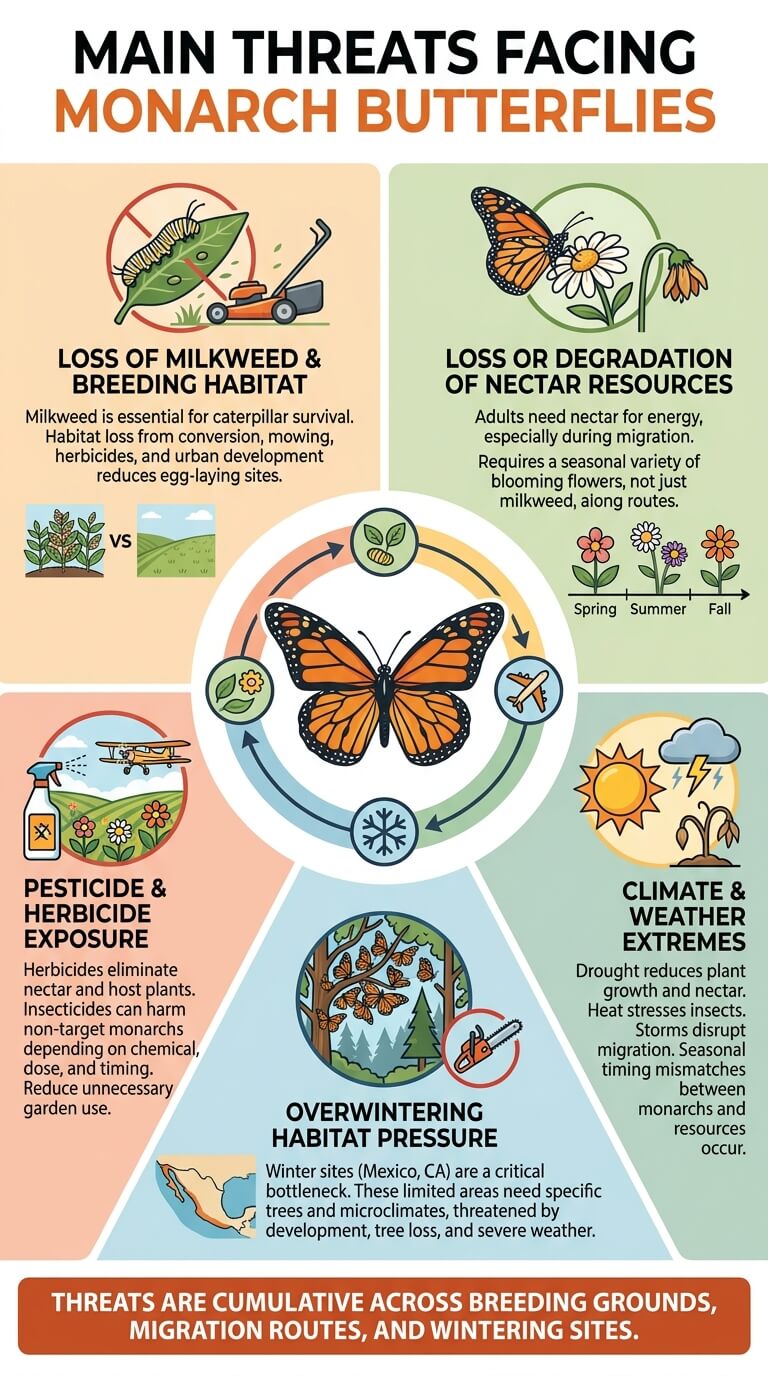
Monarch decline has no single cause. The threats add up across breeding grounds, migration routes, and wintering sites. Monarch Joint Venture summarizes major threats as breeding habitat loss, overwintering habitat loss, climate change, pesticides, natural enemies, and other human-related concerns on its monarch threats overview.
Loss of milkweed and breeding habitat
Milkweed is not optional for monarch reproduction. Adult monarchs can drink nectar from many kinds of flowers, but monarch caterpillars depend on milkweed as their host plant. If females cannot find enough milkweed in the right places, fewer eggs are laid. If caterpillars hatch on milkweed that is mowed, sprayed, removed, or stressed by drought, fewer larvae survive.
Breeding habitat can disappear when grasslands, roadsides, field margins, vacant lots, and other open spaces are converted, heavily mowed, treated with herbicides, or managed without host plants. Agricultural landscapes can still support monarchs when habitat is present, but large areas with little milkweed create gaps in the breeding network.
Loss or degradation of nectar resources
Monarch adults need nectar for energy. This is especially important during migration, when adults must find flowers along their route. Milkweed alone is not enough. Spring migrants, summer breeders, and fall migrants may need different nectar plants because different flowers bloom at different times.
The USDA Forest Service notes that monarch habitat needs both milkweed and flowering plants, because adults feed on nectar from many flowers while breeding depends on milkweed in its monarch butterfly habitat guidance. Habitat that has host plants but few nectar flowers may not support adults well. Habitat with nectar flowers but no milkweed may feed adults but cannot produce the next generation.
Pesticide and herbicide exposure context
Pesticide and herbicide issues are easy to oversimplify. Herbicides can reduce milkweed and flowering plants when they remove broadleaf plants from landscapes. Insecticides can harm non-target insects, including caterpillars and adult butterflies, depending on the chemical, dose, timing, application method, and exposure route.
This does not mean every pesticide application kills monarchs, and it does not mean every farm or garden is equally harmful. The careful point is that broad chemical exposure can reduce habitat quality and increase risk for insects that are already facing other pressures. For home gardeners, avoiding unnecessary insecticides on flowering plants and milkweed is one practical way to reduce risk.
Climate and weather extremes
Climate pressure affects monarchs in several ways. Drought can reduce milkweed growth and nectar availability. Heat can stress plants and insects. Storms can affect migration or overwintering clusters. Unusual seasonal timing can create mismatches between monarch movement and plant availability.
Weather also helps explain why annual monarch counts can jump up or down. Favorable rainfall in one region may improve plant growth and reproduction. Severe storms or heat at the wrong time can reduce survival. That is why conservation biologists look at long-term trends, not just one season.
Overwintering habitat pressure
Overwintering habitat is a bottleneck because large numbers of monarchs cluster in relatively limited areas. Eastern migratory monarchs overwinter in mountain forests in central Mexico. Western migratory monarchs overwinter mainly along coastal California and nearby areas. These sites need suitable trees, microclimate, moisture, and protection from disturbance.
When wintering groves are degraded by development, tree loss, unsuitable management, severe storms, drought, or other pressures, monarchs can lose the conditions that help them conserve energy until spring. Protecting breeding habitat matters, but it cannot replace the need for safe winter habitat.
Monarch Life Cycle and Migration Context
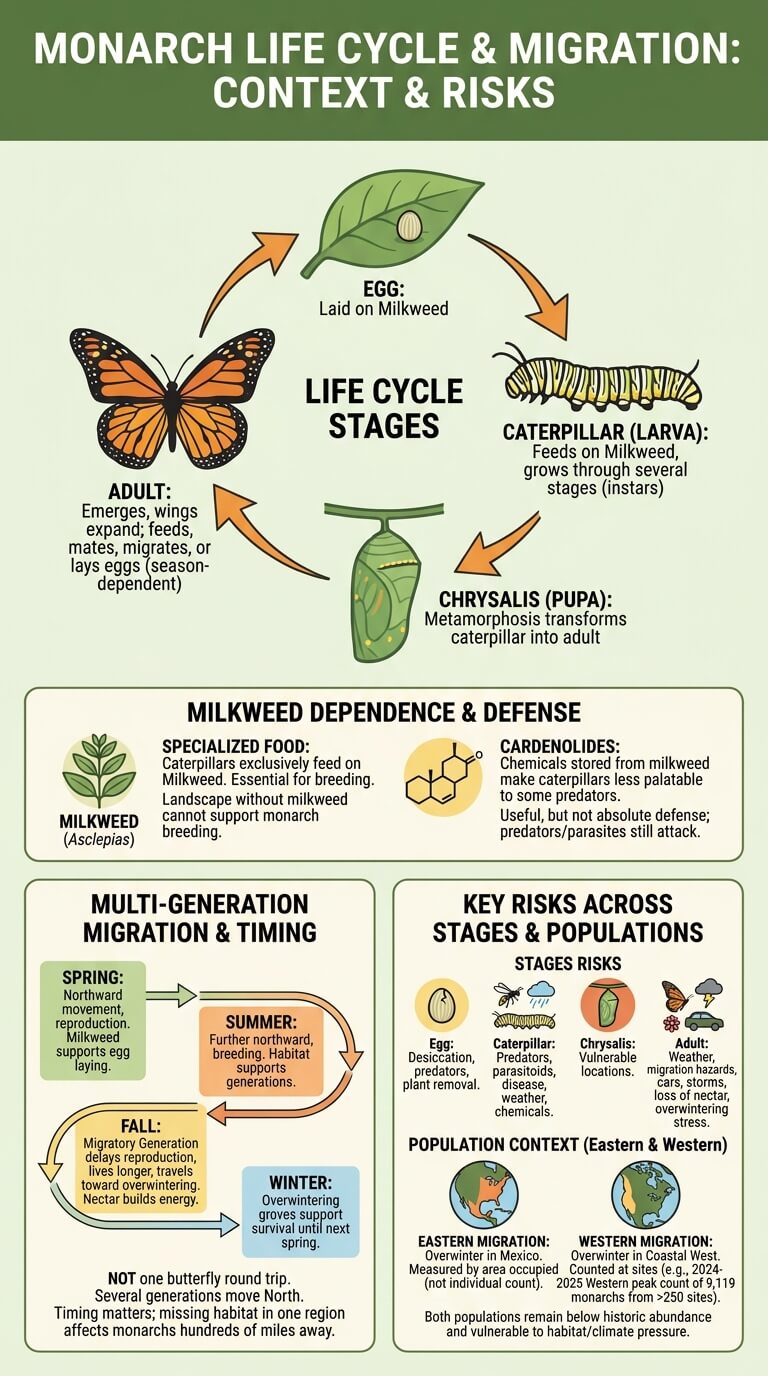
To understand why monarch butterflies are endangered or at risk, it helps to follow the animal through its life cycle. Monarch conservation is not just about adult butterflies on flowers. It also includes eggs, caterpillars, chrysalises, and the seasonal movement of multiple generations.
Eggs, caterpillars, chrysalis, and adults
A female monarch lays eggs on milkweed. A caterpillar hatches and feeds on milkweed leaves while growing through several larval stages. It then forms a chrysalis, where metamorphosis changes the caterpillar into an adult butterfly. The adult emerges, expands its wings, and eventually feeds, mates, migrates, or lays eggs depending on season and generation.
Every stage has risks. Eggs can dry out, be eaten, or be laid on plants that later get removed. Caterpillars can be affected by predators, parasitoids, disease, plant quality, weather, and chemicals. Chrysalises can be vulnerable if they form in unsafe places. Adults face weather, migration hazards, cars, storms, loss of nectar, and overwintering stress.
Milkweed dependence during the caterpillar stage
Milkweed dependence is one reason monarchs are so closely tied to habitat. Many adult butterflies can sip nectar from a broad range of flowers, but caterpillars are much more specialized. Monarch caterpillars feed on milkweeds in the genus Asclepias. That specialization helps define the monarch life cycle, but it also means a landscape without milkweed cannot support monarch breeding.
Milkweed also contains cardenolides, chemicals that monarch caterpillars can store in ways that make them less palatable to some predators. This defense is useful but not absolute. Some predators and parasites still attack monarchs, and milkweed chemistry varies among species and conditions.
Multi-generation migration explained carefully
The monarch migration is often described as if one butterfly flies from Mexico to Canada and back. That is not how the annual cycle usually works. Several generations move northward and reproduce during spring and summer. The late-season migratory generation delays reproduction, lives longer than typical summer adults, and travels toward overwintering areas.
This multi-generation system means timing matters. Spring milkweed supports egg laying after winter. Summer habitat supports breeding. Fall nectar helps migrants build energy. Winter groves support survival until the next spring. A missing piece in one region can affect monarchs that people see hundreds or thousands of miles away later in the year.
Eastern and western monarch population context
The eastern and western migratory populations are usually discussed separately because they overwinter in different places and are monitored in different ways. Eastern monarchs are often measured by the area they occupy in Mexico during winter rather than by counting every butterfly. Western monarchs are counted at coastal and nearby overwintering sites in the West.
Monarch Joint Venture notes that both populations face significant challenges, and its population trend page reports a 2024 to 2025 western peak count of 9,119 monarchs from more than 250 overwintering sites on the monarch population trends page. The exact numbers can change each year, but the long-term concern is that both migrations remain below historic abundance and vulnerable to continued habitat and climate pressure.
What People Often Misunderstand

Monarch conservation has become popular, which is good, but popularity can spread simple answers that are not always accurate. The best help for monarchs is usually habitat-based, regionally appropriate, and cautious about unintended consequences.
Monarchs are not the only pollinators that need habitat
Because monarchs are famous, they can receive more public attention than less colorful insects. That attention can help if it leads people to plant native flowers, reduce unnecessary pesticide use, and protect habitat. But monarch-focused gardens should also support other pollinators. Native bees, moths, flies, beetles, wasps, and other butterflies also need host plants, nectar, shelter, and safe nesting places.
A monarch garden with a variety of native plants can become a broader insect habitat. A garden with only one kind of milkweed may help some monarch caterpillars but miss the wider opportunity to support biodiversity across the season.
Planting milkweed is helpful only when done thoughtfully
Planting milkweed can help, but the right choice depends on region. Native milkweed species are usually preferred because they fit local climate, wildlife, and seasonal cycles. Gardeners should avoid planting milkweed in places where it may be inappropriate, invasive, or likely to be treated with pesticides.
Milkweed also needs to be paired with nectar plants. A yard with milkweed but no flowers later in the season may support caterpillars but provide little fuel for migrating adults. A better monarch habitat includes milkweed for larvae and a sequence of native blooms for adults.
Captive rearing is not a simple fix
Many people raise monarchs indoors because they want to protect caterpillars from predators or watch metamorphosis. Small educational projects can be meaningful when done carefully, but large-scale or casual rearing is not a simple conservation solution. It can spread disease, reduce natural selection, encourage repeated handling, and create butterflies that may not perform as well in the wild if rearing conditions are poor.
For most people, habitat creation and careful observation are safer conservation actions than collecting large numbers of eggs or caterpillars. If a school or community group raises monarchs, it should follow regionally appropriate guidance, use clean methods, keep numbers small, and avoid releasing unhealthy butterflies.
Conservation Actions That Can Help
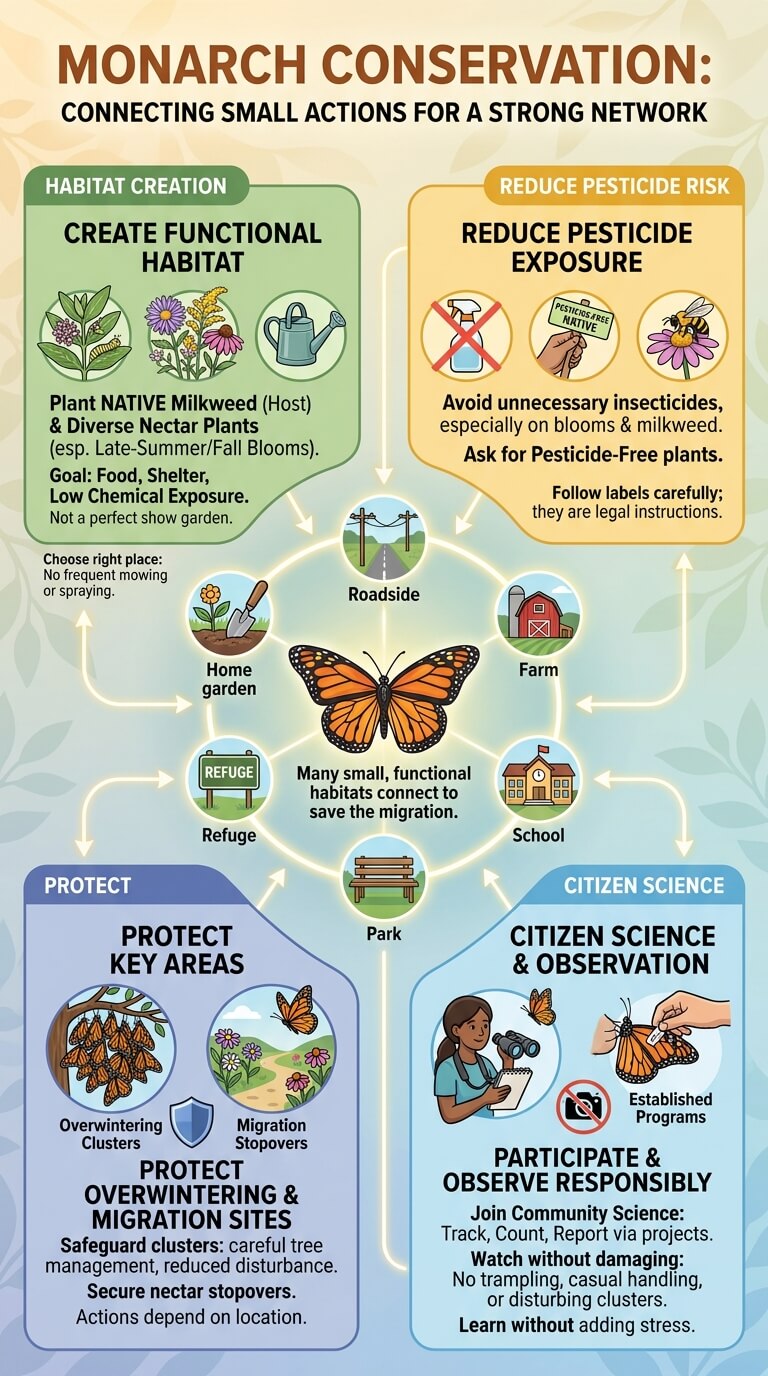
Monarch conservation works best when many small actions connect across the landscape. A single garden cannot save the migration by itself, but many gardens, rights-of-way, parks, farms, refuges, schools, and restoration sites can create a stronger habitat network.
Native milkweed and nectar plants in the right place
Choose milkweed species native to your region, and plant them where they will not be sprayed or frequently mowed during the growing season. Add nectar plants that bloom at different times, especially late-summer and fall flowers for migration. In many parts of the United States, asters, goldenrods, blazing stars, coneflowers, and other native flowering plants can support many insects, not only monarchs.
The goal is not a perfect show garden. It is a functional habitat patch with host plants, nectar, shelter, and low chemical exposure. Even small spaces can contribute when they are part of a wider network.
Reducing pesticide exposure
Home gardeners can help by avoiding unnecessary insecticides, especially on milkweed and blooming plants. If pest control is truly needed, use the least risky option, follow the label, avoid spraying open flowers, and consider whether non-chemical methods are enough. Pesticide labels are legal instructions and should be followed carefully.
Buying plants also requires caution. Some nursery plants may have been treated before purchase. Asking for pesticide-free native plants can reduce the chance that a pollinator garden becomes an exposure site for the insects it is meant to help.
Protecting overwintering and migration habitat
Overwintering sites need local and regional protection. That can include careful tree management, reduced disturbance, control of development pressure, and restoration of the microclimate that monarch clusters need. Migration habitat also matters because monarchs need stopover places with nectar as they move.
Public land managers, farmers, utility corridors, roadside managers, schools, and homeowners can all contribute in different ways. The most useful actions depend on location. A California coastal site, a Midwestern roadside, and a northeastern backyard do not need exactly the same management plan.
Citizen science and responsible observation
Community science projects help researchers track monarch timing, breeding, migration, and overwintering patterns. Observers can report sightings, count butterflies, tag monarchs through established programs, or monitor milkweed when trained to do so.
Responsible observation means watching without damaging habitat. Do not trample milkweed patches, disturb overwintering clusters, handle butterflies for casual photos, or move eggs and caterpillars unless a project has clear conservation or educational guidance. The goal is to learn from monarchs without adding stress.
Edge Cases and Regional Considerations
Monarch advice is not identical everywhere. Climate, migration timing, local milkweed species, disease pressure, and overwintering proximity can change what is helpful. This is why broad social media advice about monarchs can sometimes be incomplete.
Tropical milkweed concerns in some regions
Tropical milkweed, Asclepias curassavica, is popular in gardens because it is showy and easy to grow, but it can create problems in some regions where it stays green for long periods. Year-round milkweed can encourage monarchs to remain and breed when they would otherwise move, and it can increase concerns about the parasite Ophryocystis elektroscirrha, often called OE.
Xerces recommends avoiding tropical milkweed and choosing native milkweeds instead in its tropical milkweed guidance. Advice can vary by region, but the cautious choice for most habitat projects is to use locally native milkweed species and follow local extension or conservation guidance.
Differences between eastern and western populations
Eastern and western monarchs face overlapping threats, but the details are not identical. Eastern monarchs are strongly tied to breeding habitat across the central and eastern United States and overwintering forests in Mexico. Western monarchs rely heavily on overwintering groves along the California coast and breeding habitat across the western states.
Because the western population is much smaller in recent counts, a single bad season can look especially dramatic. The eastern population can also fluctuate widely from year to year. Comparing the two requires care because they are monitored differently and respond to different regional conditions.
Weather-driven annual fluctuations versus long-term trends
Monarch numbers can rise after a favorable breeding season or fall after drought, storms, heat, poor nectar availability, or overwintering losses. These annual changes matter, but they do not tell the whole story. Conservation concern comes from the long-term pattern of lower abundance and reduced resilience.
A resilient migration can absorb some bad years because enough butterflies remain to rebuild when conditions improve. A weakened migration has less room for error. That is why habitat restoration, pesticide reduction, and overwintering protection remain important even when a seasonal count looks better than the year before.
How This Connects to Nearby Animal Topics
Monarch conservation connects naturally to several nearby animal topics, but each topic has its own focus. Keeping the differences clear helps readers understand the bigger pollinator picture without turning every article into the same general overview.
Pollinators as a broader ecosystem group
Monarchs are part of the pollinator conversation, but pollinators include many animals besides butterflies. Bees, flies, moths, beetles, wasps, birds, bats, and other animals can move pollen while feeding. Monarch habitat work can help some of them when it includes native flowering plants and reduced chemical exposure.
Butterfly and moth biology for identification context
Monarchs are butterflies, which means they belong to the insect order Lepidoptera along with moths. Understanding butterfly and moth body features, life cycles, and host plant relationships helps explain why monarch caterpillars need milkweed and why adult butterflies alone do not tell the whole conservation story.
Garden insects and habitat choices that affect more than monarchs
Gardens are small ecosystems. Lady beetles may prey on aphids. Wasps may hunt caterpillars or visit flowers. Bees may nest in soil or stems. Moths may feed at night. A garden managed only for perfect-looking leaves can remove the messy habitat that insects need. A garden managed for life can support monarchs and many other beneficial animals.
FAQ
Are monarch butterflies legally endangered in the United States?
As of the latest official information checked for this article, monarch butterflies were proposed for listing as threatened under the U.S. Endangered Species Act, but they were not yet federally protected by a final listing rule. That status can change, so readers should check the U.S. Fish and Wildlife Service for current federal information before making legal or land-management decisions.
Why do monarch caterpillars need milkweed?
Monarch caterpillars are specialized feeders that eat milkweed. Adult monarchs can drink nectar from many flowers, but females lay eggs on milkweed because the caterpillars need it after hatching. Without milkweed, monarchs may still visit flowers as adults, but they cannot complete the breeding part of their life cycle in that area.
Is it good to raise monarchs indoors?
Raising a small number of monarchs for education can teach people about metamorphosis, but captive rearing is not a simple conservation fix. Poor rearing practices can spread disease, increase handling stress, or produce butterflies that are less prepared for the wild. For most people, planting native milkweed and nectar flowers, reducing pesticide exposure, and observing monarchs outdoors are safer ways to help.
What is the biggest threat to monarch butterflies?
There is no single threat everywhere. The biggest pressures include loss of milkweed and breeding habitat, loss of nectar resources, pesticide and herbicide exposure, climate and weather extremes, and overwintering habitat pressure. The relative importance of each threat can vary between eastern and western monarchs and between regions.
Final Thoughts
Monarch butterflies are at risk because their migration depends on a connected chain of habitat across seasons and regions. They need milkweed for caterpillars, nectar for adults, safe migration stopovers, and protected wintering sites. When those pieces are lost or degraded, fewer monarchs survive the journey from one generation to the next.
The most accurate answer to “why are monarch butterflies endangered?” is not a single dramatic cause. It is a combination of habitat loss, chemical exposure, climate pressure, overwintering vulnerability, and the biological challenge of maintaining a multi-generation migration. People can help by planting regionally appropriate native milkweed and nectar plants, reducing unnecessary pesticides, protecting habitat, and treating monarchs as wild animals to observe responsibly rather than collect casually.

Ethan Walker is the founder and research editor of Animal Fact Central. He creates and reviews educational animal facts content using trusted wildlife, pet care, and science-based sources. His work focuses on making animal behavior, adaptations, habitats, and species facts clear, accurate, and engaging for everyday readers.
Read More Details About Ethan Walker: https://animalfactcentral.com/ethan-walker/