
Nocturnal Animals explains how animals meet the basic challenges of staying alive, finding food, avoiding danger, reproducing, and handling the places they live. The most useful way to read nocturnal animals is to connect each trait with a real survival problem.
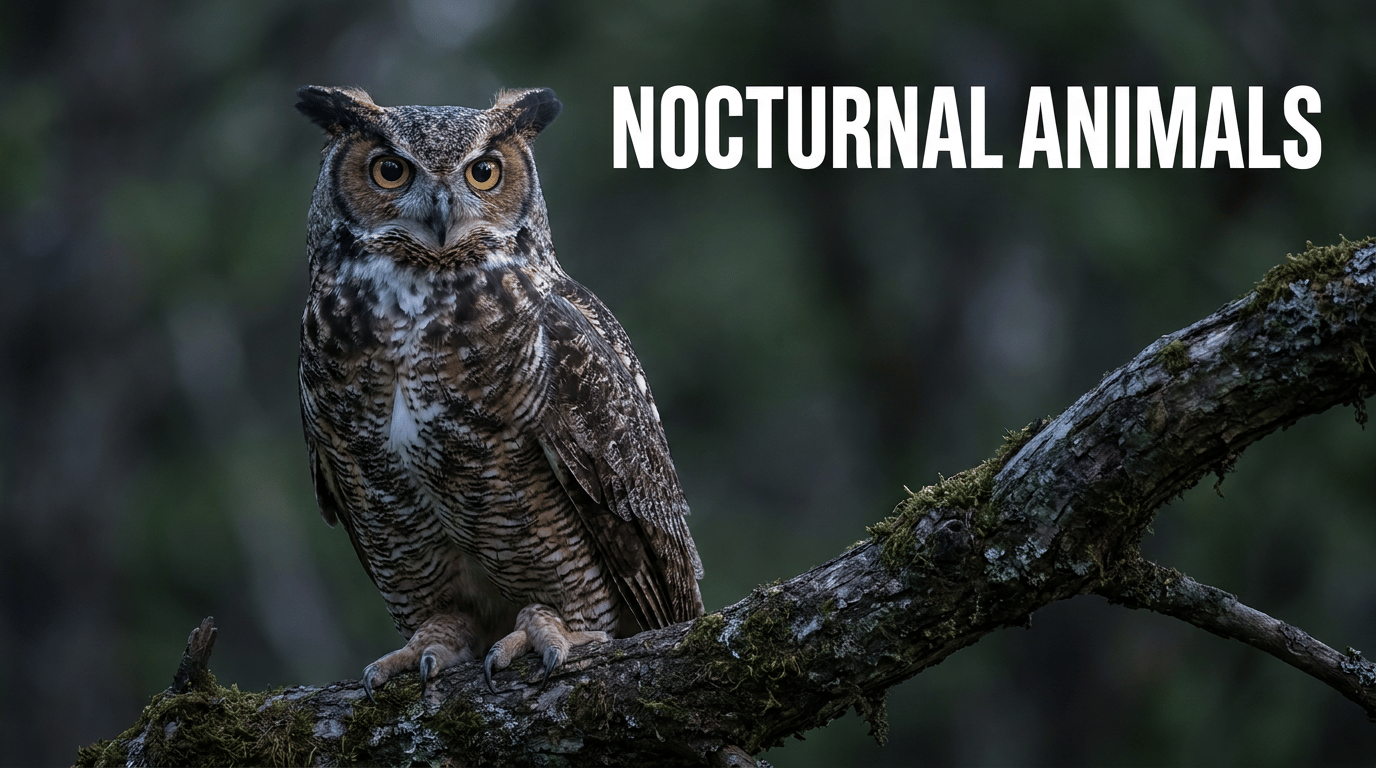
This guide is written for Students, parents, teachers, animal lovers, and readers curious about night wildlife and animal senses.. It keeps the science clear, calm, and family-friendly while avoiding the common mistake of treating evolution as if animals planned their traits. Adaptations are inherited patterns shaped across generations, not conscious choices made by one animal.
The focus here is specific: Focus on nocturnality as a behavior and sensory adaptation. Explain night vision, hearing, smell, predator avoidance, heat avoidance, and examples without turning into a general animal listicle.. Use the headings as a map, then notice how body structures, behaviors, internal processes, and seasonal timing often work together instead of acting as separate tricks.
What Are Nocturnal Animals?
This part of nocturnal animals narrows the idea into a practical survival question. Look for the pressure, the trait, and the trade-off. A helpful reference point is Animal Diversity Web species accounts.
Readers comparing nocturnal animals may also find animals that live in the arctic useful for a closer look at a related animal adaptation topic.
Readers comparing nocturnal animals may also find animal defense mechanisms useful for a closer look at a related animal adaptation topic.
Readers comparing nocturnal animals may also find camouflage in animals useful for a closer look at a related animal adaptation topic.
Nocturnal animals are active mostly at night
Behavioral traits are patterns of action. They matter because the same body can survive very differently depending on when, where, and how an animal uses it.
Feeding
Feeding: The value of this trait depends on context: habitat, season, predators, food supply, and the animal’s other adaptations.
Hunting
Hunting: This action helps only when it fits the timing, place, and risk the animal faces.
Traveling
Traveling: The value of this trait depends on context: habitat, season, predators, food supply, and the animal’s other adaptations.
Avoiding daytime risks
Avoiding daytime risks: This action helps only when it fits the timing, place, and risk the animal faces.
Nocturnal vs diurnal vs crepuscular
Behavioral traits are patterns of action. They matter because the same body can survive very differently depending on when, where, and how an animal uses it.
Day-active animals
Day-active animals: The value of this trait depends on context: habitat, season, predators, food supply, and the animal’s other adaptations.
Dawn and dusk animals
Dawn and dusk animals: The value of this trait depends on context: habitat, season, predators, food supply, and the animal’s other adaptations.
Why categories can overlap
Why categories can overlap: The value of this trait depends on context: habitat, season, predators, food supply, and the animal’s other adaptations.
Why Animals Become Nocturnal
This part of nocturnal animals narrows the idea into a practical survival question. Look for the pressure, the trait, and the trade-off.
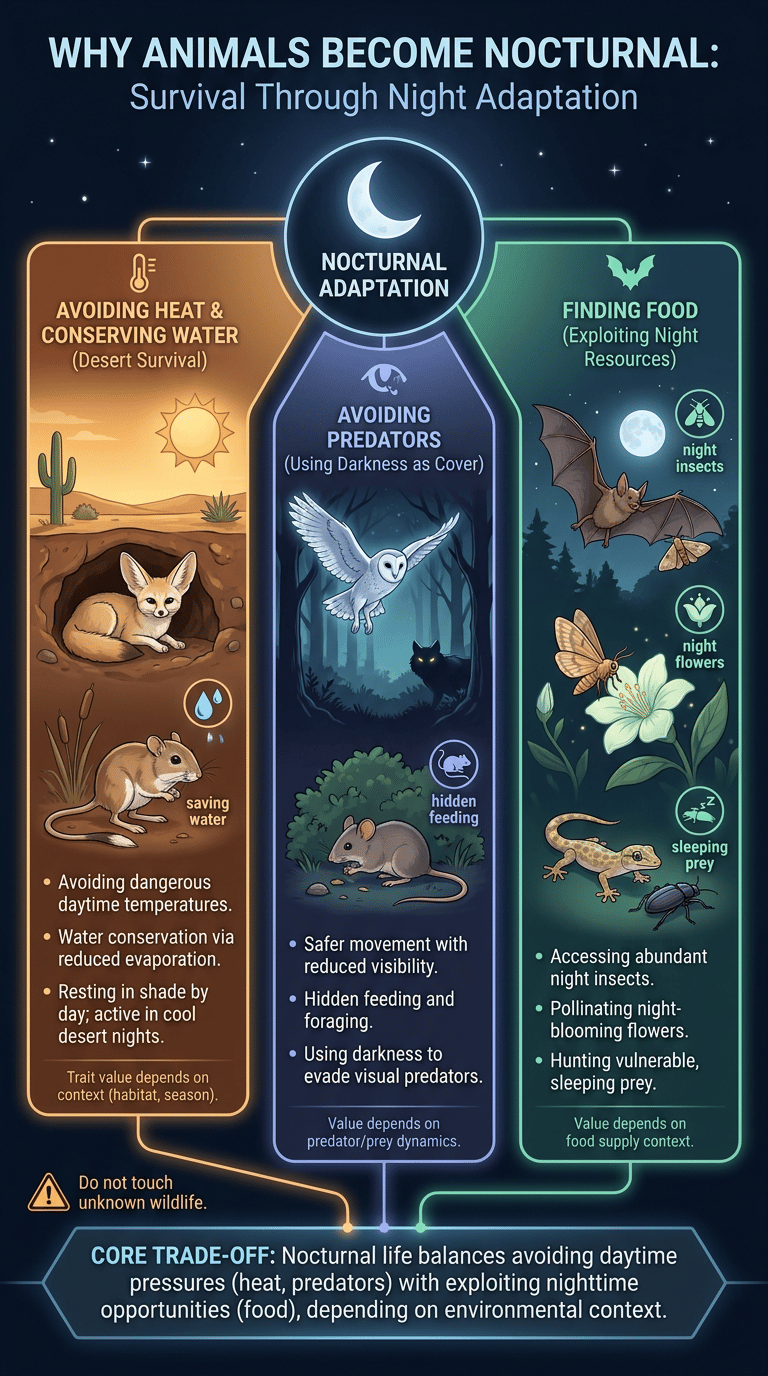
Avoiding heat
Desert survival often comes down to saving water and avoiding dangerous heat. Many desert animals solve those problems through timing, shelter, body surfaces, and efficient waste.
Desert nights
Desert nights: The value of this trait depends on context: habitat, season, predators, food supply, and the animal’s other adaptations.
Water conservation
Water conservation: This internal adjustment helps the animal manage energy, water, salt, or heat without wasting more resources than the habitat can replace.
Resting in shade by day
Resting in shade by day: The safe rule is simple: do not touch unknown wildlife, because small animals can still have serious chemical defenses.
Avoiding predators
Avoiding predators shows how nocturnal animals connects a trait to a pressure in the environment. The important question is what the trait helps the animal do.
Safer movement
Safer movement: The value of this trait depends on context: habitat, season, predators, food supply, and the animal’s other adaptations.
Hidden feeding
Hidden feeding: The value of this trait depends on context: habitat, season, predators, food supply, and the animal’s other adaptations.
Using darkness as cover
Using darkness as cover: The value of this trait depends on context: habitat, season, predators, food supply, and the animal’s other adaptations.
Finding food
Finding food shows how nocturnal animals connects a trait to a pressure in the environment. The important question is what the trait helps the animal do.
Night insects
Night insects: The value of this trait depends on context: habitat, season, predators, food supply, and the animal’s other adaptations.
Night flowers
Night flowers: The value of this trait depends on context: habitat, season, predators, food supply, and the animal’s other adaptations.
Sleeping prey
Sleeping prey: The value of this trait depends on context: habitat, season, predators, food supply, and the animal’s other adaptations.
Night Vision Adaptations
This part of nocturnal animals narrows the idea into a practical survival question. Look for the pressure, the trait, and the trade-off.
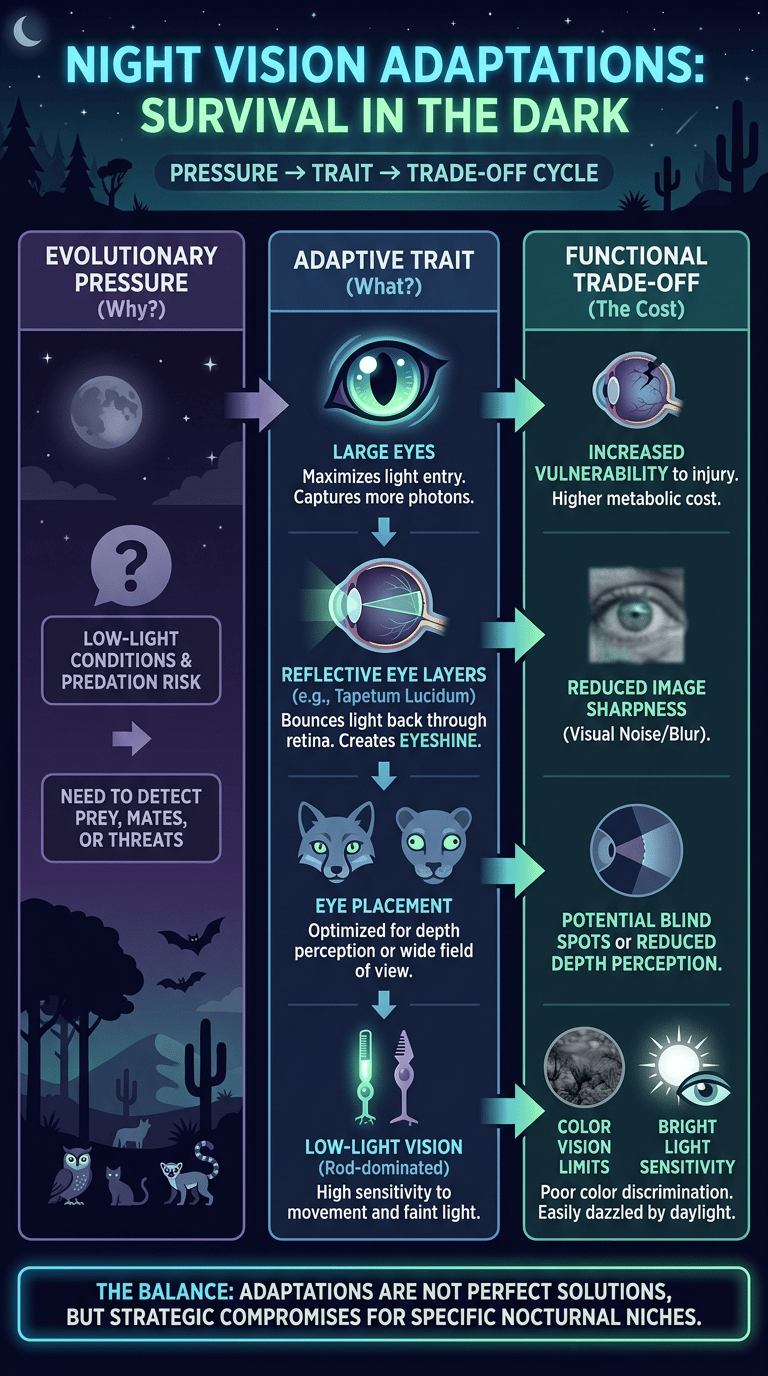
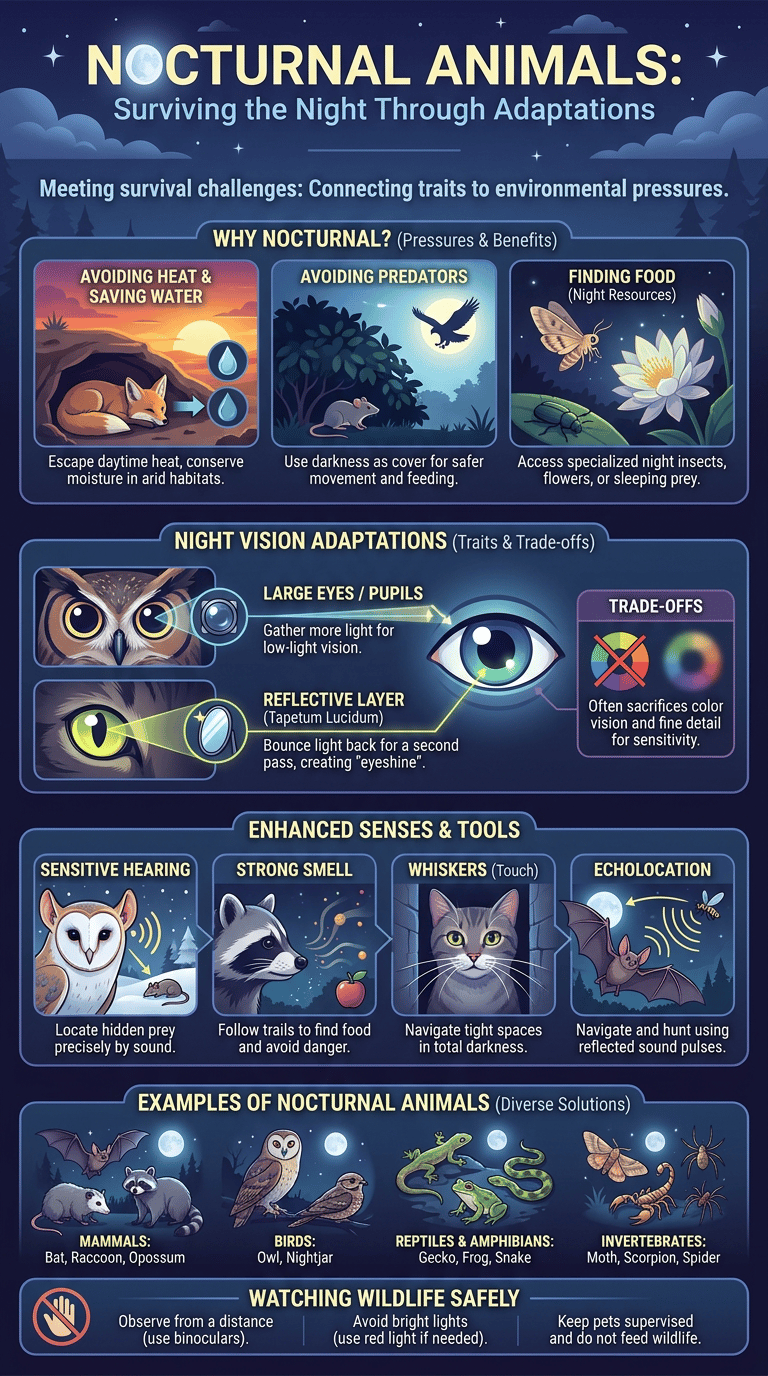
Large eyes
Large eyes shows how nocturnal animals connects a trait to a pressure in the environment. The important question is what the trait helps the animal do.
More light gathering
More light gathering: The value of this trait depends on context: habitat, season, predators, food supply, and the animal’s other adaptations.
Eye placement
Eye placement: The value of this trait depends on context: habitat, season, predators, food supply, and the animal’s other adaptations.
Reflective eye layers where relevant
Reflective eye layers where relevant shows how nocturnal animals connects a trait to a pressure in the environment. The important question is what the trait helps the animal do.
Eyeshine
Eyeshine: The value of this trait depends on context: habitat, season, predators, food supply, and the animal’s other adaptations.
Low-light vision
Low-light vision: The value of this trait depends on context: habitat, season, predators, food supply, and the animal’s other adaptations.
Trade-offs
Trade-offs shows how nocturnal animals connects a trait to a pressure in the environment. The important question is what the trait helps the animal do.
Color vision limits
Color vision limits: The visual effect depends on the background, the viewer’s eyes, lighting, distance, and whether the animal stays still.
Bright light sensitivity
Bright light sensitivity: The signal works best when predators notice it, remember it, and decide the attack is not worth the cost.
Hearing, Smell, and Touch at Night
This part of nocturnal animals narrows the idea into a practical survival question. Look for the pressure, the trait, and the trade-off.
Sensitive hearing
Night activity changes the sensory world. Animals active in darkness often rely on light gathering, sound, scent, touch, or echoes more than bright daytime color. A helpful reference point is Cornell Lab bird resources.
Owls
Owls: The value of this trait depends on context: habitat, season, predators, food supply, and the animal’s other adaptations.
Bats
Bats: The value of this trait depends on context: habitat, season, predators, food supply, and the animal’s other adaptations. A helpful reference point is U.S. Fish and Wildlife Service bat information.
Locating prey
Locating prey: The value of this trait depends on context: habitat, season, predators, food supply, and the animal’s other adaptations.
Strong smell
Night activity changes the sensory world. Animals active in darkness often rely on light gathering, sound, scent, touch, or echoes more than bright daytime color.
Mammal scent trails
Mammal scent trails: The value of this trait depends on context: habitat, season, predators, food supply, and the animal’s other adaptations.
Finding food
Finding food: The value of this trait depends on context: habitat, season, predators, food supply, and the animal’s other adaptations.
Avoiding danger
Avoiding danger: This action helps only when it fits the timing, place, and risk the animal faces.
Whiskers and touch
Whiskers and touch shows how nocturnal animals connects a trait to a pressure in the environment. The important question is what the trait helps the animal do.
Rodents
Rodents: The value of this trait depends on context: habitat, season, predators, food supply, and the animal’s other adaptations.
Cats
Cats: The value of this trait depends on context: habitat, season, predators, food supply, and the animal’s other adaptations.
Moving through tight spaces
Moving through tight spaces: The value of this trait depends on context: habitat, season, predators, food supply, and the animal’s other adaptations.
Echolocation and Other Night Tools
This part of nocturnal animals narrows the idea into a practical survival question. Look for the pressure, the trait, and the trade-off.
Bats
Bats shows how nocturnal animals connects a trait to a pressure in the environment. The important question is what the trait helps the animal do.
Sound pulses
Sound pulses: The value of this trait depends on context: habitat, season, predators, food supply, and the animal’s other adaptations.
Insect hunting
Insect hunting: This action helps only when it fits the timing, place, and risk the animal faces.
Navigation
Navigation: The value of this trait depends on context: habitat, season, predators, food supply, and the animal’s other adaptations.
Other echolocating animals
Other echolocating animals shows how nocturnal animals connects a trait to a pressure in the environment. The important question is what the trait helps the animal do.
Some whales
Some whales: The value of this trait depends on context: habitat, season, predators, food supply, and the animal’s other adaptations.
Some small mammals where relevant
Some small mammals where relevant: The value of this trait depends on context: habitat, season, predators, food supply, and the animal’s other adaptations.
Examples of Nocturnal Animals
This part of nocturnal animals narrows the idea into a practical survival question. Look for the pressure, the trait, and the trade-off.
Nocturnal mammals
Behavioral traits are patterns of action. They matter because the same body can survive very differently depending on when, where, and how an animal uses it.
Bats
Bats: The value of this trait depends on context: habitat, season, predators, food supply, and the animal’s other adaptations.
Owls are birds, not mammals
Owls are birds, not mammals: The value of this trait depends on context: habitat, season, predators, food supply, and the animal’s other adaptations.
Raccoons
Raccoons: The value of this trait depends on context: habitat, season, predators, food supply, and the animal’s other adaptations.
Opossums
Opossums: The value of this trait depends on context: habitat, season, predators, food supply, and the animal’s other adaptations.
Nocturnal birds
Behavioral traits are patterns of action. They matter because the same body can survive very differently depending on when, where, and how an animal uses it.
Owls
Owls: The value of this trait depends on context: habitat, season, predators, food supply, and the animal’s other adaptations.
Nightjars
Nightjars: The value of this trait depends on context: habitat, season, predators, food supply, and the animal’s other adaptations.
Nocturnal reptiles and amphibians
Behavioral traits are patterns of action. They matter because the same body can survive very differently depending on when, where, and how an animal uses it.
Geckos
Geckos: The value of this trait depends on context: habitat, season, predators, food supply, and the animal’s other adaptations.
Frogs
Frogs: The value of this trait depends on context: habitat, season, predators, food supply, and the animal’s other adaptations.
Snakes
Snakes: The value of this trait depends on context: habitat, season, predators, food supply, and the animal’s other adaptations.
Nocturnal invertebrates
Behavioral traits are patterns of action. They matter because the same body can survive very differently depending on when, where, and how an animal uses it.
Moths
Moths: The value of this trait depends on context: habitat, season, predators, food supply, and the animal’s other adaptations.
Scorpions
Scorpions: The value of this trait depends on context: habitat, season, predators, food supply, and the animal’s other adaptations.
Spiders
Spiders: The value of this trait depends on context: habitat, season, predators, food supply, and the animal’s other adaptations.
Watching Nocturnal Wildlife Safely
This part of nocturnal animals narrows the idea into a practical survival question. Look for the pressure, the trait, and the trade-off. A helpful reference point is National Park Service wildlife safety guidance.
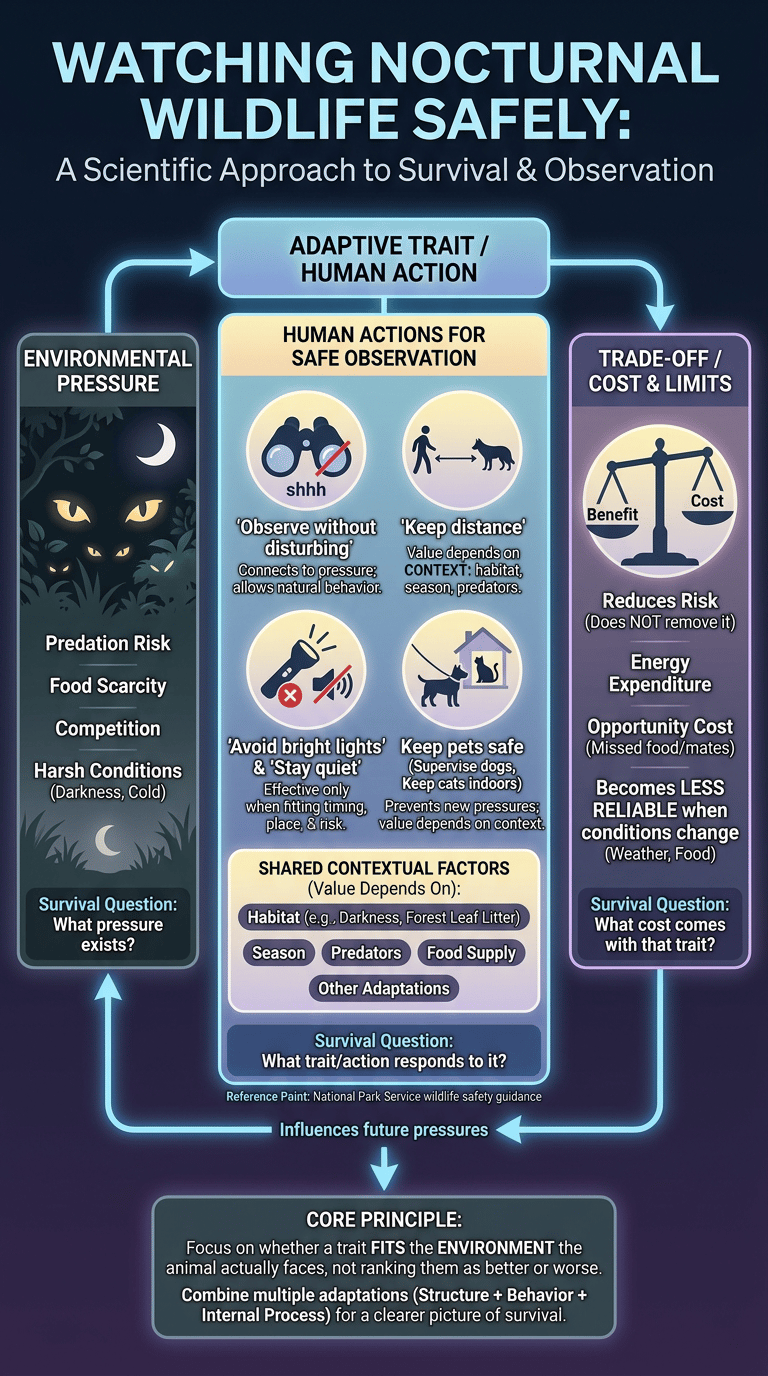
Observe without disturbing
Observe without disturbing shows how nocturnal animals connects a trait to a pressure in the environment. The important question is what the trait helps the animal do.
Keep distance
Keep distance: The value of this trait depends on context: habitat, season, predators, food supply, and the animal’s other adaptations.
Avoid bright lights
Avoid bright lights: This action helps only when it fits the timing, place, and risk the animal faces.
Stay quiet
Stay quiet: The value of this trait depends on context: habitat, season, predators, food supply, and the animal’s other adaptations.
Keep pets safe
Keep pets safe shows how nocturnal animals connects a trait to a pressure in the environment. The important question is what the trait helps the animal do.
Supervise dogs
Supervise dogs: The value of this trait depends on context: habitat, season, predators, food supply, and the animal’s other adaptations.
Keep cats indoors or supervised
Keep cats indoors or supervised: The value of this trait depends on context: habitat, season, predators, food supply, and the animal’s other adaptations.
Avoid feeding wildlife
Avoid feeding wildlife: This action helps only when it fits the timing, place, and risk the animal faces.
A useful way to study this topic is to ask three questions: what pressure exists, what trait responds to it, and what cost comes with that trait. That keeps the explanation scientific without making the animal sound as if it designed the solution.
Examples are clearest when they stay tied to habitat. A trait that works well in sand, snow, open water, forest leaf litter, or darkness may be much less useful somewhere else.
The same animal can combine several adaptations at once. A body structure may support a behavior, while an internal process makes that behavior possible during a difficult season.
For readers comparing species, avoid ranking adaptations as simply better or worse. The better question is whether a trait fits the environment the animal actually faces.
This also keeps the article honest about limits. A trait can reduce risk without removing risk, and a helpful pattern in one season can become less reliable when weather, food, or habitat changes.
When teaching or explaining the idea, pair each example with the pressure behind it. That turns a list of animal facts into a clearer picture of survival.
A useful way to study this topic is to ask three questions: what pressure exists, what trait responds to it, and what cost comes with that trait. That keeps the explanation scientific without making the animal sound as if it designed the solution.
Nocturnal Animals FAQ
These quick answers cover the common points readers usually need after learning the main concepts above.
What animals are nocturnal?
Examples depend on the topic, but useful cases include camouflage, migration, insulation, venom, specialized teeth, burrows, night activity, shells, spines, and seasonal dormancy. For nocturnal animals, the best example is one that clearly connects a trait with a survival challenge.
Why are some animals active at night?
The short answer is that nocturnal animals works only in context. A trait helps when it matches the animal’s habitat, predators, food, season, and body plan.
Do nocturnal animals see better in the dark?
The short answer is that nocturnal animals works only in context. A trait helps when it matches the animal’s habitat, predators, food, season, and body plan.
Are all night animals dangerous?
Most animals are not trying to harm people, but risk increases when wildlife is cornered, handled, fed, stepped on, trapped indoors, or approached with pets nearby.
What is the difference between nocturnal and crepuscular?
Nocturnal animals are mostly active at night. Crepuscular animals are most active around dawn and dusk, though real activity patterns can overlap by season and habitat.
Key Takeaways
- Nocturnal Animals is easiest to understand when each trait is tied to a specific survival challenge.
- Adaptations are not perfect solutions. They have costs, limits, and trade-offs that depend on habitat and season.
- Wild animals should be observed from a respectful distance, especially when venom, poison, defensive behavior, nests, dens, or dormant animals are involved.

Ethan Walker is the founder and research editor of Animal Fact Central. He creates and reviews educational animal facts content using trusted wildlife, pet care, and science-based sources. His work focuses on making animal behavior, adaptations, habitats, and species facts clear, accurate, and engaging for everyday readers.
Read More Details About Ethan Walker: https://animalfactcentral.com/ethan-walker/