
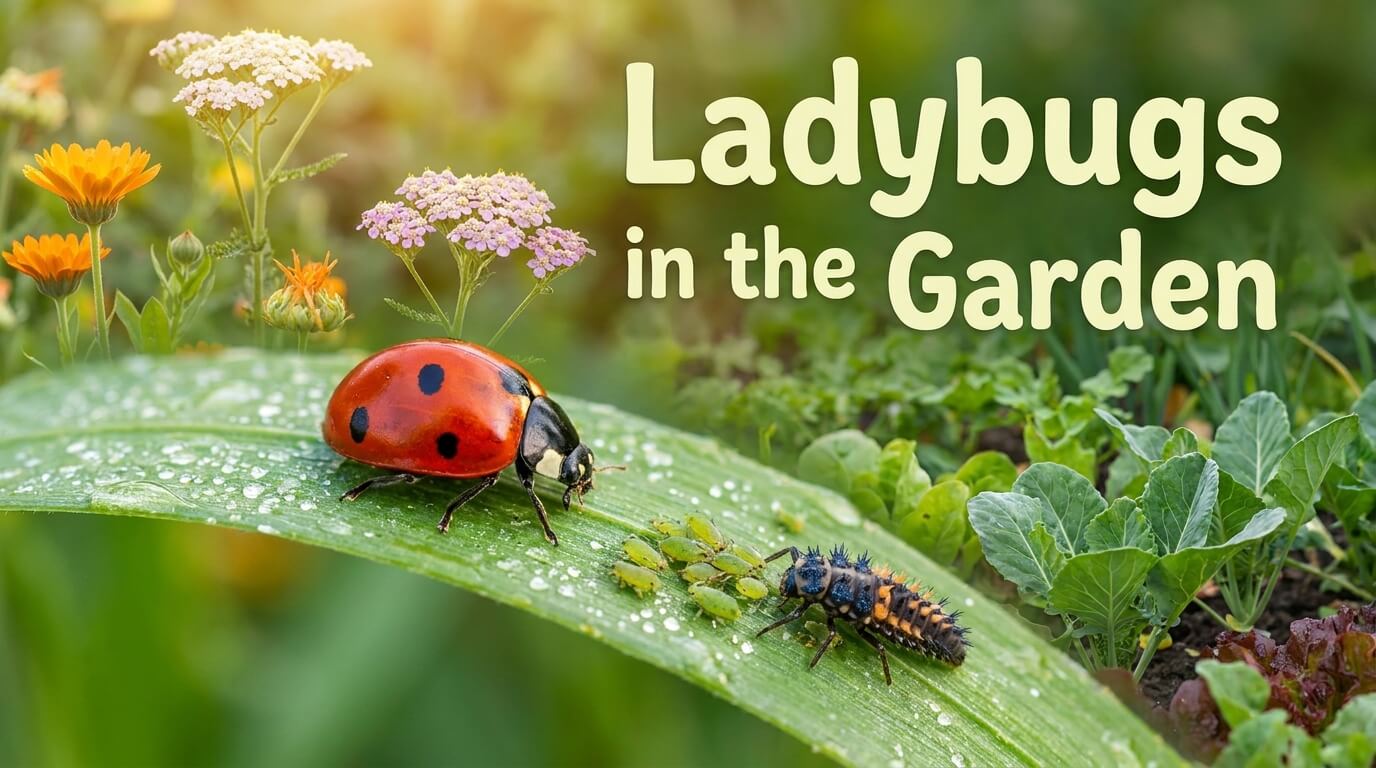
Ladybugs in the garden are usually a good sign. These small beetles, more accurately called lady beetles or ladybird beetles, are best known for eating aphids and other soft-bodied insects that can weaken vegetables, roses, fruit trees, and ornamental plants. They are not a magic cure for every pest problem, but they are important natural predators in many backyard ecosystems.
The most useful way to think about ladybugs is as part of a garden food web. They need prey, shelter, and a reasonably low-pesticide environment. If a garden has a small aphid population, flowering plants, and places for insects to hide, ladybugs may stay and reproduce. If the garden has no prey or has been treated with broad insecticides, adult ladybugs may simply leave or die.
This guide explains what ladybugs eat, why their larvae are so valuable, how to tell helpful life stages apart, why Asian lady beetles create confusion, and how gardeners can encourage beneficial insects responsibly without turning the article into a chemical pest-control manual.
Quick Answer

Ladybugs are good for gardens because many species feed on aphids, scales, mites, whiteflies, and other small, soft-bodied insects. The University of Minnesota Extension describes lady beetles as beneficial insects and notes that both adults and larvae can help control small soft-bodied pests such as aphids the University of Minnesota Extension lady beetle guide explains.
They are most helpful when pest numbers are still manageable. A few aphids on a plant can attract predators and support a balanced garden. A severe outbreak on stressed plants may need broader integrated pest management, which means identifying the pest, reducing plant stress, using low-risk methods first, and protecting helpful insects whenever possible.
Ladybugs are not a replacement for bees, butterflies, moths, or other pollinators. Some adults may visit flowers for nectar or pollen, but their main garden value is predation. In plain English, ladybugs help by eating pests more than by pollinating plants.
Why Ladybugs Matter in Gardens
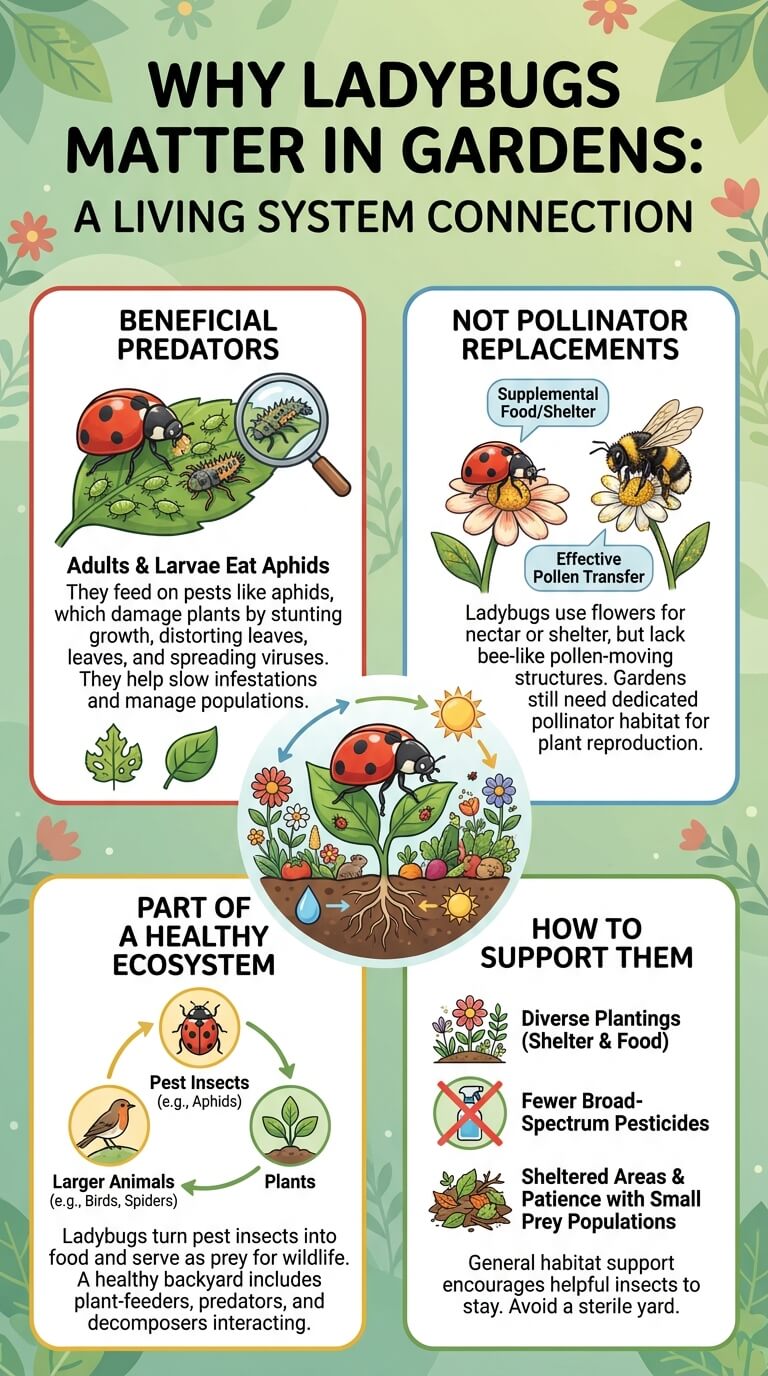
Gardeners often notice ladybugs because they are colorful and easy to recognize as adults. The deeper value is less obvious: ladybugs connect pest insects, flowering plants, soil cover, pesticide choices, and backyard wildlife into one living system.
Ladybugs as Beneficial Predators
Many ladybugs are predators. Adults and larvae search leaves, stems, buds, and undersides of foliage for small prey. Aphids are the classic example because they gather in clusters, feed on plant sap, and reproduce quickly under the right conditions. A ladybug larva moving through an aphid colony can remove many small insects over time.
This predatory role matters because aphids can stunt tender growth, distort leaves, spread some plant viruses, and leave sticky honeydew that may support sooty mold. Ladybugs do not prevent every aphid problem, but they can slow small infestations and reduce the chance that a minor problem becomes a major one.
Why They Are Not Pollinator Replacements
Ladybugs sometimes visit flowers, especially when nectar, pollen, or alternative food is available. That does not make them equivalent to bees. Bees and some other pollinators often have body structures and behaviors that move pollen between flowers more effectively. Ladybugs are beetles with a different main job.
This distinction helps prevent a common misunderstanding. A garden can support ladybugs and still need pollinator habitat. Flowering plants can feed both groups, but the reason is different. Pollinators need nectar and pollen as part of plant reproduction. Ladybugs may use flowers for supplemental food, shelter, or access to nearby prey.
How They Fit Into a Healthy Backyard Ecosystem
A healthy backyard is not insect-free. It has plants, plant-feeders, predators, parasitoids, decomposers, pollinators, birds, spiders, and other wildlife interacting at small scale. Ladybugs fit into that system by turning pest insects into food and by serving as prey for larger animals.
That does not mean a gardener must ignore plant damage. It means the first question should be, “What is happening here?” rather than “How do I kill everything on this plant?” When ladybug larvae, lacewing larvae, hover fly larvae, or parasitized aphids are already present, the garden may be regulating itself.
The best garden support for ladybugs often looks like general habitat support: diverse plantings, fewer broad-spectrum pesticides, some sheltered areas, and patience with small prey populations. A perfectly sterile yard gives helpful insects little reason to stay.
What Ladybugs Eat
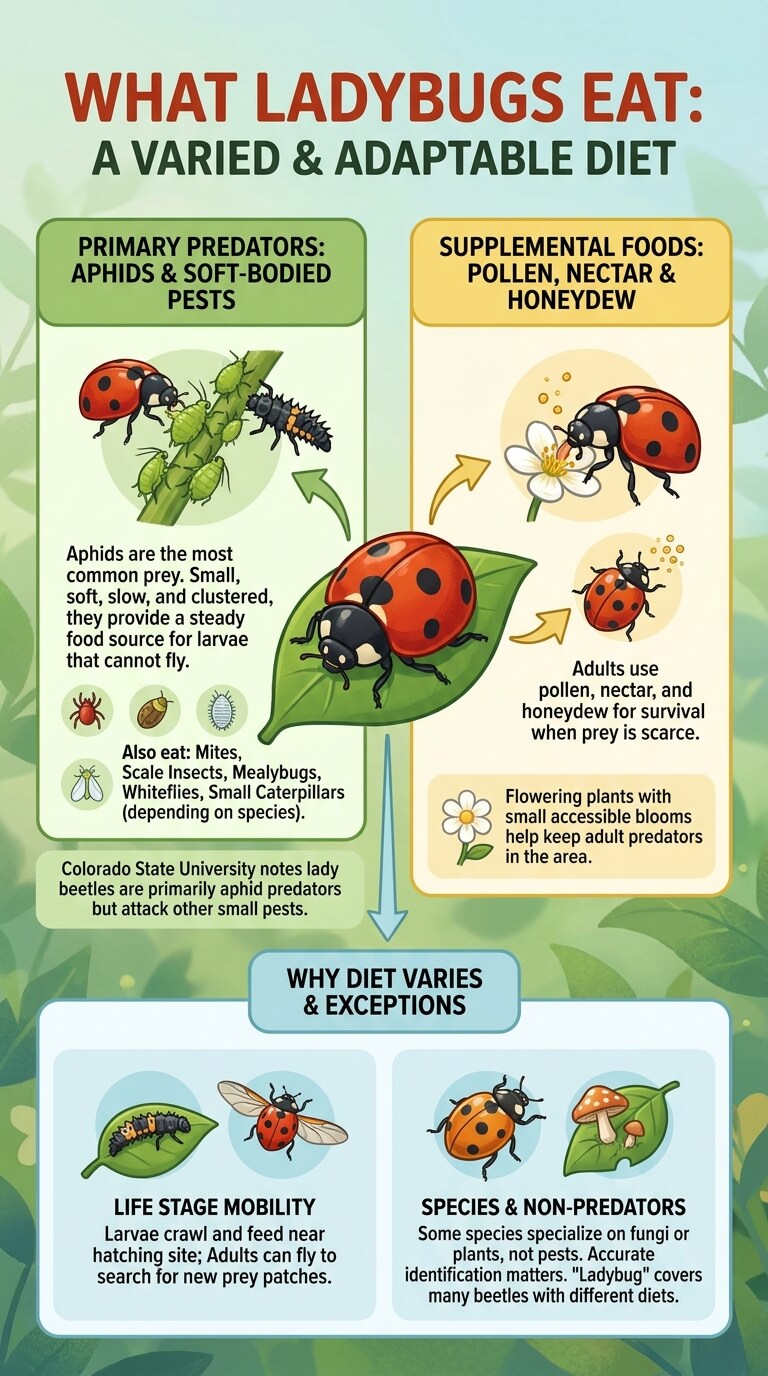
Ladybug diet depends on species, life stage, prey availability, and season. Some species are strong aphid predators. Others specialize more on scale insects, mites, mildew, or plant material. Because the common name covers many beetles in the family Coccinellidae, careful wording matters.
Aphids and Soft-Bodied Pests
Aphids are the prey most people associate with ladybugs, and for good reason. Many common garden lady beetles feed heavily on aphids. Colorado State University notes that lady beetles primarily feed on aphids and can also attack other small pests such as leafhoppers, mites, scale insects, thrips, whiteflies, and small caterpillars Colorado State University’s lady beetle overview says.
Aphids are good prey for ladybugs because they are small, soft, slow, and often clustered on new growth. They also provide a steady food source for larvae that cannot fly away to search a large area. When a female ladybug lays eggs near aphids, the newly hatched larvae may have food close by.
Ladybugs can also help with some scale insects, mealybugs, mites, and other small prey, depending on the species. They should not be expected to solve every insect problem. Chewing caterpillars, beetle larvae in soil, borers inside stems, slugs, and plant diseases usually require different identification and management.
Pollen, Nectar, and Non-Pest Foods in Some Situations
Although many ladybugs are predators, adults may also use pollen, nectar, honeydew, or other foods. These foods can help them survive when prey is scarce. Flowering plants with small accessible blooms can support adult ladybugs as well as other beneficial insects.
This does not change the main story. Ladybugs are usually discussed as predators in gardens, not primary pollinators. Their visits to flowers can still matter because flowers help keep adult predators in the area. A garden with nectar sources may hold more beneficial insects than a garden with only one crop and bare soil.
Some lady beetles are not mainly predators. A few species feed on fungi or plants. This is another reason identification matters. Most familiar beneficial ladybugs in US gardens are helpful predators, but “ladybug” is not a guarantee that every species has the same diet or impact.
Why Diet Varies by Species and Life Stage
Ladybug larvae and adults may eat similar prey, but they do not move through the garden in the same way. Adults can fly, disperse, mate, and search for new patches. Larvae crawl on plants and feed near where eggs hatched. That makes larvae especially valuable when they are already on an infested plant.
Species differences also matter. Some lady beetles specialize more on aphids. Others are better known for scale insects. A general backyard gardener does not need to identify every species perfectly, but it helps to understand that the red beetle with black spots is only one version of a much broader beetle family.
When advice says “ladybugs eat aphids,” it is a useful simplification, not a complete biological rule. The accurate version is that many lady beetle species, especially their larvae and adults, are important predators of aphids and other small soft-bodied insects.
Ladybug Life Cycle and Identification
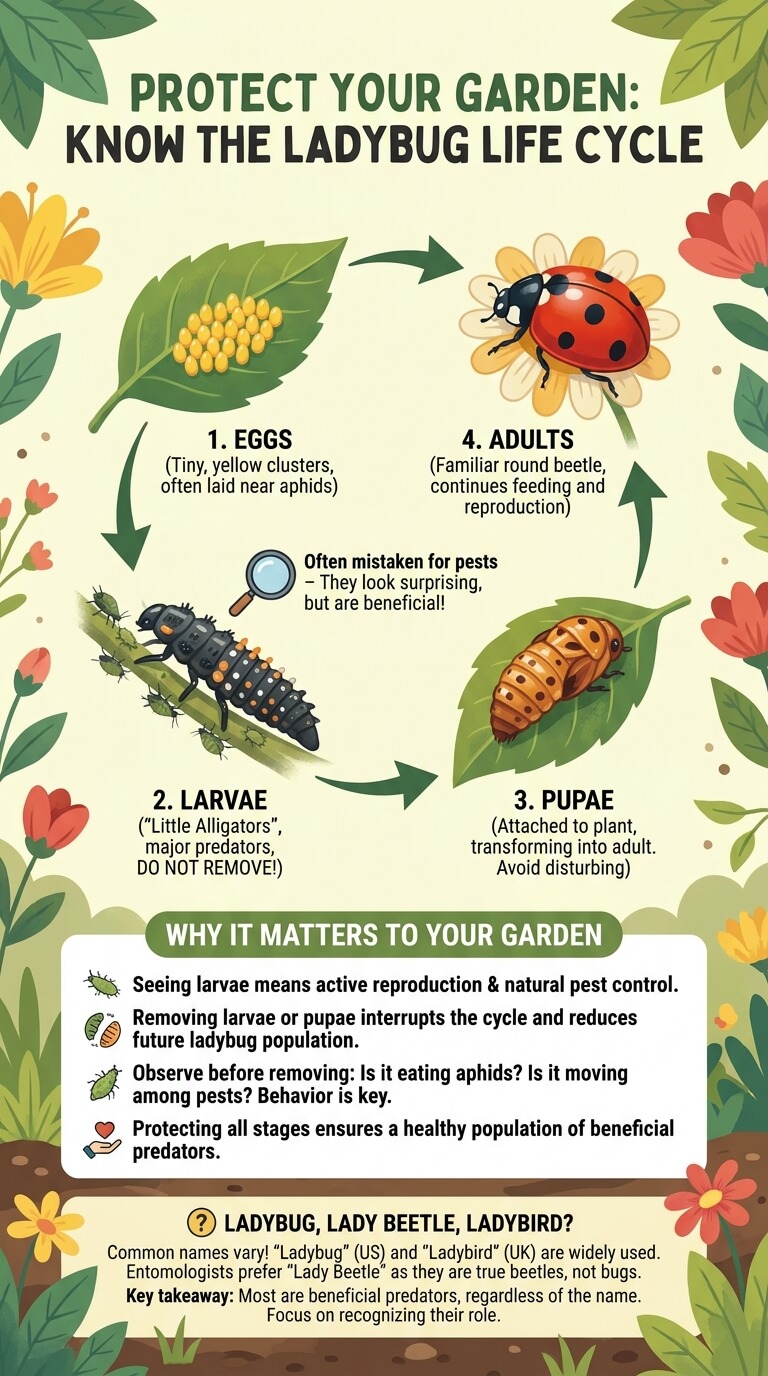
Recognizing the life cycle is one of the easiest ways to protect ladybugs in the garden. Many gardeners know the adult beetle but accidentally remove the larvae because they look unfamiliar.
Eggs, Larvae, Pupae, and Adults
Ladybugs go through complete metamorphosis: egg, larva, pupa, and adult. Eggs are often laid near prey, usually in small clusters. Larvae hatch and begin feeding. After growing through several stages, the larva attaches itself and becomes a pupa. The adult beetle then emerges.
This life cycle makes the garden timeline important. Seeing larvae means ladybugs are not just visiting. They may be reproducing nearby. Seeing pupae attached to leaves or stems means the next adult generation may be close. Removing every odd-looking insect can interrupt that process.
The adult stage gets the attention because it is round, bright, and familiar. The larval stage may do much of the visible hunting on aphid-covered plants. Learning both forms helps gardeners make better decisions.
Why Ladybug Larvae Look Surprising
Ladybug larvae do not look like tiny adult ladybugs. They often look like small, dark, alligator-shaped insects with segmented bodies, bumps, or colored markings. This can make them seem threatening, especially to people expecting every beneficial insect to look cute.
That appearance is normal. A larva crawling through aphids on a rose, milkweed, pepper plant, or fruit tree may be doing exactly what a gardener wants. If it is moving among aphids rather than chewing holes in leaves, it may be a helpful predator rather than a plant pest.
The safest approach is to observe before removing. Look for what the insect is doing. Is it eating aphids? Is it surrounded by honeydew and pest clusters? Is it on the underside of leaves where aphids gather? Behavior can be more useful than color alone.
Ladybugs, Lady Beetles, and Common Name Confusion
In the United States, people usually say ladybug. Entomologists often say lady beetle because these insects are beetles, not true bugs. True bugs belong to a different group of insects with piercing-sucking mouthparts and a different wing structure.
The common name is not wrong in casual speech. It is simply less precise. A website for general readers can use “ladybug” while explaining that “lady beetle” is the more accurate technical term. That helps readers search naturally and still learn the science.
Common names also vary by region. Ladybird, ladybird beetle, lady beetle, and ladybug may all refer to beetles in the same broad family. The important garden question is not the name alone, but whether the insect is a beneficial predator, a nuisance species indoors, or a different beetle being mistaken for one.
Ladybugs vs Asian Lady Beetles
Ladybugs vs Asian lady beetles is a confusing topic because Asian lady beetles are lady beetles. The phrase usually refers to the multicolored Asian lady beetle, Harmonia axyridis, a species that can be beneficial outdoors but troublesome when it gathers in buildings.
Why the Comparison Is Complicated
The multicolored Asian lady beetle feeds on aphids and other soft-bodied pests, so it can help in crops and gardens. USDA describes it as an effective natural control of aphids, scale, and other soft-bodied arthropods the USDA ARS multicolored Asian lady beetle profile notes.
The complication is that the same species can become a nuisance when adults gather on buildings and move indoors to overwinter. This creates the odd situation where an insect can be beneficial in a garden and unwelcome in a living room.
Another complication is that people often use “Asian lady beetle” as if it means “bad ladybug” and “ladybug” as if it means “good native beetle.” Reality is not that simple. The lady beetle family includes many species, and not every garden visitor can be sorted accurately by a quick glance at color.
Identification Clues Readers Often Use
People often look for color, spot number, body shape, and markings behind the head. Multicolored Asian lady beetles can vary from yellowish orange to red and may have many spots, few spots, or no obvious spots. Some show a dark mark that looks like an M or W on the pale area behind the head, but markings vary.
Because color and spots can be variable, identification should be cautious. A small red beetle with black spots is not automatically native. An orange beetle is not automatically harmful. If the issue is a large indoor aggregation, the location and behavior may be more useful than a single marking.
For most garden decisions, exact species identification is less urgent than protecting beneficial predators and avoiding unnecessary chemicals. For reporting invasive species, managing indoor nuisance problems, or making local ecological decisions, use state extension or local entomology guidance.
When Large Indoor Aggregations Become a Nuisance Issue
Multicolored Asian lady beetles and some other lady beetles may gather on sunny building surfaces in fall and enter cracks or gaps to overwinter. The University of Minnesota Extension explains that multicolored Asian lady beetles can become a nuisance when they cluster around buildings and move indoors, even though they feed on plant pests outdoors its nuisance-insect guidance says.
Indoor nuisance issues should be handled differently from garden sightings. Indoors, the goal is exclusion, sealing entry points, and gentle removal such as vacuuming when appropriate. Spraying random chemicals inside living spaces is not a responsible first response.
Outdoors, seeing lady beetles on aphid-covered plants is usually positive. Indoors, large clusters can stain surfaces, release odor when disturbed, and bother residents. Same broad insect group, different context.
How to Encourage Ladybugs Responsibly
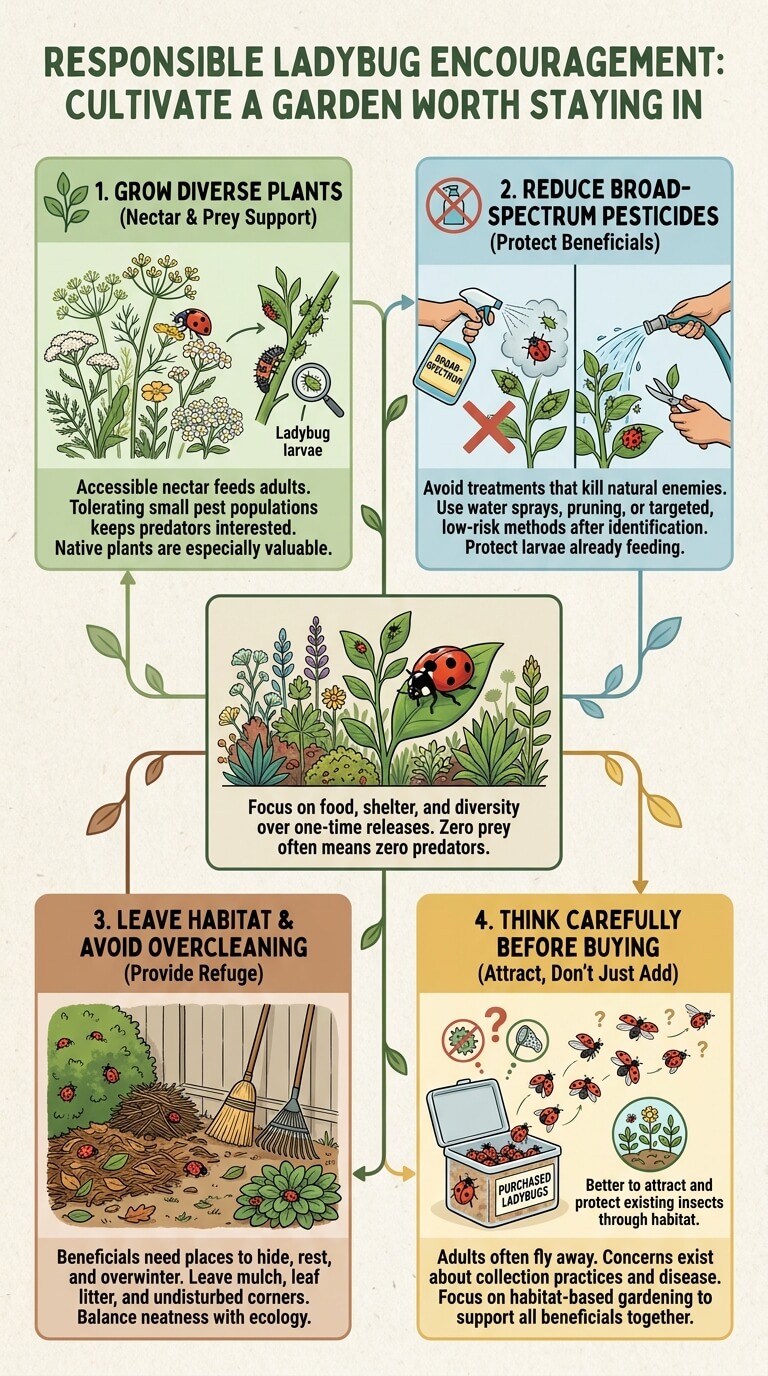
Encouraging ladybugs is less about buying a container of beetles and more about making a garden worth staying in. Food, shelter, plant diversity, and careful pest management matter more than a one-time release.
Grow Diverse Plants That Support Prey and Nectar
Diverse plantings give beneficial insects more resources across the season. Flowers with accessible nectar can support adult ladybugs and other natural enemies. Plants that support small prey populations can also keep predators interested. This does not mean letting pests destroy plants. It means understanding that zero prey can mean zero predators.
Herbs and flowers such as dill, fennel, cilantro, yarrow, alyssum, asters, and other small-flowered plants are often used in beneficial insect gardens because their blooms are accessible to many small insects. Native plants are especially valuable when they fit the region and site conditions.
Reduce Broad-Spectrum Pesticide Use
Broad-spectrum pesticides can kill pests and beneficial insects at the same time. That can remove ladybugs, lacewings, parasitoid wasps, pollinators, and other natural enemies that help keep pest populations in check. Oregon State University Extension recommends encouraging natural predators and avoiding broad-spectrum pesticides that kill beneficial insects such as ladybugs and lacewings Oregon State University’s aphid management advice says.
When a plant has aphids, low-risk first steps may include checking plant health, pruning badly infested tips when appropriate, spraying aphids off with water, or using targeted approaches that reduce harm to beneficial insects. Always follow label directions for any pesticide product and consider local extension guidance for your crop and region.
The goal is not to ban every intervention. It is to avoid reflexive spraying before identification. If ladybug larvae are already feeding, a harsh treatment may kill the solution along with the problem.
Leave Habitat and Avoid Overcleaning Every Corner
Beneficial insects need places to hide, rest, overwinter, and avoid predators. A garden that is stripped to bare soil and spotless edges may look tidy but offer fewer refuges. Mulch, plant stems, leaf litter in appropriate areas, hedges, ground cover, and undisturbed corners can support more insect life.
This does not mean letting the yard become unsafe or ignoring diseased plant material. It means leaving some habitat where it makes sense. A small brushy border, native plant patch, or less-disturbed bed can help beneficial insects persist between pest outbreaks.
Many gardeners learn to balance neatness and ecology. Keep walkways clear, manage plant diseases, remove invasive weeds, and still allow some structure for insects and other small wildlife.
Think Carefully Before Buying and Releasing Ladybugs
Buying ladybugs sounds simple, but it often disappoints. Adults may fly away soon after release, especially if prey is scarce, the weather is unsuitable, or the garden lacks habitat. Purchased insects can also raise concerns about collection practices, species identity, disease, and whether they are appropriate for the local ecosystem.
If you are considering a release, check local extension guidance first. For many home gardens, it is more responsible to attract and protect existing beneficial insects than to add purchased beetles. Habitat-based gardening supports ladybugs, lacewings, hover flies, predatory bugs, parasitoid wasps, and pollinators together.
When a pest problem is severe, identify the pest and the plant first. Ladybugs are not a universal treatment. A large aphid outbreak on stressed plants may require water sprays, pruning, ant management, or other integrated steps in addition to waiting for predators.
Common Mistakes and Myths
Ladybugs are popular, which means they attract oversimplified advice. The most common myths are not silly because they sound plausible. They are risky because they make gardeners overlook context.
Myth: More Released Ladybugs Always Means Fewer Pests
Releasing more ladybugs does not guarantee better control. If the garden does not have enough prey or shelter, many adults may disperse. If the pest infestation is already severe, a small release may not match the scale of the problem. If pesticides were recently used, released beetles may be harmed.
The better strategy is to make the garden hospitable and use pest-specific management. A few predators working in a balanced garden can be more useful than a dramatic release into poor habitat.
Myth: Ladybugs Are Harmless in Every Context
Ladybugs are generally welcome outdoors, but they are not perfect in every context. Some species can become indoor nuisances. Some may release a yellowish defensive fluid when disturbed. Large indoor gatherings can be unpleasant, even if the beetles are not eating the house or reproducing indoors.
Myth: All Spotted Beetles in the Garden Are the Same
Not every spotted beetle is a ladybug, and not every lady beetle is red with black spots. Some beneficial species are orange, yellow, black, gray, or patterned in ways that surprise beginners. Some plant-feeding beetles can also be round or spotted enough to confuse casual observers.
Before removing or protecting an insect, look at its body shape, behavior, location, and nearby damage. Is it eating aphids? Is it chewing leaves? Is it clustered indoors in fall? Is it a larva, pupa, or adult? Context prevents many identification mistakes.
Edge Cases and Exceptions
Ladybug advice works best when it includes exceptions. Gardens differ by region, plant type, season, weather, pesticide history, and surrounding habitat.
Gardens With No Prey May Not Keep Ladybugs
Ladybugs need food. If a garden has no aphids or other suitable prey, adult beetles may leave. This is normal behavior, not failure. A predator follows resources. A garden that looks perfect to a person may look empty to a ladybug.
This is why prevention and habitat matter more than last-minute releases. A garden with a modest level of insect life, flowering resources, and shelter can support natural enemies before a major outbreak begins.
Non-Native Species and Local Ecosystem Context
Some lady beetles in North America are native. Others are introduced. The multicolored Asian lady beetle is a well-known introduced species that can feed on pests but also become a nuisance. Local context matters because species composition varies by region.
Gardeners do not need to panic over every non-native lady beetle sighting, but they should be cautious about releasing insects of uncertain origin. Supporting habitat for local beneficial insects is usually a safer ecological choice than importing large numbers of predators.
Indoor Lady Beetle Nuisance Situations
Indoor lady beetle problems usually happen when adults seek protected overwintering sites. They may gather around sunny sides of buildings and enter gaps around windows, vents, siding, or doors. Once inside, they may appear near windows on warm days.
The best long-term response is prevention: seal cracks, repair screens, close gaps, and reduce entry points before fall aggregations. If beetles are already indoors, gentle removal is usually better than crushing them, which can release odor and stain surfaces.
How This Connects to Nearby Animal Topics
Ladybugs connect neatly to broader animal questions about pollinators, helpful insects, predator-prey relationships, and backyard wildlife. They are also a good example of why “bug” is a casual word, not always a scientific one.
Helpful Insects Beyond Pollinators
Bees and butterflies often receive the most attention because pollination is easy to connect to flowers and food. Ladybugs show a different kind of helpful insect role: predation. They help by eating plant-feeding insects that can stress garden plants.
That makes them an important part of an ecosystem-focused garden. A yard that supports only flowers but destroys every predator is incomplete. Pollinators, predators, parasitoids, and decomposers all contribute in different ways.
How Wasps and Ladybugs Help Gardens in Different Ways
Wasps and ladybugs can both be beneficial, but the human experience is different. Ladybugs are usually easy to welcome. Wasps may hunt pests and visit flowers, but nests near people require more caution because some species can sting in defense.
Why Pollinator-Friendly Gardens Can Also Support Predator Insects
Pollinator-friendly gardens often help predator insects too. Diverse blooms provide nectar. Plant structure gives shelter. Reduced pesticide use protects many kinds of insects. A garden built for bees and butterflies may also support ladybugs, lacewings, hover flies, and parasitoid wasps.
This is why helpful insect gardening works best as a whole-habitat approach. Instead of trying to manage one species at a time, gardeners can build conditions that support a wider community of beneficial animals.
FAQ
Are ladybugs good for vegetable gardens?
Yes, ladybugs are usually good for vegetable gardens because many species eat aphids and other small pests that feed on vegetable plants. They are especially helpful when pest populations are still small enough for natural enemies to influence.
They are not a stand-alone solution for every problem. If a plant is badly stressed, covered in pests, or showing disease symptoms, identify the problem before acting. Ladybugs can be part of integrated pest management, but good watering, plant spacing, soil health, and low-risk pest removal also matter.
Do ladybugs eat aphids?
Yes, many ladybugs eat aphids. Both adults and larvae can feed on aphids, and larvae are often very active predators on infested plants. This is why gardeners should learn what ladybug larvae look like before removing unfamiliar insects.
Diet still varies by species and life stage. Some lady beetles eat scale insects, mites, or other prey. A few are less predatory. The safest wording is that many common garden ladybugs are valuable aphid predators, not that every ladybug eats only aphids.
Should I buy ladybugs for my garden?
Usually, habitat support is a better first step than buying ladybugs. Purchased adults may fly away if the garden lacks prey, water, shelter, or suitable weather. Releases may also raise questions about species identity and local ecological fit.
Before buying insects, identify the pest and check local extension recommendations. In many gardens, planting diverse flowers, avoiding broad-spectrum pesticides, tolerating a small amount of prey, and protecting existing larvae will do more for long-term balance than a one-time release.
Are ladybug larvae good or bad?
Ladybug larvae are usually good in gardens. They look very different from adult ladybugs, often dark and spiky or alligator-shaped, but many are active predators of aphids and other small insects.
If you see a strange larva on a plant, do not remove it automatically. Watch what it is eating. If it is moving among aphids or other soft-bodied pests, it may be one of the most useful insects on the plant.
Final Thoughts
Ladybugs in the garden are valuable because many of them work as natural predators, especially against aphids and other soft-bodied pests. Their larvae, adults, diet, and seasonal behavior all matter, and the most accurate advice is more nuanced than “buy ladybugs and release them.” A garden that supports diverse plants, protects beneficial insects, limits unnecessary pesticide use, and allows some natural food-web activity is more likely to keep ladybugs around.

Ethan Walker is the founder and research editor of Animal Fact Central. He creates and reviews educational animal facts content using trusted wildlife, pet care, and science-based sources. His work focuses on making animal behavior, adaptations, habitats, and species facts clear, accurate, and engaging for everyday readers.
Read More Details About Ethan Walker: https://animalfactcentral.com/ethan-walker/