
Yes, wasps are important. They are not just picnic pests or angry insects near a nest. Many wasps help ecosystems by hunting other insects, visiting flowers, feeding birds and other animals, and taking part in the natural recycling of nutrients. Some wasps are also pollinators, although most familiar wasps are not built for pollen collection as efficiently as bees.
The honest answer has two parts. Wasps have real ecological value, and people still need to treat nests with caution. A wasp searching flowers for nectar is not the same risk as a social wasp colony defending a nest under a porch. Understanding that difference helps backyard observers, gardeners, and families respond more calmly without pretending wasps are harmless.
Quick Answer
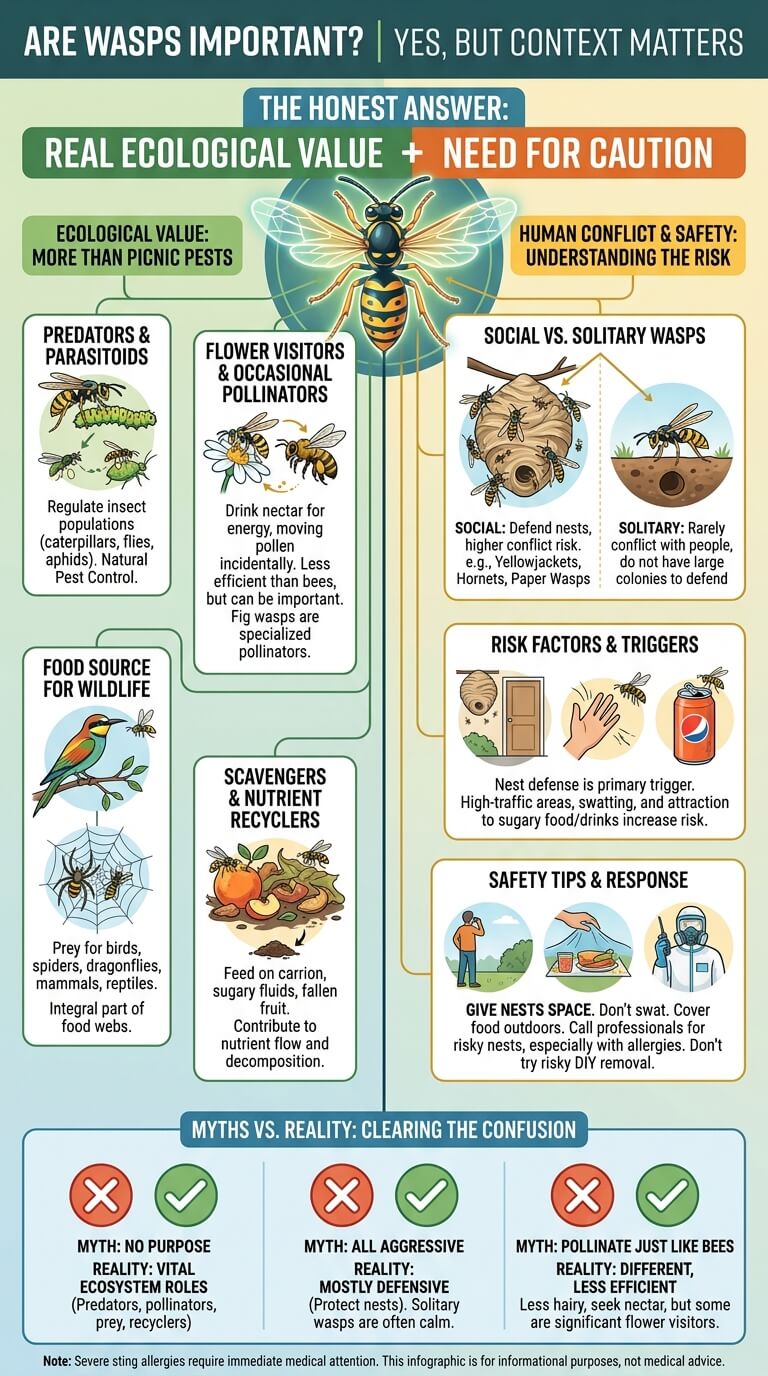
Wasps are important because they act as predators, parasitoids, flower visitors, occasional pollinators, scavengers, and prey for other animals. Some hunt caterpillars, flies, aphids, and other insects. Others lay eggs in or on host insects, which can help regulate insect populations. Adult wasps often drink nectar, so they may move pollen as they visit flowers.
They are not simply “bad bees.” Wasps belong to the same insect order as bees and ants, Hymenoptera. The Smithsonian describes this order as one of the most beneficial insect groups because of pollination, predation, and parasitism, which are all major ecological functions the Smithsonian Hymenoptera overview explains in plain language.
Still, wasps are not all the same. A tiny parasitoid wasp in a vegetable garden, a paper wasp on a flower, a fig wasp inside a fig, and a yellowjacket colony near a doorway are very different situations. The useful question is not whether every wasp should be welcomed everywhere. It is how to recognize their role while keeping people, pets, and nests separate when needed.
Why Wasps Have Such a Bad Reputation
Wasps have a bad reputation because people usually notice them in moments of conflict. A wasp at a soda can, a yellowjacket near a picnic table, or a nest close to a walkway feels much more memorable than a wasp quietly hunting caterpillars in a garden.
Stings, Nests, and Human Conflict
Many people use the word wasp for social wasps such as yellowjackets, paper wasps, and hornets. These species can defend their nests. That defense is the main reason they feel threatening around homes, playgrounds, sheds, decks, and other high-traffic places.
The risk is not equal in every situation. A single wasp on a flower may be focused on nectar. A wasp crawling around fallen fruit may be feeding. A colony close to a door, mailbox, wall void, or patio can be a bigger concern because repeated disturbance may trigger defensive behavior. Swatting at wasps, blocking nest entrances, or trying risky do-it-yourself nest removal can make the situation worse.
Wasps also arrive at human food because adults may feed on sugary liquids, fruit juices, and other easy energy sources. Late-season yellowjacket activity around outdoor meals can make wasps seem as if they exist only to bother people. In reality, the same insect may have spent part of its life cycle feeding larvae with captured insects.
Why Fear Can Hide Ecological Value
Fear is understandable, especially for anyone who has been stung or has an allergy concern. But fear can narrow the story. If we only notice wasps when they are close to people, we miss their predator role, their flower visits, and their place in food webs.
Many helpful animals are not cuddly. Spiders eat insects. Bats eat night-flying insects. Snakes control rodents in some habitats. Wasps fit that same broader idea: an animal can be uncomfortable near people and still be ecologically useful. Good wildlife writing has to hold both truths at once.
The Truth About What Wasps Do
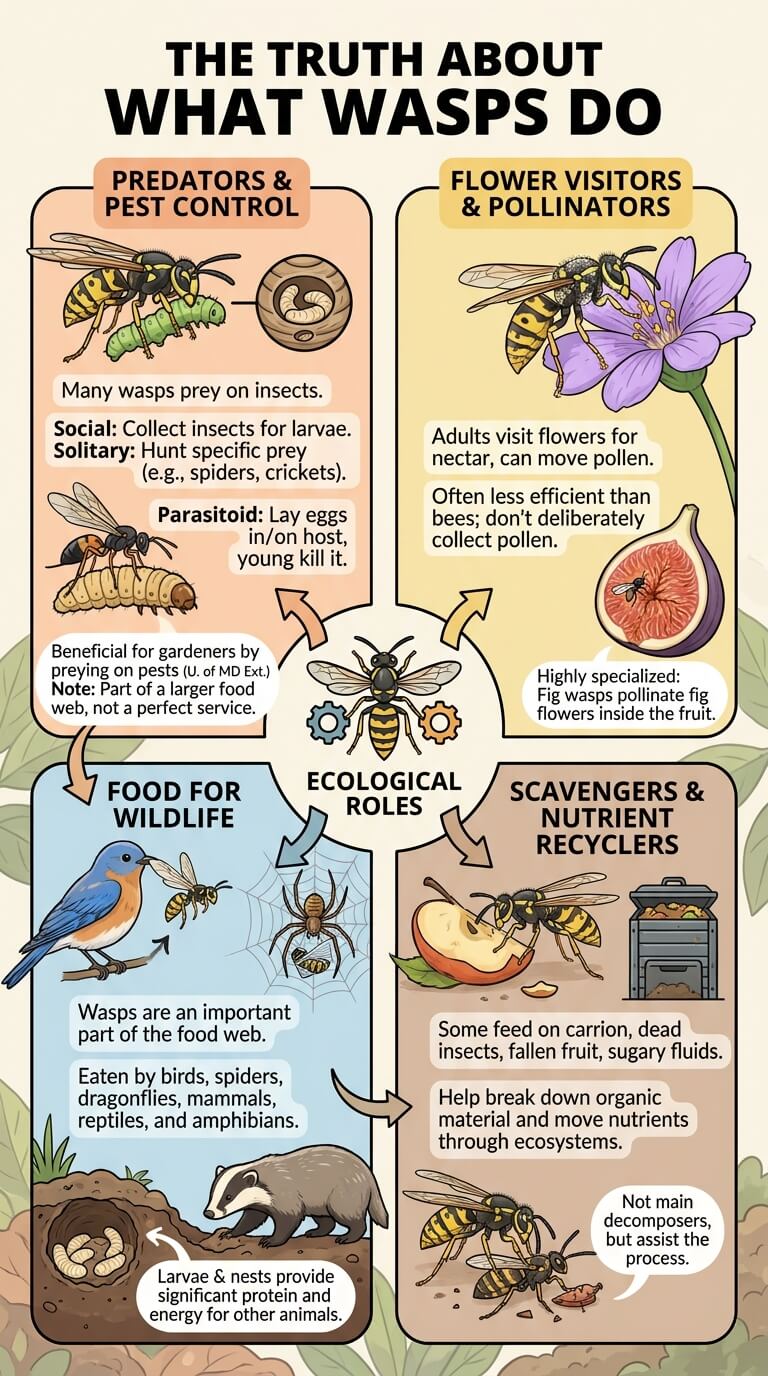
Wasps do several jobs in ecosystems. Some of those jobs are easy to see, like an adult wasp on a flower. Others happen out of sight, such as a parasitoid wasp developing inside a host insect or a social wasp colony collecting prey to feed larvae.
Wasps as Predators of Other Insects
Many wasps are predators. Social wasps often collect insects or pieces of insects to feed their larvae. Solitary hunting wasps may capture specific prey, such as caterpillars, crickets, spiders, or flies, depending on the wasp species. Parasitoid wasps use a different strategy: they lay eggs in or on a host, and their developing young eventually kill the host.
For gardeners, this predator role is one of the biggest reasons wasps matter. The University of Maryland Extension describes predatory wasps as beneficial because they prey on many insect pests, while also noting that a social wasp nest in the wrong location may need professional attention the University of Maryland Extension page on predatory wasps explains.
This does not mean wasps remove every pest problem. Nature does not work like a perfect pest-control service. Predator-prey relationships vary by habitat, season, prey availability, and species. A yard with flowers, leaf litter, and fewer broad insecticide sprays may support more beneficial insects, but wasps are only one part of a larger garden food web.
Wasps as Food for Birds and Other Animals
Wasps also matter because other animals eat them. Birds, spiders, dragonflies, robber flies, mammals, reptiles, amphibians, and other insects may prey on adult wasps, larvae, or nests. Even animals that do not specialize on wasps may take advantage of them when they are available.
This food-web role is easy to overlook because most people think of wasps as predators, not prey. But ecosystems are networks. An insect that hunts caterpillars can also become food for a bird. A nest that seems like a nuisance to people may represent protein and energy for wildlife that can safely access it.
Wasps as Flower Visitors and Sometimes Pollinators
Adult wasps often visit flowers for nectar. While they are feeding, pollen can stick to their bodies and be carried to another flower. The USDA Forest Service describes wasps as important pollinators, while also making clear that many familiar wasps are mainly predatory or parasitic rather than pollen-collecting specialists the USDA Forest Service guide to wasp pollination notes.
This is where careful wording matters. Wasps can pollinate plants, but they usually do not pollinate in exactly the same way bees do. Bees are often hairier and many species deliberately collect pollen to feed their young. Many wasps are smoother-bodied and are seeking nectar for adult energy. That means a wasp can be a real flower visitor without being the most efficient pollinator on every plant.
Some wasp-plant relationships are much more specialized. Fig wasps are the famous example: tiny wasps pollinate fig flowers inside the fig structure, and many fig species depend on these relationships. That does not mean every fig in a grocery store contains a visible wasp, and it does not mean every wasp is a fig wasp. It shows that wasp pollination ranges from casual flower visits to highly specialized mutualisms.
Wasps as Scavengers and Nutrient Recyclers in Some Contexts
Some wasps feed on carrion, dead insects, fallen fruit, sugary fluids, or bits of human food. That scavenging behavior is one reason they show up around trash cans, compost, outdoor meals, and overripe fruit. It can be annoying, but it is also connected to nutrient flow.
Scavenging animals help break down organic material and move nutrients through ecosystems. Wasps are not the main decomposers in the way fungi, bacteria, and many soil invertebrates are, but they can take part in the process by cutting up dead insects, visiting carrion, or carrying food back to larvae. Their role depends on the species and situation.
Wasps vs Bees: Why the Difference Matters
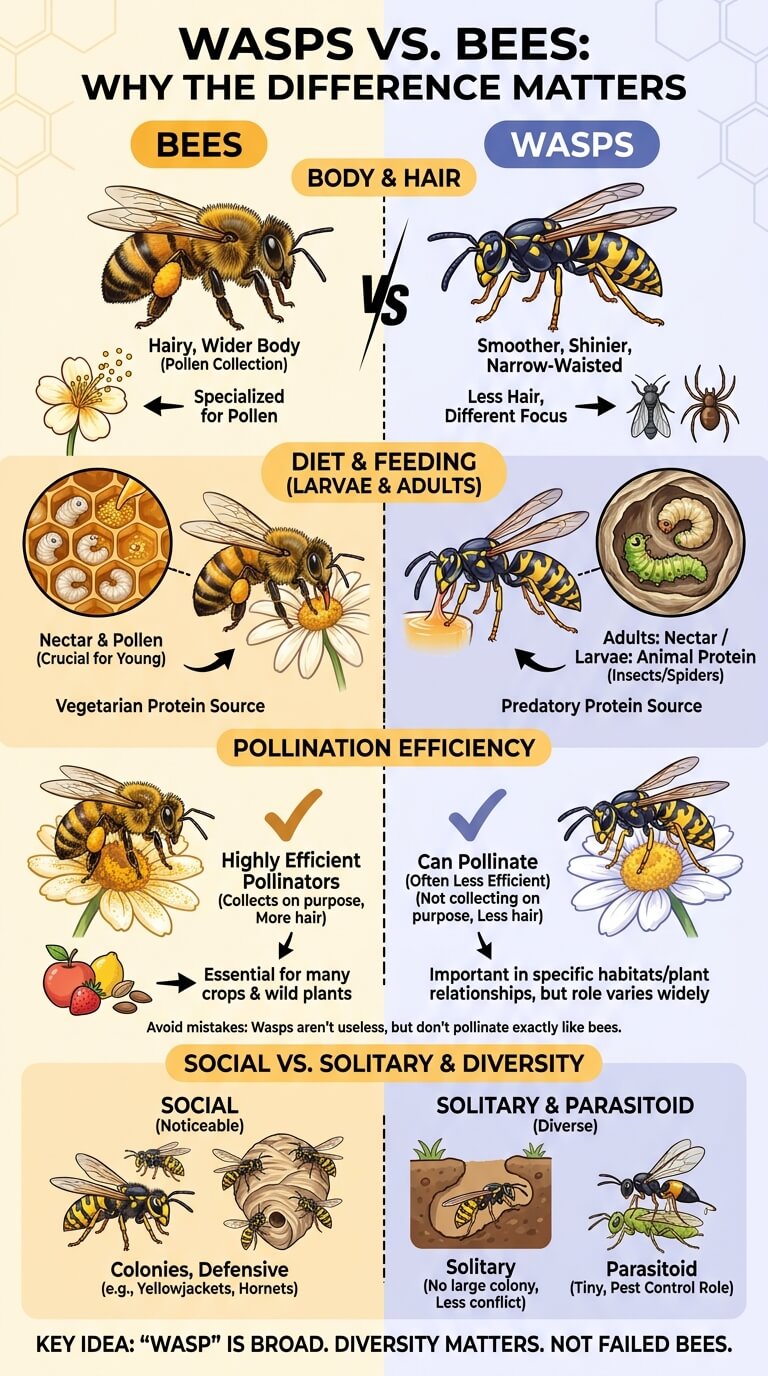
People often compare wasps with bees because both are winged insects that may visit flowers and sting. The comparison is useful, but it can also create confusion. Wasps are not failed bees. Bees evolved from wasp-like ancestors, but modern bees and wasps often have different diets, body features, nesting habits, and ecological roles.
Body Shape, Hairiness, and Feeding Differences
Many bees have hairy bodies that help collect and move pollen. Some have specialized pollen-carrying structures on their legs or underside. Many familiar wasps look smoother, shinier, and more narrow-waisted. These differences are not perfect for every species, but they help explain why bees often get more credit for pollination.
Feeding differences matter too. Bees typically collect nectar and pollen, and pollen is especially important as food for developing young. Many wasps feed their larvae animal protein, such as insects or spiders, while adult wasps may drink nectar or other sugary fluids. That is why wasps can be both predators and flower visitors.
Pollination Efficiency Compared With Bees
Wasps can pollinate, but they are often less efficient than bees on many common flowers because they are usually not collecting pollen on purpose and may have less body hair. Oregon State University Extension explains that wasps visit flowers for nectar and can transfer pollen even though they do not feed their young pollen Oregon State University Extension’s wasp pollination article says.
That distinction helps avoid two mistakes. The first mistake is saying wasps are useless because they are not bees. The second is saying wasps pollinate exactly like bees. A fair answer is that some wasps can be meaningful pollinators, especially in certain habitats or plant relationships, but their pollination role varies widely by species.
Social Wasps, Solitary Wasps, and Diversity Within the Group
The wasps people notice most are usually social wasps. Yellowjackets, hornets, and paper wasps live in colonies, build nests, and can defend those nests. But many wasp species are solitary. A solitary wasp does not have a large colony to defend, and many solitary species are far less likely to cause conflict with people.
Parasitoid wasps add another layer. They may be tiny, rarely noticed, and important in controlling insect populations. Some are used in biological control programs, but not every parasitoid wasp targets a pest species, and introducing organisms into new places is a serious ecological decision. For general readers, the key idea is diversity: “wasp” is a broad word, not one personality type.
Wasps in Gardens and Ecosystems
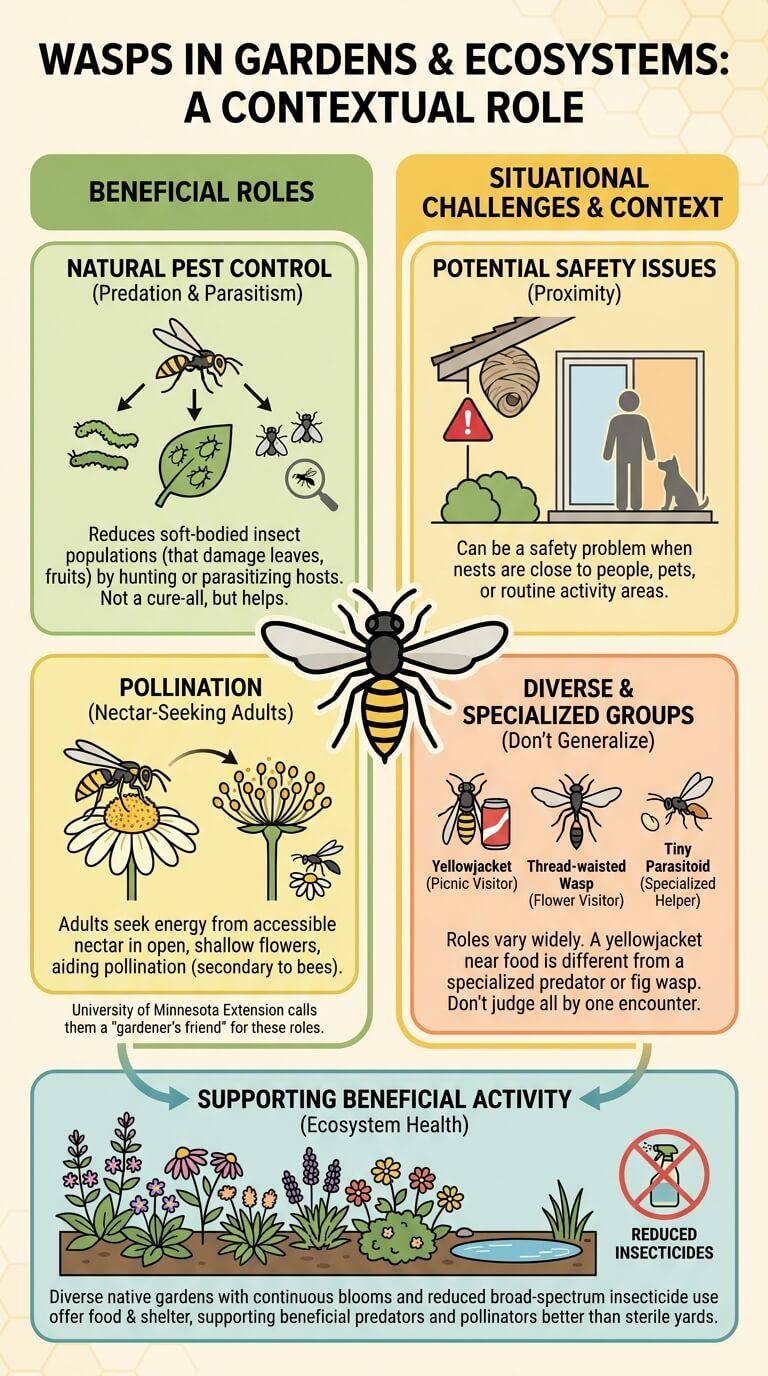
Gardeners often ask whether wasps are good or bad for a yard. The best answer is contextual. Wasps can help by hunting insects and visiting flowers. They can also become a safety problem when a nest is close to people, pets, or routine activity.
Natural Pest Control Without Overselling It
Wasps can reduce some insect populations by hunting prey or parasitizing hosts. Caterpillars, flies, aphids, and other soft-bodied insects may be taken by different wasp species. This can benefit gardens because some of those insects feed on leaves, stems, fruit, or flowers.
University of Minnesota Extension describes wasps as a gardener’s friend because many are predators and some are pollinators, especially around flowers where adults search for nectar the University of Minnesota Extension guide to wasps in gardens says.
Native Plants, Nectar, and Wasp Activity
Adult wasps need energy. Nectar-rich flowers can draw them, especially flowers with accessible nectar. Many wasps have shorter mouthparts than butterflies or some bees, so they may be more common on open, shallow, clustered flowers where nectar is easier to reach.
A diverse garden can support a wider range of beneficial insects. Flowers that bloom at different times, native plants that fit the local ecosystem, and reduced broad-spectrum insecticide use can make a yard more useful to pollinators and predators. A clean, sterile yard may look tidy, but it often offers fewer places for insects to feed, shelter, or complete their life cycles.
Why Some Wasps Are Specialists
Some wasps have very specific relationships with prey, host insects, or plants. A parasitoid wasp may depend on a narrow set of host insects. A fig wasp may be tied to a particular fig pollination system. A hunting wasp may provision its nest with one main type of prey.
Specialization can make wasps ecologically interesting. It also means you cannot judge the whole group from one backyard encounter. The yellowjacket near your drink, the thread-waisted wasp visiting flowers, the tiny parasitoid wasp on a leaf, and the fig wasp inside a fig system are not doing the same job.
Safety Around Wasps
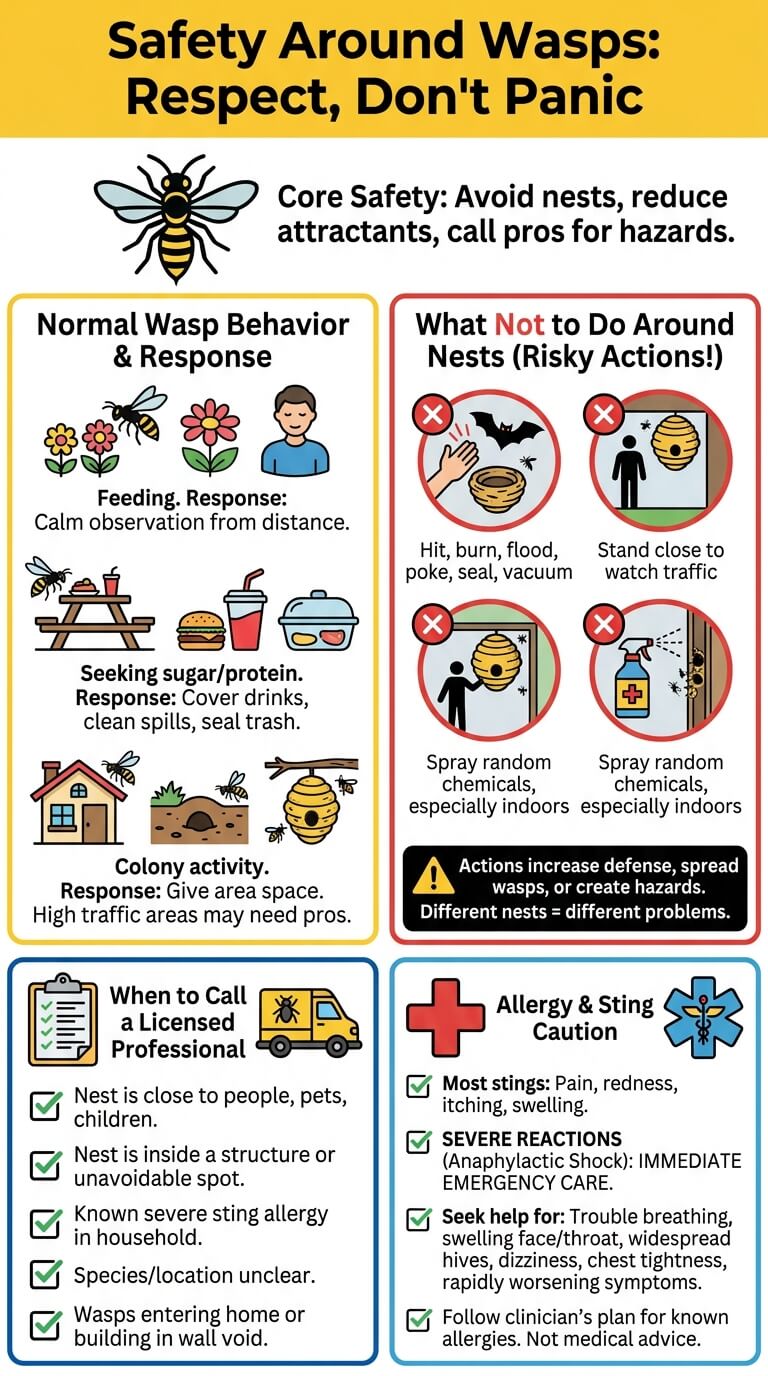
Wasps deserve respect, not panic. Most problems happen when people surprise a nest, swat repeatedly, trap wasps against skin, or try to remove a colony without training. The safest approach is usually to avoid the nest area, reduce attractants, and call a professional when the location creates a real hazard.
Normal Wasp Behavior Near Food, Flowers, and Nests
A wasp flying around flowers is often feeding. A wasp investigating a picnic table may be looking for sugar or protein. A wasp moving in and out of a crack, hole, roofline, or hanging paper nest may be part of a colony. Those situations call for different responses.
Near flowers or garden plants, calm observation from a distance is usually enough. Near food, cover drinks, clean spills, keep trash closed, and remove fallen fruit. Near a nest, give the area space. A nest near a busy door, play structure, or pet area may require professional advice.
What Not to Do Around a Wasp Nest
Do not hit, burn, flood, poke, seal, or vacuum an active wasp nest. Do not stand close to a nest entrance to watch traffic. Do not spray random chemicals into wall voids or holes, especially indoors. These actions can increase defensive behavior, spread wasps into living spaces, or create fire and chemical hazards.
It is also risky to assume that all nests can be handled the same way. A small exposed paper wasp nest under an eave, a yellowjacket nest in the ground, and a colony inside a wall are different problems. The wrong response can make a manageable situation more dangerous.
When to Call a Licensed Pest or Wildlife Professional
Professional help is wise when a nest is close to people, inside a structure, near pets, near children, or in a spot that cannot be avoided. It is also the better choice when someone in the household has a known severe sting allergy or when the species and nest location are unclear.
Not every nest must be removed. A small nest in a low-traffic area may be left alone if it does not create a safety issue. But if wasps are entering a home, building in a wall void, or repeatedly contacting people, a licensed professional can assess the safest option.
Allergy and Sting Caution in Plain Language
Most stings cause pain, redness, itching, or swelling around the sting site. However, severe allergic reactions can be life-threatening. CDC/NIOSH warns that workers allergic to insect venom can experience anaphylactic shock and need immediate emergency care the CDC/NIOSH outdoor worker guidance states.
Get emergency help for signs such as trouble breathing, swelling of the face or throat, widespread hives, dizziness, fainting, chest tightness, or symptoms that feel severe or rapidly worsening. People with known venom allergies should follow their clinician’s emergency plan. This article is not a substitute for medical advice.
Common Myths
Wasps attract myths because people meet them during stressful moments. Clearing up those myths makes backyard decisions safer and more accurate.
Myth: Wasps Have No Purpose
This is the biggest myth. Wasps have many purposes in ecosystems, although “purpose” is a human way of describing ecological roles. They hunt insects, feed other animals, visit flowers, scavenge in some contexts, and take part in specialized relationships with plants and hosts.
Calling wasps useless usually means “I do not want them near me.” That feeling may be valid around a risky nest, but it is not an ecological fact. A nest near a doorway can be a safety problem while wasps as a group remain important animals.
Myth: All Wasps Are Aggressive
Some social wasps can defend nests strongly, especially when the nest is disturbed. But many wasps are solitary, small, or focused on prey and nectar rather than people. A wasp flying by is not necessarily attacking.
The word aggressive is also easy to misuse. Defensive nest behavior is not the same as random hostility. Wasps do not need human emotions or evil intentions to be dangerous in the wrong context. They respond to threats, food, nest defense, and environmental cues.
Myth: Wasps Pollinate Just Like Bees
Wasps can pollinate, but not all wasps are equally effective pollinators, and many are not built like pollen-collecting bees. Bees often have hairier bodies and special pollen-carrying structures. Wasps may transfer pollen while drinking nectar, but many are primarily predators or parasitoids.
A better statement is this: wasps are part of the pollinator story, but they are not interchangeable with bees. Some plants benefit from wasp visits. Some relationships, such as fig and fig wasp systems, are highly specialized. Other wasp flower visits may move little pollen or may not lead to successful pollination.
Edge Cases and Exceptions
Because “wasp” is such a broad word, there are many exceptions. These edge cases help explain why simple rules often fail.
Invasive or Nuisance Wasp Situations
Some wasps can become invasive or serious nuisance species outside their native range, depending on the region. Others are native but still create safety problems when colonies are built in high-use human spaces. Ecological value does not mean every wasp population is welcome in every setting.
This is why the best response is local and situation-specific. A native paper wasp nest far from foot traffic may be left alone. A yellowjacket colony in a school playground, a wall void, or a doorway is different. A wasp species that is helpful in one ecosystem may cause problems if introduced elsewhere.
Parasitoid Wasps and Why They Are Different From Familiar Stinging Wasps
Parasitoid wasps are often tiny and rarely noticed by casual observers. Many do not look like the bold yellow-and-black social wasps people fear. Their larvae develop in or on host insects, and this can make them important natural enemies of certain pests.
Some parasitoid wasps are used in biological control. That does not mean homeowners should release random wasps or buy insects without understanding local rules and ecological risks. Biological control requires correct species identification and careful management. For most gardens, habitat support and reduced unnecessary pesticide use are safer broad principles than releasing organisms on impulse.
Fig Wasps and Specialist Pollination Relationships
Fig wasps are one of the clearest examples of wasps as specialized pollinators. The fig structure contains tiny flowers inside, and certain tiny wasps enter the structure as part of a complex life cycle. In many fig species, the plant and wasp depend on each other.
This relationship is often turned into viral food myths. The accurate version is more interesting than the shock version. Fig wasps show how closely insects and plants can evolve together, but not every commercial fig variety depends on active pollination by wasps, and people should not assume grocery-store figs contain visible insects.
How This Connects to Nearby Animal Topics
Wasps sit at the center of several animal topics: pollination, predator-prey relationships, garden ecology, insect myths, and wildlife safety. That makes them a useful bridge between “helpful insects” and “animals people misunderstand.”
Why Bees Get More Attention as Pollinators
Bees get more attention because many are specialized for pollen collection. Their bodies, behavior, and feeding needs make them major pollinators for many wildflowers and crops. This does not erase wasps. It simply explains why bees often lead the pollinator conversation.
How Animal Pollinator Lists Include Wasps Carefully
Wasps belong on animal pollinator lists, but they should be described accurately. A good list should separate bees, butterflies, moths, flies, beetles, birds, bats, and wasps by how they interact with flowers. It should also explain that flower visitation is not always the same as effective pollination.
For wasps, the careful wording is “flower visitors and sometimes pollinators,” with specialist examples where appropriate. That keeps the article honest without ignoring their role.
How Ladybugs and Wasps Both Fit Into Helpful Insect Conversations Differently
Ladybugs and wasps both appear in helpful insect discussions, but they help in different ways. Ladybugs are famous for eating aphids and other soft-bodied pests. Wasps may hunt insects, parasitize hosts, visit flowers, and defend nests. Ladybugs are usually easier for people to welcome. Wasps require more safety awareness.
That contrast is useful for gardeners. Not every helpful insect is equally safe to approach, and not every insect that worries people is useless. A healthy garden is often a mix of pollinators, predators, decomposers, plant-feeders, and animals that play more than one role.
FAQ
Do Wasps Pollinate Plants?
Yes, some wasps pollinate plants. Adult wasps often visit flowers for nectar, and pollen can stick to their bodies as they move between blooms. Some wasp-plant relationships are casual, while others are highly specialized, such as fig wasps and figs.
Wasps should not be described as identical to bees, though. Many bees are adapted for pollen collection, while many wasps are primarily predators or parasitoids that visit flowers for adult energy. Wasps are part of the pollinator story, but their effectiveness depends on the wasp species, flower structure, behavior, and habitat.
Are Wasps More Aggressive Than Bees?
Some social wasps can seem more aggressive than many bees because they may defend nests strongly and may investigate human food. Yellowjackets, for example, are often involved in conflicts around outdoor meals or nest entrances. But it is not accurate to say all wasps are aggressive.
Many wasps are solitary or focused on hunting and nectar. Defensive behavior usually makes the most sense around nests. The safest approach is to stay calm around individual wasps, avoid swatting, keep food covered outdoors, and give nests plenty of space.
Should You Remove Every Wasp Nest?
No. Not every wasp nest needs to be removed. A nest in a low-traffic area may be left alone if it does not create a safety problem. Wasps can provide ecological benefits, and many colonies are seasonal.
Removal may be appropriate when a nest is near a doorway, deck, playground, pet area, mailbox, wall void, or other place where people are likely to disturb it. People with known severe sting allergies should be especially cautious and should not attempt nest removal themselves. When in doubt, contact a licensed professional.
What Good Do Wasps Do in a Garden?
Wasps can help gardens by hunting insects, feeding their larvae prey, visiting flowers for nectar, and sometimes moving pollen. Some parasitoid wasps also help regulate host insect populations. These roles can support a more balanced garden ecosystem.
The benefit depends on the species and situation. Wasps are not a cure for every pest, and a nest too close to people can be a safety issue. A thoughtful garden can support beneficial insects while keeping outdoor dining, play, and pet areas away from heavy wasp activity.
Final Thoughts
Wasps are important, but they are not simple animals to categorize. They can be predators, pollinators, scavengers, parasitoids, prey, and safety concerns depending on the species and setting. Their reputation is shaped by painful encounters, yet their ecological roles are much broader than stings.
The best way to think about wasps is with balance. Respect their value in gardens and ecosystems. Do not swat, provoke, handle, or attempt risky nest removal. Give individual wasps space, reduce food attractants near people, and call a licensed professional when a nest creates a real hazard. Wasps do not need to be loved at the picnic table to deserve a fair place in the animal world.

Ethan Walker is the founder and research editor of Animal Fact Central. He creates and reviews educational animal facts content using trusted wildlife, pet care, and science-based sources. His work focuses on making animal behavior, adaptations, habitats, and species facts clear, accurate, and engaging for everyday readers.
Read More Details About Ethan Walker: https://animalfactcentral.com/ethan-walker/