
Quick Boa Constrictor Facts
Scientific name
The term boa constrictor commonly refers to members of a species complex historically grouped under the scientific name Boa constrictor. Taxonomy for boas has been revised over time, and regional forms may be treated differently by researchers. For up-to-date conservation assessments and taxonomic notes, consult the IUCN Red List for species assessments and range information.
Average size
Boa constrictors are large, heavy-bodied snakes with substantial variation by region, sex, and regional form.
Anacondas offer a useful comparison because they show how habitat and body size can shape large constrictor behavior.
Lifespan
These snakes can be long-lived compared with many small reptiles. Lifespan in the wild and in human care differs because of predators, disease, environmental hazards, veterinary care, diet, and captive conditions.
Habitat
Boa constrictors occupy a variety of warm habitats across their native range, often associated with forested environments but also using more open areas where shelter and prey are available. International trade and regulatory context for species moved across borders are summarized by CITES: CITES.
Diet
These snakes are carnivores that eat a range of vertebrate prey. Diet varies with age and local prey availability; younger snakes take smaller animals while larger snakes subdue larger prey.
Venom status
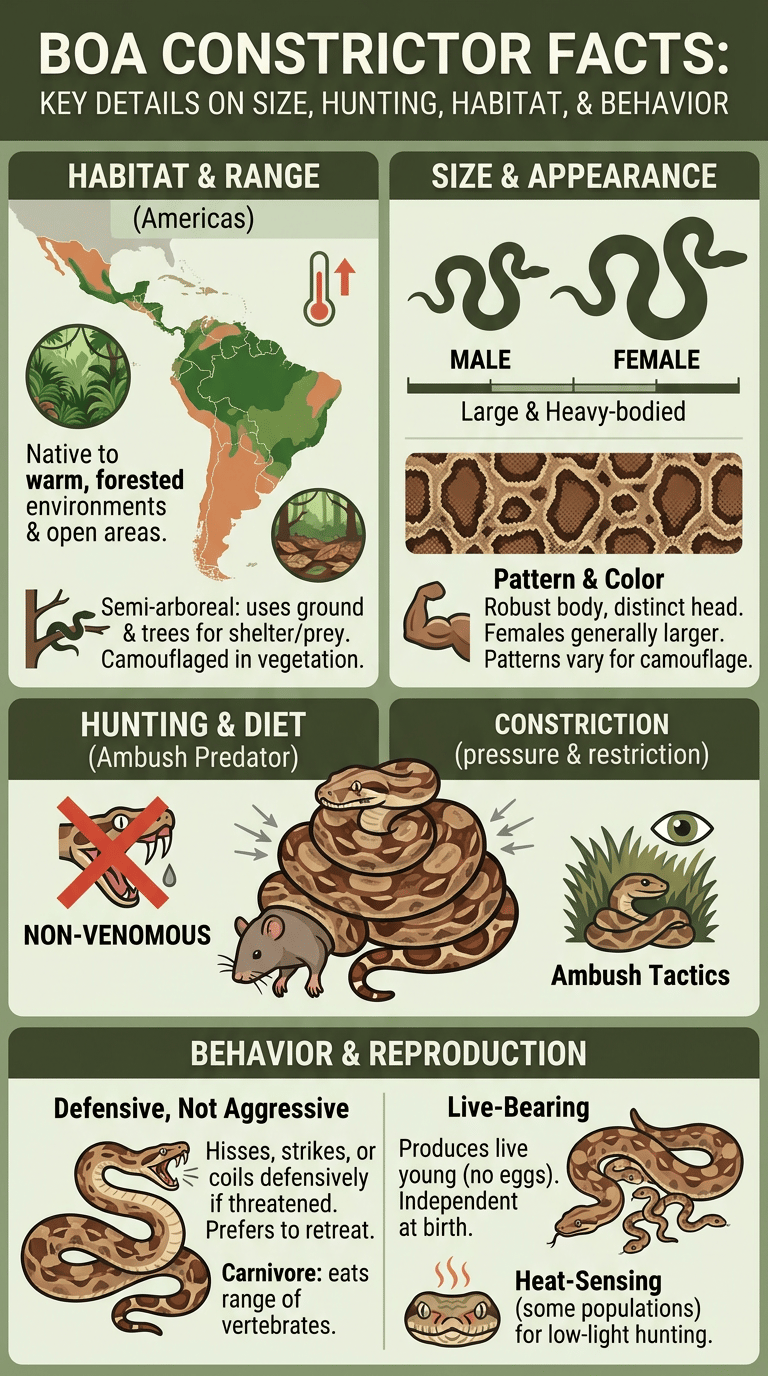
Boa constrictors are non-venomous and subdue prey by constriction rather than by injecting venom. Bites and constriction can still cause injury, and handling should be left to trained professionals.
What is a boa constrictor?
Why it is called a constrictor
The name constrictor reflects the snake’s method of subduing prey: after seizing an animal the snake coils and tightens its coils to immobilize and overpower the prey through pressure and restriction of movement.
Boa constrictor versus other boas
Boas include several genera and species that differ in size, habitat preferences, and reproductive strategies. Regional variation means local forms may be treated as subspecies or separate species by herpetologists.
Where do boa constrictors live?
Native range
Boa constrictors occur naturally in parts of the Americas in regions where climate and habitat allow them to find shelter and prey. For precise maps and range descriptions, refer to global conservation resources such as the IUCN Red List: IUCN Red List.
Rainforest habitats
In forested environments, boa constrictors use vegetation and ground cover for concealment and ambush. Forests provide prey and microhabitats with suitable temperature and humidity that support daily cycles and reproduction.
Semi-arboreal lifestyle
Boa constrictors are typically semi-arboreal, dividing time between the ground and low branches or shelters above ground. They can climb to pursue prey, escape threats, or find resting sites, but also spend time on the forest floor.
For a smaller beginner comparison, corn snake facts explain why many keepers choose a more manageable non-venomous species first.
What do boa constrictors look like?
Body shape
These snakes have robust, muscular bodies with a distinct head set off from the neck. Their musculature supports a hunting style that relies on power to hold and subdue prey.
Color and pattern
Boa constrictors display a range of colorations and patterns that help them blend into local environments, commonly showing saddles or blotches along the back and a lighter belly. Coloration varies with locality and age, and captive-bred color varieties exist in the pet trade.
Size differences between males and females
In many populations, females are generally larger and heavier than males, a size difference associated with reproductive roles.
How big do boa constrictors get?
Average adult size
Adult boa constrictors are substantially larger than juveniles, with size varying by locality and individual factors such as diet and habitat quality.
Maximum size
Some individuals attain notable size for the group, but exceptionally large specimens are uncommon and influenced by genetics, long-term resource availability, and age.
Boa constrictor versus anaconda versus python
Boa constrictors, anacondas, and pythons are large constricting snakes that differ in anatomy, typical habitat, and geographic distribution. Anacondas are commonly associated with riverine and aquatic habitats in parts of South America, while many pythons are native to Africa, Asia, and Australasia.
Are boa constrictors venomous?
Why they do not need venom
Boa constrictors rely on strength and constriction to capture and immobilize prey; they do not use venom as part of their hunting toolkit.
How constriction works
Constriction involves wrapping coils around prey and tightening to limit movement and breathing and to interfere with circulation. It is a physical method of restraint effective against the prey these snakes take.
Are boa constrictors dangerous to humans?
Boa constrictors are non-venomous but can be powerful. Bites can cause injury and constriction around a person can be dangerous. Avoid handling wild snakes; seek medical help for bites or injuries and contact local wildlife authorities or trained animal control professionals for assistance with large snakes.
What do boa constrictors eat?
Wild diet
In the wild, boa constrictors prey on a variety of vertebrates. Diet composition depends on the size of the snake and the prey available in the local environment.
How they ambush prey
Boa constrictors commonly use ambush tactics, hiding in cover and waiting for prey to come within striking distance. After seizing prey they rapidly coil around it to prevent escape. Some individuals have heat-sensing structures that aid in detecting warm-blooded prey in low light, with variation among lineages and populations.
How often they eat
Feeding frequency is influenced by prey size and availability. After consuming a substantial meal, a boa constrictor may have a long inactive period while it digests. In captivity, feeding intervals are adjusted for animal size, health, and life stage and should follow veterinary and husbandry guidance.
Boa constrictor behavior
Are boa constrictors aggressive?
They are generally not aggressive toward humans by nature but may display defensive behaviors such as hissing, striking, or coiling defensively when threatened. Individual temperament varies with experience and circumstances. When possible, wild snakes typically retreat and avoid confrontation.
Why they hide
Concealment provides protection from predators, serves as ambush sites for hunting, and helps regulate microclimate. Good shelters are a critical habitat component.
How they use heat-sensing abilities
Some boas possess specialized organs that detect radiant heat, enhancing hunting effectiveness in low-light conditions and helping locate concealed warm-blooded prey. The presence and sensitivity of these structures vary among species and populations.
Boa constrictor reproduction
Do boa constrictors lay eggs?
Boa constrictor-type snakes are generally live-bearing, producing fully formed young rather than laying eggs that develop outside the mother.
Baby boa facts
Newborn boa constrictors are independent at birth and receive no parental care. Juveniles often resemble adults in coloration and pattern, though juvenile patterns may enhance camouflage. Young snakes feed on appropriately sized prey and grow through successive molts as they mature.
As young boas grow through successive molts, learning why snakes shed skin helps owners recognize normal versus problematic shedding.
Growth rate
Growth depends on available food, environmental conditions, and genetics. In resource-rich conditions, young snakes may grow more quickly; growth continues until maturity, which can take several years depending on factors such as local ecology and individual health.
Boa constrictors as pets
Are they good pets?
Boa constrictors are kept by experienced reptile keepers and can be rewarding for people prepared to meet their needs. Prospective keepers should understand the long-term commitment, space requirements, and specialized care these snakes need, and must verify local laws before acquiring an animal.
Why they are not for everyone
These snakes are not suitable for casual or first-time pet owners who are unprepared for the physical size and husbandry demands. Their strength, dietary needs, and longevity require consistent, informed care.
Basic care challenges
Keeping a boa constrictor involves secure housing to prevent escape, proper temperature and humidity gradients, appropriate nutrition, and health monitoring. Veterinary care from professionals experienced with reptiles is important for preventive care and treatment.
Boa constrictor versus python
Reproduction difference
Boas generally give birth to live young, while many pythons lay eggs and may brood them to regulate temperature and protect the clutch.
Body difference
Both groups include large, muscular snakes but differ in skull structure, scale arrangement, and other anatomical features reflecting their distinct evolutionary histories.
Habitat difference
Pythons are native to parts of Africa, Asia, and Australasia, whereas boa constrictor-type snakes are native to the Americas. Habitat preferences vary among species in both groups.
Boa constrictor FAQs
Are boa constrictors dangerous?
Boa constrictors are non-venomous but are powerful animals. They may bite or constrict in defense. Avoid handling wild snakes and contact professionals if a large snake is found in a home or inhabited area.
How long do boa constrictors live?
Lifespan varies with environment and care. Mortality from predators, disease, and environmental hazards affects wild longevity, while proper nutrition and veterinary attention in human care can support long lifespans.
Can boa constrictors eat humans?
Boa constrictors feed on suitably sized vertebrate prey, and their ability to handle very large items is limited by anatomy. Reports of interactions with people are exceptional and not typical feeding behavior. Do not attempt to feed or handle wild snakes.
Are boa constrictors good pets?
They can be appropriate pets for experienced reptile keepers who can provide necessary husbandry, veterinary care, and long-term commitment. They are not recommended for inexperienced owners.
How strong is a boa constrictor?
Boa constrictors are strong enough to subdue and hold prey through powerful muscular coils. Because of their strength, interactions with large snakes should be handled by trained people using appropriate safety procedures.
Final thoughts
Boa constrictors are a group of large, non-venomous snakes with life histories shaped by their role as constricting predators. They occupy a range of habitats in the Americas and show variation in size, coloration, and behavior across their range. For current conservation status, range maps, and trade information, consult authoritative resources such as the IUCN Red List and the Convention on International Trade in Endangered Species (CITES).
A python comparison can help readers understand how different constrictors vary in habitat, size, and care needs.
If you encounter a boa constrictor in the wild or in an unexpected place, do not attempt to handle or capture it. Contact local wildlife authorities or trained professionals for assistance. For questions about keeping any large reptile as a pet, consult experienced reptile veterinarians and check local regulations before acquiring an animal.

Ethan Walker is the founder and research editor of Animal Fact Central. He creates and reviews educational animal facts content using trusted wildlife, pet care, and science-based sources. His work focuses on making animal behavior, adaptations, habitats, and species facts clear, accurate, and engaging for everyday readers.
Read More Details About Ethan Walker: https://animalfactcentral.com/ethan-walker/