
Tiger sharks are a well-known large shark species found in warm seas around the world. They have a reputation for eating a wide variety of prey and for being adaptable hunters. This article explains tiger shark biology, appearance, habitat, diet, hunting strategies, teeth, reproduction, conservation concerns, and realistic guidance about encounters with people, with emphasis on their role as opportunistic predators rather than sensationalizing danger.

What is a tiger shark?
Scientific classification
Tiger sharks are placed in the genus Galeocerdo and are included in the family Carcharhinidae. For authoritative species-level information and conservation assessments, consult the IUCN Red List for the latest formal listings and notes about range and threats (IUCN Red List).
Why it is called a tiger shark
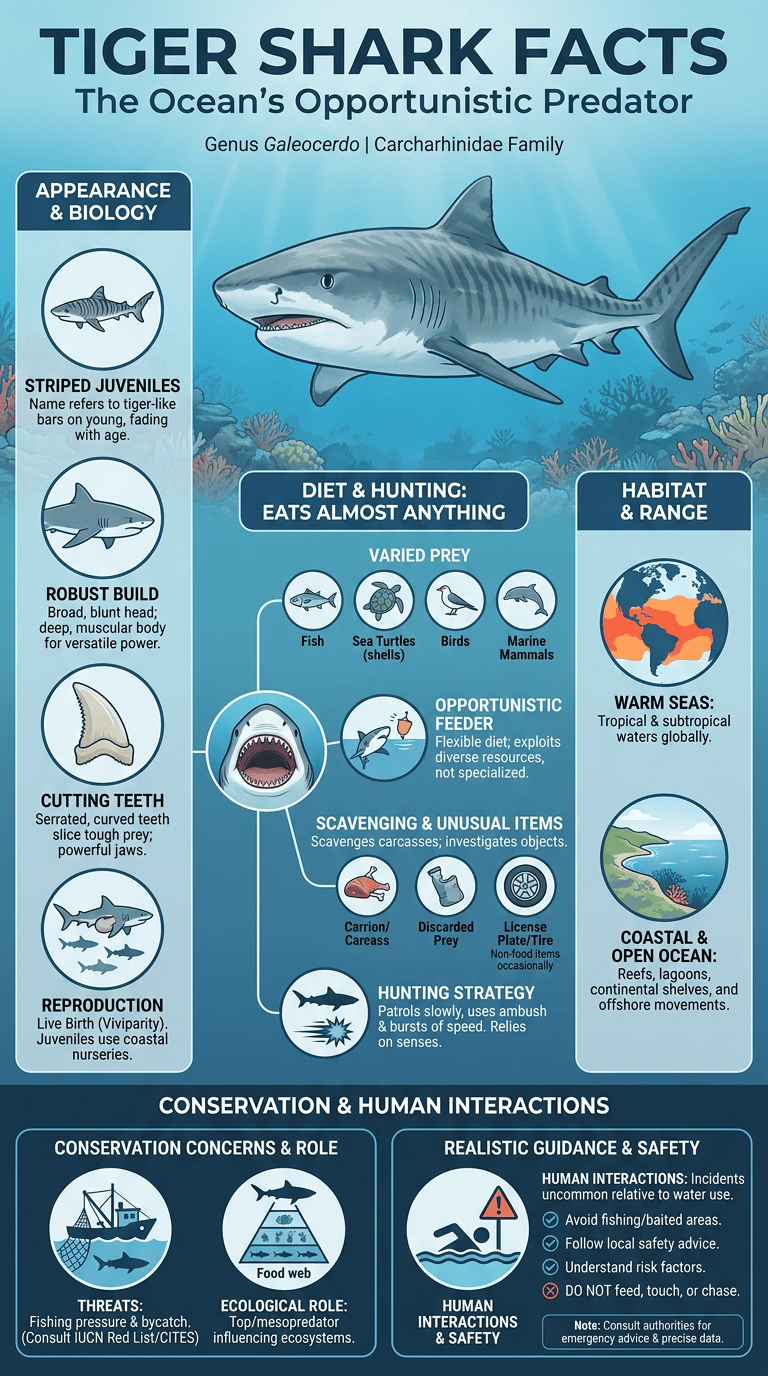
The common name refers to the dark, vertical bars or stripes that are often visible on younger animals. These markings can fade with age but are distinctive enough that the species name evokes a tiger-like pattern. See species summaries and identification guides for more detail (IUCN Red List).
How tiger sharks differ from other sharks
Tiger sharks are notable for a broad, blunt head, a robust body, and teeth shaped to cut and slice. Compared with many other requiem sharks, they are generalist feeders that consume a wider variety of prey items and are described in natural-history accounts as less specialized in diet.
Tiger shark size
General size context
Tiger sharks are considered large among predatory sharks. Published species accounts and conservation listings describe adults as substantially larger than many coastal shark species. For precise measurements and records, consult formal species fact sheets and scientific literature (IUCN Red List).
Readers comparing tiger shark facts may also find mako shark facts useful for a deeper look at a closely related shark topic.
Appearance
Stripes on young tiger sharks
Juveniles usually show prominent vertical bars or stripes on their sides that can resemble tiger stripes. These markings typically become less obvious as individuals mature.
Broad head and strong body
Tiger sharks have a broad, somewhat flattened head and a deep, muscular body. This body plan supports their role as powerful, versatile predators capable of handling a range of prey types.
Teeth shape and jaw power
The teeth are laterally compressed with serrated edges and a curved shape that helps slice through flesh and tougher materials. The jaws are structured for strong bites, enabling tiger sharks to take apart both soft and tough prey items.
Range and habitat
Tropical and subtropical waters
These sharks are generally associated with warm ocean waters, including tropical and subtropical regions. For formal range maps and region-specific notes, consult global species assessments (IUCN Red List).
Coastal habitats
Tiger sharks frequently use coastal habitats such as continental shelves, lagoons, and areas around islands and reefs, which provide access to diverse prey.
Open-ocean movement
Although often encountered near coasts, tiger sharks also undertake movements into open-ocean areas and may travel among islands and offshore features while foraging or migrating.
Diet
Varied prey
Tiger sharks are generalist predators that consume a wide variety of prey. Fish are a common component of the diet, and species accounts report diverse prey items in stomach-content studies and observational records.
Sea turtles and other large prey
Their tooth shape and jaw strength allow tiger sharks to feed on sea turtles and other animals with protective coverings.
Birds, marine mammals, carrion, and unusual items
Coastal birds and marine mammals can appear in the diet when accessible. Tiger sharks are also known to scavenge carrion and to investigate unusual objects, and species summaries note ingestion of non-food items on occasion.
Opportunistic feeding strategy
Flexible diet
They are dietary generalists that exploit a broad range of prey types rather than specializing on one or two species. This flexibility helps them exploit available resources in variable coastal ecosystems.
Scavenging behavior
Scavenging on carcasses and discarded prey supplements active hunting and is a well-documented aspect of tiger shark ecology.
Hunting behavior
Patrol hunting and ambush
Tiger sharks commonly patrol slowly along the bottom or in the water column while searching for prey and may use short bursts of speed and surprise to seize prey when needed.
Activity patterns and senses
They feed both day and night in many contexts and rely on chemical cues, vision, and lateral-line sensing to locate prey.
Teeth and feeding mechanics
Serrated, curved teeth
The curved, serrated teeth help the shark seize and cut through both soft tissues and tougher structures such as shells.
Tooth replacement
Like other sharks, tiger sharks continually replace teeth throughout life so they maintain effective bite surfaces.
Interactions with people
Recorded incidents
Tiger sharks have been implicated in some recorded bite incidents, in part because they are large, occur in coastal areas used by people, and have a generalist feeding strategy that can bring them into contact with human activities. For balanced context about recorded interactions, consult authoritative conservation and species resources (IUCN Red List).
Why attacks are uncommon
Encounters that cause harm are uncommon relative to the large numbers of people who use coastal waters. Factors influencing encounter rates include local shark abundance, human behavior in the water, and habitat overlap.
Practical safety guidance
Understand risk as a product of animal behavior, human activity, and environmental context. Precautions include avoiding swimming near fishing activity or baited areas and following local safety guidance from authorities. This article does not provide personalized emergency advice; contact local emergency services and qualified wildlife professionals in an actual emergency.
Reproduction
Live birth
Tiger sharks give birth to live young (viviparity), where embryos develop inside the mother and are born as free-swimming juveniles. Species accounts and conservation assessments describe reproductive mode and life-history characteristics in more detail (IUCN Red List).
Juvenile ecology
Juvenile tiger sharks use coastal nursery habitats that provide both resources and risks; juvenile survival is influenced by predation, competition, and environmental conditions.
Conservation
Fishing pressure and bycatch
Tiger sharks are subject to fishing pressure in many regions, including directed fishing and removal as part of commercial or recreational harvest. Bycatch in commercial fisheries can also remove individuals unintentionally. For authoritative information on threats and population trends, consult conservation listings and regulatory bodies such as the IUCN Red List and CITES (IUCN Red List; CITES).
Ecological role
Tiger sharks function as top and mesopredators in coastal ecosystems, influencing food webs through predation and scavenging. Maintaining healthy predator populations contributes to ecosystem balance and function.
FAQs about tiger sharks
Why are they called tiger sharks?
The name comes from the dark, vertical bars commonly seen on younger individuals that resemble tiger stripes (IUCN Red List).
What do tiger sharks eat?
They eat a wide variety of prey including fish, sea turtles, birds, marine mammals, and carrion. This broad diet is documented in natural-history accounts and stomach-content studies.
Are tiger sharks aggressive?
Describing animals as “aggressive” can be misleading. Tiger sharks are opportunistic predators that may investigate or take items in the environment. While they have been implicated in some unprovoked bite records, harmful encounters are uncommon relative to the level of human use of coastal waters.
Where do tiger sharks live?
Tiger sharks inhabit warm temperate, tropical, and subtropical seas and commonly use coastal habitats such as reefs, lagoons, and continental shelves while also moving through open-ocean areas (IUCN Red List).
How big can tiger sharks get?
Tiger sharks are described as among the larger predatory sharks. For precise size records and typical adult measurements, consult formal species references and scientific literature.
Safety reminder: Do not attempt to feed, touch, chase, or capture wild sharks. If you encounter an emergency involving a shark bite or a stranded animal, contact local emergency services or wildlife authorities for professional assistance.

Ethan Walker is the founder and research editor of Animal Fact Central. He creates and reviews educational animal facts content using trusted wildlife, pet care, and science-based sources. His work focuses on making animal behavior, adaptations, habitats, and species facts clear, accurate, and engaging for everyday readers.
Read More Details About Ethan Walker: https://animalfactcentral.com/ethan-walker/